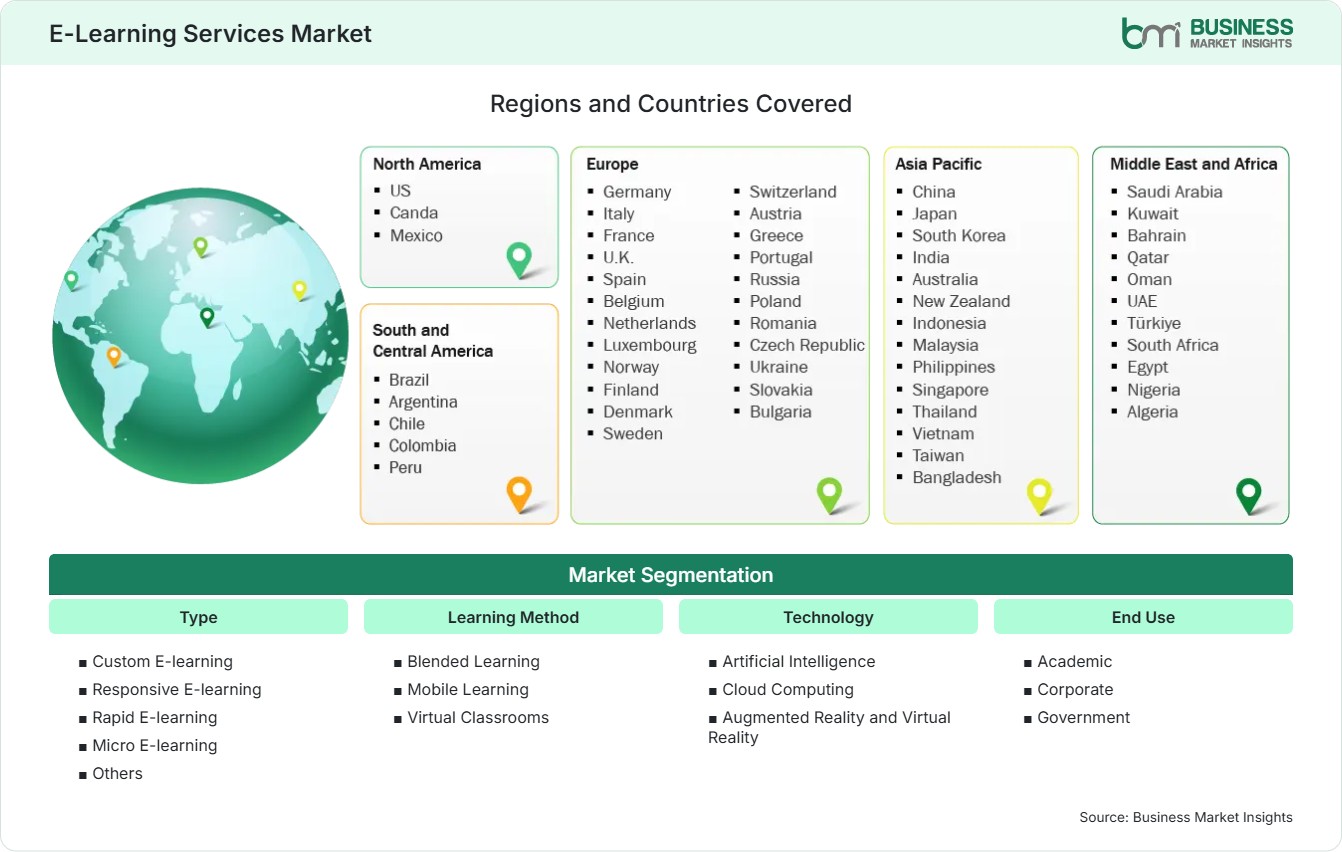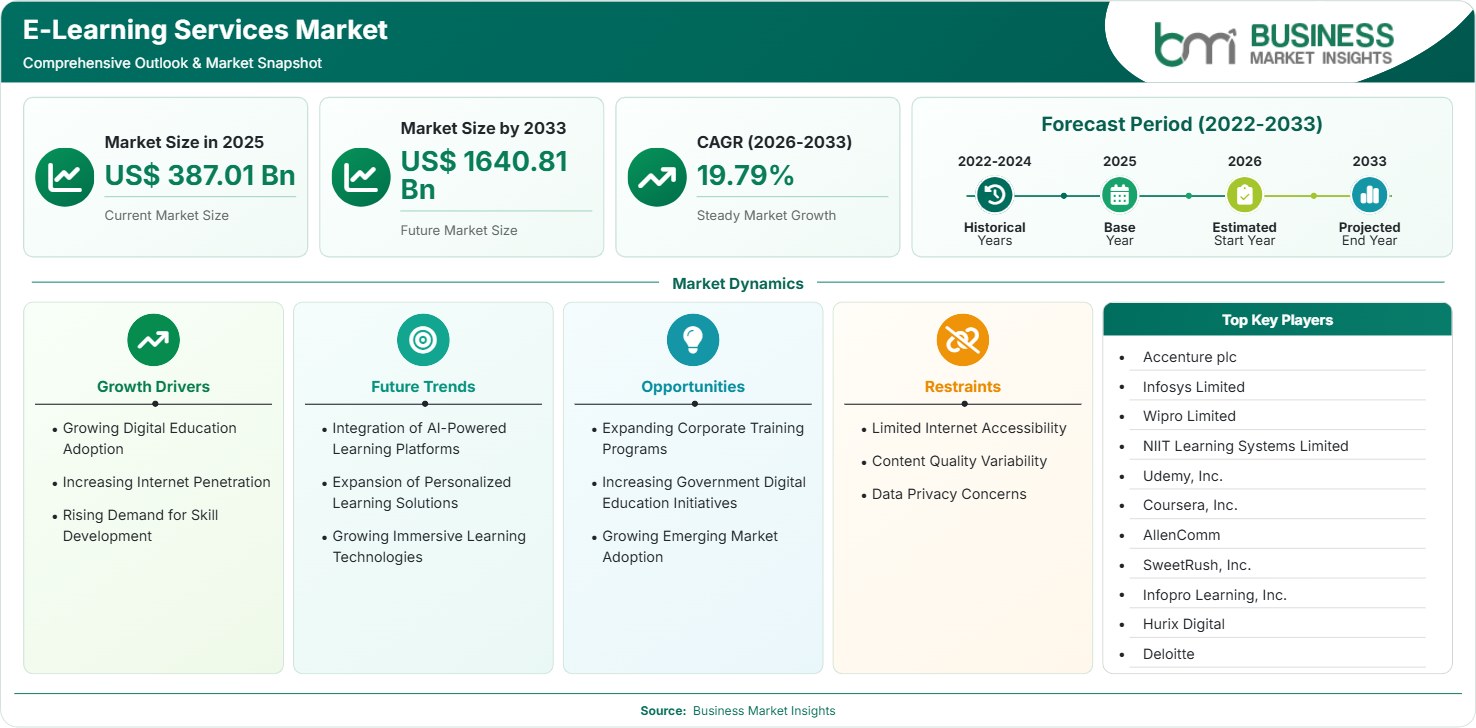
E-Learning Services Market Regional Highlights
North America E-Learning Services Market
North America accounted for a 34%–37% share in 2025 and is projected to expand at a CAGR of 17%–19% during 2026–2033. The E-Learning Services Market share in North America is supported by demand from corporations, universities, and government organizations implementing technology-enabled learning solutions. The United States and Canada remain key contributors, supported by innovation in artificial intelligence, cloud-based platforms, and personalized education technologies.
- Enterprise digital transformation programs are accelerating adoption as organizations replace traditional training models with scalable online learning platforms supporting distributed workforces and continuous professional development requirements.
- Artificial intelligence integration is improving learner personalization through adaptive content delivery, automated assessments, and analytics-driven insights that help organizations measure training effectiveness and employee performance outcomes.
- Corporate universities and higher education institutions are increasing investments in learning management systems, virtual classrooms, and hybrid education models to improve accessibility and engagement.
- Government initiatives supporting workforce reskilling and technology education are creating additional demand for digital platforms focused on professional certification and career advancement programs.
US E-Learning Services Market
The US market represents a 28%–31% share of North America in 2025 and is expected to grow at a CAGR of 17%–19% between 2026–2033. Strong enterprise technology adoption, extensive higher education networks, and increasing demand for professional development solutions support market expansion. The US E-Learning Services Market continues to benefit from investments in artificial intelligence, cloud learning platforms, and corporate training ecosystems.
- Large enterprises are expanding digital learning investments to support employee onboarding, compliance training, leadership development, and technology-focused workforce transformation programs.
- Universities and professional education providers are increasing online course offerings to serve working professionals seeking flexible certification and degree advancement opportunities.
- Rising demand for cybersecurity, data analytics, and artificial intelligence skills is increasing adoption of specialized online training programs across industries.
Europe E-Learning Services Market
Europe held a 25%–28% share in 2025 and is estimated to grow at a CAGR of 18%–20% through 2026–2033. The region benefits from strong digital education policies, enterprise training demand, and investments in lifelong learning initiatives. Germany, the United Kingdom, France, and Nordic countries are leading contributors, while Eastern European markets are showing faster adoption rates. The E-Learning Services Market growth in Europe is influenced by workforce digitization, regulatory emphasis on professional development, and increasing adoption of hybrid learning models.
- European enterprises are adopting online learning platforms to support employee reskilling initiatives linked with automation, sustainability, and digital transformation priorities.
- Government-backed education modernization programs are encouraging schools and universities to integrate virtual classrooms, digital resources, and technology-supported teaching methods.
- Germany is expanding corporate learning investments through industrial workforce development programs focused on advanced manufacturing and technology skills.
- The United Kingdom demonstrates strong demand for professional learning platforms due to increasing participation in online certifications and career-oriented education programs.
- Nordic countries are advancing digital education adoption through high connectivity levels, innovation-focused policies, and strong public investment in technology-enabled learning systems.
Asia Pacific E-Learning Services Market
Asia Pacific accounted for a 27%–30% share in 2025 and is projected to register the highest CAGR of 23%–25% during 2026–2033. Expanding internet access, large student populations, government digitization programs, and increasing corporate training requirements are driving regional growth. China, India, Japan, South Korea, and Southeast Asian countries are major contributors. The E-Learning Services Market trends in Asia Pacific reflect rapid adoption of mobile learning, localized content platforms, and affordable digital education solutions.
- India is experiencing accelerated adoption due to government digital education initiatives, expanding smartphone usage, and increasing demand for skill development platforms among students and professionals.
- China continues to invest in technology-enabled education through artificial intelligence applications, online tutoring platforms, and digital classroom infrastructure.
- Southeast Asian countries are adopting mobile-first learning solutions to improve education accessibility in regions with diverse geographic and demographic challenges.
- Japan and South Korea are focusing on advanced learning technologies, including virtual reality applications and AI-powered educational tools for personalized experiences.
Rest of World E-Learning Services Market
South and Central America, along with Middle East and Africa markets, represented a 10%–13% share in 2025 and are expected to expand at a CAGR of 20%–22% during 2026–2033. Brazil, Mexico, the United Arab Emirates, and South Africa are emerging markets supporting adoption through public initiatives and private technology investments. The E-Learning Services Market expansion in these regions is supported by affordable learning platforms and localized digital content development.
- Brazil and Mexico are increasing online education adoption through universities, professional training providers, and government-supported digital learning programs.
- Middle Eastern countries are investing in smart education initiatives to diversify economies and improve workforce capabilities through technology-based training solutions.
- African markets are adopting mobile learning platforms to overcome infrastructure limitations and expand access to education in underserved communities.
- The United Arab Emirates is strengthening digital education ecosystems through innovation programs, advanced infrastructure, and technology-focused workforce initiatives.
- South Africa is experiencing growing demand for professional learning platforms supporting employment readiness, corporate training, and higher education accessibility.