
Optical Wavelength Services Market Outlook: Size, Share, Trends, Growth Analysis, Competitive Landscape & Forecast, 2026-2033

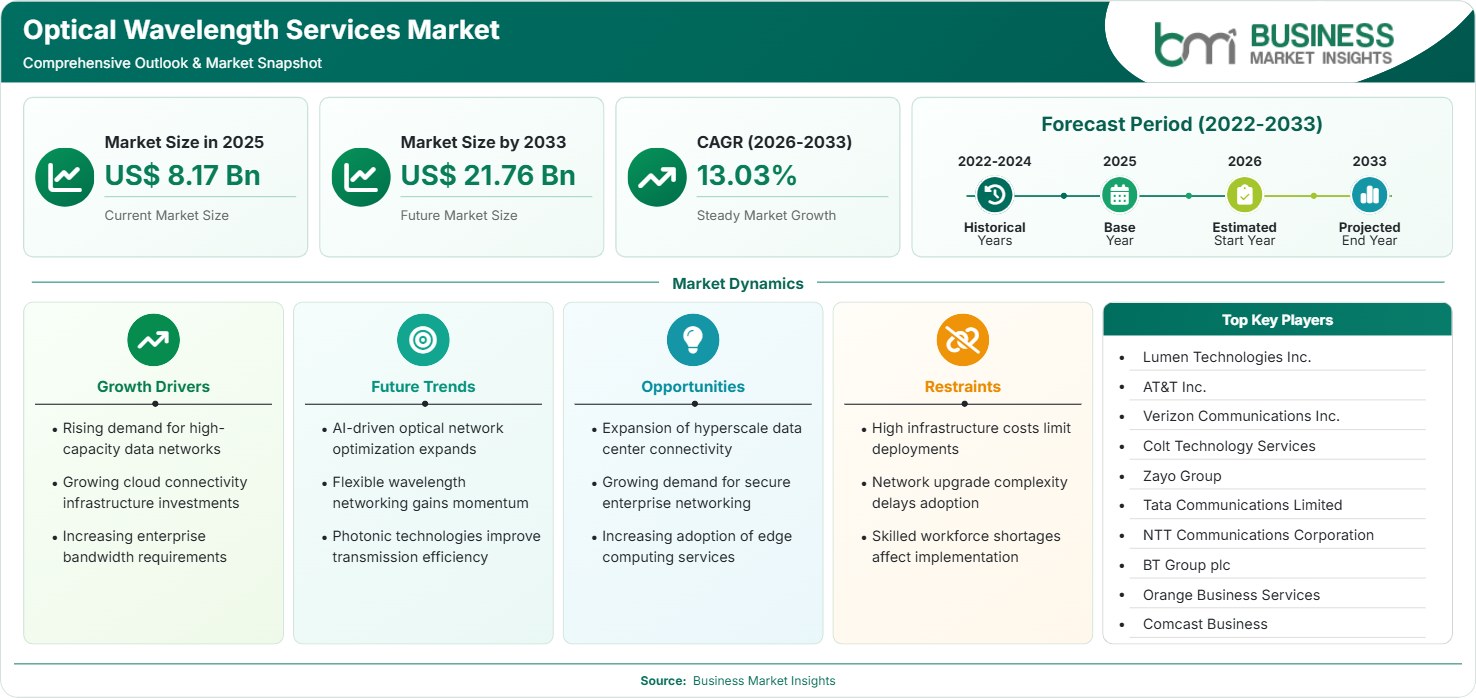
The Optical Wavelength Services Market size was valued at US$ 8.17 billion in 2025 and is projected to reach US$ 21.76 billion by 2033, growing at a CAGR of 13.03% during 2026–2033. Rising demand for high-capacity data networks, growing cloud connectivity infrastructure investments, increasing enterprise bandwidth requirements, expanding hyperscale connectivity, and accelerating digital transformation are creating significant growth opportunities for optical wavelength service providers worldwide.

Report Coverage
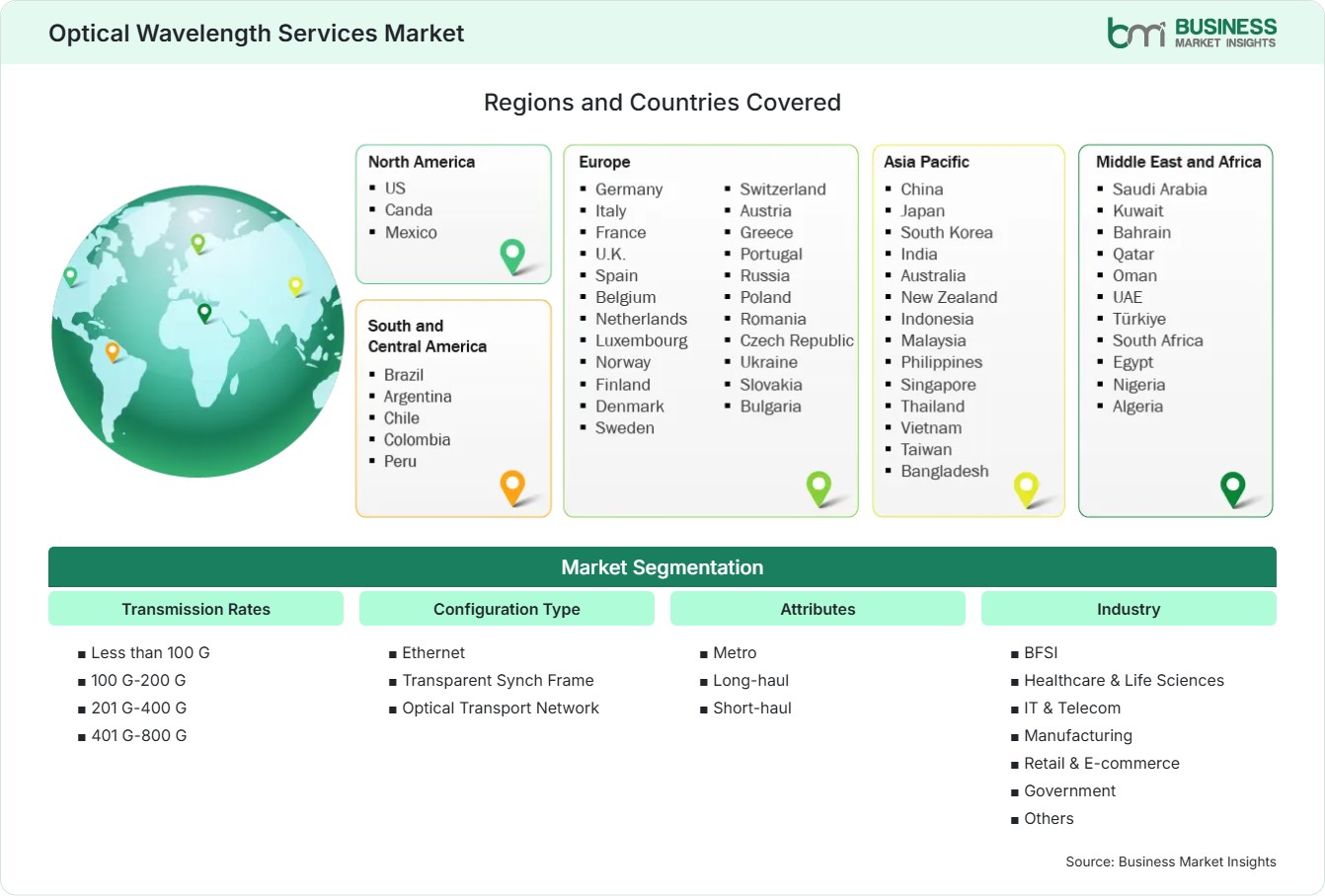
  • Transmission Rates: Less than 100 G, 100 G-200 G, 201 G-400 G, 401 G-800 G
  • Configuration Type: Ethernet, Transparent Synch Frame, Optical Transport Network
  • Attributes: Metro, Long-haul, Short-haul
  • Industry: BFSI, Healthcare & Life Sciences, IT & Telecom, Manufacturing, Retail & E-commerce, Government, Others
US$ 8.17 Bn Market size in 2025
US$ 21.76 Bn Market Size by 2033
13.03% CAGR, 2026 - 2033
2026-2033 Forecast Period

01 AI Overview

Optical Wavelength Services Market Summary

  • North America Region: North America holds 37%–40% market share in 2025 and is projected to expand at a CAGR of 12.5%–13.0% during 2026–2033. Strong hyperscale data center expansion, growing cloud networking investments, widespread enterprise digitalization, and continuous fiber infrastructure deployment continue driving regional demand. The United States remains the dominant contributor with an estimated CAGR of 12.7%–13.2%, supported by robust investments in cloud connectivity and high-capacity transport networks.
  • Fastest Growing Region: Asia Pacific accounts for 24%–27% market share in 2025 and is expected to register a CAGR of 14.3%–14.8% during 2026–2033. Rapid digital infrastructure expansion, increasing hyperscale data center investments, rising enterprise cloud adoption, and accelerating 5G deployment continue strengthening regional growth prospects.
  • Leading Segment: Optical Transport Network represents 43%–46% optical wavelength services market share in 2025 and is anticipated to grow at a CAGR of 13.2%–13.7% during 2026–2033. Increasing requirements for scalable, secure, and high-capacity optical transport solutions continue supporting segment leadership across enterprise and telecom applications.
  • High Growth Segment: 401 G – 800 G transmission rates account for 15%–18% market share in 2025 and are projected to expand at a CAGR of 16.2%–16.8% during 2026–2033. Growing adoption of artificial intelligence workloads, cloud computing, and hyperscale interconnection requirements continues accelerating deployment of ultra-high-capacity optical services.
  • Key Market Opportunity: Increasing investments in hyperscale interconnection, software-defined optical networking, edge computing infrastructure, and secure enterprise connectivity are expected to create substantial long-term commercial opportunities for global service providers.
  • Major Market Players: Lumen Technologies, Inc., AT&T Inc., Verizon Communications Inc., Colt Technology Services Group Limited, Zayo Group Holdings, Inc., Tata Communications Limited, NTT Communications Corporation, BT Group plc, Orange Business Services, and Comcast Business.
02 Strategic Insights

Optical Wavelength Services Market: Strategic Insights

Optical Wavelength Services Market Strategic Framework
FREE PDF
Request your free sample
Request free sample
03 Stakeholder View

Key Takeaways

  • The industry ecosystem is becoming increasingly interconnected as telecommunications operators, fiber infrastructure providers, cloud service companies, hyperscale data center operators, and enterprise customers collaborate to deliver scalable, resilient, and high-capacity optical networking solutions.
  • Hyperscale cloud connectivity and inter-data center transport continue representing the strongest long-term commercial opportunity as enterprises migrate mission-critical workloads toward cloud-native infrastructure and distributed computing environments.
  • Product innovation is increasingly centered on software-defined optical networking, intelligent network automation, higher transmission capacities, advanced wavelength management, and energy-efficient fiber transport technologies that improve operational efficiency and service flexibility.
  • Asia Pacific is emerging as one of the most attractive investment destinations due to expanding hyperscale infrastructure, accelerating enterprise digital transformation, growing cloud adoption, and continuous deployment of next-generation fiber backbone networks.
  • Strategic acquisitions, carrier partnerships, infrastructure-sharing agreements, and long-term capacity contracts continue strengthening global network reach while enabling service providers to expand enterprise connectivity portfolios and improve customer retention.
  • Increasing adoption of artificial intelligence, edge computing, hybrid cloud architectures, and real-time digital applications is expected to sustain long-term demand for high-performance optical networking services while supporting continued industry innovation and infrastructure modernization.
04 Geographic Outlook

Optical Wavelength Services Market Regional Highlights

North America Optical Wavelength Services Market

North America accounted for 37%–40% of the Optical Wavelength Services Market Share in 2025 and is projected to expand at a CAGR of 12.5%–13.0% during 2026–2033. The region benefits from extensive fiber-optic infrastructure, strong cloud service adoption, rapid hyperscale data center expansion, and sustained enterprise digital transformation initiatives. Continuous investments in software-defined networking, artificial intelligence infrastructure, and high-capacity backbone networks continue reinforcing regional leadership in optical wavelength services.

  • Hyperscale cloud providers continue expanding inter-data center connectivity, driving sustained demand for dedicated high-capacity wavelength services supporting latency-sensitive enterprise and cloud workloads.
  • Telecommunications operators are investing in next-generation fiber backbone infrastructure to accommodate exponential traffic growth generated by artificial intelligence, cloud computing, and streaming applications.
  • Enterprise adoption of secure private optical networking continues increasing as organizations prioritize resilient, scalable, and low-latency connectivity for mission-critical digital operations.
  • Government broadband modernization initiatives support expansion of high-capacity fiber infrastructure while encouraging deployment of advanced optical transport services across metropolitan and regional networks.
  • Continuous innovation in intelligent network automation and optical transmission technologies strengthens operational efficiency while improving service reliability and bandwidth scalability.

US Optical Wavelength Services Market

The United States represented 31%–34% of global revenue in 2025 and is forecast to register a CAGR of 12.7%–13.2% through 2026–2033. Rapid expansion of hyperscale cloud infrastructure, enterprise digital transformation, artificial intelligence deployments, and large-scale fiber investments continue maintaining the country's leadership in optical networking services.

  • Major network operators continue expanding nationwide fiber routes to strengthen long-distance optical connectivity supporting cloud providers, enterprises, and content delivery networks.
  • Increasing investments in artificial intelligence infrastructure generate growing demand for ultra-high-capacity wavelength services connecting hyperscale data centers across multiple regions.
  • Enterprise migration toward hybrid cloud architectures accelerates deployment of secure optical networking solutions designed for scalable business-critical connectivity.
  • Strategic partnerships among telecommunications companies, cloud providers, and data center operators continue strengthening national optical transport infrastructure.

Europe Optical Wavelength Services Market

Europe held 27%–30% optical wavelength services market share during 2025 and is anticipated to grow at a CAGR of 12.2%–12.7% through 2026–2033. Increasing cross-border data traffic, growing enterprise cloud adoption, expanding digital infrastructure programs, and investments in secure connectivity continue supporting regional market expansion. Germany leads regional demand with a CAGR of 12.3%–12.8%, while Poland records the fastest growth at 13.6%–14.1% owing to accelerating digital infrastructure investments.

  • Germany continues strengthening regional leadership through extensive fiber deployment, advanced enterprise networking capabilities, and sustained investments in digital transformation initiatives.
  • Poland benefits from expanding hyperscale data center development, increasing enterprise cloud adoption, and modernization of national telecommunications infrastructure.
  • European service providers continue investing in resilient cross-border optical transport networks supporting multinational enterprises and international cloud connectivity.
  • Regulatory initiatives encouraging digital sovereignty and secure enterprise communications strengthen long-term investment in advanced wavelength networking infrastructure.
  • Growing demand for low-latency connectivity supports deployment of intelligent optical transport technologies across financial services, manufacturing, and public sector organizations.

Asia Pacific Optical Wavelength Services Market

Asia Pacific accounted for 24%–27% of global revenue in 2025 and is projected to record the highest CAGR of 14.3%–14.8% during 2026–2033. Rapid cloud adoption, expanding hyperscale facilities, increasing enterprise digitalization, and continuous deployment of next-generation telecommunications infrastructure continue accelerating regional growth. China leads regional revenue with a CAGR of 14.2%–14.7%, while India records the fastest expansion at 15.0%–15.5%.

  • China continues expanding nationwide fiber infrastructure and hyperscale data center investments supporting increasing enterprise demand for high-capacity optical transport services.
  • India benefits from rapid cloud adoption, growing digital economy initiatives, expanding enterprise connectivity requirements, and increasing investments in fiber-based communication infrastructure.
  • Japan and South Korea continue investing in advanced optical networking technologies supporting artificial intelligence, 5G transport, and high-performance enterprise connectivity.
  • Growing regional internet traffic and cloud migration continue driving demand for scalable wavelength services connecting metropolitan and long-haul network environments.
  • Expanding submarine cable connectivity strengthens international bandwidth availability while supporting increasing cross-border enterprise communication requirements.

Rest of World Optical Wavelength Services Market

The Rest of World accounted for 8%–10% optical wavelength services market share in 2025 and is expected to register a CAGR of 12.8%–13.3% during 2026–2033. South & Central America continue strengthening digital connectivity through investments in fiber backbone infrastructure and enterprise networking modernization.

The Middle East & Africa are witnessing increasing deployment of high-capacity telecommunications infrastructure, cloud facilities, and digital government initiatives. Brazil leads South & Central America with a CAGR of 12.9%–13.4%, while Saudi Arabia records the fastest regional growth at 13.8%–14.3% through sustained digital infrastructure investment.

  • Brazil continues expanding metropolitan fiber infrastructure while increasing enterprise adoption of dedicated wavelength services supporting financial institutions, cloud providers, and industrial organizations.
  • Saudi Arabia accelerates investments in hyperscale data centers, national digital transformation programs, and next-generation telecommunications infrastructure supporting high-capacity connectivity.
  • Regional telecommunications operators continue expanding international fiber connectivity to improve bandwidth availability and enterprise network resilience.
  • Increasing government investments in digital infrastructure strengthen deployment of secure optical communication services across public sector organizations.
  • Growing cloud adoption across emerging economies creates sustained demand for scalable optical wavelength services supporting enterprise digital transformation.
Global Market Geography
FREE PDF
Request your free sample
Request free sample
05 Segment Analysis

Optical Wavelength Services Market Segmentation

Transmission Rates

The Transmission Rates segment accounted for 34%–37% of the market in 2025 and is projected to expand at a CAGR of 13.4%–13.9% during 2026–2033. Increasing enterprise bandwidth requirements, cloud computing expansion, and artificial intelligence workloads continue accelerating migration toward higher-capacity transmission technologies. The Optical Wavelength Services Market Forecasts indicate sustained adoption of advanced transmission rates supporting scalable and low-latency optical networking.

  • Less than 100 G: Continues serving organizations requiring cost-effective connectivity for conventional enterprise networking, regional communications, and legacy infrastructure environments.
  • 100 G – 200 G: Widely adopted across enterprise and telecommunications networks requiring balanced bandwidth, operational efficiency, and scalable transport capacity.
  • 201 G – 400 G: Experiences strong deployment across hyperscale cloud environments supporting increasing data traffic, virtualization, and high-performance enterprise applications.
  • 401 G – 800 G: Gains rapid adoption through artificial intelligence infrastructure, hyperscale interconnection, advanced cloud computing, and ultra-high-capacity backbone network deployments.

Configuration Type

The Configuration Type segment represented 43%–46% market share in 2025 and is expected to register a CAGR of 13.2%–13.7% during 2026–2033. Continuous innovation in optical networking architectures, software-defined networking, and intelligent traffic management continues strengthening adoption across enterprise and telecommunications applications. The Optical Wavelength Services Market Trends increasingly emphasize scalable, secure, and flexible network configurations.

  • Ethernet: Maintains widespread adoption owing to interoperability, cost efficiency, simplified deployment, and broad compatibility with enterprise networking environments.
  • Transparent Synch Frame: Supports high-speed optical transport requiring reliable synchronization, efficient bandwidth utilization, and carrier-grade communication performance.
  • Optical Transport Network: Leads enterprise and telecom deployments through advanced traffic management, high-capacity transport, network resilience, and superior service scalability.

Attributes

The Attributes segment generated 31%–34% of overall revenue in 2025 and is forecast to grow at a CAGR of 13.1%–13.6% through 2026–2033. Increasing enterprise digitalization, cloud connectivity expansion, and growing demand for low-latency communications continue driving adoption across metro, long-haul, and short-haul optical networking environments.

  • Metro: Supports high-capacity connectivity among metropolitan data centers, enterprise campuses, and cloud infrastructure through low-latency optical communication networks.
  • Long-haul: Enables reliable long-distance transmission connecting regional, national, and international communication infrastructure supporting hyperscale data movement.
  • Short-haul: Addresses localized enterprise connectivity requirements through efficient, cost-effective, and high-performance optical wavelength transport services.

Industry

The Industry segment accounted for 39%–42% of market revenue in 2025 and is projected to expand at a CAGR of 13.0%–13.5% during 2026–2033. Growing digital transformation initiatives, increasing cloud adoption, and expanding bandwidth-intensive applications continue strengthening demand across multiple end-use industries.

  • BFSI: Increasing secure data transmission requirements and digital banking services continue driving demand for dedicated optical wavelength connectivity.
  • Healthcare & Life Sciences: Growing telemedicine adoption, medical imaging, and digital health platforms require reliable high-capacity communication infrastructure.
  • IT & Telecom: Remains the largest adopter owing to hyperscale cloud expansion, network modernization, and increasing global internet traffic.
  • Manufacturing: Industrial automation, smart factories, and real-time operational analytics increase demand for resilient optical communication services.
  • Retail & E-commerce: Expanding omnichannel operations, cloud platforms, and digital payment systems support higher enterprise bandwidth requirements.
  • Government: National digital transformation initiatives, secure communications, and public sector cloud adoption strengthen deployment of dedicated optical networking services.
  • Others: Education, media, transportation, and energy sectors continue adopting scalable wavelength services supporting digital infrastructure modernization.
06 Market Forces

Optical Wavelength Services Market Dynamics

Key Market Drivers

Rising demand for high-capacity data networks

The growth of international traffic through the Internet, cloud computing, artificial intelligence implementation, and big data applications increases the need for large capacity optical networks. As the ITU states, worldwide broadband access continues growing and therefore requires a significant increase in transmission capacity. More and more companies are looking for scalable wavelengths providing low latency and high security. These developments continue supporting Optical Wavelength Services Market Growth by encouraging investment in next-generation optical transport technologies.

Growing cloud connectivity infrastructure investments

Hyperscale cloud providers, telecommunications companies, and colocation operators continue investing heavily in fiber backbone expansion and inter-data center connectivity. Increasing deployment of distributed cloud architectures and hybrid cloud environments requires dedicated optical wavelength services capable of supporting massive bandwidth demands. Service providers continue modernizing network infrastructure through intelligent optical transport platforms, improving operational flexibility, bandwidth efficiency, and network resilience while strengthening enterprise connectivity capabilities.

Increasing enterprise bandwidth requirements

Rapid enterprise digitalization, software-as-a-service adoption, real-time analytics, and artificial intelligence workloads continue increasing demand for scalable network capacity. Organizations demand stable optical transport networks which can facilitate seamless business operation, cloud connectivity, and application performance. The constant move towards digitization of businesses has led organizations to invest in wavelength services that have the potential to provide bandwidth capacity for the long run.

Key Market Opportunities

Expansion of hyperscale data center connectivity

Growing investments in hyperscale campuses and distributed cloud infrastructure create substantial opportunities for optical wavelength service providers. High-capacity interconnection among geographically distributed facilities requires advanced optical transport technologies capable of supporting artificial intelligence, cloud computing, and high-performance enterprise workloads. The Optical Wavelength Services Market Forecasts indicate sustained commercial opportunities driven by increasing global data center expansion and digital infrastructure investments.

Growing demand for secure enterprise networking

Organizations increasingly prioritize private, secure, and highly reliable communication networks to protect mission-critical applications and sensitive business information. Dedicated wavelength services offer greater security, better performance, and more flexibility than shared networking. Increased security issues still motivate businesses to consider installing optical communication networks that will help them in their digital transformation process.

Increasing adoption of edge computing services

Expansion of edge computing architectures requires low-latency, high-bandwidth connectivity linking distributed computing resources with centralized cloud platforms. Telecommunication companies have also started rolling out optical wavelength services that enable edge computing, automation, autonomy, and analytics. This presents opportunities for network service providers who can provide high-performance connectivity within growingly decentralized digital ecosystems.

Market Restraints and Challenges

High infrastructure costs limit deployments

Factor: Deployment of advanced optical networking infrastructure requires significant investment in fiber assets, transmission equipment, network management systems, and ongoing maintenance. Impact: High capital expenditure slows infrastructure expansion, particularly within developing economies and smaller telecommunications operators, delaying commercialization of advanced wavelength services despite increasing enterprise demand.

Network upgrade complexity delays adoption

Factor: Migration toward next-generation optical networking often requires modernization of legacy systems, interoperability validation, and extensive operational planning. Impact: Complex network integration increases implementation timelines, operational risks, and project costs, causing enterprises and service providers to delay upgrades while carefully managing service continuity and return on investment.

07 Company Analysis

Competitive Landscape

The competitive landscape is characterized by continuous investments in high-capacity fiber infrastructure, software-defined networking, cloud interconnection services, and intelligent optical transport technologies. Leading telecommunications providers are expanding global fiber footprints, strengthening hyperscale connectivity, and developing secure enterprise networking solutions to enhance service portfolios. Strategic collaborations, long-term wavelength agreements, and infrastructure modernization initiatives continue supporting comprehensive Optical Wavelength Services Market Analysis across enterprise, cloud, and carrier applications.

Company Name

Overview

Products and Services Relevant to this Market

Lumen Technologies, Inc.

Global network service provider delivering advanced fiber connectivity and enterprise networking solutions across international markets.

Optical wavelength services, dedicated fiber connectivity, cloud networking, Ethernet services, SD-WAN, and managed network solutions.

AT&T Inc.

Leading telecommunications company providing enterprise communication infrastructure and high-capacity optical transport services worldwide.

Wavelength networking, optical transport, dedicated internet, Ethernet connectivity, managed networking, and enterprise communication solutions.

Verizon Communications Inc.

Global telecommunications provider delivering secure enterprise networking and advanced fiber-based communication services.

Optical wavelength connectivity, Ethernet services, cloud networking, managed security, and high-capacity transport solutions.

Colt Technology Services Group Limited

International digital infrastructure company specializing in enterprise optical networking and high-bandwidth connectivity services.

Optical wavelength services, Ethernet networking, cloud connectivity, data center interconnection, and managed communication services.

Zayo Group Holdings, Inc.

Global provider of communications infrastructure supporting enterprise, carrier, and hyperscale connectivity requirements.

Dark fiber, wavelength services, Ethernet networking, colocation connectivity, and long-haul optical transport solutions.

Tata Communications Limited

International digital ecosystem provider delivering secure enterprise networking and global connectivity services.

Global wavelength connectivity, cloud networking, Ethernet solutions, managed communication, and optical transport infrastructure.

NTT Communications Corporation

Global ICT services provider offering advanced networking, cloud integration, and enterprise communication solutions.

Optical transport networking, cloud connectivity, Ethernet services, managed WAN, and secure enterprise networking solutions.

BT Group plc

Leading communications provider delivering enterprise networking and international optical transport infrastructure.

Wavelength networking, managed optical services, enterprise connectivity, cloud networking, and secure communication platforms.

Orange Business Services

Global enterprise digital services provider focused on secure communications and digital transformation solutions.

Optical connectivity, managed networking, cloud interconnection, enterprise WAN, cybersecurity, and communication infrastructure.

Comcast Business

Enterprise connectivity provider delivering scalable fiber networking and advanced business communication services.

Ethernet services, optical wavelength networking, dedicated internet access, managed networking, and enterprise connectivity solutions.

10 Trust & Transparency

Research Methodology

The market analysis combines proprietary research with secondary data from government agencies, company disclosures, regulatory filings, industry databases and expert interviews. Market estimates are validated through data triangulation, cross-market benchmarking and analyst review.

View Full Research Methodology

11 Questions Answered

Frequently Asked Questions

What does the Optical Wavelength Services Market Report include?

The Market Report provides detailed insights into market size, segmentation, competitive landscape, regional performance, technology trends, growth drivers, restraints, opportunities, recent developments, and future business outlook.

What are the major future opportunities for market participants?

Expansion of hyperscale data centers, secure enterprise networking, edge computing deployment, software-defined optical networking, and artificial intelligence-driven infrastructure modernization are expected to generate significant long-term growth opportunities.

Which configuration type dominates the market?

Optical Transport Network is the leading configuration type because it provides superior scalability, high-capacity transmission, advanced traffic management, and reliable network performance for enterprise and carrier applications.

Which region leads the Optical Wavelength Services Market?

North America remains the leading regional market due to its mature telecommunications infrastructure, extensive hyperscale data center presence, strong cloud adoption, and continuous investment in high-capacity optical networking technologies.

What factors are driving the Market?

Growing cloud computing adoption, increasing enterprise bandwidth requirements, hyperscale data center expansion, artificial intelligence workloads, and continuous investments in fiber-optic infrastructure are the primary factors driving market expansion.

Access the Full Optical Wavelength Services Market Report

Get segment-level forecasts, regional estimates, competitive benchmarking, company profiles and downloadable Excel datasets.

Access the full Optical Wavelength Services Market Report
350 pages PDF & Excel | 2026-08-05