
Optical Communication Systems and Networking Market Outlook: Size, Share, Trends, Growth Analysis, Competitive Landscape & Forecast, 2026-2033

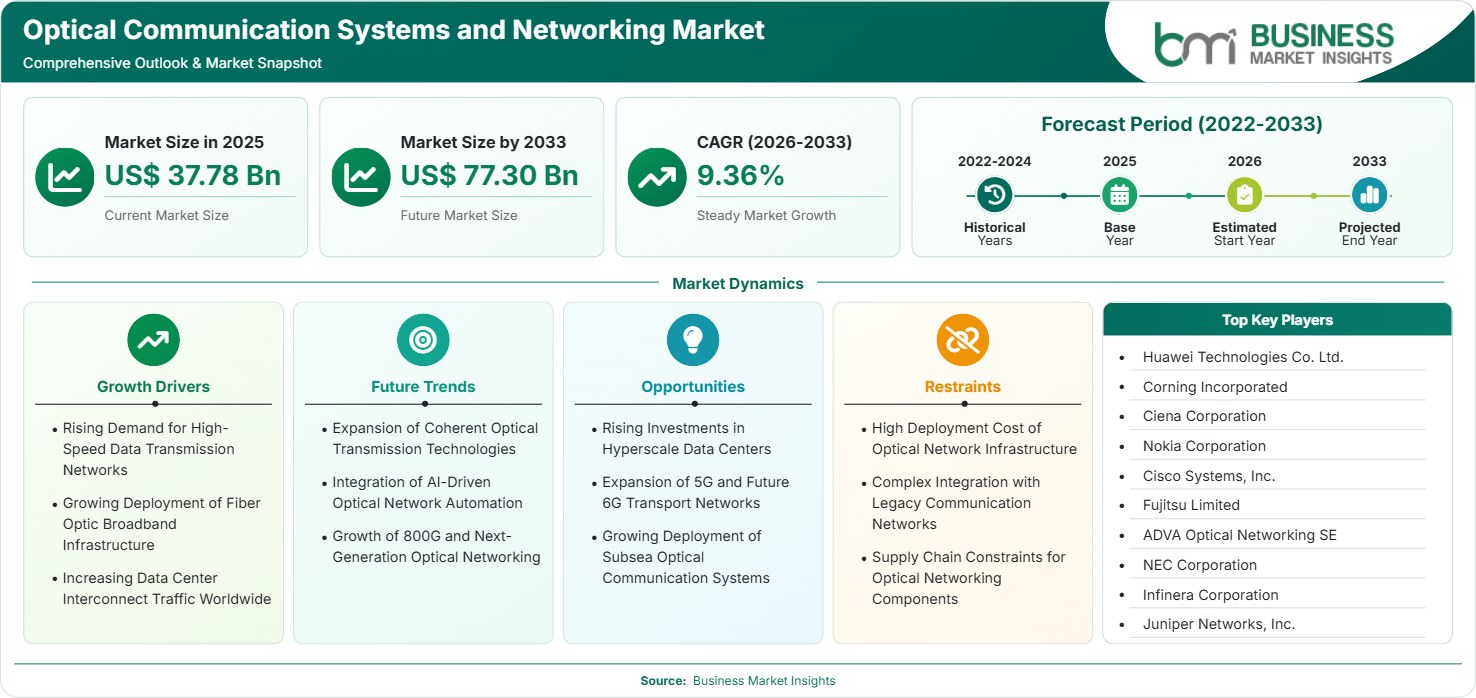
The Optical Communication Systems and Networking Market size was valued at US$ 37.78 Billion in 2025 and is projected to reach US$ 77.30 Billion by 2033, growing at a CAGR of 9.36% during 2026–2033. Rising demand for high-bandwidth data transmission, expansion of 5G infrastructure, increasing cloud computing adoption, and growing investments in hyperscale data centers are supporting market growth globally.

Report Coverage
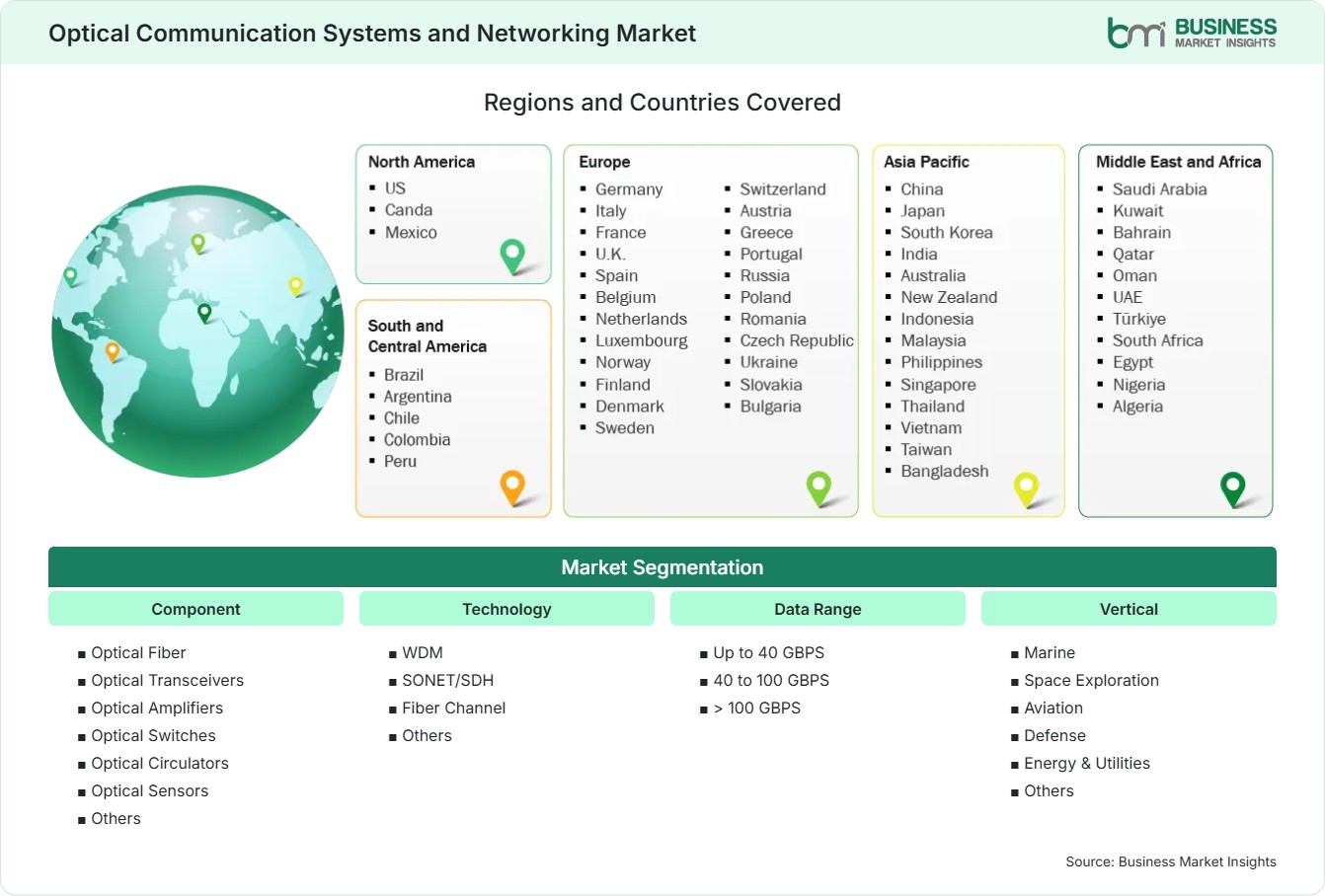
  • Component: Optical Fiber, Optical Transceivers, Optical Amplifiers, Optical Switches, Optical Circulators, Optical Sensors, Others
  • Technology: WDM, SONET/SDH, Fiber Channel, Others
  • Data Range: Up to 40 GBPS, 40 to 100 GBPS, > 100 GBPS
  • Vertical: Marine, Space Exploration, Aviation, Defense, Energy & Utilities, Others
US$ 37.78 Bn Market size in 2025
US$ 77.30 Bn Market Size by 2033
9.36% CAGR, 2026 - 2033
2026-2033 Forecast Period

01 AI Overview

Optical Communication Systems and Networking Market Summary

  • North America Region: North America holds a optical communication systems and networking market share of 36%–39% in 2025, growing with a CAGR of 8.8%–9.4% during 2026–2033. Strong investments in cloud infrastructure, data center expansion, advanced telecommunications networks, and defense communication systems continue supporting regional leadership. The U.S. market is expected to register a CAGR of 8.9%–9.5%.
  • Fastest Growing Region: Asia Pacific accounts for 26%–29% share in 2025 and is projected to grow at a CAGR of 10.2%–10.9% through 2033. Expanding fiber-optic infrastructure, rapid 5G deployment, increasing internet penetration, and growing digital transformation initiatives continue supporting regional expansion.
  • Leading Segment: Optical Fiber represents 29%–32% share in 2025 and is expected to grow at a CAGR of 9.1%–9.8% through 2033. Rising fiber network deployments, increasing broadband connectivity requirements, and growing adoption of high-speed communication infrastructure continue supporting segment dominance.
  • High Growth Segment: >100 GBPS accounts for 19%–22% share in 2025 and is forecast to grow at a CAGR of 11.4%–12.1% during 2026–2033. Growing demand for ultra-high-speed communication, cloud computing applications, AI workloads, and hyperscale data center connectivity continues accelerating growth.
  • Key Market Opportunity: Expansion of next-generation fiber networks, AI-enabled networking platforms, hyperscale data center interconnects, and advanced optical transport systems is creating substantial growth opportunities.
  • Major Market Players: Huawei Technologies Co. Ltd., Corning Incorporated, Ciena Corporation, Nokia Corporation, Cisco Systems, Inc., Fujitsu Limited, ADVA Optical Networking SE, NEC Corporation, Infinera Corporation, Juniper Networks, Inc.
02 Strategic Insights

Optical Communication Systems and Networking Market: Strategic Insights

Optical Communication Systems and Networking Market Strategic Framework
FREE PDF
Request your free sample
Request free sample
03 Stakeholder View

Key Takeaways

  • Optical networking remains the backbone of modern telecommunications and high-speed data transmission infrastructure.
  • Optical fiber continues to dominate the optical communication systems and networking market due to growing deployment of broadband, metro, and long-haul communication networks.
  • Data rates exceeding 100 GBPS are experiencing rapid growth due to rising cloud, AI, and hyperscale computing requirements.
  • Asia Pacific offers significant growth opportunities driven by large-scale fiber infrastructure deployment and telecommunications expansion.
  • 5G backhaul and data center interconnect applications continue generating substantial demand for advanced optical technologies.
  • Technological innovation is increasingly focused on network scalability, energy efficiency, bandwidth optimization, and ultra-low latency communications.
04 Geographic Outlook

Optical Communication Systems and Networking Market Regional Highlights

North America Optical Communication Systems and Networking Market

North America accounts for 36%–39% Optical Communication Systems and Networking Market share in 2025 and is projected to grow at a CAGR of 8.8%–9.4% through 2033. Strong investment in telecommunications infrastructure, rapid growth in data center construction, increasing cloud adoption, and ongoing network modernization initiatives continue supporting regional leadership.

  • Telecommunications providers continue expanding fiber-optic networks to support growing broadband and 5G connectivity requirements.
  • Hyperscale data center investments are creating significant demand for advanced optical networking technologies and high-capacity interconnect solutions.
  • Cloud service providers are increasingly deploying optical communication systems to improve network performance and scalability.
  • Defense organizations continue investing in secure and high-capacity communication networks for mission-critical applications.
  • Enterprises are increasingly adopting advanced networking architectures to support digital transformation strategies.
  • Technological innovation remains focused on improving bandwidth utilization, network resilience, and operational efficiency.

US Optical Communication Systems and Networking Market

The United States contributes approximately 85%–89% of North American revenue and is expected to register a CAGR of 8.9%–9.5% through 2033. Extensive fiber deployments, strong cloud infrastructure investments, and increasing demand for high-capacity communication networks continue supporting market leadership.

  • Large-scale investments in data center infrastructure continue driving deployment of advanced optical networking products.
  • Telecommunications operators are expanding network capacity to support rapidly growing data traffic volumes.
  • AI and cloud computing applications continue generating substantial demand for high-speed optical interconnect solutions.
  • Government and defense communication projects remain important contributors to optical communication systems and networking market demand.
  • Ongoing innovation in optical transport technologies is strengthening industry competitiveness.

Europe Optical Communication Systems and Networking Market

Europe represents 24%–27% of global revenue in 2025 and is anticipated to expand at a CAGR of 9.0%–9.7% through 2033. Increasing digital infrastructure investments, broadband expansion initiatives, and strong enterprise connectivity demand continue supporting regional growth. Germany remains the leading market while Poland demonstrates stronger growth momentum.

  • Germany continues leading regional demand due to advanced industrial infrastructure and ongoing telecommunications modernization projects.
  • Poland is among the fastest-growing markets and is estimated to register a CAGR of 10.0%–10.7% during the forecast period.
  • Fiber broadband expansion continues supporting substantial investment in optical communication equipment.
  • Network operators are increasingly upgrading legacy infrastructure to support higher transmission capacities.
  • Industrial digitalization and smart infrastructure deployments continue generating additional market opportunities.

Asia Pacific Optical Communication Systems and Networking Market

Asia Pacific accounts for 26%–29% of global revenue in 2025 and is expected to achieve the fastest CAGR of 10.2%–10.9% through 2033. Growing telecommunications investments, large-scale fiber network deployment, increasing internet usage, and expanding cloud infrastructure continue supporting strong regional growth.

  • China remains the largest regional market due to significant investments in fiber-optic infrastructure and telecommunications modernization.
  • India is projected to achieve approximately 10.9%–11.6% CAGR, supported by broadband expansion, data center growth, and rapid digitalization initiatives.
  • 5G deployment programs continue creating demand for high-capacity optical transport systems.
  • Cloud service providers are increasingly investing in regional connectivity infrastructure.
  • Rising enterprise digitization is supporting adoption of advanced networking technologies.
  • Smart city and digital economy initiatives continue strengthening market opportunities.

Rest of World Optical Communication Systems and Networking Market

Rest of World accounts for 8%–11% of global revenue in 2025 and is projected to expand at a CAGR of 9.1%–9.8% through 2033. Expanding broadband infrastructure, growing internet adoption, and increasing investment in digital connectivity projects continue supporting market development.

  • Brazil continues generating demand through telecommunications modernization and broadband expansion programs.
  • The UAE is increasing investments in advanced networking infrastructure and smart city connectivity projects.
  • Saudi Arabia is expected to achieve approximately 9.9%–10.6% CAGR through 2033, supported by digital transformation and communications infrastructure development.
  • Data center investments continue creating demand for optical networking technologies.
  • Governments are prioritizing broadband accessibility and high-speed connectivity initiatives.
  • Network modernization programs continue supporting long-term market expansion.
Global Market Geography
FREE PDF
Request your free sample
Request free sample
05 Segment Analysis

Optical Communication Systems and Networking Market Segmentation

Component

The component segment forms the technological foundation of optical communication infrastructure, enabling the transmission, amplification, routing, monitoring, and management of high-speed optical signals across communication networks. The segment accounts for approximately 29%–32% share in 2025 and is projected to grow at a CAGR of 9.4%–10.0% through 2033. The expanding Optical Communication Systems and Networking Market scope is supported by rising internet traffic, increasing deployment of cloud infrastructure, rapid growth of data centers, and expanding adoption of fiber-based communication technologies across multiple industries.

  • Optical Fiber: Optical fiber remains the dominant component category due to its critical role in long-haul, metro, access, and submarine communication networks. Growing deployment of fiber-to-the-home (FTTH) and 5G backhaul networks continues supporting demand.
  • Optical Transceivers: Optical transceivers are witnessing strong demand owing to increasing requirements for high-speed data transmission across enterprise networks, cloud computing facilities, and telecom infrastructure.
  • Optical Amplifiers: Amplifiers play a vital role in extending transmission distances and improving signal quality within long-haul communication networks.
  • Optical Switches: Optical switches are increasingly adopted to enable efficient traffic management, network flexibility, and resource optimization within advanced communication architectures.
  • Optical Circulators: Optical circulators support signal routing and bidirectional communication applications in sophisticated optical networking environments.
  • Optical Sensors: Optical sensors continue expanding across industrial monitoring, utilities, aerospace, defense, and smart infrastructure applications.
  • Others: Additional components include wavelength management devices, multiplexers, demultiplexers, couplers, splitters, modulators, and advanced optical networking equipment.

Technology

Advancements in transmission technology continue driving the evolution of optical communication networks. This segment accounts for approximately 38%–41% share in 2025 and is expected to register a CAGR of 9.5%–10.2% through 2033. Current Optical Communication Systems and Networking Market trends indicate growing investments in high-capacity transmission technologies capable of supporting increasing global bandwidth demand.

  • WDM (Wavelength Division Multiplexing): WDM represents the leading technology segment due to its ability to significantly increase fiber capacity by transmitting multiple wavelengths simultaneously through a single optical fiber.
  • SONET/SDH: SONET/SDH technologies continue supporting telecommunications infrastructure where high reliability, synchronization, and standardized network management capabilities are required.
  • Fiber Channel: Fiber Channel remains important in storage networking environments, supporting high-speed connectivity between servers, storage devices, and enterprise data centers.
  • Others: Additional technologies include optical transport networking, passive optical networking, coherent optical communication, and emerging next-generation transmission solutions.

Data Range

Data transmission capacity remains a critical factor influencing the adoption of optical communication systems as network traffic continues growing worldwide. This segment accounts for approximately 34%–37% share in 2025 and is projected to grow at a CAGR of 9.8%–10.5% through 2033.

  • Up to 40 GBPS: This segment continues serving conventional enterprise communication, telecom access networks, industrial connectivity, and legacy networking environments.
  • 40 to 100 GBPS: Mid-range transmission capacities remain widely deployed within carrier networks, enterprise data centers, metro infrastructure, and cloud connectivity applications.
  • >100 GBPS: This represents the fastest-growing segment driven by hyperscale data centers, AI computing environments, cloud services, advanced research networks, and next-generation telecommunications infrastructure.

Vertical

The adoption of optical communication technologies continues expanding across a diverse range of end-use industries seeking reliable, high-capacity, and low-latency transmission capabilities. This segment accounts for approximately 41%–44% share in 2025 and is projected to expand at a CAGR of 9.6%–10.3% through 2033.

  • Marine: Marine applications utilize optical communication systems within submarine cables, offshore energy infrastructure, maritime communication systems, and ocean monitoring projects.
  • Space Exploration: Optical technologies are increasingly deployed within satellite communications, deep-space missions, earth observation platforms, and space-based data transmission systems.
  • Aviation: Aviation operators employ optical networking solutions within aircraft communication systems, avionics networks, airport infrastructure, and air traffic management environments.
  • Defense: Defense organizations represent a major end-user category due to growing requirements for secure, high-speed, and mission-critical communication networks.
  • Energy & Utilities: Utilities increasingly deploy optical communication infrastructure to support smart grids, transmission system management, substation automation, and remote monitoring capabilities.
  • Others: Additional verticals include telecommunications, healthcare, industrial automation, education, transportation, financial services, and government communication networks.
06 Market Forces

Optical Communication Systems and Networking Market Dynamics

Key Market Drivers

Rising Demand for High-Speed Data Transmission Networks

The exponential growth of digital services, cloud computing, video streaming, artificial intelligence workloads, and connected devices continues driving unprecedented demand for high-speed data transmission networks. Consumers and enterprises increasingly require seamless connectivity capable of handling growing volumes of data with minimal latency and high reliability. Optical communication systems provide the bandwidth capacity and transmission efficiency necessary to support these evolving requirements. Enterprises are also modernizing network infrastructure to support digital transformation strategies and increasingly data-intensive operations. As global data generation continues expanding, demand for high-capacity optical networking technologies is expected to remain a primary driver of optical communication systems and networking market growth.

Growing Deployment of Fiber Optic Broadband Infrastructure

Fiber optic broadband deployment continues accelerating worldwide as governments, telecommunications providers, and infrastructure investors prioritize high-speed connectivity. Fiber networks offer superior bandwidth, reliability, scalability, and operational efficiency compared with many legacy communication technologies. Broadband expansion initiatives are increasingly focused on improving access in urban, suburban, and underserved areas to support economic development and digital inclusion objectives. Fiber-to-the-home, fiber-to-the-building, and fiber-based enterprise connectivity projects continue generating substantial demand for optical communication components and systems. Growing demand for reliable broadband access across residential, commercial, and industrial users remains a significant driver.

Increasing Data Center Interconnect Traffic Worldwide

The continuous expansion of cloud computing, hyperscale infrastructure, artificial intelligence applications, and enterprise digital transformation initiatives is creating substantial growth in data center interconnect traffic. Modern data centers require ultra-high-capacity communication links capable of supporting massive volumes of information exchange across geographically distributed facilities. Optical communication systems provide the speed, scalability, and efficiency needed to support these demanding environments. As cloud adoption and digital services continue expanding globally, data center networking requirements are expected to remain an important growth driver for the industry.

Key Market Opportunities

Rising Investments in Hyperscale Data Centers

Hyperscale data centers represent one of the most significant opportunities within the optical communication systems and networking market. Global cloud service providers, technology companies, and enterprise operators continue investing heavily in data center expansion to support rapidly increasing computing and storage requirements. These facilities depend on optical networking technologies for efficient internal connectivity and long-distance data transmission. Growing AI workloads, cloud applications, and edge computing deployments are further strengthening demand for high-capacity interconnect solutions. Manufacturers providing advanced optical components and networking platforms are expected to benefit significantly from continued hyperscale infrastructure investments.

Expansion of 5G and Future 6G Transport Networks

The deployment of 5G infrastructure and ongoing development of future 6G technologies are creating substantial opportunities for optical communication vendors. Mobile networks increasingly require high-capacity backhaul and fronthaul connectivity solutions to support rapidly growing mobile data traffic. Optical transport networks provide the bandwidth and reliability needed for next-generation wireless communication environments. Telecommunications operators continue investing in network upgrades to improve coverage, performance, and service quality. As research and commercialization efforts surrounding advanced wireless technologies progress, demand for scalable optical transport infrastructure is expected to increase significantly.

Growing Deployment of Subsea Optical Communication Systems

Subsea optical communication networks remain critical components of global connectivity infrastructure, transmitting large volumes of international internet and telecommunications traffic. Increasing demand for cross-border data exchange, cloud services, digital commerce, and international connectivity is driving investments in submarine cable systems worldwide. Governments, telecommunications providers, and cloud companies continue expanding subsea network capacity to improve reliability and reduce latency. Long-term Optical Communication Systems and Networking Market Forecasts remain favorable as deployment of advanced submarine communication systems continues expanding across key global connectivity corridors.

Market Restraints and Challenges

High Deployment Cost of Optical Network Infrastructure

Factor: Establishing optical communication networks often requires substantial investment in fiber deployment, transmission equipment, network management systems, civil infrastructure, and maintenance activities. Large-scale projects such as nationwide broadband networks, metro fiber systems, and long-haul communication infrastructure can involve significant capital expenditures. Installation complexity and geographical challenges may further increase project costs.

Impact: High infrastructure costs can delay network expansion projects, restrict adoption in cost-sensitive regions, and increase investment risks for network operators. Organizations may implement deployments in phases, potentially slowing overall market growth despite strong long-term demand fundamentals.

Complex Integration with Legacy Communication Networks

Factor: Many organizations continue operating legacy networking systems that may not easily integrate with advanced optical communication technologies. Migration often requires equipment upgrades, interoperability testing, network redesign, workforce training, and operational adjustments. Integration complexity can vary significantly depending on existing infrastructure conditions and technology requirements.

Impact: Integration challenges may increase deployment timelines, project costs, and implementation risks. Organizations must carefully plan network modernization initiatives to ensure compatibility and maintain service continuity, which can temporarily slow adoption of advanced optical networking solutions.

07 Company Analysis

Competitive Landscape

The Optical Communication Systems and Networking Market analysis is characterized by intense competition among telecommunications equipment providers, optical networking specialists, fiber manufacturers, and network infrastructure companies. Market participants are focusing on high-capacity optical transport systems, coherent optics, wavelength-division multiplexing technologies, hyperscale data center connectivity, and next-generation network automation solutions. Growing investments in broadband infrastructure, 5G deployments, cloud computing ecosystems, data center interconnects, and subsea communication networks continue driving product innovation and strategic expansion activities across the industry.

Company Name

Overview

Products and Services relevant to this market

Huawei Technologies Co. Ltd.

Telecommunications and networking company providing optical networking infrastructure for carriers, enterprises, and cloud operators.

Optical transport systems, WDM solutions, optical transmission equipment, data center interconnect solutions, and broadband networking technologies.

Corning Incorporated

Materials science company and leading manufacturer of optical fiber solutions for communications infrastructure.

Optical fiber, fiber-optic cables, connectivity solutions, network infrastructure products, and broadband communication technologies.

Ciena Corporation

Networking systems provider specializing in optical communications, network automation, and transport technologies.

Optical transport platforms, packet networking solutions, coherent optics, network management software, and data center interconnect systems.

Nokia Corporation

Telecommunications technology provider supporting fixed, mobile, IP, and optical networking environments.

Optical networking platforms, WDM systems, transport solutions, fiber access infrastructure, and service provider networking technologies.

Cisco Systems, Inc.

Networking and communication technology company serving enterprise, telecommunications, and cloud infrastructure markets.

Optical networking systems, data center interconnect solutions, optical transceivers, routing platforms, and network management technologies.

Fujitsu Limited

Technology company offering communication and optical transport solutions for service providers and enterprises.

Optical transmission systems, network infrastructure technologies, transport platforms, optical networking equipment, and communication management solutions.

ADVA Optical Networking SE

Optical networking specialist focused on high-speed transmission and synchronization technologies.

Optical transport systems, edge networking solutions, timing and synchronization products, and fiber communication infrastructure.

NEC Corporation

Information technology and network infrastructure provider serving telecommunications and enterprise markets.

Optical communication systems, submarine cable technologies, network transport platforms, telecom infrastructure, and optical networking solutions.

Infinera Corporation

Optical networking company specializing in high-capacity transport and data center connectivity solutions.

Optical transport equipment, coherent optical systems, subsea communication technologies, and high-capacity networking platforms.

Juniper Networks, Inc.

Networking technology provider focused on communication, cloud, and enterprise networking infrastructure.

Optical networking solutions, network automation software, data center networking products, transport infrastructure, and communication technologies.

10 Trust & Transparency

Research Methodology

The market analysis combines proprietary research with secondary data from government agencies, company disclosures, regulatory filings, industry databases and expert interviews. Market estimates are validated through data triangulation, cross-market benchmarking and analyst review.

View Full Research Methodology

11 Questions Answered

Frequently Asked Questions

How are 5G and cloud computing influencing optical communication demand?

5G networks require high-capacity optical backhaul and fronthaul infrastructure, while cloud computing environments depend on high-speed optical interconnects to support rising data traffic, low-latency communications, and scalable networking operations.

What does this Optical Communication Systems and Networking Market Report cover?

This report covers component analysis, technology segmentation, data range evaluation, vertical assessments, regional trends, competitive landscape analysis, market dynamics, opportunities, restraints, and growth prospects through 2033.

Why is the >100 GBPS data range segment growing rapidly?

The segment is experiencing strong growth due to increasing demand from hyperscale data centers, artificial intelligence workloads, cloud service providers, high-performance computing environments, and advanced telecom transport networks.

Which component segment dominates the market?

Optical Fiber represents the leading segment due to its critical role in broadband connectivity, telecommunications networks, hyperscale data centers, long-haul communication systems, and fiber-to-the-home deployments.

What is driving growth in the Optical Communication Systems and Networking market?

Rising demand for high-speed data transmission networks, growing deployment of fiber-optic broadband infrastructure, increasing data center interconnect traffic, and expansion of cloud computing and 5G networks are the primary factors driving market growth.

Access the Full Optical Communication Systems and Networking Market Report

Get segment-level forecasts, regional estimates, competitive benchmarking, company profiles and downloadable Excel datasets.

Access the full Optical Communication Systems and Networking Market Report
350 pages PDF & Excel | 2026-08-12