
Network Access Control Market Outlook: Size, Share, Trends, Growth Analysis, Competitive Landscape & Forecast, 2026-2033

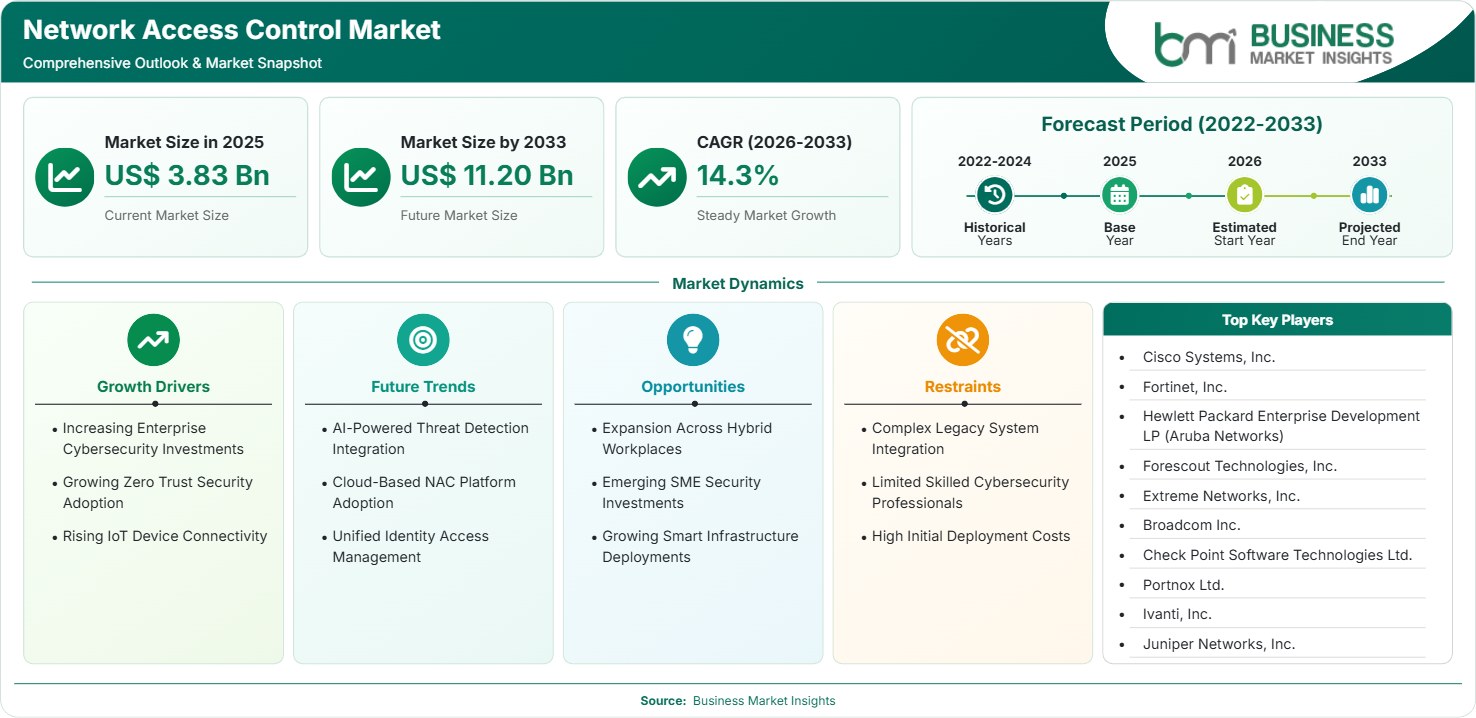
The Network Access Control Market size was valued at US$ 3.83 Billion in 2025 and is projected to reach US$ 11.20 Billion by 2033, growing at a CAGR of 14.3% during 2026–2033. Rising Zero Trust security adoption, increasing enterprise cybersecurity investments, cloud-first IT strategies, and growing IoT device connectivity continue accelerating solution deployment, while AI-powered policy automation and managed security services create substantial long-term growth opportunities.

Report Coverage
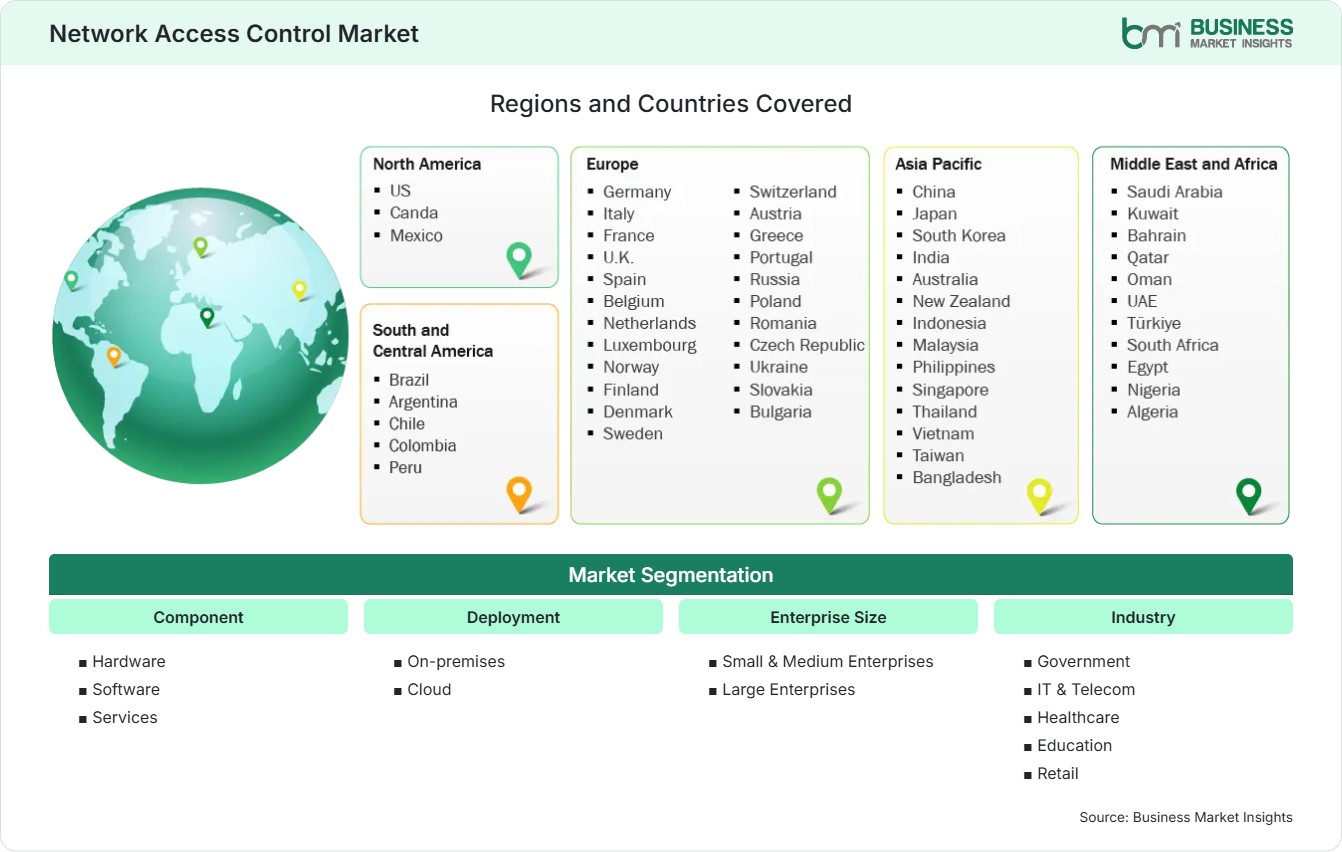
  • Component: Hardware, Software, Services
  • Deployment: On-premises, Cloud
  • Enterprise Size: Small & Medium Enterprises, Large Enterprises
  • Industry: Government, IT & Telecom, Healthcare, Education, Retail
US$ 3.83 Bn Market size in 2025
US$ 11.20 Bn Market Size by 2033
14.3% CAGR, 2026 - 2033
2026-2033 Forecast Period

01 AI Overview

Network Access Control Market Summary

  • North America Region: North America accounts for 36%–39% of the market in 2025 and is projected to expand at a 13.0%–14.0% CAGR during 2026–2033. Enterprise cybersecurity spending, Zero Trust mandates, and rapid cloud adoption continue supporting solution deployment across regulated industries. The United States remains the largest contributor, supported by federal cybersecurity initiatives and enterprise modernization, advancing at a 13.2%–14.2% CAGR.
  • Fastest Growing Region: Asia Pacific represents 24%–27% of the market in 2025 while registering the highest projected 16.0%–17.0% CAGR. Accelerated digital transformation, expanding 5G infrastructure, smart manufacturing investments, and rising cybersecurity awareness continue driving enterprise deployments across major regional economies.
  • Leading Segment: Software holds 48%–51% market share in 2025 and is expected to register a 14.5%–15.5% CAGR. Enterprises increasingly prioritize centralized policy management, AI-driven endpoint visibility, automated compliance monitoring, and seamless identity integration across hybrid enterprise environments.
  • High Growth Segment: Cloud Deployment contributes 39%–42% market share during 2025 and is forecast to grow at a 17.0%–18.0% CAGR. Growing hybrid workplaces, SaaS adoption, distributed workforces, and multi-cloud security requirements continue accelerating cloud-native implementation.
  • Key Market Opportunity: Zero Trust adoption in government, healthcare, banking, education, and manufacturing industries generates ongoing requirement for identity-centric authentication, intelligent endpoint profiling, and automated policy orchestration.
  • Major Market Players: Cisco Systems, Inc.; Fortinet, Inc.; Hewlett Packard Enterprise Development LP; Forescout Technologies, Inc.; Extreme Networks, Inc.; Broadcom Inc.; Check Point Software Technologies Ltd.; Portnox Ltd.; Ivanti, Inc.; Juniper Networks, Inc.
02 Strategic Insights

Network Access Control Market: Strategic Insights

Network Access Control Market Strategic Framework
FREE PDF
Request your free sample
Request free sample
03 Stakeholder View

Key Takeaways

  • The industry value chain increasingly integrates hardware manufacturers, software developers, identity management providers, cloud platform vendors, and managed security service providers to deliver unified Zero Trust security architectures.
  • Cloud-native deployments across SMEs, educational institutions, and healthcare organizations present the strongest long-term commercial opportunity due to simplified implementation, subscription pricing, and centralized policy management.
  • Artificial intelligence, behavioral analytics, machine learning, and automated endpoint profiling continue redefining product innovation as vendors prioritize autonomous threat detection and adaptive authentication capabilities.
  • Asia Pacific presents one of the most attractive regional investment opportunities because of accelerating enterprise digitalization, expanding industrial IoT deployments, favorable government cybersecurity initiatives, and increasing cloud infrastructure investments.
  • Technology Partnerships, strategic acquisitions, and Platform Consolidation will continue to be important strategies as providers continue to enhance their identity management, endpoint security, and network visibility in a comprehensive cybersecurity ecosystem.
  • Organizations increasingly prefer unified cybersecurity platforms capable of combining network access control, endpoint management, identity governance, and continuous compliance monitoring through centralized policy orchestration.
04 Geographic Outlook

Network Access Control Market Regional Highlights

North America Network Access Control Market

North America accounts for 36%–39% of global revenue during 2025 while expanding at a CAGR of 13.0%–14.0% through 2033. The Network Access Control Market share remains the highest globally due to mature cybersecurity spending, Zero Trust implementation, advanced cloud infrastructure, and stringent regulatory compliance requirements across government, healthcare, finance, and critical infrastructure sectors.

  • Federal cybersecurity mandates continue accelerating enterprise investment in identity-centric security, endpoint compliance validation, and continuous authentication across public-sector organizations and critical infrastructure operators.
  • Financial institutions increasingly deploy AI-assisted policy enforcement, behavioral analytics, and adaptive authentication to strengthen cyber resilience against ransomware and credential-based attacks.
  • Healthcare organizations modernize digital infrastructure by securing connected medical devices, clinical applications, and electronic health records through automated endpoint visibility and network segmentation.
  • Manufacturing enterprises continue expanding industrial IoT deployments requiring intelligent device discovery, operational technology protection, and policy-driven network segmentation without interrupting production environments.
  • Strategic collaborations between cybersecurity vendors and hyperscale cloud providers continue strengthening enterprise adoption of integrated Zero Trust security platforms.

US Network Access Control Market

The United States accounts for 29%–32% of the global Network Access Control Market revenue in 2025, while registering a CAGR of 13.2%–14.2% through 2033. Federal Zero Trust strategies, enterprise cloud migration, expanding digital infrastructure investments, and growing cybersecurity budgets continue to support nationwide deployment across both the public and private sectors.

  • Federal agencies increasingly modernize cybersecurity architecture through continuous authentication, identity verification, endpoint posture assessment, and automated policy enforcement supporting national cyber resilience.
  • Large enterprises accelerate replacement of legacy authentication infrastructure with AI-enabled identity management platforms supporting hybrid workforces and distributed cloud environments.
  • Healthcare providers strengthen endpoint visibility across connected medical devices, clinical systems, and remote healthcare infrastructure to reduce operational cybersecurity risks.
  • Critical infrastructure operators expand investments in intelligent network segmentation, protecting energy, transportation, telecommunications, and public utility environments.

Europe Network Access Control Market

Europe represents 28%–31% of global revenue in 2025 and is projected to register a 13.5%–14.5% CAGR during 2026–2033. Strong cybersecurity regulations, increasing adoption of Zero Trust security frameworks, expanding industrial digitalization, and growing cloud migration initiatives continue to strengthen enterprise demand across both public and private sectors. Germany remains the leading regional market, while the United Kingdom records the fastest expansion as organizations accelerate cybersecurity modernization to support digital transformation and increasingly distributed work environments.

  • Germany continues leading regional adoption through strong investments in Industry 4.0, manufacturing cybersecurity, and critical infrastructure protection, supporting a projected CAGR of 13.2%–14.2% through 2033.
  • The United Kingdom is expected to record the highest regional growth at a 14.5%–15.5% CAGR, supported by cloud adoption, financial sector cybersecurity initiatives, and expanding Zero Trust implementation.
  • France continues strengthening enterprise cybersecurity capabilities through increased investment in public-sector digital infrastructure, identity management solutions, and compliance-driven network security modernization.
  • Financial services, manufacturing, healthcare, and government organizations remain the largest enterprise adopters as increasingly sophisticated cyber threats encourage continuous authentication and automated policy enforcement.
  • Strategic collaboration between cybersecurity providers, telecommunications operators, and cloud service companies continues to expand deployment opportunities across highly regulated industries.

Asia Pacific Network Access Control Market

Asia Pacific accounts for 24%–27% of the global Network Access Control Market during 2025 while registering the fastest regional CAGR of 16.0%–17.0% through 2033. Accelerated digital transformation, expanding cloud infrastructure, and rapid enterprise modernization continue to support sustained cybersecurity investment throughout the region. China remains the largest market by revenue, while India demonstrates the strongest growth due to expanding enterprise digitalization and rising cybersecurity awareness.

  • China leads regional adoption through large-scale enterprise digital transformation, smart manufacturing initiatives, and growing investment in domestic cybersecurity capabilities, advancing at a 15.5%–16.5% CAGR.
  • India is projected to record the fastest regional expansion with a 17.5%–18.5% CAGR, supported by cloud migration, government digital initiatives, fintech growth, and increasing SME cybersecurity investments.
  • Japan continues investing in advanced enterprise cybersecurity to secure manufacturing operations, critical infrastructure, and increasingly connected industrial IoT environments.
  • South Korea strengthens market demand through nationwide digital infrastructure modernization, advanced telecommunications deployment, and expanding smart factory implementation.
  • Regional enterprises increasingly integrate artificial intelligence, behavioral analytics, and automated endpoint profiling to improve operational efficiency while reducing cybersecurity risks across distributed digital ecosystems.

Rest of World Network Access Control Market

The Rest of World region contributes 8%–10% of total market revenue in 2025 and is projected to expand at a 14.8%–15.8% CAGR during 2026–2033. Increasing cybersecurity investments, government-led digital transformation programs, and expanding cloud infrastructure continue supporting steady adoption across South & Central America, the Middle East, and Africa. Brazil remains the leading market in South & Central America, while the United Arab Emirates records the strongest growth across the Middle East.

South & Central America continues benefiting from expanding financial technology ecosystems, digital banking adoption, and increasing enterprise cybersecurity awareness. Meanwhile, Middle Eastern and African economies strengthen investment in smart city development, critical infrastructure protection, and national cybersecurity frameworks supporting long-term market expansion.

  • Brazil remains the largest regional market with a projected CAGR of 14.5%–15.5%, supported by financial services modernization, expanding cloud adoption, and increasing enterprise cybersecurity investments.
  • The United Arab Emirates is expected to register the highest regional growth at a 16.5%–17.5% CAGR, driven by smart government initiatives, digital infrastructure expansion, and advanced cybersecurity strategies.
  • Saudi Arabia continues increasing investment in digital transformation, industrial cybersecurity, and national critical infrastructure protection through long-term technology modernization programs.
  • South Africa strengthens enterprise demand through expanding cloud adoption, financial sector modernization, and increasing implementation of identity-centric cybersecurity solutions.
  • Governments and private enterprises throughout the region increasingly prioritize Zero Trust architecture, centralized access governance, and AI-assisted endpoint management to protect rapidly expanding digital ecosystems.
Global Market Geography
FREE PDF
Request your free sample
Request free sample
05 Segment Analysis

Network Access Control Market Segmentation

Component

The Component segment forms the technological foundation of enterprise network security by combining appliances, software platforms, and professional services. Software accounted for the largest share of 48%–51% in 2025 and the overall segment is projected to expand at a 14.5%–15.5% CAGR during 2026–2033. Increasing adoption of Zero Trust architecture, AI-enabled policy management, and centralized endpoint visibility continues supporting enterprise investments. The market scope continues broadening as organizations integrate identity governance, endpoint compliance, and automated threat response into unified cybersecurity platforms.

  • Hardware: Hardware appliances will continue to be crucial for firms that need specialized security architecture, advanced authentication, network segregation, and strict compliance with data protection standards.
  • Software: Software dominates for all new deployments owing to its centralized management capabilities, endpoint detection, policy enforcement, artificial intelligence-based analytics, reporting, and compatibility with identity and cloud security platforms.
  • Services: Consulting, deployment, managed security, and technical support services continue expanding as organizations require specialized expertise to implement, optimize, and maintain enterprise-grade access control environments.

Deployment

The deployment towards cloud-native architecture is gaining prominence with an increasing emphasis on flexible operations and simplified management. The share of cloud deployment stands at 39%-42% of total market revenue for 2025 with a CAGR of 17.0%-18.0% between 2025 and 2033. Subscription-based delivery models, hybrid work environments, and multi-cloud strategy initiatives are driving the pace of adoption.

  • On-premises: Organizations with strict regulatory obligations continue preferring on-premises deployments to retain complete infrastructure control, protect sensitive operational data, and support internal security governance requirements.
  • Cloud: Cloud-based implementations provide scalable deployment, centralized management, automated software updates, remote administration, and seamless integration across distributed enterprise environments supporting modern digital workplaces.

Enterprise Size

Large enterprises remain the dominant customer category, representing 63%–66% of total revenue in 2025 while advancing at a CAGR of 13.5%–14.5% through 2033. Expanding cybersecurity budgets, complex network environments, regulatory compliance obligations, and global digital transformation initiatives continue supporting sustained investment across multinational organizations.

  • Small & Medium Enterprises: SMEs increasingly adopt subscription-based security solutions because cloud delivery minimizes implementation complexity while improving affordability, scalability, and access to managed cybersecurity expertise.
  • Large Enterprises: Large organizations prioritize continuous authentication, AI-powered endpoint profiling, centralized policy enforcement, and enterprise-wide compliance management supporting geographically distributed operations and hybrid workforces.

Industry

Government remains the leading end-use industry with a market share of 23%–26% during 2025 while growing at a CAGR of 14.2%–15.2% through 2033. Expanding national cybersecurity strategies, critical infrastructure protection programs, and Zero Trust mandates continue strengthening long-term investment across public-sector organizations. The Network Access Control Market trends increasingly reflect growing demand from highly regulated industries requiring comprehensive visibility, identity verification, and automated access governance.

  • Government: Public-sector organizations implement intelligent authentication frameworks protecting critical infrastructure, citizen services, classified information systems, and increasingly interconnected digital government environments.
  • IT & Telecom: Telecommunications providers deploy advanced access control technologies supporting 5G infrastructure, cloud-native operations, distributed enterprise connectivity, and secure digital service delivery.
  • Healthcare: Healthcare organizations strengthen cybersecurity by protecting connected medical devices, electronic health records, telemedicine infrastructure, and expanding digital clinical operations through continuous endpoint monitoring.
  • Education: Universities and educational institutions secure research infrastructure, campus networks, student devices, and bring-your-own-device environments using centralized authentication and automated policy enforcement.
  • Retail: Retail enterprises enhance cybersecurity across omnichannel commerce, payment ecosystems, connected point-of-sale terminals, customer wireless networks, and digitally integrated supply chain operations.
06 Market Forces

Network Access Control Market Dynamics

Key Market Drivers

Increasing Enterprise Cybersecurity Investments

The rise of cyber threats, ransomware attacks, insider threats, and attacks continue increasing enterprise cybersecurity expenditure across the globe. Enterprises have started adopting an approach that is centered around continuous authentication, endpoint compliance, and policy orchestration using artificial intelligence to secure distributed enterprise environments. The network access control market growth is expected to be driven by growing regulatory compliance requirements for the government sector, healthcare sector, banking sector, manufacturing sector, and critical infrastructure sector, where continuous monitoring and identity verification are becoming critical to cybersecurity.

Growing Zero Trust Security Adoption

Zero Trust technology has transformed into a comprehensive approach to cybersecurity which focusing on verification rather than trust. Network access control solutions allow for identity authentication, posturing of endpoints, network segmentation, and authentication policies as means of enabling Zero Trust throughout an organization. Cybersecurity architectures of governments, digital transformation projects, and corporate boards persistently push companies towards upgrading their outdated security architectures. Vendors now incorporate behavioral analysis and artificial intelligence into their products as well as automation of compliance with regulations.

Rising IoT Device Connectivity

The industrial Internet of Things, healthcare devices, smart buildings, and intelligent manufacturing are constantly increasing the number of unmanaged devices attached to corporate networks. It is imperative for companies to automatically discover devices, classify endpoints, assess risks, and monitor endpoints without interrupting operations. Hence, it becomes important to have advanced policy management, AI-based endpoint profiling, and adaptive authentication as essential capabilities of secure digital transformation across healthcare, manufacturing, transportation, critical infrastructure, and education sectors.

Key Market Opportunities

Expansion Across Hybrid Workplaces

Hybrid work models will continue to provide constant opportunities for security solutions that focus on identity management and that will help protect workers accessing enterprise apps from various locations and through different devices. Cloud-based authentication solutions and access policies are becoming an increasingly popular choice for organizations looking to enhance their cybersecurity capabilities while maintaining high levels of efficiency among workers. Network Access Control Market Forecasts expect continued investments in combined security platforms to support secure remote operations.

Emerging SME Security Investments

Small and medium-sized enterprises increasingly recognize cybersecurity as a key requirement for their businesses rather than a cost incurred in the operations of the business. There is also subscription-based pricing, which is making it easier and more convenient for companies to deploy cybersecurity solutions. Companies that offer scalable, affordable, and AI-driven solutions have a great opportunity in the market.

Growing Smart Infrastructure Deployments

Smart cities, intelligent transportation systems, connected utilities, and digital public infrastructure continue creating new deployment opportunities for advanced access control technologies. Governments and infrastructure operators increasingly require centralized authentication, endpoint visibility, and automated policy enforcement protecting large-scale connected environments. These initiatives support sustained long-term demand for intelligent cybersecurity platforms capable of securing millions of interconnected devices across critical infrastructure ecosystems.

Market Restraints and Challenges

Complex Legacy System Integration

Factor: There is a wide variety of businesses that still have outdated networks that are not compatible with current identity-based security systems.

Impact: Integration becomes more difficult which makes implementation more costly and longer in time. Additionally, it makes automation less efficient. Businesses often need to develop custom approaches to migration and upgrade their infrastructure.

Limited Skilled Cybersecurity Professionals

Factor: The ongoing worldwide shortage of skilled cybersecurity experts still impacts the implementation, monitoring, and optimization of complex enterprise. The deployment and management of NAC solutions call for special knowledge about network architecture, identity management, policy enforcement, and threat detection, which is often unavailable. Especially problematic for small and medium-sized businesses is the recruitment and retention of such specialists because of their cost and competition.

Impact: It might result in delayed implementations, incorrectly configured security policies, and low usage of complex functions of NAC solutions. Consequently, the adoption of NAC solutions will be reduced.

07 Company Analysis

Competitive Landscape

Network Access Control Market analysis is a demonstration of growing competition in the field of unified security platforms which involve Identity management, Endpoint visibility, Policy orchestration, and compliance monitoring. Strategic partnerships, product development, managed security services, and cloud ecosystem integration continue to be the main differentiators of leading solution providers.

Company Name

Overview

Products and Services Relevant to this Market

Cisco Systems, Inc.

Global networking and cybersecurity leader offering comprehensive enterprise security platforms with extensive worldwide partner ecosystem.

Cisco Identity Services Engine (ISE), Secure Access, Zero Trust solutions, endpoint visibility, network segmentation, policy enforcement.

Fortinet, Inc.

Cybersecurity company delivering integrated network security through the Fortinet Security Fabric architecture.

FortiNAC, FortiGate integration, endpoint compliance, device visibility, network access authentication, Zero Trust security.

Hewlett Packard Enterprise Development LP (Aruba Networks)

Enterprise networking provider focused on AI-driven networking, wireless infrastructure, and intelligent access management.

Aruba ClearPass Policy Manager, network authentication, role-based access control, endpoint profiling, guest management.

Forescout Technologies, Inc.

Specialist cybersecurity company providing agentless device visibility and automated policy enforcement solutions.

Device discovery, IoT security, automated compliance, network segmentation, continuous monitoring, risk assessment.

Extreme Networks, Inc.

Enterprise networking company delivering cloud-managed networking and security management platforms.

ExtremeControl, network access management, authentication, endpoint policy enforcement, cloud network administration.

Broadcom Inc.

Global technology company providing enterprise infrastructure software and cybersecurity technologies.

Enterprise security software, identity integration, infrastructure management, policy enforcement, network protection solutions.

Check Point Software Technologies Ltd.

Cybersecurity vendor specializing in advanced threat prevention and unified enterprise security architecture.

Zero Trust Network Access, endpoint security, identity awareness, network segmentation, centralized security management.

Portnox Ltd.

Cloud-native security specialist focused on SaaS-based network access control and Zero Trust implementation.

Cloud NAC, passwordless authentication, certificate management, endpoint compliance, cloud-based policy orchestration.

Ivanti, Inc.

Enterprise software company integrating endpoint management, security, and digital workspace technologies.

Ivanti Neurons, unified endpoint management, device discovery, access control, vulnerability remediation, automation.

Juniper Networks, Inc.

Networking and AI-driven operations company delivering secure enterprise networking solutions.

Juniper Mist AI, network access assurance, secure connectivity, AI-driven operations, enterprise access management.

08 Industry Activity

Recent Developments

April 2025

Hewlett Packard Enterprise expanded its HPE Aruba Networking Central Network Access Control (NAC) solution with enhanced cloud-based access control, precision policy management, and Zero Trust Network Access (ZTNA) capabilities to strengthen enterprise identity- and device-based network security.

March 2025

Fortinet, Inc. expanded its Operational Technology (OT) Security Platform with enhanced asset visibility, network segmentation, secure connectivity, and automated threat response capabilities, strengthening Zero Trust and Network Access Control (NAC) for critical infrastructure and industrial environment.

February 2025

Check Point Software Technologies Ltd. introduced new AI-powered innovations for the Infinity Platform, adding unified security management capabilities that accelerate Zero Trust implementation, strengthen threat prevention, and simplify enterprise network security operations.

August 2024

Hewlett Packard Enterprise introduced AI-powered Network Detection and Response (NDR) along with campus-based Zero Trust Network Access capabilities, enabling organizations to apply consistent network access policies across campus, branch, and cloud environments.

10 Trust & Transparency

Research Methodology

The market analysis combines proprietary research with secondary data from government agencies, company disclosures, regulatory filings, industry databases and expert interviews. Market estimates are validated through data triangulation, cross-market benchmarking and analyst review.

View Full Research Methodology

11 Questions Answered

Frequently Asked Questions

What does the Market Report help organizations understand?

The Network Access Control Market Report provides strategic insights into market size, competitive positioning, technology adoption, segmentation, regional opportunities, emerging investment areas, and long-term business growth prospects, supporting informed decision-making for technology vendors, investors, and enterprise buyers.

Which industries generate the highest demand?

Government, IT & Telecom, Healthcare, Education, and Retail remain the primary end-use industries due to growing compliance requirements, digital transformation initiatives, expanding connected device ecosystems, and increasing cyber threats.

Which deployment model is growing the fastest?

Cloud deployment represents the fastest-growing segment because organizations increasingly require scalable, subscription-based, centrally managed security platforms supporting distributed users, hybrid workplaces, and multi-cloud infrastructure.

Which region leads the Market?

North America remains the leading regional market with an estimated 36%–39% revenue share in 2025, supported by mature cybersecurity investments, federal Zero Trust initiatives, and widespread cloud adoption.

What is driving demand in the Network Access Control Market?

Growing Zero Trust adoption, increasing enterprise cybersecurity investment, hybrid workplace expansion, cloud migration, and rising IoT connectivity continue driving enterprise demand for intelligent identity verification and automated policy enforcement.

Access the Full Network Access Control Market Report

Get segment-level forecasts, regional estimates, competitive benchmarking, company profiles and downloadable Excel datasets.

Access the full Network Access Control Market Report
350 pages PDF & Excel | 2026-07-31