
Dark Fiber Network Market Outlook: Size, Share, Trends, Growth Analysis, Competitive Landscape & Forecast, 2026-2033

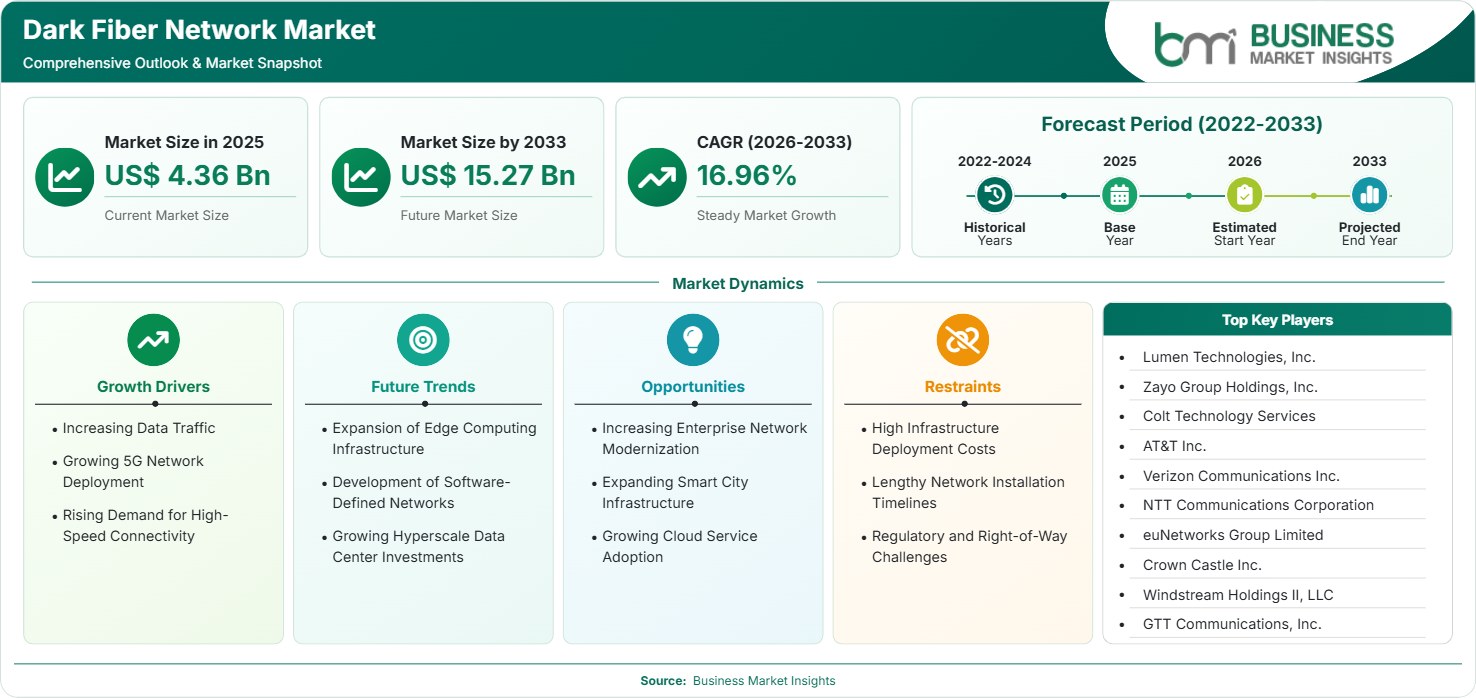
The Dark Fiber Network Market size was valued at US$ 4.36 Billion in 2025 and is projected to reach US$ 15.27 Billion by 2033, growing at a CAGR of 16.96% during 2026–2033, driven by rising data traffic, 5G deployment, cloud expansion, enterprise modernization, and smart infrastructure investments.

Report Coverage
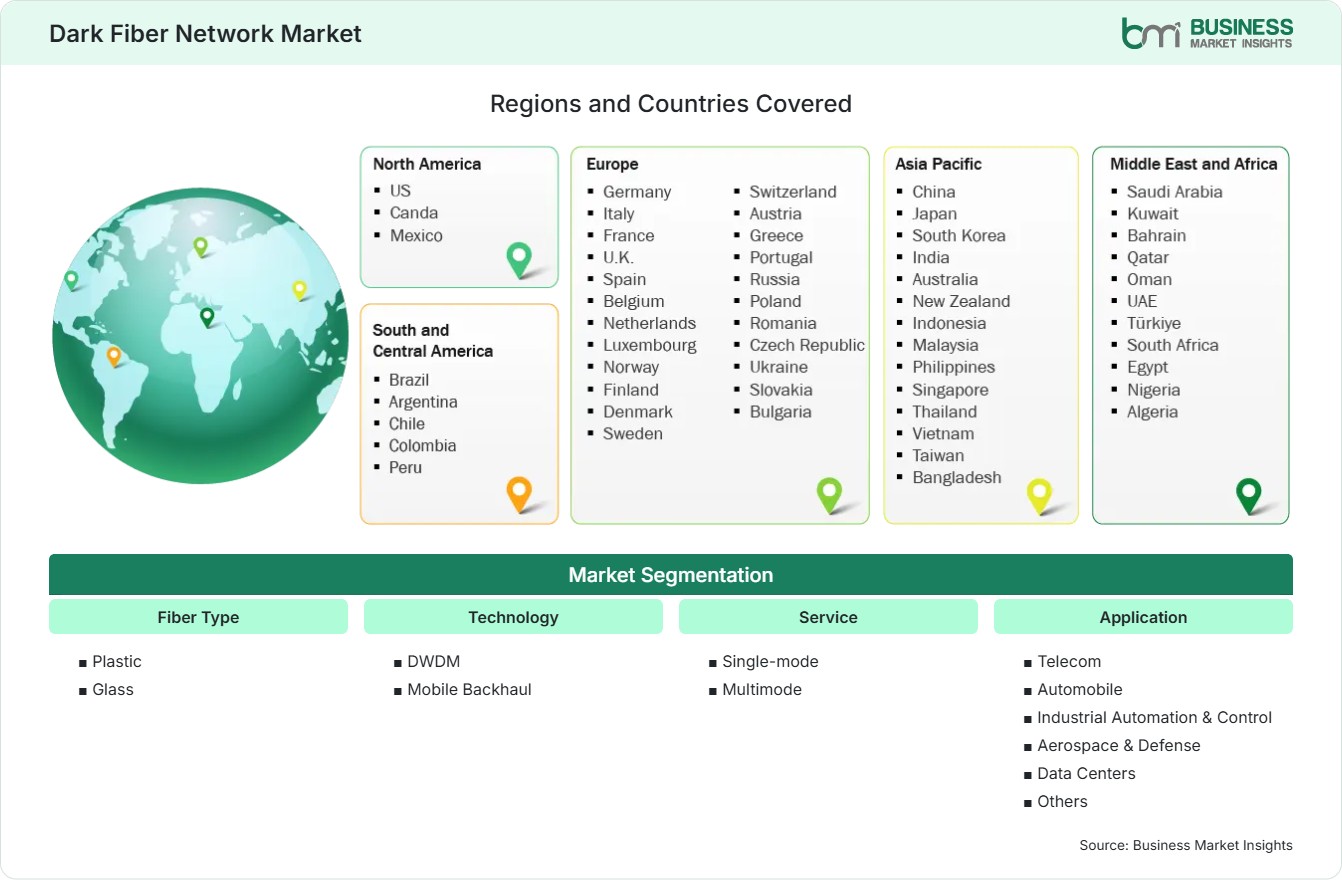
  • Fiber Type: Plastic, Glass
  • Technology: DWDM, Mobile Backhaul
  • Service: Single-mode, Multimode
  • Application: Telecom, Automobile, Industrial Automation & Control, Aerospace & Defense, Data Centers, Others
US$ 4.36 Bn Market size in 2025
US$ 15.27 Bn Market Size by 2033
16.96% CAGR, 2026 - 2033
2026-2033 Forecast Period

01 AI Overview

Dark Fiber Network Market Summary

  • North America Region: North America holds 34%–37% share in 2025, expanding at a CAGR of 15.8%–16.5%, supported by hyperscale data centers, enterprise connectivity upgrades, fiber infrastructure investments, and increasing demand for secure high-capacity networks. The U.S. market analysis indicates strong adoption through telecom modernization and cloud expansion, growing at a CAGR of 16.0%–16.6% during 2026–2033.
  • Fastest Growing Region: Asia Pacific accounts for 29%–32% share in 2025, growing at a CAGR of 18.2%–18.9%, driven by 5G expansion, digital transformation programs, smart cities, rising internet penetration, and increasing investments in advanced telecommunications infrastructure across developing economies.
  • Leading Segment: Data Centers represent 28%–31% share in 2025, growing at a CAGR of 17.5%–18.2%, supported by hyperscale facilities, artificial intelligence workloads, cloud computing expansion, and increasing demand for dedicated high-speed fiber connectivity solutions.
  • High Growth Segment: Mobile Backhaul technology represents 24%–27% share in 2025, expanding at a CAGR of 18.0%–18.7%, driven by 5G network deployment, increasing bandwidth requirements, low-latency communication needs, and telecom operator infrastructure upgrades.
  • Key Market Opportunity: Increasing enterprise digitization, artificial intelligence adoption, cloud migration, and edge computing expansion are creating opportunities for dark fiber deployment through private networks, scalable connectivity solutions, and long-term infrastructure partnerships.
  • Major Market Players: Lumen Technologies, Inc.; Zayo Group Holdings, Inc.; Colt Technology Services; AT&T Inc.; Verizon Communications Inc.; NTT Communications Corporation; euNetworks Group Limited; Crown Castle Inc.; Windstream Holdings II, LLC; GTT Communications, Inc.
02 Strategic Insights

Dark Fiber Network Market: Strategic Insights

Dark Fiber Network Market Strategic Framework
FREE PDF
Request your free sample
Request free sample
03 Stakeholder View

Key Takeaways

  • The market ecosystem is evolving from traditional telecom infrastructure toward flexible fiber ownership models, with infrastructure providers, network operators, cloud companies, and enterprises forming interconnected value chains to support scalable digital connectivity requirements.
  • Data centers, mobile backhaul, and enterprise networking applications represent major growth opportunities as organizations require dedicated bandwidth, reduced latency, and improved control over network performance for advanced digital operations.
  • Optical technologies such as dense wavelength division multiplexing and advanced fiber management platforms are transforming deployment strategies by enabling higher capacity transmission, improved efficiency, and optimized utilization of existing fiber assets.
  • Asia Pacific provides a compelling investment landscape due to rapid 5G adoption, expanding digital economies, large-scale data center investments, and government initiatives supporting next-generation communication infrastructure.
  • Strategic acquisitions, infrastructure partnerships, and network expansion investments are shaping competitive positioning as companies seek broader fiber footprints, stronger regional presence, and enhanced connectivity capabilities.
  • Enterprise demand for private networks is creating additional opportunities beyond traditional telecommunications, enabling industries such as manufacturing, automotive, defense, and automation to adopt dedicated fiber-based communication systems.
04 Geographic Outlook

Dark Fiber Network Market Regional Highlights

North America Dark Fiber Network Market

North America represented 34%–37% share in 2025 and is projected to grow at a CAGR of 15.8%–16.5% during 2026–2033. The region maintains leadership due to extensive fiber infrastructure, hyperscale data center expansion, enterprise network upgrades, and strong telecom investments. The Dark Fiber Network Market share is supported by increasing demand for secure connectivity, private networks, and high-bandwidth applications across cloud computing, financial services, healthcare, and government sectors.

  • The United States remains the dominant contributor due to large-scale data center deployments, telecom infrastructure modernization, and increasing enterprise adoption of dedicated fiber connectivity solutions for advanced applications.
  • Canada demonstrates steady growth through broadband expansion programs, smart city initiatives, and increasing investments in fiber-based infrastructure supporting digital transformation across commercial and public sector networks.
  • Major telecom operators are expanding fiber footprints to support 5G backhaul requirements, edge computing deployments, and increasing bandwidth consumption from cloud-based services and artificial intelligence applications.
  • Enterprise organizations are adopting dedicated fiber networks to improve security, reliability, and performance for mission-critical operations, supporting long-term demand across multiple industries.

US Dark Fiber Network Market

The United States Dark Fiber Network Market accounted for 82%–85% of North American revenue in 2025 and is expected to expand at a CAGR of 16.0%–16.6% through 2033. The country benefits from advanced fiber availability, growing private network deployments, and rising demand from enterprises seeking scalable connectivity solutions for digital transformation, automation, and high-performance computing environments.

  • Large technology companies and cloud service providers continue investing in data center networks, increasing demand for dedicated fiber infrastructure and high-capacity connectivity solutions.
  • Telecom operators are accelerating fiber deployment strategies to support 5G networks, edge computing platforms, and increasing bandwidth requirements from residential and enterprise users.
  • Industrial sectors are adopting private fiber networks to enhance operational reliability, cybersecurity, and real-time communication capabilities across manufacturing and automation environments.

Europe Dark Fiber Network Market

Europe accounted for 24%–27% Dark Fiber Network Market share in 2025 and is forecast to expand at a CAGR of 15.6%–16.3% during 2026–2033. Germany leads regional adoption, while the United Kingdom, France, and the Netherlands demonstrate strong growth through data center expansion, enterprise digitization, and increasing demand for high-speed network infrastructure.

  • Germany maintains a strong position through industrial automation adoption, enterprise connectivity requirements, and investments in advanced telecommunications infrastructure supporting Industry 4.0 applications.
  • The United Kingdom demonstrates growth through expanding cloud ecosystems, financial technology operations, and increasing demand for secure fiber connectivity across commercial sectors.
  • France continues developing fiber infrastructure through broadband initiatives, smart city programs, and increasing digital transformation activities among enterprises and public institutions.
  • The Netherlands benefits from strategic data center locations, international connectivity routes, and growing demand for high-capacity networks supporting digital services.

Asia Pacific Dark Fiber Network Market

Asia Pacific accounted for 29%–32% share in 2025 and is projected to register the fastest CAGR of 18.2%–18.9% during 2026–2033.China represents the largest market, while India, Japan, and Southeast Asian economies demonstrate increasing opportunities through smart city programs, cloud adoption, and enterprise network modernization.

  • China leads regional demand through extensive telecommunications infrastructure, large-scale data center development, and government initiatives supporting advanced digital connectivity networks.
  • India demonstrates strong growth potential due to increasing internet penetration, 5G expansion, digital economy initiatives, and rising enterprise demand for reliable network infrastructure.
  • Japan continues investing in high-performance communication systems, supporting applications including automation, robotics, artificial intelligence, and advanced industrial connectivity solutions.
  • Southeast Asian countries are increasing fiber investments as cloud providers, enterprises, and governments expand digital infrastructure capabilities across emerging economies.

Rest of World Dark Fiber Network Market

The Rest of World region represented 10%–12% share in 2025 and is anticipated to grow at a CAGR of 14.8%–15.5% through 2033. South and Central America are experiencing rising demand through broadband expansion, cloud adoption, and telecom modernization. Middle East and Africa markets are advancing through smart city projects, digital transformation initiatives, and investments in communication infrastructure.

  • Brazil is expanding fiber connectivity through telecom investments, increasing enterprise digitization, and growing demand for reliable broadband infrastructure.
  • Middle Eastern countries are investing in smart cities, government digitalization programs, and advanced telecommunications networks to support economic diversification strategies.
  • South Africa demonstrates rising adoption through data center expansion, improved connectivity infrastructure, and increasing demand from enterprise customers.
  • International connectivity projects are strengthening regional network capacity and creating opportunities for infrastructure providers and telecom operators.
  • Enterprise modernization initiatives are encouraging adoption of dedicated connectivity solutions across banking, manufacturing, and public sector applications.
Global Market Geography
FREE PDF
Request your free sample
Request free sample
05 Segment Analysis

Dark Fiber Network Market Segmentation

Fiber Type

The Fiber Type segment plays a critical role in determining network performance, scalability, and deployment flexibility. Glass fiber accounted for the leading share of 68%–72% in 2025 and is projected to grow at a CAGR of 17.2%–17.8% during 2026–2034, driven by superior transmission capacity, low signal loss, and suitability for long-distance communication infrastructure. The Dark Fiber Network Market scope continues expanding as enterprises and telecom operators prioritize high-capacity fiber solutions for cloud, edge computing, and next-generation connectivity requirements.

  • Plastic: Plastic fiber solutions support short-distance communication applications where flexibility, lightweight design, and cost efficiency are important. Adoption is increasing in specialized industrial environments, consumer applications, and localized networking systems requiring simplified installation approaches.
  • Glass: Glass fiber remains the preferred technology for backbone infrastructure due to exceptional bandwidth capabilities, durability, and compatibility with advanced optical transmission systems. Telecom operators and data centers increasingly deploy glass fiber for scalable connectivity.

Technology

The Technology segment defines network efficiency through advanced transmission capabilities and connectivity optimization. DWDM represented the dominant technology with a share of 62%–66% in 2025 and is expected to register a CAGR of 17.5%–18.0% during 2026–2034. Increasing bandwidth requirements, artificial intelligence workloads, and hyperscale data center expansion are strengthening adoption. The Dark Fiber Network Market trends indicate rising preference for technologies enabling multiple data channels over existing fiber infrastructure.

  • DWDM: Dense wavelength division multiplexing enables higher capacity utilization by transmitting multiple wavelengths through single fibers. Deployment is increasing among telecom operators and enterprises requiring scalable, high-performance communication networks.
  • Mobile Backhaul: Mobile backhaul solutions support increasing 5G network requirements by connecting cell sites with core networks. Growing wireless traffic and expanding mobile infrastructure are accelerating adoption among telecom providers.

Service

The Service segment influences deployment models based on bandwidth requirements, distance coverage, and application complexity. Single-mode fiber dominated with a share of 78%–82% in 2025 and is forecast to grow at a CAGR of 17.0%–17.6% during 2026–2034. Its ability to support long-distance transmission and high-speed communication makes it essential for telecom networks, data centers, and enterprise connectivity.

  • Single-mode: Single-mode fiber supports high-speed, long-distance communication with minimal signal attenuation. Telecom networks, cloud infrastructure, and large-scale enterprise connectivity projects increasingly rely on this solution for reliable performance.
  • Multimode: Multimode fiber is utilized for shorter-distance applications within campuses, buildings, and data centers. Cost advantages and easier deployment support continued adoption across localized networking environments.

Application

The Application segment demonstrates diversified adoption across telecommunications, industrial systems, and digital infrastructure sectors. Telecom applications accounted for the largest share of 31%–35% in 2025 and are expected to expand at a CAGR of 16.8%–17.4% during 2026–2034. Increasing network traffic, 5G expansion, and demand for dedicated connectivity are strengthening deployment. The Dark Fiber Network Market analysis highlights growing application diversity as enterprises adopt private fiber infrastructure.

  • Telecom: Telecom applications represent the core deployment area due to increasing bandwidth consumption, network upgrades, and demand for secure high-capacity communication infrastructure.
  • Automobile: Automotive applications are expanding through connected vehicles, autonomous driving technologies, and advanced manufacturing networks requiring reliable data transmission capabilities.
  • Industrial Automation & Control: Industrial users are adopting fiber networks for real-time monitoring, automation systems, and operational efficiency improvements across manufacturing environments.
  • Aerospace & Defense: Aerospace and defense organizations utilize dedicated fiber infrastructure for secure communication, mission-critical applications, and high-performance data exchange requirements.
  • Data Centers: Data centers are increasingly deploying fiber networks to support cloud services, artificial intelligence workloads, and high-speed interconnectivity between computing facilities.
06 Market Forces

Dark Fiber Network Market Dynamics

Key Market Drivers

Increasing Data Traffic

An increase in the demand for digital services, cloud computing, video-on-demand, and artificial intelligence services is causing an increase in the need for more bandwidth. Industry projections have indicated that global internet traffic keeps increasing each year owing to more data being generated by businesses and individuals. The growth of the Dark Fiber Network Market is being facilitated by the development of scalable fiber capacities in order to cope with the growing transmission needs. There is a rising need for low-latency communication networks as the result of increasing adoption of edge computing and high-performing applications.

Growing 5G Network Deployment

The expansion of 5G networks is accelerating demand for high-capacity backhaul infrastructure capable of supporting increased mobile data consumption and low-latency applications. Telecom operators are deploying fiber-based connectivity to connect base stations, edge locations, and core network systems. The Dark Fiber Network market is experiencing growth due to investments made towards setting up next generation mobile networks within developed and developing nations. Fiber networks help in improving network efficiency and also help in enhancing communication capabilities.

Rising Demand for High-Speed Connectivity

Increasing use of cloud computing, remote work, digital platform, and technology connectivity is resulting in rising need for fast and reliable communication networks. Businesses in financial services, health care, manufacturing, and government industry verticals require dedicated connectivity to facilitate critical business processes. Fiber-based network offers superior capabilities when compared to the conventional network options, such as higher bandwidth capacity, lower latency, and better reliability. Increased use of artificial intelligence, automation, and Internet of things applications is adding momentum to the demand for advanced communication network.

Key Market Opportunities

Increasing Enterprise Network Modernization

The companies are enhancing their existing communications infrastructure to embrace digital transformation, hybrid cloud systems, and innovative operations technology. Private fiber networks offer companies more control, better security, and scalability than shared connectivity services. Banks, manufacturing firms, hospitals, and government agencies are using more of the private fiber networks for essential operations. Dark Fiber Network Market Forecasts show high market opportunity due to the modernization programs in enterprises that want to have better connectivity for automation and artificial intelligence. Infrastructure companies can leverage the value created by custom-designed networks, lease options, and managed connectivity services.

Expanding Smart City Infrastructure

Smart city initiatives are creating opportunities for advanced fiber infrastructure deployment through connected transportation systems, surveillance networks, public services, and intelligent utility management. Governments worldwide are investing in digital infrastructure to improve urban efficiency and service delivery. The dark fiber network ensures that there is adequate capacity for communication in order to facilitate live data transfer from one connected device to the other in a city. New economies are increasingly making use of fiber communication in their urban development plans.

Growing Cloud Service Adoption

The rise in migration towards the use of cloud computing is boosting the need for dedicated connectivity solutions connecting enterprises, data centers, and cloud service providers. Enterprises need stable connectivity to facilitate cloud-based applications, artificial intelligence solutions, and distributed computing systems. The use of fiber connectivity offers an opportunity to enhance data transmission speeds, reduce latencies, and secure connections when conducting cloud-based activities. Hyperscale data centers are creating more demand for the provision of fiber connectivity solutions that offer high bandwidths.

Market Restraints and Challenges

High Infrastructure Deployment Costs

Factor: Significant capital requirements for fiber installation, trenching, maintenance, and network expansion increase financial barriers for infrastructure providers. Impact: High deployment costs can delay expansion projects, particularly in developing regions where investment availability is limited. Developing extensive fiber networks involves significant cost implications, as well as regulatory requirements and lengthy timelines. Despite the fact that fiber infrastructures have great longevity, the initial hurdles involved in implementing them could limit usage among smaller companies.

Lengthy Network Installation Timelines

Factor: Complex permitting processes, construction challenges, and geographic limitations can extend fiber deployment schedules. Impact: Longer installation timelines may delay connectivity expansion and increase project execution risks for operators. Urban congestion, regulatory issues, and environmental concerns can also pose extra problems for network construction. The company should coordinate with different parties such as municipal authorities and utility companies before deploying the networks. Such complexities may influence time schedules and business profits.

07 Company Analysis

Competitive Landscape

The Dark Fiber Network Market analysis indicates a competitive environment shaped by telecommunications companies, infrastructure providers, and connectivity specialists focusing on fiber expansion, network densification, and high-capacity communication solutions. Leading companies are investing in metropolitan fiber networks, data center connectivity, enterprise solutions, and long-term infrastructure partnerships to strengthen their market positions. Competitive strategies include network expansion, strategic collaborations, technology upgrades, and customized connectivity services.

Company Name

Overview

Products and Services relevant to this market

Lumen Technologies, Inc.

Lumen Technologies provides global communications infrastructure and operates extensive fiber networks supporting enterprise and telecom connectivity requirements.

Offers dark fiber solutions, wavelength services, dedicated connectivity, managed network solutions, and high-capacity fiber infrastructure for businesses.

Zayo Group Holdings, Inc.

Zayo Group specializes in fiber infrastructure services with extensive metropolitan and long-haul networks across major markets.

Provides dark fiber leasing, fiber transport, network connectivity, data center solutions, and enterprise communication infrastructure services.

Colt Technology Services

Colt Technology Services delivers high-performance digital infrastructure solutions focused on enterprises and financial service organizations globally.

Provides fiber connectivity, dedicated networks, optical solutions, Ethernet services, and data center interconnection capabilities.

AT&T Inc.

AT&T operates large-scale telecommunications infrastructure supporting broadband, enterprise networking, and advanced communication services.

Offers fiber networks, enterprise connectivity, dedicated internet access, managed services, and high-speed communication infrastructure solutions.

Verizon Communications Inc.

Verizon is a major telecommunications provider offering advanced networking solutions across consumer and enterprise markets.

Provides fiber connectivity, private networking, cloud connectivity, broadband infrastructure, and enterprise network services.

NTT Communications Corporation

NTT Communications delivers global ICT infrastructure solutions through extensive network assets and technology capabilities.

Provides optical networks, international fiber connectivity, data center interconnection, cloud networking, and managed communication services.

euNetworks Group Limited

euNetworks operates extensive fiber networks across European metropolitan areas and provides specialized connectivity solutions.

Offers dark fiber, customized fiber routes, cloud connectivity, data center access, and high-bandwidth enterprise solutions.

Crown Castle Inc.

Crown Castle develops shared communications infrastructure supporting wireless and fiber network expansion.

Provides fiber infrastructure, small cell connectivity, fiber solutions, and network support services for telecom operators and enterprises.

Windstream Holdings II, LLC

Windstream provides advanced communications services with fiber-based solutions supporting enterprise and residential connectivity needs.

Offers fiber broadband, dedicated internet services, dark fiber solutions, and managed network infrastructure for organizations.

GTT Communications, Inc.

GTT Communications delivers global network services focused on enterprise connectivity and international communications.

Provides fiber-based networking, internet transport, managed connectivity, and high-performance communication solutions.

10 Trust & Transparency

Research Methodology

The market analysis combines proprietary research with secondary data from government agencies, company disclosures, regulatory filings, industry databases and expert interviews. Market estimates are validated through data triangulation, cross-market benchmarking and analyst review.

View Full Research Methodology

11 Questions Answered

Frequently Asked Questions

5. What is covered in the Dark Fiber Network Market Report?

The report covers market size, regional trends, segmentation analysis, competitive landscape, growth factors, opportunities, challenges, and strategic developments influencing future industry expansion.

What role does private networking play in dark fiber adoption?

Private networking allows organizations to control bandwidth, security, and performance, making dark fiber solutions attractive for businesses requiring customized infrastructure for mission-critical applications.

Which industries are adopting dark fiber connectivity solutions?

Industries including telecommunications, finance, healthcare, manufacturing, aerospace, defense, and government are adopting dedicated fiber networks to support secure communication and advanced digital operations.

How do dark fiber networks support data center expansion?

Dark fiber networks enable direct, high-capacity connections between data centers, improving latency, reliability, and scalability for cloud providers, enterprises, and digital service platforms requiring efficient data exchange.

What factors are accelerating adoption of dark fiber networks?

The adoption of dark fiber networks is accelerating due to increasing bandwidth demand, cloud migration, 5G deployment, artificial intelligence applications, and enterprise requirements for secure, dedicated connectivity infrastructure.

Access the Full Dark Fiber Network Market Report

Get segment-level forecasts, regional estimates, competitive benchmarking, company profiles and downloadable Excel datasets.

Access the full Dark Fiber Network Market Report
350 pages PDF & Excel | 2026-08-12