Network Slicing Market Regional Highlights
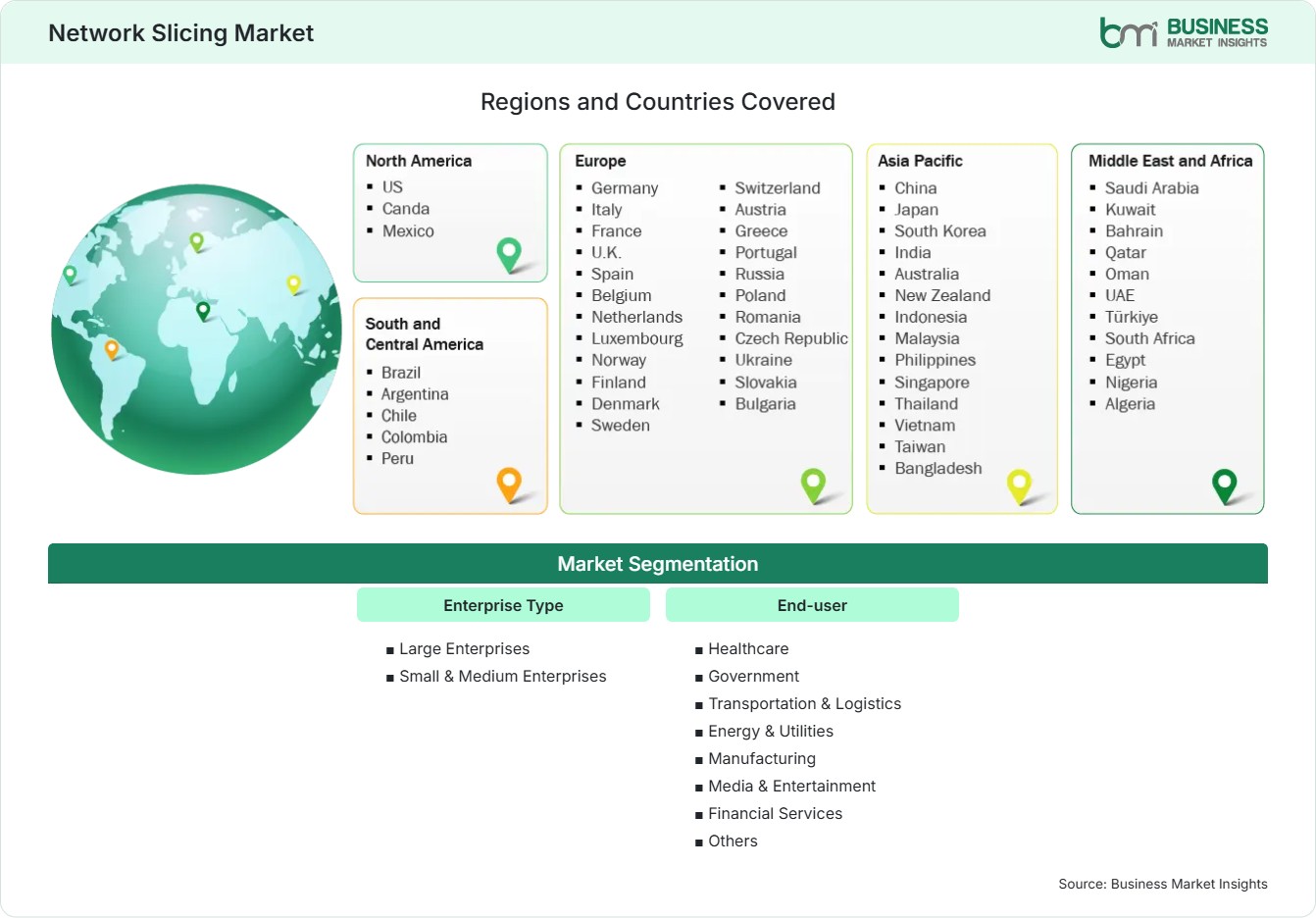
North America Network Slicing Market
North America represents 35%-37% share in 2025 and is projected to expand at 32%-35% CAGR through 2033. Early 5G standalone development, enterprise digitization, cloud adoption, and differentiated connectivity commercialization reinforce regional leadership.
- Enterprise buyers increasingly seek predictable connectivity for distributed operations, encouraging service models based on performance commitments rather than conventional bandwidth packages.
- Private 5G integration is creating hybrid architectures for factories, campuses, logistics facilities, healthcare environments, and public-sector applications requiring controlled network performance.
- Cloud-native orchestration is improving slice provisioning, lifecycle management, assurance, and integration across multiple network domains.
- Strong telecommunications, cloud, networking, software, and cybersecurity ecosystems support faster integration of slicing into broader enterprise infrastructure strategies.
US Network Slicing Market
The U.S. represents 64%-68% of North American demand in 2025 and is expected to grow at 32%-35% CAGR. Advanced mobile infrastructure, enterprise cloud migration, and private networking support adoption.
- Demand is strongest where connectivity performance directly influences operational outcomes, including public safety, healthcare, industrial facilities, logistics, and connected enterprise environments.
- Enterprises increasingly consider slicing alongside private networking when mobility, broad geographic coverage, or rapid service activation is more important than dedicated physical infrastructure.
- The mature technology ecosystem supports collaboration among operators, cloud platforms, application developers, integrators, and enterprise technology teams.
Europe Network Slicing Market
Europe holds 22%-24% Network Slicing Market share in 2025 and is projected to grow at 35%-38% CAGR. Germany, the United Kingdom, France, and Nordic markets provide attractive opportunities through industrial digitization and advanced connectivity.
- Germany offers strong opportunities through manufacturing modernization, robotics, industrial IoT, logistics automation, and connected production environments.
- The United Kingdom is developing differentiated connectivity applications around enterprise services, public infrastructure, mobility, and performance-sensitive digital workloads.
- France and Nordic markets benefit from sophisticated telecom ecosystems, private networking initiatives, and industrial automation requirements.
- European deployments increasingly emphasize interoperability, cybersecurity, lifecycle automation, service assurance, and cross-domain management.
Asia Pacific Network Slicing Market
Asia Pacific accounts for 26%-28% share in 2025 and is forecast to grow at 39%-42% CAGR, making it the fastest-growing region. China, Japan, South Korea, and India provide strong adoption foundations.
- China provides significant scale through advanced mobile infrastructure and industrial applications spanning manufacturing, logistics, smart infrastructure, and connected public services.
- Japan combines sophisticated enterprise technology adoption with private networking and industrial applications requiring controlled connectivity characteristics.
- South Korea benefits from advanced mobile infrastructure and demanding enterprise and consumer applications supporting premium connectivity development.
- India offers substantial long-term potential as 5G expansion, enterprise digitization, cloud adoption, and rising data requirements broaden demand for differentiated services.
Rest of World Network Slicing Market
Rest of World represents 14%-16% share in 2025 and is expected to expand at 34%-37% CAGR. South and Central America are developing gradually, while Gulf markets provide stronger near-term opportunities.
South and Central America are supported by 5G deployment, enterprise digitalization, smart logistics, and infrastructure modernization. Brazil and Mexico provide leading commercial bases, while Chile and Colombia offer opportunities across industrial and enterprise applications.
The Middle East and Africa show uneven adoption, although Saudi Arabia and the United Arab Emirates provide attractive opportunities through smart infrastructure, enterprise digitization, and advanced telecommunications. South Africa provides additional potential across industrial and public-sector applications.
- Brazil and Mexico are positioned around enterprise connectivity, logistics, industrial modernization, and expanding mobile infrastructure.
- Gulf economies are prioritizing smart infrastructure and digital transformation, supporting performance-assured connectivity for public and commercial applications.
- South Africa offers opportunities in mining, industrial operations, logistics, and public-sector connectivity where reliability can improve operational efficiency.
- Emerging markets remain sensitive to infrastructure economics, increasing interest in managed and shared connectivity models.