
Unified Communication Market Outlook: Size, Share, Trends, Growth Analysis, Competitive Landscape & Forecast, 2026-2033

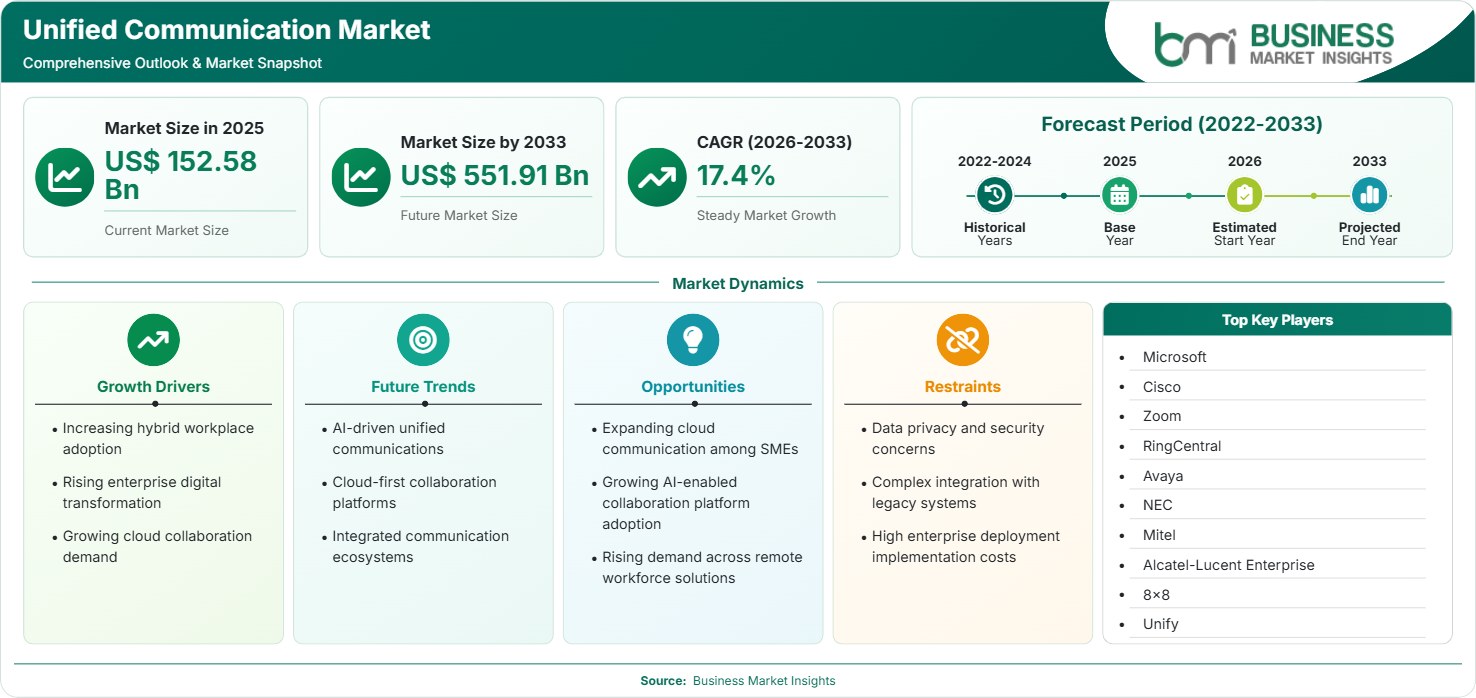
The Unified Communication Market size was valued at US$ 152.58 billion in 2025 and is projected to reach US$ 551.91 billion by 2033, growing at a CAGR of 17.4% from 2026 to 2033, driven by hybrid workplace adoption, enterprise digital transformation, cloud collaboration demand, AI-enabled communication platforms, SME adoption, and remote workforce solutions.

Report Coverage
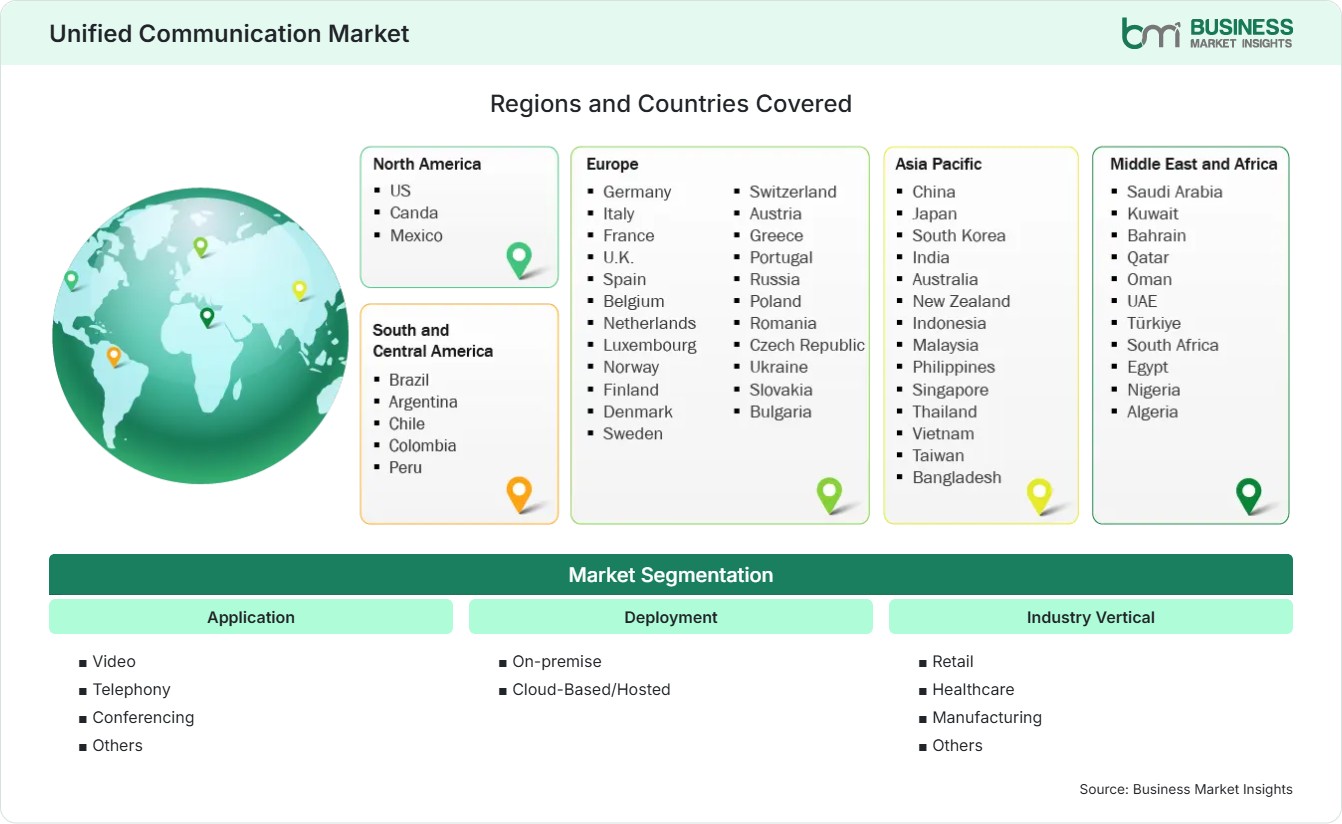
  • Application: Video, Telephony, Conferencing, Others
  • Deployment: On-premise, Cloud-Based/Hosted
  • Industry Vertical: Retail, Healthcare, Manufacturing, Others
US$ 152.58 Bn Market size in 2025
US$ 551.91 Bn Market Size by 2033
17.4% CAGR, 2026 - 2033
2026-2033 Forecast Period

AI Overview

Unified Communication Market Summary

  • North America Region: North America holds a market share of 38%–41% in 2025, growing with a CAGR of 15%–17%, influenced by enterprise cloud migration, hybrid work models, digital transformation initiatives, and advanced collaboration adoption. The US market expands with a CAGR of 15%–17% during 2026–2033, supported by enterprise communication modernization and cloud platform investments.
  • Fastest Growing Region: Asia Pacific represents a share range of 25%–28% in 2025, expanding with a CAGR of 19%–21% driven by digital workplace expansion, SME technology adoption, cloud infrastructure growth, and increasing remote collaboration requirements.
  • Leading Segment: Cloud-Based/Hosted Deployment represents the leading deployment segment with a share range of 62%–65% in 2025, growing at a CAGR of 18%–20% due to scalability, flexibility, and reduced infrastructure requirements.
  • High Growth Segment: Video Application demonstrates a share range of 32%–35% in 2025, expanding at a CAGR of 19%–21% due to virtual meetings, remote engagement, and enterprise collaboration requirements.
  • Key Market Opportunity: Growth opportunities are concentrated in AI-powered communication platforms, SME cloud adoption, remote workforce management, and integrated enterprise collaboration ecosystems.
  • Major Market Players: Microsoft, Cisco, Zoom, RingCentral, Avaya, NEC, Mitel, Alcatel-Lucent Enterprise, 8x8, Unify.
Strategic Insights

Unified Communication Market: Strategic Insights

Unified Communication Market Strategic Framework
FREE PDF
Request your free sample
Request free sample
Stakeholder View

Key Takeaways

  • The communication technology ecosystem is shifting toward cloud-first platforms integrating voice, video, messaging, and business applications.
  • SMEs represent a major growth opportunity as hosted communication platforms reduce infrastructure requirements and enable scalable collaboration.
  • Innovation priorities include AI assistants, intelligent meeting analytics, automated workflows, and enhanced cybersecurity capabilities.
  • Asia Pacific provides strong investment potential through digital transformation initiatives, expanding cloud adoption, and enterprise modernization.
  • Strategic partnerships between software providers, telecom operators, and enterprise technology companies are accelerating platform development.
Geographic Outlook

Unified Communication Market Regional Highlights

North America Unified Communication Market

North America accounted for a share range of 38%–41% in 2025 and is projected to grow at a CAGR of 15%–17% during 2026–2033. The region maintains its leadership position due to advanced cloud infrastructure, enterprise technology adoption, the expansion of hybrid work, and a strong presence of communication technology providers. The Unified Communication Market share in North America is driven by demand for secure, integrated collaboration platforms.

  • The United States remains the largest contributor due to enterprise digital transformation and widespread cloud collaboration adoption.
  • Organizations are upgrading communication systems to support flexible workforce structures and productivity improvements.
  • Technology companies are investing in AI-driven collaboration features and advanced security capabilities.
  • Enterprises are replacing traditional communication systems with scalable cloud-based solutions.

US Unified Communication Market

The US represented a share range of 34%–37% in 2025 and is expected to expand at a CAGR of 15%–17% between 2026 and 2033. The country remains a leading market due to strong enterprise software adoption, mature cloud infrastructure, and widespread hybrid workplace implementation. Demand is supported by organizations seeking integrated communication ecosystems and improved workforce connectivity.

  • Enterprises are adopting unified platforms to improve communication efficiency across distributed teams.
  • Cloud service adoption is increasing among businesses seeking a flexible communication infrastructure.
  • AI-enabled collaboration tools are gaining traction for productivity and workflow optimization.
  • Large enterprises are investing in secure communication solutions to support global operations.

Europe Unified Communication Market

Europe held a share range of 25%–28% in 2025, growing at a CAGR of 16%–18% during 2026–2033. The region benefits from increasing cloud adoption, enterprise modernization, and demand for secure digital communication platforms. Germany, the United Kingdom, and France represent leading markets, while Nordic countries demonstrate strong adoption through advanced digital workplace initiatives.

  • Germany supports growth through enterprise digitalization and industrial communication modernization.
  • The United Kingdom is expanding collaboration platform adoption across businesses and public organizations.
  • France is investing in cloud communication solutions for enterprise productivity improvements.
  • European organizations prioritize secure platforms aligned with regional data protection requirements.

Asia Pacific Unified Communication Market

Asia Pacific accounted for a share range of 25%–28% in 2025 and is expanding at a CAGR of 19%–21% during 2026–2033. The region represents the fastest-growing market due to expanding cloud adoption, increasing enterprise digitalization, growing SME technology investments, and rising remote workforce requirements. China, India, Japan, South Korea, and Southeast Asian economies are driving regional demand through the modernization of communication infrastructure.

  • China is expanding adoption through enterprise cloud migration, digital workplace initiatives, and technology infrastructure development.
  • India is experiencing strong demand due to SME digital transformation and increasing remote collaboration requirements.
  • Japan and South Korea are adopting advanced communication platforms through enterprise automation and productivity initiatives.
  • Southeast Asian markets are increasing investments in cloud-based collaboration systems and digital business solutions.

Rest of World Unified Communication Market

The rest of the world accounted for 6%–9% in 2025, growing at a CAGR of 17%–19% during 2026–2033. Latin America, the Middle East, and Africa are adopting unified communication solutions through cloud infrastructure development, enterprise modernization, and expanding digital services. Brazil, Mexico, the UAE, and Saudi Arabia are emerging markets supported by investments in business technology and the adoption of remote work.

  • Brazil is increasing communication platform adoption through enterprise digitalization and cloud technology investments.
  • Mexico is expanding usage across businesses requiring scalable collaboration and workforce connectivity solutions.
  • Middle Eastern countries are investing in digital transformation programs and enterprise communication modernization.
  • African markets are gradually adopting cloud collaboration platforms through improved technology infrastructure.
Global Market Geography
FREE PDF
Request your free sample
Request free sample
Segment Analysis

Unified Communication Market Segmentation

Application

The application segment is driven by increasing enterprise requirements for integrated communication, productivity improvement, and workforce connectivity. Video applications were the leading application segment, with a share of 32%–35% in 2025 and a CAGR of 19%–21% between 2026 and 2033. The Unified Communication Market's scope is expanding due to increased adoption of video collaboration, business conferencing, and digital workplace solutions.

  • Video: Video communication is expanding due to hybrid work models, virtual meetings, customer engagement requirements, and remote collaboration needs.
  • Telephony: Telephony solutions remain essential for enterprise communication through cloud calling, VoIP adoption, and integrated business communication platforms.
  • Conferencing: Conferencing applications support organizational collaboration through virtual meetings, team coordination, and global workforce connectivity.

Deployment

The deployment segment reflects enterprise preference for scalable, flexible, and cost-efficient communication infrastructure. Cloud-Based/Hosted deployment represents the dominant segment due to reduced hardware requirements, simplified management, and rapid scalability. Organizations are increasingly transitioning from traditional communication systems toward hosted platforms that support distributed teams and digital business operations.

  • On-premise: On-premises solutions continue serving enterprises requiring direct infrastructure control, customized configurations, and specific security management approaches.
  • Cloud-Based/Hosted: Cloud-based platforms are gaining adoption through scalability, lower maintenance requirements, flexible pricing models, and faster enterprise deployment.

Industry Vertical

The industry vertical segment is expanding as organizations across multiple sectors adopt digital collaboration technologies to improve operational efficiency. The retail, healthcare, and manufacturing industries are increasingly adopting communication platforms to support distributed operations and customer engagement. Enterprise demand is increasing for secure, integrated solutions that connect employees, customers, and business systems.

  • Retail: Retail organizations adopt communication platforms to improve customer service, employee coordination, and multi-location operational management.
  • Healthcare: Healthcare providers use unified communication solutions for remote consultations, care coordination, and secure information exchange.
  • Manufacturing: Manufacturing companies implement collaboration platforms to connect operational teams, improve workflows, and support distributed production environments.
Market Forces

Unified Communication Market Dynamics

Key Market Drivers

Increasing Hybrid Workplace Adoption

The expansion of hybrid workplace models is a major driver supporting communication platform adoption as organizations require seamless connectivity between office-based and remote employees. The Unified Communication Market growth is supported by increasing demand for integrated voice, video, messaging, and collaboration tools. Firms are designing their workplace strategies with flexibility, productivity, and employee engagement in mind. These communication systems allow team collaboration irrespective of the location, along with ensuring consistency in operations. Organizations are adopting systems that offer a seamless experience across devices and environments. As firms adopt a flexible work structure, they are shifting from disparate communication systems to more integrated ones.

Rising Enterprise Digital Transformation

Enterprise digital transformation initiatives are accelerating the adoption of unified communication solutions as organizations modernize their technology infrastructure and improve operational efficiency. The Unified Communication Market trends are influenced by increasing investments in cloud platforms, automation, and integrated business applications. Organizations are looking for communication solutions that integrate their staff, clients, and processes into a single platform. Digital transformation efforts are now incorporating collaboration solutions as key parts of their operations. Organizations are embracing new communication solutions to help them make better decisions and be more productive and customer-friendly. Technology vendors are also providing advanced solutions, such as artificial intelligence and analytics, for enterprise communications.

Growing Cloud Collaboration Demand

The growing need for cloud collaboration services will further propel market growth, as enterprises increasingly demand a communication infrastructure that is not dependent on hardware. There are benefits to using cloud-based platforms, such as scalability, speed, and easier management than conventional systems. Enterprises operating across multiple sites are now turning to hosted platforms to establish communication channels within their workforces. The move towards software-based communication systems is driving organizations to incorporate collaboration capabilities into their business applications. Vendors have developed platforms incorporating enhanced security, automation, and interoperability capabilities to meet enterprise needs.

Key Market Opportunities

Expanding Cloud Communication Among SMEs

Another area with considerable opportunities is small and medium-sized enterprises, as the availability of cloud-based communication platforms enables companies to tap into advanced collaboration features without requiring major infrastructure investments. The use of hosted systems by SMEs to improve efficiency, customer interaction, and team connectivity has become more common in recent times. With cloud-based systems, companies can scale up their communication services as needed while keeping maintenance simple. Expansion of cloud communication services into underserved business segments is expected to support the unified communication market forecast.

Growing AI-Enabled Collaboration Platform Adoption

AI-enabled collaboration platforms are creating opportunities by improving communication efficiency through automation, intelligent assistants, meeting analysis, and workflow optimization. Organizations are increasingly exploring artificial intelligence features that enhance productivity and reduce administrative tasks. AI capabilities such as automated summaries, smart scheduling, and real-time assistance are becoming important differentiators among communication providers. Enterprises are seeking platforms that can integrate AI tools while maintaining security and compliance standards. Technology companies are investing in intelligent communication features to strengthen competitiveness. Continued development of enterprise AI applications is expected to create new opportunities for unified communication solution providers.

Rising Demand Across Remote Workforce Solutions

Remote workforce expansion is creating opportunities for communication providers, as businesses require reliable platforms to support geographically distributed employees. Organizations are investing in solutions that enable collaboration, knowledge sharing, and real-time communication regardless of location. Unified platforms help businesses maintain productivity while supporting flexible work arrangements. Demand is increasing across industries with global operations, including technology, professional services, healthcare, and finance. Providers offering secure, scalable, and integrated remote communication solutions can benefit from this shift. Continued workforce flexibility trends are expected to sustain demand for advanced collaboration platforms.

Market Restraints and Challenges

Data Privacy and Security Concerns

Factor: Unified communication platforms manage sensitive business conversations, customer information, and organizational data across multiple channels, increasing exposure to cybersecurity risks.

Impact: Concerns related to data breaches, unauthorized access, compliance requirements, and privacy regulations can delay adoption among enterprises handling confidential information. Organizations must evaluate security capabilities, encryption standards, identity management systems, and regulatory compliance before deployment. Communication providers are investing in advanced security frameworks, threat detection technologies, and governance features to address these challenges. However, enterprises operating in highly regulated sectors may require additional validation before migrating critical communication activities to cloud environments. Security considerations remain an important factor influencing technology selection decisions.

Complex Integration with Legacy Systems

Factor: Many enterprises continue operating with traditional communication infrastructure, creating technical challenges when integrating modern unified platforms with existing systems.

Impact: Complex migration processes, compatibility issues, and implementation requirements can increase deployment timelines and operational costs. Organizations may require customized integration solutions to connect communication platforms with business applications, customer relationship management systems, and existing workflows. Technology providers are developing interoperability tools and migration services to simplify adoption. However, businesses with extensive legacy infrastructure may experience slower transition rates compared with cloud-native organizations. Successful deployment depends on effective planning, technical expertise, and integration strategies that minimize operational disruption.

Company Analysis

Competitive Landscape

The Unified Communication Market analysis highlights a competitive environment shaped by cloud innovation, artificial intelligence integration, cybersecurity capabilities, and enterprise collaboration requirements. Leading companies are focusing on scalable platforms, ecosystem partnerships, automation features, and enhanced user experiences to strengthen their market positions.

Company Name

Overview

Products and Services relevant to this market

Microsoft

Technology company providing enterprise software and collaboration solutions.

Teams platform, cloud communication, collaboration services, enterprise productivity tools.

Cisco

Networking and communication technology provider serving global enterprises.

Webex, collaboration platforms, video conferencing, communication solutions.

Zoom

Communication technology company focused on video collaboration.

Video meetings, unified communication platforms, cloud collaboration services.

RingCentral

Cloud communication provider supporting business collaboration.

UCaaS platforms, cloud telephony, messaging, video solutions.

Avaya

Enterprise communication technology provider with global operations.

Business communication systems, contact center, collaboration platforms.

NEC

Technology company providing communication and IT solutions.

Enterprise communication systems, collaboration solutions, digital platforms.

Mitel

Communication solutions provider for businesses and organizations.

Unified communication platforms, cloud collaboration, business telephony.

Alcatel-Lucent Enterprise

Enterprise networking and communication technology company.

Communication platforms, cloud collaboration, business networking solutions.

8x8

Cloud communication and customer engagement technology provider.

UCaaS platforms, video meetings, cloud contact center solutions.

Unify

Enterprise communication solutions provider.

Collaboration platforms, business communication systems, workplace solutions.

Industry Activity

Recent Developments

June 2026

BluIP announced an expanded go-to-market partnership with NICE to deliver an integrated UCaaS and CCaaS solution. The collaboration combines BluIP’s cloud PBX capabilities with NICE CXone, enabling enterprises to modernize communications and integrate AI-powered customer engagement capabilities.

March 2026

e& and Telavox announced a strategic UCaaS partnership in the UAE to provide an AI-powered cloud-native unified communications platform for businesses. The solution combines Telavox’s UCaaS capabilities with e&’s enterprise connectivity services to support B2B communication modernization.

January 2026

FirstComm launched AscendOne, a unified communications platform combining voice, messaging, meetings, contact center, and AI-powered productivity tools. The platform was developed with Intermedia Intelligent Communications, a strategic technology partner, to help businesses modernize communication workflows.

January 2025

CallTower acquired Inoria, a Genesys-focused Contact Center as a Service (CCaaS) provider and managed services company. The acquisition expanded CallTower’s unified communications and customer experience capabilities by strengthening its UCaaS and CCaaS offerings for global customers.

Trust & Transparency

Research Methodology

The market analysis combines proprietary research with secondary data from government agencies, company disclosures, regulatory filings, industry databases and expert interviews. Market estimates are validated through data triangulation, cross-market benchmarking and analyst review.

View Full Research Methodology

Questions Answered

Frequently Asked Questions

How does the Unified Communication Market Report support business decisions?

The market report provides insights into technology trends, competitive strategies, regional opportunities, market segments, and future investment areas.

Which industries benefit most from unified communication adoption?

Retail, healthcare, manufacturing, technology, financial services, and professional services sectors increasingly use communication platforms for improved connectivity.

How is artificial intelligence influencing communication platforms?

AI is improving collaboration through intelligent assistants, automated meeting summaries, workflow automation, analytics, and enhanced user productivity features.

Why are enterprises shifting toward cloud-based communication platforms?

Cloud platforms provide scalability, reduced infrastructure requirements, flexible deployment, and easier management compared with traditional communication systems.

What factors are driving the adoption of the unified communication market?

Hybrid work models, enterprise digital transformation, cloud migration, and demand for integrated collaboration tools are major factors accelerating adoption across industries.

Access the Full Unified Communication Market Report

Get segment-level forecasts, regional estimates, competitive benchmarking, company profiles and downloadable Excel datasets.

Access the full Unified Communication Market Report
350 pages PDF & Excel | 2026-07-31