
Maritime Satellite Communication Market Outlook: Size, Share, Trends, Growth Analysis, Competitive Landscape & Forecast, 2026-2033

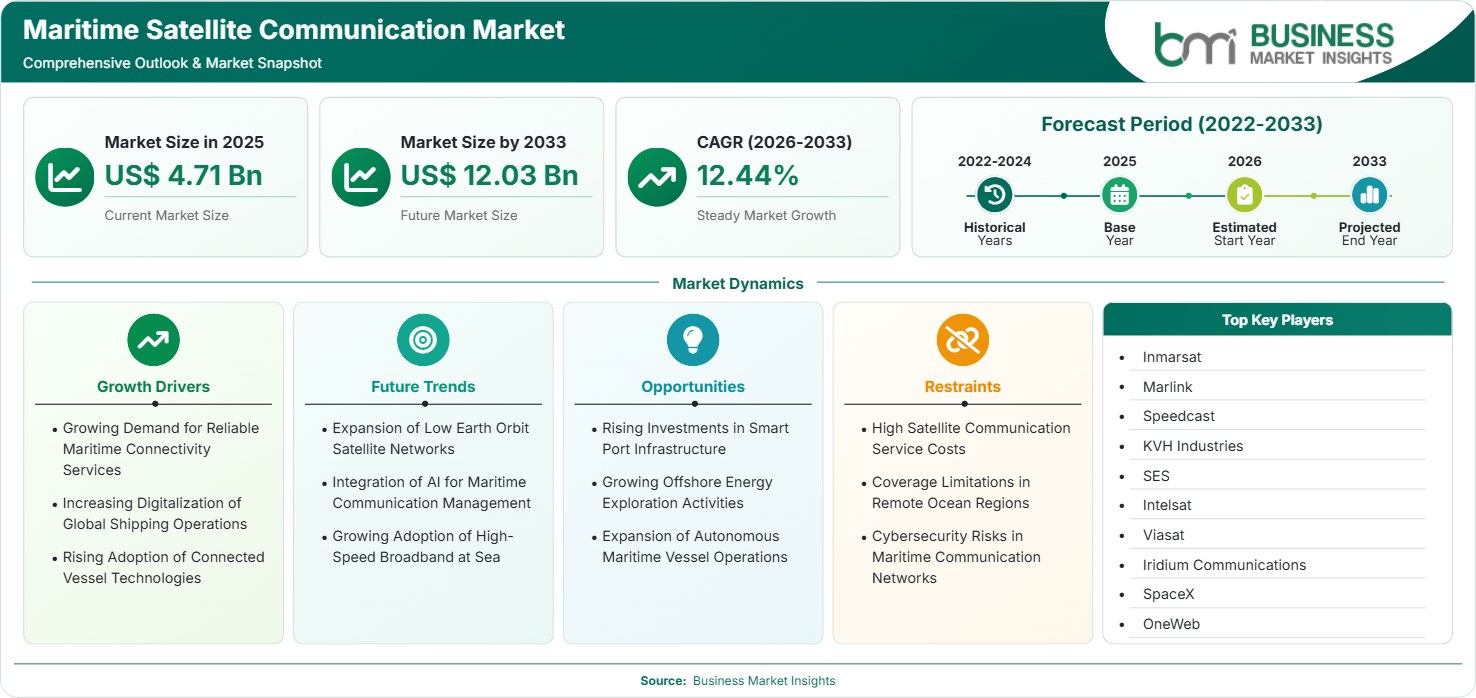
The Maritime Satellite Communication Market size was valued at US$ 4.71 billion in 2025 and is projected to reach US$ 12.03 billion by 2033, growing at a CAGR of US$ 12.44% during 2026–2033, driven by connected vessel adoption, maritime digitization, fleet optimization, and opportunities from autonomous shipping technologies.

Report Coverage
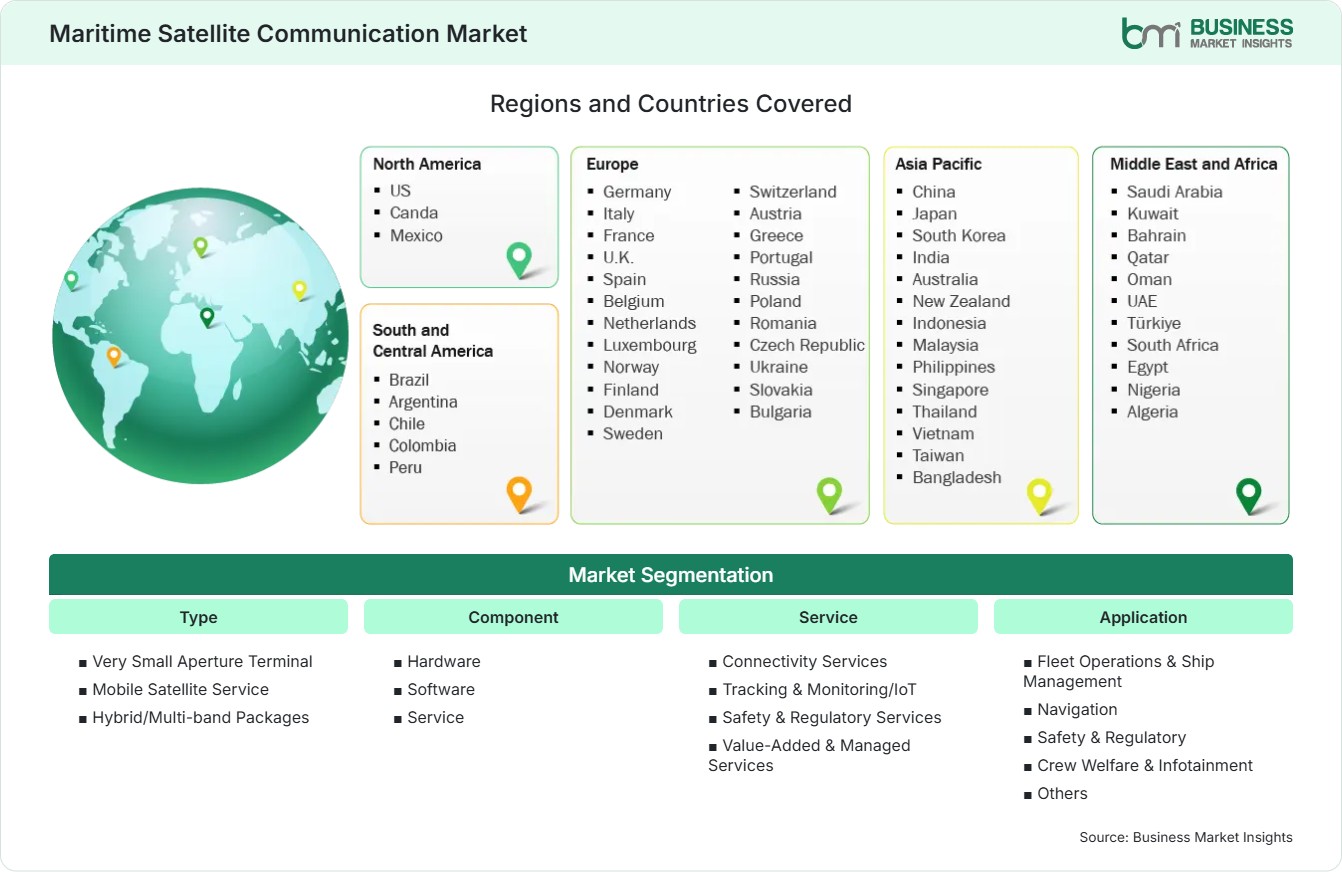
  • Type: Very Small Aperture Terminal, Mobile Satellite Service, Hybrid/Multi-band Packages
  • Component: Hardware, Software, Service
  • Service: Connectivity Services, Tracking & Monitoring/IoT, Safety & Regulatory Services, Value-Added & Managed Services
  • Application: Fleet Operations & Ship Management, Navigation, Safety & Regulatory, Crew Welfare & Infotainment, Others
  • End User: Merchant/Commercial Shipping, Passenger & Leisure, Offshore Energy, Fishing Fleets, Government & Defense, Others
US$ 4.71 Bn Market size in 2025
US$ 12.03 Bn Market Size by 2033
12.44% CAGR, 2026 - 2033
2026-2033 Forecast Period

01 AI Overview

Maritime Satellite Communication Market Summary

  • North America Region: North America holds a 32%–35% share in 2025, growing with a CAGR of 11.5%–12.5%, influenced by commercial fleet modernization, defense connectivity, and offshore operations. The US market shows strong adoption of maritime communication, expanding at a CAGR of 11.8%–12.8% through 2033 due to advanced satellite infrastructure.
  • Fastest Growing Region: Asia Pacific holds a 28%–31% share in 2025, growing with a CAGR of 13.0%–14.0%, supported by expanding shipping fleets, port modernization, maritime trade growth, and increasing satellite connectivity requirements.
  • Leading Segment: Very Small Aperture Terminal (VSAT) (Broadband) holds a 45%–48% share in 2025, growing with a CAGR of 12.5%–13.5% driven by high-speed connectivity demand, fleet management applications, and broadband communication requirements.
  • High Growth Segment: Tracking & Monitoring/IoT services hold a 22%–25% share in 2025, growing with a CAGR of 14.0%–15.0% supported by vessel monitoring, operational analytics, asset tracking, and connected maritime technology deployment.
  • Key Market Opportunity: Expansion of smart ports, autonomous vessels, offshore energy projects, and integrated maritime digital platforms creates opportunities for satellite providers delivering reliable connectivity across commercial and remote ocean environments.
  • Major Market Players: Inmarsat, Marlink, Speedcast, KVH Industries, SES, Intelsat, Viasat, Iridium Communications, SpaceX, OneWeb.
02 Strategic Insights

Maritime Satellite Communication Market: Strategic Insights

Maritime Satellite Communication Market Strategic Framework
FREE PDF
Request your free sample
Request free sample
03 Stakeholder View

Key Takeaways

  • The market ecosystem is evolving from traditional ship communication systems toward integrated connectivity platforms combining satellite networks, IoT applications, fleet management tools, and operational analytics for maritime stakeholders.
  • High-growth opportunities are emerging in broadband VSAT services, vessel tracking solutions, and managed connectivity offerings as shipping companies prioritize real-time operational visibility and improved fleet efficiency.
  • Technology innovation is focused on multi-orbit satellite networks, high-throughput connectivity, artificial intelligence-enabled analytics, and hybrid communication architectures designed to improve maritime reliability.
  • Asia Pacific represents a strategic investment opportunity due to expanding commercial fleets, increasing maritime trade activity, and modernization initiatives across major shipping economies including China, India, Japan, and Singapore.
  • Industry consolidation is progressing through partnerships between satellite operators, connectivity providers, and maritime technology companies seeking broader coverage, improved service capabilities, and integrated digital solutions.
04 Geographic Outlook

Maritime Satellite Communication Market Regional Highlights

North America Maritime Satellite Communication Market

North America accounted for a 32%–35% share in 2025 and is projected to expand at a CAGR of 11.5%–12.5% from 2026–2033. The region benefits from advanced maritime infrastructure, defense applications, offshore activities, and commercial shipping connectivity requirements. The Maritime Satellite Communication Market share remains concentrated in the US, supported by strong satellite service providers and fleet modernization initiatives.

  • Commercial shipping operators are investing in broadband connectivity solutions to improve vessel operations, communication reliability, and crew welfare services.
  • Defense and government maritime programs are supporting demand for secure satellite communication networks and advanced connectivity capabilities.
  • Offshore energy activities are increasing adoption of reliable communication systems for remote platforms and maritime operational coordination.
  • Technology providers are expanding hybrid connectivity solutions combining satellite networks with terrestrial communication infrastructure.

US Maritime Satellite Communication Market

The US Maritime Satellite Communication Market represented a 27%–30% share in 2025 and is expected to grow at a CAGR of 11.8%–12.8% during 2026–2033. The country remains a major market due to commercial shipping activity, defense investments, offshore energy operations, and advanced satellite communication infrastructure supporting maritime connectivity requirements.

  • Maritime operators are adopting high-throughput satellite services to support digital vessel management and operational data exchange.
  • Government and defense agencies are increasing investments in secure communication networks for maritime surveillance and mission support.
  • Offshore oil and gas activities require dependable connectivity solutions for remote platforms and operational safety requirements.
  • Fleet operators are integrating IoT-enabled monitoring systems to improve asset tracking and performance management.

Europe Maritime Satellite Communication Market

Europe held a 25%–28% share in 2025 and is forecast to register a CAGR of 11.0%–12.0% between 2026–2033. Germany, Norway, the UK, and Denmark represent leading markets due to strong maritime industries, offshore activities, and regulatory emphasis on vessel safety. Digital shipping initiatives are supporting regional communication technology adoption.

  • Norway is expanding maritime connectivity adoption through offshore energy operations, shipping expertise, and advanced vessel technology deployment.
  • Germany is investing in smart shipping solutions supporting commercial fleets, logistics networks, and maritime automation initiatives.
  • The UK market benefits from offshore industries and demand for reliable communication services across maritime operations.
  • European regulations focused on safety, tracking, and environmental monitoring are encouraging connectivity upgrades.

Asia Pacific Maritime Satellite Communication Market

Asia Pacific represented a 28%–31% share in 2025 and is expected to achieve a CAGR of 13.0%–14.0% through 2033, making it the fastest-growing region. China, Japan, India, and Singapore are major contributors due to expanding maritime trade, port modernization, and fleet digitization. The Maritime Satellite Communication Market growth is supported by increasing connectivity requirements.

  • China is advancing adoption through large commercial fleets, smart port development, and investments in maritime digital infrastructure.
  • India is experiencing rising demand due to shipping expansion, coastal development programs, and offshore connectivity requirements.
  • Japan and South Korea are adopting advanced communication systems for technology-driven shipping operations.
  • Singapore is strengthening maritime connectivity through smart port initiatives and digital shipping ecosystem development.

Rest of World Maritime Satellite Communication Market

The rest of the world accounted for a 7%–10% share in 2025 and is projected to grow at a CAGR of 10.0%–11.0% during 2026–2033. South America, the Middle East, and Africa are adopting satellite communication solutions through offshore energy expansion, commercial shipping growth, and maritime infrastructure development. Brazil, UAE, and Saudi Arabia represent important growth markets.

  • Brazil is increasing adoption through offshore energy activities, shipping operations, and expanding maritime logistics requirements.
  • Middle Eastern countries are deploying advanced connectivity systems for offshore projects and maritime trade infrastructure.
  • Saudi Arabia and UAE investments in ports and energy sectors are supporting satellite communication demand.
  • African maritime markets are gradually expanding through improved connectivity access, shipping development, and offshore resource activities.
Global Market Geography
FREE PDF
Request your free sample
Request free sample
05 Segment Analysis

Maritime Satellite Communication Market Segmentation

Type

The Type segment represents a critical structure within the market, with VSAT broadband solutions maintaining leadership due to high-speed connectivity needs across commercial vessels. This segment held a 45%–48% share in 2025 and is projected to grow at a CAGR of 12.5%–13.5% between 2026–2034. The Maritime Satellite Communication Market scope continues expanding through hybrid networks, maritime IoT adoption, and increasing requirements for reliable ship-to-shore communication.

  • Very Small Aperture Terminal (VSAT) (Broadband): VSAT broadband systems provide high-speed internet, operational connectivity, and crew communication capabilities, supporting commercial fleets, offshore platforms, and advanced maritime applications.
  • Mobile Satellite Service (MSS): MSS solutions enable dependable voice, messaging, and data communication for vessels requiring consistent connectivity across remote ocean routes and challenging maritime environments.
  • Hybrid/Multi-band Packages: Hybrid packages combine multiple satellite bands and communication technologies, allowing operators to optimize performance, coverage, reliability, and operational costs across diverse vessel requirements.

Component

The Component segment is driven by increasing integration of advanced communication infrastructure, software platforms, and managed connectivity solutions. The segment accounted for a 30%–33% share in 2025 and is estimated to expand at a CAGR of 11.8%–12.8% from 2026–2034. Hardware modernization, software intelligence, and service-based models are strengthening adoption among shipping operators seeking scalable maritime connectivity solutions.

  • Hardware: Hardware components include antennas, terminals, modems, and onboard communication equipment supporting satellite connectivity deployment across commercial and specialized maritime vessels.
  • Software: Software platforms enable network management, analytics, cybersecurity monitoring, and operational optimization for connected vessels using advanced satellite communication systems.
  • Service: Service offerings provide connectivity management, technical support, and customized communication solutions that improve operational continuity and simplify maritime network administration.

Service

The Service segment is expanding through growing demand for managed connectivity, vessel monitoring, and regulatory compliance solutions. This segment represented a 35%–38% share in 2025 and is expected to achieve a CAGR of 12.0%–13.0% between 2026–2034. The Maritime Satellite Communication market trends indicate an increasing preference for integrated services combining connectivity, analytics, safety, and operational support.

  • Connectivity Services: Connectivity services deliver internet access, data exchange, and communication capabilities required for fleet operations, navigation support, and crew welfare applications.
  • Tracking & Monitoring/IoT: Tracking and monitoring solutions enable real-time vessel visibility, asset management, route optimization, and operational analytics through connected maritime technologies.
  • Safety & Regulatory Services: Safety services support emergency communication, compliance requirements, navigation assistance, and maritime regulations through reliable satellite-based communication systems.
  • Value-Added & Managed Services: Managed services provide customized solutions including cybersecurity, network optimization, analytics, and technical management for complex maritime communication environments.

Application

The Application segment reflects increasing digitalization across maritime operations, with fleet management and ship operations representing major adoption areas. The segment held a 40%–43% share in 2025 and is projected to grow at a CAGR of 12.2%–13.2% through 2034. Growing automation, safety requirements, and connected vessel technologies are driving broader application deployment.

  • Fleet Operations & Ship Management: Solutions support vessel tracking, operational monitoring, maintenance planning, and communication between ships and shore-based management teams.
  • Navigation, Safety & Regulatory: Applications improve navigation accuracy, emergency response capabilities, compliance reporting, and maritime safety through continuous satellite connectivity.
  • Crew Welfare & Infotainment: Services enhance onboard communication, entertainment access, and internet availability, improving crew satisfaction during extended maritime operations.

End User

The End User segment is influenced by expanding maritime trade, offshore activities, and defense communication requirements. The segment accounted for a 50%–53% share in 2025 and is expected to grow at a CAGR of 11.5%–12.5% during 2026–2034. Diverse vessel categories are adopting advanced connectivity solutions to improve operational performance and safety standards.

  • Merchant/Commercial Shipping: Commercial shipping operators adopt satellite communication for fleet coordination, navigation support, cargo monitoring, and operational efficiency improvements.
  • Passenger & Leisure: Passenger vessels utilize connectivity solutions for guest services, entertainment platforms, safety communication, and enhanced onboard experiences.
  • Offshore Energy: Offshore operators require dependable communication networks for platform operations, remote monitoring, workforce coordination, and safety management.
  • Fishing Fleets: Fishing fleets use satellite systems for vessel tracking, navigation assistance, weather updates, and improved operational planning.
  • Government & Defense: Government and defense users deploy secure communication solutions for surveillance, maritime security, mission coordination, and strategic operations.
06 Market Forces

Maritime Satellite Communication Market Dynamics

Key Market Drivers

Growing Demand for Reliable Maritime Connectivity Services

The maritime satellite communication market trend is driven by the increased need for continuous connectivity among commercial ships, offshore structures, and government vessels. In light of the importance of digital communication systems recognized by the International Maritime Organization, global shipping companies are implementing satellite-based connectivity to enhance navigation, tracking, and communication between vessels. Trends in Maritime Satellite Communication include the growing adoption of high-throughput satellites, multi-band services, and managed connectivity services that offer seamless connectivity in remote oceans. Expansion of maritime trade and digitalization are driving demand for communication infrastructure.

Increasing Digitalization of Global Shipping Operations

Digital transformation within shipping processes is driving the use of connected vessels and cloud-based fleet management and analysis systems. Shipping firms are using satellite communication networks to enhance routing, improve fuel efficiency, monitor cargoes, and maintain schedules. The growing need for electronic navigation systems and automated reports is driving demand for connectivity solutions. There is growing pressure for greater operational transparency and reduced downtime for vessels, thereby driving shipping firms to establish communication networks to support data-driven maritime applications.

Rising Adoption of Connected Vessel Technologies

Connected vessel technologies are becoming a major driver as maritime operators deploy IoT sensors, remote monitoring systems, and automated operational tools. The need for reliable communication channels to convey the performance of these technologies, equipment status, and environmental conditions arises. Satellite communications enable connectivity beyond coastal coverage, facilitating international maritime operations. The increasing adoption of intelligent shipping techniques and the development of autonomous ships are driving demand for reliable communication infrastructure.

Key Market Opportunities

Rising Investments in Smart Port Infrastructure

Port optimization initiatives are creating new avenues for satellite communication providers, as ports are adopting technologies such as automation, digitization of logistics systems, and connected infrastructure. Governments and port authorities are investing in technologies that improve the coordination of vessels and cargo tracking. According to the Maritime Satellite Communication Market Forecasts, there will be a growing need for integrated communication technologies for port-to-vessel communication and maritime communications. Investments in automated port facilities and intelligent shipping ecosystems will foster collaboration among satellite, technology, and maritime companies.

Growing Offshore Energy Exploration Activities

The increasing use of offshore energy facilities is creating a need for efficient communication systems capable of providing connectivity to remote platforms and vessels. There is a need for constant communication to ensure the monitoring and safety of operations at offshore wind, oil, and gas facilities. Satellite communication systems offer an indispensable solution, especially in areas without terrestrial connectivity. Increased investments in offshore renewable energy facilities will provide more opportunities for communication service providers.

Expansion of Autonomous Maritime Vessel Operations

The development of autonomous ships will enable innovative satellite communication systems that support remote control, navigation guidance, and real-time monitoring of operations. Vessels have increasingly been relying on intelligent vessels that require reliable, low-latency communication systems. The development of satellite networks is underway to enable autonomous operations, artificial intelligence solutions, and maritime analytics.

Market Restraints and Challenges

High Satellite Communication Service Costs

Factor: Premium satellite bandwidth pricing and specialized maritime communication equipment increase deployment expenses for vessel operators.

Impact: High initial and recurring costs can restrict adoption among smaller shipping companies and fishing fleets with limited technology budgets. With the increasing need for connectivity, cost sensitivity remains an issue in the maritime industry, which prioritizes price. Cost sensitivity is an important factor to consider when choosing satellite services, as there needs to be a balance between communication needs and operational efficiency. Technological advances in satellites may lower the cost barrier.

Coverage Limitations in Remote Ocean Regions

Factor: Geographic constraints and uneven satellite coverage availability in certain ocean regions can affect communication reliability.

Impact: Limited connectivity performance may reduce operational confidence for vessels operating in extremely remote maritime areas. While new satellite constellations are improving global coverage, challenges related to network availability, latency, and service consistency remain. Maritime operators require dependable communication solutions for safety-critical applications, making continuous coverage expansion essential. Improved satellite infrastructure and multi-orbit networks are expected to address these limitations over the forecast period.

07 Company Analysis

Competitive Landscape

The Maritime Satellite Communication Market analysis highlights a competitive environment shaped by satellite operators, maritime connectivity providers, and technology companies developing integrated communication platforms. Leading companies are focusing on high-throughput satellite networks, managed connectivity services, hybrid communication solutions, and digital maritime applications to strengthen their positions across commercial shipping, offshore energy, government, and defense sectors.

Company Name

Overview

Products and Services relevant to this market

Inmarsat

Global satellite communication provider delivering maritime connectivity solutions for commercial and government users worldwide.

Fleet broadband, maritime safety services, IoT connectivity, vessel communication platforms, and managed satellite solutions.

Marlink

Maritime connectivity specialist providing integrated communication and digital solutions for vessel operators globally.

VSAT services, hybrid networks, cyber security solutions, remote monitoring, and fleet management services.

Speedcast

Satellite communications provider supporting maritime, offshore, energy, and enterprise connectivity requirements.

Managed connectivity, VSAT solutions, IoT services, remote operations support, and maritime network management.

KVH Industries

Technology company offering maritime communication systems and connectivity solutions for vessels.

TracNet systems, satellite communications, internet services, vessel monitoring, and maritime entertainment solutions.

SES

Global satellite operator providing connectivity through geostationary and medium Earth orbit networks.

Satellite bandwidth, maritime connectivity services, multi-orbit solutions, and secure communication platforms.

Intelsat

Satellite communications company delivering global connectivity solutions for maritime and enterprise markets.

Maritime broadband, satellite capacity, managed connectivity, and communication infrastructure services.

Viasat

Communications company providing satellite-based connectivity services across multiple industries.

Maritime broadband services, vessel communication systems, data connectivity, and network solutions.

Iridium Communications

Satellite communications provider specializing in global coverage and mission-critical connectivity.

Iridium Certus services, voice communication, IoT connectivity, safety solutions, and tracking services.

SpaceX

Aerospace company operating satellite networks supporting global connectivity applications.

Starlink maritime connectivity, broadband internet services, and high-speed satellite communication solutions.

OneWeb

Satellite communications company developing low Earth orbit connectivity networks.

LEO satellite broadband services, maritime connectivity solutions, and enterprise communication platforms.


10 Trust & Transparency

Research Methodology

The market analysis combines proprietary research with secondary data from government agencies, company disclosures, regulatory filings, industry databases and expert interviews. Market estimates are validated through data triangulation, cross-market benchmarking and analyst review.

View Full Research Methodology

11 Questions Answered

Frequently Asked Questions

What future technologies will influence maritime communication adoption?

Future adoption will be influenced by autonomous vessels, artificial intelligence-based fleet analytics, multi-orbit satellite networks, smart ports, and integrated communication platforms designed for connected maritime ecosystems.

What role does this Maritime Satellite Communication Market Report provide for businesses?

This Report provides strategic insights into market dynamics, technology developments, competitive positioning, segment opportunities, and regional trends to support investment planning and business decision-making.

Which industries benefit most from maritime satellite communication market?

Commercial shipping, offshore energy, passenger vessels, fishing fleets, government operations, and defense organizations benefit from satellite communication by improving safety, operational coordination, tracking capabilities, and remote connectivity.

How are satellite technologies changing maritime connectivity?

Modern satellite technologies including high-throughput satellites, LEO networks, and hybrid systems are improving bandwidth availability, reducing latency, and enabling advanced applications such as IoT monitoring, autonomous vessel support, and predictive fleet management.

What factors are driving adoption of maritime satellite communication solutions?

Increasing vessel digitalization, demand for real-time monitoring, regulatory safety requirements, and the expansion of connected shipping operations are driving adoption. Commercial fleets are investing in reliable communication systems to improve operational efficiency and support advanced maritime applications.

Access the Full Maritime Satellite Communication Market Report

Get segment-level forecasts, regional estimates, competitive benchmarking, company profiles and downloadable Excel datasets.

Access the full Maritime Satellite Communication Market Report
350 pages PDF & Excel | 2026-08-10