
Mobile Satellite Services (MSS) Market Outlook: Size, Share, Trends, Growth Analysis, Competitive Landscape & Forecast, 2026-2033

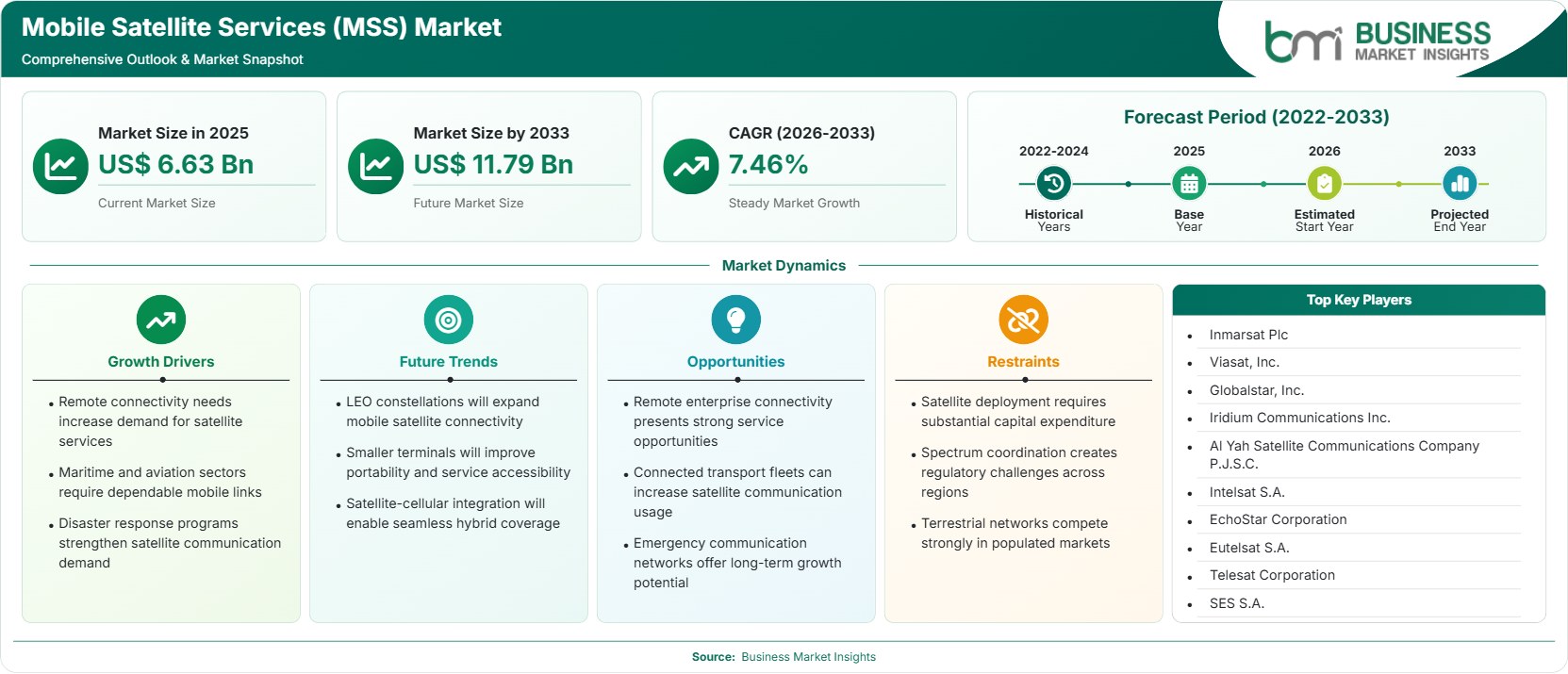
The Mobile Satellite Services (MSS) Market size was valued at USD 6.63 Billion in 2025 and is projected to reach USD 11.79 Billion by 2033, growing at a CAGR of 7.46% during 2026–2033. Rising demand for mission-critical connectivity across aviation, maritime, defense, and remote industrial operations, alongside expanding direct-to-device satellite capabilities, continues to create substantial opportunities for service providers and infrastructure operators.

Report Coverage
  • Service: Voice, Data
  • Frequency: L-Band, S-Band
  • End User: Aviation, Maritime, Government and Military
US$ 6.63 Bn Market size in 2025
US$ 11.79 Bn Market Size by 2033
7.46% CAGR, 2026 - 2033
2026-2033 Forecast Period

01 AI Overview

Mobile Satellite Services (MSS) Market Summary

  • North America Region: North America holds a market share of 34%–38% in 2025, growing with a CAGR of 6.5%–7.2% during 2026–2033. Strong defense communication spending, advanced aviation connectivity adoption, and expanding satellite-enabled IoT deployments support demand. Opportunity stems from direct-to-device integration and emergency response networks. Brief U.S. analysis: The U.S. remains the largest regional contributor, supported by government contracts and aviation connectivity investments, recording a CAGR of 6.7%–7.4%.
  • Fastest Growing Region: Asia Pacific holds a market share of 24%–28% in 2025, growing with a CAGR of 8.5%–9.3% during 2026–2033. Maritime trade expansion, remote infrastructure projects, and digital inclusion programs accelerate satellite communication adoption across emerging economies.
  • Leading Segment: Voice and Data services account for 70%–74% share in 2025 and are projected to expand at a 7.0%–7.8% CAGR. Critical communications requirements, global coverage demands, and integrated mobility solutions continue supporting sustained commercial and government adoption.
  • High Growth Segment: Government and Military applications represent 29%–33% share in 2025 while expanding at 8.2%–9.0% CAGR. Growing security concerns, resilient communication requirements, and modernization of defense networks accelerate procurement activity globally.
  • Key Market Opportunity: Expanding non-terrestrial network ecosystems and satellite-to-smartphone connectivity platforms are creating new revenue avenues across consumer, enterprise, public safety, transportation, and industrial communications environments worldwide.
  • Major Market Players: Inmarsat Plc, Viasat, Inc., Globalstar, Inc., Iridium Communications Inc., Al Yah Satellite Communications Company P.J.S.C., Intelsat S.A., EchoStar Corporation, Eutelsat S.A., Telesat Corporation, SES S.A.
02 Strategic Insights

Mobile Satellite Services (MSS) Market: Strategic Insights

Mobile Satellite Services (MSS) Market Strategic Framework
FREE PDF
Request your free sample
Request free sample
03 Stakeholder View

Key Takeaways

  • The ecosystem increasingly depends on integrated satellite operators, equipment suppliers, network service providers, and value-added mobility specialists serving aviation, maritime, government, and industrial users.
  • Government and military applications present the strongest upside due to demand for secure communications, network resilience, and operational continuity across contested and remote environments.
  • Industry innovation is shifting toward multi-orbit connectivity, direct-to-device capabilities, software-defined networks, and seamless integration with terrestrial communication standards.
  • Asia-Pacific offers a compelling investment proposition due to expanding maritime trade routes, large underserved populations, and government programs focused on digital inclusion.
  • Strategic partnerships, spectrum acquisitions, and network modernization initiatives are increasing across the industry as operators seek stronger market positioning and broader coverage capabilities.
  • Environmental monitoring, autonomous transportation, and remote industrial automation are creating new addressable opportunities for satellite-enabled mobility services.
04 Geographic Outlook

Mobile Satellite Services (MSS) Market Regional Highlights

North America Mobile Satellite Services (MSS) Market

North America accounted for 34%–38% Mobile Satellite Services (MSS) Market share in 2025 and is expected to grow at 6.5%–7.2% CAGR through 2033. Demand remains supported by defense modernization programs, aviation connectivity upgrades, maritime communication requirements, and industrial IoT deployments. The region benefits from established satellite infrastructure, strong spectrum resources, and continuous investment in next-generation communication systems. Commercial mobility users increasingly seek resilient communications beyond terrestrial coverage limitations.

  • Defense agencies continue investing in resilient communication networks supporting mission-critical operations across domestic and international environments.
  • Aviation operators prioritize enhanced passenger connectivity capabilities and operational communications for fleet management applications.
  • Maritime companies adopt satellite-enabled monitoring, navigation, and crew welfare solutions across long-distance shipping routes.
  • Direct-to-device initiatives are accelerating partnerships between satellite operators and mobile network providers.

US Mobile Satellite Services (MSS) Market

The United States accounts for 70%–75% of North American share and records a projected 6.7%–7.4% CAGR through 2033. Federal government programs, aviation leadership, and extensive commercial satellite deployments support market expansion. Strong participation from major satellite operators and technology innovators contributes to network modernization and enhanced service quality. Demand remains particularly robust among defense agencies, transportation operators, and emergency communication stakeholders.

  • Government communications contracts remain a major revenue source, supporting deployment of advanced mobility communication solutions.
  • Commercial aviation connectivity upgrades continue generating demand for high-capacity satellite communication services.
  • Emergency preparedness programs increasingly integrate satellite connectivity for disaster resilience and public safety requirements.
  • Remote industrial operations utilize satellite-based monitoring and asset management technologies across energy and resource sectors.

Europe Mobile Satellite Services (MSS) Market

Europe held 25%–29% share in 2025 and is projected to advance at 6.8%–7.5% CAGR during the forecast period. Strong maritime activity, aviation connectivity investment, and government-supported secure communication initiatives underpin regional demand. The United Kingdom remains the leading market, while Germany demonstrates notable growth. Increasing emphasis on digital sovereignty, secure communications, and transportation modernization supports broader adoption across commercial and governmental applications.

  • The United Kingdom maintains leadership through established satellite service capabilities and international mobility communication operations.
  • Germany emerges as a high-growth market with projected growth around 7.4%–8.0% CAGR supported by industrial digitalization initiatives.
  • Maritime operators increasingly deploy advanced communication services supporting logistics optimization and operational safety.
  • European aviation stakeholders are accelerating investments in passenger connectivity solutions and flight operations management.
  • Government agencies continue supporting secure communication infrastructure development across strategic sectors.

Asia Pacific Mobile Satellite Services (MSS) Market

Asia Pacific represented 24%–28% share in 2025 and is forecast to expand at 8.5%–9.3% CAGR, making it the fastest growing regional market. Rising maritime trade, infrastructure development, and remote connectivity requirements support demand expansion. China leads regional adoption, while India records particularly strong growth momentum. Expanding cross-border logistics activity and digital inclusion programs are creating favorable conditions for sustained market development.

  • China maintains regional leadership through expanding satellite infrastructure and increasing connectivity requirements.
  • India is among the fastest-growing national markets with estimated 9.0%–9.8% CAGR supported by digital transformation initiatives.
  • Growing offshore energy activities create demand for reliable mobile communication services in remote environments.
  • Expanding aviation passenger traffic encourages greater investment in onboard connectivity technologies.
  • Remote enterprise operations increasingly require resilient communications where terrestrial networks remain unavailable.

Rest of World Mobile Satellite Services (MSS) Market

Rest of World accounts for 11%–15% share in 2025 and is projected to grow at 7.3%–8.1% CAGR through 2033. The Middle East benefits from defense investments and satellite infrastructure modernization. South and Central America experience increasing demand from mining, agriculture, and transportation sectors. Connectivity gaps across remote territories continue supporting adoption of satellite-enabled communication services throughout the region.

  • The UAE remains a leading Middle Eastern market supported by satellite communication investments and government initiatives.
  • Saudi Arabia demonstrates strong growth with communications infrastructure modernization programs underway.
  • Brazil leads South and Central America through increasing demand from logistics, agriculture, and energy industries.
  • Remote industrial sites continue requiring reliable communications beyond terrestrial network availability.
  • Emergency management and disaster response applications contribute to growing deployment activity across the region.
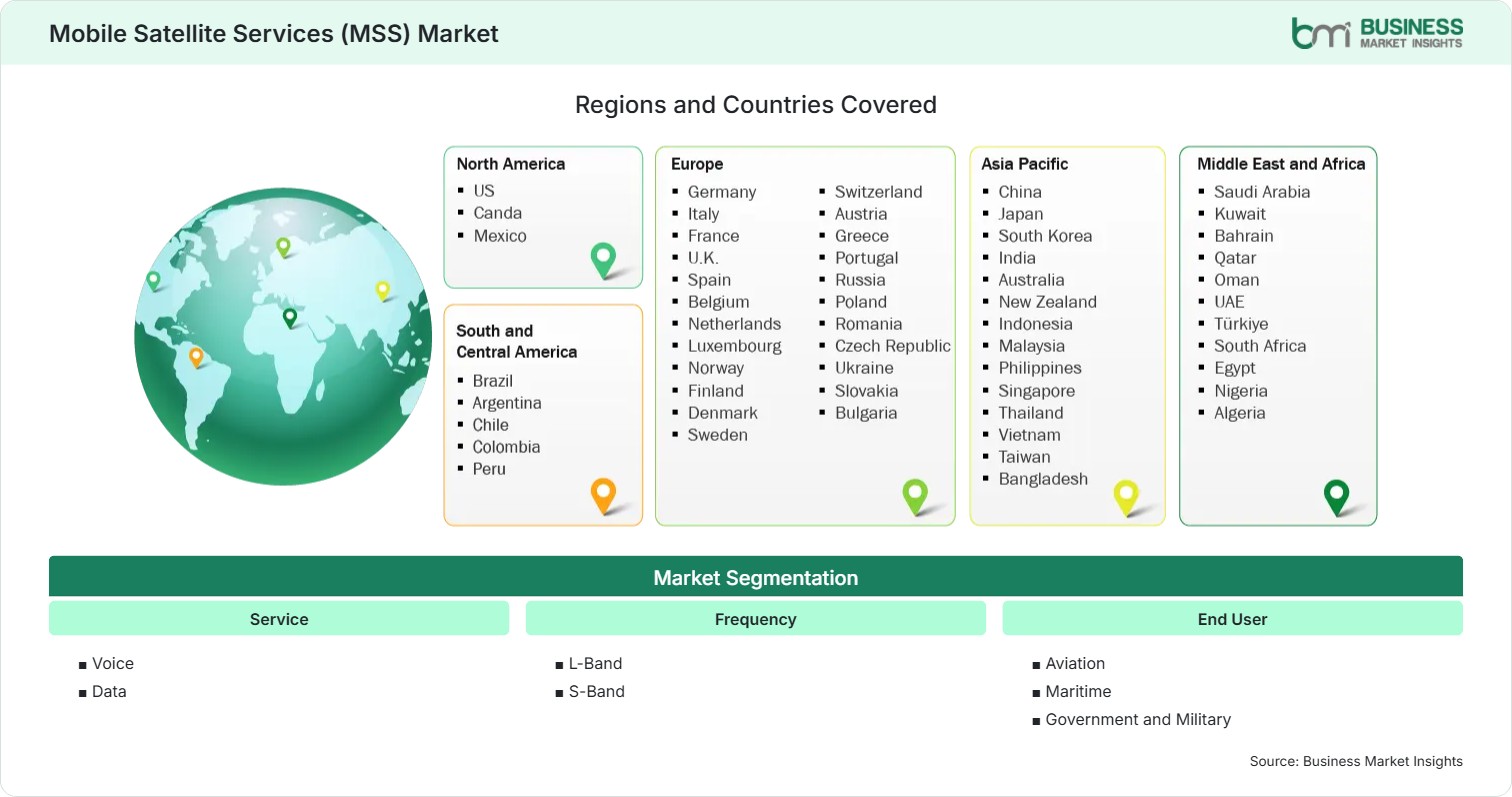
Global Market Geography
FREE PDF
Request your free sample
Request free sample
05 Segment Analysis

Mobile Satellite Services (MSS) Market Segmentation

Service 

Service remains the dominant segment, accounting for 70%–74% share in 2025 and expected to grow at 7.0%–7.8% CAGR. The Mobile Satellite Services (MSS) Market scope continues expanding as mobility users prioritize always-on communications, operational visibility, and resilient connectivity. Increasing integration of satellite and terrestrial networks strengthens long-term service demand.

  • Voice and Data: Voice and data solutions remain essential across aviation, maritime, public safety, defense, and industrial operations, supporting mission-critical communications, remote asset connectivity, and operational continuity requirements worldwide.

Frequency 

Frequency technologies represent a foundational element of industry development, with demand shaped by coverage performance, mobility requirements, and service reliability. The segment benefits from increasing deployment of next-generation communication platforms across commercial and government applications, recording steady growth through the forecast period.

  • L-Band: L-Band solutions offer highly reliable weather-resistant connectivity and remain widely adopted across maritime, aviation, defense, and emergency communication applications requiring dependable operational performance.
  • S-Band: S-Band services support expanding mobility applications while facilitating improved capacity utilization, consumer connectivity initiatives, and integration with evolving non-terrestrial communication frameworks.

End User

End-user demand continues broadening across transportation, defense, public safety, and industrial sectors. The Mobile Satellite Services (MSS) Market trends increasingly reflect the growing role of resilient communications in ensuring operational continuity and connectivity under challenging geographic and environmental conditions.

  • Aviation: Airlines and business aviation operators deploy satellite connectivity solutions to improve passenger services, operational awareness, fleet communications, and real-time flight management capabilities.
  • Maritime: Maritime users depend on satellite communications for navigation, logistics coordination, compliance monitoring, crew welfare, and offshore operational support across global shipping routes.
  • Government and Military: Government and military organizations prioritize secure, resilient, and globally available communications supporting intelligence gathering, emergency response, defense operations, and strategic mobility requirements.
06 Market Forces

Mobile Satellite Services (MSS) Market Dynamics

Key Market Drivers

Remote connectivity needs increase demand for satellite services

Global enterprises continue expanding operations into remote geographies where terrestrial coverage remains unavailable or unreliable. Mining activities, offshore energy production, transportation corridors, and environmental monitoring programs increasingly depend on satellite connectivity. The industry associations have found that there is an increase in the need for digitalization among remote industrial sites, leading to the requirement of having resilient communication networks. IoT adoption will help boost the existing usage trends of enterprises that wish to have continuous visibility of their operations. The continuous convergence of satellite communication within the context of the digital transformation of enterprises will continue to drive demand growth.

Maritime and aviation sectors require dependable mobile links

Global aviation passenger volumes and maritime trade activity continue increasing, creating greater reliance on connectivity solutions that function beyond terrestrial coverage. The airlines are working on ways to improve passengers' experience on board along with improving their communication capabilities. The shipping firms make use of various tracking, routing, monitoring, and crew welfare services which require consistent connectivity. They lay emphasis on reliability, low latency, and coverage, hence, satellite communications form part of the critical infrastructure for them. Modernization of transportation infrastructure globally is leading to increased adoption of advanced mobility communications services.

Disaster response programs strengthen satellite communication demand

Public safety agencies and emergency management organizations increasingly integrate satellite communications into preparedness strategies. Natural disasters often affect terrestrial systems, and therefore the importance of resilient communication channels that do not depend on terrestrial infrastructure is evident. Governments are developing emergency response programs that require reliable connectivity even in critical situations. NGOs and other civil protection organizations also make use of satellite phones to coordinate their operations and share information.

Key Market Opportunities

Remote enterprise connectivity presents strong service opportunities

The organizations which operate from various geographic locations are still searching for robust connectivity solutions that can help them to achieve their objectives of digital transformation. Energy firms, logistics firms, agriculture firms, and resource mining companies have started leveraging satellite-based connectivity solutions. The introduction of hybrid satellite and terrestrial solutions is benefiting such firms. Mobile Satellite Services (MSS) Market Forecasts indicate growing commercialization opportunities arising from industrial automation, remote monitoring, and connected infrastructure investments. Operators capable of delivering scalable solutions tailored to enterprise requirements are likely to capture sustained growth opportunities.

Connected transport fleets can increase satellite communication usage

Commercial transportation operators are increasingly investing in fleet digitization initiatives that depend on continuous communication capabilities. Continuous monitoring, optimization of routes, maintenance in advance, and management of compliance need continuous connectivity in large geographical regions. The use of satellite and terrestrial systems enhances the connectivity of ground, air, and marine transport assets. Efficiency and effectiveness increasingly becoming important lead to greater adoption of communications technologies. Mobility service providers may benefit from these evolving demands for transportation technology solutions.

Emergency communication networks offer long-term growth potential

National governments and public safety organizations continue strengthening communication resilience strategies. Emergency communication systems’ investments now include the use of satellites that enable the response process to continue even during network disruptions. Awareness of climate change and disaster preparedness makes the market ripe for investment. Satellite mobile technology enables coordination between agencies and also ensures that communication is uninterrupted in those regions. These factors make the market conducive for investment by the providers of such services.

Market Restraints and Challenges

Satellite deployment requires substantial capital expenditure

Factor: Satellite manufacturing, launch services, ground infrastructure development, and spectrum management require substantial financial commitments from operators. Impact: Large capital expenditure needs can make investments take longer to recoup, create greater financing risk and reduce access to investment opportunities for smaller companies entering the market. Companies have to continuously invest in improving their networks in order to stay ahead of the competition and provide adequate capacity to cater for their changing customer needs. Increased competition in the wider space communications industry is adding to the pressure.

Spectrum coordination creates regulatory challenges across regions

Factor: Mobile satellite service providers operate within complex international regulatory frameworks governing spectrum allocation and orbital resources. Impact: Slow approval processes and cross-border coordination needs may affect deployment plans, add complexity to operations, and affect strategies for entering markets. Regulatory discrepancies across jurisdictions may pose challenges to service expansion efforts and require extensive stakeholder consultation. The need for effective spectrum coordination shall remain key as non-terrestrial communications become more popular.

07 Company Analysis

Competitive Landscape

The Mobile Satellite Services (MSS) Market analysis reflects a competitive environment characterized by spectrum ownership, network coverage, mobility expertise, and strategic partnerships.

Company Name

Overview

Products and Services relevant to this market

Inmarsat Plc

Global mobility communications provider serving maritime, aviation, government and enterprise customers through satellite networks.

Mobile voice, broadband connectivity, safety services, maritime communications, aviation connectivity solutions.

Viasat, Inc.

Major satellite communications operator with integrated mobility and broadband service capabilities.

In-flight connectivity, maritime communications, government communications, direct-to-device initiatives.

Globalstar, Inc.

LEO satellite operator focused on mobile satellite communications and IoT connectivity.

Satellite voice, messaging, asset tracking, IoT connectivity, emergency communications.

Iridium Communications Inc.

Global LEO satellite communications provider with worldwide coverage capabilities.

Satellite voice, Certus broadband, IoT connectivity, defense communications, positioning services.

Al Yah Satellite Communications Company P.J.S.C.

Middle East satellite operator supporting government and commercial connectivity markets.

Secure communications, mobility services, government satellite solutions.

Intelsat S.A.

Global satellite communications company with strong mobility market presence.

Aviation connectivity, maritime communications, managed satellite network services.

EchoStar Corporation

Satellite communications and network services provider serving multiple mobility applications.

Satellite connectivity, broadband services, communication infrastructure solutions.

Eutelsat S.A.

GEO and LEO satellite operator serving mobility, enterprise, and government customers.

OneWeb connectivity, aviation solutions, maritime services, enterprise communications.

Telesat Corporation

Satellite network provider focused on advanced communication services and infrastructure.

Broadband connectivity, enterprise connectivity, mobility communications solutions.

SES S.A.

Global satellite operator leveraging multi-orbit communications capabilities.

Mobility services, maritime connectivity, aviation communications, government solutions.

10 Trust & Transparency

Research Methodology

The market analysis combines proprietary research with secondary data from government agencies, company disclosures, regulatory filings, industry databases and expert interviews. Market estimates are validated through data triangulation, cross-market benchmarking and analyst review.

View Full Research Methodology

11 Questions Answered

Frequently Asked Questions

What does a Mobile Satellite Services (MSS) Market Report typically cover?

It evaluates market size, competitive dynamics, regional trends, segmentation performance, technology developments, growth opportunities, and strategic industry developments.

What technologies are shaping future industry development?

Multi-orbit networks, direct-to-device connectivity, software-defined payloads, integrated 5G non-terrestrial networks, and advanced satellite IoT solutions.

Why is Asia Pacific growing rapidly?

Growing maritime activity, digital inclusion investments, transportation modernization, and expanding infrastructure projects are driving regional adoption.

Which end-user segment offers the greatest growth potential?

Government and military applications are expected to demonstrate the strongest expansion due to secure communication and resilience requirements.

What are Mobile Satellite Services?

They are communication services delivered through satellites to provide voice, data, tracking, and connectivity for users operating beyond terrestrial network coverage.

Access the Full Mobile Satellite Services (MSS) Market Report

Get segment-level forecasts, regional estimates, competitive benchmarking, company profiles and downloadable Excel datasets.

Access the full Mobile Satellite Services (MSS) Market Report
350 pages PDF & Excel | 2026-08-19