
Managed Services Market Outlook: Size, Share, Trends, Growth Analysis, Competitive Landscape & Forecast, 2026-2033

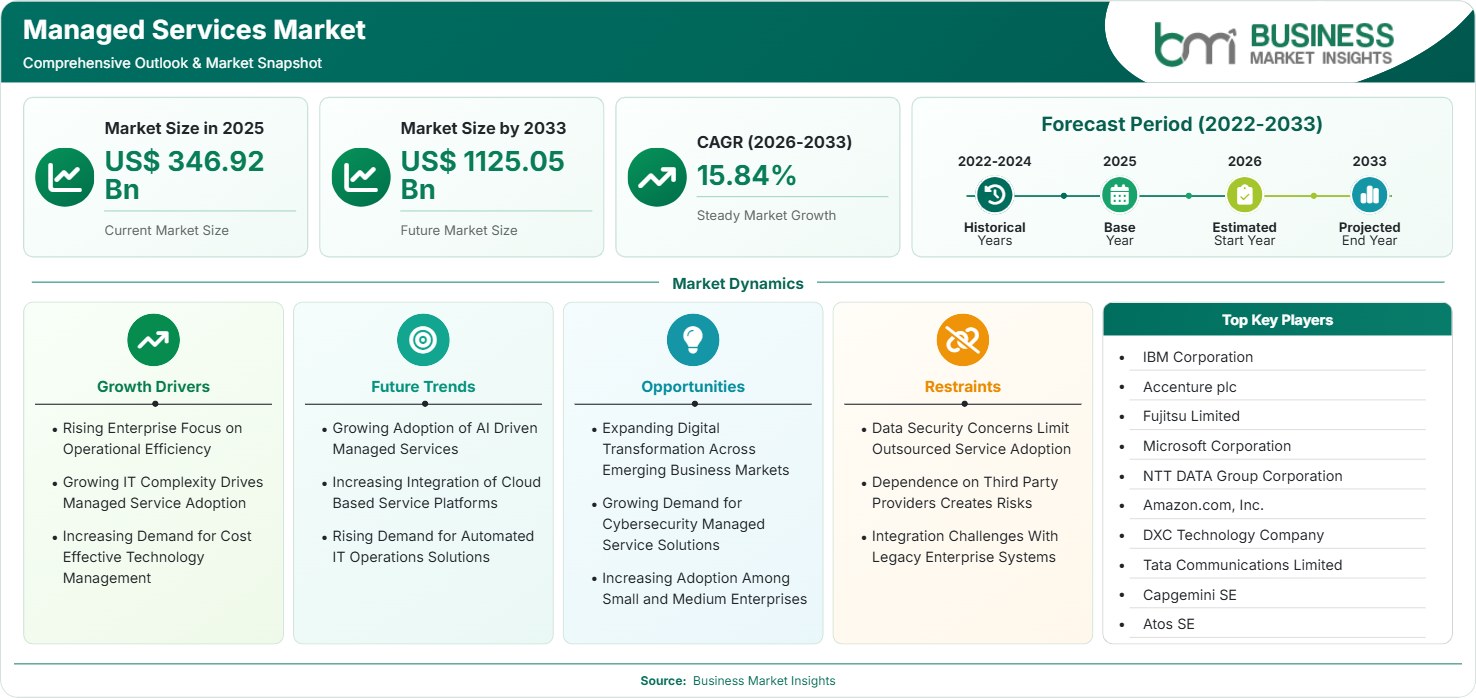
The Managed Services Market size was valued at US$ 346.92 Billion in 2025 and is projected to reach US$ 1125.05 Billion by 2033, growing at a CAGR of 15.84% during 2026–2033, driven by cloud migration, cybersecurity outsourcing, AI-enabled operations, hybrid workforce expansion, regulatory compliance requirements, and rising enterprise demand for scalable IT management, automation, resilience, and digital transformation services.

Report Coverage
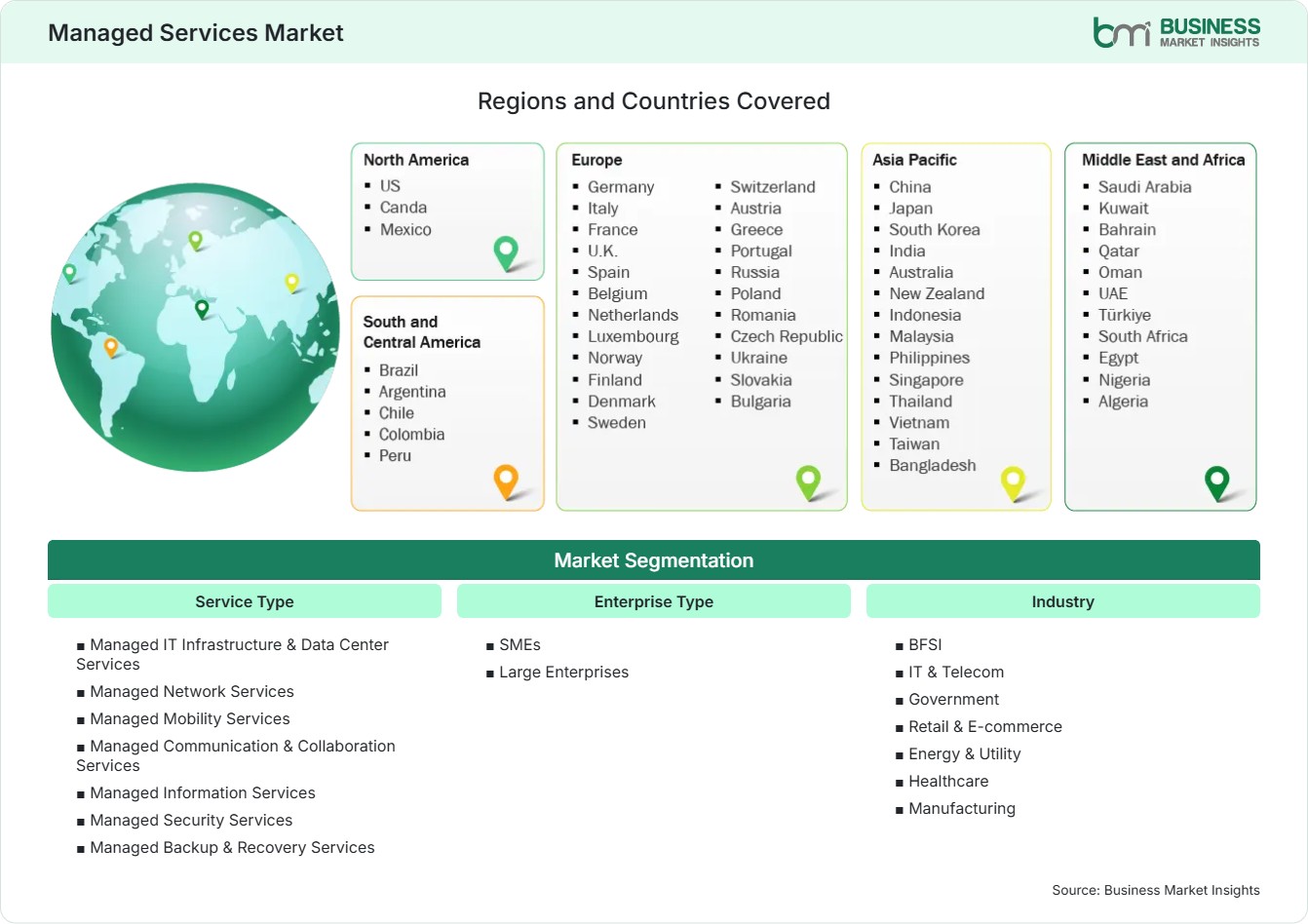
  • Service Type: Managed IT Infrastructure & Data Center Services, Managed Network Services, Managed Mobility Services, Managed Communication & Collaboration Services, Managed Information Services, Managed Security Services, Managed Backup & Recovery Services
  • Enterprise Type: SMEs, Large Enterprises
  • Industry: BFSI, IT & Telecom, Government, Retail & E-commerce, Energy & Utility, Healthcare, Manufacturing
US$ 346.92 Bn Market size in 2025
US$ 1125.05 Bn Market Size by 2033
15.84% CAGR, 2026 - 2033
2026-2033 Forecast Period

01 AI Overview

Managed Services Market Summary

  • North America Region: North America holds a market share of 36%–39% in 2025, growing with a CAGR of 14.2%–15.0% during 2026–2033. Growth is supported by cloud modernization, cybersecurity investments, managed SOC adoption, AI-enabled monitoring, compliance obligations, hybrid workplace management, multicloud integration, infrastructure outsourcing, operational efficiency goals, and increasing managed service contracts across enterprises. The U.S. accounts for 74%–78% of regional demand and is projected to expand at a CAGR of 14.5%–15.3%.
  • Fastest Growing Region: Asia Pacific holds a market share of 26%–29% in 2025 and is anticipated to grow at a CAGR of 18.2%–19.0% through 2033. Rapid digitization, expanding SME technology adoption, cloud-native deployments, government digital initiatives, cybersecurity modernization, data center investments, telecom transformation programs, and growing managed infrastructure demand continue accelerating regional expansion.
  • Leading Segment: Managed IT Infrastructure & Data Center Services commands a market share of 28%–31% in 2025 and advances at a CAGR of 15.0%–15.8%. Enterprises increasingly outsource infrastructure management, workload optimization, storage administration, virtualization support, disaster recovery operations, and multicloud governance to improve efficiency and reduce operational complexity.
  • High Growth Segment: Managed Security Services represents 17%–20% share in 2025 and expands at a CAGR of 18.8%–19.6%. Rising cyberattacks, ransomware incidents, compliance mandates, zero-trust implementation, threat intelligence adoption, security operations outsourcing, endpoint protection requirements, and workforce shortages are driving accelerated demand globally.
  • Key Market Opportunity: AI-powered autonomous operations platforms are creating opportunities for predictive monitoring, automated remediation, intelligent ticketing, cloud optimization, enhanced security analytics, and improved service delivery across enterprise IT environments globally.
  • Major Market Players: IBM Corporation, Accenture plc, Fujitsu Limited, Microsoft Corporation, NTT DATA Group Corporation, Amazon.com, Inc., DXC Technology Company, Tata Communications Limited, Capgemini SE, and Atos SE.
02 Strategic Insights

Managed Services Market: Strategic Insights

Managed Services Market Strategic Framework
FREE PDF
Request your free sample
Request free sample
03 Stakeholder View

Key Takeaways

  • The ecosystem is evolving toward integrated service platforms where cloud providers, cybersecurity vendors, software companies, and managed service providers collaborate to deliver end-to-end digital operations support.
  • Managed security, multicloud management, and AI-enabled infrastructure services present the strongest revenue opportunities as organizations prioritize resilience, compliance, and operational efficiency.
  • Automation technologies, predictive analytics, AIOps platforms, and intelligent service desks are transforming service delivery models and reducing dependence on manual intervention.
  • Asia Pacific offers a compelling investment case due to accelerating cloud adoption, expanding digital infrastructure, growing SME technology spending, and supportive government digitization programs.
  • Strategic acquisitions continue reshaping the competitive landscape as providers seek cybersecurity expertise, cloud capabilities, industry specialization, and regional expansion opportunities.
  • Industry-specific service portfolios tailored for healthcare, BFSI, manufacturing, and government sectors are becoming important differentiators in competitive contract bidding.
04 Geographic Outlook

Managed Services Market Regional Highlights

North America Managed Services Market

North America accounts for approximately 36%–39% of global revenue in 2025 and is projected to register a CAGR of 14.2%–15.0% through 2033. The region benefits from mature digital infrastructure, widespread multicloud deployment, and strong presence of global technology providers. The Managed Services Market share remains highest within this region due to enterprise-scale digital transformation programs.

  • Enterprises increasingly adopt managed security operations centers to strengthen threat detection, improve compliance performance, and address persistent cybersecurity talent shortages.
  • Multicloud management services are witnessing strong demand as organizations optimize workloads across public, private, and hybrid cloud environments.
  • Financial institutions continue investing in outsourced infrastructure management to improve resilience, reduce operational risks, and support digital banking initiatives.
  • AI-enabled operational platforms improve incident resolution speed, predictive maintenance effectiveness, and overall service quality across enterprise environments.

US Managed Services Market

The United States represents 74%–78% of North American demand and is expected to expand at a CAGR of 14.5%–15.3% during the forecast period. Enterprises across finance, healthcare, retail, and technology sectors increasingly rely on outsourced expertise to manage complex digital ecosystems. Strong investment in hyperscale data centers and digital infrastructure further strengthens service demand across enterprise customers nationwide.

  • Federal cybersecurity frameworks encourage organizations to adopt advanced managed security and compliance monitoring solutions.
  • Healthcare providers increasingly outsource infrastructure management to support electronic health records, analytics, and regulatory compliance requirements.
  • AI and automation technologies enhance operational efficiency, enabling providers to deliver predictive support and proactive service management.
  • Cloud-native application environments generate new demand for specialized management, optimization, and governance services.

Europe Managed Services Market

Europe holds approximately 24%–27% of global revenue in 2025 and is forecast to grow at a CAGR of 14.8%–15.6% through 2033. Digital sovereignty initiatives, data protection regulations, and cloud modernization projects drive outsourcing activity across enterprises. Germany leads regional demand due to industrial digitization investments, while Eastern European markets exhibit faster adoption rates.

  • Germany maintains regional leadership through Industry 4.0 adoption and large-scale digital transformation initiatives.
  • Poland and Romania are among the faster-growing markets, supported by expanding technology ecosystems and cloud investments.
  • GDPR compliance requirements encourage adoption of managed monitoring, governance, and security services.
  • Telecommunications providers increasingly outsource network management functions to improve efficiency and service performance.

Asia Pacific Managed Services Market

Asia Pacific accounts for 26%–29% of global revenue in 2025 and is expected to achieve the fastest CAGR of 18.2%–19.0% during 2026–2033. Expanding SME technology investments, cybersecurity modernization programs, and increasing demand for scalable IT operations continue strengthening regional prospects and Managed Services Market growth across industries.

  • India benefits from growing cloud adoption, digital transformation spending, and expanding managed security service requirements.
  • China continues investing in enterprise cloud infrastructure and advanced digital operations management capabilities.
  • Southeast Asian enterprises increasingly outsource network and infrastructure management to support rapid business expansion.
  • Regional governments promote digital economy programs that accelerate technology adoption and managed service utilization.

Rest of World Managed Services Market

South & Central America and the Middle East & Africa collectively account for 9%–12% of global revenue in 2025 and are projected to expand at a CAGR of 15.5%–16.3% through 2033.

Brazil leads adoption in South & Central America, while the UAE and Saudi Arabia remain major growth centers in the Middle East. Enterprise modernization initiatives, regulatory compliance requirements, and increasing technology outsourcing continue supporting long-term development.

  • Brazil benefits from expanding enterprise digitization programs and increasing cloud adoption across financial services and retail sectors.
  • Saudi Arabia's Vision 2030 initiatives encourage digital transformation and managed technology service deployment.
  • UAE enterprises increasingly invest in cybersecurity outsourcing and multicloud management solutions.
  • Telecommunications and public-sector organizations drive significant demand for managed infrastructure and network services.
  • Regional providers are expanding partnerships with global hyperscalers to improve service capabilities and scalability.
Global Market Geography
FREE PDF
Request your free sample
Request free sample
05 Segment Analysis

Managed Services Market Segmentation

Service Type

Service Type represents the largest revenue contributor, accounting for approximately 58%–61% of total revenue in 2025 and projected to expand at a CAGR of 16.0%–16.8% through 2034. The Managed Services Market scope continues expanding as providers integrate AI-driven automation, predictive analytics, and cloud-native management capabilities across diverse enterprise environments.

  • Managed IT Infrastructure & Data Center Services: Organizations rely on outsourced infrastructure management to improve uptime, optimize resource utilization, support multicloud environments, and reduce operational complexity across distributed technology ecosystems.
  • Managed Network Services: Growing network complexity, SD-WAN deployment, remote workforce connectivity requirements, and performance optimization needs continue driving adoption among enterprises seeking reliable digital operations.
  • Managed Mobility Services: Enterprises increasingly deploy mobility management solutions to secure devices, support hybrid workforces, enhance productivity, and streamline endpoint administration across geographically dispersed operations.
  • Managed Communication & Collaboration Services: Cloud-based collaboration platforms, unified communications, and digital workplace initiatives encourage outsourcing of communication infrastructure management and user support functions.
  • Managed Information Services: Data governance, analytics support, compliance management, and information lifecycle optimization are driving demand for specialized information management services across industries.
  • Managed Security Services: Increasing ransomware incidents, regulatory obligations, and cybersecurity workforce shortages accelerate adoption of outsourced threat monitoring, incident response, and security operations capabilities.
  • Managed Backup & Recovery Services: Business continuity requirements, disaster recovery planning, and rising data volumes encourage organizations to adopt managed backup and recovery solutions.

Enterprise Type

Enterprise Type segmentation demonstrates strong adoption across organizations of all sizes, accounting for 18%–22% of overall segmentation value and advancing at a CAGR of 15.7%–16.5% through 2034. The Managed Services Market trends indicate increasing demand from organizations seeking scalable operational support without substantial internal IT expansion.

  • SMEs: Small and medium enterprises increasingly leverage outsourced technology expertise to access enterprise-grade capabilities, improve cybersecurity readiness, and support digital transformation initiatives cost-effectively.
  • Large Enterprises: Large organizations utilize comprehensive managed service portfolios to optimize complex environments, manage multicloud operations, enhance governance, and improve operational efficiency.

Industry

Industry-based adoption accounts for approximately 28%–31% of revenue contribution and is projected to expand at a CAGR of 16.5%–17.3% through 2034. Demand continues rising as providers develop tailored offerings aligned with industry workflows, regulatory obligations, and operational requirements.

  • BFSI: Financial institutions increasingly adopt managed cybersecurity, cloud management, and compliance monitoring services to strengthen resilience and support digital banking ecosystems.
  • IT & Telecom: Technology and telecommunications organizations utilize advanced infrastructure, network, and application management services to maintain performance and support rapid innovation cycles.
  • Government: Public sector agencies deploy managed services to improve operational efficiency, strengthen cybersecurity capabilities, and modernize legacy technology environments.
  • Retail & E-commerce: Retailers leverage managed platforms to support omnichannel operations, customer analytics, cybersecurity protection, and scalable digital commerce infrastructure.
  • Energy & Utility: Utilities increasingly adopt managed monitoring, cybersecurity, and infrastructure optimization services to improve operational reliability and asset performance.
  • Healthcare: Healthcare providers utilize managed technology services to support electronic health records, compliance management, cybersecurity protection, and patient-centric digital initiatives.
  • Manufacturing: Industrial organizations implement managed infrastructure, analytics, and network services to support connected operations, automation programs, and Industry 4.0 initiatives.
06 Market Forces

Managed Services Market Dynamics

Key Market Drivers

Accelerating Enterprise Cloud Transformation Initiatives

Companies all over the world are increasingly deploying their applications on public, private, and hybrid cloud infrastructure, leading to increased demand for dedicated management skills. Enterprise adoption of the multicloud model is now becoming common, according to various evaluations of the cloud industry, resulting in operational challenges that cannot be easily handled by the internal staff. Providers of managed services assist in making better use of the cloud resources, improving governance and security measures, and ensuring proper performance of workloads. Growth in the demand for predictable operation models by enterprises is driving the Managed Services Market. With the increasing trend towards modernizing old infrastructure and cloud-native apps, it is becoming necessary to outsource the management of infrastructure.

Escalating Cybersecurity Threat Landscape

Security threats are constantly becoming more severe, with ransomware, supply chain hacks, and advanced threats targeting companies in all industry sectors. International cybersecurity agencies note that there is an increase in both the rate and the sophistication of attacks, thus urging organizations to engage managed security services. These services ensure monitoring, threat intelligence, incident response, vulnerability management, and compliance through a specially designed security operation center. It becomes evident to companies that having top-notch cybersecurity skills internally is costly and demanding. Thus, managed security becomes a good choice to compensate for the lack of personnel. Increasing regulation and greater data security requirements continue to fuel the need for outsourcing security management solutions globally.

Expansion of AI-Driven IT Operations Platforms

AI and machine learning technologies are changing the dynamics of how service delivery is operated. Modern AIOps platforms automatically monitor, correlate events, proactively maintain, and solve incidents in complex IT environments. Many companies are employing such tools to decrease downtime, increase service performance, and optimize their operational costs. Companies providing their services through the incorporation of AI provide better visibility, improved problem-solving, and better management of infrastructure. The combination of automation, analytics, and cloud management leads to tangible increases in productivity of organizations working on achieving digital transformation goals. With increasing dynamism in the business environment, AI-operated operational platforms have started playing a key role in current managed services approaches.

Key Market Opportunities

Growth Potential in SME Digital Transformation Programs

The dynamic nature of enterprise environments makes AI-driven operational platforms a key part of the managed services strategies.Enterprises of small to medium sizes provide an impressive untapped potential for service providers. Most companies are still shifting from traditional IT support services to complete outsourcing that includes cloud, security, networking, and collaboration platforms. Subscription services make the use of advanced technology by SMEs possible without large investments. The Managed Services Market forecasts emphasize the important role of SMEs as future sources of revenue growth. The increase in electronic business, legal regulations, and issues concerning security makes SMEs look for external help. Companies that will be able to offer scalable and industry-specific solutions can benefit from this demand.

Industry-Specific Managed Service Platforms

Vertically-oriented service portfolios designed for the health care, manufacturing, BFSI, government, and retail industries provide many growth opportunities. The demands of different industries are sometimes specific in terms of compliance, processes, and technology infrastructure. Service providers creating a specialization of this type will be able to win customers and enter into more profitable contracts. Monitoring, analysis, governance, and security services that are customized to fit the requirements of the industries in question provide a competitive advantage. With the proliferation of digital transformation efforts increasingly focusing on individual industries, the market for such services will grow tremendously.

Edge Computing and Distributed Infrastructure Management

The fast growth of connected devices, automation, and low-latency applications is spurring the development of edge computing models. Businesses will need tailored expertise in order to manage, secure, and optimize distributed infrastructure ecosystems that cover several locations. Managed service providers will be able to benefit from such developments through the provision of comprehensive edge management platforms, remote monitoring services, and cybersecurity services. Significant investment in smart manufacturing, smart health care, smart transportation, and digital infrastructure developments is conducive to sustainable opportunity generation. Enterprises look for partners who can handle complicated edge environments and make sure that they operate reliably, effectively, and in accordance with regulations.

Market Restraints and Challenges

Data Sovereignty and Regulatory Compliance Complexity

Factor: Increasing national and regional regulations governing data residency, privacy protection, and digital sovereignty create operational challenges for service providers. Impact: Organizations operating across multiple jurisdictions must navigate varying compliance requirements, increasing service delivery complexity and implementation costs. Providers often need localized infrastructure, specialized governance frameworks, and region-specific operating models to satisfy regulatory obligations. Compliance audits, reporting requirements, and contractual obligations can extend deployment timelines and reduce operational flexibility. As governments strengthen oversight of digital ecosystems, providers face ongoing investments in compliance capabilities. These challenges may slow adoption among highly regulated sectors despite growing demand for outsourced technology management.

Persistent Skills Shortages and Talent Retention Pressures

Factor: Demand for cybersecurity specialists, cloud architects, automation engineers, and AI operations professionals continues exceeding available workforce supply. Impact: Service providers face increasing recruitment costs, wage inflation, and resource constraints that can affect scalability and service quality. Competition for specialized talent is particularly intense in cybersecurity and cloud management disciplines. Organizations unable to secure sufficient expertise may experience longer implementation timelines and operational inefficiencies. Talent shortages also influence pricing structures and contract profitability. Sustained workforce development investments remain necessary to support expanding customer requirements and maintain competitive differentiation across global markets.

07 Company Analysis

Competitive Landscape

The competitive environment remains highly dynamic as enterprises seek cloud-native operations, cybersecurity resilience, AI-enabled monitoring, and outcome-based service delivery models. Managed Services Market analysis indicates that providers with integrated cloud, security, automation, and consulting capabilities are strengthening their competitive positions through platform investments and strategic partnerships.

Company Name

Overview

Products and Services Relevant to this Market

IBM Corporation

Global technology and consulting company with extensive expertise in hybrid cloud, AI, and enterprise transformation services.

Managed infrastructure services, cloud management, security operations, application management, automation platforms, and hybrid cloud solutions.

Accenture plc

Leading professional services organization focused on digital transformation, cloud modernization, and technology operations.

Managed cloud services, cybersecurity services, workplace solutions, application operations, infrastructure management, and industry-specific managed offerings.

Fujitsu Limited

Japanese technology provider serving enterprises through digital transformation and operational modernization initiatives.

Managed data centers, network operations, cloud services, cybersecurity management, workplace support, and infrastructure outsourcing solutions.

Microsoft Corporation

Global software and cloud leader with extensive enterprise ecosystem and cloud platform capabilities.

Azure managed services, security monitoring, endpoint management, collaboration services, cloud operations, and AI-enabled management tools.

NTT DATA Group Corporation

International IT services company delivering consulting, infrastructure, and digital business solutions globally.

Network management, cloud operations, managed security, application support, data center services, and digital workplace management.

Amazon.com, Inc.

Technology and cloud computing leader supporting enterprise modernization through scalable cloud infrastructure.

AWS managed operations, cloud migration services, security management, analytics operations, infrastructure optimization, and monitoring services.

DXC Technology Company

Enterprise technology services provider supporting large-scale IT transformation and operational efficiency initiatives.

Managed infrastructure, cloud operations, workplace services, application management, cybersecurity operations, and business process services.

Tata Communications Limited

Digital ecosystem enabler offering connectivity, cloud, security, and collaboration solutions worldwide.

Managed network services, unified communications, cloud connectivity, cybersecurity management, and digital infrastructure solutions.

Capgemini SE

Consulting and technology services company focused on intelligent industry and digital transformation.

Managed cloud platforms, cybersecurity services, application management, infrastructure operations, and business technology solutions.

Atos SE

European digital services company specializing in secure digital transformation and operational modernization.

Managed workplace services, cybersecurity operations, cloud management, infrastructure outsourcing, and mission-critical digital services.

10 Trust & Transparency

Research Methodology

The market analysis combines proprietary research with secondary data from government agencies, company disclosures, regulatory filings, industry databases and expert interviews. Market estimates are validated through data triangulation, cross-market benchmarking and analyst review.

View Full Research Methodology

11 Questions Answered

Frequently Asked Questions

Which technology areas are expected to create future opportunities?

Growth opportunities are expected in AI operations, multi-cloud management, zero-trust security services, edge infrastructure management, digital workplace solutions, and industry-specific managed platforms supporting enterprise modernization initiatives.

What differentiates a Managed Services Market Report from traditional IT outsourcing research?

The report evaluates recurring service models, cloud operations, cybersecurity management, automation capabilities, provider ecosystems, and long-term operational value creation rather than project-based outsourcing activities alone.

Why are SMEs increasingly adopting outsourced IT operations?

SMEs often face resource limitations and skills shortages. Outsourced management enables access to advanced technologies, cybersecurity expertise, and scalable infrastructure without requiring substantial internal technology investments.

How are artificial intelligence technologies influencing service delivery?

AI improves incident detection, predictive maintenance, automated remediation, capacity planning, and security monitoring. Service providers increasingly use AI-driven platforms to reduce downtime, improve service-level performance, and optimize operational costs.

What industries generate the highest demand for managed services?

BFSI, IT & telecom, healthcare, manufacturing, and government organizations represent major demand centers due to complex infrastructure requirements, cybersecurity obligations, compliance needs, and growing dependence on cloud-based operational environments.

Access the Full Managed Services Market Report

Get segment-level forecasts, regional estimates, competitive benchmarking, company profiles and downloadable Excel datasets.

Access the full Managed Services Market Report
350 pages PDF & Excel | 2026-08-26