
Mobile Analytics Market Outlook: Size, Share, Trends, Growth Analysis, Competitive Landscape & Forecast, 2026-2033

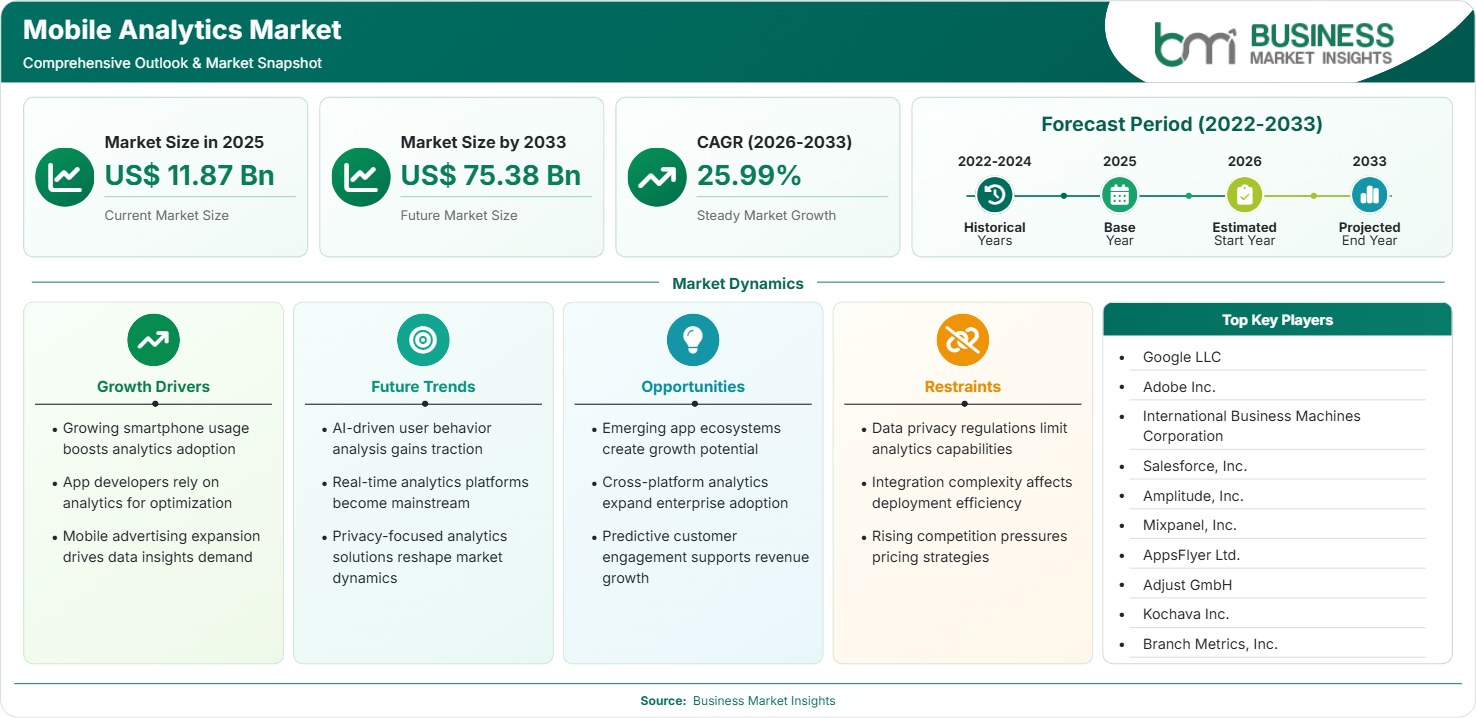
The Mobile Analytics Market size was valued at US$ 11.87 Billion in 2025 and is projected to reach US$ 75.38 Billion by 2033, growing at a CAGR of 25.99% during 2026–2033. Rising smartphone usage, growing app economies, AI-driven customer engagement, privacy-focused attribution technologies, and expanding enterprise mobility initiatives continue creating substantial opportunities across industries.

Report Coverage
  • Type: Advertising/Marketing Analytics, In-App Analytics, Performance Analytics, Others
  • Deployment: Cloud, On-premises
  • End-user: BFSI, Retail & E-Commerce, IT & Telecommunication, Transportation & Logistics, Energy & Utility
US$ 11.87 Bn Market size in 2025
US$ 75.38 Bn Market Size by 2033
25.99% CAGR, 2026 - 2033
2026-2033 Forecast Period

AI Overview

Mobile Analytics Market Summary

  • North America Region: North America holds a market share of 35%–38% in 2025, growing at a CAGR of 24%–27% during 2026–2033. Growth is supported by advanced digital advertising ecosystems, enterprise mobility investments, customer experience analytics adoption, AI integration, and increasing real-time data monetization initiatives across sectors. US maintains regional leadership through large-scale analytics deployments across retail, finance, and telecom sectors, recording a CAGR of 24%–27%.
  • Fastest Growing Region: Asia Pacific holds a Mobile Analytics Market share of 27%–30% in 2025, growing at a CAGR of 28%–31% during 2026–2033. Rapid smartphone adoption, expanding digital payment ecosystems, super-app proliferation, cloud infrastructure investments, and rising mobile commerce penetration continue accelerating analytics platform demand.
  • Leading Segment: Cloud holds a market share of 68%–72% in 2025, growing at a CAGR of 26%–29% during 2026–2033. Scalable processing, lower deployment costs, flexible integration, AI-enabled insights, and growing demand for cross-channel customer intelligence support segment leadership globally.
  • High Growth Segment: Performance Analytics holds a market share of 24%–28% in 2025, growing at a CAGR of 29%–32% during 2026–2033. Organizations increasingly prioritize real-time optimization, predictive engagement metrics, retention enhancement, campaign measurement precision, and advanced behavioral modeling capabilities.
  • Key Market Opportunity: Expansion of AI-powered predictive analytics platforms enables enterprises to improve retention, personalize engagement, optimize marketing spend, strengthen customer lifetime value measurement, and accelerate data-driven decision-making capabilities.
  • Major Market Players: Google LLC, Adobe Inc., International Business Machines Corporation, Salesforce, Inc., Amplitude, Inc., Mixpanel, Inc., AppsFlyer Ltd., Adjust GmbH, Kochava Inc., Branch Metrics, Inc.
Strategic Insights

Mobile Analytics Market: Strategic Insights

Mobile Analytics Market Strategic Framework
FREE PDF
Request your free sample
Request free sample
Stakeholder View

Key Takeaways

  • The ecosystem increasingly integrates mobile measurement partners, application developers, cloud providers, advertising networks, and enterprise software vendors into unified data intelligence value chains.
  • Performance-focused applications within retail, digital banking, and subscription services present the strongest upside as organizations seek measurable customer acquisition and retention outcomes.
  • Innovation is shifting toward AI-driven behavioral analytics, predictive churn detection, automated cohort discovery, and privacy-preserving attribution technologies supporting compliance requirements.
  • Asia Pacific offers a compelling investment environment due to expanding mobile commerce volumes, digital wallet penetration, and growing enterprise demand for customer intelligence platforms.
  • Strategic acquisitions increasingly focus on journey analytics, attribution technologies, customer data platforms, and AI-powered engagement solutions that strengthen analytics capabilities.
  • Organizations prioritizing first-party data strategies are gaining competitive advantages as privacy regulations reduce dependence on traditional third-party tracking methodologies.
Geographic Outlook

Mobile Analytics Market Regional Highlights

North America Mobile Analytics Market

North America accounted for approximately 35%–38% of global revenue in 2025 and is projected to expand at a CAGR of 24%–27% through 2033. The region benefits from mature app ecosystems, extensive cloud adoption, and significant marketing technology investments. Strong enterprise demand for customer behavior intelligence and AI-driven engagement optimization strengthens deployment activity. The region maintains the largest Mobile Analytics Market share due to advanced digital advertising spending, widespread enterprise mobility strategies, and strong adoption of subscription-based digital services across multiple industries.

  • Enterprises increasingly deploy predictive engagement platforms to optimize customer lifetime value, improve retention metrics, and enhance campaign attribution across digital channels.
  • Financial institutions invest heavily in behavioral analytics to support fraud mitigation, digital onboarding optimization, and personalized customer experiences.
  • Retail organizations use advanced analytics frameworks to improve conversion performance, recommendation accuracy, and omnichannel engagement effectiveness.
  • Growing adoption of privacy-compliant measurement solutions supports sustainable data collection while addressing evolving regulatory requirements.

US Mobile Analytics Market

The United States represents about 78%–82% of regional revenue and records a CAGR of 24%–27% through 2033. Large technology companies, mobile advertising networks, and software innovators create a favorable deployment environment. Demand remains strong across e-commerce, digital banking, telecommunications, and media applications. Advanced AI implementation, high smartphone penetration, and enterprise digital transformation initiatives continue supporting market expansion while encouraging development of sophisticated customer intelligence platforms and real-time decision systems.

  • Large enterprises increasingly integrate mobile and web analytics environments, creating unified customer intelligence ecosystems supporting personalized engagement initiatives.
  • Digital advertising expenditure growth drives demand for attribution accuracy, campaign optimization, and performance measurement capabilities.
  • Telecommunications providers leverage customer behavior analytics to reduce churn and create targeted service offerings.

Europe Mobile Analytics Market

Europe held a 24%–27% share in 2025 and is anticipated to expand at a CAGR of 23%–26% through 2033. Stringent privacy frameworks encourage innovation in consent-driven analytics architectures. Germany leads regional deployment activity, while Eastern European markets demonstrate faster adoption rates. Enterprise investments emphasize customer journey visibility, digital experience optimization, and secure data management. Regulatory compliance requirements have accelerated demand for privacy-preserving measurement approaches, strengthening long-term platform relevance across multiple industries and application categories.

  • Germany remains the leading country, supported by advanced industrial digitization and enterprise software adoption initiatives.
  • Poland demonstrates one of the strongest expansion trajectories with estimated growth exceeding regional averages due to digital transformation programs.
  • GDPR-driven innovation continues encouraging development of privacy-compliant attribution and customer intelligence technologies.
  • Retail and financial sectors remain major spending categories due to growing demand for customer engagement optimization.

Asia Pacific Mobile Analytics Market

Asia Pacific region accounted for 27%–30% of the revenue share in 2025 and is projected to have the highest CAGR of 28%–31% between 2024 and 2033. The growth of the Mobile Analytics Market can be attributed to increased smartphone usage, the super-app economy, the usage of digital payments, and cloud technology modernization. Countries such as China, India, Japan, and the Southeast Asian nations generate considerable demand. The adoption of a mobile-first approach, app downloads, and increasing participation of small and medium enterprises create favorable conditions for long-term analytics platform adoption and service innovation.

  • China remains the largest regional contributor due to extensive digital platform ecosystems and advertising technology investments.
  • India records among the fastest growth rates supported by expanding digital commerce and fintech adoption.
  • Southeast Asia presents strong opportunities as mobile-first internet usage continues expanding across consumer segments.
  • Cloud-based analytics deployments gain traction due to scalability and lower implementation barriers.

Rest of World Mobile Analytics Market

The Rest of World region accounts for 10%–13% of global revenue in 2025 and is anticipated to expand at a CAGR of 25%–28% through 2033. South and Central America benefit from digital banking expansion and rising e-commerce participation. The Middle East and Africa are witnessing increasing investments in smart city programs, mobile connectivity, and cloud infrastructure. These developments support greater utilization of customer intelligence systems and data-driven engagement strategies among public and private organizations.

  • Brazil remains the leading South American market due to strong digital payment and mobile commerce activity.
  • Saudi Arabia exhibits rapid adoption supported by digital transformation initiatives and smart economy investments.
  • Expanding mobile internet coverage continues improving addressable opportunities across developing economies.
  • Financial inclusion programs support growing demand for customer analytics and engagement optimization capabilities.
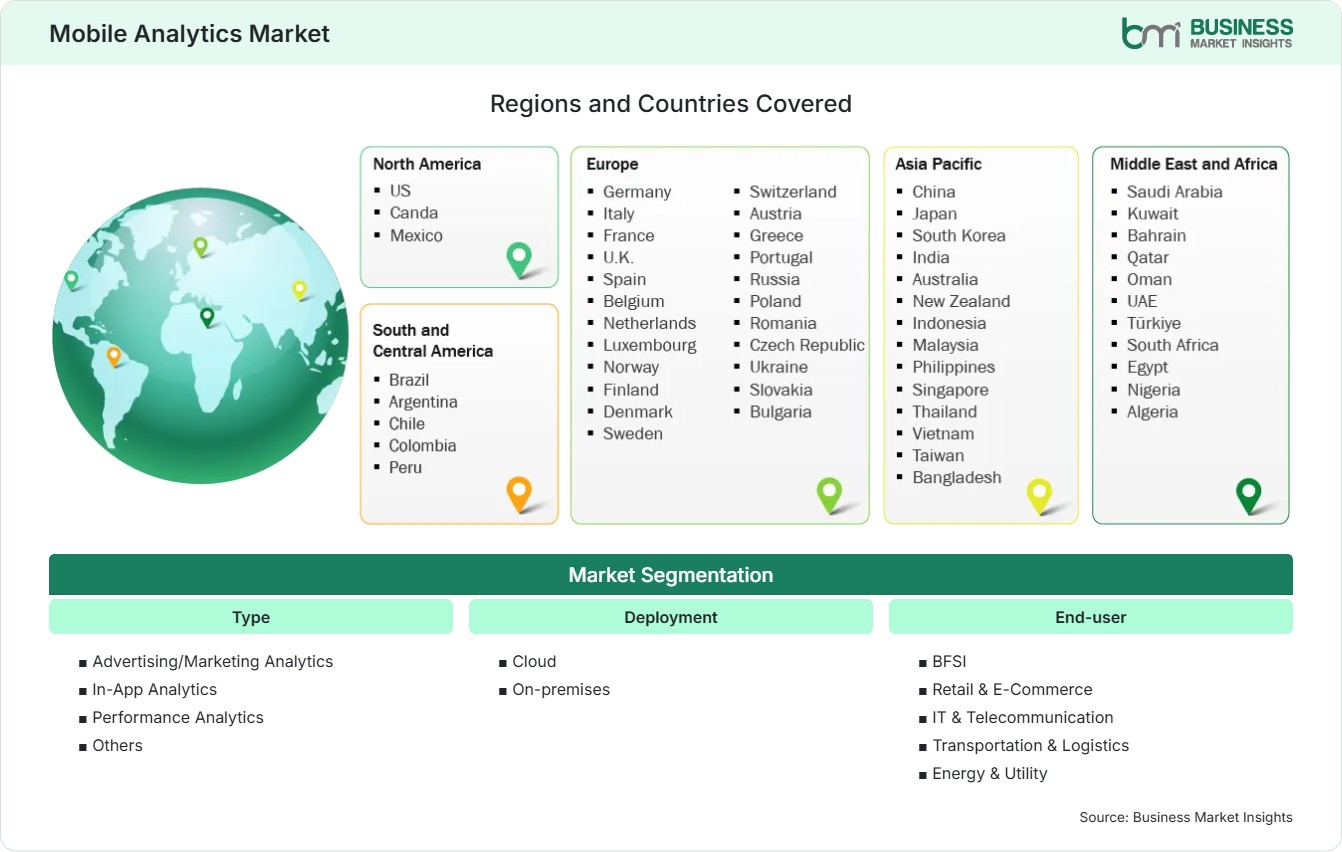
Global Market Geography
FREE PDF
Request your free sample
Request free sample
Segment Analysis

Mobile Analytics Market Segmentation

Type

Type-based demand remains diverse, with Advertising/Marketing Analytics the largest contributor by revenue, accounting for about 32% to 36% in 2025, growing at a CAGR of 25% to 28%. The scope of the Mobile Analytics Market continues to widen as companies integrate their capabilities to acquire, engage, and retain customers and behavior analytics into a single package.

  • Advertising/Marketing Analytics: Supports attribution tracking, campaign optimization, audience segmentation, and return-on-investment measurement across rapidly expanding digital advertising ecosystems.
  • In-App Analytics: Enables user behavior tracking, feature performance measurement, churn identification, and experience optimization initiatives across consumer and enterprise applications.
  • Performance Analytics: Increasing demand for real-time operational visibility, predictive insights, and customer retention optimization supports strong adoption momentum.

Deployment

The cloud-based deployment approach is expected to hold a revenue market share of 68%-72% in 2025 and register a CAGR of 26%-29%. Scalability, process flexibility, minimal infrastructure requirements, and compatibility with customer data ecosystems are critical considerations for organizations. Trends in the Mobile Analytics Market highlight the move towards cloud-based analytics platforms.

  • Cloud: Provides elastic computing resources, rapid implementation capabilities, AI integration potential, and lower operational complexity for analytics workloads.
  • On-premises: Remains relevant among organizations requiring strict data control, customized deployment environments, and enhanced governance frameworks.

End-user

The BFSI vertical accounts for 22%–26% of market share in 2025 and is projected to grow at a 25%–28% CAGR. The growing adoption of analytics by organizations to enable digital onboarding, manage fraud, improve customer engagement, and offer personalized services is increasing demand for behavioral intelligence.

  • BFSI: Employs analytics to improve digital experiences, risk assessment efficiency, and personalized financial service delivery.
  • Retail & E-Commerce: Uses customer behavior intelligence to enhance product discovery, conversion rates, and marketing effectiveness across channels.
  • IT & Telecommunication: Integrates analytics platforms to monitor engagement, reduce churn, and optimize service ecosystems.
  • Transportation & Logistics: Utilizes mobile insights for customer service enhancement, route engagement tracking, and operational monitoring capabilities.
  • Energy & Utility: Applies analytics to digitally engage consumers, improve service communication, and strengthen customer support effectiveness.
Market Forces

Mobile Analytics Market Dynamics

Key Market Drivers

Rapid Expansion of Mobile Application Ecosystems

The global engagement with mobile apps continues to grow as these apps, including e-commerce, online banking, entertainment, and corporate productivity, become indispensable elements of everyday life. According to industry experts, there are billions of smartphone users worldwide, offering vast amounts of data on user behavior that can be used for personalization and optimization. Companies need analytics solutions to analyze the customer experience, prevent customer churn, and optimize the conversion process. The Mobile Analytics Market growth is driven by the development of mobile app ecosystems and the reliance on mobile as a channel for customer interaction. The growing demand for actionable insights derived from user behavior patterns is driving platform adoption across industries. The combination of rising digital transactions and application usage creates sustainable demand for advanced analytics capabilities.

Growing Enterprise Focus on Data-Driven Customer Engagement

Enterprises are investing heavily in digital experience management and customer intelligence initiatives. Real-time insights into user behavior enable more effective personalization strategies, targeted communications, and retention programs. Analytics solutions offer insights into customer preferences, application performance, and engagement trends across various touchpoints. With rising acquisition costs, businesses have started focusing more on maximizing lifetime value and retention ratios. More advanced solutions like segmentation, predictive analytics, and AI-backed recommendations help to boost adoption rates even further. Demand is spread among the BFSI, retail, telecoms, and transportation industries.

AI and Machine Learning Integration in Analytics Platforms

AI is important in enhancing the benefits of analytics by automating processes such as anomaly detection, predictive forecasting, audience segmentation, and behavior modeling. More companies are using platforms that can generate intelligence from complex data environments. The Mobile Analytics Market trends indicate a preference for platforms that reduce the burden of manual data analysis and improve decision accuracy. This encourages more organizations to use the platforms to pursue advanced digital transformation goals.

Key Market Opportunities

Predictive Analytics for Customer Lifetime Value Enhancement

Predictive analytics presents a major opportunity to adopt a proactive approach to customer engagement. Modern technologies enable analysis of behavior, transactional history, and interaction patterns to determine long-term potential and the likelihood of churn. Mobile Analytics Market Forecasts suggest that investments in predictive analytics for retention-oriented growth are growing. Providers who can offer AI-enabled forecasts combined with real-time customer engagement technologies are well-positioned to meet the increasing demands in this area. This is especially true for industries such as subscription services, digital banking, e-commerce, and telecommunications, where customer loyalty directly impacts profitability.

Growth of Mobile Commerce in Emerging Economies

Smartphone penetration, usage of digital wallets, and app-based commerce are still growing rapidly in emerging markets. Companies doing business in those markets need a customer intelligence solution that enables localized engagement programs. Analytics solutions will help businesses analyze customer behavior, optimize their conversion funnels, and boost campaign performance. The presence of solid digitalization programs in Asia, Latin America, and the Middle East will provide a favorable environment for the solution to be deployed. Vendors providing cost-effective, scalable solutions designed for mobile-first environments can access substantial untapped demand. This trend creates long-term expansion opportunities across both enterprise and small business segments.

Privacy-First Measurement and Attribution Innovation

Emerging privacy expectations are reshaping the analytics industry and calling for a new breed of measurement technologies. Businesses are looking for technologies that provide them with insights in a manner that complies with regulations. Models of attribution that focus on privacy, solutions that use first-party data, and measurement techniques that utilize consent could be interesting areas of development. Companies that succeed in merging data usability and compliance requirements will differentiate themselves from their competitors. There is high demand for such products in industries that handle highly regulated customer data. The development of privacy-preserving analytics could offer valuable opportunities for differentiation and partnering.

Market Restraints and Challenges

Data Privacy Regulations and Compliance Complexity

Factor: Expanding global privacy regulations require organizations to implement comprehensive consent management, governance controls, and secure data handling practices. Impact: Compliance obligations increase operational costs and implementation complexity, particularly for multinational organizations managing diverse regulatory environments. Analytics deployments must align with evolving legal requirements while preserving insight quality. Failure to address compliance standards can result in financial penalties, reputational damage, and reduced customer trust. Consequently, many organizations adopt more cautious deployment strategies, extending purchasing cycles and increasing vendor scrutiny. These challenges create barriers for smaller providers lacking extensive compliance resources and support infrastructures.

Fragmented Data Sources and Integration Difficulties

Factor: Enterprises frequently manage customer information across applications, cloud environments, advertising platforms, and legacy systems. Impact: Integration complexity limits visibility, reduces analytical accuracy, and delays realization of business value. Data inconsistencies affect attribution models, personalization initiatives, and reporting reliability. Organizations often require significant investment in data engineering resources and interoperability frameworks before achieving comprehensive customer intelligence. The challenge becomes more pronounced as digital ecosystems expand and data volumes increase. Vendors unable to provide seamless integrations face adoption barriers, while implementation difficulties can negatively influence customer satisfaction and return on investment.

Company Analysis

Competitive Landscape

Mobile Analytics Market analysis indicates competition is centered on AI capabilities, attribution accuracy, cloud scalability, privacy compliance, and integration breadth.

Company Name

Overview

Products and Services relevant to this market

Google LLC

Major analytics provider leveraging extensive mobile ecosystem and cloud capabilities.

Firebase Analytics, Google Analytics, attribution tools, reporting, engagement analytics.

Adobe Inc.

Enterprise digital experience technology leader serving global organizations.

Adobe Analytics, customer journey analytics, behavioral intelligence solutions.

International Business Machines Corporation

Provides enterprise-grade analytics and AI-driven business intelligence platforms.

Mobile data analytics, AI insights, customer analytics, cloud solutions.

Salesforce, Inc.

Customer engagement and data platform provider with integrated analytics.

Marketing analytics, customer intelligence, mobile engagement analytics.

Amplitude, Inc.

Specialized product analytics company focused on behavioral intelligence.

User journey analytics, retention measurement, experimentation capabilities.

Mixpanel, Inc.

Product analytics vendor supporting engagement optimization strategies.

Event tracking, funnel analysis, cohort analytics, retention intelligence.

AppsFlyer Ltd.

Mobile attribution and measurement specialist with global presence.

Marketing attribution, campaign analytics, fraud prevention tools.

Adjust GmbH

Mobile measurement partner focused on attribution and privacy compliance.

Attribution analytics, fraud prevention, campaign performance tracking.

Kochava Inc.

Provides omnichannel measurement and attribution services.

Mobile attribution, campaign measurement, audience analytics platforms.

Branch Metrics, Inc.

Deep linking and mobile attribution technology provider.

Linking solutions, attribution analytics, engagement measurement services.

Trust & Transparency

Research Methodology

The market analysis combines proprietary research with secondary data from government agencies, company disclosures, regulatory filings, industry databases and expert interviews. Market estimates are validated through data triangulation, cross-market benchmarking and analyst review.

View Full Research Methodology

Questions Answered

Frequently Asked Questions

Why is this Mobile Analytics Market Report valuable for decision-makers?

The study provides insights into demand trends, regional opportunities, competitive positioning, growth segments, technology shifts, and strategic investment areas influencing future market development.

What factors are driving adoption in emerging economies?

Rising smartphone penetration, expanding digital payments, rapid e-commerce growth, cloud investments, and government-supported digital transformation programs are accelerating adoption.

How does AI improve analytics effectiveness?

AI enables predictive modeling, behavioral segmentation, anomaly detection, churn forecasting, and automated insight generation, helping organizations make faster and more accurate business decisions.

What makes cloud deployment the preferred choice?

Cloud platforms offer scalability, faster implementation, lower infrastructure costs, simplified integration, and easier access to AI-powered analytics capabilities compared with traditional deployment environments.

Which industry generates the strongest demand for mobile analytics solutions?

BFSI, retail, and e-commerce currently represent some of the strongest demand centers due to heavy reliance on digital customer engagement, mobile transactions, personalization, and retention optimization strategies.

Access the Full Mobile Analytics Market Report

Get segment-level forecasts, regional estimates, competitive benchmarking, company profiles and downloadable Excel datasets.

Access the full Mobile Analytics Market Report
350 pages PDF & Excel | 2026-08-31