
Unified Communication as a Service (UCaaS) Market Outlook: Size, Share, Trends, Growth Analysis, Competitive Landscape & Forecast, 2026-2033

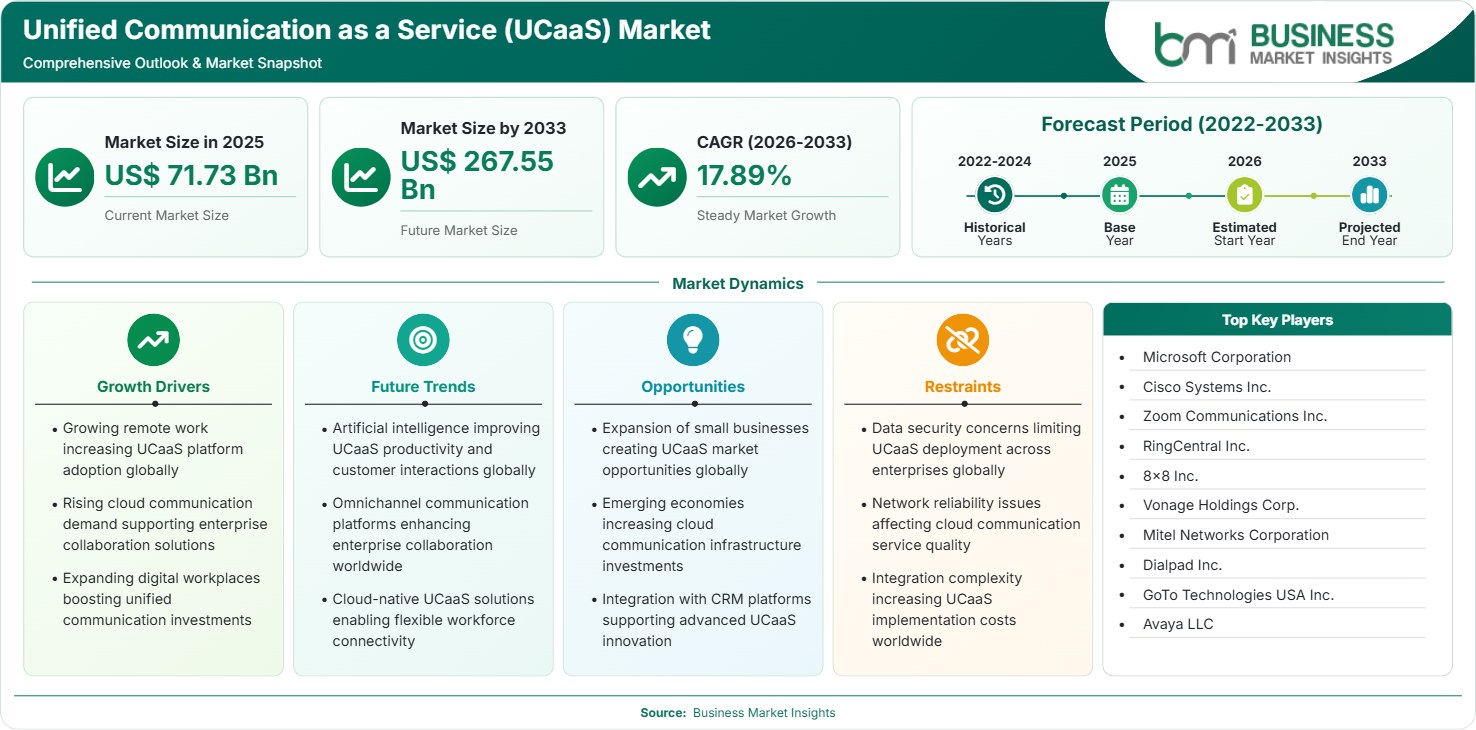
The Unified Communication as a Service (UCaaS) Market size was valued at US$ 71.73 billion in 2025 and is projected to reach US$ 267.55 billion by 2033, growing at a CAGR of 17.89% during 2026–2033, driven by enterprise cloud adoption, hybrid work expansion, digital workplace transformation, AI-enabled collaboration, and increasing demand for integrated communication platforms.

Report Coverage
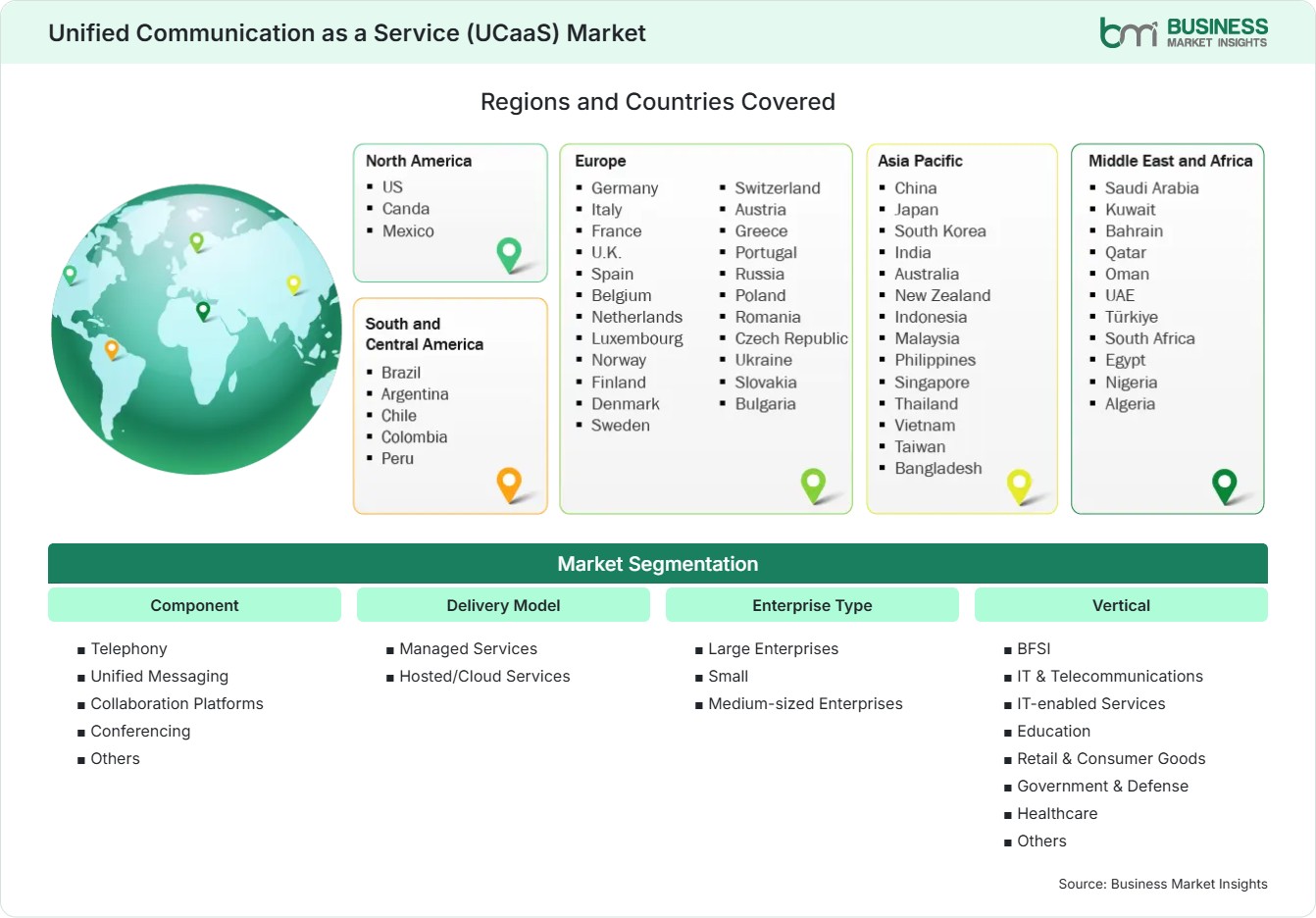
  • Component: Telephony, Unified Messaging, Collaboration Platforms, Conferencing, Others
  • Delivery Model: Managed Services, Hosted/Cloud Services
  • Enterprise Type: Large Enterprises, Small, Medium-sized Enterprises
  • Vertical: BFSI, IT & Telecommunications, IT-enabled Services , Education, Retail & Consumer Goods, Government & Defense, Healthcare, Others
US$ 71.73 Bn Market size in 2025
US$ 267.55 Bn Market Size by 2033
17.89% CAGR, 2026 - 2033
2026-2033 Forecast Period

AI Overview

Unified Communication as a Service (UCaaS) Market Summary

  • North America Region: North America accounted for 38%–41% share in 2025 and is projected to grow at a CAGR of 17%–19% during 2026–2033. Enterprise cloud migration, advanced digital infrastructure, hybrid workforce adoption, and AI-enabled collaboration platforms continue strengthening regional demand. The US market is expected to register a 17.5%–19.5% CAGR during 2026–2033 owing to increasing enterprise software investments and rapid deployment of cloud communication solutions.
  • Fastest Growing Region: Asia Pacific held 24%–27% share in 2025 and is anticipated to expand at a CAGR of 19%–21% through 2026–2033. Growing digital economies, cloud infrastructure expansion, SME digitization, and increasing internet penetration continue accelerating regional adoption.
  • Leading Segment: Hosted/Cloud Services represented 63%–66% Unified Communication as a Service (UCaaS) market share in 2025 and is forecast to expand at a CAGR of 18%–20% during 2026–2033. Scalability, subscription pricing, simplified deployment, and remote workforce support continue driving enterprise preference.
  • High Growth Segment: Small and Medium-sized Enterprises (SMEs) accounted for 39%–42% share in 2025 while recording the fastest 19%–21% CAGR during 2026–2033 owing to increasing cloud adoption and affordable SaaS communication platforms.
  • Key Market Opportunity: Increasing digital transformation among SMEs, AI-enabled collaboration platforms, CRM integration, and expansion of cloud communication infrastructure continue creating long-term opportunities for service providers.
  • Major Market Players: Microsoft Corporation, Cisco Systems Inc., Zoom Communications Inc., RingCentral Inc., 8x8 Inc., Vonage Holdings Corp., Mitel Networks Corporation, Dialpad Inc., GoTo Technologies USA Inc., Avaya LLC
Strategic Insights

Unified Communication as a Service (UCaaS) Market: Strategic Insights

Unified Communication as a Service (UCaaS) Market Strategic Framework
FREE PDF
Request your free sample
Request free sample
Stakeholder View

Key Takeaways

  • The market ecosystem is increasingly centered around cloud platform providers, telecom operators, software vendors, cybersecurity companies, and systems integration partners delivering end-to-end collaboration services.
  • Hosted cloud deployment continues providing the strongest commercial opportunity as organizations replace legacy communication infrastructure with scalable subscription-based platforms.
  • Artificial intelligence, real-time transcription, multilingual collaboration, intelligent routing, and workflow automation are reshaping enterprise communication strategies.
  • Asia Pacific offers substantial investment potential due to expanding SME digitalization, government cloud initiatives, and rapidly improving communication infrastructure.
  • Strategic acquisitions, platform partnerships, and ecosystem integrations remain major competitive strategies as vendors strengthen collaboration capabilities.
  • Vertical-specific communication platforms are gaining importance as regulated industries demand secure, compliant, and highly customized collaboration environments.
Geographic Outlook

Unified Communication as a Service (UCaaS) Market Regional Highlights

North America Unified Communication as a Service (UCaaS) Market

North America accounted for 38%–41% of the market in 2025 and is expected to register a CAGR of 17%–19% during 2026–2033. The region benefits from mature cloud infrastructure, widespread hybrid work adoption, and strong enterprise investment in digital collaboration technologies. The Unified Communication as a Service (UCaaS) Market share remains the largest globally due to continuous innovation by leading software providers and growing demand for integrated enterprise communication platforms.

  • Enterprises are replacing traditional PBX systems with cloud-native communication platforms that improve flexibility, scalability, and operational efficiency across distributed workforces.
  • Increasing investments in artificial intelligence, cybersecurity, and unified collaboration technologies continue strengthening enterprise cloud communication adoption.
  • Telecom providers are expanding managed communication services through strategic partnerships with leading cloud platform vendors.
  • Healthcare, BFSI, government, and education sectors continue modernizing communication infrastructure to support secure digital collaboration.

US Unified Communication as a Service (UCaaS) Market

The US represented 70%–73% of the North American market in 2025 and is projected to grow at a CAGR of 17.5%–19.5% through 2026–2033. Strong enterprise software spending, mature cloud infrastructure, and increasing hybrid workforce adoption continue supporting market expansion. Organizations across multiple industries are investing in AI-enabled communication platforms to improve workforce productivity and customer engagement.

  • Large enterprises continue migrating legacy communication infrastructure toward integrated cloud collaboration environments.
  • Artificial intelligence capabilities such as meeting summaries, intelligent routing, and virtual assistants are becoming standard enterprise requirements.
  • Financial institutions increasingly deploy secure communication platforms to strengthen regulatory compliance and operational efficiency.
  • Expanding hyperscale cloud infrastructure continues improving service quality and enterprise adoption.

Europe Unified Communication as a Service (UCaaS) Market

Europe held 27%–30% share of the market in 2025 and is forecast to expand at a CAGR of 18%–20% during 2026–2033. Enterprise digital transformation, increasing cloud adoption, and strict data protection regulations continue driving demand. Germany leads regional implementation, while the United Kingdom records the fastest adoption among mature markets. The Unified Communication as a Service (UCaaS) Market growth is further supported by increasing investments in secure enterprise collaboration infrastructure.

  • Germany continues investing in enterprise cloud modernization across manufacturing and industrial sectors.
  • The United Kingdom is witnessing rapid deployment of AI-enabled communication and collaboration platforms.
  • France is expanding cloud adoption across healthcare, education, and government organizations.
  • Nordic countries continue leading digital workplace adoption through advanced broadband infrastructure and cloud readiness.
  • Growing regulatory compliance requirements are encouraging secure cloud communication deployments.

Asia Pacific Unified Communication as a Service (UCaaS) Market

Asia Pacific accounted for 24%–27% market share in 2025 and is anticipated to register the fastest 19%–21% CAGR through 2026–2033. Increasing SME digitization, expanding cloud infrastructure, rapid internet penetration, and government digital transformation initiatives continue strengthening regional demand. China, India, Japan, South Korea, Singapore, and Australia remain key growth contributors due to expanding enterprise cloud investments.

  • China continues expanding enterprise cloud communication through rapid digital transformation and large-scale cloud infrastructure investments.
  • India is witnessing increasing UCaaS adoption among SMEs due to affordable SaaS subscription models and growing startup ecosystems.
  • Japan and South Korea continue investing in AI-powered enterprise collaboration technologies, promoting Unified Communication as a Service (UCaaS) Market.
  • Southeast Asian economies are strengthening enterprise communication infrastructure through expanding cloud service availability.
  • Regional telecom operators are partnering with software vendors to deliver integrated communication platforms.

Rest of World Unified Communication as a Service (UCaaS) Market

Rest of World represented 5%–8% of the market in 2025 and is projected to expand at a CAGR of 16%–18% during 2026–2033. Latin America, the Middle East, and Africa are experiencing increasing demand as enterprises modernize communication infrastructure and expand cloud adoption. Government digitalization programs and improving connectivity continue supporting long-term market development.

  • Brazil and Mexico are increasing enterprise cloud communication investments through digital transformation initiatives.
  • Gulf countries continue strengthening cloud infrastructure supporting enterprise collaboration services.
  • African enterprises are gradually adopting hosted communication platforms as broadband accessibility improves.
  • Managed communication service providers are expanding regional partnerships to improve customer reach and implementation capabilities.
  • Education and public sector organizations increasingly adopt cloud collaboration platforms to enhance operational efficiency.
Global Market Geography
FREE PDF
Request your free sample
Request free sample
Segment Analysis

Unified Communication as a Service (UCaaS) Market Segmentation

Component

Component segmentation reflects increasing enterprise demand for integrated communication ecosystems that unify voice, messaging, meetings, and collaboration. Collaboration Platforms accounted for 31%–34% market share in 2025 and are projected to grow at a CAGR of 18%–20% during 2026–2033 as organizations prioritize seamless teamwork, workflow automation, and AI-enabled productivity. The Unified Communication as a Service (UCaaS) Market scope continues expanding with increasing digital workplace transformation across industries.

  • Telephony: Cloud telephony solutions continue replacing legacy PBX systems by delivering flexible voice communication, simplified management, reduced infrastructure costs, and seamless integration with enterprise productivity applications.
  • Unified Messaging: Unified messaging solutions improve communication efficiency by consolidating voicemail, email, instant messaging, and notifications into centralized cloud-based platforms accessible from multiple connected devices.
  • Collaboration Platforms: Collaboration platforms remain the largest component owing to increasing demand for team messaging, document sharing, video collaboration, workflow integration, and AI-assisted productivity features.
  • Conferencing: Cloud conferencing platforms continue witnessing strong adoption as enterprises expand hybrid work models requiring secure, high-quality virtual meetings and real-time collaboration across distributed teams.
  • Others: Additional communication services including contact center integration, communication APIs, mobility management, and workforce engagement tools continue complementing enterprise UCaaS deployments.

Delivery Model

Delivery model segmentation highlights enterprise preference for scalable cloud-native communication solutions. Hosted/Cloud Services held the largest 63%–66% market share in 2025 and are projected to expand at a CAGR of 18%–20% during 2026–2033 due to subscription pricing, simplified deployment, automatic updates, and improved scalability. The Unified Communication as a Service (UCaaS) Market trends indicate continued migration away from on-premises communication infrastructure.

  • Managed Services: Managed services remain important for organizations requiring dedicated operational support, regulatory compliance, security monitoring, implementation assistance, and continuous platform optimization.
  • Hosted/Cloud Services: Hosted cloud services dominate because they provide rapid deployment, flexible scalability, lower capital expenditure, and seamless integration with enterprise productivity ecosystems.

Enterprise Type

Enterprise type segmentation demonstrates increasing cloud communication adoption across organizations of every size. Large Enterprises accounted for 58%–61% share in 2025 and are forecast to register a CAGR of 17%–19% during 2026–2033 owing to complex communication requirements, global operations, and continuous digital transformation investments.

  • Large Enterprises: Large organizations prioritize secure, scalable, AI-enabled communication platforms supporting thousands of users across geographically distributed business operations and multiple communication channels.
  • Small and Medium-sized Enterprises (SMEs): SMEs are the fastest-growing adopters as affordable subscription pricing, minimal infrastructure requirements, and simplified deployment improve accessibility to advanced enterprise collaboration technologies.

Vertical

Vertical segmentation reflects growing communication modernization across multiple industries. IT and Telecommunications maintained the leading 24%–27% market share in 2025 and is expected to expand at a CAGR of 18%–20% through 2026–2033 because of high digital maturity, distributed workforces, and continuous cloud technology adoption.

  • BFSI: Financial institutions increasingly deploy secure communication platforms supporting regulatory compliance, customer engagement, digital banking operations, and workforce collaboration.
  • IT and Telecommunications: Technology companies continue leading adoption through extensive cloud utilization, hybrid workforce management, and rapid implementation of AI-enabled communication platforms.
  • IT-enabled Services (ITeS): ITeS organizations leverage UCaaS platforms to improve customer support, workforce productivity, remote operations, and global service delivery capabilities.
  • Education: Educational institutions increasingly adopt cloud collaboration platforms supporting virtual classrooms, digital learning environments, administrative communication, and academic collaboration.
  • Retail and Consumer Goods: Retail organizations utilize cloud communication to strengthen customer engagement, store coordination, inventory collaboration, and omnichannel business operations.
  • Government and Defense: Government agencies modernize secure communication infrastructure supporting digital public services, emergency coordination, and interdepartmental collaboration requirements.
  • Healthcare: Healthcare providers increasingly implement unified communication solutions supporting telehealth services, clinical collaboration, secure patient communication, and operational efficiency.
  • Others: Additional industries including transportation, logistics, hospitality, manufacturing, and energy continue expanding adoption of integrated enterprise communication platforms to improve operational coordination.
Market Forces

Unified Communication as a Service (UCaaS) Market Dynamics

Key Market Drivers

Growing remote work increasing UCaaS platform adoption globally

Growing remote work increasing UCaaS platform adoption globally is accelerating enterprise migration toward integrated cloud communication environments. Organizations are adopting unified platforms that combine voice, messaging, video conferencing, file sharing, and collaboration into a single interface to support hybrid workforces. According to the International Labour Organization and enterprise digital workplace trends, flexible work models continue influencing long-term technology investments. The Unified Communication as a Service (UCaaS) Market growth is driven by increasing workforce mobility, artificial intelligence-enabled productivity tools, and demand for secure enterprise collaboration. Businesses continue prioritizing scalable subscription-based communication solutions that improve operational efficiency while reducing infrastructure complexity.

Rising cloud communication demand supporting enterprise collaboration solutions

Rising cloud communication demand supporting enterprise collaboration solutions is strengthening enterprise adoption of scalable communication platforms across public and private sectors. Organizations increasingly require unified environments capable of supporting real-time collaboration, secure communications, workflow automation, and seamless integration with business applications. Cloud-native deployment enables rapid implementation, continuous software updates, and lower operational costs compared with conventional communication infrastructure. Vendors are expanding AI-powered features including meeting transcription, intelligent routing, multilingual translation, and conversational analytics. Continuous improvements in cloud infrastructure and enterprise connectivity are further strengthening long-term demand for advanced UCaaS platforms.

Expanding digital workplaces boosting unified communication investments

Expanding digital workplaces boosting unified communication investments continues transforming enterprise collaboration strategies worldwide. Businesses are integrating communication platforms with productivity suites, workflow management software, cybersecurity tools, and enterprise applications to create connected digital work environments. Hybrid work policies, distributed global teams, and increasing employee mobility continue driving investments in cloud communication technologies. Organizations are also adopting intelligent collaboration capabilities including virtual assistants, automated meeting summaries, and AI-powered scheduling. Continuous workplace digitization across healthcare, finance, education, manufacturing, and government sectors remains a significant driver supporting sustained market expansion.

Key Market Opportunities

Expansion of small businesses creating UCaaS market opportunities globally

Expansion of small businesses creating UCaaS market opportunities globally is creating substantial demand for affordable cloud communication platforms that require minimal upfront investment. SMEs increasingly prefer subscription-based unified communication services that provide enterprise-grade telephony, messaging, conferencing, and collaboration capabilities without maintaining complex IT infrastructure. Cloud deployment enables faster implementation, scalability, and simplified management while supporting business expansion. The Unified Communication as a Service (UCaaS) Market Forecasts indicate continued investment from service providers in SME-focused product portfolios, flexible pricing models, and industry-specific collaboration capabilities that enhance productivity and operational efficiency.

Emerging economies increasing cloud communication infrastructure investments

Emerging economies increasing cloud communication infrastructure investments are creating attractive opportunities for UCaaS providers as governments and enterprises strengthen digital connectivity. Expanding broadband coverage, regional data centers, hyperscale cloud facilities, and enterprise digital transformation initiatives are improving accessibility to cloud-based communication services. Asia Pacific, Latin America, the Middle East, and Africa continue investing in digital infrastructure that supports enterprise collaboration. Service providers are establishing regional partnerships and localized cloud deployments to improve regulatory compliance, reduce latency, and accelerate enterprise adoption across developing markets.

Integration with CRM platforms supporting advanced UCaaS innovation

Integration with CRM platforms supporting advanced UCaaS innovation is enabling organizations to deliver personalized customer engagement and intelligent business communications. Enterprises increasingly connect communication platforms with customer relationship management systems to improve sales productivity, customer support, and operational workflows. Artificial intelligence further enhances these integrations through automated call routing, customer sentiment analysis, predictive recommendations, and workflow automation. Vendors continue expanding open APIs and ecosystem partnerships that simplify enterprise integration while creating differentiated cloud communication experiences across multiple business applications.

Market Restraints and Challenges

Data security concerns limiting UCaaS deployment across enterprises globally

Factor: Data security concerns remain one of the primary challenges affecting enterprise adoption of cloud communication platforms because organizations manage sensitive business conversations, customer information, financial records, and confidential corporate data. Impact: Security risks increase compliance requirements, delay procurement decisions, and encourage additional investments in encryption, identity management, and cybersecurity frameworks. Enterprises operating in highly regulated industries frequently require advanced security certifications, regional data residency, and continuous compliance monitoring before migrating mission-critical communication systems to cloud environments.

Network reliability issues affecting cloud communication service quality

Factor: Network reliability issues continue influencing communication quality because UCaaS platforms depend heavily on stable broadband connectivity and low-latency cloud infrastructure. Impact: Connectivity interruptions, bandwidth limitations, and network congestion can reduce call quality, disrupt virtual meetings, and negatively affect business productivity. Organizations increasingly invest in redundant network architectures, software-defined wide area networking (SD-WAN), traffic optimization technologies, and multiple connectivity providers to improve service availability while cloud vendors expand regional infrastructure to enhance platform resilience and user experience.

Company Analysis

Competitive Landscape

The Unified Communication as a Service (UCaaS) Market analysis indicates a highly competitive environment characterized by continuous innovation in cloud communications, artificial intelligence, collaboration software, and enterprise productivity platforms. Leading vendors are strengthening their positions through strategic acquisitions, AI-powered communication capabilities, cybersecurity enhancements, CRM integrations, and global cloud infrastructure expansion. Industry participants are also investing in vertical-specific solutions, advanced analytics, and omnichannel communication services to differentiate their offerings and support enterprise digital transformation initiatives.

Company Name

Overview

Products and Services relevant to this market

Microsoft Corporation

Microsoft Corporation develops enterprise cloud software, productivity solutions, and intelligent communication platforms for organizations worldwide.

Microsoft Teams, Teams Phone, cloud collaboration, enterprise messaging, conferencing, AI-powered productivity, and communication services.

Cisco Systems Inc.

Cisco Systems Inc. provides enterprise networking, cybersecurity, and cloud communication technologies supporting digital workplaces.

Webex Suite, cloud calling, unified communications, conferencing, collaboration software, contact center, and networking solutions.

Zoom Communications Inc.

Zoom Communications Inc. delivers cloud-based video communications and enterprise collaboration technologies globally.

Zoom Workplace, Zoom Phone, meetings, webinars, contact center, messaging, and AI-enabled collaboration services.

RingCentral Inc.

RingCentral Inc. specializes in cloud-native business communication platforms for enterprises and SMEs.

Cloud telephony, messaging, video meetings, contact center, AI communications, and unified collaboration solutions.

8x8 Inc.

8x8 Inc. provides integrated cloud communications and customer engagement platforms for businesses.

Voice, video, messaging, contact center, communication APIs, analytics, and unified cloud communication solutions.

Vonage Holdings Corp.

Vonage Holdings Corp. develops cloud communications and programmable communication technologies for enterprises.

Unified communications, cloud telephony, communications APIs, contact center, messaging, and collaboration platforms.

Mitel Networks Corporation

Mitel Networks Corporation supplies enterprise communication technologies across public and private cloud environments.

Unified communications, business telephony, collaboration, contact center, cloud communications, and enterprise networking solutions.

Dialpad Inc.

Dialpad Inc. develops artificial intelligence-powered cloud communication platforms supporting enterprise collaboration.

AI-powered voice, meetings, messaging, contact center, transcription, analytics, and cloud communication services.

GoTo Technologies USA Inc.

GoTo Technologies USA Inc. provides cloud communications and remote collaboration solutions for businesses globally.

GoTo Connect, virtual meetings, cloud phone systems, messaging, remote support, and collaboration platforms.

Avaya LLC

Avaya LLC delivers enterprise communication, collaboration, and customer experience technologies worldwide.

Unified communications, cloud contact center, collaboration platforms, business telephony, and enterprise communication services.

Trust & Transparency

Research Methodology

The market analysis combines proprietary research with secondary data from government agencies, company disclosures, regulatory filings, industry databases and expert interviews. Market estimates are validated through data triangulation, cross-market benchmarking and analyst review.

View Full Research Methodology

Questions Answered

Frequently Asked Questions

How will the Unified Communication as a Service (UCaaS) Market Report support business decision?

The report provides comprehensive insights into market dynamics, competitive landscape, regional opportunities, segmentation, technology trends, strategic developments, and future growth prospects, enabling organizations to make informed investment and expansion decisions.

What industries are rapidly adopting UCaaS solutions?

BFSI, IT and Telecommunications, IT-enabled Services (ITeS), healthcare, education, retail, and government organizations are rapidly deploying UCaaS platforms to improve collaboration, customer engagement, and operational efficiency.

Which delivery model accounts for the largest market share?

Hosted/Cloud Services represent the largest share owing to lower deployment costs, simplified scalability, automatic software updates, flexible subscription pricing, and seamless integration with enterprise productivity applications.

Which region dominates the market?

North America leads the market because of advanced cloud infrastructure, high enterprise technology spending, mature digital ecosystems, and the strong presence of leading cloud communication solution providers.

What is driving the Unified Communication as a Service (UCaaS) Market?

Increasing hybrid work adoption, enterprise cloud migration, digital workplace transformation, AI-enabled collaboration tools, and growing demand for integrated communication platforms are the major factors driving market expansion.

Access the Full Unified Communication as a Service (UCaaS) Market Report

Get segment-level forecasts, regional estimates, competitive benchmarking, company profiles and downloadable Excel datasets.

Access the full Unified Communication as a Service (UCaaS) Market Report
350 pages PDF & Excel | 2026-08-31
Similar Research

Related Market Reports