
Customer Communication Management Market Outlook: Size, Share, Trends, Growth Analysis, Competitive Landscape & Forecast, 2026-2033

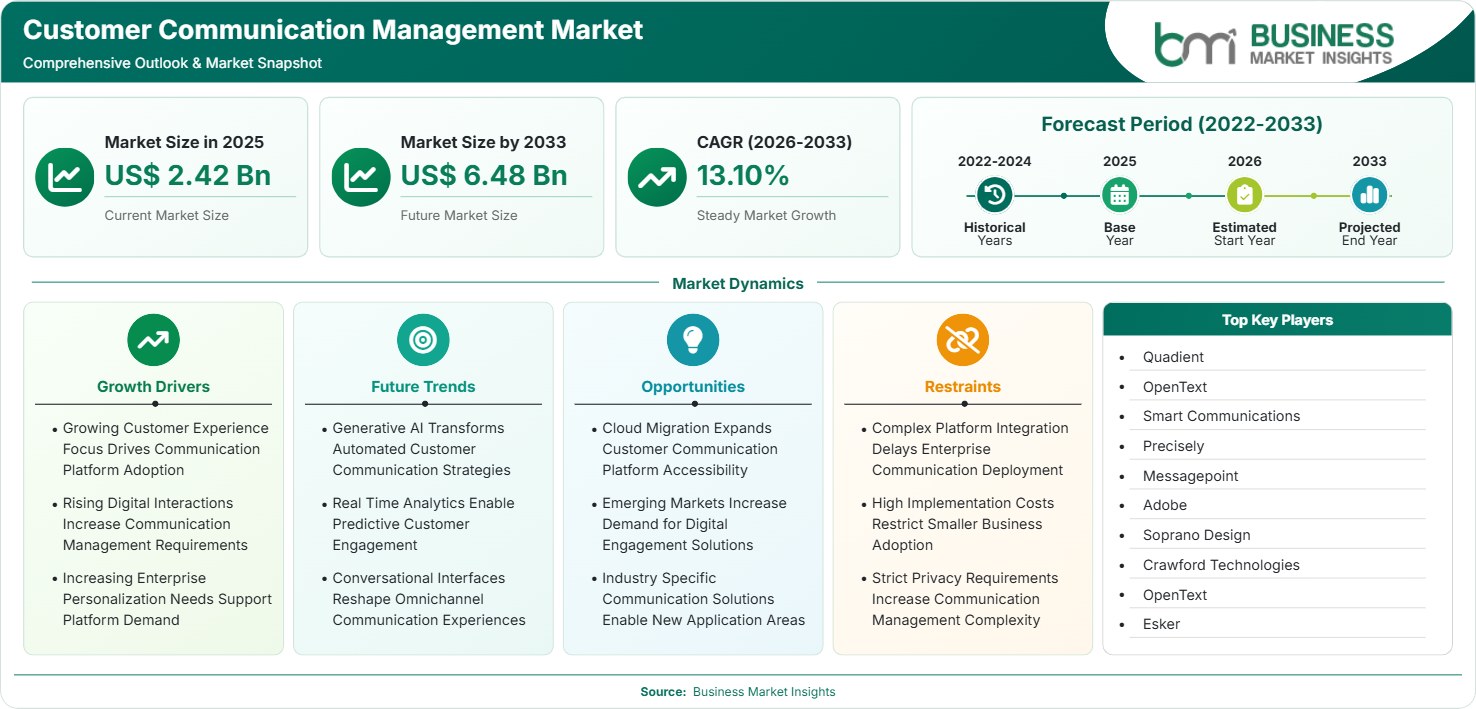
The Customer Communication Management Market size was valued at US$ 2.42 billion in 2025 and is projected to reach US$ 6.48 billion by 2033, growing at a CAGR of 13.10% during 2026–2033. Increasing digital engagement requirements, demand for personalized customer interactions, enterprise automation adoption, and cloud-based communication platforms are creating strong opportunities across industries.

Report Coverage
  • Component: Software, Services
  • Enterprise Type: Large Enterprises, SMEs
  • Channel: SMS, Email, Website, Social Media, Others
  • Industry: BFSI, Retail, IT & Telecom, Government, Healthcare, Others
US$ 2.42 Bn Market size in 2025
US$ 6.48 Bn Market Size by 2033
13.10% CAGR, 2026 - 2033
2026-2033 Forecast Period

01 AI Overview

Customer Communication Management Market Summary

  • North America Region: North America holds a leading position with a share ranging between 38%–41% in 2025 and is projected to grow at a CAGR of 12.4%–12.9% through 2033. Strong enterprise technology adoption, advanced customer experience strategies, and widespread cloud infrastructure support regional expansion. The U.S. Customer Communication Management Market benefits from high digital transformation investment, enterprise software adoption, and omnichannel communication requirements, supporting a CAGR of 12.5%–13.0%.
  • Fastest Growing Region: Asia Pacific represents the fastest-growing region with a share of 23%–26% in 2025 and is expected to expand at a CAGR of 14.5%–15.2%. Increasing digital services adoption, expanding online customer engagement, and growing enterprise modernization initiatives continue strengthening market opportunities.
  • Leading Segment: Software represents the leading component segment with a share of 62%–65% in 2025 and is projected to grow at a CAGR of 13.2%–13.8%. Growing demand for automation, personalization engines, analytics capabilities, and integrated communication platforms supports segment leadership.
  • High Growth Segment: Social Media channel solutions demonstrate strong expansion with a share of 15%–18% in 2025 and a CAGR of 14.8%–15.5%. Increasing consumer interaction through digital platforms and demand for real-time engagement are accelerating adoption.
  • Key Market Opportunity: Expansion of cloud communication platforms, AI-enabled personalization, and industry-specific engagement solutions is enabling providers to develop scalable platforms that improve customer interactions across banking, retail, healthcare, and government sectors.
  • Major Market Players: Quadient, OpenText Corporation, Smart Communications, Precisely, Messagepoint Inc., Adobe Inc., Soprano Design, Crawford Technologies, and Esker Inc.
02 Strategic Insights

Customer Communication Management Market: Strategic Insights

Customer Communication Management Market Strategic Framework
FREE PDF
Request your free sample
Request free sample
03 Stakeholder View

Key Takeaways

  • The Customer Communication Management Market ecosystem is evolving from traditional document management toward integrated communication experience platforms connecting content creation, workflow automation, analytics, and customer engagement technologies.
  • Businesses are prioritizing personalized communication capabilities, creating opportunities for platforms that combine customer data, automation tools, and omnichannel delivery mechanisms.
  • Artificial intelligence, machine learning, and predictive analytics are influencing platform development by improving content recommendations, customer segmentation, and communication efficiency.
  • Asia Pacific provides strong expansion potential as enterprises across developing economies accelerate digital transformation and adopt advanced customer engagement technologies.
  • Strategic partnerships and acquisitions are increasing as technology providers seek stronger cloud capabilities, broader communication channels, and specialized industry solutions.
  • The shift toward automated and intelligent communication management is encouraging vendors to invest in flexible architectures that support changing enterprise requirements.
04 Geographic Outlook

Customer Communication Management Market Regional Highlights

North America Customer Communication Management Market

North America accounted for approximately 38%–41% of global revenue in 2025 and is expected to expand at a CAGR of 12.4%–12.9% through 2033. The region maintains leadership due to advanced enterprise software adoption, strong cloud infrastructure, and increasing investment in customer experience technologies across banking, retail, healthcare, and government sectors.

  • The United States remains the largest contributor due to strong adoption of enterprise communication platforms, advanced digital services, and high investment in customer experience management technologies.
  • Canada demonstrates steady growth through increasing cloud adoption, expanding digital banking services, and rising demand for automated customer communication solutions.
  • Enterprises continue integrating AI-powered communication tools to improve personalization, automate workflows, and enhance customer engagement across multiple interaction channels.
  • Strong presence of technology providers and software innovators supports continuous development of advanced communication management capabilities across industries.

US Customer Communication Management Market

The United States represents the dominant country-level contributor within North America, supported by mature enterprise technology adoption, strong software spending, and increasing demand for personalized customer interactions. The market is projected to grow at a CAGR of 12.5%–13.0% through 2033, driven by digital transformation and omnichannel engagement initiatives.

  • Financial institutions continue adopting advanced communication platforms to improve customer service, regulatory messaging, and personalized engagement strategies.
  • Retail organizations are increasing investments in automated communication systems supporting customer retention, loyalty programs, and digital commerce experiences.
  • Enterprises are prioritizing cloud-based solutions to improve scalability, operational efficiency, and integration with existing technology ecosystems.

Europe Customer Communication Management Market

Europe represented approximately 26%–29% of global revenue in 2025 and is projected to expand at a CAGR of 12.0%–12.6% through 2033. Germany leads regional adoption through enterprise automation and industrial digitalization, while the United Kingdom demonstrates strong growth through financial technology advancement and digital service expansion.

  • Germany maintains regional leadership due to strong enterprise software adoption, automation initiatives, and demand for secure communication management systems.
  • The United Kingdom experiences increased adoption through financial services modernization, digital banking expansion, and customer experience investments.
  • European organizations are prioritizing secure communication solutions supporting regulatory compliance, data protection, and operational efficiency.
  • Growing adoption of cloud technologies is enabling businesses to modernize communication workflows and improve customer engagement.

Asia Pacific Customer Communication Management Market

Asia Pacific accounted for approximately 23%–26% of global revenue in 2025 and is forecast to achieve the fastest CAGR of 14.5%–15.2% through 2033. China leads regional adoption, while India demonstrates rapid growth through digital transformation initiatives, expanding online services, and increasing enterprise technology investments.

  • China continues expanding through digital commerce growth, financial technology adoption, and increasing enterprise demand for automated customer engagement platforms.
  • India demonstrates strong momentum through government digital initiatives, expanding businesses, and rising adoption of cloud-based communication solutions.
  • Japan and South Korea continue investing in advanced customer experience technologies across banking, telecommunications, and retail industries.
  • Regional enterprises are adopting omnichannel communication strategies to improve customer interactions and operational efficiency.

Rest of World Customer Communication Management Market

Rest of World regions contribute approximately 7%–10% of global revenue in 2025 and are projected to grow at a CAGR of 12.8%–13.5% through 2033. Latin America shows increasing adoption through digital banking expansion, while Middle East and Africa markets benefit from government digitalization and enterprise modernization initiatives.

  • Brazil represents an important Latin American market due to expanding digital services, financial technology adoption, and increasing enterprise communication requirements.
  • Middle Eastern countries are investing in digital government services and customer engagement platforms to improve citizen and business interactions.
  • African markets are gradually adopting cloud communication solutions as enterprises seek affordable and scalable digital engagement technologies.
  • International technology partnerships are improving regional access to advanced communication management platforms and implementation expertise.
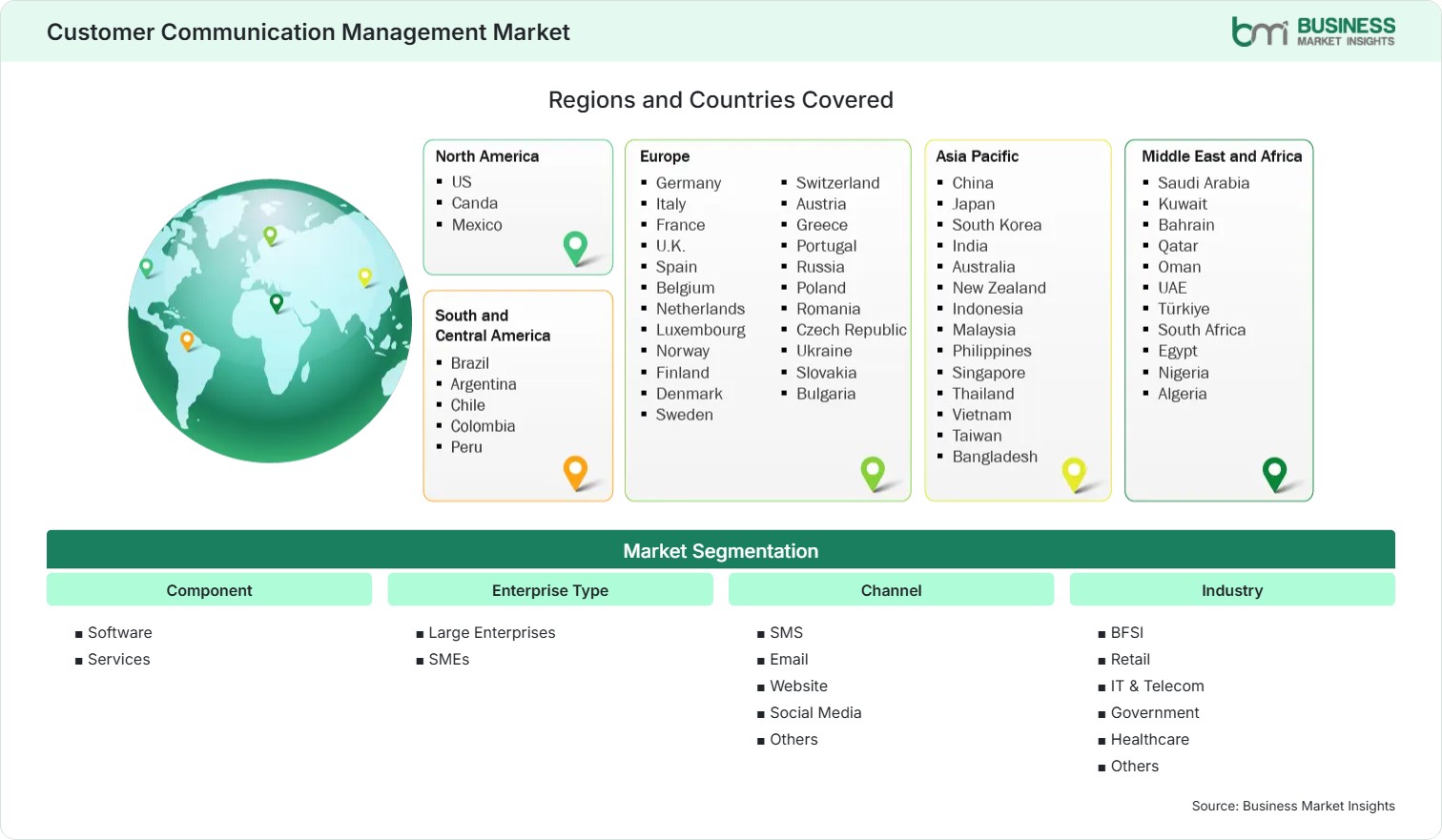
Global Market Geography
FREE PDF
Request your free sample
Request free sample
05 Segment Analysis

Customer Communication Management Market Segmentation

Component

The Component segment defines the technology foundation of communication management platforms, with Software accounting for 62%–65% market share in 2025 and expanding at a CAGR of 13.2%–13.8% through 2033. The Customer Communication Management Market scope continues expanding as enterprises prioritize automation, content personalization, workflow optimization, and integrated communication experiences.

  • Software: Enables automated content creation, customer interaction management, analytics, and omnichannel delivery. Demand is increasing as organizations adopt intelligent platforms for personalized communication and operational efficiency.
  • Services: Includes consulting, implementation, integration, maintenance, and support services helping enterprises deploy communication platforms effectively across complex technology environments.

Enterprise Type

The Enterprise Type segment reflects adoption patterns across organizations of different scales. Large Enterprises represent the dominant segment with 68%–71% Customer Communication Management Market share in 2025 and a CAGR of 12.8%–13.4% through 2033, supported by extensive communication requirements, complex customer journeys, and greater technology investment capabilities.

  • Large Enterprises: Require scalable communication platforms to manage high-volume interactions, regulatory communications, and personalized customer engagement across global operations.
  • SMEs: Increasingly adopt cloud-based communication solutions due to affordability, simplified deployment, and growing demand for professional customer engagement capabilities.

Channel

The Channel segment demonstrates increasing diversification as businesses adopt multiple digital communication touchpoints. Email remains the leading channel with 34%–37% share in 2025 and a CAGR of 12.6%–13.2% through 2033. The Customer Communication Management Market trend reflects rising demand for integrated channel management and consistent customer experiences.

  • SMS: Continues supporting transactional alerts, authentication messages, and time-sensitive customer communications due to broad accessibility and reliability.
  • Email: Remains widely adopted for marketing, service notifications, account updates, and personalized communication campaigns across industries.
  • Website: Supports self-service communication, digital customer journeys, and personalized content delivery through enterprise websites and online platforms.
  • Social Media: Gains momentum as organizations use digital platforms for customer engagement, support interactions, brand communication, and real-time responses.
  • Others: Includes emerging communication channels such as mobile applications, chat platforms, and specialized messaging solutions supporting evolving customer preferences.

Industry

The Industry segment covers diverse adoption areas, with BFSI maintaining leadership at 29%–32% share in 2025 and a CAGR of 13.0%–13.6% through 2033. Increasing regulatory communication requirements, customer service expectations, and digital banking transformation continue supporting adoption across financial organizations.

  • BFSI: Uses communication management platforms for statements, notifications, compliance messaging, personalized offers, and customer relationship enhancement.
  • Retail: Adopts solutions to improve promotional communication, loyalty engagement, customer service interactions, and personalized shopping experiences.
  • IT & Telecom: Requires scalable platforms to manage large customer bases, service notifications, billing communications, and digital engagement initiatives.
  • Government: Implements communication solutions for citizen services, public notifications, digital programs, and administrative information delivery.
  • Healthcare: Uses platforms for patient communication, appointment notifications, healthcare updates, and personalized engagement initiatives.
  • Others: Includes education, utilities, travel, and professional services organizations adopting communication platforms to improve customer interaction efficiency.
06 Market Forces

Customer Communication Management Market Dynamics

Key Market Drivers

Growing Customer Experience Focus Drives Communication Platform Adoption

Organizations across industries are prioritizing customer experience improvements as competition increases across digital channels. Businesses are investing in communication management platforms to deliver consistent, personalized, and timely interactions throughout customer journeys. Advanced analytics, automation capabilities, and integrated communication workflows are helping enterprises understand customer preferences and improve engagement outcomes. The Customer Communication Management Market trend is influenced by growing demand for seamless experiences across email, mobile, web, and social platforms. Companies are increasingly replacing fragmented communication systems with centralized platforms that improve operational efficiency, enhance personalization, and support long-term customer relationships.

Rising Digital Interactions Increase Communication Management Requirements

As the pace of digital interactions accelerates, demand for scalable communication management solutions capable of handling large volumes of customer interactions has increased. Organizations are dealing with increasing volumes of digital information, notifications, and personal messages through various channels. Communication platforms help companies automate their processes, maintain consistency, and respond faster. The growing adoption of online products and services, mobile applications, and digital commerce is pushing companies to update their communication systems. Tech vendors are adding features such as workflow automation, analytics, and platform integration.

Increasing Enterprise Personalization Needs Support Platform Demand

As personalization needs grow, companies are encouraged to adopt more effective communication management tools. Companies use customer data and other analytics, along with automation tools, to deliver messages tailored to customers' preferences, behavior, and interactions with the company. Personalized communication may help improve customer engagement, retention, and service efficiency across industries. Providers create intelligent solutions that integrate customer insights with content management tools to facilitate personalized communication strategies. Competition between different businesses only boosts this trend.

Key Market Opportunities

Cloud Migration Expands Customer Communication Platform Accessibility

The process of cloud migration is opening up many new opportunities, as it allows companies to gain access to flexible, scalable, and affordable communication management systems. These systems place fewer demands on infrastructure and enable easy installation and remote operation for enterprises operating across different geographic locations. Smaller businesses are more likely to adopt cloud-based platforms because they require lower investment and easier installation. Vendors are constantly developing software-as-a-service platforms that are automated and integrated. With more companies moving towards cloud-first approaches, adoption is expected to grow due to increased agility, faster deployment, and easier management of communication processes.

Emerging Markets Increase Demand for Digital Engagement Solutions

The emerging economies will provide fresh avenues as firms accelerate their digitalization and adopt modern technologies to engage customers. The growth of internet usage, e-commerce, and digital services will make it imperative for organizations to enhance their communication skills. Vendors have an opportunity to gain an advantage by providing scalable solutions suited to regional business needs, budgets, and customer preferences. The adoption of digital communication is gaining momentum across industries such as banking, retail, government, and telecommunications, thereby expanding the market potential for communication platforms. It would be useful to make alliances with regional technological firms to achieve greater market penetration.

Industry Specific Communication Solutions Enable New Application Areas

There is a rising demand for specialized communication solutions as various industries seek systems tailored to their particular workflows, compliance requirements, and customer engagement practices. Industry-specific solutions could help tackle the needs in the health care, financial services, government, and retail sectors. Vendors that can build industry-specific competencies will benefit from customization, automation, and analytics as differentiation tools. Growing regulatory and customer service demands are pushing companies to adopt specialized rather than generic solutions. This provides opportunities for vendors who can offer customized features and domain expertise.

Market Restraints and Challenges

Complex Platform Integration Delays Enterprise Communication Deployment

Factor: Communication management platforms often require integration with existing enterprise systems, customer databases, content repositories, and business applications. Impact: The process of integrating complex solutions is lengthy and increases technological demands, delaying the anticipated business benefits. It is possible that organizations will face difficulties with system compatibility, data transfer, and workflow customization. The vendors need to improve their integration platforms, provide implementation assistance, and demonstrate strong interoperability skills to streamline the process. Simplified APIs and flexible architectures are becoming increasingly crucial for faster adoption by enterprises with diverse technology ecosystems.

High Implementation Costs Restrict Smaller Business Adoption

Factor: Advanced communication management solutions require investment in software licensing, customization, integration, and employee training. Impact: Increased implementation costs can pose barriers for companies with limited technology budgets. Firms can defer platform upgrades or stick to simple communication tools because of the demand for enhanced customer interaction. Cloud pricing and other measures by vendors have been devised to tackle this problem. Cost reduction and simplifying implementations are key strategies towards increasing adoption.

07 Company Analysis

Competitive Landscape

The competitive environment is characterized by platform innovation, cloud-based communication capabilities, automation enhancements, and increasing focus on personalized customer engagement. The Customer Communication Management Market analysis highlights that leading providers are expanding capabilities through artificial intelligence, workflow automation, omnichannel delivery, and industry-focused solutions to address growing enterprise communication requirements.

Company Name

Overview

Products and Services relevant to this market

Quadient

Global technology provider specializing in customer communication, business process automation, and customer experience solutions for enterprises worldwide.

Customer communication management platforms, document automation, digital communication solutions, customer journey management, and omnichannel engagement tools.

OpenText Corporation

Enterprise information management company providing software solutions for content management, digital communications, and business process optimization.

Customer communication platforms, enterprise content management, digital experience solutions, document automation, and workflow management technologies.

Smart Communications

Customer communications technology company focused on cloud-based solutions for personalized and automated customer interactions.

Customer communication management software, document generation platforms, digital engagement solutions, and personalized communication automation tools.

Precisely

Data integrity and software company providing solutions that improve business data management, customer communication, and operational efficiency.

Data-driven communication solutions, customer engagement technologies, workflow automation, and integration capabilities supporting enterprise communications.

Messagepoint Inc.

Customer communications software provider specializing in intelligent content management and personalized customer engagement solutions.

Communication management platforms, content automation, document generation, personalization tools, and AI-enabled customer communication solutions.

Adobe Inc.

Global software company offering digital experience solutions supporting customer engagement, marketing automation, and personalized communications.

Adobe Experience Cloud, customer journey management, digital content solutions, marketing automation, analytics, and personalization technologies.

Soprano Design

Enterprise messaging technology company providing secure mobile communication and customer engagement solutions.

Business messaging platforms, SMS communication solutions, mobile engagement tools, and secure enterprise messaging technologies.

Crawford Technologies

Software provider focused on document accessibility, customer communications, and enterprise output management solutions.

Document automation, customer communication software, accessibility solutions, digital delivery platforms, and output management technologies.

Esker Inc.

Cloud software company delivering automation solutions for business processes, customer service, and digital transformation initiatives.

Customer service automation, document processing solutions, workflow automation, cloud communication tools, and business process platforms.

10 Trust & Transparency

Research Methodology

The market analysis combines proprietary research with secondary data from government agencies, company disclosures, regulatory filings, industry databases and expert interviews. Market estimates are validated through data triangulation, cross-market benchmarking and analyst review.

View Full Research Methodology

11 Questions Answered

Frequently Asked Questions

What technologies are shaping the future of communication management platforms?

According to the Customer Communication Management Market forecasts, artificial intelligence, predictive analytics, automation, cloud computing, customer data integration, and real-time personalization technologies are shaping future platforms by improving communication efficiency and customer engagement capabilities.

What does this Customer Communication Management Market report provide to businesses?

This report provides insights into technology trends, competitive strategies, segmentation opportunities, regional developments, adoption factors, and business considerations supporting strategic planning and investment decisions.

How are cloud technologies influencing communication management adoption?

Cloud platforms are improving accessibility, scalability, and deployment flexibility by reducing infrastructure requirements. They enable organizations to implement communication solutions faster while supporting distributed operations and evolving customer interaction models.

Which industries are the major users of communication management solutions?

Banking, financial services, insurance, retail, telecommunications, healthcare, and government organizations are major adopters due to high communication volumes, regulatory requirements, and increasing customer engagement expectations.

What is driving adoption of customer communication management platforms?

Increasing focus on customer experience, digital transformation, omnichannel engagement, workflow automation, and demand for personalized interactions are encouraging enterprises across industries to adopt advanced communication management solutions.

Access the Full Customer Communication Management Market Report

Get segment-level forecasts, regional estimates, competitive benchmarking, company profiles and downloadable Excel datasets.

Access the full Customer Communication Management Market Report
350 pages PDF & Excel | 2026-08-07