
Enterprise Asset Management Market Outlook: Size, Share, Trends, Growth Analysis, Competitive Landscape & Forecast, 2026-2033

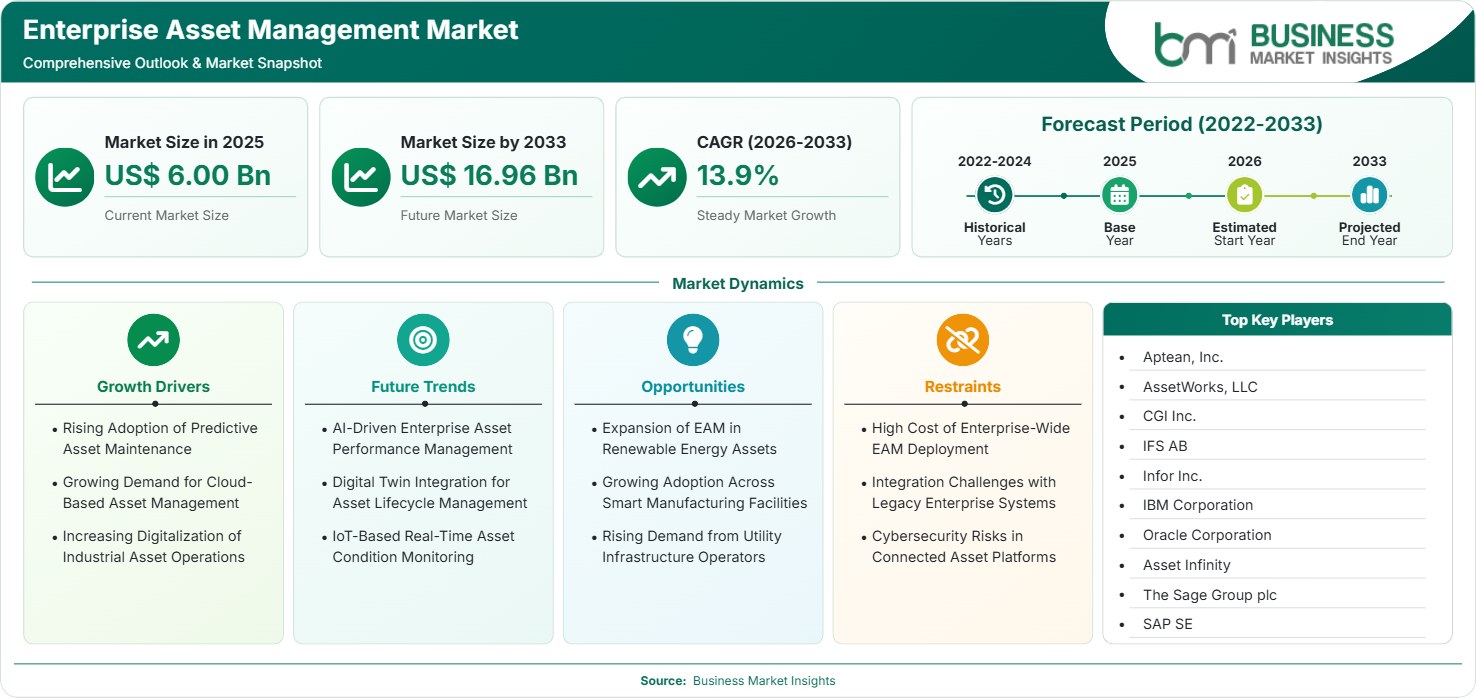
The Enterprise Asset Management Market size was valued at US$ 6.00 Billion in 2025 and is projected to reach US$ 16.96 Billion by 2033, growing at a CAGR of 13.9% during 2026–2033. Rising digital transformation across asset-intensive industries, increasing adoption of predictive maintenance, and growing investments in cloud-based asset management platforms are driving market growth. Integration of AI, IoT, and analytics continues creating significant opportunities for enterprise asset optimization.

Report Coverage
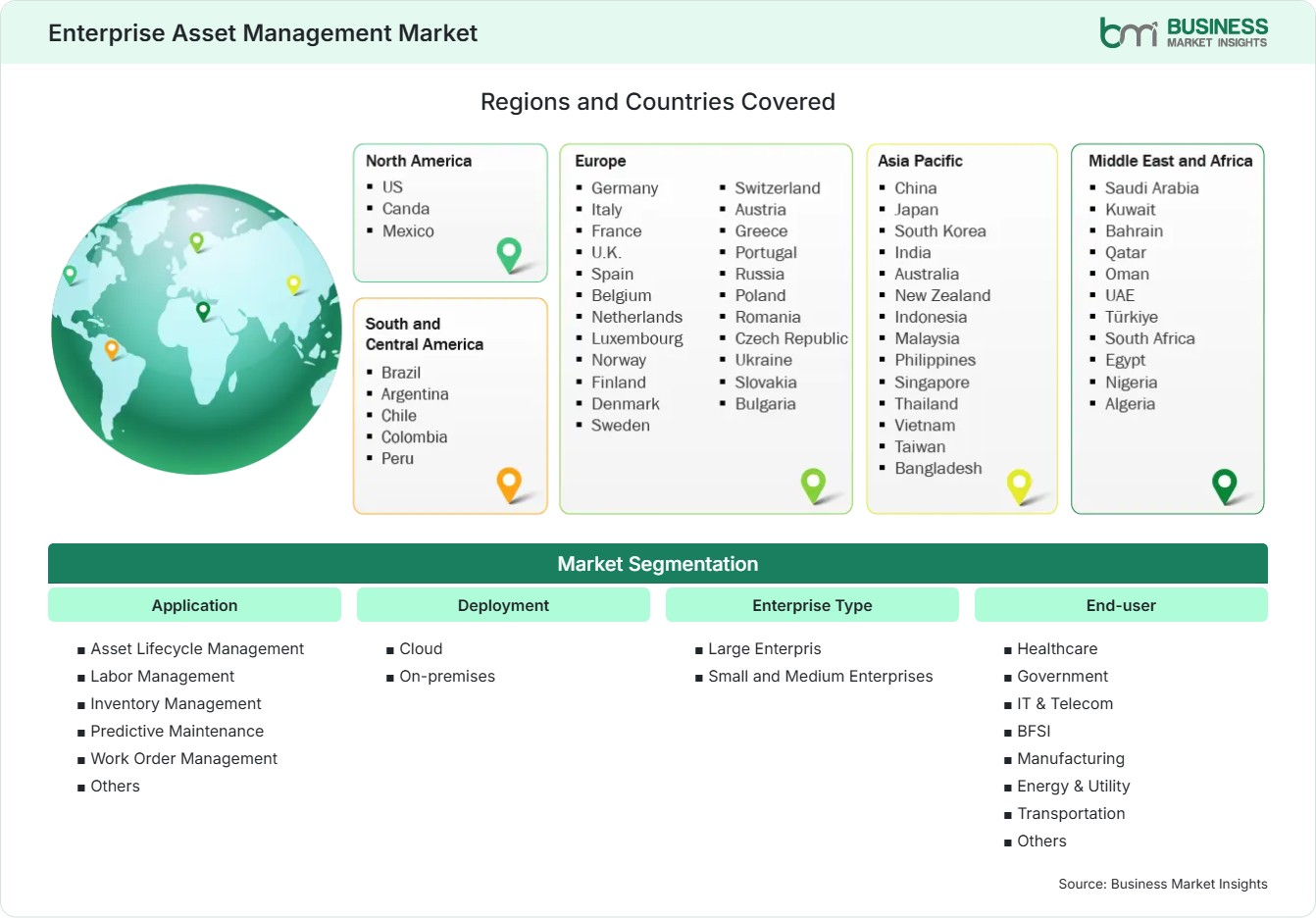
  • Application: Asset Lifecycle Management, Labor Management, Inventory Management, Predictive Maintenance, Work Order Management, Others
  • Deployment: Cloud, On-premises
  • Enterprise Type: Large Enterpris, Small and Medium Enterprises
  • End-user: Healthcare, Government, IT & Telecom, BFSI, Manufacturing, Energy & Utility, Transportation, Others
US$ 6.00 Bn Market size in 2025
US$ 16.96 Bn Market Size by 2033
13.9% CAGR, 2026 - 2033
2026-2033 Forecast Period

01 AI Overview

Enterprise Asset Management Market Summary

  • North America Region: North America holds a market share of 37%–40% in 2025 and is projected to grow at a CAGR of 13.2%–13.7% during 2026–2033. Strong enterprise software adoption, widespread industrial digitalization, and increasing predictive maintenance initiatives continue supporting regional demand. The US remains the largest regional market, expanding at a CAGR of 13.3%–13.8%.
  • Fastest Growing Region: Asia Pacific accounts for 24%–27% of the market in 2025 and is expected to register the fastest CAGR of 15.2%–15.8% during the forecast period. Rapid industrial automation, smart manufacturing investments, and cloud adoption continue accelerating regional growth.
  • Leading Segment: Deployment – Cloud represents 59%–62% of the market in 2025 and is projected to expand at a CAGR of 14.5%–15.0%. Scalability, remote accessibility, and lower infrastructure costs continue driving enterprise adoption.
  • High Growth Segment: Application – Predictive Maintenance accounts for 18%–21% of the market in 2025 while registering a CAGR of 15.4%–16.0%. AI-enabled analytics, IoT integration, and reduced equipment downtime continue supporting rapid expansion.
  • Key Market Opportunity: Growing adoption of AI-powered asset performance management, industrial IoT platforms, and digital twin technologies is creating substantial opportunities for enterprise software providers.
  • Major Market Players: Aptean, Inc., AssetWorks, LLC, CGI Inc., IFS AB, Infor Inc., IBM Corporation, Oracle Corporation, Asset Infinity, The Sage Group plc, and SAP SE.
02 Strategic Insights

Enterprise Asset Management Market: Strategic Insights

Enterprise Asset Management Market Strategic Framework
FREE PDF
Request your free sample
Request free sample
03 Stakeholder View

Key Takeaways

  • The enterprise asset management market ecosystem is supported by enterprise software vendors, cloud infrastructure providers, system integrators, IoT solution providers, and consulting firms delivering comprehensive asset lifecycle management solutions.
  • Manufacturing, energy & utilities, transportation, and healthcare continue presenting the strongest commercial opportunities as organizations modernize maintenance operations and asset performance management.
  • Innovation is increasingly focused on AI-powered predictive maintenance, digital twins, mobile workforce management, cloud-native platforms, and advanced analytics for intelligent asset optimization.
  • Asia Pacific offers the strongest long-term investment opportunity due to accelerating industrial digitalization, smart factory deployments, expanding cloud infrastructure, and increasing enterprise technology spending.
  • Strategic acquisitions, cloud platform expansion, AI integration, and partnerships with industrial technology providers continue strengthening competitive positioning across the enterprise software landscape.
  • ESG initiatives, energy efficiency optimization, and real-time sustainability reporting are emerging as important differentiators within modern enterprise asset management platforms.
04 Geographic Outlook

Enterprise Asset Management Market Regional Highlights

North America Enterprise Asset Management Market

North America accounts for 37%–40% of the global market in 2025 and is projected to grow at a CAGR of 13.2%–13.7% during 2026–2033. The Enterprise Asset Management Market share is supported by strong enterprise software adoption, mature cloud infrastructure, and increasing investments in digital transformation across asset-intensive industries. Growing deployment of AI-enabled predictive maintenance and industrial IoT solutions continues strengthening regional demand.

  • Manufacturing, utilities, transportation, and healthcare organizations are increasingly adopting cloud-based enterprise asset management platforms to improve operational efficiency and asset utilization.
  • Widespread implementation of predictive maintenance technologies is reducing equipment downtime while optimizing maintenance planning and lifecycle management.
  • Organizations continue integrating AI, IoT, and analytics with enterprise software to enable real-time monitoring and intelligent asset decision-making.
  • Growing emphasis on regulatory compliance, operational resilience, and cybersecurity is accelerating modernization of enterprise asset management systems.
  • Expansion of smart infrastructure projects continues creating long-term demand for advanced asset lifecycle management platforms.

US Enterprise Asset Management Market

The United States represents 31%–34% of the global market in 2025 and is expected to register a CAGR of 13.3%–13.8% through 2033. High enterprise technology spending, widespread cloud adoption, and increasing investments in industrial automation continue driving market growth. Organizations are prioritizing predictive maintenance, digital asset tracking, and intelligent maintenance planning to improve operational performance.

  • Large enterprises continue modernizing legacy asset management systems with cloud-native platforms integrated with AI and advanced analytics.
  • Utilities and manufacturing companies are increasingly deploying connected asset monitoring solutions to improve equipment reliability and reduce maintenance costs.
  • Growing adoption of mobile workforce management solutions continues improving field service productivity and operational visibility.
  • Investments in Industry 4.0 initiatives continue accelerating deployment of intelligent enterprise asset management technologies.

Europe Enterprise Asset Management Market

Europe holds 27%–30% of the global market in 2025 and is projected to expand at a CAGR of 13.4%–13.9% during the forecast period. Strong industrial automation, digital manufacturing initiatives, and regulatory focus on operational efficiency continue supporting regional growth. Germany leads the regional market, while Spain records the fastest growth owing to increasing enterprise digital transformation investments.

  • Germany maintains regional leadership through advanced manufacturing capabilities, industrial automation, and widespread deployment of enterprise software solutions.
  • Spain is projected to witness the fastest regional growth due to increasing cloud adoption, smart manufacturing investments, and digital modernization initiatives.
  • Organizations continue integrating enterprise asset management platforms with ERP, IoT, and industrial automation systems to improve productivity.
  • Sustainability initiatives and asset performance optimization are encouraging greater investment in intelligent lifecycle management solutions.
  • Expanding renewable energy infrastructure continues increasing demand for digital asset management platforms across utilities.

Asia Pacific Enterprise Asset Management Market

Asia Pacific accounts for 24%–27% of the global market in 2025 and is projected to record the fastest CAGR of 15.2%–15.8% during 2026–2033. Rapid industrialization, expanding smart manufacturing initiatives, and growing enterprise cloud adoption continue driving market growth. China dominates the regional market, while India records the fastest growth owing to accelerating digital transformation and industrial automation.

  • China continues investing in smart factories, industrial automation, and intelligent manufacturing technologies requiring advanced asset management platforms.
  • India records the fastest regional growth supported by increasing enterprise software adoption, cloud migration, and expanding industrial digitalization initiatives.
  • Japan and South Korea continue strengthening adoption of AI-enabled maintenance solutions across advanced manufacturing industries.
  • Rising investments in utilities, transportation, and infrastructure modernization continue supporting broader deployment of enterprise asset management software.
  • Growing adoption of IoT-enabled asset monitoring is improving operational visibility and maintenance efficiency across industries.

Rest of World Enterprise Asset Management Market

The Rest of World accounts for 8%–10% of the global market in 2025 and is projected to grow at a CAGR of 13.5%–14.0% during the forecast period.

South & Central America continues to witness increased enterprise software adoption as organizations modernize maintenance operations and industrial infrastructure. Brazil leads the regional market, while Mexico records the fastest growth through expanding manufacturing and digital transformation initiatives.

The Middle East & Africa continues benefiting from investments in smart infrastructure, utilities, and industrial diversification. Saudi Arabia leads the regional market, while the United Arab Emirates records the fastest growth due to increasing adoption of digital asset management technologies.

  • Brazil continues investing in industrial modernization and enterprise digital transformation, supporting higher demand for intelligent asset management solutions.
  • Mexico is strengthening market growth through manufacturing expansion, cloud adoption, and increasing automation across industrial sectors.
  • Saudi Arabia continues implementing digital transformation initiatives across energy, utilities, and public infrastructure under long-term economic diversification programs.
  • The United Arab Emirates is rapidly adopting AI-powered enterprise software to improve infrastructure management and operational efficiency.
  • Increasing investments in smart cities, transportation, and utility infrastructure continue supporting long-term adoption of enterprise asset management platforms.
Global Market Geography
FREE PDF
Request your free sample
Request free sample
05 Segment Analysis

Enterprise Asset Management Market Segmentation

Application

Application remains the primary factor influencing enterprise asset management software adoption across asset-intensive industries. Asset Lifecycle Management accounts for 26%–29% of the market in 2025 and is projected to grow at a CAGR of 13.8%–14.3% during 2026–2033. The Enterprise Asset Management Market scope continues expanding as organizations focus on maximizing asset utilization, reducing operational costs, and extending equipment lifespan.

  • Asset Lifecycle Management: Asset lifecycle management dominates the market by enabling organizations to optimize asset planning, acquisition, maintenance, utilization, and retirement through centralized digital platforms.
  • Labor Management: Labor management solutions improve workforce scheduling, technician productivity, skill allocation, and maintenance resource utilization across complex enterprise operations.
  • Inventory Management: Inventory management applications optimize spare parts availability, reduce procurement costs, and improve maintenance efficiency through real-time inventory visibility.
  • Predictive Maintenance: Predictive maintenance solutions leverage AI, analytics, and IoT data to identify equipment failures before breakdowns, minimizing unplanned downtime.
  • Work Order Management: Work order management streamlines maintenance planning, task assignment, technician coordination, and service documentation across enterprise environments.
  • Others: Other applications include asset tracking, compliance management, warranty management, reporting, mobile inspections, and performance analytics.

Deployment

Deployment preferences continue shifting toward flexible and scalable enterprise software environments. Cloud accounts for 59%–62% of the market in 2025 and is expected to register a CAGR of 14.5%–15.0% during the forecast period. Lower infrastructure costs, remote accessibility, and faster implementation continue shaping Enterprise Asset Management Market trends.

  • Cloud: Cloud deployment leads the market by providing scalability, remote access, lower maintenance costs, automatic software updates, and seamless integration with enterprise applications.
  • On-premises: On-premises deployment remains preferred among organizations requiring greater control over data security, regulatory compliance, and customized enterprise software environments.

Enterprise Type

Enterprise size significantly influences deployment models, investment priorities, and software functionality requirements. Large Enterprises account for 67%–70% of the market in 2025 and are projected to grow at a CAGR of 13.6%–14.1% during 2026–2033. Increasing digital transformation investments continue supporting enterprise-wide software adoption.

  • Large Enterprises: Large enterprises dominate due to extensive asset portfolios, complex maintenance operations, higher technology budgets, and widespread implementation of digital transformation strategies.
  • Small and Medium Enterprises: Small and medium enterprises are increasingly adopting cloud-based platforms that offer affordable deployment, simplified implementation, and scalable asset management capabilities.

End-user

End-user demand is driven by digital transformation, operational efficiency, and asset optimization initiatives across industries. Manufacturing accounts for 24%–27% of the market in 2025 and is projected to grow at a CAGR of 14.2%–14.8% through 2033. Industry 4.0 adoption continues accelerating enterprise asset management investments.

  • Healthcare: Healthcare organizations utilize enterprise asset management platforms to improve medical equipment availability, maintenance scheduling, compliance, and asset tracking.
  • Government: Government agencies deploy asset management solutions to optimize public infrastructure, transportation assets, facilities, and operational efficiency.
  • IT & Telecom: IT and telecom companies leverage enterprise asset management to monitor network infrastructure, data centers, communication assets, and maintenance operations.
  • BFSI: Financial institutions utilize asset management platforms to manage facilities, IT infrastructure, branch assets, and operational maintenance activities.
  • Manufacturing: Manufacturing remains the leading end-user owing to extensive equipment assets, predictive maintenance requirements, and increasing industrial automation.
  • Energy & Utility: Energy and utility operators increasingly deploy enterprise asset management software to optimize power generation, transmission, distribution, and field asset maintenance.
  • Transportation: Transportation organizations utilize enterprise asset management for fleet optimization, railway infrastructure, airport assets, and maintenance planning.
  • Others: Other end users include education, retail, construction, mining, oil and gas, and logistics organizations managing large asset portfolios.
06 Market Forces

Enterprise Asset Management Market Dynamics

Key Market Drivers

Rising Adoption of Predictive Asset Maintenance

Organizations are increasingly deploying predictive maintenance technologies to reduce equipment failures, improve operational reliability, and optimize maintenance schedules. The Enterprise Asset Management Market growth is supported by AI-powered analytics, IoT sensors, and machine learning algorithms that continuously monitor equipment health and predict failures before they occur. Predictive maintenance minimizes unplanned downtime, lowers maintenance costs, extends asset lifespan, and enables organizations to improve operational productivity across manufacturing, utilities, transportation, and other asset-intensive industries.

Growing Demand for Cloud-Based Asset Management

Enterprise asset management systems that use the cloud have become increasingly popular over time for the following reasons: they offer scalability, low implementation costs, remote access, automatic software upgrades, and easy integration with enterprise applications. More and more businesses are opting for cloud-based solutions to increase their operational flexibility and cut down on IT expenses.

Increasing Digitalization of Industrial Asset Operations

Industrial enterprises keep on investing in digitization solutions, which increase visibility of assets, effectiveness of maintenance activities, and the overall performance of operations. The integration of enterprise asset management systems with IoT devices, industrial automation systems, and analytics makes it possible to monitor operations in real time and make data-driven maintenance decisions.

Key Market Opportunities

Expansion of EAM in Renewable Energy Assets

Growing investments in renewable energy infrastructure are creating significant opportunities for enterprise asset management software providers. Enterprise Asset Management Market Forecasts indicate increasing demand as wind farms, solar parks, battery storage facilities, and smart grids require advanced lifecycle management, predictive maintenance, and remote asset monitoring capabilities to maximize operational performance.

Growing Adoption Across Smart Manufacturing Facilities

Smart factory manufacturers are increasingly deploying intelligent enterprise asset management (EAM) systems that have been developed in conjunction with the application of industrial automation, robotics, artificial intelligence (AI), and IoT technologies. The systems offer benefits such as real-time monitoring capabilities, predictive maintenance services, and other data analytics that can enhance the efficiency of asset management by improving equipment use, reducing downtime, and improving maintenance scheduling. Integrations with manufacturing execution systems and digital twins further add value to operations and production processes. As companies embrace Industry 4.0, EAM is being deployed in efforts to make business processes more efficient, manage asset lifecycles better, minimize costs, and deliver quality products. More investment in digital transformation within manufacturing facilities will drive greater demand for intelligent EAM systems.

Rising Demand from Utility Infrastructure Operators

Utility companies have been making efforts to modernize power generation, transmission, distribution, and water utility systems by implementing digital asset management software solutions. The enterprise asset management system helps utility companies increase asset performance, implement effective maintenance, compliance management, and extend the life of their assets. Enterprise asset management software enables companies to monitor their assets in real time, manage their workforce, and assess risks to help reduce service outages. With increasing investments being made in smart grids, renewable energy integration, and aged asset infrastructure replacement, there has been an increasing need for enterprise asset management systems among utility companies.

Market Restraints and Challenges

High Cost of Enterprise-Wide EAM Deployment

Factor: Enterprise-wide implementation requires substantial investments in software licensing, cloud infrastructure, system integration, employee training, and ongoing maintenance services.

Impact: High deployment costs may delay implementation among budget-constrained organizations, particularly small and medium enterprises, extending return-on-investment timelines and slowing enterprise-wide adoption.

Integration Challenges with Legacy Enterprise Systems

Factor: Many organizations operate legacy ERP, maintenance, and operational systems that lack seamless compatibility with modern enterprise asset management platforms.

Impact: Integration complexity increases implementation time, project costs, and operational disruption while requiring customized development, extensive testing, and skilled technical resources for successful deployment.

07 Company Analysis

Competitive Landscape

The Enterprise Asset Management Market analysis is highly competitive, with global enterprise software providers and specialized asset management vendors focusing on cloud-native platforms, AI-powered maintenance, IoT integration, and digital asset lifecycle management. Companies are expanding their SaaS offerings, strengthening analytics capabilities, and forming strategic partnerships to enhance operational efficiency across asset-intensive industries.

Company Name

Overview

Products and Services Relevant to this Market

Aptean, Inc.

Enterprise software company providing industry-specific business management solutions for manufacturing and distribution sectors.

Enterprise asset management software, maintenance management, ERP solutions, and industrial asset optimization platforms.

AssetWorks, LLC

Provider of asset lifecycle management and infrastructure management software for public and private organizations.

Enterprise asset management software, fleet management, facilities management, and infrastructure asset solutions.

CGI Inc.

Global IT consulting and business solutions company serving public and private sector enterprises.

Enterprise asset management implementation, consulting, digital transformation, cloud integration, and managed services.

IFS AB

Global enterprise software company specializing in asset-intensive industries and industrial applications.

Enterprise asset management software, field service management, ERP, and industrial AI solutions.

Infor Inc.

Enterprise software provider delivering cloud-based business applications for multiple industries.

Cloud enterprise asset management, ERP software, maintenance management, and operational analytics solutions.

IBM Corporation

Global technology company offering AI, cloud computing, and enterprise software solutions.

IBM Maximo Application Suite, AI-powered asset management, predictive maintenance, and industrial IoT solutions.

Oracle Corporation

Leading enterprise software and cloud infrastructure provider serving global organizations.

Oracle Enterprise Asset Management, cloud ERP, maintenance management, and asset lifecycle solutions.

Asset Infinity

Cloud-based asset management software provider focused on enterprise asset tracking and maintenance.

Asset tracking software, maintenance management, inventory management, and cloud-based enterprise asset solutions.

The Sage Group plc

Multinational enterprise software company providing business management and accounting solutions.

Enterprise management software, operational management tools, business applications, and cloud services.

SAP SE

Global enterprise software leader providing integrated business management platforms.

SAP Enterprise Asset Management, SAP S/4HANA, predictive maintenance, IoT integration, and asset intelligence solutions.

08 Industry Activity

Recent Developments

February 2026

IFS AB partnered with Siemens and Cognizant to expand its Industrial AI capabilities, embedding advanced predictive maintenance and digital twin technology to optimize enterprise asset performance and lifecycles.

January 2026

Hitachi Energy, in collaboration with Microsoft, launched an AI-enabled Ellipse Enterprise Asset Management solution to improve critical infrastructure resilience through predictive asset management and enhanced operational intelligence.

December 2025

IBM Corporation launched Maximo Condition Insight within the IBM Maximo Application Suite, introducing agentic AI-driven capabilities to automate predictive maintenance, anomaly detection, and real-time asset monitoring for industrial enterprises.

April 2025

Naviam launched as a new enterprise asset management company by uniting seven leading IBM Maximo solution providers under one brand, expanding its cloud, mobile, and GIS-enabled asset management capabilities.

10 Trust & Transparency

Research Methodology

The market analysis combines proprietary research with secondary data from government agencies, company disclosures, regulatory filings, industry databases and expert interviews. Market estimates are validated through data triangulation, cross-market benchmarking and analyst review.

View Full Research Methodology

11 Questions Answered

Frequently Asked Questions

What are the major opportunities in the Enterprise Asset Management Market?

Key opportunities include expanding renewable energy infrastructure, increasing smart manufacturing deployments, rising adoption by utility operators, and growing integration of AI, IoT, and digital twin technologies.

Who are the major companies operating in the market?

Major companies include Aptean, Inc., AssetWorks, LLC, CGI Inc., IFS AB, Infor Inc., IBM Corporation, Oracle Corporation, Asset Infinity, The Sage Group plc, and SAP SE.

Which region is expected to witness the fastest growth?

Asia Pacific is projected to record the fastest growth owing to accelerating industrial automation, smart manufacturing initiatives, enterprise cloud adoption, and increasing digital transformation investments.

Which segment dominates the Enterprise Asset Management Market Report?

The Cloud deployment segment dominates the market due to its scalability, lower infrastructure costs, remote accessibility, faster implementation, and seamless integration with enterprise applications.

What is driving the market?

The market is driven by increasing adoption of predictive maintenance, rapid industrial digitalization, growing cloud deployment, AI-enabled asset analytics, and rising investments in Industry 4.0 technologies across asset-intensive industries.

Access the Full Enterprise Asset Management Market Report

Get segment-level forecasts, regional estimates, competitive benchmarking, company profiles and downloadable Excel datasets.

Access the full Enterprise Asset Management Market Report
350 pages PDF & Excel | 2026-07-31