
Enterprise Data Management Market Outlook: Size, Share, Trends, Growth Analysis, Competitive Landscape & Forecast, 2026-2033

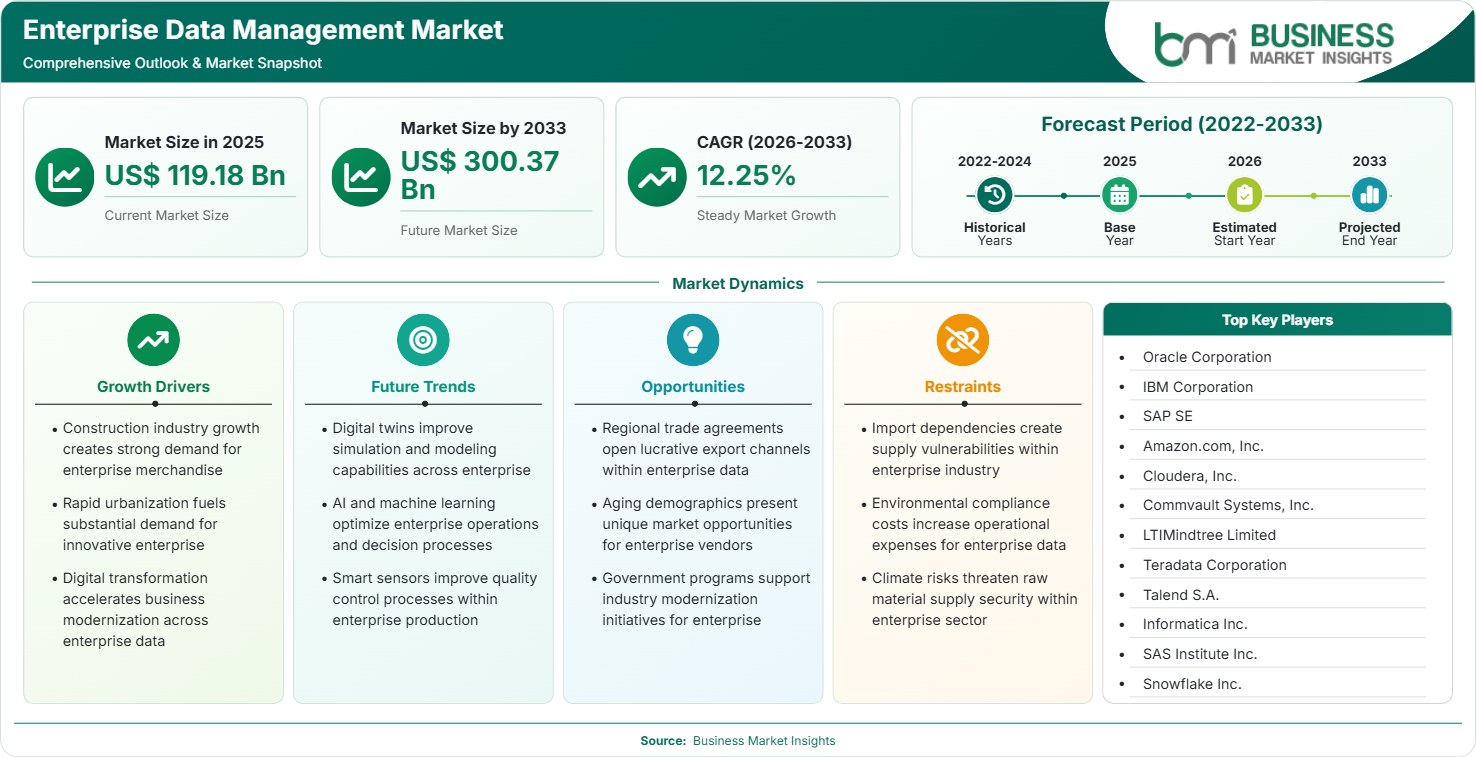
The Enterprise Data Management Market size was valued at US$ 119.18 Billion in 2025 and is projected to reach US$ 300.37 Billion by 2033, growing at a CAGR of 12.25% during 2026–2033. Rising enterprise digital transformation, AI-driven analytics adoption, stricter regulatory compliance, cloud migration, and expanding data governance initiatives are accelerating demand, while growing investments in intelligent data platforms create long-term opportunities across industries.

Report Coverage
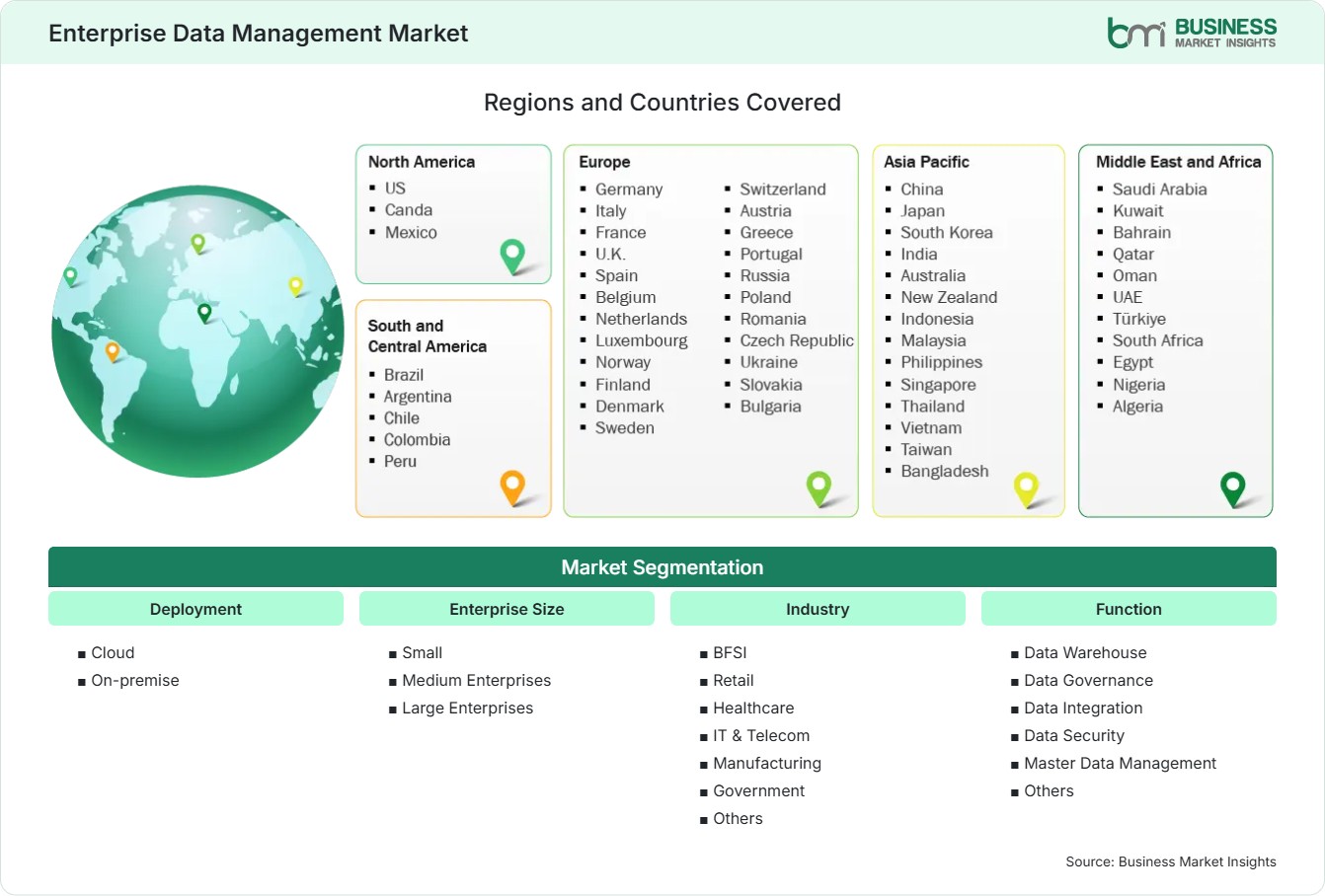
  • Deployment: Cloud, On-premise
  • Enterprise Size: Small, Medium Enterprises, Large Enterprises
  • Industry: BFSI, Retail, Healthcare, IT & Telecom, Manufacturing, Government, Others
  • Function: Data Warehouse, Data Governance, Data Integration, Data Security, Master Data Management, Others
US$ 119.18 Bn Market size in 2025
US$ 300.37 Bn Market Size by 2033
12.25% CAGR, 2026 - 2033
2026-2033 Forecast Period

AI Overview

Enterprise Data Management Market Summary

  • North America Region: North America holds 36%–39% market share in 2025, growing with a 10.8%–11.6% CAGR during 2026–2033, supported by enterprise cloud modernization, AI-powered governance, cybersecurity investments, regulatory compliance, hybrid infrastructure expansion, analytics automation, trusted data ecosystems, digital transformation initiatives, strategic partnerships, and innovation across large organizations. The U.S. dominates regional adoption through mature cloud ecosystems, AI integration, and enterprise modernization initiatives, advancing at an estimated CAGR of 10.9%–11.7%.
  • Fastest Growing Region: Asia Pacific holds 24%–27% market share in 2025, expanding at a 14.3%–15.2% CAGR during 2026–2033 as governments accelerate digital infrastructure, enterprises modernize legacy platforms, cloud adoption rises, data localization regulations strengthen, AI deployment expands, and investments increase across financial services, healthcare, manufacturing, and telecommunications.
  • Leading Segment: Cloud deployment accounts for 61%–64% market share in 2025 and advances with a 13.1%–13.9% CAGR through scalable infrastructure, lower operational costs, AI-enabled analytics, multi-cloud strategies, real-time accessibility, automated governance, secure collaboration, rapid implementation, flexible resource management, and enterprise-wide digital modernization.
  • High Growth Segment: Data Governance represents 17%–20% Enterprise Data Management Market share in 2025 while recording a 14.8%–15.6% CAGR, driven by stricter compliance frameworks, expanding AI governance requirements, metadata management, privacy regulations, enterprise risk reduction, trusted analytics, cross-functional collaboration, policy automation, and stronger information lifecycle management.
  • Key Market Opportunity: Enterprises increasingly invest in unified data fabrics integrating structured and unstructured information, enabling AI-ready architectures, regulatory compliance, real-time decision-making, operational resilience, automated governance, improved interoperability, scalable analytics, and sustainable digital transformation initiatives globally.
  • Major Market Players: Oracle Corporation, IBM Corporation, SAP SE, Amazon.com, Inc., Cloudera, Inc., Commvault Systems, Inc., LTIMindtree Limited, Teradata Corporation, Talend S.A., Informatica Inc., SAS Institute Inc., and Snowflake Inc.
Strategic Insights

Enterprise Data Management Market: Strategic Insights

Enterprise Data Management Market Strategic Framework
FREE PDF
Request your free sample
Request free sample
Stakeholder View

Key Takeaways

  • The Enterprise Data Management Market ecosystem is rapidly evolving toward integrated platforms that combine governance, security, metadata management, data integration, and analytics, enabling organizations to simplify complex data supply chains while improving enterprise-wide operational visibility.
  • Cloud deployment and data governance present the strongest commercial opportunities as enterprises prioritize scalable architectures, regulatory compliance, AI readiness, and secure collaboration across geographically distributed operations.
  • Artificial intelligence, machine learning, data fabric architectures, and automation are reshaping enterprise information strategies by improving data quality, accelerating integration workflows, reducing manual intervention, and enabling predictive business intelligence.
  • Asia Pacific offers the most compelling regional investment opportunity due to expanding digital economies, government-backed cloud initiatives, increasing enterprise IT spending, and rapid adoption across manufacturing, banking, healthcare, and telecommunications sectors.
  • Strategic acquisitions, technology alliances, and ecosystem partnerships continue redefining competitive positioning as vendors integrate AI, cybersecurity, cloud-native services, and governance capabilities into unified enterprise platforms to strengthen customer retention and recurring revenue.
  • Sustainability initiatives are encouraging organizations to optimize data infrastructure, reduce redundant storage, improve resource utilization, and implement intelligent lifecycle management practices that lower operational costs while supporting long-term digital resilience.
Geographic Outlook

Enterprise Data Management Market Regional Highlights

North America Enterprise Data Management Market

North America maintains leadership through mature cloud ecosystems, strong enterprise software investments, and widespread AI implementation across regulated industries. The region accounts for 36%–39% Enterprise Data Management Market share in 2025 and is projected to register a 10.8%–11.6% CAGR during 2026–2033. High digital maturity, increasing enterprise cybersecurity expenditure, advanced analytics adoption, and continuous modernization of legacy infrastructure strengthen demand. Financial institutions, healthcare organizations, technology providers, and government agencies remain the primary adopters of integrated enterprise data management platforms.

  • Large enterprises continue replacing fragmented legacy environments with unified cloud-native data ecosystems, improving governance, analytics performance, operational resilience, regulatory compliance, and cross-functional collaboration while reducing infrastructure complexity and long-term maintenance costs.
  • Artificial intelligence and generative AI applications are increasing enterprise demand for trusted datasets, metadata management, automated cataloging, and governance platforms capable of supporting responsible AI deployment across highly regulated business environments.
  • Financial services institutions continue expanding master data management and enterprise integration initiatives to improve fraud detection, customer analytics, regulatory reporting, and operational efficiency while strengthening enterprise-wide information consistency.
  • Healthcare providers increasingly implement secure data integration and governance solutions supporting interoperability requirements, electronic health records, clinical analytics, privacy compliance, and advanced research initiatives across distributed healthcare networks.
  • Strategic partnerships among hyperscale cloud providers, software vendors, and enterprise consulting firms continue accelerating modernization projects, encouraging broader adoption of scalable enterprise information management architectures.

US Enterprise Data Management Market

The United States represents the largest national Enterprise Data Management Market within North America, accounting for 81%–84% of regional revenue in 2025 while advancing at a 10.9%–11.7% CAGR through 2026–2033. Strong investments in AI infrastructure, cloud computing, cybersecurity, and enterprise software modernization continue driving adoption. Fortune 500 companies increasingly integrate governance, analytics, and intelligent automation platforms to improve operational efficiency, regulatory compliance, and digital competitiveness across multiple industries.

  • Technology companies continue investing heavily in AI-ready data platforms supporting predictive analytics, real-time intelligence, automated governance, and secure multi-cloud environments for enterprise-scale operations.
  • Banking institutions prioritize trusted enterprise information management to strengthen anti-money laundering programs, risk management, regulatory reporting, customer personalization, and digital banking transformation initiatives.
  • Healthcare organizations expand enterprise integration strategies to improve patient outcomes, streamline clinical workflows, enhance interoperability, and secure sensitive healthcare information while meeting evolving regulatory standards.
  • Federal and state government agencies continue modernizing information infrastructure, emphasizing cybersecurity, digital public services, standardized governance frameworks, and resilient enterprise architectures supporting long-term operational efficiency.

Europe Enterprise Data Management Market

Europe captures 27%–30% regional Enterprise Data Management Market share in 2025 and is anticipated to grow at a 11.4%–12.2% CAGR during 2026–2033. Strong privacy regulations, increasing enterprise cloud adoption, and investments in industrial digitalization continue supporting regional expansion. Germany remains the leading national market, while Spain and several Central European economies demonstrate comparatively faster adoption through digital transformation programs, AI investments, and manufacturing modernization initiatives.

  • Organizations continue strengthening governance frameworks to comply with evolving European privacy regulations while improving enterprise-wide transparency, data quality, and secure information exchange across multinational operations.
  • Manufacturing companies increasingly implement integrated information management platforms supporting Industry 4.0 initiatives, predictive maintenance, digital twins, supply chain optimization, and real-time operational intelligence.
  • Financial institutions accelerate cloud migration strategies while maintaining strong governance, cybersecurity, and regulatory compliance capabilities through advanced metadata management and enterprise integration technologies.
  • Germany leads regional revenue generation through mature enterprise software adoption, while Spain records one of the strongest expansion rates supported by digital innovation funding and cloud modernization initiatives.
  • Increasing sustainability reporting requirements encourage organizations to establish centralized enterprise information platforms capable of delivering accurate environmental, social, and governance reporting with greater operational efficiency.

Asia Pacific Enterprise Data Management Market

Asia Pacific accounts for 24%–27% Enterprise Data Management Market share in 2025 and is forecast to expand at the highest 14.3%–15.2% CAGR between 2026 and 2033. Rapid enterprise digitization, expanding cloud infrastructure, AI adoption, and supportive government digital economy initiatives continue accelerating regional demand. China generates the largest regional revenue, while India records the fastest growth owing to expanding technology investments, digital public infrastructure, and enterprise modernization programs.

  • Enterprises across banking, manufacturing, retail, and telecommunications increasingly deploy cloud-based governance and integration solutions supporting digital transformation, intelligent automation, customer analytics, and operational resilience.
  • National digital economy strategies encourage investment in sovereign cloud infrastructure, cybersecurity capabilities, AI innovation, and advanced enterprise information management technologies across public and private sectors.
  • China maintains regional leadership through extensive enterprise cloud adoption, whereas India demonstrates the strongest expansion supported by accelerating SaaS adoption, startup innovation, and digital government initiatives.
  • Growing regulatory attention toward data localization and privacy compliance encourages organizations to strengthen governance frameworks while improving enterprise-wide information visibility and lifecycle management capabilities.
  • Regional technology vendors increasingly collaborate with global cloud providers to deliver scalable, AI-enabled enterprise data platforms tailored to industry-specific regulatory and operational requirements.

Rest of World Enterprise Data Management Market

South & Central America, together with the Middle East and Africa, collectively account for 8%–10% Enterprise Data Management Market share in 2025 while registering a 12.1%–13.0% CAGR during 2026–2033.

Digital transformation investments across banking, public administration, energy, telecommunications, and healthcare continue strengthening regional demand. Brazil leads adoption within South & Central America, whereas the United Arab Emirates records the fastest expansion through smart government initiatives, cloud infrastructure development, and AI-driven enterprise modernization.

  • Brazilian enterprises continue investing in governance and integration platforms supporting financial modernization, regulatory compliance, digital banking, and advanced customer intelligence across rapidly evolving business environments.
  • The United Arab Emirates accelerates cloud-first strategies through national AI initiatives, smart government programs, and expanding investments in enterprise digital infrastructure supporting long-term economic diversification.
  • Energy and utilities organizations across the Middle East increasingly implement intelligent information management platforms to improve operational efficiency, predictive maintenance, regulatory reporting, and sustainability monitoring.
  • African enterprises progressively adopt cloud-native enterprise information platforms to improve operational agility, digital financial services, healthcare modernization, and public sector efficiency despite infrastructure disparities.
  • International cloud providers continue expanding regional data center capacity and strategic partnerships, enabling secure data residency, regulatory compliance, lower latency, and broader enterprise adoption across emerging markets.
Global Market Geography
FREE PDF
Request your free sample
Request free sample
Segment Analysis

Enterprise Data Management Market Segmentation

Deployment

Deployment remains the foundation of enterprise information strategies as organizations balance scalability, security, compliance, and operational efficiency. The cloud segment leads with 61%–64% market share in 2025 and is projected to register a 13.1%–13.9% CAGR through 2033 due to flexible infrastructure, AI integration, and lower ownership costs. The Enterprise Data Management Market scope continues expanding as hybrid operating models encourage organizations to combine cloud agility with secure on-premise environments for mission-critical workloads.

  • Cloud: Enterprises increasingly adopt cloud deployment to enable scalable storage, AI-enabled analytics, faster implementation, seamless remote collaboration, automated updates, stronger disaster recovery capabilities, and optimized infrastructure utilization across global operations.
  • On-premise: Organizations operating under stringent regulatory requirements continue investing in on-premise environments to maintain complete infrastructure control, support sensitive workloads, strengthen internal security policies, and integrate legacy enterprise applications effectively.

Enterprise Size

Enterprise adoption varies according to organizational complexity, regulatory obligations, and digital maturity. Large enterprises account for 68%–71% Enterprise Data Management Market share in 2025 while expanding at a 12.0%–12.8% CAGR, driven by multi-location operations, extensive data ecosystems, and advanced governance requirements. SMEs increasingly embrace cloud-native solutions that reduce implementation complexity, improve business intelligence, and enable enterprise-grade data capabilities without significant capital expenditure.

  • Small & Medium Enterprises (SMEs): SMEs increasingly implement subscription-based enterprise data platforms to improve decision-making, strengthen customer insights, automate compliance activities, and support business expansion with affordable, scalable technology solutions.
  • Large Enterprises: Large organizations prioritize integrated governance, master data management, enterprise-wide analytics, and intelligent automation to improve operational consistency, optimize strategic planning, and manage increasingly complex digital ecosystems efficiently.

Industry

Industry adoption continues accelerating as organizations recognize data as a strategic business asset supporting innovation, resilience, and competitive differentiation. The BFSI segment holds 24%–27% Enterprise Data Management Market share in 2025 and is expected to achieve a 12.8%–13.6% CAGR through 2033, supported by regulatory compliance, fraud prevention, customer analytics, and digital banking transformation. Healthcare, manufacturing, and government sectors also demonstrate strong implementation momentum through expanding digital modernization initiatives.

  • BFSI: Financial institutions deploy advanced governance, integration, and security platforms to strengthen regulatory reporting, improve customer intelligence, enhance fraud detection, and optimize enterprise-wide risk management capabilities.
  • Retail: Retail organizations utilize enterprise data management to unify omnichannel customer information, improve inventory visibility, personalize shopping experiences, strengthen demand forecasting, and optimize pricing strategies through advanced analytics.
  • Healthcare: Healthcare providers integrate clinical, operational, and administrative information to improve patient outcomes, regulatory compliance, research collaboration, and secure interoperability across increasingly connected healthcare ecosystems.
  • IT & Telecom: IT and telecommunications companies leverage intelligent data platforms to manage large-scale network information, automate service delivery, optimize infrastructure performance, and improve customer experience through predictive analytics.
  • Manufacturing: Manufacturers implement centralized enterprise information management to support predictive maintenance, digital twins, production optimization, supply chain visibility, and quality assurance across smart manufacturing environments.
  • Government: Public sector agencies adopt secure governance and integration platforms to modernize citizen services, improve policy implementation, strengthen cybersecurity, and enhance transparency across digital government operations.

Function

Functional adoption reflects enterprise priorities surrounding trusted information, regulatory compliance, operational efficiency, and AI readiness. Data Integration represents the largest functional segment with 29%–32% Enterprise Data Management Market share in 2025 and is forecast to grow at a 13.3%–14.1% CAGR through 2033. Organizations increasingly integrate governance, security, warehousing, and master data capabilities into unified platforms that deliver consistent, high-quality information supporting strategic business decisions.

  • Data Warehouse: Enterprise data warehouses consolidate structured information from multiple operational systems, enabling consistent reporting, advanced analytics, historical trend evaluation, and enterprise-wide business intelligence initiatives.
  • Data Governance: Organizations strengthen governance frameworks through automated policy management, metadata administration, compliance monitoring, stewardship programs, and trusted information practices supporting regulatory obligations and responsible AI deployment.
  • Data Integration: Modern integration platforms connect cloud applications, legacy systems, IoT environments, and third-party data sources, improving interoperability, operational efficiency, and real-time business decision-making across distributed enterprises.
  • Data Security: Enterprise security solutions safeguard sensitive business information through encryption, access controls, continuous monitoring, threat detection, identity management, and compliance with evolving global privacy regulations.
  • Master Data Management: Master data management establishes standardized enterprise records across customers, suppliers, products, and operational assets, improving information consistency, governance effectiveness, and cross-functional collaboration throughout organizations.
Market Forces

Enterprise Data Management Market Dynamics

Key Market Drivers

Accelerating AI Adoption Increases Enterprise Data Modernization

Rapid deployment of AI, machine learning, and generative AI technologies is changing enterprise information management around the world. Quality, managed, and integrated data sets are necessary for model training, predictive modeling, and automated decision-making processes. As noted by industry observers at IMF and OECD, enterprise investment in AI is growing in financial services, healthcare, manufacturing, and telecommunications industries. The Enterprise Data Management Market growth has become more related to the development of data ecosystems that are built without data silos along with better governance, metadata management, and interoperability. Companies have started making investments in intelligent data catalogs, automated lineage tracking, and real-time integration platforms. These efforts are focused not only on increasing business agility and managing risks but also on responsible AI adoption and meeting privacy requirements.

Cloud Transformation and Hybrid Infrastructure Expansion

Global enterprises continue migrating mission-critical workloads toward hybrid and multi-cloud environments to improve operational flexibility, resilience, and cost efficiency. Cloud providers are expanding regional data centers while organizations modernize legacy applications through cloud-native architectures and containerized platforms. As per the IDC and trends in the enterprise technology industry, there is going to be an increase in the investment towards hybrid clouds due to scalability and resilience. Enterprise data management plays an important role through the integration of data in public clouds, private environment, and on-premises. Advanced orchestration techniques and API-based integrations eliminate the problem of duplicate data and improve visibility across the enterprises. Through this, the organizations will be able to innovate without impacting the business continuity and regulations.

Growing Regulatory Requirements Strengthen Data Governance Investments

Governments worldwide continue introducing stricter regulations governing privacy, cybersecurity, digital resilience, and cross-border information management. Regulations including GDPR in Europe, changing privacy laws in the United States, and various data protection laws in the Asia Pacific mandate organizations to improve their governance practices. Metadata management, master data management, policy automation, and lifecycle governance technology are some of the solutions adopted by organizations to remain compliant and enable innovation at the same time. Increased emphasis on environmental, social, and governance reporting has led to an increased need for centralized information systems within organizations that are able to produce credible reports. Improved governance also enhances the quality of data, mitigates compliance risk, enables responsible use of AI, and builds organizational trust.

Key Market Opportunities

Data Fabric and Intelligent Automation Platforms Create New Revenue Streams

Companies have started making investments in data fabric platforms, which can help manage structured and unstructured data in a distributed environment. These platforms combine governance, metadata intelligence, automation, and AI-based orchestration within a single system. The Enterprise Data Management Market Forecasts indicate that companies will give preference to investments in real-time analysis, automated data management, and cross-cloud collaboration during the forecasted period. Companies that can provide intelligent automation, low-code integration, and governance services will be able to secure enterprise spend in the long run. Specific industry-oriented solutions for banking, healthcare, manufacturing, and governmental systems open up more business possibilities by meeting complicated regulatory, efficiency, and digitization needs while simplifying implementation and lowering overall cost of ownership.

Expanding Digital Economies Across Emerging Markets

Digital transformation in Asia Pacific, Middle East, Latin America, and selected regions of Africa provides many opportunities for enterprise platform vendors. Governments continue making investments in the cloud, digital government, cybersecurity framework, and artificial intelligence strategies, which facilitate enterprise modernization. Increased uptake by small and medium-size enterprises creates even more demand for solutions due to the cost-effectiveness of cloud-based platforms. Technology providers increasingly establish regional partnerships, local data centers, and managed services to satisfy evolving data residency requirements. These sectors, such as finance, manufacturing, retail, telecommunications, and healthcare, will continue to receive investments since there is a need for upgrades of technology, ensuring resilience and capability development through leveraging of data.

Industry-Specific Solutions Accelerate Enterprise Modernization

From a generic information management platform to industry-specific systems that will be able to meet their individual needs for operation, compliance, and analysis. The banking industry needs sophisticated software solutions for fraud detection and management; healthcare organizations need interoperability and security of their information; and manufacturing companies need predictive maintenance and logistics management solutions. Vendors offering configurable platforms with embedded compliance controls, AI-powered analytics, and sector-specific workflows can differentiate themselves in competitive markets. The creation of strategic alliances between the cloud companies, software vendors, and consultancy firms helps build implementation strength that allows for quick implementation, good ROI, and long-term customer retention.

Market Restraints and Challenges

Complex Legacy System Integration and Data Silos

Factor: Various companies have been running enterprise application software that was designed many years ago in various domains such as finance, manufacturing, healthcare, and the public sector. In most cases, these enterprise applications may have different standards when it comes to their data format and even databases.

Impact: The challenges of integration complicate implementation schedules and drive up the costs of consulting, infrastructure, and investment return. Organizations typically face problems such as poor quality of data, duplicated data entries, low inter-operability, and gaps in governance, which hinder the performance of analytics and AI programs. Moreover, enterprises have to spend a lot of money on middleware, API management, metadata management, and migration in order to fully utilize their enterprise data management solutions. This is a major obstacle, especially for those organizations with a lot of legacy infrastructure.

Rising Cybersecurity Risks and Regulatory Compliance Burdens

Factor: The emergence of cloud computing, hybrid work models, integrated systems, and global data exchange has resulted in a greater vulnerability of enterprises to cyber attacks and changing privacy laws. Enterprises have to be compliant with a set of rules, including GDPR, security measures for the particular industry and new data protection laws that are being formulated by nations worldwide.

Impact: Compliance comes with increased complexity in operations and higher implementation and governance costs. Corporations need to make sure that they constantly invest in encryption, identity and access management, security surveillance, zero-trust frameworks, audits, and staff education. Small companies frequently have problems allocating enough resources to support compliance initiatives, and thus the implementation process becomes less effective. If not done properly, governance and cybersecurity measures can lead to fines, inefficiencies, reputation damage, and loss of stakeholder confidence.

Company Analysis

Competitive Landscape

The competitive environment is characterized by continuous innovation in cloud-native architectures, AI-enabled governance, metadata management, security, and real-time analytics. The Enterprise Data Management Market analysis indicates that leading vendors are strengthening their portfolios through strategic acquisitions, platform modernization, hyperscaler partnerships, and industry-specific solutions. Companies are increasingly integrating artificial intelligence, automation, and multi-cloud interoperability into their offerings to help enterprises manage growing data volumes, comply with evolving regulations, and accelerate digital transformation initiatives across global business operations.

Company Name

Overview

Products and Services Relevant to this Market

Oracle Corporation

Oracle provides comprehensive enterprise data platforms supporting cloud transformation, database modernization, governance, analytics, and hybrid enterprise environments across multiple industries worldwide.

Oracle Database, Oracle Autonomous Database, Oracle Cloud Infrastructure, Oracle Data Integrator, Oracle Analytics Cloud, master data management, governance, integration, and enterprise data services.

IBM Corporation

IBM delivers enterprise-grade data management, AI, hybrid cloud, and consulting solutions, serving highly regulated industries requiring secure, scalable, and intelligent information management capabilities.

IBM Cloud Pak for Data, IBM Watsonx, IBM Db2, data governance, data integration, metadata management, AI-powered analytics, consulting, and hybrid cloud services.

SAP SE

SAP enables organizations to unify operational and analytical data through integrated enterprise software supporting digital transformation, business intelligence, and governance initiatives across global enterprises.

SAP Datasphere, SAP HANA, SAP Master Data Governance, SAP Data Intelligence Cloud, analytics, enterprise integration, cloud platforms, and business process management solutions.

Amazon.com, Inc.

Amazon Web Services provides scalable cloud infrastructure and managed data services enabling enterprises to modernize applications, improve analytics, and optimize digital operations globally.

Amazon Redshift, AWS Glue, Amazon S3, AWS Lake Formation, Amazon EMR, data lakes, cloud storage, analytics, governance, and integration services.

Cloudera, Inc.

Cloudera specializes in hybrid data platforms that combine analytics, governance, machine learning, and security for complex enterprise environments requiring scalable information management.

Cloudera Data Platform, data engineering, machine learning, metadata management, governance, streaming analytics, hybrid cloud, and enterprise integration solutions.

Commvault Systems, Inc.

Commvault focuses on cyber resilience, backup, recovery, governance, and intelligent information protection for enterprises operating across hybrid and multi-cloud environments.

Data protection, backup and recovery, cyber resilience, compliance management, cloud data management, disaster recovery, governance, and workload mobility solutions.

LTIMindtree Limited

LTIMindtree delivers digital transformation, cloud modernization, AI, enterprise integration, and consulting services supporting organizations throughout large-scale technology modernization initiatives.

Enterprise data integration, cloud migration, AI implementation, analytics, governance consulting, managed services, application modernization, and digital engineering solutions.

Teradata Corporation

Teradata provides enterprise analytics and cloud-native data platforms enabling organizations to derive actionable insights from complex, high-volume business information.

Teradata Vantage, cloud analytics, enterprise data warehousing, AI integration, advanced analytics, governance, workload management, and business intelligence solutions.

Talend S.A.

Talend offers comprehensive data integration, quality, governance, and integrity solutions that help enterprises improve trusted information across hybrid and cloud environments.

Talend Data Fabric, data integration, API integration, data quality, governance, metadata management, cloud connectivity, and enterprise automation capabilities.

Informatica Inc.

Informatica is a leading provider of intelligent cloud data management solutions supporting governance, integration, master data management, and AI-powered enterprise automation.

Intelligent Data Management Cloud, master data management, data catalog, governance, integration, privacy management, metadata intelligence, and cloud-native automation.

SAS Institute Inc.

SAS develops advanced analytics and AI platforms enabling enterprises to convert trusted information into strategic insights while maintaining governance and regulatory compliance.

SAS Viya, advanced analytics, artificial intelligence, machine learning, governance, data management, business intelligence, and risk analytics solutions.

Snowflake Inc.

Snowflake delivers a cloud-native data platform enabling secure sharing, scalable analytics, AI workloads, and cross-cloud collaboration for modern enterprise environments.

Snowflake AI Data Cloud, data warehousing, data sharing, cloud analytics, governance, cybersecurity integration, application development, and collaborative data ecosystem service

Trust & Transparency

Research Methodology

The market analysis combines proprietary research with secondary data from government agencies, company disclosures, regulatory filings, industry databases and expert interviews. Market estimates are validated through data triangulation, cross-market benchmarking and analyst review.

View Full Research Methodology

Questions Answered

Frequently Asked Questions

What technologies are shaping the future of enterprise information management?

Artificial intelligence, machine learning, data fabric architecture, metadata intelligence, cloud-native platforms, automation, master data management, zero-trust security, and real-time analytics are expected to redefine enterprise information management throughout the forecast period.

How does this Enterprise Data Management Market Report support business decision-making?

The report provides strategic insights into market dynamics, regional opportunities, competitive positioning, technology trends, segmentation analysis, and investment priorities, enabling organizations to evaluate expansion strategies, benchmark competitors, and identify long-term growth opportunities.

Which industries generate the strongest demand for enterprise data management solutions?

BFSI, healthcare, manufacturing, IT & telecom, retail, and government organizations represent the largest adopters due to their extensive compliance obligations, complex information ecosystems, increasing digital transformation initiatives, and growing dependence on advanced analytics.

Which deployment model is expected to dominate during the Enterprise Data Management Market forecast period?

Cloud deployment is expected to remain the leading model because it offers scalability, lower infrastructure costs, faster implementation, automated upgrades, and seamless integration with AI, analytics, and multi-cloud business environments while supporting enterprise agility.

What are the primary factors accelerating enterprise data management adoption?

Organizations are investing in enterprise data management to support AI implementation, cloud transformation, regulatory compliance, cybersecurity, and real-time analytics. Growing enterprise data volumes and increasing demand for trusted business intelligence are also driving platform modernization across multiple industries.

Access the Full Enterprise Data Management Market Report

Get segment-level forecasts, regional estimates, competitive benchmarking, company profiles and downloadable Excel datasets.

Access the full Enterprise Data Management Market Report
350 pages PDF & Excel | 2026-08-31