
Data Migration Market Outlook: Size, Share, Trends, Growth Analysis, Competitive Landscape & Forecast, 2026–2033

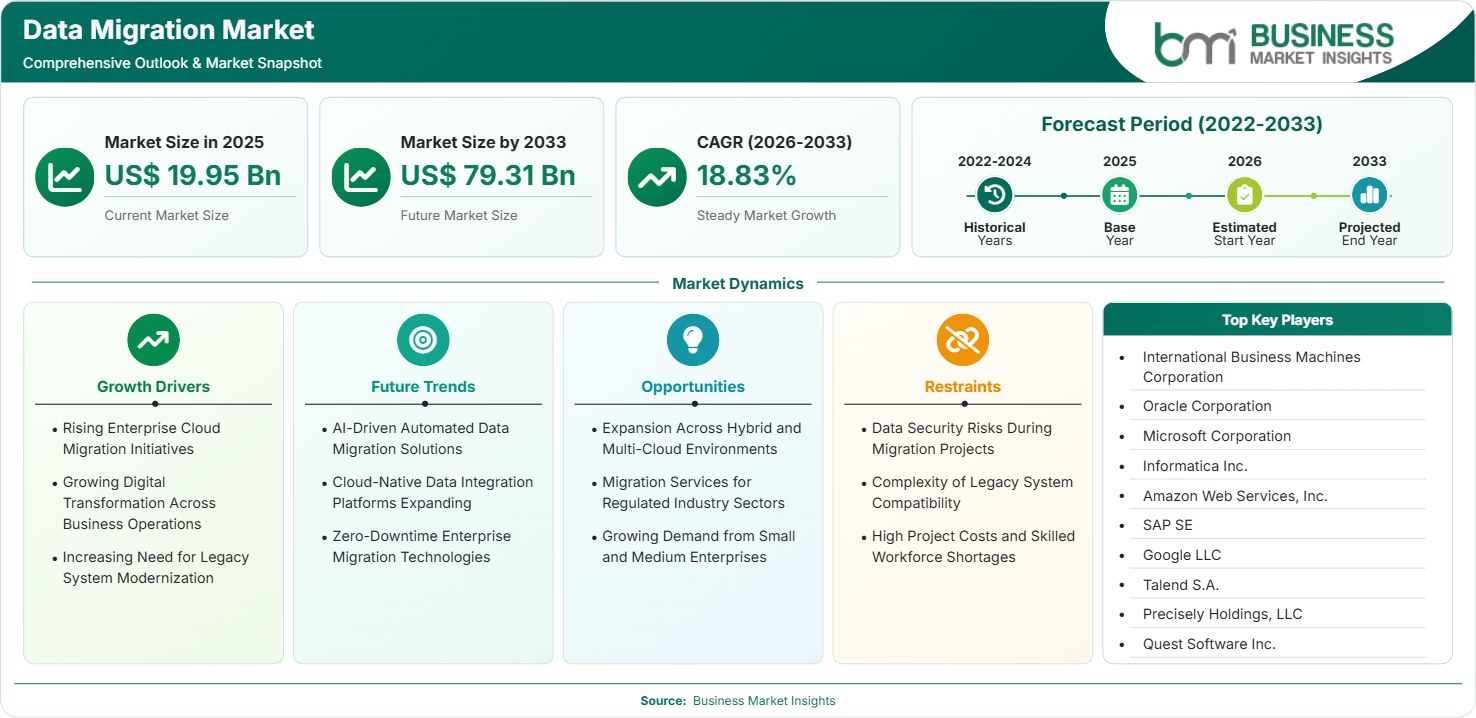
The Data Migration Market size was valued at US$ 19.95 Billion in 2025 and is projected to reach US$ 79.31 Billion by 2033, growing at a CAGR of 18.83% during 2026–2033. Increasing enterprise cloud migration initiatives, digital transformation programs, legacy system modernization, and growing demand for scalable data management solutions are driving market expansion.

Report Coverage
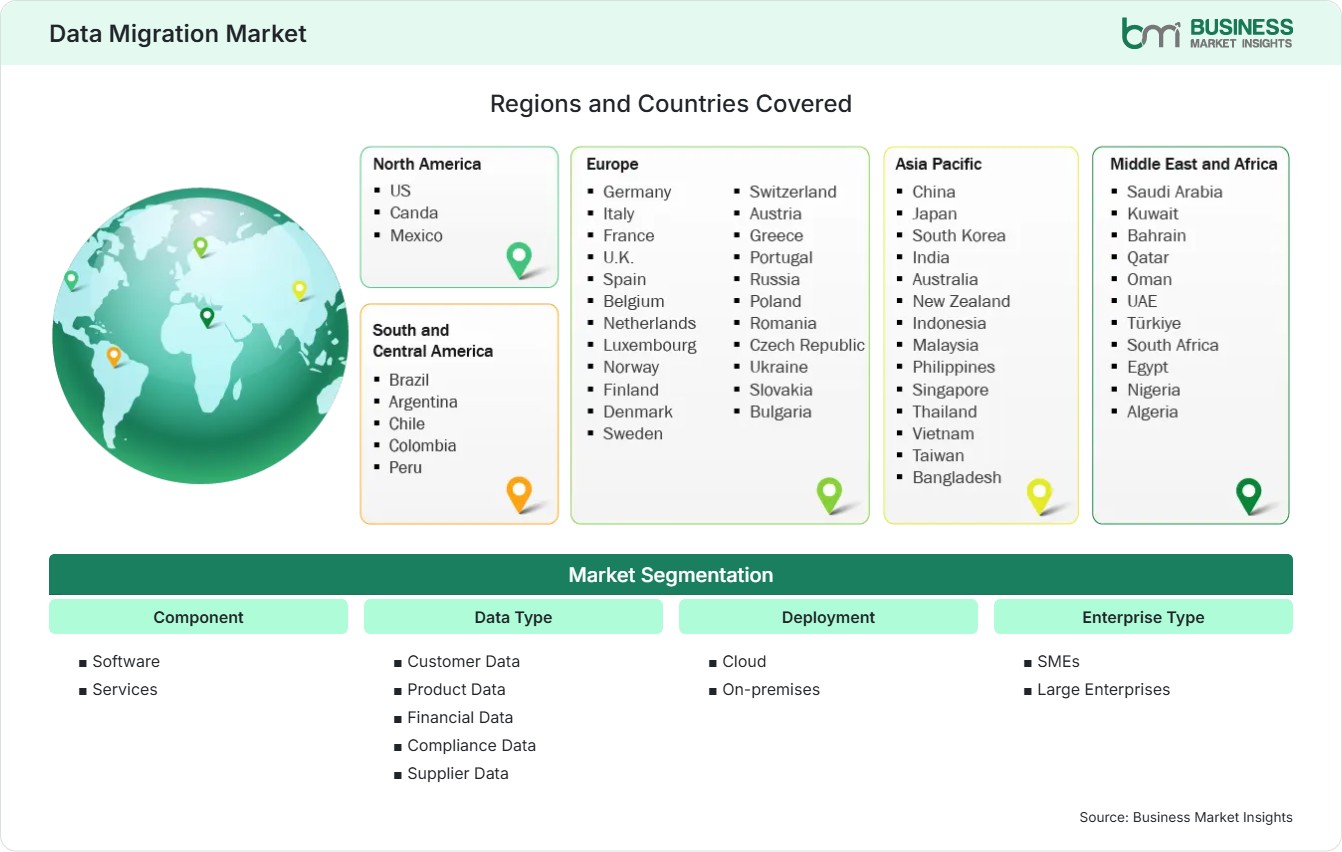
  • Component: Software, Services
  • Data Type: Customer Data, Product Data, Financial Data, Compliance Data,Supplier Data
  • Deployment: Cloud, On-premises
  • Enterprise Type: SMEs, Large Enterprises
  • Industry: BFSI, Retail, Government & Defense, Healthcare, IT & Telecommunications, Energy & Utilities, Others
US$ 19.95 Bn Market size in 2025
US$ 79.31 Bn Market Size by 2033
18.83% CAGR, 2026 - 2033
2026-2033 Forecast Period

AI Overview

Data Migration Market Summary

  • North America Region: North America holds 34%–37% market share in 2025 and is projected to grow at a 17.8%–18.6% CAGR during 2026–2033. Strong adoption of cloud platforms, enterprise modernization initiatives, and advanced data management technologies support regional leadership. The United States represents the largest contributor due to high digital transformation investments, increasing cloud migration activities, and strong presence of technology providers.
  • Fastest Growing Region: Asia Pacific represents 28%–31% market share in 2025 and is expected to grow at a 20.0%–21.0% CAGR through 2033. Rapid digitalization, expanding cloud infrastructure, increasing enterprise technology investments, and growing adoption among emerging economies are supporting regional growth.
  • Leading Segment: Services Component holds 58%–62% market share in 2025 and is projected to grow at a 18.5%–19.2% CAGR during 2026–2033. Organizations increasingly rely on professional and managed migration services to ensure secure data transfer, system compatibility, and reduced operational disruption.
  • High Growth Segment: Cloud Deployment represents 55%–60% market share in 2025 and is expected to grow at a 20.0%–21.0% CAGR. Increasing adoption of cloud-native applications, hybrid cloud environments, and scalable infrastructure is accelerating cloud-based migration activities.
  • Key Market Opportunity: Expansion across hybrid and multi-cloud environments, migration services for regulated industries, and increasing adoption among small and medium enterprises are creating new growth opportunities.
  • Major Market Players: International Business Machines Corporation, Oracle Corporation, Microsoft Corporation, Informatica Inc., Amazon Web Services, Inc., SAP SE, Google LLC, Talend S.A., Precisely Holdings, LLC, Quest Software Inc.
Strategic Insights

Data Migration Market: Strategic Insights

Data Migration Market Strategic Framework
FREE PDF
Request your free sample
Request free sample
Stakeholder View

Key Takeaways

  • Data migration is becoming a strategic priority as organizations modernize legacy systems and transition toward cloud-based infrastructure.
  • Cloud deployment is expected to remain a major growth area due to increasing adoption of hybrid and multi-cloud environments.
  • Service providers are gaining importance as enterprises require specialized expertise for complex migration planning, execution, and optimization.
  • BFSI, healthcare, government, and telecommunications sectors present significant opportunities due to increasing data volumes and regulatory requirements.
  • Artificial intelligence, automation, and advanced analytics integration are shaping the future development of data migration solutions.
  • Small and medium enterprises represent an emerging opportunity as affordable cloud migration solutions become increasingly accessible.
Geographic Outlook

Data Migration Market Regional Highlights

North America Data Migration Market

North America accounts for 34%–37% of the Data Migration Market share in 2025 and is projected to grow at a 17.8%–18.6% CAGR during 2026–2033. The region maintains market leadership due to strong cloud adoption, widespread enterprise digital transformation initiatives, and the presence of leading technology providers. Organizations across BFSI, healthcare, government, and IT sectors are investing in data migration solutions to modernize infrastructure, improve operational efficiency, and support advanced analytics capabilities.

  • The U.S. market is driven by large-scale cloud transformation programs, enterprise modernization initiatives, and increasing demand for secure data management solutions.
  • Technology companies are expanding migration service offerings to support complex enterprise workloads and multi-cloud environments.
  • Organizations are prioritizing automated migration platforms to reduce downtime and improve migration accuracy.
  • Regulatory requirements related to data protection and compliance are encouraging investments in secure migration solutions.

US Data Migration Market

The United States data migration market contributes approximately 85%–88% of North American demand and is expected to grow at a 18.0%–18.8% CAGR through 2033. The market benefits from strong enterprise technology spending, rapid cloud adoption, and continuous modernization of legacy IT environments. Large organizations are increasingly migrating databases, applications, and business-critical workloads to cloud platforms to improve scalability and operational flexibility.

  • Enterprises are adopting cloud migration strategies to improve infrastructure agility and support digital business models.
  • Financial institutions and healthcare organizations are investing in secure migration solutions to manage sensitive information.
  • Government agencies are modernizing legacy systems through cloud-based transformation programs.
  • Growing demand for automation and artificial intelligence-based migration tools is improving migration efficiency.

Europe Data Migration Market

Europe represents approximately 26%–29% market share in 2025 and Europe Data Migration Market forecast to grow at a 17.2%–18.0% CAGR during 2026–2033. The region is experiencing increasing demand for data migration solutions due to cloud adoption, regulatory compliance requirements, and enterprise modernization initiatives. Countries including Germany, the United Kingdom, France, and the Netherlands are leading adoption due to advanced digital infrastructure and strong enterprise technology investments.

  • Germany is supporting market growth through industrial digitalization and enterprise cloud transformation initiatives.
  • The United Kingdom is witnessing increased adoption due to financial sector modernization and cloud-based technology investments.
  • France is expanding migration activities through government digital transformation programs and enterprise modernization.
  • European organizations are prioritizing secure migration frameworks to meet data privacy and compliance requirements.

Asia Pacific Data Migration Market

Asia Pacific data migration market holds 28%–31% market share in 2025 and is expected to achieve the fastest growth at a 20.0%–21.0% CAGR through 2033. The region is witnessing rapid adoption due to digital transformation initiatives, expanding cloud infrastructure, increasing enterprise technology investments, and growing data generation. China, India, Japan, South Korea, and Southeast Asian countries are major contributors.

  • China is expanding adoption through cloud infrastructure investments and large-scale enterprise digitalization programs.
  • India is experiencing strong growth due to increasing cloud adoption among businesses and government technology initiatives.
  • Japan and South Korea are investing in modernization of enterprise IT systems and advanced data management platforms.
  • Southeast Asian economies are adopting migration solutions as organizations transition toward cloud-based operations.
  • Regional enterprises are increasingly using managed migration services to overcome technical complexity.

Rest of World Data Migration Market

The Rest of World region contributes approximately 7%–9% market share in 2025 and is projected to grow at a 19.0%–20.0% CAGR during 2026–2033. Latin America, the Middle East, and Africa are gradually adopting data migration solutions due to increasing digitalization, cloud infrastructure development, and enterprise technology upgrades. Latin American markets are benefiting from increasing cloud investments across financial services, retail, and telecommunications sectors. Middle Eastern countries are adopting advanced data management solutions as part of smart city and digital economy initiatives.

  • Brazil and Mexico are supporting regional growth through enterprise digital transformation and cloud adoption.
  • Middle Eastern countries are investing in cloud infrastructure and data modernization programs.
  • African markets are experiencing increasing demand due to expanding digital services and improving IT infrastructure.
  • Small and medium enterprises are adopting cost-effective migration solutions to improve technology capabilities.
  • Growing demand for secure and scalable data management is creating opportunities for global migration providers.
Global Market Geography
FREE PDF
Request your free sample
Request free sample
Segment Analysis

Data Migration Market Segmentation

Component

The Component segment accounted for approximately 98%–99% data migration market share in 2025 and is projected to grow at a 18.5%–19.2% CAGR during 2026–2033. Organizations require both migration software platforms and specialized services to efficiently transfer, transform, validate, and manage enterprise data across different environments. Services currently dominate market demand due to the complexity of migration projects, while software solutions are gaining traction through automation, artificial intelligence integration, and self-service migration capabilities.

  • Software: Data migration software enables automated data movement, transformation, validation, and monitoring across databases, applications, and cloud platforms. Increasing demand for automation and reduced migration complexity is supporting software adoption.
  • Services: Data migration services hold the leading position due to increasing enterprise dependence on consulting, implementation, integration, and managed migration support. Service providers help organizations manage complex migration projects while minimizing operational disruptions.

Data Type

The Data Type segment represented approximately 97%–99% market share in 2025 and is expected to grow at a 18.6%–19.4% CAGR between 2026 and 2033. Enterprises are migrating diverse data categories to improve accessibility, analytics capabilities, and operational efficiency. Growing data volumes across industries are increasing demand for secure migration solutions capable of handling structured and unstructured information while maintaining compliance requirements.

  • Customer Data: Customer data migration is increasing as businesses modernize customer relationship management platforms, improve personalization capabilities, and adopt cloud-based customer experience solutions.
  • Product Data: Product data migration supports retail, manufacturing, and e-commerce organizations by enabling efficient transfer of product information across platforms and applications.
  • Financial Data: Financial data migration is gaining importance among BFSI organizations requiring secure transfer of transactional information, accounting records, and financial databases.
  • Compliance Data: Compliance data migration supports organizations in maintaining regulatory requirements by securely transferring governance, audit, and policy-related information.
  • Supplier Data: Supplier data migration enables organizations to improve supply chain visibility by consolidating vendor information and integrating procurement systems.

Deployment

The Deployment segment accounted for approximately 98%–99% market share in 2025 and is projected to grow at a 19.0%–20.0% CAGR through 2033. Enterprises are increasingly transitioning from traditional infrastructure toward cloud-based environments to improve scalability, flexibility, and operational efficiency. Cloud deployment is gaining strong adoption due to increasing cloud migration initiatives, hybrid infrastructure development, and demand for cost-effective data management solutions.

  • Cloud: Cloud deployment represents the fastest-growing segment due to increasing adoption of public cloud platforms, hybrid cloud environments, and cloud-native applications. Organizations are migrating workloads to cloud platforms to improve agility and reduce infrastructure complexity.
  • On-premises: On-premises deployment continues to support organizations requiring greater control over sensitive data, compliance requirements, and legacy infrastructure management. Large enterprises with complex systems continue using on-premises migration approaches during phased modernization programs.

Enterprise Type

The Enterprise Type segment represented approximately 96%–98% market share in 2025 and is expected to grow at a 18.4%–19.3% CAGR during 2026–2033. Large enterprises currently account for significant demand due to complex IT environments, extensive data volumes, and large-scale modernization initiatives. Small and medium enterprises are emerging as an important growth segment due to increasing availability of affordable cloud migration solutions and managed services.

  • Large Enterprises: Large enterprises dominate adoption due to complex infrastructure requirements, multiple applications, and increasing need for enterprise-wide data modernization strategies.
  • SMEs: SMEs are increasingly adopting data migration solutions to transition toward cloud platforms, improve operational efficiency, and access advanced technologies without significant infrastructure investments.

Industry

The Industry segment accounted for approximately 95%–97% data migration market share in 2025 and is projected to grow at a 18.7%–19.5% CAGR through 2033. Data migration adoption is expanding across industries as organizations modernize applications, improve data accessibility, and transition toward digital operating models. BFSI, IT & telecommunications, healthcare, and government sectors represent major demand contributors due to high data volumes and increasing technology transformation requirements.

  • BFSI: Financial institutions are adopting data migration solutions to modernize banking platforms, improve analytics capabilities, and enhance secure data management.
  • Retail: Retail companies are migrating customer, product, and transaction data to support e-commerce expansion, personalization, and omnichannel operations.
  • Government & Defense: Government organizations are implementing migration solutions to modernize legacy systems, improve service delivery, and strengthen digital infrastructure.
  • Healthcare: Healthcare providers are adopting data migration technologies to manage electronic health records, improve interoperability, and support healthcare digitalization.
  • IT & Telecommunications: IT and telecom companies represent major adopters due to large-scale infrastructure modernization, cloud migration, and data center transformation initiatives.
  • Energy & Utilities: Energy and utility organizations are using migration solutions to modernize operational systems and improve data-driven decision-making.
  • Others: Other industries include education, manufacturing, transportation, and professional services adopting migration solutions for operational improvement and digital transformation.
Market Forces

Data Migration Market Dynamics

Key Market Drivers

Rising Enterprise Cloud Migration Initiatives

Enterprise cloud platform usage is one of the key factors driving the need for data migration solutions. Companies are moving towards cloud environments from their conventional set-ups for greater scalability, flexibility, cost effectiveness, and agility. The growth in the market is aided by increasing investments in cloud, including public cloud, private cloud, and hybrid cloud architectures. Enterprises need secure data migration solutions that will help them migrate applications, databases, and workloads without operational disruptions. This will define Data Migration Market trends owing to increased preference for automated data migration solutions and cloud-friendly data management.

Growing Digital Transformation Across Business Operations

The rise of digital transformation programs within different industries is creating a requirement for effective data migration processes. Modern companies implement complex analytics, AI technologies, enterprise-level applications, and connectivity which require centralization of data. Data migration helps companies merge multiple systems, making their data accessible and providing the ability to make decisions based on real-time information. The BFSI, healthcare, retail, and telecom sectors are already implementing data migration solutions to upgrade their activities and deliver better experiences to customers.

Increasing Need for Legacy System Modernization

Enterprises worldwide are focusing on modernizing outdated IT infrastructure to improve performance, security, and operational efficiency. Legacy systems often create limitations due to outdated architectures, integration challenges, and restricted scalability. Data migration solutions enable organizations to transfer critical information from legacy databases and applications into modern cloud and digital platforms. Growing technology upgrades across government, financial services, healthcare, and industrial sectors are increasing demand for migration expertise. Companies are adopting automated migration tools and consulting services to reduce complexity and accelerate modernization initiatives.

Key Market Opportunities

Expansion Across Hybrid and Multi-Cloud Environments

The growing adoption of hybrid and multi-cloud strategies is creating significant opportunities for data migration solution providers. Enterprises are increasingly combining multiple cloud platforms with existing infrastructure to optimize performance, improve flexibility, and address specific workload requirements. This approach requires efficient data movement across different environments while maintaining security and compliance. Migration providers are developing solutions that support seamless data transfer, workload portability, and cloud interoperability.

Migration Services for Regulated Industry Sectors

Highly regulated industries such as BFSI, healthcare, and government are creating new growth opportunities due to increasing demand for secure and compliant migration services. These sectors manage sensitive data that requires controlled transfer processes, strong security measures, and regulatory compliance. Service providers are offering specialized migration frameworks designed to address industry-specific requirements. Growing investments in digital healthcare systems, modern banking platforms, and government technology infrastructure are supporting demand for secure migration solutions. Companies with strong compliance expertise are expected to gain competitive advantages in these sectors.

Growing Demand from Small and Medium Enterprises

Small and medium enterprises are increasingly adopting data migration solutions as cloud technologies become more accessible and affordable. SMEs are moving away from traditional infrastructure to cloud-based platforms to improve efficiency, reduce maintenance costs, and access advanced digital capabilities. Managed migration services and subscription-based solutions are enabling smaller organizations to overcome technical resource limitations. Growing digitalization among SMEs across emerging economies is creating new opportunities for migration providers. Vendors are focusing on simplified platforms and cost-effective solutions to expand adoption among smaller businesses.

Market Restraints and Challenges

Data Security Risks During Migration Projects

Factor: Data migration involves transferring sensitive business information across systems, networks, and cloud environments, creating potential security vulnerabilities. Impact: Security risks during migration can increase concerns related to data breaches, unauthorized access, compliance violations, and operational disruptions. Organizations handling confidential customer, financial, and healthcare information require strong encryption, authentication, and monitoring capabilities throughout migration processes. Security concerns may delay migration decisions, especially among highly regulated industries.

Complexity of Legacy System Compatibility

Factor: Many organizations operate outdated legacy systems with complex architectures that may lack compatibility with modern cloud platforms and applications. Impact: Compatibility challenges can increase migration complexity, extend project timelines, and raise implementation costs. Organizations may require customized integration approaches, data transformation processes, and specialized technical expertise to successfully migrate legacy data. Difficulties in maintaining data accuracy and system functionality during migration can create operational risks.

Company Analysis

Competitive Landscape

The competitive environment consists of global technology companies, cloud service providers, data management software vendors, and specialized migration service providers focusing on enterprise modernization and cloud transformation. Data Migration Market analysis indicates that leading players are strengthening their positions through cloud-native migration platforms, automation capabilities, artificial intelligence integration, and industry-specific solutions.

Company Name

Overview

Products and Services relevant to this market

International Business Machines Corporation

Global technology company providing enterprise software, cloud solutions, and IT services.

IBM Cloud migration services, data management solutions, hybrid cloud migration platforms, and enterprise modernization services.

Oracle Corporation

Enterprise technology provider specializing in databases, cloud infrastructure, and business applications.

Oracle Cloud migration solutions, database migration tools, cloud services, and enterprise data management platforms.

Microsoft Corporation

Global technology company offering cloud computing, software, and enterprise digital transformation solutions.

Azure Migrate, cloud migration services, database migration tools, and hybrid cloud migration capabilities.

Informatica Inc.

Data management company specializing in enterprise data integration, governance, and migration solutions.

Intelligent data management platforms, cloud data migration, data integration, and enterprise data transformation solutions.

Amazon Web Services, Inc.

Leading cloud service provider offering infrastructure, migration, and modernization solutions.

AWS Migration Hub, database migration services, cloud migration tools, and application modernization services.

SAP SE

Enterprise software company providing business applications and data management solutions.

SAP migration services, SAP S/4HANA migration solutions, data transformation platforms, and enterprise application migration support.

Google LLC

Technology company providing cloud computing, data analytics, and digital transformation solutions.

Google Cloud migration services, database migration tools, cloud infrastructure solutions, and data modernization platforms.

Talend S.A.

Data integration and data quality software provider supporting enterprise data management requirements.

Data integration platforms, cloud migration support, data quality management, and enterprise data transformation solutions.

Precisely Holdings, LLC

Data integrity company providing data management, integration, and governance solutions.

Data migration software, data quality solutions, integration platforms, and enterprise data management services.

Quest Software Inc.

Software company providing IT management, database, and migration solutions.

Database migration tools, application modernization solutions, data management software, and enterprise migration services.

Trust & Transparency

Research Methodology

The market analysis combines proprietary research with secondary data from government agencies, company disclosures, regulatory filings, industry databases and expert interviews. Market estimates are validated through data triangulation, cross-market benchmarking and analyst review.

View Full Research Methodology

Questions Answered

Frequently Asked Questions

What are the key challenges in data migration projects?

Data security risks, legacy system compatibility issues, integration complexity, and migration downtime remain major challenges.

Which industries are major users of data migration solutions?

BFSI, healthcare, retail, government, telecommunications, and energy sectors are major adopters due to increasing data management needs.

Why are enterprises investing in data migration solutions?

Enterprises use migration solutions to modernize IT systems, improve data accessibility, enhance analytics, and support digital transformation.

Which deployment model is gaining higher adoption in the data migration market?

Cloud deployment is gaining strong adoption due to scalability, flexibility, hybrid cloud expansion, and reduced infrastructure requirements.

What factors are driving growth in the data migration market report?

Cloud adoption, digital transformation, legacy system modernization, and increasing enterprise data volumes are driving market growth.

Access the Full Data Migration Market Report

Get segment-level forecasts, regional estimates, competitive benchmarking, company profiles and downloadable Excel datasets.

Access the full Data Migration Market Report
350 pages PDF & Excel | 2026-08-25
Similar Research

Related Market Reports