
Data Center Market Outlook: Size, Share, Trends, Growth Analysis, Competitive Landscape & Forecast, 2026-2033

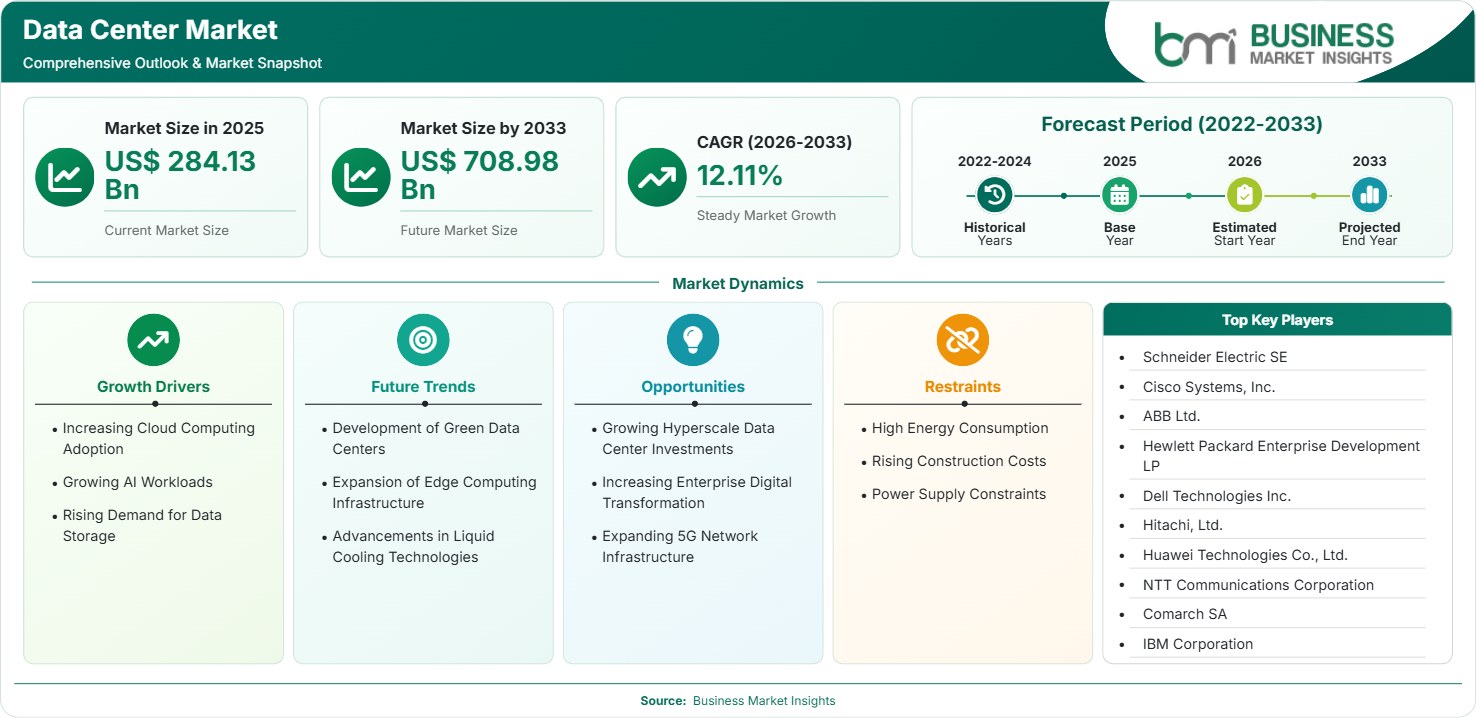
The Data Center Market size was valued at US$ 284.13 Billion in 2025 and is projected to reach US$ 708.98 Billion by 2033, growing at a CAGR of 12.11% during 2026–2033, driven by cloud expansion, AI computing, enterprise digitalization, hyperscale investments, edge infrastructure growth, and sustainable data center modernization initiatives.

Report Coverage
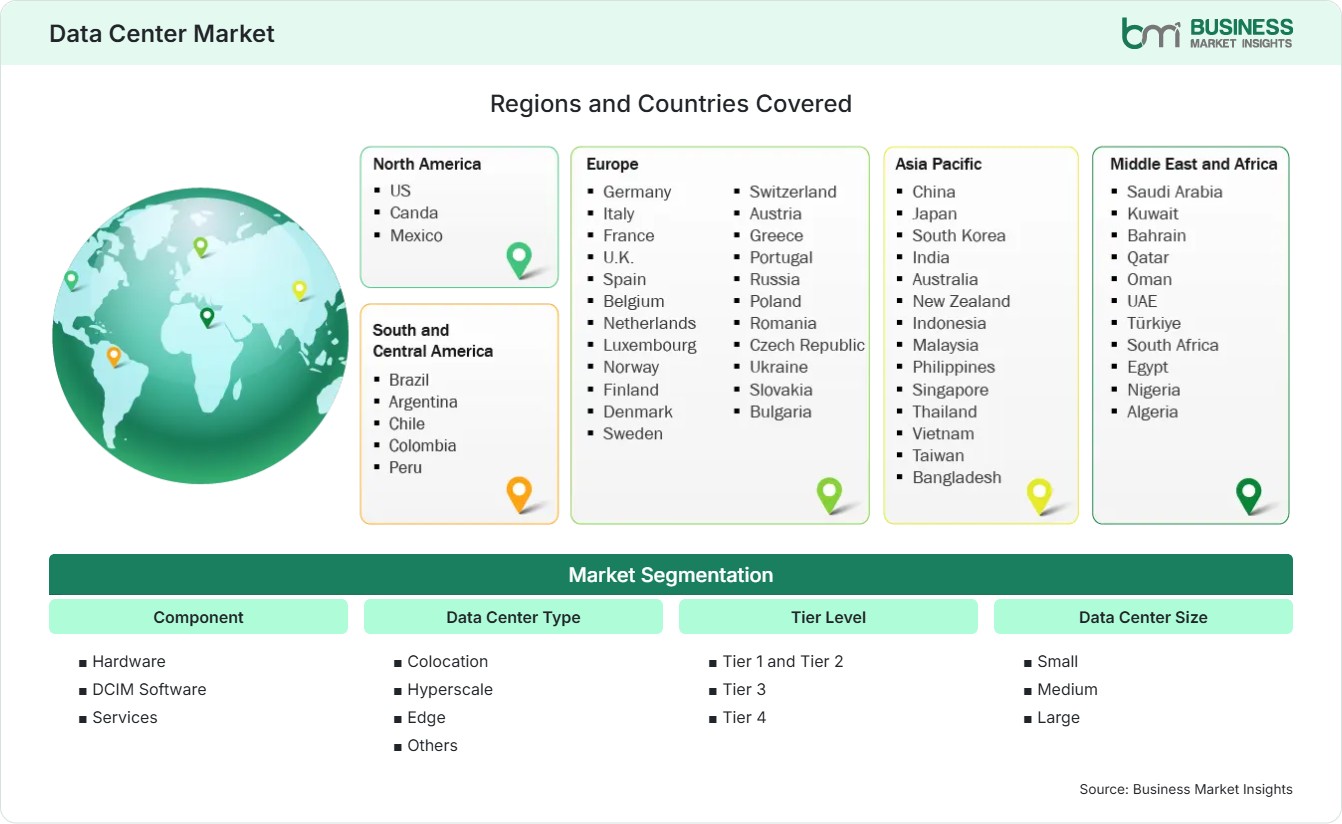
  • Component: Hardware, DCIM Software, Services
  • Data Center Type: Colocation, Hyperscale, Edge, Others
  • Tier Level: Tier 1 and Tier 2, Tier 3, Tier 4
  • Data Center Size: Small, Medium, Large
  • Industry: BFSI, IT & Telecom, Healthcare, Government, Manufacturing, Retail & E-commerce, Others
US$ 284.13 Bn Market size in 2025
US$ 708.98 Bn Market Size by 2033
12.11% CAGR, 2026 - 2033
2026-2033 Forecast Period

AI Overview

Data Center Market Summary

  • North America Region: North America holds a 38%–41% market share in 2025, growing at a 11.5%–12.3% CAGR during 2026–2033, supported by hyperscale cloud investments, AI infrastructure deployment, enterprise modernization, and sustainability initiatives. The U.S. dominates regional expansion with a projected 11.8%–12.5% CAGR, driven by hyperscale cloud providers and enterprise digital transformation.
  • Fastest Growing Region: Asia Pacific accounts for 27%–30% market share in 2025 and is projected to expand at a 13.2%–14.1% CAGR during 2026–2033, supported by digital economies, expanding cloud adoption, government digital initiatives, AI investments, and increasing enterprise demand for localized computing infrastructure.
  • Leading Segment: Hardware commands 47%–50% market share in 2025 while advancing at a 11.8%–12.6% CAGR during 2026–2033, supported by continuous investments in servers, networking equipment, storage infrastructure, power systems, and cooling technologies for modern computing environments.
  • High Growth Segment: Hyperscale data centers represent 34%–37% market share in 2025 and are forecast to grow at a 13.5%–14.4% CAGR through 2033 as cloud providers expand AI-ready campuses, high-density computing, and regional digital infrastructure.
  • Key Market Opportunity: Enterprises increasingly deploy AI-ready, energy-efficient, modular facilities integrating renewable power, liquid cooling, automation, and intelligent infrastructure management, creating substantial opportunities for technology providers, infrastructure vendors, and colocation operators worldwide.
  • Major Market Players: Schneider Electric SE, Cisco Systems, Inc., ABB Ltd., Hewlett Packard Enterprise Development LP, Dell Technologies Inc., Hitachi, Ltd., Huawei Technologies Co., Ltd., NTT Communications Corporation, Comarch SA, and IBM Corporation.
Strategic Insights

Data Center Market: Strategic Insights

Data Center Market Strategic Framework
FREE PDF
Request your free sample
Request free sample
Stakeholder View

Key Takeaways

  • The market ecosystem is transforming from conventional facilities to the development of digital infrastructure networks in terms of hardware vendors, cloud providers, colocation facilities, energy firms, and software companies.
  • Artificial intelligence workloads, cloud migrations, and edge computing use cases have been identified as the most promising growth segments, which drive the need for powerful servers, sophisticated network solutions, scalable storage systems, and facilities that can support intense computing activities.
  • Innovation focuses have moved from simply building out more data centers to include innovative sustainability-focused infrastructure, such as liquid cooling technology, AI-powered facility management, modular infrastructure, energy generation technology, and automation.
  • Asia Pacific presents a compelling investment opportunity due to rapid digital transformation, expanding internet usage, government-led technology initiatives, and increasing demand for localized data processing infrastructure across India, China, Southeast Asia, and other emerging technology markets.
  • Strategic investments, partnerships, and acquisitions are increasing as technology companies, infrastructure providers, and cloud operators seek to strengthen their positions in AI-ready infrastructure, edge computing networks, and sustainable facility development.
Geographic Outlook

Data Center Market Regional Highlights

North America Data Center Market

North America maintains a dominant position due to extensive cloud infrastructure, advanced enterprise technology adoption, and strong hyperscale operator presence. The region accounted for 38%–41% Data Center Market share in 2025 and is projected to grow at 11.5%–12.3% CAGR between 2026 and 2033. The United States remains the primary contributor, supported by AI investments, digital transformation initiatives, and increasing demand for high-performance computing environments across industries.

  • The region benefits from extensive hyperscale deployment by cloud providers, increasing demand for large-scale campuses, advanced networking infrastructure, and AI-optimized facilities supporting enterprise workloads.
  • Renewable energy integration and sustainability regulations are encouraging operators to invest in efficient power systems, advanced cooling technologies, and environmentally responsible infrastructure development strategies.
  • Growing adoption of edge computing across telecommunications, manufacturing, and healthcare sectors is expanding regional infrastructure requirements beyond traditional centralized facilities.
  • Strong presence of technology companies, infrastructure suppliers, and cloud service providers continues strengthening regional innovation, investment activity, and competitive development.

US Data Center Market

The United States represents the largest contributor within North America, accounting for 29%–32% Data Center Market share in 2025 with a projected 11.8%–12.5% CAGR during 2026–2033. Strong cloud adoption, artificial intelligence investments, enterprise digitalization, and increasing demand for secure computing environments continue driving facility expansion. Major technology hubs across Virginia, Texas, California, and Arizona support large-scale infrastructure development.

  • The U.S. benefits from substantial hyperscale investment, with cloud providers expanding AI-ready campuses and high-density computing facilities to support advanced workloads.
  • Increasing enterprise adoption of hybrid cloud environments is accelerating demand for colocation services, scalable infrastructure, and secure data processing capabilities.
  • Government initiatives supporting cybersecurity, digital infrastructure resilience, and domestic technology capabilities are encouraging continued facility modernization.
  • Growing renewable energy procurement among operators is improving sustainability performance while addressing rising electricity requirements from large-scale computing operations.

Europe Data Center Market

Europe accounted for 23%–26% share in 2025 and is expected to expand at 10.8%–11.7% CAGR through 2033. Germany, the United Kingdom, Netherlands, and Nordic countries remain important markets due to advanced digital ecosystems and favorable energy conditions supporting facility development.

  • European operators are prioritizing energy-efficient infrastructure due to sustainability regulations and increasing focus on reducing operational carbon emissions.
  • Germany and the United Kingdom continue attracting investments through enterprise digitalization, cloud adoption, and strong technology ecosystems.
  • Nordic countries are gaining attention because of renewable energy availability, cooler climates, and opportunities for sustainable large-scale facilities.
  • Regulatory requirements around data sovereignty are encouraging regional infrastructure development and localized computing capacity.

Asia Pacific Data Center Market

Asia Pacific represented 27%–30% Data Center Market share in 2025 and is projected to achieve the fastest expansion with a 13.2%–14.1% CAGR from 2026 to 2033. Rapid internet penetration, cloud adoption, AI investments, and government digital programs are accelerating infrastructure development.

  • China continues expanding large-scale computing infrastructure through cloud development, artificial intelligence initiatives, and national digital transformation programs.
  • India is experiencing increased investment due to expanding digital services, technology outsourcing activities, and rising enterprise cloud adoption.
  • Southeast Asian countries are attracting international operators through favorable investment policies and increasing demand for localized digital infrastructure.
  • Japan and Australia are strengthening their positions through advanced technology ecosystems, cybersecurity requirements, and enterprise modernization initiatives.

Rest of World Data Center Market

Rest of World regions accounted for 8%–11% share in 2025 and are projected to grow at 12.5%–13.6% CAGR during the forecast period. South America and the Middle East are witnessing increased infrastructure investments due to cloud adoption, digital government programs, and rising enterprise technology requirements. Countries including Brazil, Mexico, UAE, and Saudi Arabia are emerging as attractive destinations for new facilities.

Growing connectivity investments and economic diversification programs are encouraging data center expansion across developing markets. Regional operators are focusing on renewable-powered facilities and localized computing capabilities.

  • Middle Eastern countries are investing heavily in digital infrastructure as part of economic diversification strategies and smart city development programs.
  • Brazil and Mexico are supporting regional expansion through increasing cloud demand, enterprise modernization, and improved connectivity infrastructure.
  • Africa is emerging as a developing opportunity area due to rising internet penetration and increasing digital service requirements.
  • Latin American markets are attracting international operators seeking new growth opportunities beyond mature infrastructure locations.
  • Renewable energy availability is encouraging sustainable facility development across selected emerging markets.
Global Market Geography
FREE PDF
Request your free sample
Request free sample
Segment Analysis

Data Center Market Segmentation

Component

The component segment remains central as organizations invest in physical infrastructure, management software, and professional services to support expanding computing needs. The segment held a Data Center Market scope across hardware, DCIM software, and services categories, with hardware maintaining 47%–50% share in 2025 and growing at 11.8%–12.6% CAGR between 2026–2033 due to infrastructure modernization.

  • Hardware: Includes servers, storage systems, networking equipment, power systems, and cooling infrastructure required for reliable data processing and high-performance computing operations.
  • DCIM (Data Center Infrastructure Management) Software: Supports monitoring, automation, asset tracking, energy optimization, and operational visibility across modern infrastructure environments.
  • Services: Covers consulting, installation, maintenance, managed services, and operational support required for efficient facility deployment and long-term performance management.

Data Center Type

Data center type segmentation reflects changing enterprise requirements for scalability, flexibility, and performance. Hyperscale facilities maintained strong adoption with 34%–37% share in 2025 and are expected to expand at 13.5%–14.4% CAGR through 2033. The segment continues benefiting from cloud expansion, AI workloads, and large-scale digital service demand.

  • Colocation: Enables organizations to access shared infrastructure, reduce capital expenditure, and improve scalability through professionally managed facilities.
  • Hyperscale: Supports massive computing requirements of cloud providers and digital platforms through highly scalable, energy-efficient infrastructure.
  • Edge: Provides localized processing capabilities for applications requiring low latency, including IoT, autonomous systems, and real-time analytics.
  • Others: Includes specialized facilities designed for specific enterprise, research, and operational requirements across multiple industries.

Tier Level

Tier-based classification highlights infrastructure reliability, redundancy, and availability requirements among enterprises. Higher-tier facilities are gaining preference as businesses demand continuous operations, stronger resilience, and improved service quality. Tier 3 and Tier 4 facilities represent the fastest adoption categories due to increasing requirements for mission-critical applications, cloud services, and artificial intelligence workloads.

  • Tier 1 and Tier 2: Supports basic computing requirements with limited redundancy, suitable for small enterprises, regional operations, and less critical applications requiring cost-effective infrastructure.
  • Tier 3: Provides enhanced redundancy, maintainability, and operational reliability, making it suitable for enterprises requiring improved uptime, cloud hosting, and business continuity capabilities.
  • Tier 4: Delivers the highest availability standards with fault-tolerant architecture, advanced power systems, and maximum reliability for financial services, healthcare, and large-scale digital platforms.

Data Center Size

Data center size segmentation reflects changing deployment strategies across enterprises, cloud operators, and service providers. Large facilities continue leading adoption due to hyperscale requirements and AI-driven workloads, while smaller facilities gain relevance through edge computing expansion. The Data Center Market trends indicate increasing demand for flexible infrastructure models supporting diverse operational environments.

  • Small: Designed for localized workloads, branch operations, and edge applications requiring compact infrastructure with efficient management capabilities.
  • Medium: Supports regional enterprises and growing organizations requiring scalable computing resources, improved reliability, and balanced infrastructure investment.
  • Large: Enables hyperscale operations, advanced computing environments, and extensive digital workloads through high-capacity infrastructure deployments.

Industry

Industry segmentation demonstrates broad adoption across sectors requiring secure, scalable, and high-performance computing capabilities. The BFSI, IT and telecom, healthcare, government, manufacturing, and retail sectors increasingly depend on advanced infrastructure for digital services, analytics, automation, and data processing. The Data Center Market share distribution continues expanding as organizations prioritize digital transformation initiatives.

  • BFSI: Requires secure, compliant infrastructure for financial transactions, analytics, risk management, and digital banking platforms with high availability standards.
  • IT & Telecom: Drives significant demand through cloud services, network expansion, software platforms, and telecommunications infrastructure modernization.
  • Healthcare: Adopts advanced facilities to support electronic health records, medical imaging, artificial intelligence diagnostics, and healthcare data management.
  • Government: Invests in secure infrastructure supporting public services, cybersecurity programs, digital governance, and sovereign data management requirements.
  • Manufacturing: Utilizes computing infrastructure for industrial automation, smart factories, predictive analytics, and connected production environments.
  • Retail & E-commerce: Requires scalable infrastructure for online platforms, customer analytics, inventory systems, and digital commerce operations.
Market Forces

Data Center Market Dynamics

Key Market Drivers

Increasing Cloud Computing Adoption

Cloud migration continues to accelerate as enterprises shift workloads from traditional infrastructure toward hybrid and multi-cloud environments. In terms of industry evaluation, global demand for cloud services is still on the rise since firms focus on scalability, flexibility, and operational effectiveness. The Data Center Market growth include increased needs for cloud hosting, distributed computing, and secure enterprise platforms. The market trends reflect more investments in energy-efficient data centers, automation solutions, and advanced networks. Cloud companies are developing regional availability zones and campuses in response to the rising number of digital workloads.

Growing AI Workloads

The growing use of artificial intelligence is increasing the need for specific infrastructure that is able to support high-performance computing, acceleration, and analysis capabilities. AI systems need large amounts of computational power, which results in investments in high-density servers, cooling solutions, and facilities design. Growing usage of generative AI solutions by enterprises is impacting infrastructure design and pushing companies to create an environment that is ready for AI use.

Rising Demand for Data Storage

The growing number of data produced by enterprises due to connectivity among devices, digital platforms, and analytics programs is driving the need for more scalable storage systems. There will be a need for companies to have secure platforms that can manage increased amounts of structured and unstructured data. Growing deployment of IoT, applications utilizing video, and real-time analytics are leading to greater needs for storage across various sectors. The reaction by data centers includes better storage technology, improved network connections, and intelligent management systems.

Key Market Opportunities

Growing Hyperscale Data Center Investments

Hyperscale expansion represents a major opportunity as cloud providers and technology companies increase infrastructure capacity to support artificial intelligence, cloud computing, and digital services. Data Center Market Forecasts highlight that there is room for investments through mega-facility creation, power management systems, and infrastructure development. There are attempts by the hyperscale companies to incorporate renewable energy, modular building techniques, and efficient cooling techniques to boost operational efficiency. The vendors who provide unique hardware, automation systems, and infrastructure services stand to gain from the growing demand for capacity.

Increasing Enterprise Digital Transformation

Digital transformation within enterprises is leading to openings in infrastructure provision as companies transform their business processes by embracing cloud computing, analysis, automation, and artificial intelligence. Enterprises in BFSI, healthcare, manufacturing, and retail sectors will need computing infrastructure that can accommodate their digital processes and customer services. The service provider can capitalize on growth through managed infrastructure, consulting services, cybersecurity, and hybrid cloud integration. As more companies depend on digital platforms, there is a push towards building robust infrastructure.

Expanding 5G Network Infrastructure

The development of 5G network infrastructure is opening up possibilities for edge computing centers, which allow for faster data processing and lower latency. There is a need for telecommunications companies to have a distributed network infrastructure in order to cater to connected devices, automation, and real-time applications. The use of edge data center deployments is gaining more importance due to the decentralized nature of digital ecosystems. The companies offering these kinds of services will reap the benefits of the high demand from telecommunications and industry.

Market Restraints and Challenges

High Energy Consumption

Factor: Increasing computational workloads and high-density server deployments are raising electricity requirements across facilities. Impact: Increased use of energy means increased costs, sustainability concerns, and the need for operators to develop energy solutions through the use of renewable energy sources and efficient systems. Big plants will require efficient cooling and power management systems that keep performance levels high while limiting their environmental footprint. Availability of energy sources and the stability of energy grids are factors considered during site selection of new infrastructural development projects.

Rising Construction Costs

Factor: Increasing prices of land, construction materials, specialized equipment, and infrastructure components are raising facility development expenses. Impact: An increase in capital will result in the postponement of expansions and poses difficulties to smaller firms that seek competitive advantage. The installation of modern facilities needs modern electrical works, security, cooling systems, and engineering skills, hence increasing the complexity of the whole process. Factors such as disruption in supply chain and equipment availability might affect the schedule of the project.

Company Analysis

Competitive Landscape

The competitive environment includes infrastructure equipment manufacturers, cloud technology providers, networking companies, and facility management solution providers. Data Center Market analysis highlights increasing competition around energy efficiency, AI-ready infrastructure, automation, sustainable operations, and integrated management platforms.

Company Name

Overview

Products and Services Relevant to this Market

Schneider Electric SE

Global energy management and automation company providing infrastructure solutions for efficient and sustainable digital facilities.

Data center power systems, cooling solutions, UPS systems, EcoStruxure management platforms, and infrastructure automation technologies.

Cisco Systems, Inc.

Technology company specializing in networking, cybersecurity, and digital infrastructure solutions for enterprise environments.

Networking equipment, data center switching, security platforms, cloud networking, and infrastructure management solutions.

ABB Ltd.

Engineering technology company delivering electrification and automation solutions supporting modern infrastructure development.

Power distribution systems, automation technologies, energy management solutions, and data center electrical infrastructure.

Hewlett Packard Enterprise Development LP

Enterprise technology provider delivering computing, networking, and hybrid cloud infrastructure solutions.

Servers, storage systems, networking platforms, edge solutions, and enterprise infrastructure services.

Dell Technologies Inc.

Global technology company providing computing infrastructure and digital transformation solutions.

Servers, storage systems, networking solutions, hyper-converged infrastructure, and enterprise data center platforms.

Hitachi, Ltd.

Technology conglomerate providing digital systems, infrastructure solutions, and operational technologies.

Data infrastructure solutions, IT services, storage technologies, and digital transformation platforms.

Huawei Technologies Co., Ltd.

Technology company offering digital infrastructure, cloud, networking, and computing solutions globally.

Servers, storage, networking equipment, cloud infrastructure, and intelligent data center solutions.

NTT Communications Corporation

Telecommunications and infrastructure provider operating global digital infrastructure networks.

Colocation services, cloud connectivity, network solutions, and managed data center services.

Comarch SA

Technology provider delivering IT solutions, software platforms, and infrastructure management services.

IT infrastructure solutions, cloud services, monitoring platforms, and enterprise digital management systems.

IBM Corporation

Enterprise technology company providing cloud computing, artificial intelligence, and infrastructure solutions.

Hybrid cloud platforms, AI infrastructure, consulting services, automation tools, and enterprise computing solutions.

Trust & Transparency

Research Methodology

The market analysis combines proprietary research with secondary data from government agencies, company disclosures, regulatory filings, industry databases and expert interviews. Market estimates are validated through data triangulation, cross-market benchmarking and analyst review.

View Full Research Methodology

Questions Answered

Frequently Asked Questions

What information does the Data Center Market Report provide for businesses?

The report provides insights into infrastructure trends, segmentation, competitive positioning, regional developments, technology adoption patterns, and investment opportunities. It helps stakeholders evaluate market dynamics and develop strategic approaches for infrastructure planning.

What role does artificial intelligence play in facility management?

Artificial intelligence improves facility monitoring, predictive maintenance, workload optimization, and energy management. AI-enabled management systems help operators enhance reliability, reduce downtime risks, and optimize resource utilization across complex infrastructure environments.

Why are sustainable technologies becoming important for modern facilities?

Sustainable technologies help operators reduce energy consumption, manage operational costs, and meet environmental targets. Advanced cooling systems, renewable energy integration, and intelligent management platforms are becoming essential components of next-generation infrastructure strategies.

How are edge facilities changing the data center deployment landscape?

Edge facilities are enabling localized processing by reducing latency for applications such as 5G services, industrial automation, autonomous systems, and real-time analytics. Their expansion supports decentralized infrastructure models closer to end users and connected devices.

What factors are influencing future investment decisions in Data Center Market?

Investment decisions are increasingly shaped by AI computing requirements, energy availability, sustainability goals, location advantages, and demand for low-latency services. Operators are prioritizing facilities with advanced cooling, renewable energy access, scalable designs, and strong connectivity ecosystems.

Access the Full Data Center Market Report

Get segment-level forecasts, regional estimates, competitive benchmarking, company profiles and downloadable Excel datasets.

Access the full Data Center Market Report
350 pages PDF & Excel | 2026-08-18
Similar Research

Related Market Reports