
Software Defined Data Center Market Outlook: Size, Share, Trends, Growth Analysis, Competitive Landscape & Forecast, 2026-2033

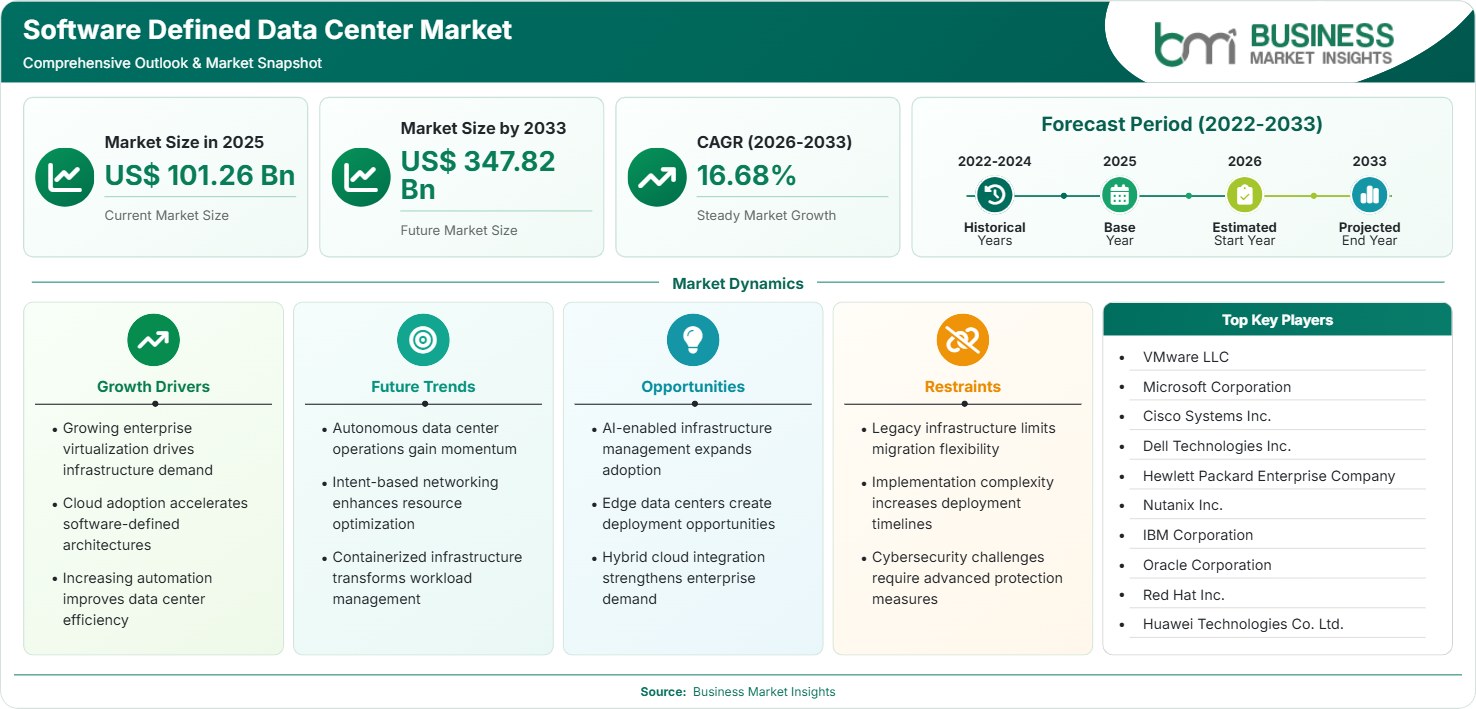
The Software Defined Data Center Market size was valued at US$ 101.26 billion in 2025 and is projected to reach US$ 347.82 billion by 2033, growing at a CAGR of 16.68% during 2026–2033. Growing enterprise virtualization, rapid cloud adoption, and increasing automation across IT infrastructure continue driving investment in software-defined technologies that improve scalability, operational efficiency, and workload flexibility.

Report Coverage
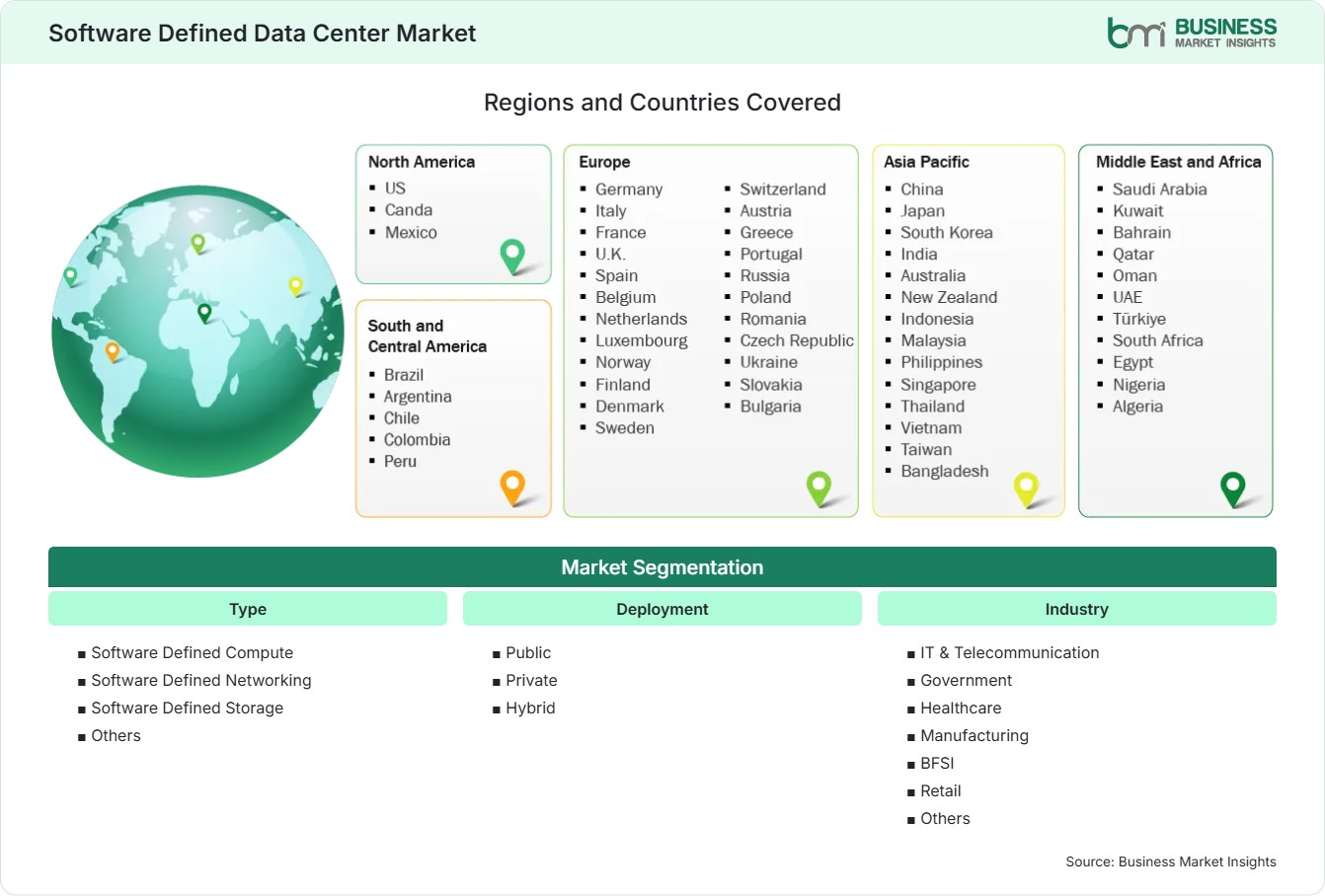
  • Type: Software Defined Compute, Software Defined Networking, Software Defined Storage, Others
  • Deployment: Public, Private, Hybrid
  • Industry: IT & Telecommunication, Government, Healthcare, Manufacturing, BFSI, Retail, Others
US$ 101.26 Bn Market size in 2025
US$ 347.82 Bn Market Size by 2033
16.68% CAGR, 2026 - 2033
2026-2033 Forecast Period

AI Overview

Software Defined Data Center Market Summary

  • North America Region: North America holds 37%–40% market share in 2025 and is projected to grow at a CAGR of 15.8%–16.4% during 2026–2033. High cloud adoption, mature digital infrastructure, and enterprise modernization initiatives support regional expansion. The U.S. remains the largest contributor with a CAGR of 15.9%–16.5%, driven by hyperscale data center investments and AI-enabled infrastructure management.
  • Fastest Growing Region: Asia Pacific accounts for 28%–31% market share in 2025 and is anticipated to register the fastest CAGR of 17.9%–18.6%. Expanding cloud services, enterprise digital transformation, increasing data localization requirements, and rapid hyperscale data center development continue accelerating regional demand.
  • Leading Segment: Solution represents 63%–66% market share in 2025 and is expected to grow at a CAGR of 16.7%–17.3%, supported by rising deployment of virtualization software, orchestration platforms, and integrated infrastructure management solutions.
  • High Growth Segment: Hybrid deployment captures 37%–40% market share in 2025 and is projected to record a CAGR of 18.2%–18.8%, driven by enterprise demand for workload flexibility, security, and seamless cloud integration.
  • Key Market Opportunity: Expanding AI-powered infrastructure management, edge computing deployments, and hybrid cloud adoption continue creating substantial opportunities for software-defined infrastructure providers across enterprise and service provider environments.
  • Major Market Players: VMware LLC, Microsoft Corporation, Cisco Systems, Inc., Dell Technologies Inc., Hewlett Packard Enterprise Company, Nutanix, Inc., IBM Corporation, Oracle Corporation, Red Hat, Inc., and Huawei Technologies Co., Ltd.
Strategic Insights

Software Defined Data Center Market: Strategic Insights

Software Defined Data Center Market Strategic Framework
FREE PDF
Request your free sample
Request free sample
Stakeholder View

Key Takeaways

  • Enterprise digital transformation continues accelerating software-defined infrastructure deployment as organizations seek greater agility, automation, and centralized management across distributed computing environments.
  • Hybrid cloud architectures provide significant growth opportunities by enabling enterprises to optimize workloads while maintaining security, regulatory compliance, and operational flexibility.
  • AI-powered infrastructure monitoring, predictive analytics, and automated resource optimization are becoming key differentiators among leading technology providers.
  • Asia Pacific offers the strongest long-term investment potential because of expanding hyperscale data centers, cloud adoption, and government-led digital infrastructure initiatives.
  • Strategic partnerships among cloud providers, software vendors, and infrastructure manufacturers continue accelerating innovation and enterprise deployment of software-defined technologies.
  • Investments in cybersecurity, workload orchestration, and intelligent infrastructure management remain essential for maintaining competitive advantage in rapidly evolving enterprise IT environments.
Geographic Outlook

Software Defined Data Center Market Regional Highlights

North America Software Defined Data Center Market

North America accounts for 37%–40% Software Defined Data Center Market share in 2025 and is projected to expand at a CAGR of 15.8%–16.4% during 2026–2033. Strong enterprise cloud adoption, mature hyperscale infrastructure, and significant investments in virtualization technologies continue supporting regional leadership. Organizations increasingly deploy software-defined solutions to improve operational efficiency, automate infrastructure management, and strengthen cybersecurity across hybrid computing environments.

  • Hyperscale cloud providers continue expanding regional data center capacity to support AI workloads and enterprise cloud services.
  • Increasing investments in software-defined networking improve infrastructure flexibility and workload optimization across enterprise environments.
  • Financial institutions and healthcare providers continue modernizing legacy IT systems through virtualization technologies.
  • Growing cybersecurity investments support secure deployment of software-defined infrastructure across critical enterprise operations.

US Software Defined Data Center Market

The United States contributes 83%–86% of North American revenue and is expected to register a CAGR of 15.9%–16.5% during the forecast period. Enterprise cloud migration, AI infrastructure investments, and continued expansion of hyperscale facilities strengthen national market leadership.

  • Leading cloud providers continue investing in advanced software-defined infrastructure technologies.
  • AI-enabled automation improves operational efficiency across enterprise and hyperscale data centers.
  • Growing enterprise virtualization supports modernization of legacy IT environments.
  • Continuous software innovation strengthens workload orchestration and resource optimization capabilities.

Europe Software Defined Data Center Market

Europe represents 24%–27% market share in 2025 and is expected to grow at a CAGR of 15.2%–15.8% through 2026–2033. Digital sovereignty initiatives, cloud modernization, and stringent data governance regulations continue encouraging investment in software-defined infrastructure. Germany remains the largest regional market, while the Netherlands records the fastest growth due to expanding cloud infrastructure and hyperscale investments.

  • Enterprises increasingly adopt hybrid cloud platforms to comply with regional data protection requirements.
  • Investments in sustainable data centers encourage deployment of software-defined resource optimization technologies.
  • Manufacturing and BFSI sectors continue accelerating enterprise infrastructure modernization.
  • Digital transformation programs strengthen demand for intelligent infrastructure management solutions.

Asia Pacific Software Defined Data Center Market

Asia Pacific holds 28%–31% market share in 2025 and is projected to register the fastest 17.9%–18.6% CAGR through 2026–2033. Expanding cloud infrastructure, rapid enterprise digitization, increasing internet usage, and government support for digital economies continue driving regional expansion. China remains the largest market, while India records the highest growth because of accelerating cloud adoption and large-scale data center investments.

  • Rapid expansion of hyperscale facilities strengthens regional cloud infrastructure capacity.
  • Government digital transformation initiatives accelerate enterprise adoption of software-defined technologies.
  • Telecommunications providers continue modernizing infrastructure to support next-generation digital services.
  • Rising demand for AI computing increases investment in intelligent data center management platforms.

Rest of World Software Defined Data Center Market

The Rest of World region accounts for 7%–9% market share in 2025 and is projected to expand at a CAGR of 15.9%–16.6% during 2026–2033. Cloud infrastructure investments, enterprise modernization, and digital economy initiatives continue supporting adoption across Latin America, the Middle East, and Africa.

  • Brazil continues leading regional adoption through expanding enterprise cloud infrastructure investments.
  • GCC countries accelerate hyperscale data center development to strengthen digital transformation initiatives.
  • Increasing demand for secure enterprise computing supports deployment of software-defined infrastructure.
  • Growth in managed cloud services encourages wider adoption among small and medium-sized enterprises.
Global Market Geography
FREE PDF
Request your free sample
Request free sample
Segment Analysis

Software Defined Data Center Market Segmentation

Component

The component segment represents the foundation of software-defined infrastructure, enabling organizations to virtualize, automate, and centrally manage computing resources. It accounted for 63%–66% market share in 2025 and is projected to register a CAGR of 16.7%–17.3% during 2026–2033. Increasing enterprise modernization, cloud-native deployments, and demand for automated IT operations continue expanding the Software Defined Data Center Market scope across private, public, and hybrid infrastructure environments.

  • Solution: Accounts for the largest share owing to widespread adoption of virtualization software, infrastructure orchestration platforms, software-defined networking, software-defined storage, and centralized management solutions that improve scalability, resource utilization, and operational efficiency.
  • Services: Growing implementation, consulting, integration, managed services, and technical support requirements continue driving demand as enterprises modernize legacy infrastructure and deploy software-defined technologies across distributed IT environments.

Type

The type segment continues evolving as enterprises deploy specialized software-defined technologies to optimize infrastructure performance, improve workload flexibility, and automate resource management. The segment represented 34%–37% market share in 2025 and is anticipated to expand at a CAGR of 17.1%–17.7% throughout the forecast period. Current Software Defined Data Center Market trends indicate increasing investments in intelligent networking, virtualized storage, and compute infrastructure supporting AI workloads and hybrid cloud operations.

  • Software Defined Compute: Enables virtualization of computing resources, improving workload allocation, server utilization, application scalability, and centralized infrastructure management across enterprise and cloud environments.
  • Software Defined Networking: Simplifies network provisioning, policy management, security enforcement, and traffic optimization while enabling greater flexibility for multi-cloud and hybrid infrastructure deployments.
  • Software Defined Storage: Supports intelligent storage allocation, automated data management, scalability, backup optimization, and efficient utilization of distributed storage resources across enterprise data centers.

Deployment

Deployment models continue diversifying as organizations align infrastructure strategies with business continuity, regulatory compliance, and workload optimization objectives. This segment captured 37%–40% market share in 2025 and is expected to record the fastest CAGR of 18.2%–18.8% during 2026–2033. Growing enterprise demand for operational flexibility, cybersecurity, and seamless cloud integration continues strengthening adoption across all deployment environments.

  • Public: Supports scalable infrastructure deployment with reduced capital expenditure, enabling organizations to rapidly provision software-defined resources while benefiting from cloud provider innovation and global infrastructure availability.
  • Private: Preferred by organizations requiring enhanced security, regulatory compliance, predictable performance, and greater control over mission-critical workloads and sensitive enterprise data.
  • Hybrid: Combines public and private infrastructure to deliver workload flexibility, disaster recovery, optimized resource utilization, and secure application deployment across distributed enterprise environments.

Industry

Industry adoption continues expanding as organizations modernize IT infrastructure to improve agility, automation, cybersecurity, and operational resilience. The segment accounted for 29%–32% market share in 2025 and is projected to register a CAGR of 17.0%–17.6% through 2026–2033. Enterprise investment in digital transformation, AI infrastructure, and cloud-native applications continues driving software-defined infrastructure deployment across multiple industries.

  • IT & Telecommunication: Leads adoption through large-scale cloud infrastructure deployment, virtualization initiatives, software-defined networking implementation, and continuous investment in next-generation digital services.
  • Government: Utilizes software-defined infrastructure to strengthen digital governance, improve cybersecurity, optimize public sector IT operations, and support secure digital service delivery.
  • Healthcare: Increasingly deploys software-defined platforms to manage electronic health records, medical imaging, telemedicine applications, and secure patient data infrastructure.
  • Manufacturing: Benefits from software-defined environments supporting industrial automation, IoT integration, predictive maintenance, and real-time production analytics across connected manufacturing facilities.
  • BFSI: Adopts intelligent infrastructure to improve cybersecurity, support digital banking services, optimize transaction processing, and maintain regulatory compliance across enterprise operations.
  • Retail: Expands deployment of software-defined technologies to support omnichannel commerce, inventory management, customer analytics, and scalable digital retail infrastructure.
Market Forces

Software Defined Data Center Market Dynamics

Key Market Drivers

Growing enterprise virtualization drives infrastructure demand

Modern IT environments keep evolving with enterprise virtualization through consolidation of hardware resources, improved workload mobility, and reduced infrastructure costs. Companies in industries such as banking, healthcare, manufacturing, and telecommunication replace their hardware-driven IT environment with software-based IT environments offering centralized management and increased operational flexibility. Virtualization technologies including virtual machines, containerized applications, and resource provisioning are now essential elements of digital transformation projects. Modernization of legacy infrastructure in order to accommodate cloud native applications and business continuity strategy creates high demand for software-defined solutions. These developments remain a major contributor to Software Defined Data Center Market growth, encouraging technology providers to expand virtualization capabilities and intelligent infrastructure solutions.

Cloud adoption accelerates software-defined architectures

The growing adoption of public, private, and hybrid cloud environments is accelerating deployment of software-defined architectures across enterprise data centers. Increasingly, organizations are demanding for an infrastructure that is able to support varying workloads, fast application deployments, and easy allocation of resources within and across the on-premises and cloud environment. Software defined networking, storage, and computing make the process more efficient while being scalable. In addition to this, cloud services providers are making significant investments into intelligent infrastructures that ease the management process across the distributed environments. The investments are continuously building the trust of enterprises in the software defined infrastructure.

Increasing automation improves data center efficiency

Automation solutions are becoming increasingly important for today’s data centers because businesses want to minimize human interaction, better use their infrastructure, and ensure operational resiliency. Smart orchestration systems automate the allocation of computing resources, workload optimization, infrastructure health monitoring, and issue detection before they can impact business processes. AI-enabled monitoring and analytics also help in improving service availability and lowering costs. Continuous innovation in automation software is strengthening Software Defined Data Center Market trends, enabling enterprises to manage increasingly complex IT environments with greater efficiency, scalability, and reliability.

Key Market Opportunities

AI-enabled infrastructure management expands adoption

Artificial intelligence is revolutionizing the management of infrastructure through the capability to analyze data predictively, automate fault management, intelligent workload balancing, and proactive resource allocation. More businesses are using software-based AI platforms to increase efficiency while reducing downtime and infrastructure maintenance costs. Machine learning algorithms are continually being incorporated into software-defined platforms by technology companies. Software Defined Data Center Market Forecasts indicate that AI-enabled infrastructure management will remain one of the strongest long-term growth opportunities as enterprises continue investing in autonomous and self-optimizing IT operations.

Edge data centers create deployment opportunities

Rapid growth in edge computing is increasing demand for software-defined infrastructure capable of managing geographically distributed computing resources. The industries that include manufacturing, telecommunication, health care, retail, and transport have been forced by need for reduced latency to deploy small-scale edge data centers, which are to be connected to large cloud centers. Software-defined technologies make it easy for the management of such infrastructure and workloads to be carried out remotely. The expansion of IoTs and real-time analytics applications will present an opportunity for software-defined infrastructure companies.

Hybrid cloud integration strengthens enterprise demand

Organizations continue adopting hybrid cloud strategies that combine private infrastructure with public cloud services to improve flexibility, regulatory compliance, and business continuity. Software-defined technologies offer centralized management within multiple cloud environments along with migration and efficient utilization of resources. Enterprises now focus on adopting a platform that offers interconnectivity, automation, and security for their applications. With hybrid IT systems becoming popular, vendors who offer software-defined management solutions are likely to receive long-term investment from enterprises in the future.

Market Restraints and Challenges

Legacy infrastructure limits migration flexibility

Many enterprises continue operating legacy IT infrastructure that was not designed to support software-defined architectures or cloud-native applications. Factor: Existing hardware dependencies, outdated software platforms, and compatibility limitations complicate migration planning and increase infrastructure modernization requirements. Impact: Organizations often experience higher implementation costs, extended migration schedules, and operational disruptions while transitioning to software-defined environments, delaying return on investment and slowing enterprise-wide adoption of advanced infrastructure technologies.

Implementation complexity increases deployment timelines

Deploying software-defined infrastructure requires careful planning, integration expertise, cybersecurity validation, and alignment with existing enterprise systems.

Factor: Complex implementation processes involving virtualization, networking, storage integration, workload migration, and employee training increase project complexity and resource requirements.

Impact: Longer deployment timelines, increased consulting expenses, and greater operational risks may delay infrastructure modernization projects, particularly among organizations with limited technical expertise or highly customized legacy IT environments.

Company Analysis

Competitive Landscape

The competitive landscape is shaped by continuous innovation in virtualization, cloud management, software-defined networking, AI-driven infrastructure automation, and hybrid cloud platforms. Software Defined Data Center Market analysis shows that leading technology providers are strengthening their positions through strategic partnerships, platform integration, infrastructure modernization, and investments in intelligent data center management solutions that improve scalability, security, and operational efficiency.

Company Name

Overview

Products and Services Relevant to this Market

VMware LLC

Leading provider of virtualization and cloud infrastructure software serving enterprise and hyperscale data centers worldwide.

VMware Cloud Foundation, vSphere, NSX, vSAN, virtualization software, software-defined networking, and cloud management solutions.

Microsoft Corporation

Global technology company delivering enterprise cloud platforms and intelligent infrastructure management technologies.

Microsoft Azure, Azure Stack, Hyper-V, System Center, cloud infrastructure, virtualization, and hybrid cloud solutions.

Cisco Systems, Inc.

Networking and infrastructure leader providing software-defined networking and enterprise data center technologies.

Cisco ACI, Nexus switches, software-defined networking, data center automation, security, and cloud infrastructure solutions.

Dell Technologies Inc.

Enterprise infrastructure provider offering integrated software-defined data center platforms and cloud solutions.

Dell APEX, PowerEdge servers, storage platforms, hyperconverged infrastructure, virtualization, and cloud management solutions.

Hewlett Packard Enterprise Company

Global enterprise IT company specializing in hybrid cloud, edge computing, and intelligent infrastructure solutions.

HPE GreenLake, software-defined storage, networking platforms, cloud services, and enterprise infrastructure management solutions.

Nutanix, Inc.

Pioneer in hyperconverged infrastructure and enterprise cloud software with strong hybrid cloud capabilities.

Hyperconverged infrastructure, cloud platform software, virtualization, disaster recovery, automation, and hybrid cloud management.

IBM Corporation

Enterprise technology company delivering hybrid cloud platforms, AI-powered infrastructure, and consulting services.

IBM Cloud, Red Hat OpenShift integration, infrastructure automation, AI operations, and hybrid cloud management solutions.

Oracle Corporation

Cloud infrastructure and enterprise software provider supporting software-defined enterprise environments.

Oracle Cloud Infrastructure, virtualization platforms, cloud networking, database services, and enterprise infrastructure solutions.

Red Hat, Inc.

Open-source software leader focused on hybrid cloud infrastructure and containerized application platforms.

Red Hat OpenShift, Ansible Automation Platform, enterprise Linux, Kubernetes, cloud automation, and infrastructure management software.

Huawei Technologies Co., Ltd.

Global ICT company delivering cloud computing, networking, storage, and intelligent data center technologies.

FusionCube, FusionStorage, CloudFabric, software-defined networking, intelligent data center, and cloud infrastructure solutions.

Trust & Transparency

Research Methodology

The market analysis combines proprietary research with secondary data from government agencies, company disclosures, regulatory filings, industry databases and expert interviews. Market estimates are validated through data triangulation, cross-market benchmarking and analyst review.

View Full Research Methodology

Questions Answered

Frequently Asked Questions

What does the Software Defined Data Center Market Report include?

The Market Report provides comprehensive insights into market dynamics, competitive landscape, segmentation, regional outlook, technology developments, investment opportunities, and future growth strategies across global enterprise infrastructure markets.

Why is software-defined networking becoming increasingly important?

Software-defined networking improves network automation, centralized policy management, workload mobility, and infrastructure scalability while simplifying operations across distributed enterprise and hybrid cloud environments.

Which industries are major users of software defined data center technologies?

IT and telecommunications, BFSI, healthcare, government, manufacturing, and retail sectors are among the largest adopters due to increasing digital transformation, cloud migration, and cybersecurity requirements.

Which deployment model is expected to experience the highest growth?

Hybrid deployment is projected to record the fastest growth because it combines public cloud scalability with private infrastructure security, enabling organizations to optimize workloads while maintaining regulatory compliance and operational flexibility.

What is driving demand for software defined data center solutions?

Growing enterprise virtualization, hybrid cloud adoption, AI-enabled infrastructure management, and increasing demand for automated IT operations are encouraging organizations to modernize traditional data centers using software-defined technologies.

Access the Full Software Defined Data Center Market Report

Get segment-level forecasts, regional estimates, competitive benchmarking, company profiles and downloadable Excel datasets.

Access the full Software Defined Data Center Market Report
350 pages PDF & Excel | 2026-08-17