
Data Center Infrastructure Market Outlook: Size, Share, Trends, Growth Analysis, Competitive Landscape & Forecast, 2026-2033

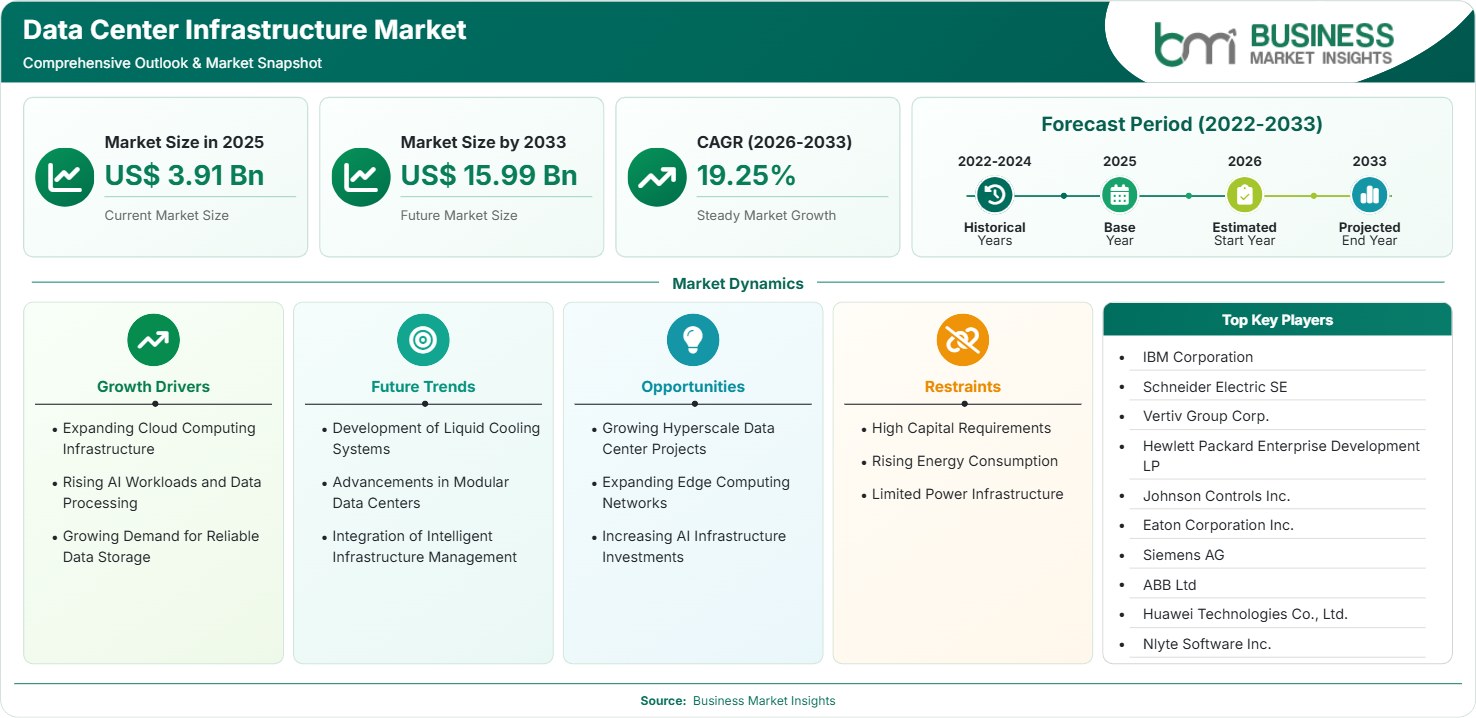
The Data Center Infrastructure Market size was valued at US$ 3.91 Billion in 2025 and is projected to reach US$ 15.99 Billion by 2033, growing at a CAGR of 19.25% during 2026–2033, driven by AI workloads, hyperscale expansion, cloud adoption, edge computing, power modernization, liquid cooling, automation, and resilient digital infrastructure investments.

Report Coverage
  • Component: Solutions, Services
US$ 3.91 Bn Market size in 2025
US$ 15.99 Bn Market Size by 2033
19.25% CAGR, 2026 - 2033
2026-2033 Forecast Period

AI Overview

Data Center Infrastructure Market Summary

  • North America Region: North America holds a market share of 34%–38% in 2025, growing with a CAGR of 18.2%–19.1%, influenced by hyperscale expansion, AI infrastructure, cloud migration, power modernization, and data-center construction. The U.S. represents the dominant regional market, expanding at a 18.5%–19.3% CAGR through 2033 as AI-focused facilities require higher-density power, cooling, and monitoring capabilities.
  • Fastest Growing Region: Asia Pacific holds a market share of 28%–32% in 2025, growing with a CAGR of 21.0%–22.4%, supported by cloud adoption, sovereign digital infrastructure, AI investment, hyperscale campuses, 5G services, and expanding enterprise data requirements.
  • Leading Segment: Solutions hold a market share of 67%–71% in 2025, growing with a CAGR of 19.6%–20.4%, driven by integrated power, cooling, racks, monitoring, automation, physical infrastructure, and increasingly standardized high-density data-center designs.
  • High Growth Segment: Services hold a market share of 29%–33% in 2025, growing with a CAGR of 18.3%–19.2%, supported by commissioning, maintenance, infrastructure optimization, monitoring, consulting, lifecycle management, and demand for operational continuity.
  • Key Market Opportunity: Integrated AI-ready infrastructure creates the strongest opportunity as operators seek standardized power, thermal management, monitoring, digital twins, modular construction, and lifecycle services that shorten deployment schedules and improve utilization.
  • Major Market Players: IBM Corporation, Schneider Electric SE, Vertiv Group Corp., Hewlett Packard Enterprise Development LP, Johnson Controls Inc., Eaton Corporation plc, Siemens AG, ABB Ltd., Huawei Technologies Co., Ltd., and Nlyte Software, Inc.
Strategic Insights

Data Center Infrastructure Market: Strategic Insights

Data Center Infrastructure Market Strategic Framework
FREE PDF
Request your free sample
Request free sample
Stakeholder View

Key Takeaways

  • The value chain is moving toward integrated infrastructure platforms that connect electrical systems, thermal management, racks, controls, monitoring, and services.
  • AI-focused facilities offer the strongest upside because accelerated computing increases rack density and creates requirements for higher-capacity power distribution, liquid cooling, thermal monitoring, and infrastructure designed around rapidly changing compute configurations.
  • Product innovation is shifting from standalone hardware toward digitally orchestrated infrastructure. Digital twins, predictive analytics, automated commissioning, intelligent power management, and real-time environmental monitoring are becoming important differentiation factors.
  • India, Southeast Asia, the Middle East, and selected Latin American markets offer compelling investment cases because cloud adoption and sovereign infrastructure requirements are increasing while mature markets face land, power, permitting, and grid constraints.
  • Recent collaborations around AI-ready facilities, power architectures, modular construction, and digital energy management indicate that ecosystem coordination can accelerate commercialization and improve project execution.
  • Service capabilities are gaining strategic importance because infrastructure complexity is increasing faster than many operators can expand specialist engineering teams.
Geographic Outlook

Data Center Infrastructure Market Regional Highlights

North America Data Center Infrastructure Market

North America holds a 34%–38% share in 2025 and records a 18.2%–19.1% CAGR during 2026–2033. The region benefits from hyperscale construction, AI infrastructure, enterprise cloud migration, and strong technology investment. The United States remains the principal demand center, while Canada and Mexico provide additional opportunities through colocation, cloud, and manufacturing-linked digital facilities. Data Center Infrastructure Market share is reinforced by mature power, cooling, automation, and monitoring ecosystems, while grid constraints increasingly favor modular deployment and energy-management technologies.

  • Hyperscale expansion is increasing demand for high-capacity UPS systems, switchgear, thermal infrastructure, rack solutions, and monitoring platforms capable of supporting dense accelerated-computing environments.
  • AI deployment is encouraging operators to redesign facilities around higher rack densities, advanced liquid cooling, increased power availability, and tighter integration between electrical and thermal infrastructure.
  • Grid interconnection delays are encouraging developers to evaluate on-site generation, modular electrical systems, energy storage, and flexible infrastructure configurations that can shorten time-to-power for new campuses.
  • Colocation providers are investing in standardized infrastructure that supports different customer workloads, allowing facilities to accommodate enterprise computing, cloud services, and AI deployments without extensive redesign.

US Data Center Infrastructure Market

The United States represents 71%–75% of North American demand in 2025 and records a 18.5%–19.3% CAGR during 2026–2033. The country benefits from major cloud platforms, AI investment, enterprise digitization, and hyperscale expansion. Data Center Infrastructure Market growth is increasingly constrained by electricity availability rather than demand. Developers are consequently prioritizing locations with dependable grid access, renewable generation, transmission capacity, favorable permitting, and infrastructure suppliers capable of rapid deployment.

  • AI data-center construction is increasing requirements for high-density power delivery, liquid cooling, modular electrical infrastructure, and monitoring systems designed around accelerated computing.
  • Texas, Virginia, Arizona, Georgia, and selected Midwestern markets provide development opportunities where land availability, energy resources, fiber connectivity, and industrial infrastructure can support large facilities.
  • Operators increasingly require digital monitoring and predictive maintenance because higher infrastructure density increases the operational consequences of power, cooling, or equipment failures.

Europe Data Center Infrastructure Market

Europe holds a 21%–24% share in 2025 and expands at a 17.2%–18.4% CAGR through 2033. Germany, the United Kingdom, the Netherlands, France, and Ireland remain important markets, while Spain and Nordic countries provide high-growth opportunities. Germany records an estimated 17.5%–18.5% CAGR, while Spain and the Nordic region can achieve 19.0%–20.5% growth as renewable-energy availability and digital infrastructure investments support new capacity. Sustainability requirements strongly influence facility design.

  • Germany combines industrial demand, cloud adoption, and established engineering capabilities, supporting investments in power management, cooling, automation, and infrastructure monitoring.
  • The United Kingdom remains a major European digital hub, with demand supported by cloud services, financial technology, AI workloads, and enterprise modernization requiring resilient infrastructure.
  • Spain and Nordic markets provide opportunities where renewable electricity, land availability, and expanding digital infrastructure can support new data-center developments with lower-carbon operating models.
  • European operators increasingly emphasize energy efficiency, heat reuse, water management, and renewable-power integration as sustainability requirements become more influential in site selection and infrastructure procurement.

Asia Pacific Data Center Infrastructure Market

Asia Pacific holds a 28%–32% share in 2025 and records a 21.0%–22.4% CAGR during 2026–2033, making it the fastest-growing region. China, Japan, India, Singapore, Australia, and South Korea form the principal demand centers. India records approximately 22.0%–23.5% CAGR, while Southeast Asia achieves about 22.5%–24.0% as cloud adoption, AI services, digital payments, and sovereign infrastructure requirements accelerate capacity deployment across regional markets.

  • India is becoming a major growth center as cloud adoption, digital public infrastructure, AI services, and enterprise modernization create demand for scalable facilities and integrated power and cooling systems.
  • Southeast Asia benefits from expanding digital services and international connectivity, although developers increasingly evaluate energy availability, water constraints, and environmental requirements when selecting new sites.
  • China and South Korea provide substantial demand through cloud platforms, electronics ecosystems, AI workloads, telecommunications, and enterprise computing, supporting broad infrastructure modernization.
  • Japan and Australia offer mature data-center ecosystems where demand increasingly emphasizes efficiency, resilience, advanced cooling, automation, and lifecycle optimization rather than capacity expansion alone.

Rest of World Data Center Infrastructure Market

South and Central America represent an emerging demand base, with Brazil and Mexico providing the strongest opportunities. The Middle East and Africa are expanding through cloud adoption, digital government programs, telecommunications modernization, and sovereign infrastructure initiatives. Rest of World holds a 9%–12% share in 2025 and records a 16.0%–17.4% CAGR during 2026–2033. Brazil records approximately 16.5%–17.5% growth, while the United Arab Emirates and Saudi Arabia offer 18.0%–19.5% opportunities. Data Center Infrastructure Market share is therefore more geographically diversified as operators pursue regional resilience and lower-latency services.

  • Brazil provides the strongest South American opportunity because cloud adoption, enterprise digitization, telecommunications, and financial technology are increasing requirements for reliable computing infrastructure.
  • Mexico benefits from North American supply-chain integration and growing digital services, creating opportunities for colocation, enterprise facilities, power-management equipment, cooling, and monitoring solutions.
  • Saudi Arabia and the United Arab Emirates are investing in digital infrastructure and AI capabilities, supporting demand for high-density facilities, modular systems, advanced cooling, and energy management.
  • South Africa provides a gateway opportunity for African digital services, although power reliability, infrastructure economics, and connectivity remain important considerations for large-scale facility development.
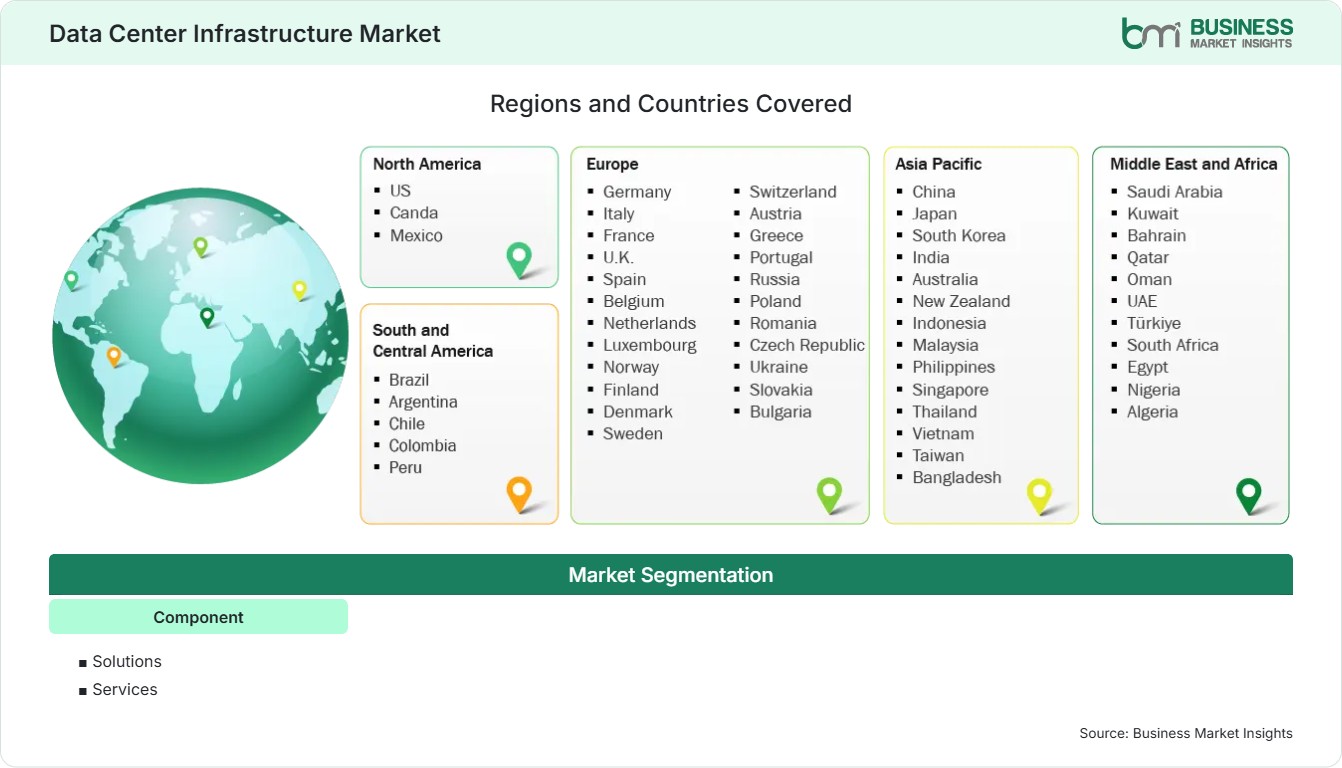
Global Market Geography
FREE PDF
Request your free sample
Request free sample
Segment Analysis

Data Center Infrastructure Market Segmentation

Component

Component demand is divided between integrated physical and digital infrastructure solutions and specialized lifecycle services. Solutions lead with a 67%–71% share in 2025 and record a 19.6%–20.4% CAGR during 2026–2033. The Data Center Infrastructure Market scope increasingly includes integrated power, cooling, monitoring, automation, and deployment architectures designed for high-density workloads.

  • Solutions: Solutions combine power, cooling, racks, monitoring, management, automation, and related infrastructure technologies, supporting integrated facility design and increasingly standardized deployment of high-density computing environments.
  • Services: Services cover consulting, installation, commissioning, maintenance, optimization, monitoring, and lifecycle support, helping operators manage complex facilities while improving uptime, efficiency, and infrastructure utilization.
Market Forces

Data Center Infrastructure Market Dynamics

Key Market Drivers

Expanding Cloud Computing Infrastructure

Cloud computing is increasing demand for scalable, resilient, and continuously available data center environments. Service providers require power management, cooling management, monitoring, physical infrastructure, and infrastructure management capabilities along with increasing computing capability needs. In addition, companies are also increasingly deploying cloud-based IT resources, thus relying on infrastructure that is managed by professionals. This supports the Data Center Infrastructure Market growth through recurring needs for infrastructure and lifecycle services. Cloud-based data center infrastructures will be increasingly focusing on modularity, automation, visibility, redundancy, and capacity utilization.

Rising AI Workloads and Data Processing

AI workloads are changing infrastructure requirements by increasing computing intensity, power requirements, thermal management needs, and facility planning complexity. For high-performance computing systems to work, infrastructure that supports dense equipment setups and stable operations needs to be provided. This is making more consideration be given to advanced cooling and power distribution, infrastructure management, automation, and capacity planning. AI will lead to higher need for infrastructure visibility due to the fact that workload variations affect power and thermal operations. Therefore, suppliers are creating more integrated infrastructure solutions as opposed to individual equipment groups. AI will increase the need for infrastructure that supports high-density and reliable operations.

Growing Demand for Reliable Data Storage

Data generation and storage requirements are increasing the importance of dependable physical infrastructure. Power supply, environmental control, monitoring, security, and maintenance are essential for storage systems to run uninterrupted. In addition, the need for expanding the storage capacity also necessitates a scalable infrastructure design that can incorporate more equipment into the infrastructure without causing major disruptions. These considerations are shaping the Data Center Infrastructure Market growth in terms of monitoring, management, reliable power, cooling, and services. Infrastructure providers that can provide both reliability and capacity can capture demand from operators seeking predictable performance and simplified facility management.

Key Market Opportunities

Growing Hyperscale Data Center Projects

Hyperscale facilities create substantial opportunities for infrastructure suppliers because their scale requires coordinated deployment of power, cooling, monitoring, automation, physical systems, and services. Large-scale facilities would also need infrastructure architecture that can grow without affecting the operations of the facilities. Suppliers will get an opportunity to create standardized but still configurable systems that will ease the process of deployment across several facilities. The value of services comes in during installation, commissioning, maintenance, monitoring, optimization, and management of the lifecycle of such systems. The opportunity becomes especially critical in instances where operators are trying to achieve standardization of the infrastructure architecture of different facilities.

Expanding Edge Computing Networks

Edge computing creates opportunities for smaller, distributed infrastructure environments located closer to users, devices, enterprises, and operational systems. The need for efficient, reliable, remotely monitored, and maintainable infrastructure arises because the distributed facilities may lack some of the technical capabilities present in large, centralized facilities. There is an opportunity for the supplier to meet this need through modular power solutions, compact cooling solutions, remote monitoring solutions, automation of management processes, and service delivery models geared towards distributed installations. Distributed edge infrastructure adds value to the need for standardization because there could be multiple sites being managed at once.

Increasing AI Infrastructure Investments

AI infrastructure investments are creating opportunities for suppliers capable of supporting higher-density computing environments, more demanding power requirements, thermal management challenges, and accelerated facility expansion. The commercial opportunity extends across infrastructure solutions, planning services, deployment support, monitoring, optimization, and lifecycle management. Data Center Infrastructure Market Forecasts point toward continued demand for infrastructure architectures capable of adapting to changing workload characteristics. Suppliers can capture value by developing solutions that coordinate power, cooling, monitoring, automation, and capacity management rather than treating each requirement independently. AI-focused infrastructure also encourages customers to prioritize scalability and operational visibility, creating opportunities for service providers that can optimize facility performance as computing requirements evolve.

Market Restraints and Challenges

High Capital Requirements

Factor: Data center infrastructure requires substantial investment across power systems, cooling, physical equipment, monitoring, automation, facility management, installation, and ongoing services. Impact: High capital requirements may lead to longer purchasing periods and difficulty in increasing infrastructure capacities in case of organizations with limited budget capabilities. The large infrastructure facilities may also need a phased implementation process in order to become available for usage. Thus, customers have to assess the overall lifecycle cost, which includes maintenance costs, energy consumption, replacement of equipment, operational efficiency. Suppliers may facilitate the adoption process through the development of modular infrastructure architecture, scalability, flexibility of services offered and solutions based on particular customer needs.

Rising Energy Consumption

Factor: Increasing computing density, AI workloads, storage requirements, cooling demand, and continuous facility operation can raise overall energy requirements. Impact: Increased energy usage may raise operating expenses and intensify pressure on facility efficiencies, energy management, cooling systems, and infrastructure optimization. Energy should thus be taken into consideration while selecting infrastructure options as well as for further capacity. Energy issues will also have an effect on the design of the facility, equipment choices, capacity, and overall lifecycle management of the facility. The higher the computing demands, the harder the balancing act for the infrastructure providers becomes.

Company Analysis

Competitive Landscape

Data Center Infrastructure Market analysis indicates competition is moving from individual equipment categories toward integrated infrastructure ecosystems. Vendors increasingly differentiate through power and thermal expertise, modular construction, digital monitoring, automation, application engineering, and lifecycle services. The competitive field combines diversified industrial companies, technology providers, infrastructure specialists, and software-focused data-center management businesses.

Company Name

Overview

Products and Services relevant to this market

IBM Corporation

Global technology company providing enterprise computing, hybrid cloud, AI, automation, and infrastructure-management capabilities for complex digital environments.

Hybrid cloud infrastructure, AI platforms, automation, enterprise systems, monitoring, consulting, and data-center management capabilities.

Schneider Electric SE

Energy-management and automation specialist with a major portfolio dedicated to resilient, efficient, and digitally managed data-center infrastructure.

UPS systems, switchgear, PDUs, cooling, racks, EcoStruxure software, monitoring, automation, and integrated data-center solutions.

Vertiv Group Corp.

Critical digital infrastructure provider specializing in power, thermal management, modular systems, and infrastructure for high-density computing.

UPS, power distribution, thermal management, liquid cooling, racks, prefabricated infrastructure, monitoring, and lifecycle services.

Hewlett Packard Enterprise Development LP

Enterprise technology provider supporting hybrid cloud, high-performance computing, AI, servers, storage, and infrastructure management.

Servers, storage, AI systems, hybrid cloud platforms, infrastructure management, networking, and data-center services.

Johnson Controls Inc.

Building technology and controls provider with extensive expertise in data-center cooling, automation, efficiency, and facility management.

HVAC, cooling systems, controls, building management, energy optimization, fire protection, and data-center facility solutions.

Eaton Corporation plc

Intelligent power-management company addressing electrical distribution, backup power, energy resilience, and AI data-center power requirements.

UPS, switchgear, PDUs, power distribution, energy management, backup power, monitoring, and high-voltage data-center architectures.

Siemens AG

Diversified technology company offering electrification, automation, building technology, digitalization, and energy-management capabilities for critical facilities.

Electrical systems, automation, building management, power distribution, monitoring, digital twins, and infrastructure optimization technologies.

ABB Ltd.

Electrification and automation specialist supporting power reliability, energy efficiency, and electrical infrastructure for large digital facilities.

Switchgear, UPS, power distribution, automation, monitoring, energy management, and electrification solutions.

Huawei Technologies Co., Ltd.

Technology company with extensive digital infrastructure capabilities spanning data-center facilities, power, cooling, networking, and intelligent management.

Data-center power, cooling, racks, UPS, networking, management software, modular facilities, and integrated infrastructure solutions.

Nlyte Software, Inc.

Data-center infrastructure management software provider focused on visibility, asset management, sustainability, and operational decision support.

Infrastructure management software, asset tracking, capacity management, dashboards, sustainability reporting, monitoring, and optimization tools.

Trust & Transparency

Research Methodology

The market analysis combines proprietary research with secondary data from government agencies, company disclosures, regulatory filings, industry databases and expert interviews. Market estimates are validated through data triangulation, cross-market benchmarking and analyst review.

View Full Research Methodology

Questions Answered

Frequently Asked Questions

Which infrastructure layer is becoming strategically important beyond power and cooling?

Infrastructure-management software is becoming increasingly important because operators need unified visibility into capacity, energy use, assets, environmental conditions, maintenance, and sustainability performance.

How does the Data Center Infrastructure Market Report help infrastructure buyers?

The market report provides a structured view of component opportunities, regional demand, technology dynamics, competitive positioning, investment priorities, and infrastructure requirements associated with cloud, AI, hyperscale, and edge computing deployment.

Why are modular data-center systems gaining attention?

Modular systems can shift part of infrastructure assembly into controlled factory environments, reducing site complexity and potentially improving schedule predictability.

What is the role of digital twins in data centers?

Digital twins can connect engineering models with operational information, allowing operators to evaluate infrastructure behavior, identify constraints, support commissioning, and improve maintenance planning.

How is AI changing data-center infrastructure design?

AI increases rack power density and thermal output, requiring higher-capacity power distribution, advanced liquid cooling, stronger monitoring, and more flexible facility architectures.

Access the Full Data Center Infrastructure Market Report

Get segment-level forecasts, regional estimates, competitive benchmarking, company profiles and downloadable Excel datasets.

Access the full Data Center Infrastructure Market Report
350 pages PDF & Excel | 2026-08-19
Similar Research

Related Market Reports