Data Center Colocation Market Regional Highlights
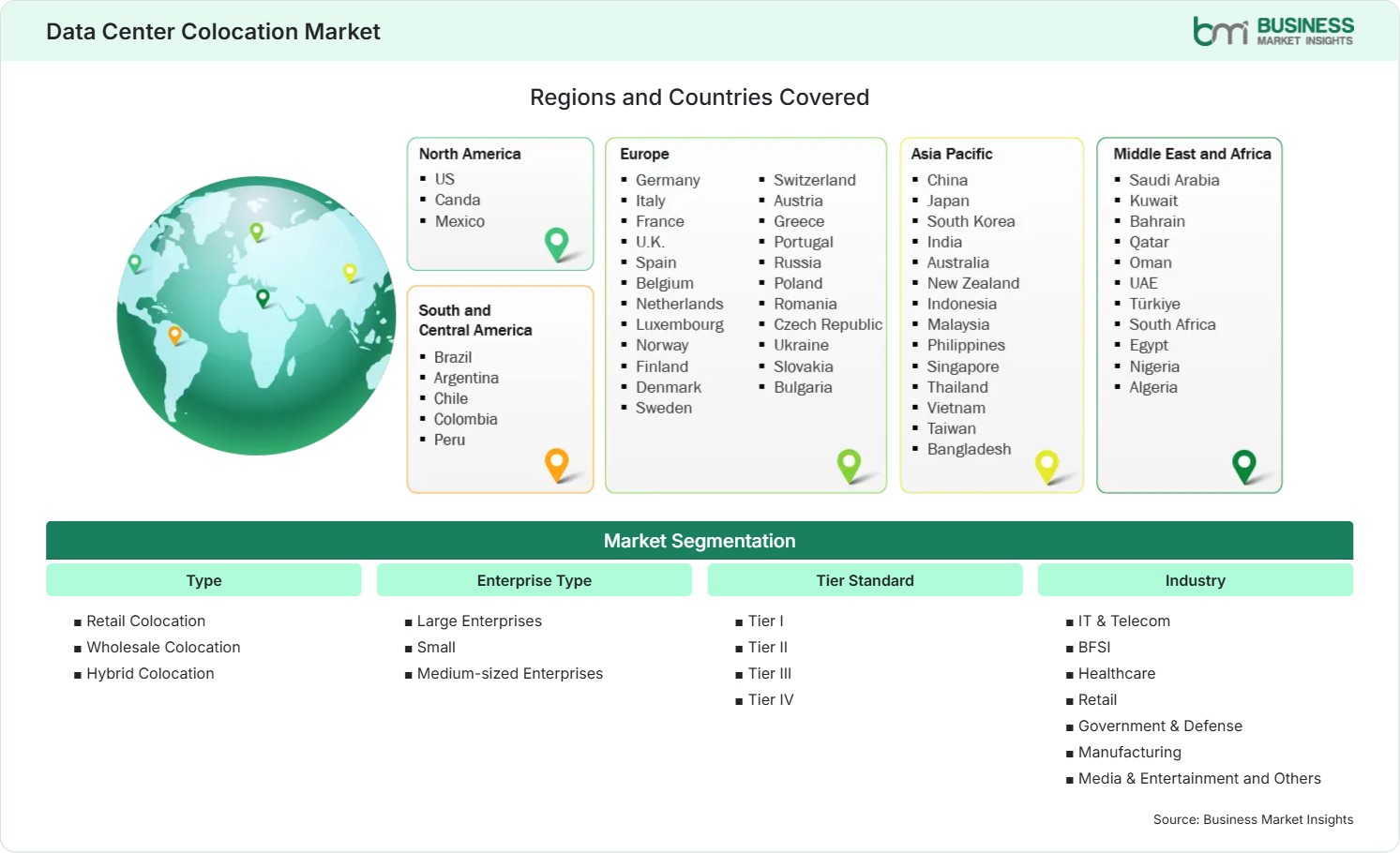
North America Data Center Colocation Market
North America accounts for 36%–39% of global revenue in 2025 and is expected to expand at a CAGR of 10.8%–11.6% during 2026–2033. There is a mature cloud ecosystem in the area, along with substantial enterprise IT expenditure, extensive AI usage, and fiber connectivity. There have been continued large investments by hyperscale cloud service providers to support capacity expansion within major metropolises. The area also enjoys the use of more renewable energy purchases and robust demand for resilient digital infrastructure.
- Large hyperscale developments across Northern Virginia, Dallas, Phoenix, Atlanta, and Silicon Valley continue increasing demand for high-capacity campuses with advanced cooling systems and substantial power availability.
- Enterprise migration from owned facilities toward outsourced infrastructure improves operational flexibility while supporting growing requirements for cloud connectivity, cybersecurity compliance, and disaster recovery capabilities.
- The Data Center Colocation Market share remains highest in this region due to extensive carrier-neutral ecosystems, dense interconnection environments, and sustained investments by cloud and AI service providers.
- Rising deployment of generative AI applications increases rack densities, encouraging operators to invest in liquid cooling technologies and next-generation power distribution architectures.
- Renewable energy procurement agreements and carbon reduction commitments are increasingly influencing site selection decisions among enterprise and hyperscale customers.
US Data Center Colocation Market
The United States represents approximately 76%–80% of North American demand and is forecast to grow at a CAGR of 10.9%–11.7% through 2033. With strong cloud adoption, significant capital investment into AI infrastructure, and growth in digital services driving market development, Northern Virginia continues to be the largest global colocation center, with Dallas, Chicago, Phoenix, and Atlanta making significant investments as well. In addition, regulatory focus on cybersecurity and resilience drives demand.
- AI infrastructure investments by technology companies are accelerating demand for facilities capable of supporting high-density workloads and advanced thermal management solutions.
- Federal and state initiatives supporting digital transformation are encouraging additional infrastructure deployments across strategic metropolitan locations.
- Financial services, healthcare, and public sector organizations increasingly utilize third-party facilities to strengthen resilience and compliance capabilities.
- Demand for edge-enabled architectures is encouraging distributed deployments that improve latency performance for digital applications and content delivery networks.
Europe Data Center Colocation Market
Europe holds a market share range of 24%–27% in 2025 and is projected to expand at a CAGR of 11.2%–12.0% through 2033. Robust data-protection policies, the growing trend toward using clouds, and sustainability policies will be defining investment trends in the future. German and UK regions lead when it comes to deployment by region, while Spain, Italy, and the Nordic region show rapid growth. Increasingly, operators are favoring renewable energy sources, waste-heat recovery systems, and efficient cooling methods.
- Frankfurt, London, Amsterdam, Paris and Dublin are still important interconnection hubs, drawing in multinational cloud providers and enterprise customers.
- Germany is at the forefront of regional capacity additions, while Spain shows one of the fastest rates of growth with a compound annual growth rate between 12.4% and 13.2%.
- Sustainability regulations promote the use of energy-efficient designs, contracts for renewable power, and more advanced cooling technologies in new buildings.
- The increasing demand for sovereign cloud services is leading to greater requirements regarding localized infrastructure and environments that comply with regulatory standards.
- The greater the use of AI in the manufacturing, finance, and research sectors, the more demand there is for high-performance colocation facilities.
Asia Pacific Data Center Colocation Market
Asia Pacific accounts for 27%–30% of global revenue in 2025 and is expected to register the fastest CAGR of 13.8%–14.7% during 2026–2033. Rapid digital transformation, expanding internet penetration, and growing cloud adoption continue driving regional investments. China, Japan, and India represent major demand centers, while Malaysia and Indonesia are emerging as high-growth destinations. The region benefits from government-backed digital economy initiatives, expanding hyperscale investments, and increasing requirements for localized data processing and storage infrastructure.
- China is still the biggest market in the region, thanks to strong demand for cloud services and ongoing investment in large-scale infrastructure projects.
- India shows one of the highest rates of expansion, with a CAGR between 15.1% and 16.0% as digitalisation and the adoption of AI speed up.
- Regional operators are expanding capacity to address increasing requirements from cloud providers, financial institutions, and digital commerce platforms.
- Data localization rules in many countries push businesses to use local infrastructure to meet legal and oversight needs.
- Investing in submarine cables and carrying out network modernization projects helps to improve connectivity and enhances the competitiveness of the regional ecosystem.
Rest of World Data Center Colocation Market
The Rest of World region represents 10%–13% of global demand in 2025 and is projected to grow at a CAGR of 12.0%–12.9% through 2033. South and Central America benefit from growing cloud adoption and enterprise modernization initiatives, while the Middle East and Africa experience increasing investment linked to national digital transformation programs. Saudi Arabia, the UAE, Brazil, and Mexico remain leading destinations. Demand continues rising as governments prioritize digital infrastructure, cybersecurity readiness, and localized data hosting capabilities.
- Brazil is still the biggest market in South America, thanks to the continued adoption of the cloud and the increasing demand from businesses for resilient infrastructure services.
- Mexico continues benefiting from cross-border connectivity requirements and increasing investments from international operators expanding regional footprints.
- Saudi Arabia is experiencing one of the fastest rates of growth in the world, with a compound annual growth rate ranging from 14.0% to 14.8% as a result of its major initiatives to develop its digital economy.
- The developments carried out in the UAE are increasingly concentrating on creating facilities that are ready for AI, incorporating renewable energy and expanding the hyperscale ecosystem.
- The expansion of programmes in the fields of fintech, e-commerce, and government digitalisation is still contributing to increased long-term demand in emerging economies.