
Hyperscale Data Center Market Outlook: Size, Share, Trends, Growth Analysis, Competitive Landscape & Forecast, 2026-2033

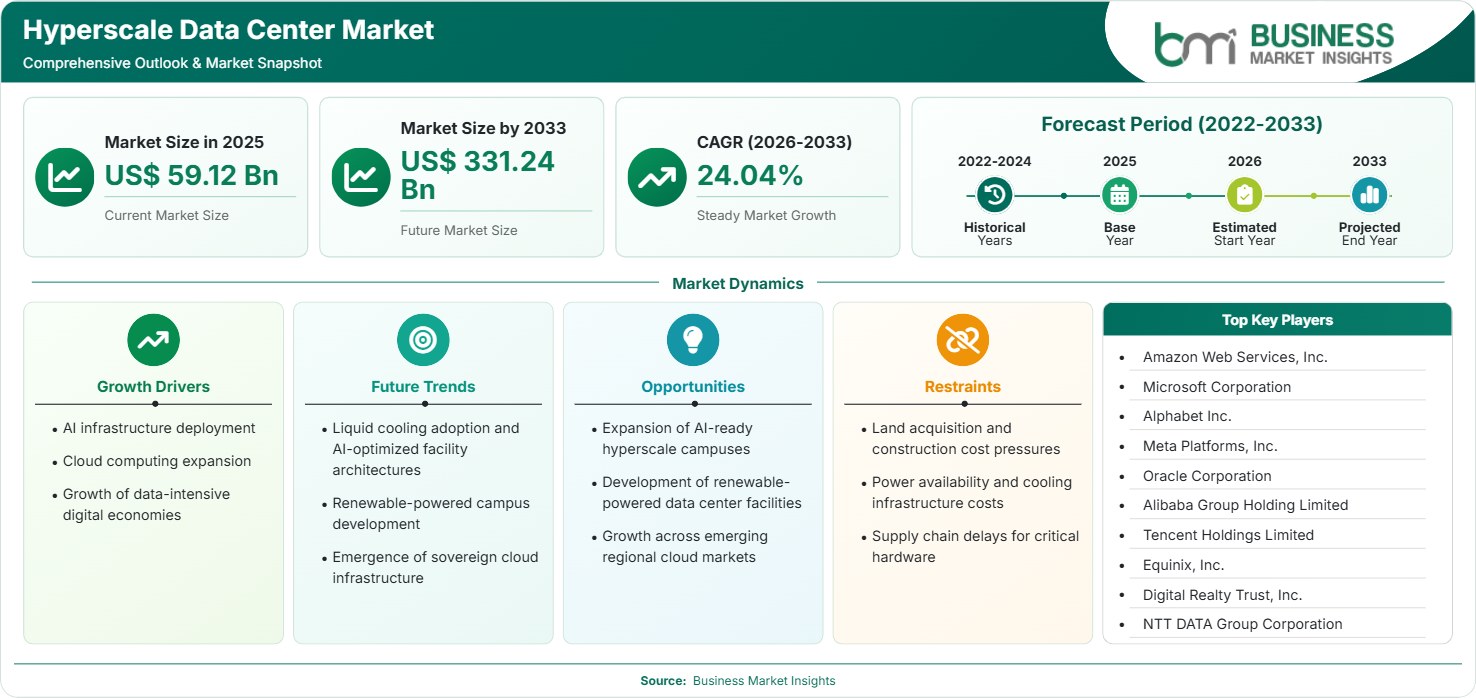
The Hyperscale Data Center Market size was valued at US$ 59.12 Billion in 2025 and is projected to reach US$ 331.24 Billion by 2033, growing at a CAGR of 24.04% during 2026–2033. Key growth drivers include AI infrastructure deployment, cloud computing expansion, high-performance computing demand, and digital sovereignty initiatives. Opportunities stem from liquid cooling, renewable-powered campuses, and emerging regional cloud investments.

Report Coverage
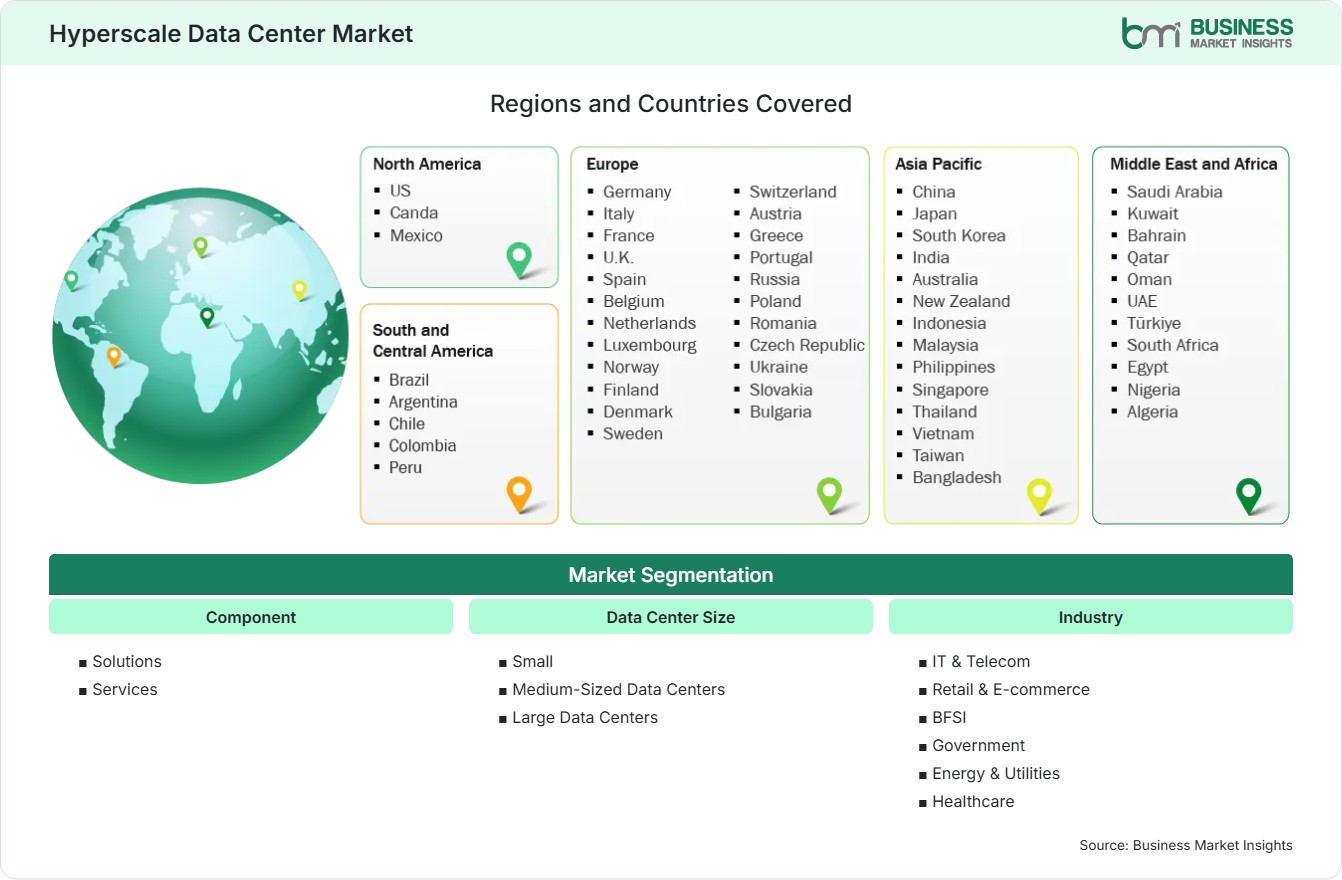
  • Component: Solutions, Services
  • Data Center Size: Small, Medium-Sized Data Centers, Large Data Centers
  • Industry: IT & Telecom, Retail & E-commerce, BFSI, Government, Energy & Utilities, Healthcare
US$ 59.12 Bn Market size in 2025
US$ 331.24 Bn Market Size by 2033
24.04% CAGR, 2026 - 2033
2026-2033 Forecast Period

AI Overview

Hyperscale Data Center Market Summary

  • North America Region: Holds a market share of 38%–41% in 2025, growing at a 21%–23% CAGR during 2026–2033, driven by hyperscaler capital expenditure, AI training clusters, advanced fiber connectivity, renewable energy procurement, and enterprise cloud migration. US leadership is reinforced by major AI deployments and cloud campus expansion, supporting a CAGR of 21%–23%.
  • Fastest Growing Region: Asia Pacific accounts for 28%–31% share in 2025 and expands at 27%–29% CAGR during 2026–2033. Demand originates from sovereign cloud initiatives, AI adoption, digital commerce, expanding internet populations, and large-scale infrastructure investments across China, India, and Southeast Asia.
  • Leading Segment: Solutions represent 63%–66% share in 2025 and advance at 23%–25% CAGR during 2026–2033. Growth reflects increasing deployment of power systems, networking equipment, cooling platforms, monitoring technologies, and automation tools supporting scalable digital infrastructure.
  • High Growth Segment: Large Data Centers hold 68%–71% share in 2025 and register 25%–27% CAGR during 2026–2033. Demand is supported by AI workloads, hyperscale cloud expansion, higher rack densities, and integrated energy management architectures.
  • Key Market Opportunity: Large-scale AI infrastructure requires advanced cooling, clean power sourcing, and data sovereignty compliance, creating opportunities for operators, technology vendors, utilities, construction firms, and colocation providers globally.
  • Major Market Players: Amazon Web Services, Inc.; Microsoft Corporation; Alphabet Inc.; Meta Platforms, Inc.; Oracle Corporation; Alibaba Group Holding Limited; Tencent Holdings Limited; Equinix, Inc.; Digital Realty Trust, Inc.; NTT DATA Group Corporation.
Strategic Insights

Hyperscale Data Center Market: Strategic Insights

Hyperscale Data Center Market Strategic Framework
FREE PDF
Request your free sample
Request free sample
Stakeholder View

Key Takeaways

  • The ecosystem increasingly integrates utilities, chip designers, networking vendors, construction specialists, and cloud operators, creating longer value chains and stronger interdependencies around power availability and AI readiness.
  • Large campuses supporting AI training, inference, and cloud-native services present the highest revenue upside due to escalating compute-density requirements and multiyear capacity expansion programs.
  • Innovation is shifting toward liquid cooling, programmable infrastructure, AI-driven facility monitoring, advanced power distribution, and automated workload optimization to improve efficiency.
  • Asia Pacific offers a compelling investment case as cloud penetration, digital commerce activity, and sovereign cloud programs stimulate demand across China, India, Indonesia, and Malaysia.
  • Strategic partnerships between cloud providers, colocation operators, and renewable energy developers are accelerating capital deployment and infrastructure consolidation.
  • Sustainability-focused procurement policies increasingly influence site selection, equipment sourcing, and operational strategies across the industry.
Geographic Outlook

Hyperscale Data Center Market Regional Highlights

North America Hyperscale Data Center Market

North America accounts for 38%–41% of global revenue in 2025 and advances at a 21%–23% CAGR through 2033. The region benefits from mature cloud ecosystems, extensive fiber networks, and large-scale AI investments. The Hyperscale Data Center Market share remains strongest across the United States and Canada due to significant hyperscaler presence. Growing energy procurement agreements, advanced cooling adoption, and favorable infrastructure availability continue supporting deployment of high-capacity digital campuses.

  • Large AI training clusters drive demand for high-density racks, liquid cooling, and advanced networking infrastructure.
  • Renewable power procurement agreements increasingly influence site selection and long-term operating economics.
  • Northern Virginia, Texas, and Ohio remain major capacity expansion hubs supported by connectivity advantages.
  • Investments in automation and predictive maintenance improve operational efficiency across large campuses.
  • Enterprise cloud migration continues generating sustained infrastructure requirements.

US Hyperscale Data Center Market

The United States represents 78%–81% of the North American Hyperscale Data Center Market revenue and records a 21%–23% CAGR through 2033. Major operators continue expanding AI-ready campuses to accommodate cloud, machine learning, and enterprise workloads. Capacity growth is supported by deep fiber ecosystems, infrastructure financing, and technology innovation. The country remains the leading deployment destination for hyperscale operators and large-scale digital infrastructure investments.

  • AI model development stimulates demand for high-performance computing environments and advanced cooling systems.
  • Utility partnerships increasingly focus on renewable power procurement and grid reliability enhancement.
  • Colocation providers and cloud companies collaborate to accelerate capacity delivery timelines.
  • Data sovereignty and cybersecurity requirements support infrastructure modernization initiatives.

Europe Hyperscale Data Center Market

Europe holds 24%–27% Hyperscale Data Center Market revenue share in 2025 and progresses at a 22%–24% CAGR. Digital sovereignty requirements, cloud adoption, and enterprise modernization support regional expansion. Germany leads regional deployment activity, while Spain emerges as a high-growth country with a CAGR range exceeding regional averages. Sustainability regulations encourage investment in energy-efficient designs, waste heat recovery, and renewable-powered facilities. The region remains strategically important for multinational cloud providers.

  • Germany leads capacity deployment through strong enterprise demand and connectivity infrastructure.
  • Spain demonstrates accelerated growth supported by digital economy investments and cloud adoption.
  • Sustainability regulations encourage advanced cooling technologies and renewable energy integration.
  • Cross-border data governance requirements stimulate localized infrastructure development.
  • AI adoption across manufacturing and financial services increases compute demand.

Asia Pacific Hyperscale Data Center Market

Asia Pacific captures 28%–31% of global revenue in 2025 and posts the highest CAGR of 27%–29% through 2033. Strong digital transformation, expanding internet populations, and significant cloud investments underpin regional momentum. China remains the leading market, while India records the fastest development trajectory. The region demonstrates the strongest Hyperscale Data Center Market growth potential owing to e-commerce expansion, AI adoption, and government-backed digital infrastructure initiatives.

  • China remains the largest regional contributor through cloud and AI infrastructure deployment.
  • India attracts investments through digitalization programs and enterprise cloud migration.
  • Southeast Asian economies increasingly support hyperscale development through regulatory incentives.
  • Growing digital commerce volumes require scalable computing and storage environments.
  • Local cloud regions improve latency performance and regulatory compliance capabilities.

Rest of World Hyperscale Data Center Market

Rest of World represents 8%–10% of global revenue in 2025 and grows at a 24%–26% CAGR. The Middle East benefits from smart city initiatives and sovereign cloud investments, while South and Central America gain momentum from cloud adoption and connectivity improvements. Saudi Arabia leads deployment activity, whereas Brazil remains a key growth market. Increasing digital infrastructure spending broadens regional opportunities across multiple industry sectors.

  • Saudi Arabia attracts large-scale cloud and digital infrastructure investments.
  • Brazil benefits from enterprise modernization and increasing cloud penetration.
  • Renewable-energy-powered campuses improve long-term project attractiveness.
  • Data localization requirements create new infrastructure demand.
  • International operators expand regional footprints through strategic partnerships.
Global Market Geography
FREE PDF
Request your free sample
Request free sample
Segment Analysis

Hyperscale Data Center Market Segmentation

Component

This segment accounts for the largest industry revenue, with solutions generating roughly 63%–66% share in 2025 and advancing at 23%–25% CAGR. Growing infrastructure complexity, AI deployments, and operational automation support technology spending. The Hyperscale Data Center Market scope continues expanding as organizations modernize networking, power, cooling, and monitoring capabilities.

  • Solutions: Includes infrastructure platforms supporting compute, storage, networking, cooling, security, orchestration, and automation requirements for scalable deployments and operational efficiency.
  • Services: Covers consulting, integration, deployment, maintenance, managed operations, and optimization services needed for continuous performance and uptime management.

Data Center Size

Large facilities dominate deployment strategies with 68%–71% share in 2025 and a projected 25%–27% CAGR. Rising AI demand favors campuses capable of delivering substantial power, cooling, and compute density. Smaller facilities maintain relevance in localized and specialized deployments.

  • Small and Medium-Sized Data Centers: Support regional workloads, edge connectivity requirements, specialized enterprise applications, and localized compliance needs.
  • Large Data Centers: Enable cloud-scale operations, AI training environments, high-density computing, and global workload distribution through centralized infrastructure models.

Industry

Industry adoption continues broadening as digital transformation accelerates. IT and Telecom commands the largest contribution, while healthcare and retail applications gain momentum. The appearance of Hyperscale Data Center Market trends is increasingly linked with AI-driven analytics, cybersecurity, and cloud-native service delivery.

  • IT & Telecom: Relies on scalable infrastructure for cloud services, network management, and digital application delivery.
  • Retail & E-commerce: Uses large-scale computing environments to support transactions, personalization, and demand forecasting.
  • BFSI: Requires resilient infrastructure for secure transactions, risk analytics, and regulatory compliance.
  • Government: Supports digital public services, sovereign cloud programs, and cybersecurity initiatives.
  • Energy & Utilities: Utilizes advanced analytics, grid monitoring, and operational optimization applications.
  • Healthcare: Expands deployment of AI diagnostics, electronic records, and data-intensive research workloads.
Market Forces

Hyperscale Data Center Market Dynamics

Key Market Drivers

Accelerating AI Infrastructure Investments

AI training and inference workloads increasingly require high-density computing environments supported by advanced cooling, networking, and power systems. According to industry sources, hyperscalers keep spending a considerable amount of money on infrastructure scaling with regard to AI. The rising need for acceleration, GPU clusters, and scalable storage drives the construction of facilities. This process helps to expand capacity in the long run while making sure that facilities are energy efficient and sustainable. A considerable interest in this kind of service from enterprises, governments, and tech companies keeps boosting investments in the infrastructure field.

Expanding Cloud Service Consumption

Cloud-native application development, hybrid computing strategies, and enterprise modernization efforts remain important growth catalysts. Cloud computing is being adopted by businesses to scale up their operations. This trend is creating a need for networking, storage, and processing capabilities via hyperscale infrastructure. Growing reliance on digital services in sectors like finance, health care, telecoms, and retail adds further to this demand. With growing adoption of cloud computing and AI, there is growing demand for advanced facilities that can handle critical operations with the required levels of security and performance.

Growth of Data-Intensive Digital Economies

Rapid expansion of digital payments, streaming services, e-commerce platforms, and connected devices generates substantial data volumes. The operators need to build scalable infrastructures to efficiently handle all these processes. The growing adoption of real-time analysis, Internet of Things applications, and machine learning technologies is increasing the usage of these infrastructures. Connectivity investments and broadband usage are facilitating broad digital participation, and businesses are searching for dependable computing infrastructures to gain a competitive advantage. All these factors create a conducive climate for infrastructure deployment and growth.

Key Market Opportunities

Renewable-Powered Campus Development

Growing focus on carbon reduction creates opportunities for renewable-powered hyperscale campuses. Long-term power purchase contracts and on-site power generation arrangements are gaining more popularity among operators. Regions where there is favorable availability of renewable energy receive significant investment because of lower operational costs and sustainability goals. Companies involved in the provision of energy management systems, cooling technology, and grid integration are well-placed to benefit from this trend. Energy efficiency considerations are being considered in long-term infrastructure plans.

Emergence of Sovereign Cloud Infrastructure

Governments increasingly implement data sovereignty frameworks requiring localized processing and storage. Such policies drive the creation of a compliant digital infrastructure and regional clouds. This, in turn, creates the demand that leads to cooperation between cloud companies, telcos, and infrastructure players. Those organizations needing local control generate the possibilities of campus development, management services, and secure computing environments. Further expansion of sovereign clouds in Europe, Asia Pacific, and the Middle East regions presents a promising growth direction for market players.

AI-Optimized Facility Architectures

Future Hyperscale Data Center Market Forecasts increasingly depend on AI-optimized facilities capable of supporting higher rack densities and accelerated computing workloads. Innovative liquid-cooling systems, automation tools, and efficient network design are emerging as key competitive differentiators. Providers of tailored infrastructure offerings are able to capitalize on an increasing demand for the purpose of reengineering campus designs based on AI demands. Cloud computing, AI inference, and edge intelligence create expanding investment opportunities and future revenue streams.

Market Restraints and Challenges

Power Availability Constraints

Factor: Rising energy requirements associated with AI-intensive facilities are increasing pressure on regional power infrastructure. Impact: Project approval and deployment may be delayed in cases where there is inadequate capacity on the grid. Hyperscale data centers typically have an electricity requirement of several hundred megawatts, thus leading to competition for limited energy supplies. Interconnection with the utilities may lengthen project development time and increase the cost of the project. Difficulties in energy procurement can affect the geography of expansion.

Construction Costs and Supply Chain Pressures

Factor: Escalating costs for electrical equipment, cooling systems, and specialized construction materials affect project economics. Impact: Increased capital expenditure can lead to extended return on investment and can create complications during budgeting. Limitations within the supply chain in respect of transformers, switchgear, and more sophisticated semiconductors can create delays during infrastructure roll-out. Lack of engineering and construction manpower increases risks. The operators are still considering modular solutions and supplier diversification, yet cost fluctuations will remain an issue.

Company Analysis

Competitive Landscape

The Hyperscale Data Center Market analysis reflects competition among cloud providers, infrastructure operators, and colocation specialists focused on AI-ready capacity expansion.

Company Name

Overview

Products and Services relevant to this market

Amazon Web Services, Inc.

Global cloud infrastructure leader operating extensive hyperscale regions and AI-ready facilities.

Cloud computing, storage, AI infrastructure, networking services, data center operations.

Microsoft Corporation

Expands Azure infrastructure worldwide with strong focus on AI workloads.

Azure cloud, AI platforms, storage systems, networking, hyperscale infrastructure.

Alphabet Inc.

Operates Google Cloud and large-scale computing infrastructure globally.

Cloud services, AI processing platforms, networking, storage, data center technologies.

Meta Platforms, Inc.

Major operator of large AI-focused digital infrastructure environments.

Social platform infrastructure, AI computing environments, advanced networking systems.

Oracle Corporation

Expands cloud infrastructure through large-scale regional deployments.

Oracle Cloud Infrastructure, database services, compute, networking platforms.

Alibaba Group Holding Limited

Leading Asian cloud provider with extensive hyperscale infrastructure.

Cloud computing, storage, AI services, enterprise digital solutions.

Tencent Holdings Limited

Supports cloud and digital ecosystem growth through large facilities.

Tencent Cloud, computing resources, storage, networking capabilities.

Equinix, Inc.

Global colocation specialist enabling interconnection-rich deployments.

Colocation, interconnection services, digital infrastructure platforms.

Digital Realty Trust, Inc.

Operates carrier-neutral facilities serving enterprise and cloud clients.

Data center leasing, connectivity ecosystems, infrastructure services.

NTT DATA Group Corporation

Provides infrastructure services and global data center capabilities.

Colocation, managed services, cloud connectivity, infrastructure management.

Trust & Transparency

Research Methodology

The market analysis combines proprietary research with secondary data from government agencies, company disclosures, regulatory filings, industry databases and expert interviews. Market estimates are validated through data triangulation, cross-market benchmarking and analyst review.

View Full Research Methodology

Questions Answered

Frequently Asked Questions

What does the Hyperscale Data Center Market Report highlight for investors?

The report emphasizes AI infrastructure expansion, sovereign cloud opportunities, renewable-powered campuses, and long-term demand for scalable computing environments across global regions.

How does regional regulation influence deployment?

Data sovereignty, cybersecurity requirements, and localization policies often determine site selection, capacity planning, and investment priorities for operators.

Why are power strategies becoming critical?

High-density computing requires substantial electricity capacity. Operators increasingly seek renewable energy agreements, utility partnerships, and energy-efficiency technologies to ensure long-term scalability.

Which industries generate the strongest demand?

IT & Telecom, BFSI, retail, healthcare, and government organizations are significant consumers due to cloud migration, analytics, cybersecurity, and digital service delivery requirements.

What factors are shaping future infrastructure design?

AI workloads, sustainability targets, and higher rack densities are encouraging adoption of liquid cooling, automation, advanced power systems, and modular deployment models.

Access the Full Hyperscale Data Center Market Report

Get segment-level forecasts, regional estimates, competitive benchmarking, company profiles and downloadable Excel datasets.

Access the full Hyperscale Data Center Market Report
350 pages PDF & Excel | 2026-08-27