
Edge Data Center Market Outlook: Size, Share, Trends, Growth Analysis, Competitive Landscape & Forecast, 2026-2033

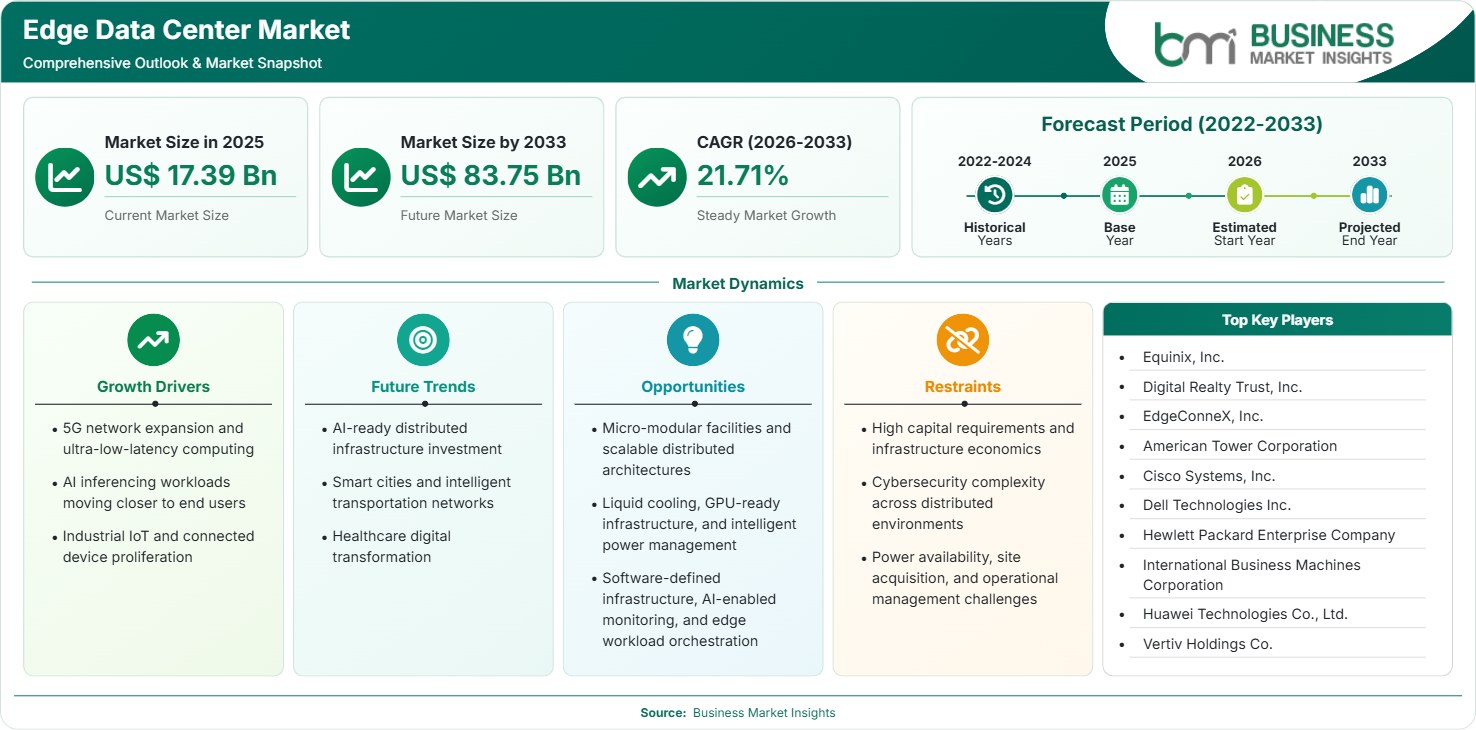
The Edge Data Center Market size was valued at US$ 17.39 Billion in 2025 and is projected to reach US$ 83.75 Billion by 2033, growing at a CAGR of 21.71% during 2026–2033. Key drivers include 5G densification, AI inferencing, IoT expansion, low-latency computing demand, and digital sovereignty initiatives. Opportunities stem from modular deployments, industrial edge applications, and emerging-market connectivity investments.

Report Coverage
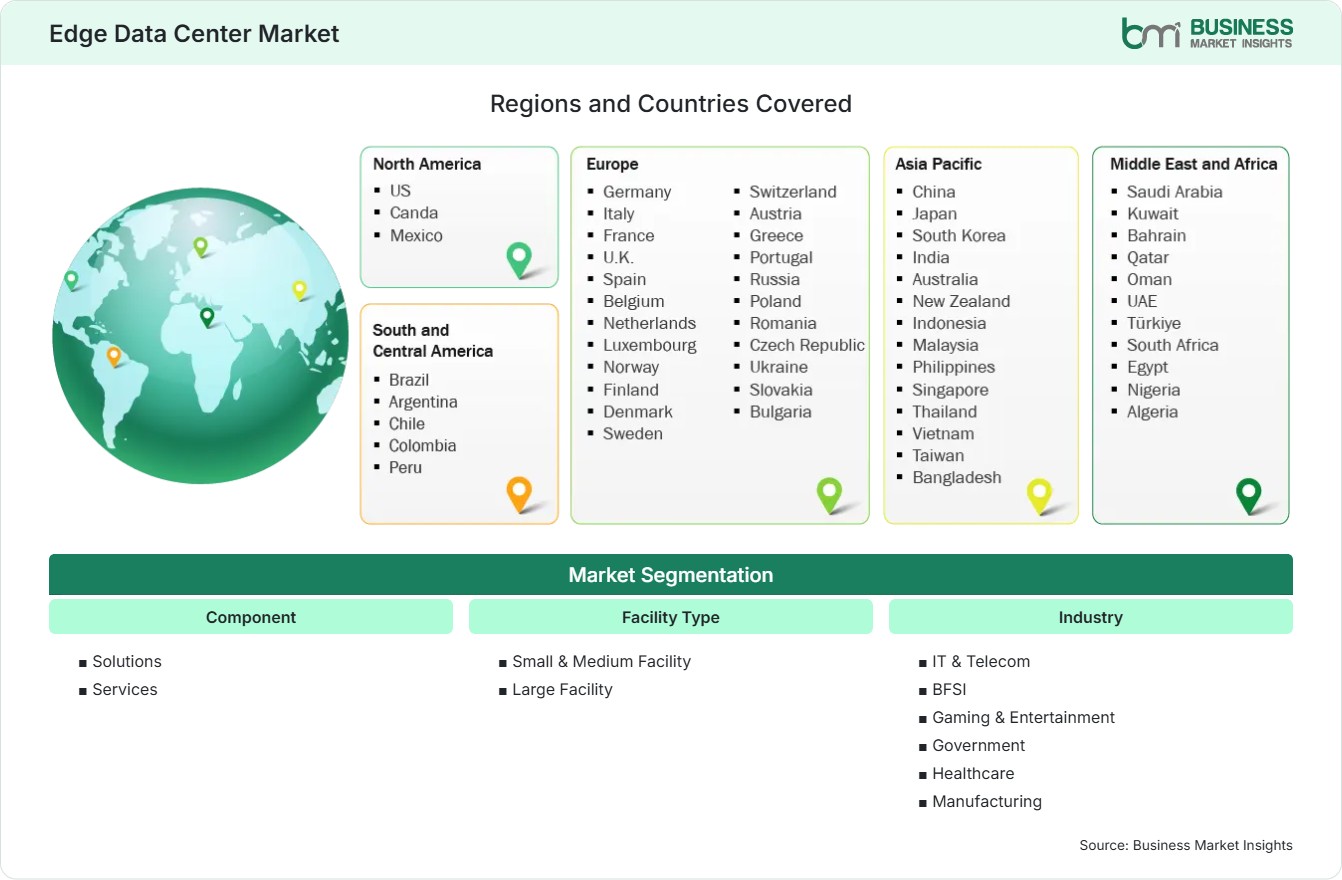
  • Component: Solutions, Services
  • Facility Type: Small & Medium Facility, Large Facility
  • Industry: IT & Telecom, BFSI, Gaming & Entertainment, Government, Healthcare, Manufacturing
US$ 17.39 Bn Market size in 2025
US$ 83.75 Bn Market Size by 2033
21.71% CAGR, 2026 - 2033
2026-2033 Forecast Period

AI Overview

Edge Data Center Market Summary

  • North America Region: North America holds a market share of 38%–41% in 2025, growing with a CAGR of 19%–21% during 2026–2033 driven by AI workloads, 5G infrastructure expansion, enterprise digitalization, hyperscale-edge integration, and increased content delivery requirements. US demand benefits from telecom modernization and localized computing deployments, advancing at 20%–22% CAGR through 2033.
  • Fastest Growing Region: Asia Pacific holds a market share of 26%–29% in 2025, growing with a CAGR of 24%–26% during 2026–2033 supported by smart manufacturing, rising internet users, 5G rollout, cloud localization mandates, and accelerating investments across India, Southeast Asia, and China.
  • Leading Segment: Solutions accounts for 64%–68% share in 2025 and expands at 20%–22% CAGR through 2033. Adoption is supported by integrated power systems, modular architecture, advanced cooling, network infrastructure upgrades, and scalable distributed computing requirements.
  • High Growth Segment: Healthcare represents 10%–13% share in 2025 and advances at 25%–27% CAGR through 2033. Growth is supported by connected healthcare, diagnostic imaging workloads, telemedicine expansion, real-time analytics, and data residency compliance requirements.
  • Key Market Opportunity: Deployment of AI-ready distributed facilities near industrial zones, smart cities, logistics corridors, and telecom aggregation points creates opportunities for low-latency services, localized processing, energy optimization, and recurring infrastructure revenues.
  • Major Market Players: Equinix, Inc.; Digital Realty Trust, Inc.; EdgeConneX, Inc.; American Tower Corporation; Cisco Systems, Inc.; Dell Technologies Inc.; Hewlett Packard Enterprise Company; International Business Machines Corporation; Huawei Technologies Co., Ltd.; Vertiv Holdings Co.
Strategic Insights

Edge Data Center Market: Strategic Insights

Edge Data Center Market Strategic Framework
FREE PDF
Request your free sample
Request free sample
Stakeholder View

Key Takeaways

  • The value chain increasingly integrates infrastructure vendors, telecommunications operators, colocation providers, software platforms, and managed-service specialists, creating strong partnership-driven deployment models.
  • Healthcare, gaming, and industrial automation applications offer some of the strongest long-term revenue opportunities due to latency sensitivity and growing real-time data requirements.
  • AI inferencing at the network edge is accelerating innovation in cooling, power efficiency, workload orchestration, and autonomous infrastructure management solutions.
  • India, Indonesia, Vietnam, and selected Middle Eastern markets provide compelling investment cases due to digital transformation programs and expanding connectivity infrastructure.
  • Strategic acquisitions continue focusing on network proximity assets, modular infrastructure technologies, and regional colocation facilities to strengthen distributed computing footprints.
  • Sustainability has become a major competitive differentiator, encouraging operators to adopt renewable energy sourcing, intelligent cooling systems, and advanced energy-management technologies.
Geographic Outlook

Edge Data Center Market Regional Highlights

North America Edge Data Center Market

North America accounted for 38%–41% Edge Data Center Market share in 2025 and is projected to expand at 19%–21% CAGR through 2033. The region benefits from extensive cloud ecosystems, high AI adoption, widespread fiber connectivity, and advanced telecommunications networks. Enterprise demand for localized processing continues increasing across financial services, healthcare, media delivery, and manufacturing environments. Strong capital investment by colocation providers and telecom operators further supports regional leadership.

  • AI inference deployments are increasing across enterprise campuses, creating sustained demand for localized compute infrastructure and advanced cooling technologies.
  • Telecom operators are integrating edge facilities with 5G architectures to improve application responsiveness and network efficiency.
  • Content streaming, gaming, and cloud services continue driving distributed infrastructure investment near metropolitan demand centers.
  • Energy-efficient modular deployments are gaining traction as operators target lower operational costs and sustainability goals.

US Edge Data Center Market

The United States represented approximately 82%–85% of North American share in 2025 and is expected to grow at 20%–22% CAGR during 2026–2033. Strong enterprise technology spending, widespread cloud adoption, and advanced telecom infrastructure support deployment activity. Federal cybersecurity initiatives and AI investments are further increasing demand for localized processing resources across multiple industries.

  • Large metropolitan areas remain focal points for distributed computing expansion serving cloud, media, and telecommunications workloads.
  • Healthcare organizations increasingly deploy local processing systems to support compliance, imaging, and telehealth services.
  • Industrial facilities are adopting low-latency infrastructure to support automation and predictive maintenance applications.
  • Growing AI inferencing requirements are encouraging deployment of GPU-enabled distributed facilities.

Europe Edge Data Center Market

Europe held 24%–27% share in 2025 and is anticipated to grow at 20%–22% CAGR through 2033. Data sovereignty regulations, industrial digitalization, and growing AI adoption encourage local infrastructure deployment. Germany remains the leading market, while Spain and Poland exhibit some of the fastest expansion. Strong sustainability requirements are accelerating investment in energy-efficient architectures and advanced cooling solutions.

  • GDPR-related compliance requirements support domestic processing and distributed infrastructure adoption.
  • Manufacturing modernization programs across Germany strengthen localized computing demand.
  • Renewable energy integration is becoming a key investment consideration for facility operators.
  • Spain records some of the highest regional expansion rates due to connectivity and cloud investment activity.
  • Smart-city deployments are increasing demand for low-latency computing capabilities.

Asia Pacific Edge Data Center Market

Asia Pacific accounted for 26%–29% share in 2025 and is projected to expand at 24%–26% CAGR, making it the fastest-growing region. Rising internet penetration, mobile data traffic growth, and extensive 5G rollout support investment activity. China leads regional demand, while India demonstrates among the strongest growth trajectories. Government-led digital initiatives and smart manufacturing projects further strengthen adoption.

  • Large-scale 5G deployments continue creating opportunities for telecommunications-integrated edge facilities.
  • India benefits from digital public infrastructure expansion and growing enterprise cloud usage.
  • E-commerce growth drives investment in localized processing and content delivery capabilities.
  • Smart manufacturing initiatives accelerate adoption across industrial environments.
  • Regional cloud providers increasingly establish distributed facilities to improve service responsiveness.

Rest of World Edge Data Center Market

The Rest of World region captured 8%–10% share in 2025 and is forecast to grow at 21%–23% CAGR through 2033. The Middle East benefits from digital diversification programs and smart-city investments, while South and Central America are supported by expanding broadband infrastructure and cloud adoption. Local data processing requirements continue improving the business case for distributed deployments.

  • Saudi Arabia and the UAE lead regional investment due to large technology and smart-city initiatives.
  • Brazil remains the leading South American market supported by enterprise digital transformation.
  • Growing subsea connectivity projects improve infrastructure economics across multiple emerging markets.
  • Financial institutions increasingly adopt local processing capabilities for compliance and performance objectives.
  • Telecom-led deployment models remain important across developing digital economies.
Global Market Geography
FREE PDF
Request your free sample
Request free sample
Segment Analysis

Edge Data Center Market Segmentation

Component

Component solutions held 64%–68% share in 2025 and are expected to grow at 20%–22% CAGR. The Edge Data Center Market scope continues expanding as organizations prioritize scalable infrastructure, intelligent management software, resilient power systems, and managed services supporting distributed computing environments.

  • Solutions: Demand is supported by modular deployments, integrated cooling systems, networking equipment, AI-ready platforms, and infrastructure modernization strategies.
  • Services: Managed and professional services gain traction as enterprises seek deployment expertise, operational support, monitoring, and lifecycle management.

Facility Type

Small & medium facilities represented 56%–60% share in 2025 and are projected to grow at 22%–24% CAGR. Decentralized deployment strategies, urban proximity requirements, and faster implementation timelines support adoption across telecommunications and enterprise environments.

  • Small & Medium Facility: Favored for metro-edge deployments, telecom integration, content delivery requirements, and lower capital investment thresholds.
  • Large Facility: Increasingly adopted for regional aggregation, AI processing, cloud interconnection, and multi-tenant infrastructure environments.

Industry

IT & Telecom maintained 30%–34% share in 2025 and is expected to expand at 20%–22% CAGR. Current Edge Data Center Market trends indicate growing adoption across communications, distributed cloud architectures, mobile networks, and real-time service delivery ecosystems.

  • IT & Telecom: Core demand originates from network modernization, cloud integration, 5G expansion, and latency-sensitive digital services.
  • BFSI: Localized processing supports regulatory compliance, secure transactions, fraud detection, and digital banking services.
  • Gaming & Entertainment: Distributed infrastructure improves streaming quality, cloud gaming responsiveness, and content delivery efficiency.
  • Government: Investments center on cybersecurity, citizen services, digital infrastructure resilience, and sovereign computing initiatives.
  • Healthcare: Adoption is driven by telemedicine, diagnostic imaging, connected devices, and real-time patient monitoring.
  • Manufacturing: Industrial automation, predictive maintenance, robotics, and digital-twin applications support deployment activity.
Market Forces

Edge Data Center Market Dynamics

Key Market Drivers

5G Network Expansion and Ultra-Low-Latency Computing

Global 5G subscriptions continue to expand rapidly, while telecom operators densify their network infrastructure, increasing requirements for localized compute processing. Many high-level applications do not have any room for delays due to remote central facility locations. Autonomy solutions, factory automation processes, digital immersion systems, and ecosystems of interlinked devices need processing that is as near real-time as possible. Edge facilities closer to consumers lower latency and enhance network efficiency. The underlying driver will remain relevant because communication service providers view distributed computing as the future of network architecture. Private wireless networks will continue to fuel infrastructure needs.

AI Inferencing Workloads Moving Closer to End Users

Artificial intelligence deployment is shifting from centralized training environments to localized inference architectures. The trend is towards processing information closer to where it originates to decrease bandwidth usage and optimize response times. Applications such as computer vision, predictive maintenance, smart security, and customer analytics need localized processing capability. The collaboration between machine learning and distributed computing technology is driving the development of hardware technologies, the use of GPUs, and orchestration software. The continued expansion of AI into organizations, industries, health care, and government generates consistent demand for infrastructure.

Industrial IoT and Connected Device Proliferation

Billions of connected devices generate data streams requiring immediate analysis and action. The deployment of IIoT solutions in manufacturing plants, logistics centers, energy installations, and smart cities results in an ongoing requirement for localized processing capabilities. The transfer of all the data to central locations is costly and time-consuming. Localized infrastructure facilitates decision-making as well as enhances resiliency and bandwidth utilization. The trend towards automation and digitalization makes the need for local processing crucial. An increasing number of sensors, machines, and intelligent infrastructure solutions facilitate further implementation in the future.

Key Market Opportunities

AI-Ready Distributed Infrastructure Investment

The strongest investment opportunities are emerging around AI-ready facilities capable of supporting inferencing, automation, and analytics workloads. Organizations continue seeking capacity closer to enterprise locations, industrial assets, and telecommunications networks. Edge Data Center Market Forecasts show that there will be increased demand for high-density solutions with cutting-edge cooling techniques and intelligent power distribution, as well as GPU-ready architecture. There are recurring income streams that investors can take advantage of through colocation, managed services, and infrastructure-as-a-service leasing. Solutions geared towards artificial intelligence scenarios will fetch premium pricing.

Smart Cities and Intelligent Transportation Networks

Urban digitalization programs increasingly require localized data processing for traffic management, surveillance, public services, and connected infrastructure. The smart transportation solutions produce vast amounts of data that need to be analyzed instantly. The distribution network helps cities and service providers become more responsive and efficient. Governments around the world continue to invest in intelligent infrastructure initiatives, providing technology companies, operators, and investors with numerous business opportunities. Data analytics, communication networks, sensors, and localized computing are major fields for future infrastructure development.

Healthcare Digital Transformation

Healthcare systems continue to digitize operations through connected medical devices, remote monitoring platforms, diagnostic imaging technologies, and telemedicine services. Such systems produce important information that requires secure and compliant processing. Having localized facilities ensures better availability, lower latency, and compliance with regulations. The increasing cost in the sector, as well as the development of digital health programs, provides favorable conditions for the implementation of such initiatives. Providers who can deliver reliable environments will benefit from increased demand from hospitals and other health-related organizations.

Market Restraints and Challenges

High Capital Requirements and Infrastructure Economics

Factor: The installation of distributed infrastructure entails substantial expenditure on essential systems such as power supply, cooling technology, networking devices, physical security, and site acquisition. While central infrastructure can function from one single place, distributed infrastructure entails developing many sites, equipping them, connecting them and maintaining them. More costs of energy utilization, connectivity, maintenance, compliance, and labor force further add up to the total cost involved.

Impact: Heavy initial investments will hinder the implementation of projects, especially in small markets, where budgets and the profitability expected from these budgets might be small. Investment in more than one location will increase the payback period and add pressure on the project's profitability. Organizations should strike a good balance between increasing infrastructure and costs, as well as demands. Therefore, cost minimization, effective use of resources, and scalability in infrastructure become crucial factors.

Cybersecurity Complexity Across Distributed Environments

Factor: As organizations extend their infrastructure across multiple locations, they experience increased complexity, which creates a wider window of exposure for cyberattacks. Distributed setups may feature many kinds of systems, networks, devices, and data centers that need to have similar security measures in place. Uniform implementation of security policies, access control, monitoring activities, and compliance may involve considerable effort.

Impact: The increasing sophistication of cybersecurity issues may cause delays in implementation, especially in industries working with sensitive or regulated information. It is important to implement advanced cybersecurity measures, hire cybersecurity professionals, continuously monitor the system, and perform vulnerability assessments in order to provide security for a distributed environment. In case of poor cybersecurity measures implementation, companies may face disruption of their work, sanctions, financial losses, and reputation loss. Therefore, the need for cybersecurity measures may make the implementation of distributed infrastructures more costly and complex.

Company Analysis

Competitive Landscape

The competitive environment remains dynamic, with vendors focusing on platform integration, AI readiness, modular deployment models, and geographic expansion. Current Edge Data Center Market analysis indicates increasing collaboration between infrastructure providers, telecom operators, and cloud ecosystem participants.

Company Name

Overview

Products and Services relevant to this market

Equinix, Inc.

Global digital infrastructure company with extensive interconnection ecosystems and distributed colocation footprint.

Edge facilities, colocation, interconnection services, network exchange, digital infrastructure solutions.

Digital Realty Trust, Inc.

Major global data center operator serving enterprises, cloud providers, and telecommunications customers.

Colocation, edge deployments, connectivity platforms, scalable digital infrastructure services.

EdgeConneX, Inc.

Specialist provider focused on localized data center infrastructure across strategic growth markets.

Edge facilities, hyperscale support, colocation, customized infrastructure environments.

American Tower Corporation

Communications infrastructure leader expanding digital infrastructure and edge-related capabilities.

Edge locations, telecommunications infrastructure, network connectivity support services.

Cisco Systems, Inc.

Global networking technology provider supporting distributed computing environments.

Networking platforms, security solutions, edge computing infrastructure technologies.

Dell Technologies Inc.

Enterprise technology company delivering infrastructure and computing platforms.

Servers, storage, edge systems, integrated infrastructure solutions.

Hewlett Packard Enterprise Company

Provides enterprise infrastructure, networking, and intelligent edge platforms.

Edge computing systems, hybrid cloud infrastructure, networking solutions.

International Business Machines Corporation

Technology and consulting company supporting enterprise digital transformation initiatives.

Hybrid cloud, AI platforms, edge management and analytics solutions.

Huawei Technologies Co., Ltd.

Telecommunications and ICT provider with broad infrastructure capabilities.

Edge computing platforms, networking equipment, integrated data center solutions.

Vertiv Holdings Co.

Critical infrastructure specialist serving distributed and centralized facilities.

Power management, cooling systems, modular infrastructure, monitoring solutions.

Trust & Transparency

Research Methodology

The market analysis combines proprietary research with secondary data from government agencies, company disclosures, regulatory filings, industry databases and expert interviews. Market estimates are validated through data triangulation, cross-market benchmarking and analyst review.

View Full Research Methodology

Questions Answered

Frequently Asked Questions

Why are emerging economies becoming attractive deployment locations?

Rapid digitization, expanding internet adoption, national data localization requirements, and telecom modernization programs create favorable conditions for distributed infrastructure development.

What does the Edge Data Center Market Report indicate about sustainability priorities?

Operators are increasingly investing in efficient cooling systems, intelligent power management, renewable energy sourcing, and modular designs to improve environmental performance.

How does AI influence infrastructure investment decisions?

AI inferencing requires localized processing for rapid decision-making, encouraging deployment of GPU-ready systems, advanced cooling technologies, and scalable distributed architectures.

Which industries are creating the strongest long-term demand?

IT & telecom, healthcare, manufacturing, gaming, financial services, and government sectors are leading adopters because their operations increasingly depend on real-time data processing.

What differentiates edge facilities from traditional centralized data centers?

Edge facilities process data closer to users, applications, or devices, reducing latency, improving responsiveness, and minimizing bandwidth requirements compared with distant centralized infrastructure.

Access the Full Edge Data Center Market Report

Get segment-level forecasts, regional estimates, competitive benchmarking, company profiles and downloadable Excel datasets.

Access the full Edge Data Center Market Report
350 pages PDF & Excel | 2026-08-31