
Edge AI Market Outlook: Size, Share, Trends, Growth Analysis, Competitive Landscape & Forecast, 2026-2033

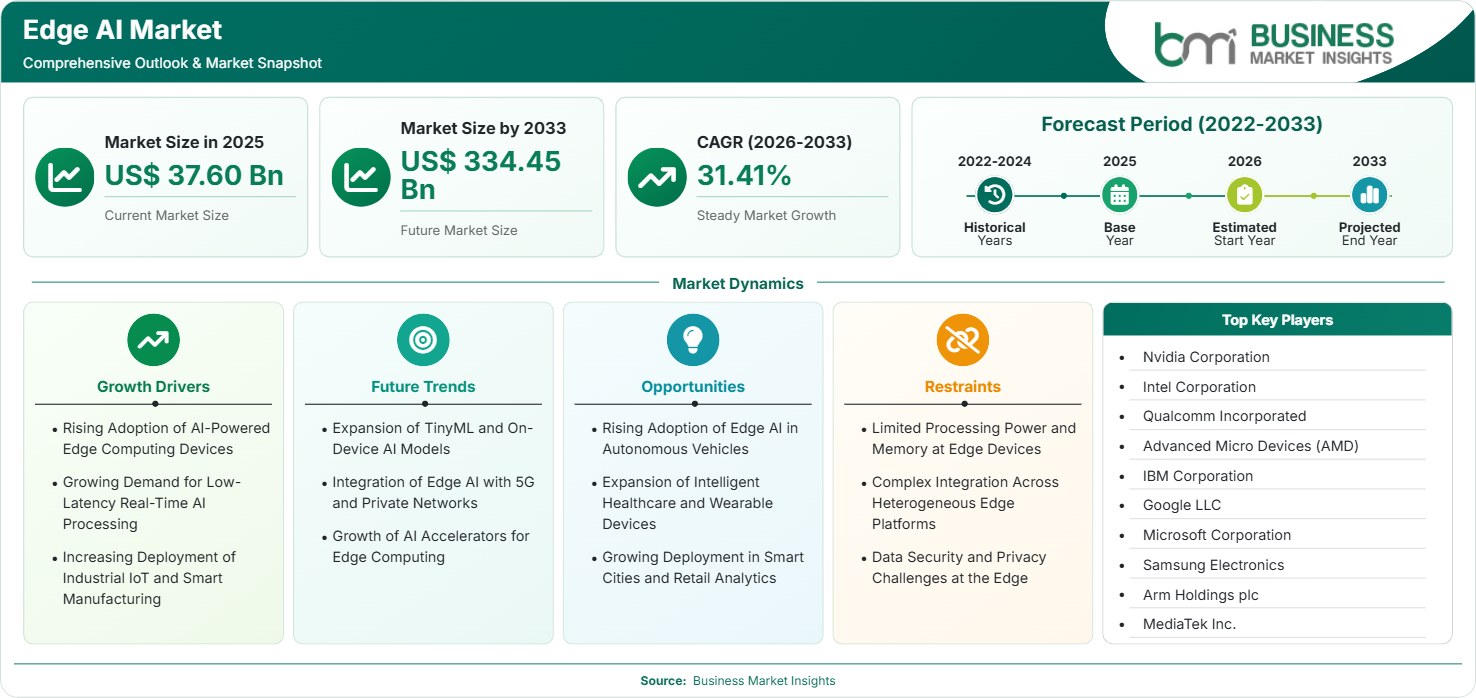
The Edge AI Market size was valued at US$ 37.60 Billion in 2025 and is projected to reach US$ 334.45 Billion by 2033, growing at a CAGR of 31.41% during 2026–2033. Rising deployment of intelligent edge devices, increasing demand for real-time data processing, expanding adoption of IoT ecosystems, and growing need for low-latency AI inferencing are supporting market growth globally.

Report Coverage
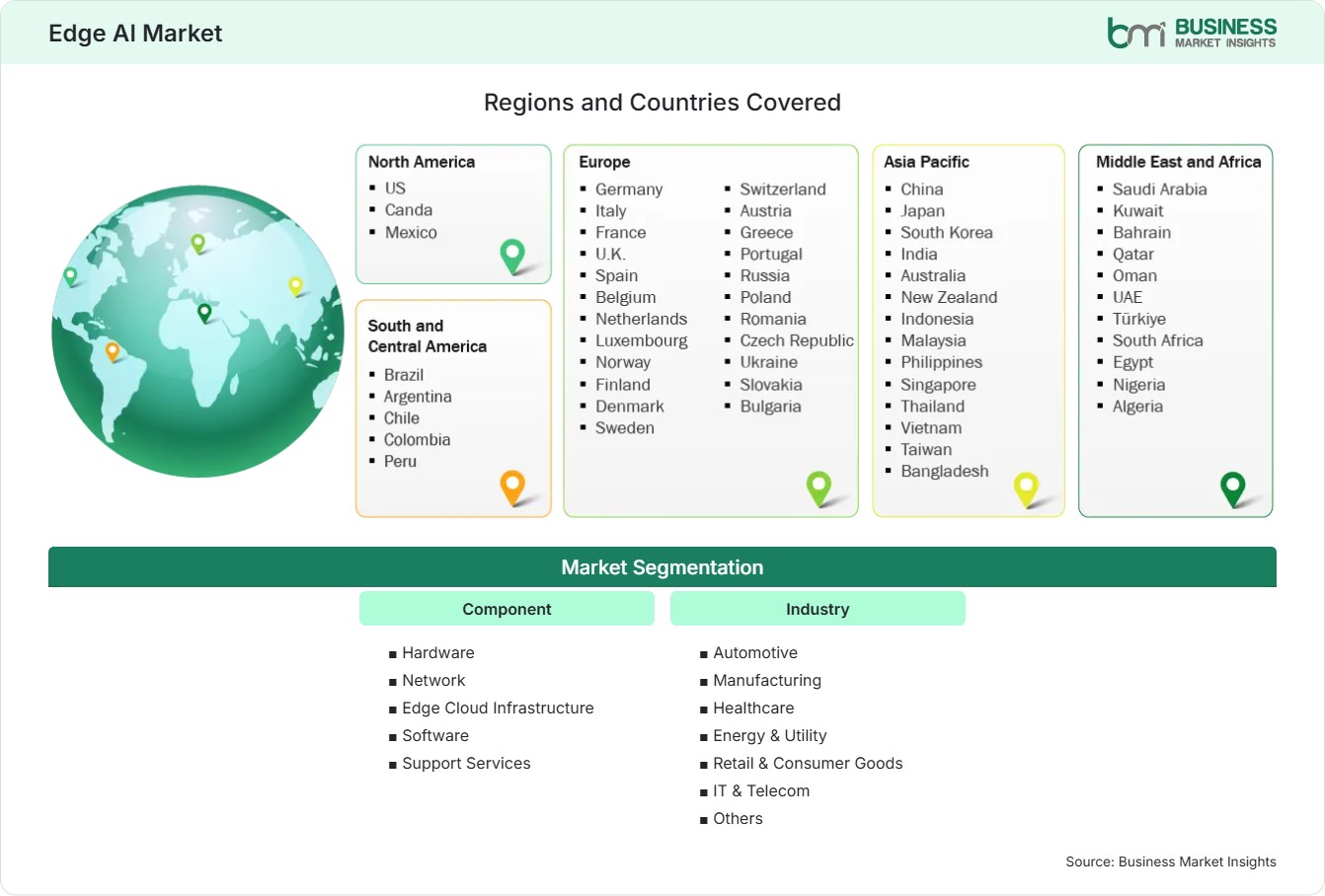
  • Component: Hardware, Network, Edge Cloud Infrastructure, Software, Support Services
  • Industry: Automotive, Manufacturing, Healthcare, Energy & Utility, Retail & Consumer Goods, IT & Telecom, Others
US$ 37.60 Bn Market size in 2025
US$ 334.45 Bn Market Size by 2033
31.41% CAGR, 2026 - 2033
2026-2033 Forecast Period

01 AI Overview

Edge AI Market Summary

  • North America Region: North America holds a edge AI market share of 38%–41% in 2025, growing with a CAGR of 30.0%–31.2% during 2026–2033. Strong investments in AI infrastructure, widespread adoption of connected devices, advanced cloud-edge ecosystems, and growing enterprise digitalization continue supporting regional leadership. The U.S. market is expected to register a CAGR of 30.2%–31.4%.
  • Fastest Growing Region: Asia Pacific accounts for 24%–27% share in 2025 and is projected to grow at a CAGR of 33.5%–34.8% through 2033. Rapid industrial automation, growing smart city deployments, expanding IoT adoption, and increasing investments in AI-enabled devices continue supporting regional growth.
  • Leading Segment: Hardware represents 36%–39% share in 2025 and is expected to grow at a CAGR of 31.0%–32.0% through 2033. Rising deployment of AI chips, edge processors, accelerators, and intelligent embedded systems continues supporting segment dominance.
  • High Growth Segment: Healthcare accounts for 10%–13% share in 2025 and is forecast to grow at a CAGR of 35.0%–36.2% during 2026–2033. Increasing use of AI-powered medical devices, remote patient monitoring, diagnostics, and real-time healthcare analytics is accelerating growth.
  • Key Market Opportunity: Expansion of autonomous systems, industrial edge intelligence, AI-powered IoT devices, and real-time analytics platforms is creating significant growth opportunities.
  • Major Market Players: ADLINK Technology Inc., Alphabet Inc., Amazon Inc., Gorilla Technology Group, Intel Corporation, International Business Machines Corporation, Microsoft Corporation, Nutanix, Inc., Synaptics Incorporated, Viso AI.
02 Strategic Insights

Edge AI Market: Strategic Insights

Edge AI Market Strategic Framework
FREE PDF
Request your free sample
Request free sample
03 Stakeholder View

Key Takeaways

  • Edge AI is enabling intelligent real-time decision-making without dependence on centralized cloud infrastructure.
  • Hardware remains the largest segment due to increasing deployment of AI-enabled processors and embedded systems.
  • Healthcare is emerging as one of the fastest-growing industries due to real-time diagnostics and monitoring requirements.
  • North America maintains leadership through strong AI investments and advanced technology ecosystems.
  • Asia Pacific offers significant growth opportunities through industrial automation and smart city initiatives.
  • Growing adoption of autonomous devices and intelligent IoT ecosystems is accelerating edge AI market expansion.
04 Geographic Outlook

Edge AI Market Regional Highlights

North America Edge AI Market

North America accounts for 38%–41% Edge AI Market share in 2025 and is projected to grow at a CAGR of 30.0%–31.2% through 2033. Strong adoption of artificial intelligence technologies, increasing deployment of connected devices, advanced cloud-edge integration capabilities, and growing investments in autonomous systems continue supporting regional leadership.

  • Enterprises are increasingly deploying edge AI platforms to improve real-time analytics and operational efficiency.
  • Manufacturing facilities are utilizing edge intelligence solutions to support predictive maintenance and process automation.
  • Healthcare providers are adopting AI-enabled edge devices for remote monitoring and diagnostic applications.
  • Telecommunications companies continue investing in edge infrastructure to support low-latency services.
  • AI-powered video analytics and security solutions are witnessing growing adoption across industries.
  • Technological innovation in processors and AI accelerators continues strengthening market growth.

US Edge AI Market

The United States contributes approximately 85%–89% of North American revenue and is expected to register a CAGR of 30.2%–31.4% through 2033. Strong AI research capabilities, growing enterprise digitalization, and substantial investments in intelligent infrastructure continue supporting market leadership.

  • Organizations increasingly deploy edge AI for business automation and real-time decision-making.
  • Automotive and healthcare sectors remain major adopters of AI-enabled edge technologies.
  • Expansion of smart manufacturing initiatives continues supporting demand.
  • Cloud providers are strengthening edge computing ecosystems through infrastructure investments.
  • Edge-driven IoT applications continue generating substantial opportunities across industries.

Europe Edge AI Market

Europe represents 25%–28% of global revenue in 2025 and is anticipated to expand at a CAGR of 30.8%–32.0% through 2033. Increasing industrial automation, smart manufacturing investments, and rising adoption of intelligent infrastructure continue supporting regional growth. Germany remains the leading market while Poland demonstrates stronger growth momentum.

  • Germany continues leading regional adoption through Industry 4.0 initiatives and AI investments.
  • Poland is among the fastest-growing markets and is estimated to register a CAGR of 32.5%–33.7% during the forecast period.
  • Enterprises increasingly deploy AI-enabled edge systems to improve operational visibility and responsiveness.
  • Healthcare organizations continue investing in intelligent medical technologies.
  • Growing demand for secure data processing is accelerating edge AI deployment.
  • Smart city development projects continue supporting market expansion.

Asia Pacific Edge AI Market

Asia Pacific accounts for 24%–27% of global revenue in 2025 and is expected to achieve the fastest CAGR of 33.5%–34.8% through 2033. Rapid industrialization, widespread IoT adoption, growing smart city initiatives, and increasing AI investments continue supporting strong market growth.

  • China remains the largest regional market due to substantial AI innovation activities and smart manufacturing initiatives.
  • India is projected to achieve approximately 35.0%–36.2% CAGR, supported by digital transformation programs, expanding IoT deployments, and increasing AI adoption.
  • Manufacturing companies increasingly leverage edge AI to improve productivity and automation capabilities.
  • Smart surveillance and public infrastructure projects continue driving adoption.
  • Telecommunications operators are investing in edge networks to improve service delivery.
  • Growing deployment of intelligent connected devices is strengthening market demand.

Rest of World Edge AI Market

Rest of World accounts for 8%–11% of global revenue in 2025 and is projected to expand at a CAGR of 31.2%–32.4% through 2033. Increasing investment in digital infrastructure, automation technologies, and intelligent devices continues supporting market development.

  • Brazil continues generating demand through industrial digitalization initiatives.
  • The UAE is investing in AI-powered smart city and infrastructure projects.
  • Saudi Arabia is expected to achieve approximately 33.0%–34.2% CAGR through 2033, supported by technology modernization and AI adoption initiatives.
  • Organizations increasingly implement edge analytics solutions to improve operational efficiency.
  • Expansion of connected ecosystems continues driving demand for localized AI processing.
  • Intelligent transportation and energy projects are creating new growth opportunities.
Global Market Geography
FREE PDF
Request your free sample
Request free sample
05 Segment Analysis

Edge AI Market Segmentation

Component

The component segment forms the technological backbone of the edge AI ecosystem, enabling data processing, inferencing, communication, orchestration, and management directly at the edge of networks. The segment accounts for approximately 36%–39% share in 2025 and is projected to grow at a CAGR of 31.8%–32.9% through 2033. The expanding Edge AI Market scope is supported by growing adoption of connected devices, increasing AI-enabled automation, rising demand for real-time analytics, and accelerating deployment of intelligent edge infrastructure across industries.

  • Hardware: Hardware represents the dominant segment due to increasing deployment of AI processors, edge accelerators, gateways, embedded systems, smart sensors, and intelligent cameras capable of executing machine learning workloads locally.
  • Network: Network infrastructure continues witnessing strong growth as organizations require reliable high-speed connectivity to support edge-to-cloud communication and distributed AI operations.
  • Edge Cloud Infrastructure: Edge cloud solutions are increasingly adopted to enable decentralized computing, data processing, and application orchestration closer to end devices.
  • Software: Software platforms support AI model deployment, edge orchestration, machine learning lifecycle management, and real-time analytics execution across distributed environments.
  • Support Services: Consulting, integration, deployment, monitoring, maintenance, and managed services continue gaining importance as organizations scale edge AI initiatives.

Industry

Industry adoption continues expanding rapidly as organizations recognize the value of localized intelligence, reduced latency, and enhanced operational efficiency. This segment accounts for approximately 39%–42% share in 2025 and is expected to register a CAGR of 32.0%–33.1% through 2033. Current Edge AI Market trends indicate growing implementation across mission-critical and data-intensive operational environments.

  • Automotive: Automotive companies increasingly utilize edge AI for autonomous driving systems, advanced driver assistance systems (ADAS), vehicle monitoring, predictive maintenance, and intelligent transportation applications.
  • Manufacturing: Manufacturing remains one of the largest adopters due to increasing deployment of predictive maintenance, quality inspection, robotics, process automation, and industrial IoT solutions.
  • Healthcare: Healthcare is the fastest-growing segment owing to growing adoption of AI-enabled medical devices, patient monitoring systems, diagnostic equipment, and wearable healthcare technologies.
  • Energy & Utility: Edge AI supports smart grids, asset monitoring, predictive maintenance, energy optimization, and remote infrastructure management.
  • Retail & Consumer Goods: Retailers are increasingly deploying intelligent analytics, personalized customer engagement solutions, smart inventory management systems, and automated checkout technologies.
  • IT & Telecom: Telecommunications providers utilize edge AI for network optimization, traffic management, security monitoring, and low-latency service delivery.
  • Others: Additional applications include logistics, transportation, agriculture, defense, education, smart buildings, and public infrastructure projects.
06 Market Forces

Edge AI Market Dynamics

Key Market Drivers

Rising Adoption of AI-Powered Edge Computing Devices

The adoption of intelligent edge devices is accelerating across industries as organizations seek faster and more efficient ways to process data. Traditional cloud-centric architectures often face challenges associated with bandwidth limitations, latency concerns, and growing data volumes. Edge AI devices enable data processing directly at the source, allowing organizations to obtain actionable insights in real time. Smart cameras, autonomous machines, industrial sensors, connected vehicles, intelligent medical devices, and robotics systems increasingly rely on embedded artificial intelligence capabilities. Continuous advancements in processor performance, power efficiency, and machine learning frameworks are making edge AI technology more accessible and scalable. As enterprises continue investing in connected ecosystems and intelligent automation, adoption of AI-powered edge devices is expected to remain a significant market driver.

Growing Demand for Low-Latency Real-Time AI Processing

Many modern applications require immediate decision-making capabilities that cannot tolerate delays associated with transmitting data to centralized cloud environments. Industries such as healthcare, manufacturing, transportation, telecommunications, and public safety increasingly depend on real-time analytics to ensure operational effectiveness and user safety. Edge AI enables local inferencing and rapid response times by processing information near its source. This capability is becoming especially important in autonomous systems, industrial automation platforms, remote monitoring applications, and mission-critical decision environments. Organizations are increasingly prioritizing low-latency architectures to improve responsiveness, efficiency, and reliability. As demand for instantaneous intelligence continues growing, edge AI solutions are expected to experience substantial adoption.

Increasing Deployment of Industrial IoT and Smart Manufacturing

Industrial digitalization initiatives continue driving strong demand for edge AI technologies across manufacturing and production environments. Smart factories increasingly deploy connected sensors, intelligent machinery, robotics platforms, and automated quality assurance systems capable of generating large volumes of operational data. Edge AI allows organizations to analyze this data in real time, reducing downtime, improving production efficiency, and optimizing resource utilization. Manufacturers are also using edge intelligence to support predictive maintenance programs, defect detection, process monitoring, and workplace safety initiatives. Industry 4.0 strategies remain a major catalyst for technology adoption as companies seek greater operational visibility and automation. These trends continue creating substantial growth opportunities for edge AI providers worldwide.

Key Market Opportunities

Rising Adoption of Edge AI in Autonomous Vehicles

Autonomous and semi-autonomous vehicles require rapid processing of sensor information, navigation data, environmental conditions, and vehicle performance metrics. Edge AI technology enables vehicles to make decisions locally without depending entirely on cloud connectivity. Automotive manufacturers and technology developers are increasingly investing in AI-enabled perception systems, driver assistance features, intelligent navigation solutions, and vehicle safety platforms. The continued evolution of smart mobility ecosystems and connected transportation infrastructure is expected to generate significant long-term opportunities for edge AI vendors.

Expansion of Intelligent Healthcare and Wearable Devices

Healthcare organizations and medical technology companies are increasingly utilizing edge AI to improve patient outcomes and operational efficiency. Wearable devices equipped with AI capabilities can monitor vital signs, detect anomalies, and provide real-time health insights without relying on continuous cloud communication. Hospitals and healthcare providers are also deploying AI-enabled diagnostic tools, imaging systems, and remote monitoring solutions. Growing demand for personalized healthcare services, preventive care, and telemedicine capabilities continues strengthening opportunities across this segment. The healthcare sector is expected to remain one of the most attractive markets for future edge AI deployments.

Growing Deployment in Smart Cities and Retail Analytics

Smart city initiatives and retail modernization programs are creating favorable conditions for edge AI adoption. Municipal authorities increasingly deploy intelligent surveillance systems, traffic management platforms, environmental monitoring solutions, and public safety technologies powered by edge intelligence. Similarly, retailers utilize edge AI to analyze customer behavior, optimize inventory management, personalize shopping experiences, and improve operational efficiency. Long-term Edge AI Market Forecasts remain highly favorable as smart infrastructure investments and intelligent retail deployments continue expanding worldwide.

Market Restraints and Challenges

Limited Processing Power and Memory at Edge Devices

Factor: Although edge devices continue becoming more powerful, many systems still face hardware limitations related to processing capability, memory availability, storage capacity, and energy consumption. Running sophisticated artificial intelligence models locally often requires balancing performance with operational efficiency, particularly in mobile, battery-powered, or resource-constrained environments.

Impact: Hardware limitations may restrict the complexity of AI workloads that can be executed at the edge, requiring model optimization and specialized chip architectures. These constraints can increase development complexity and influence deployment decisions across certain applications.

Complex Integration Across Heterogeneous Edge Platforms

Factor: Organizations often operate diverse ecosystems consisting of devices, sensors, gateways, applications, communication protocols, and cloud environments sourced from multiple vendors. Integrating these heterogeneous systems into a unified edge AI framework can be technically challenging and resource intensive. Interoperability, compatibility, scalability, and lifecycle management requirements further increase complexity.

Impact: Integration challenges may increase deployment costs, extend implementation timelines, and complicate large-scale adoption initiatives. Organizations must invest in standardization, orchestration platforms, and system integration expertise to achieve efficient and scalable edge AI deployments across distributed environments.

07 Company Analysis

Competitive Landscape

The Edge AI Market analysis is characterized by intense competition among semiconductor manufacturers, cloud computing providers, AI platform developers, edge infrastructure vendors, and intelligent device manufacturers. Market participants are focusing on AI accelerators, edge computing platforms, embedded intelligence, real-time analytics, and distributed machine learning capabilities to strengthen their market positions. Growing adoption of industrial IoT, autonomous systems, smart healthcare devices, intelligent surveillance platforms, and connected infrastructure is driving innovation across the market. Companies continue investing in edge-native AI solutions capable of delivering low-latency processing, enhanced privacy, reduced bandwidth utilization, and scalable deployment across distributed environments.

Company Name

Overview

Products and Services relevant to this market

ADLINK Technology Inc.

Edge computing and industrial AI company focused on intelligent edge platforms and embedded systems.

Edge AI hardware, industrial gateways, AI-enabled computing platforms, machine vision solutions, and intelligent edge infrastructure.

Alphabet Inc.

Technology company providing artificial intelligence, cloud computing, and edge AI technologies.

Edge AI frameworks, machine learning platforms, TensorFlow Lite solutions, cloud-edge integration services, and intelligent analytics tools.

Amazon Inc.

Cloud and technology company providing edge computing and artificial intelligence services.

AWS edge services, IoT platforms, edge AI solutions, machine learning infrastructure, and real-time data processing technologies.

Gorilla Technology Group

AI and analytics company specializing in video intelligence and edge-based decision solutions.

Intelligent video analytics, edge AI platforms, smart surveillance systems, AI-powered security solutions, and analytics software.

Intel Corporation

Semiconductor manufacturer focused on AI processors, edge computing, and intelligent platforms.

AI accelerators, edge processors, embedded computing solutions, machine learning hardware, and industrial edge platforms.

International Business Machines Corporation (IBM)

Enterprise technology company providing artificial intelligence and edge computing solutions.

Edge AI software, intelligent automation platforms, hybrid cloud-edge solutions, AI analytics systems, and enterprise AI applications.

Microsoft Corporation

Cloud computing and AI provider supporting enterprise edge deployments and intelligent infrastructure.

Azure IoT Edge, AI services, edge analytics platforms, machine learning solutions, and intelligent cloud-edge ecosystems.

Nutanix, Inc.

Hybrid cloud and edge infrastructure company supporting distributed application environments.

Edge cloud infrastructure, hybrid cloud solutions, enterprise edge management platforms, and distributed computing environments.

Synaptics Incorporated

Semiconductor company focused on intelligent processing technologies and embedded AI applications.

AI-enabled processors, IoT chipsets, intelligent edge devices, embedded computing technologies, and connected device solutions.

Viso AI

Computer vision and edge AI software provider serving enterprise AI deployment requirements.

Edge AI platforms, computer vision solutions, AI deployment software, intelligent monitoring systems, and machine learning management tools.

10 Trust & Transparency

Research Methodology

The market analysis combines proprietary research with secondary data from government agencies, company disclosures, regulatory filings, industry databases and expert interviews. Market estimates are validated through data triangulation, cross-market benchmarking and analyst review.

View Full Research Methodology

11 Questions Answered

Frequently Asked Questions

How does Edge AI differ from traditional cloud AI?

Edge AI processes data locally near the source of generation, reducing latency, improving privacy, minimizing bandwidth requirements, and enabling faster decision-making compared to cloud-dependent AI architectures.

What does this Edge AI Market Report cover?

This report covers component analysis, industry segmentation, regional trends, competitive landscape assessment, growth drivers, market opportunities, restraints, challenges, and future market prospects through 2033.

Why is the healthcare industry segment growing rapidly?

Healthcare is witnessing strong growth because of increasing deployment of AI-enabled diagnostic systems, remote patient monitoring devices, wearable health technologies, and real-time medical analytics applications.

Which component segment dominates the market?

Hardware represents the leading segment due to increasing adoption of AI chips, processors, accelerators, smart cameras, intelligent gateways, and embedded edge computing systems.

What is driving growth in the Edge AI market?

Rising adoption of AI-powered edge computing devices, growing demand for low-latency real-time AI processing, increasing deployment of industrial IoT systems, and expanding smart manufacturing initiatives are major drivers supporting market growth.

Access the Full Edge AI Market Report

Get segment-level forecasts, regional estimates, competitive benchmarking, company profiles and downloadable Excel datasets.

Access the full Edge AI Market Report
350 pages PDF & Excel | 2026-08-12