
Edge Computing Market Outlook: Size, Share, Trends, Growth Analysis, Competitive Landscape & Forecast, 2026–2033

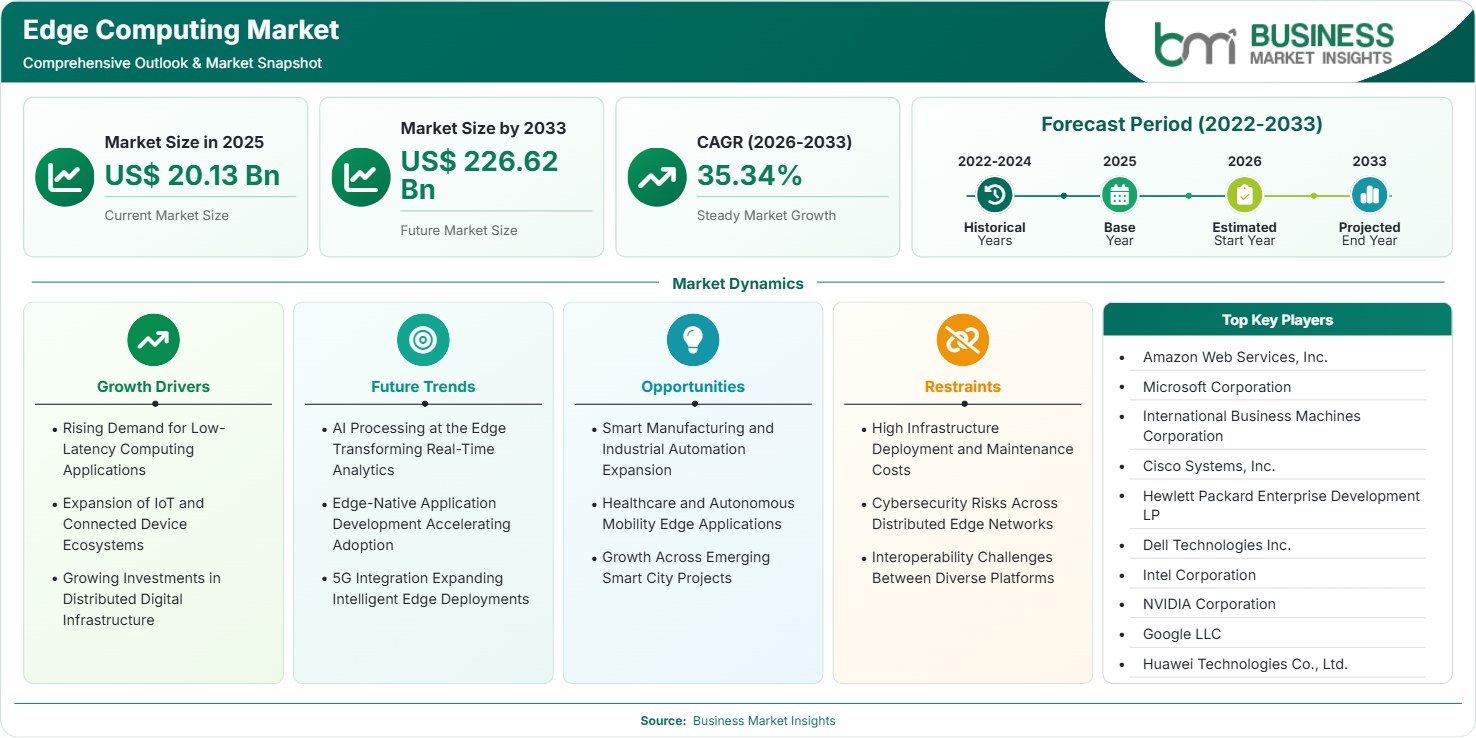
The Edge Computing Market size was valued at US$ 20.13 Billion in 2025 and is projected to reach US$ 226.62 Billion by 2033, growing at a CAGR of 35.34% during 2026–2033. Rising demand for low-latency applications, IoT expansion, distributed infrastructure investments, industrial automation, and smart city deployments are accelerating market growth.

Report Coverage
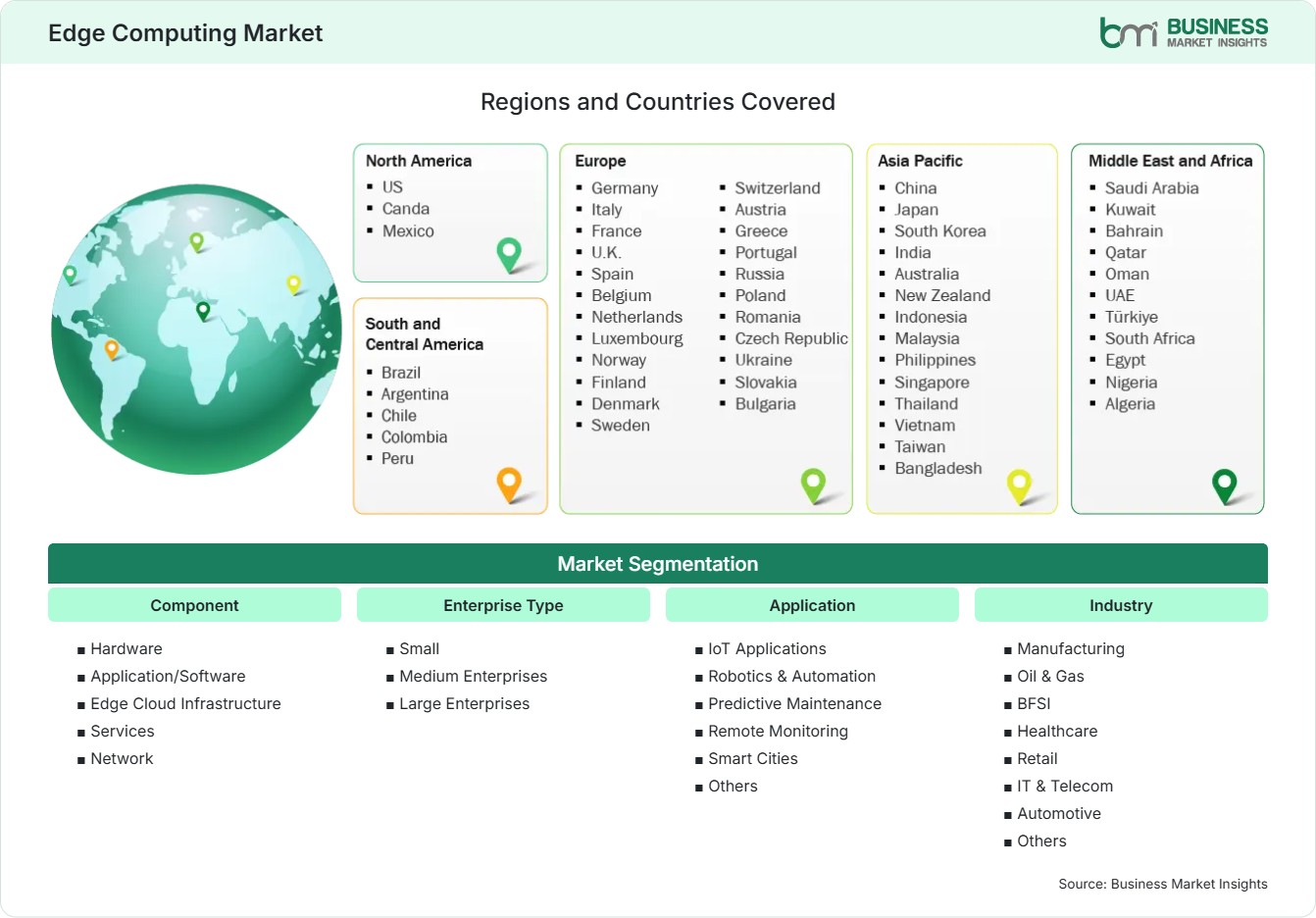
  • Component: Hardware, Application/Software, Edge Cloud Infrastructure, Services, Network
  • Enterprise Type: Small, Medium Enterprises, Large Enterprises
  • Application: IoT Applications, Robotics & Automation, Predictive Maintenance, Remote Monitoring, Smart Cities, Others
  • Industry: Manufacturing, Oil & Gas, BFSI, Healthcare, Retail, IT & Telecom, Automotive, Others
US$ 20.13 Bn Market size in 2025
US$ 226.62 Bn Market Size by 2033
35.34% CAGR, 2026 - 2033
2026-2033 Forecast Period

AI Overview

Edge Computing Market Summary

  • North America Region: North America holds 36%–39% market share in 2025 and is projected to grow at a 33.5%–34.5% CAGR during 2026–2033. Strong cloud infrastructure, advanced 5G networks, and increasing adoption of artificial intelligence-driven applications are supporting regional expansion. The U.S. leads regional adoption due to extensive technology investments, hyperscale cloud presence, and industrial IoT deployment, growing at approximately 34.0%–35.0% CAGR.
  • Fastest Growing Region: Asia Pacific accounts for 30%–33% market share in 2025 and is expected to expand at a 37.0%–38.0% CAGR through 2033. Rapid industrial automation, smart city initiatives, connected device adoption, 5G expansion, and increasing investments in digital infrastructure are driving accelerated regional growth.
  • Leading Segment: Hardware Component holds 38%–41% market share in 2025 and is expected to grow at a 34.5%–35.5% CAGR during 2026–2033. Rising deployment of edge servers, gateways, processors, and connected infrastructure is strengthening segment leadership.
  • High Growth Segment: Edge Cloud Infrastructure represents 22%–25% market share in 2025 and is projected to grow at a 38.0%–39.0% CAGR. Growing enterprise demand for scalable distributed computing environments, cloud-edge integration, and real-time processing capabilities is accelerating adoption.
  • Key Market Opportunity: Expansion of industrial automation, autonomous mobility, healthcare applications, and smart city infrastructure is creating opportunities for edge computing providers delivering real-time analytics, AI processing, and distributed connectivity solutions.
  • Major Market Players: Amazon Web Services, Inc., Microsoft Corporation, International Business Machines Corporation, Cisco Systems, Inc., Hewlett Packard Enterprise Development LP, Dell Technologies Inc., Intel Corporation, NVIDIA Corporation, Google LLC, Huawei Technologies Co., Ltd.
Strategic Insights

Edge Computing Market: Strategic Insights

Edge Computing Market Strategic Framework
FREE PDF
Request your free sample
Request free sample
Stakeholder View

Key Takeaways

  • The edge computing ecosystem is evolving from basic data processing infrastructure toward intelligent distributed platforms supporting artificial intelligence, automation, IoT, and real-time decision-making applications.
  • Industrial automation, predictive maintenance, smart manufacturing, and connected mobility applications represent high-growth opportunities as enterprises require faster processing and improved operational efficiency.
  • Hardware innovation, edge AI processors, specialized chips, and integrated cloud-edge platforms are shaping technology development as providers focus on improving performance and reducing latency.
  • Asia Pacific presents strong investment potential due to expanding manufacturing ecosystems, smart city initiatives, 5G deployment, and increasing adoption of connected technologies across emerging economies.
  • Strategic partnerships between cloud providers, semiconductor companies, network operators, and infrastructure vendors are increasing as companies seek integrated edge computing solutions.
  • Cybersecurity capabilities, data management frameworks, and distributed infrastructure protection are becoming critical differentiation factors as enterprises expand edge deployments across diverse environments.
Geographic Outlook

Edge Computing Market Regional Highlights

North America Edge Computing Market

North America accounts for 36%–39% of the Edge Computing Market share in 2025 and is projected to expand at a 33.5%–34.5% CAGR during 2026–2033. The region maintains leadership due to advanced cloud infrastructure, strong enterprise technology adoption, widespread IoT implementation, and increasing demand for real-time computing capabilities. The United States represents the dominant contributor, supported by hyperscale cloud providers, semiconductor innovation, industrial automation investments, and 5G deployment. Enterprises are increasingly adopting edge platforms to optimize data processing, improve operational efficiency, and support AI-enabled applications.

  • Growing adoption of artificial intelligence and machine learning applications is increasing demand for edge infrastructure capable of processing data closer to end users and connected devices.
  • Manufacturing, automotive, and telecommunications companies are investing in distributed computing environments to improve automation, reduce latency, and enhance operational visibility.
  • Expansion of private 5G networks is supporting edge computing deployment by enabling secure, high-speed connectivity for enterprise and industrial applications.
  • Cloud service providers are strengthening edge capabilities through integrated platforms that combine cloud resources with localized computing infrastructure.

US Edge Computing Market

The United States edge computing market contributes approximately 82%–85% of North American demand and is expected to grow at a 34.0%–35.0% CAGR through 2033. Strong technology infrastructure, extensive enterprise digitization, advanced semiconductor development, and large-scale cloud investments are supporting market expansion.

  • Increasing investments by hyperscale cloud providers are accelerating deployment of edge infrastructure and enabling enterprises to access distributed computing capabilities.
  • Industrial organizations are adopting edge platforms to support automation, robotics, predictive maintenance, and connected manufacturing operations.
  • Healthcare providers are implementing edge-enabled solutions for medical imaging, remote monitoring, and real-time patient data analysis.
  • Automotive companies are expanding edge computing adoption for connected vehicles, autonomous systems, and advanced driver assistance technologies.

Europe Edge Computing Market

Europe represents approximately 24%–27% market share in 2025 and Europe Edge Computing Market forecast to grow at a 32.5%–33.5% CAGR during 2026–2033. Germany, the United Kingdom, and France are leading adoption due to industrial automation, smart manufacturing initiatives, and increasing focus on data sovereignty. Enterprises are investing in edge infrastructure to support Industry 4.0 transformation, connected operations, and real-time analytics..

  • German manufacturers are adopting edge computing platforms to improve production automation, equipment monitoring, and industrial process optimization.
  • European enterprises are investing in secure edge architectures to address data privacy requirements and support localized data processing needs.
  • Telecommunications providers are expanding edge infrastructure to support 5G services, connected applications, and low-latency digital experiences.
  • Healthcare organizations are deploying edge solutions for medical analytics, remote healthcare services, and improved data processing efficiency.
  • Government-backed digital transformation programs are encouraging adoption of distributed computing technologies across European economies.

Asia Pacific Edge Computing Market

Asia Pacific Edge Computing Market holds 30%–33% market share in 2025 and is forecast to achieve the fastest growth at a 37.0%–38.0% CAGR through 2033. Rapid industrialization, expanding IoT adoption, smart city investments, and increasing digital infrastructure development are driving regional demand. China, Japan, India, and South Korea are major contributors due to advanced manufacturing capabilities, technology investments, and 5G expansion..

  • China’s manufacturing ecosystem is accelerating edge computing adoption through industrial automation, smart factories, and connected production environments.
  • India’s expanding digital economy and smart infrastructure initiatives are creating opportunities for edge-enabled applications across enterprises and public services.
  • Japan and South Korea are investing in robotics, automotive technologies, and advanced manufacturing systems supported by edge computing capabilities.
  • Southeast Asian countries are adopting edge solutions to enhance connectivity, digital services, and industrial modernization initiatives.
  • Increasing regional investments in data centers and telecommunications infrastructure are improving accessibility to edge computing technologies.

Rest of World Edge Computing Market

The Rest of World region accounts for approximately 8%–10% market share in 2025 and is projected to grow at a 34.0%–35.0% CAGR during 2026–2033. Latin America is witnessing increasing adoption due to digital transformation, industrial modernization, and expansion of connected services. The Middle East and Africa region is advancing through smart city programs, telecommunications investments, and government-led digital initiatives. Organizations across these markets are adopting edge computing to improve connectivity, reduce latency, and support emerging technology applications.

  • Brazil and Mexico are expanding edge adoption through industrial digitization, connected services, and increasing enterprise technology investments.
  • Middle Eastern countries are implementing smart city initiatives requiring advanced edge infrastructure for connected urban systems.
  • African markets are adopting edge solutions to improve digital service delivery and overcome connectivity limitations.
  • Telecommunications operators are deploying edge infrastructure to support low-latency applications and expanding mobile data demand.
  • Growing partnerships between global technology providers and regional enterprises are improving availability of edge computing solutions.
Global Market Geography
FREE PDF
Request your free sample
Request free sample
Segment Analysis

Edge Computing Market Segmentation

Component

The Component segment accounted for approximately 48%–51% Edge Computing market share in 2025 and is projected to grow at a 35.0%–35.8% CAGR during 2026–2033. Growing demand for distributed computing infrastructure, real-time analytics, and connected device management is accelerating adoption across hardware, software, cloud infrastructure, services, and networking components.

  • Hardware: Hardware solutions are witnessing strong adoption due to increasing deployment of edge servers, gateways, processors, storage devices, and specialized computing equipment across industrial and commercial environments.
  • Application/Software: Software platforms are expanding as enterprises require edge analytics, application management, artificial intelligence processing, and orchestration capabilities for distributed computing environments.
  • Edge Cloud Infrastructure: Edge cloud infrastructure is gaining momentum as organizations seek localized computing resources that provide lower latency, improved data processing efficiency, and seamless integration with centralized cloud platforms.
  • Services: Edge computing services are growing as enterprises seek managed solutions, consulting support, deployment assistance, and operational expertise to implement complex distributed computing environments.
  • Network: Network components are becoming essential with increasing demand for high-speed connectivity, 5G integration, secure communication, and reliable data transfer across edge-enabled ecosystems.

Enterprise Type

The Enterprise Type segment represented approximately 62%–65% Edge Computing Market share in 2025 and is expected to expand at a 35.5%–36.2% CAGR through 2033. Large enterprises currently dominate adoption due to extensive digital infrastructure, higher technology investments, and complex operational requirements. However, small and medium enterprises are increasingly adopting edge solutions through cloud-based models, managed services, and simplified deployment options.

  • Small & Medium Enterprises: SMEs are adopting edge computing through affordable service models to improve operational efficiency, support IoT applications, and access advanced computing capabilities without extensive infrastructure investments.
  • Large Enterprises: Large enterprises are implementing edge solutions to manage complex data environments, improve automation, enhance customer experiences, and support mission-critical applications requiring real-time processing.

Application

The Application segment accounted for approximately 56%–59% market share in 2025 and is projected to grow at a 35.8%–36.5% CAGR during 2026–2033. Increasing adoption of connected technologies, industrial automation, and real-time decision-making applications is driving demand across multiple use cases. The Edge Computing Market trends indicate increasing integration of artificial intelligence, automation, and analytics across application areas.

  • IoT Applications: IoT applications represent a major adoption area as organizations deploy edge platforms to process sensor data, improve connectivity, and enable real-time monitoring of connected devices.
  • Robotics & Automation: Robotics and automation applications are expanding as manufacturers utilize edge computing for faster decision-making, machine control, and intelligent industrial operations.
  • Predictive Maintenance: Predictive maintenance solutions are gaining adoption as edge analytics enable real-time equipment monitoring, failure prediction, and reduced operational downtime across industrial environments.
  • Remote Monitoring: Remote monitoring applications are increasing across healthcare, energy, and industrial sectors through localized data processing and continuous operational visibility.
  • Smart Cities: Smart city initiatives are adopting edge computing to support intelligent transportation, public safety systems, energy management, and connected urban infrastructure.

Industry

The Industry segment represented approximately 60%–63% market share in 2025 and is expected to grow at a 35.2%–36.0% CAGR during the forecast period. Industrial sectors are increasingly adopting edge computing to improve automation, operational intelligence, and real-time decision-making. Manufacturing, telecommunications, healthcare, automotive, and retail industries are among the leading adopters due to increasing data generation and demand for faster processing.

  • Manufacturing: Manufacturing companies are deploying edge computing for smart factories, industrial automation, robotics, predictive maintenance, and real-time production optimization.
  • Oil & Gas: Oil and gas companies utilize edge solutions for remote asset monitoring, operational safety, predictive analytics, and efficient management of geographically distributed facilities.
  • BFSI: Financial institutions are adopting edge technologies to improve transaction processing, enhance customer experiences, support fraud detection, and enable secure real-time analytics.
  • Healthcare: Healthcare organizations are implementing edge computing for medical imaging, remote patient monitoring, connected devices, and faster healthcare data processing.
  • Retail: Retail companies are adopting edge solutions for personalized customer experiences, inventory management, smart stores, and real-time analytics across physical and digital channels.
  • IT & Telecom: IT and telecom providers are expanding edge infrastructure to support 5G services, cloud applications, network optimization, and low-latency digital services.
  • Automotive: Automotive companies are integrating edge computing into connected vehicles, autonomous driving systems, advanced driver assistance technologies, and vehicle data processing platforms.
Market Forces

Edge Computing Market Dynamics

Key Market Drivers

Rising Demand for Low-Latency Computing Applications

Companies are turning towards solutions like edge computing in order to develop applications that need immediate data processing, less latency, and real-time decision-making features. The manufacturing sector, health care, automotive industry, telecommunications, and banking are some of the sectors that are using edge computing to enhance the performance of their applications. The increased use of self-reliant systems, automation, Internet of Things, and AI applications is leading companies to develop localized computing abilities. This Edge Computing Market trend is driven by increased demand for faster data processing and lesser network congestion.

Expansion of IoT and Connected Device Ecosystems

The proliferation of Internet of Things ecosystems has been increasing demand for edge computing capabilities to handle vast amounts of data from network devices. Companies in industries such as industrial, automotive, healthcare, retail, and smart cities have deployed millions of sensors and IoT devices that require data processing at the network edge. Cloud-only systems face issues regarding latencies, bandwidth utilization, and the requirement of real-time responses. Technology vendors are providing platform solutions integrating all the capabilities for IoT ecosystems.

Growing Investments in Distributed Digital Infrastructure

Global organizations are making greater investments in distributed digital infrastructure to ensure cloud-edge convergence, artificial intelligence applications, and advanced connectivity. Organizations are adopting decentralized computing systems to boost the performance of applications, increase resiliency, and handle increased data volumes resulting from digitized processes. This will define future trends in the Edge Computing Market as it will allow the creation of scalable systems that are capable of blending centralized cloud systems and distributed computing power. The growing interest among organizations in digital transformation is enhancing the demand for edge computing infrastructures.

Key Market Opportunities

Smart Manufacturing and Industrial Automation Expansion

The growth of the smart manufacturing industry and industrial automation industry presents a key opportunity for edge computing suppliers since more manufacturing facilities deploy connected machines, robots, and smart manufacturing processes. The manufacturers need timely analysis of information to increase efficiency, improve quality control, minimize downtimes, and increase overall productivity. The use of edge computing will provide the opportunity to conduct local analysis and respond quickly due to analyzing information from the machines or sensors close to the manufacturing process.

Healthcare and Autonomous Mobility Edge Applications

Healthcare and autonomous mobility sectors are creating new opportunities through increasing adoption of real-time data processing applications. Healthcare providers are implementing edge computing for medical imaging, remote monitoring, connected devices, and AI-assisted diagnostics requiring rapid analysis. Similarly, automotive companies are integrating edge capabilities into connected vehicles, autonomous driving systems, and advanced driver assistance technologies. These applications require reliable, low-latency computing environments capable of processing large data volumes instantly.

Growth Across Emerging Smart City Projects

Smart city development initiatives across emerging economies are creating significant opportunities for edge computing adoption. Governments and urban authorities are investing in intelligent transportation systems, connected infrastructure, energy management, public safety solutions, and digital citizen services. Edge computing enables these systems to process large volumes of urban data locally, improving response times and reducing dependency on centralized infrastructure. Expansion of 5G networks and connected device ecosystems is further supporting smart city deployments.

Market Restraints and Challenges

High Infrastructure Deployment and Maintenance Costs

Factor: Significant capital expenditure is needed for hardware, edge servers, networking system, software platforms and maintenance in order to implement edge computing successfully. Impact: The high cost of implementation may hinder its implementation among budget-constrained businesses, especially small and medium-sized businesses which have a low budget for technologies. Enterprises need to invest to enhance infrastructure, hire skilled people, implement security systems and manage the distributed system well in order to use edge computing.

Cybersecurity Risks Across Distributed Edge Networks

Factor: The edge computing environment consists of many distributed devices, endpoints, and network links, thus posing potential risk to security threats and cyberattacks. Impact: The larger attack surfaces that come from edge network environments may pose some problems with respect to security of data, device, authentication, and regulatory compliance. Unlike the centralized infrastructure, edge environments demand security management in different places.

Company Analysis

Competitive Landscape

The competitive environment includes cloud service providers, semiconductor manufacturers, networking companies, infrastructure specialists, and technology solution providers developing advanced distributed computing platforms. Edge Computing Market analysis highlights that leading companies are focusing on edge AI capabilities, cloud-edge integration, industrial automation solutions, high-performance processors, and secure networking technologies to strengthen their market presence.

Company Name

Overview

Products and Services relevant to this market

Amazon Web Services, Inc.

Global cloud technology provider offering scalable cloud computing, infrastructure, and edge services for enterprises across multiple industries.

AWS IoT Greengrass, AWS Outposts, AWS Wavelength, edge computing platforms, cloud integration services, and distributed application solutions.

Microsoft Corporation

Global technology company providing cloud computing, software platforms, artificial intelligence, and enterprise digital solutions.

Azure Edge services, Azure Stack Edge, Azure IoT, hybrid cloud solutions, edge AI capabilities, and distributed computing platforms.

International Business Machines Corporation

Technology and consulting company delivering cloud, artificial intelligence, automation, and enterprise infrastructure solutions.

IBM Edge Application Manager, edge AI solutions, hybrid cloud platforms, automation tools, and industrial edge computing services.

Cisco Systems, Inc.

Networking and cybersecurity company specializing in connectivity infrastructure, enterprise networks, and digital transformation solutions.

Cisco Edge Intelligence, networking platforms, IoT solutions, secure edge infrastructure, and industrial connectivity technologies.

Hewlett Packard Enterprise Development LP

Enterprise technology company providing servers, hybrid cloud, networking, and edge infrastructure solutions.

HPE Edgeline systems, edge servers, hybrid cloud platforms, data processing solutions, and enterprise edge computing infrastructure.

Dell Technologies Inc.

Global infrastructure technology provider offering computing systems, storage, networking, and edge solutions.

Dell NativeEdge platform, edge servers, data management solutions, IoT infrastructure, and enterprise edge deployment platforms.

Intel Corporation

Semiconductor and technology company developing processors, AI hardware, and computing technologies for edge environments.

Intel Xeon processors, edge AI accelerators, OpenVINO toolkit, edge computing hardware, and optimized software solutions.

NVIDIA Corporation

Technology company specializing in accelerated computing, artificial intelligence, and graphics processing solutions.

NVIDIA EGX platform, AI edge computing solutions, GPUs, AI software frameworks, and intelligent edge infrastructure.

Google LLC

Technology company providing cloud computing, artificial intelligence, and digital infrastructure solutions.

Google Distributed Cloud Edge, Google Cloud edge solutions, AI platforms, IoT services, and distributed computing technologies.

Huawei Technologies Co., Ltd.

Information and communication technology company providing networking, cloud, and digital infrastructure solutions globally.

Huawei Intelligent EdgeFabric, edge computing platforms, cloud-edge solutions, networking equipment, and industrial digitalization technologies.

Trust & Transparency

Research Methodology

The market analysis combines proprietary research with secondary data from government agencies, company disclosures, regulatory filings, industry databases and expert interviews. Market estimates are validated through data triangulation, cross-market benchmarking and analyst review.

View Full Research Methodology

Questions Answered

Frequently Asked Questions

What factors should enterprises evaluate before implementing edge computing solutions?

Enterprises should assess infrastructure requirements, security capabilities, workload suitability, connectivity availability, scalability, and integration with existing cloud and IT environments.

What role does artificial intelligence play in edge computing market report?

Artificial intelligence enables advanced analytics, automated decision-making, predictive maintenance, and intelligent processing at the edge, improving performance for real-time enterprise applications.

Which industries are expected to benefit most from edge computing adoption?

Manufacturing, healthcare, automotive, telecommunications, retail, and smart city sectors are major beneficiaries due to increasing demand for real-time analytics and connected applications.

How does edge computing differ from traditional cloud computing?

Edge computing processes data closer to its source, reducing latency and bandwidth requirements, while traditional cloud computing relies primarily on centralized data centers for processing and storage.

What is driving the rapid adoption of edge computing solutions?

Increasing IoT deployments, artificial intelligence applications, 5G connectivity, industrial automation, and demand for low-latency processing are accelerating enterprise adoption of edge computing technologies.

Access the Full Edge Computing Market Report

Get segment-level forecasts, regional estimates, competitive benchmarking, company profiles and downloadable Excel datasets.

Access the full Edge Computing Market Report
350 pages PDF & Excel | 2026-08-25
Similar Research

Related Market Reports