
Next Generation Computing Market Outlook: Size, Share, Trends, Growth Analysis, Competitive Landscape & Forecast, 2026–2033

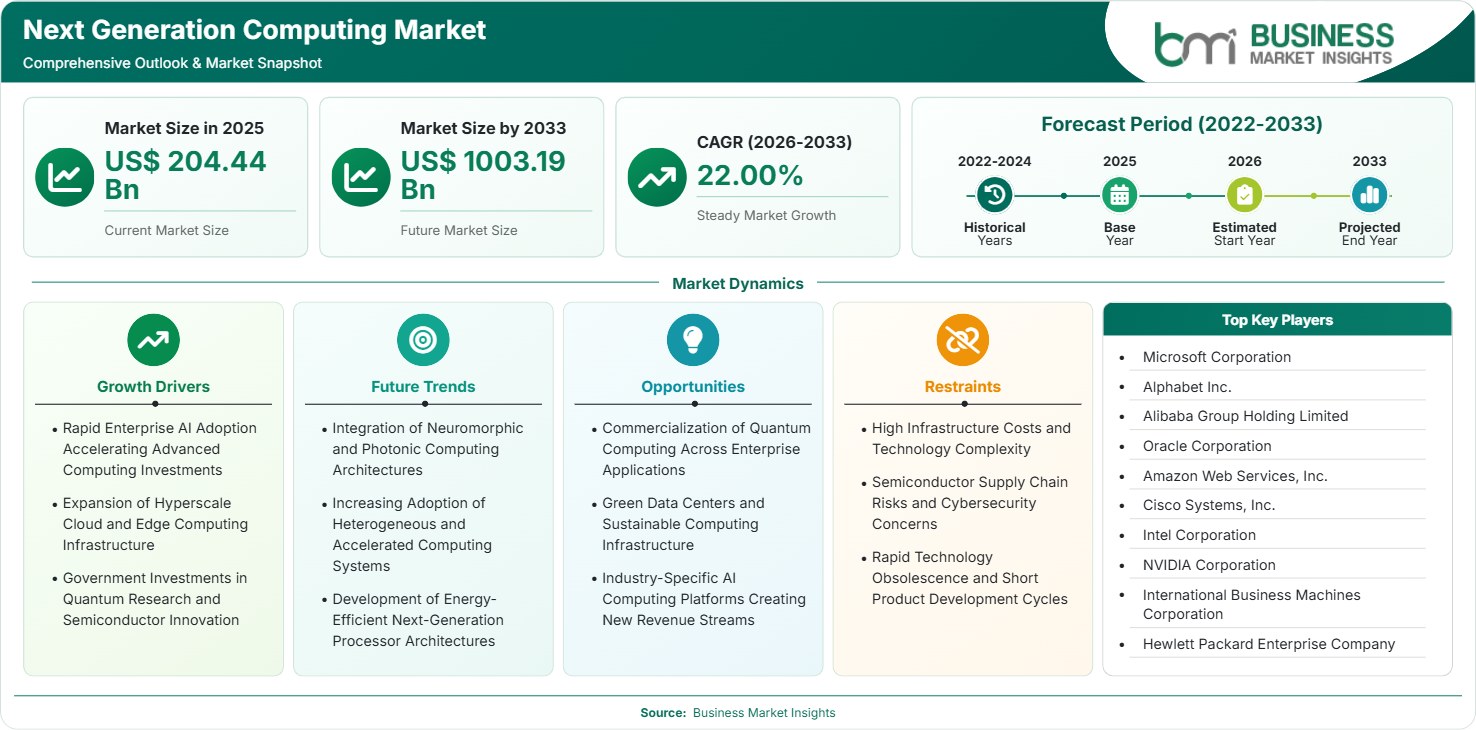
The Next Generation Computing Market size was valued at US$ 204.44 Billion in 2025 and is projected to reach US$ 1003.19 Billion by 2033, growing at a CAGR of 22.00% during 2026–2033. Rising enterprise digital transformation, and cloud-native innovation are creating significant opportunities across industrial, financial, and government computing ecosystems.

Report Coverage
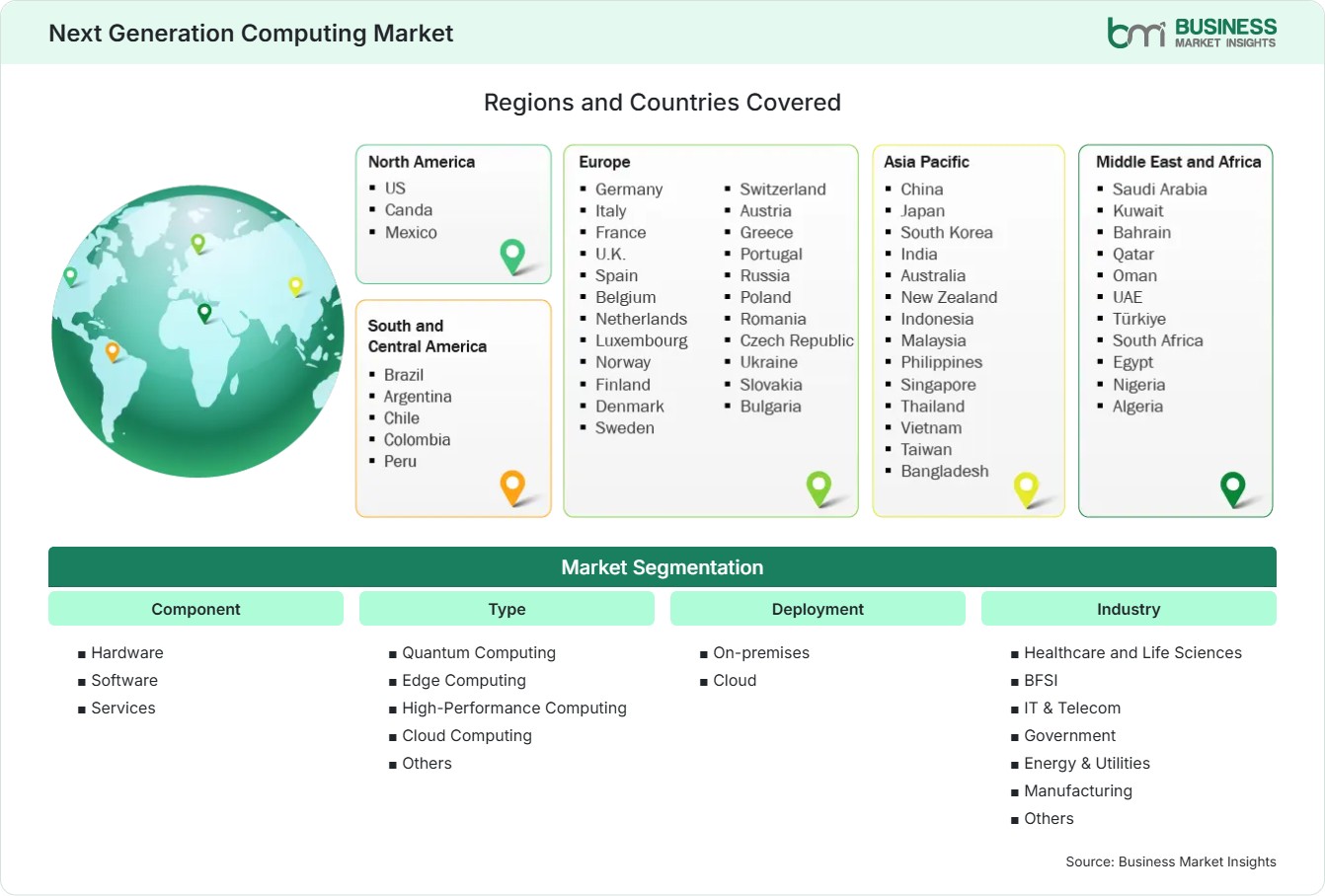
  • Component: Hardware, Software, Services
  • Type: Quantum Computing, Edge Computing, High-Performance Computing , Cloud Computing, Others
  • Deployment: On-premises, Cloud
  • Industry: Healthcare and Life Sciences, BFSI, IT & Telecom, Government, Energy & Utilities, Manufacturing, Others
US$ 204.44 Bn Market size in 2025
US$ 1003.19 Bn Market Size by 2033
22.00% CAGR, 2026 - 2033
2026-2033 Forecast Period

AI Overview

Next Generation Computing Market Summary

  • North America Region: North America holds 36%–39% market share in 2025, growing with a CAGR of 20%–22% during 2026–2033. Strong hyperscale investments, semiconductor innovation, and enterprise cloud migration continue strengthening long-term technology leadership across regional industries. The U.S. contributes most regional revenue through advanced AI infrastructure investments, and enterprise digital modernization, recording a CAGR of 20%–22% through 2033.
  • Fastest Growing Region: Asia Pacific holds 26%–29% market share in 2025 while advancing at a CAGR of 24%–26% through 2026–2033. Government-backed semiconductor programs, expanding hyperscale data centers, and digital infrastructure investments continue accelerating enterprise technology transformation across developing economies.
  • Leading Segment: Cloud Computing accounts for 34%–37% market share in 2025 and is expected to expand at 22%–24% CAGR through 2026–2033. Enterprise cloud migration, operational flexibility, and lower deployment costs continue supporting broad commercial implementation worldwide.
  • High Growth Segment: Quantum Computing represents 8%–10% market share in 2025 while advancing at 28%–31% CAGR through 2026–2033. Rising government funding, pharmaceutical simulation, and commercialization initiatives continue supporting accelerated ecosystem development and innovation.
  • Key Market Opportunity: Enterprise convergence of artificial intelligence, edge intelligence, quantum processing, cloud-native platforms, and sustainable high-performance computing infrastructure enables scalable automation, real-time analytics, resilient digital operations, and long-term competitive differentiation across global industries.
  • Major Market Players: Microsoft Corporation, Alphabet Inc., Alibaba Group Holding Limited, Oracle Corporation, Amazon Web Services, Inc., Cisco Systems, Inc., Intel Corporation, NVIDIA Corporation, International Business Machines Corporation, and Hewlett Packard Enterprise Company.
Strategic Insights

Next Generation Computing Market: Strategic Insights

Next Generation Computing Market Strategic Framework
FREE PDF
Request your free sample
Request free sample
Stakeholder View

Key Takeaways

  • The technology ecosystem is rapidly evolving from centralized computing toward distributed, AI-driven architectures that combine cloud, edge, high-performance, and quantum capabilities.
  • Healthcare, financial services, advanced manufacturing, telecommunications, and government organizations present the strongest commercial opportunities as they increasingly require ultra-fast processing.
  • Continuous innovation in AI accelerators, advanced GPUs, photonic processors, quantum hardware, and software optimization frameworks is shifting research priorities toward energy-efficient computing.
  • Asia Pacific offers one of the most compelling long-term investment destinations due to expanding semiconductor manufacturing capacity, and strong digital transformation initiatives across emerging economies.
  • Strategic acquisitions, hyperscale infrastructure expansion, semiconductor partnerships, and collaborative quantum research programs continue reshaping competitive positioning.
  • Sustainability has become a critical competitive differentiator, encouraging organizations to invest in energy-efficient processors, and intelligent workload optimization that reduce operational costs.
Geographic Outlook

Next Generation Computing Market Regional Highlights

North America Next Generation Computing Market

North America accounted for 36%–39% of the Next Generation Computing Market share in 2025 and is projected to expand at a CAGR of 20%–22% during 2026–2033. Strong investments in AI infrastructure, hyperscale cloud platforms, semiconductor innovation, and quantum computing research continue supporting regional leadership.

  • The United States and Canada continue investing heavily in AI-ready data centers, quantum laboratories, and advanced semiconductor manufacturing, strengthening enterprise adoption while improving computational efficiency across commercial and public-sector organizations.
  • Hyperscale cloud providers continue expanding regional infrastructure with GPU-rich computing environments supporting generative AI, machine learning, and advanced analytics workloads for enterprises requiring scalable, secure, and high-performance digital platforms.
  • Federal investments in scientific computing, national security applications, and research collaborations encourage universities, laboratories, and technology companies to accelerate commercialization of next-generation computing capabilities across multiple industries.

US Next Generation Computing Market

The United States next generation computing market represented approximately 82%–85% of North American revenue in 2025 and is forecast to register a CAGR of 20%–22% through 2033. Extensive investments in artificial intelligence, advanced semiconductor fabrication, quantum research, defense modernization, and enterprise cloud adoption position the country as the primary innovation hub.

  • Federal initiatives supporting semiconductor production, AI research, and quantum innovation continue strengthening domestic technology leadership while improving resilience across strategic computing supply chains and national critical infrastructure.
  • Large enterprises increasingly integrate hybrid cloud, edge intelligence, and high-performance computing to support predictive analytics, autonomous operations, and large-scale generative AI deployments across diverse industrial environments.
  • Research partnerships between universities, government laboratories, and technology vendors accelerate commercialization of advanced computing platforms for healthcare, aerospace, financial modeling, and scientific discovery applications.

Europe Next Generation Computing Market

Europe next generation computing market captured approximately 24%–27% market share during 2025 while advancing at a CAGR of 21%–23% through 2026–2033. Regional investments in sovereign cloud infrastructure, AI regulation, digital transformation, and semiconductor resilience continue supporting sustainable expansion. Germany remains the leading regional market, whereas Nordic countries and Eastern European economies demonstrate comparatively faster adoption

  • Germany leads regional adoption through strong industrial automation, manufacturing digitization, AI implementation, and research investments supporting advanced computing applications across automotive, engineering, and industrial sectors.
  • France continues strengthening national AI strategies, quantum research initiatives, and sovereign cloud infrastructure while encouraging collaboration between research institutions and commercial technology providers.
  • Nordic countries are recording faster growth through digital government programs, sustainable data center expansion, renewable-powered computing infrastructure, and advanced cloud adoption supporting enterprise innovation and environmental objectives.
  • The European Union's investments in semiconductor resilience, cybersecurity regulations, and digital sovereignty continue encouraging enterprises to modernize legacy infrastructure while strengthening regional technology independence.

Asia Pacific Next Generation Computing Market

Asia Pacific next generation computing market represented 26%–29% market share in 2025 and is anticipated to register the fastest CAGR of 24%–26% during the forecast period. Rapid digitalization, government-backed semiconductor initiatives, hyperscale cloud expansion, and increasing enterprise AI adoption continue driving regional demand. China remains the largest regional market, while India and Southeast Asia demonstrate the fastest expansion supported by digital infrastructure development, manufacturing modernization, startup innovation, and public-sector technology investments.

  • China continues investing extensively in semiconductor manufacturing, AI innovation, quantum computing research, and cloud infrastructure to strengthen domestic technological capabilities and global competitiveness across strategic digital industries.
  • India records one of the fastest regional growth trajectories through expanding digital transformation programs, cloud adoption, AI startups, and government initiatives supporting advanced computing infrastructure development.
  • Japan strengthens regional competitiveness through robotics innovation, high-performance computing research, advanced semiconductor technologies, and industrial automation supporting manufacturing productivity improvements.
  • South Korea accelerates investments in AI semiconductors, memory technologies, next-generation processors, and hyperscale cloud infrastructure, creating new opportunities for enterprise digital transformation and intelligent manufacturing.
  • Southeast Asian economies continue attracting global technology investments due to expanding data center capacity, supportive digital policies, skilled workforce availability, and increasing enterprise cloud migration initiatives.

Rest of World Next Generation Computing Market

The Rest of the World accounted for 10%–12% market share in 2025 while expanding at a CAGR of 22%–24% through 2026–2033. South & Central America continue increasing investments in enterprise cloud adoption, digital banking, and industrial automation.

Meanwhile, the Middle East & Africa benefit from national digital transformation programs, smart city developments, AI strategies, and growing hyperscale data center investments. The United Arab Emirates leads regional adoption, while Saudi Arabia records the fastest growth through diversified technology investment strategies and innovation-driven economic development initiatives.

  • Brazil continues strengthening enterprise cloud adoption, financial technology innovation, and digital public services, encouraging greater deployment of advanced computing infrastructure across commercial industries.
  • Mexico benefits from expanding manufacturing modernization, nearshoring investments, and industrial automation projects requiring intelligent computing platforms supporting real-time operational analytics.
  • The United Arab Emirates leads regional technology deployment through smart government initiatives, AI strategies, and hyperscale data center investments supporting enterprise digital transformation objectives.
  • South Africa continues expanding digital infrastructure, research collaborations, and enterprise modernization initiatives supporting wider adoption of intelligent computing technologies across healthcare, finance, and public administration sectors.
Global Market Geography
FREE PDF
Request your free sample
Request free sample
Segment Analysis

Next Generation Computing Market Segmentation

Component

The Component segment accounted for 100% of the market by classification in 2025, with Software emerging as the largest revenue contributor. The segment is projected to advance at a 22%–24% CAGR through 2033, supported by increasing enterprise digital transformation, AI-enabled automation, and cloud-native application deployment.

  • Hardware: High-performance processors, GPUs, AI accelerators, networking equipment, and advanced storage systems enable computationally intensive workloads across enterprise, scientific, and industrial environments while supporting expanding edge and cloud infrastructure deployments.
  • Software: AI frameworks, cloud orchestration platforms, quantum development kits, virtualization technologies, and security solutions enable enterprises to maximize computing resources, automate operations, and improve workload management across distributed environments.
  • Services: Consulting, implementation, managed services, integration, maintenance, and technical support help organizations accelerate technology adoption while ensuring operational continuity, cybersecurity compliance, and long-term infrastructure optimization.

Type

The By Type segment reflects rapidly evolving enterprise technology preferences, with Cloud Computing holding the largest 34%–37% share during 2025 while advancing at a 22%–24% CAGR. The Next Generation Computing Market trends indicate accelerating investments in quantum research and edge intelligence for future commercial applications.

  • Quantum Computing: Enables molecular simulation, financial optimization, cryptography, and advanced scientific research through exponentially higher computational capability than conventional processing architectures.
  • Edge Computing: Supports low-latency processing by bringing computing resources closer to connected devices, enabling industrial automation, autonomous systems, smart cities, and real-time IoT analytics.
  • High-Performance Computing (HPC): Provides exceptional computational capability for weather forecasting, engineering simulations, pharmaceutical research, defense applications, and artificial intelligence model training requiring massive parallel processing.
  • Cloud Computing: Delivers scalable infrastructure, flexible resource allocation, lower capital expenditure, hybrid deployment flexibility, and enterprise-grade security for organizations accelerating digital transformation initiatives.

Deployment

The Deployment segment demonstrates growing enterprise preference for hybrid digital infrastructure, with Cloud accounting for 62%–65% market share in 2025 while registering a CAGR of 23%–25% during the forecast period.

  • On-premises: Preferred by defense, healthcare, government, and regulated industries requiring maximum control over sensitive information, compliance management, low-latency processing, and dedicated computing infrastructure.
  • Cloud: Supports rapid scalability, subscription-based deployment, remote collaboration, AI integration, disaster recovery, and cost-efficient infrastructure management across enterprises of all organizational sizes.

Industry

The industry segment is driven by accelerating enterprise digitalization, with IT & Telecom holding 28%–31% market share in 2025 and expanding at a CAGR of 23%–25% through 2033.

  • Healthcare and Life Sciences: Advanced computing accelerates precision medicine, genomic sequencing, AI-assisted diagnostics, medical imaging analysis, pharmaceutical discovery, and clinical research through faster data processing capabilities.
  • BFSI: Financial institutions deploy intelligent computing for fraud detection, algorithmic trading, risk assessment, cybersecurity enhancement, regulatory compliance, and personalized customer engagement supported by real-time analytics.
  • IT & Telecom: Technology providers utilize advanced computing infrastructure to support hyperscale cloud services, AI workloads, network virtualization, 5G deployment, and large-scale enterprise digital transformation initiatives.
  • Government: Public agencies leverage high-performance computing, AI, and secure cloud platforms for defense modernization, public administration, cybersecurity, smart governance, and scientific research initiatives.
  • Energy & Utilities: Intelligent computing enables predictive maintenance, grid optimization, renewable energy integration, asset monitoring, and operational analytics supporting resilient and sustainable energy infrastructure.
  • Manufacturing: Manufacturers increasingly adopt AI-powered computing, digital twins, robotics, predictive maintenance, quality inspection, and industrial automation to improve productivity, operational efficiency, and supply chain resilience.
Market Forces

Next Generation Computing Market Dynamics

Key Market Drivers

Rapid Enterprise AI Adoption Accelerating Advanced Computing Investments

Artificial intelligence has emerged as the main motivator for investments made in sophisticated computing infrastructure. Training deep learning models demands the use of thousands of GPUs, which calls for organizations to upgrade their current computing systems. Investments being made in AI chips, intelligent cloud, and distributed computing architecture will keep on fueling Next Generation Computing Market growth through enhanced inference capabilities, real-time analytics, increased efficiencies, and scalable digital transformations.

Expansion of Hyperscale Cloud and Edge Computing Infrastructure

The investment in hyperscale data centers and edge computing solutions is increasing year after year by billions of dollars to provide low latency services to enterprise application software. The increase in need for IoT solutions, autonomous systems, industrial automation systems, and even connected health care solutions is driving the need for computing resources in proximity to end-users to enhance the enterprise efficiency in different industrial verticals.

Government Investments in Quantum Research and Semiconductor Innovation

Governments worldwide are now acknowledging the role of advanced computing as a vital part of national infrastructure for competitiveness and national security reasons. Countries like the United States, European Union, China, Japan, and South Korea keep spending billions of dollars in semiconductor manufacturing, quantum computing, and artificial intelligence innovation programs. All these efforts help build strong technological competencies at home while minimizing their dependency on foreign semiconductor supply networks. This will create conducive environment for businesses to adopt technologies in future.

Key Market Opportunities

Commercialization of Quantum Computing Across Enterprise Applications

Quantum computing is evolving from laboratory experimentation to business use in pharmaceuticals, financial models, logistical models, cybersecurity, and material sciences. As per the Next Generation Computing Market Forecasts, enterprises will increasingly experiment with quantum computing-based applications that can solve complex optimization problems which classical computing cannot solve.

Green Data Centers and Sustainable Computing Infrastructure

Environmental legislation and company sustainability goals motivate companies to adopt power-efficient processors, liquid-cooling technology, energy-producing facilities, and intelligent workload management programs. Hyperscale companies today focus on lowering energy consumption while ensuring computing capability for AI-based applications. Providers that offer power-efficient chips, thermal management capabilities, and energy optimization software based on AI will likely gain from the rising interest among businesses in environmentally friendly IT solutions.

Industry-Specific AI Computing Platforms Creating New Revenue Streams

Technology companies have started focusing on building domain-specific computing frameworks that are specifically designed for healthcare diagnostic purposes, industrial automation processes, financial analytics, scientific research, telecommunications, and autonomous transport. Domain-specific architecture comprises AI accelerators, cloud-based applications, cybersecurity, and advanced analytics specific to the particular industry.

Market Restraints and Challenges

High Infrastructure Costs and Technology Complexity

Factor: High-performance computing implementations involve significant expenditures in customized chips, artificial intelligence chips, quantum computing technology, network connectivity, cooling systems, and expertise of technical professionals. Impact: These expensive factors restrict usage by small to medium sized businesses despite the rising need for implementing AI-enabled digital transformation. In addition, integration problems are experienced with regard to legacy systems, cybersecurity framework, and software upgrades.

Semiconductor Supply Chain Risks and Cybersecurity Concerns

Factor: Disruptions in global semiconductor supply chain, uncertainties in geopolitics, export control regulations, and growing cybersecurity risks are still impacting the availability of technology and the level of business confidence. Impact: Inability to procure next-generation semiconductors will delay the development of infrastructures and increase the procurement costs for cloud service providers and enterprises. At the same time, advanced cyber threats targeting AI infrastructure and cloud computing demand constant security efforts.

Company Analysis

Competitive Landscape

The Next Generation Computing Market analysis reflects an intensely competitive environment characterized by continuous innovation in artificial intelligence, quantum computing, cloud infrastructure, high-performance computing, and edge technologies. Leading technology companies are strengthening their market positions through strategic acquisitions, semiconductor advancements, cloud platform expansion, AI infrastructure investments, and collaborative research initiatives.

Company Name

Overview

Products and Services Relevant to this Market

Microsoft Corporation

Global technology leader focusing on cloud computing, artificial intelligence, enterprise software, and quantum computing research through continuous investment in advanced digital infrastructure.

Azure Cloud, Azure Quantum, AI services, enterprise software, cloud infrastructure, cybersecurity platforms, edge computing solutions, and developer tools.

Alphabet Inc.

Parent company of Google with extensive investments in cloud infrastructure, artificial intelligence, quantum computing research, and large-scale distributed computing platforms.

Google Cloud Platform, Tensor Processing Units (TPUs), Vertex AI, quantum research, Kubernetes solutions, and advanced data analytics services.

Alibaba Group Holding Limited

Leading Chinese technology company expanding cloud services, AI innovation, intelligent computing infrastructure, and enterprise digital transformation capabilities across Asia Pacific.

Alibaba Cloud, AI development platforms, cloud databases, edge computing, intelligent analytics, enterprise infrastructure, and digital business solutions.

Oracle Corporation

Enterprise software and cloud technology provider delivering integrated infrastructure, database technologies, AI-enabled business applications, and secure cloud computing environments.

Oracle Cloud Infrastructure, Autonomous Database, enterprise applications, AI services, cloud security, analytics, and high-performance database solutions.

Amazon Web Services, Inc.

World's largest hyperscale cloud provider offering scalable computing, machine learning services, storage, analytics, and enterprise cloud infrastructure globally.

Amazon EC2, AWS Lambda, Amazon SageMaker, Graviton processors, cloud storage, AI services, HPC infrastructure, and edge computing solutions.

Cisco Systems, Inc.

Global networking technology company strengthening enterprise connectivity, cybersecurity, edge computing, and intelligent infrastructure through software-driven networking solutions.

Enterprise networking, edge computing, cybersecurity platforms, hybrid cloud networking, AI-ready infrastructure, collaboration software, and automation solutions.

Intel Corporation

Semiconductor leader developing CPUs, AI accelerators, networking technologies, and advanced computing platforms supporting enterprise, cloud, and industrial applications.

Xeon processors, AI accelerators, FPGA solutions, networking chips, edge computing platforms, HPC processors, and semiconductor technologies.

NVIDIA Corporation

Leading AI computing company driving innovation in GPU acceleration, data center infrastructure, autonomous systems, and generative artificial intelligence platforms.

GPUs, CUDA software, DGX systems, AI Enterprise platform, networking technologies, HPC infrastructure, and accelerated computing solutions.

International Business Machines Corporation

Technology company specializing in hybrid cloud, quantum computing, artificial intelligence, enterprise consulting, and advanced research supporting digital transformation.

IBM Quantum, IBM Cloud, watsonx AI platform, hybrid cloud solutions, consulting services, automation software, and enterprise infrastructure.

Hewlett Packard Enterprise Company

Enterprise infrastructure provider delivering servers, storage, networking, edge computing, and hybrid cloud technologies for mission-critical business environments.

HPE GreenLake, ProLiant servers, HPC systems, storage platforms, edge computing, networking infrastructure, and AI-enabled enterprise solutions.

Trust & Transparency

Research Methodology

The market analysis combines proprietary research with secondary data from government agencies, company disclosures, regulatory filings, industry databases and expert interviews. Market estimates are validated through data triangulation, cross-market benchmarking and analyst review.

View Full Research Methodology

Questions Answered

Frequently Asked Questions

How does the Next Generation Computing Market Report support business decision-making?

The report delivers comprehensive insights into market dynamics, regional opportunities, competitive positioning, technology developments, investment trends, and future growth prospects.

Why are cloud deployment models gaining faster adoption than on-premises infrastructure?

Cloud deployment provides scalability, flexible pricing, rapid implementation, automatic updates, and simplified infrastructure management. Organizations also benefit from access to advanced AI services, and global availability without significant upfront capital investment.

How will quantum computing influence the future competitive landscape?

Quantum computing will complement conventional computing by solving optimization, molecular simulation, financial modeling, and cryptographic challenges that exceed classical processing capabilities.

Which industries are expected to generate the highest revenue opportunities during the forecast period?

Healthcare and life sciences, BFSI, IT & telecom, manufacturing, government, and energy & utilities are expected to remain the most lucrative sectors. These industries increasingly require high-performance computing, and real-time data processing to improve operational efficiency and decision-making.

What factors are driving long-term demand for the Next Generation Computing Market?

Demand is being supported by rapid AI adoption, expansion of cloud-native applications, increasing data generation, edge computing deployment, quantum research, and the modernization of enterprise IT infrastructure.

Access the Full Next Generation Computing Market Report

Get segment-level forecasts, regional estimates, competitive benchmarking, company profiles and downloadable Excel datasets.

Access the full Next Generation Computing Market Report
350 pages PDF & Excel | 2026-08-17
Similar Research

Related Market Reports