
Cognitive Computing Market Outlook: Size, Share, Trends, Growth Analysis, Competitive Landscape & Forecast, 2026-2033

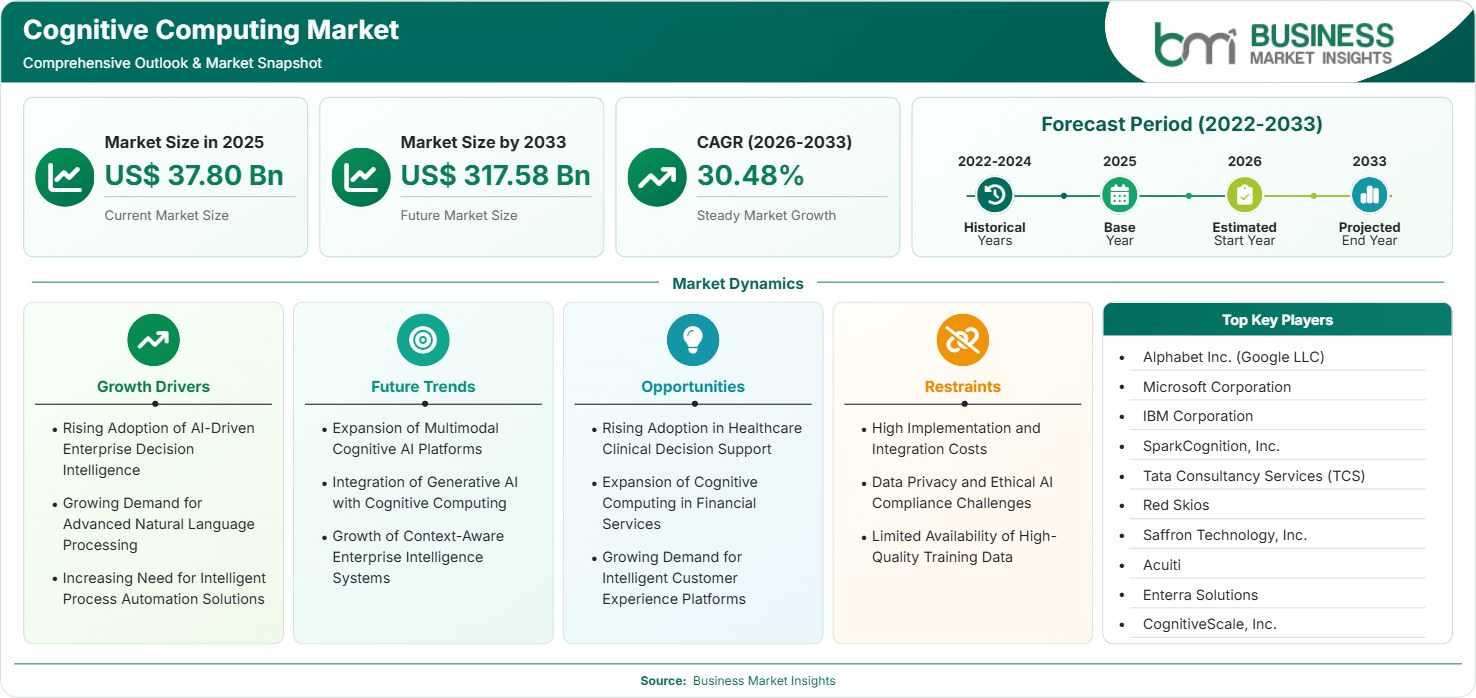
The Cognitive Computing Market size was valued at US$ 37.80 Billion in 2025 and is projected to reach US$ 317.58 Billion by 2033, growing at a CAGR of 30.48% during 2026–2033. Rising enterprise adoption of artificial intelligence technologies, growing demand for data-driven decision-making, increasing deployment of intelligent automation solutions, and expanding utilization of machine learning and natural language processing across industries are supporting market growth globally.

Report Coverage
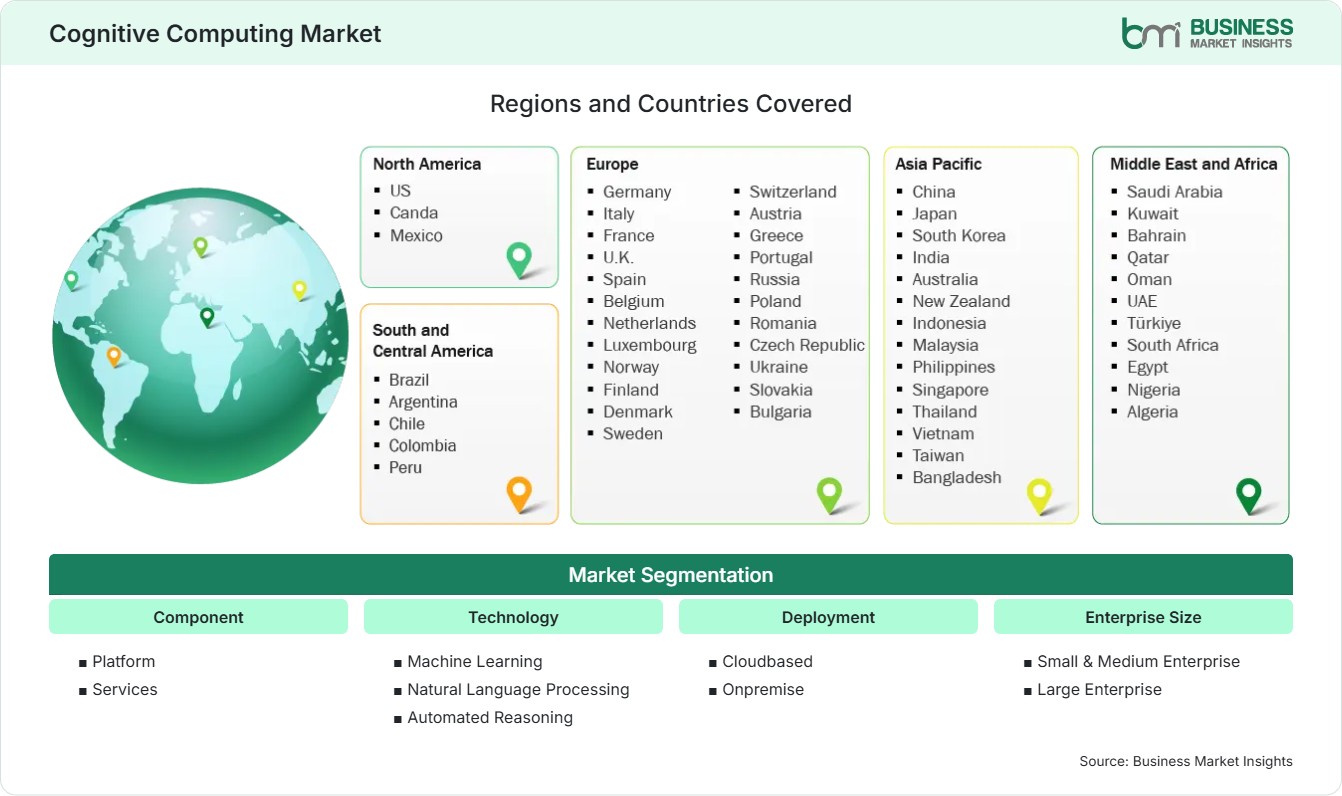
  • Component: Platform, Services
  • Technology: Machine Learning , Natural Language Processing , Automated Reasoning
  • Deployment: Cloudbased, Onpremise
  • Enterprise Size: Small & Medium Enterprise , Large Enterprise
  • End-user: BFSI, Healthcare, Retail & ecommerce, IT & Telecom
US$ 37.80 Bn Market size in 2025
US$ 317.58 Bn Market Size by 2033
30.48% CAGR, 2026 - 2033
2026-2033 Forecast Period

AI Overview

Cognitive Computing Market Summary

  • North America Region: North America holds a market share of 38%–41% in 2025, growing with a CAGR of 29.0%–30.2% during 2026–2033. Strong investments in artificial intelligence, widespread adoption of cloud platforms, advanced digital infrastructure, and high enterprise spending on intelligent technologies continue supporting regional leadership. The U.S. market is expected to register a CAGR of 29.3%–30.5%.
  • Fastest Growing Region: Asia Pacific accounts for 23%–26% share in 2025 and is projected to grow at a CAGR of 32.5%–33.8% through 2033. Expanding digital transformation initiatives, growing enterprise AI adoption, increasing cloud penetration, and strong government support for artificial intelligence development continue driving regional expansion.
  • Leading Segment: Machine Learning (ML) represents 34%–37% share in 2025 and is expected to grow at a CAGR of 30.5%–31.8% through 2033. Increasing use of predictive analytics, intelligent automation, advanced forecasting, and enterprise decision support systems continues supporting segment dominance.
  • High Growth Segment: Cloud-based Deployment accounts for 58%–61% share in 2025 and is forecast to grow at a CAGR of 32.8%–34.1% during 2026–2033. Scalability, lower infrastructure costs, rapid implementation capabilities, and increasing integration with enterprise applications are accelerating growth.
  • Key Market Opportunity: Expansion of generative AI, intelligent enterprise assistants, autonomous decision-support platforms, and cognitive analytics solutions is creating substantial opportunities across industries.
  • Major Market Players: Alphabet Inc. (Google LLC), Microsoft Corporation, IBM Corporation, SparkCognition, Inc., Tata Consultancy Services (TCS), Red Skios, Saffron Technology, Inc., Acuiti, Enterra Solutions, CognitiveScale, Inc.
Strategic Insights

Cognitive Computing Market: Strategic Insights

Cognitive Computing Market Strategic Framework
FREE PDF
Request your free sample
Request free sample
Stakeholder View

Key Takeaways

  • Cognitive computing is becoming a strategic technology for organizations seeking intelligent automation and data-driven decision-making.
  • Machine learning remains the dominant technology segment due to its broad enterprise applicability.
  • Cloud-based deployment continues gaining traction because of flexibility, scalability, and lower implementation barriers.
  • BFSI and healthcare sectors remain major adopters of cognitive computing technologies.
  • Enterprises are increasingly utilizing cognitive systems to improve customer interactions, risk management, and operational efficiency.
  • Asia Pacific represents a major growth opportunity due to accelerating digitalization and AI investments.
Geographic Outlook

Cognitive Computing Market Regional Highlights

North America Cognitive Computing Market

North America accounts for 38%–41% Cognitive Computing Market share in 2025 and is projected to grow at a CAGR of 29.0%–30.2% through 2033. Widespread adoption of artificial intelligence technologies, strong cloud infrastructure, advanced analytics capabilities, and substantial enterprise technology spending continue supporting regional leadership.

  • Organizations are increasingly integrating cognitive computing solutions into customer service, process automation, and business intelligence functions.
  • Financial institutions continue deploying advanced analytics and automated decision systems to improve operational efficiency.
  • Healthcare providers are leveraging cognitive platforms for diagnostics support, patient engagement, and clinical decision-making.
  • Technology companies continue investing heavily in research and development activities related to artificial intelligence.
  • Cloud-based cognitive computing solutions are witnessing strong enterprise adoption across industries.
  • Growing focus on intelligent automation is creating additional opportunities for market expansion.

US Cognitive Computing Market

The United States contributes approximately 86%–90% of North American revenue and is expected to register a CAGR of 29.3%–30.5% through 2033. Strong AI innovation ecosystems, high digital transformation spending, and increasing enterprise demand for intelligent technologies continue supporting market leadership.

  • Enterprises are increasingly deploying cognitive computing platforms to improve productivity and decision quality.
  • BFSI institutions continue adopting AI-powered analytics for risk management and customer engagement.
  • Technology providers are expanding investments in machine learning and natural language processing solutions.
  • Generative AI integration is accelerating demand for advanced cognitive platforms.
  • Growing enterprise cloud adoption continues supporting rapid implementation of cognitive technologies.

Europe Cognitive Computing Market

Europe represents 25%–28% of global revenue in 2025 and is anticipated to expand at a CAGR of 29.8%–31.0% through 2033. Increasing enterprise modernization activities, rising adoption of AI technologies, and growing focus on operational efficiency continue driving regional growth. Germany remains the leading market while Poland demonstrates stronger growth momentum.

  • Germany continues leading regional adoption through strong industrial digitalization and enterprise AI investments.
  • Poland is among the fastest-growing countries and is estimated to register a CAGR of 31.5%–32.7% during the forecast period.
  • Retail and financial services organizations are increasingly deploying cognitive analytics platforms.
  • Growing interest in intelligent automation is supporting demand across multiple sectors.
  • Public and private investments in AI technologies continue strengthening innovation ecosystems.
  • Cloud-based deployments are accelerating across enterprise environments.

Asia Pacific Cognitive Computing Market

Asia Pacific accounts for 23%–26% of global revenue in 2025 and is expected to achieve the fastest CAGR of 32.5%–33.8% through 2033. Rapid digital transformation, increasing AI investments, expanding cloud infrastructure, and growing enterprise technology adoption continue supporting strong regional growth.

  • China remains the largest regional market due to substantial investments in artificial intelligence and enterprise digitalization.
  • India is projected to achieve approximately 34.0%–35.3% CAGR, supported by growing IT services development and enterprise AI adoption.
  • Businesses are increasingly utilizing cognitive platforms to improve customer engagement and operational productivity.
  • Expansion of cloud services is accelerating deployment of advanced analytics and AI solutions.
  • Telecommunications providers continue investing in intelligent customer support and automation technologies.
  • Government initiatives supporting digital economies are strengthening market opportunities.

Rest of World Cognitive Computing Market

Rest of World accounts for 8%–11% of global revenue in 2025 and is projected to expand at a CAGR of 30.0%–31.2% through 2033. Increasing digital transformation initiatives, expanding cloud adoption, and growing awareness regarding AI-driven decision-making continue supporting market development.

  • Brazil continues generating demand through enterprise modernization and analytics adoption initiatives.
  • The UAE is witnessing increasing investments in artificial intelligence and smart government programs.
  • Saudi Arabia is expected to achieve approximately 31.8%–33.0% CAGR through 2033, supported by digital transformation and technology diversification programs.
  • Enterprises are increasingly investing in intelligent automation platforms.
  • Expanding cloud ecosystems continue supporting deployment of cognitive computing solutions.
  • Growing interest in AI-powered business intelligence tools is strengthening market growth.
Global Market Geography
FREE PDF
Request your free sample
Request free sample
Segment Analysis

Cognitive Computing Market Segmentation

Component

The component segment serves as the foundation of the cognitive computing ecosystem, encompassing software platforms and professional services that enable enterprises to deploy, manage, optimize, and scale intelligent decision-making capabilities. The segment accounts for approximately 62%–65% share in 2025 and is projected to grow at a CAGR of 30.8%–31.9% through 2033. The expanding Cognitive Computing Market scope is supported by increasing enterprise investments in artificial intelligence, rising adoption of intelligent business applications, growing need for advanced analytics capabilities, and accelerating digital transformation initiatives across industries.

  • Platform: Platforms represent the dominant segment due to growing adoption of cognitive computing frameworks for machine learning, knowledge management, intelligent automation, predictive analytics, and real-time decision support. Organizations increasingly rely on cognitive platforms to process structured and unstructured data, automate workflows, and improve business intelligence capabilities.
  • Services: Services continue witnessing strong demand as enterprises require consulting, integration, implementation, customization, maintenance, support, and training capabilities to successfully deploy cognitive computing environments. Service providers play a critical role in helping organizations maximize return on investment and achieve operational outcomes.

Technology

Technology remains the primary driver behind innovation and value creation within the cognitive computing industry. This segment accounts for approximately 34%–37% share in 2025 and is expected to register a CAGR of 30.9%–32.1% through 2033. Current Cognitive Computing Market trends indicate growing demand for advanced AI technologies capable of understanding context, generating insights, automating decisions, and enhancing human productivity.

  • Machine Learning (ML): Machine learning remains the largest segment due to its ability to identify patterns, improve forecasting accuracy, automate predictions, and continuously learn from large datasets without explicit programming.
  • Natural Language Processing (NLP): NLP technologies are increasingly utilized for conversational AI, virtual assistants, document intelligence, sentiment analysis, customer support automation, and enterprise knowledge management.
  • Automated Reasoning: Automated reasoning solutions support intelligent decision-making, risk analysis, rule-based processing, and complex problem-solving by replicating logical reasoning capabilities within enterprise environments.

Deployment

Deployment preferences continue evolving as enterprises seek scalable, secure, and cost-efficient approaches for cognitive computing implementation. This segment accounts for approximately 58%–61% share in 2025 and is forecast to expand at a CAGR of 32.8%–34.1% through 2033.

  • Cloud-based: Cloud deployment dominates the market due to rapid scalability, lower infrastructure costs, simplified maintenance, and seamless access to advanced AI capabilities. Organizations increasingly prefer cloud-based cognitive platforms because they support faster implementation and continuous innovation.
  • On-premise: On-premise deployment remains important among organizations requiring greater control over sensitive information, regulatory compliance, cybersecurity management, and mission-critical operational environments.

Enterprise Size

Enterprise size significantly influences adoption patterns, technology investments, and deployment strategies within the cognitive computing market. This segment accounts for approximately 64%–67% share in 2025 and is expected to grow at a CAGR of 30.2%–31.4% through 2033.

  • Small & Medium Enterprises (SMEs): SMEs are increasingly adopting cloud-based cognitive computing solutions to improve operational efficiency, automate business processes, enhance customer engagement, and gain actionable business insights.
  • Large Enterprise: Large enterprises continue dominating adoption due to greater data volumes, larger technology budgets, extensive digital transformation programs, and increasing demand for intelligent decision-support systems across global operations.

End-user

End-user demand continues expanding as organizations recognize the strategic value of cognitive computing in improving operational efficiency, customer satisfaction, and business decision-making. This segment accounts for approximately 39%–42% share in 2025 and is projected to grow at a CAGR of 31.0%–32.2% through 2033.

  • BFSI: Financial institutions utilize cognitive computing for fraud detection, risk management, customer analytics, compliance monitoring, and investment decision support.
  • Healthcare: Healthcare organizations increasingly deploy cognitive systems for clinical decision support, patient engagement, medical imaging analysis, operational optimization, and healthcare analytics.
  • Retail & e-commerce: Retailers leverage cognitive technologies for recommendation engines, inventory optimization, customer personalization, demand forecasting, and digital commerce enhancement.
  • IT & Telecom: Telecommunications providers and technology companies use cognitive computing to improve customer service automation, network optimization, predictive maintenance, and operational intelligence.
Market Forces

Cognitive Computing Market Dynamics

Key Market Drivers

Rising Adoption of AI-Driven Enterprise Decision Intelligence

Organizations across all industries are increasingly adopting decision intelligence systems that integrate artificial intelligence, machine learning, advanced analytics, and contextual reasoning. Enterprises of today have access to vast amounts of data generated from customers, processes, supply chain, finances, and digital engagements. Conventional analytical technologies have been found to be inadequate at translating such vast data into actionable information. Cognitive computing technologies help resolve this issue by uncovering insights through identifying patterns, offering recommendations, predicting outcomes, and enabling intelligent decision making. Today’s business executives are increasingly deploying AI-based systems to facilitate strategic planning, execution, risk management, and competitiveness. Growing significance of data-driven decision making is continuing to drive adoption of cognitive computing technologies around the world.

Growing Demand for Advanced Natural Language Processing

Natural language processing has emerged as one of the most transformative technologies within the cognitive computing ecosystem. Enterprises increasingly rely on NLP solutions to understand customer interactions, automate conversational experiences, analyze textual information, and improve accessibility to organizational knowledge. Businesses generate substantial volumes of unstructured content in the form of emails, reports, documents, customer feedback, social media interactions, and service requests. NLP-powered systems help organizations extract valuable insights from these information sources while improving efficiency and responsiveness. Additionally, the rapid adoption of virtual assistants, conversational AI platforms, chatbots, and generative AI applications is creating sustained demand for sophisticated language processing technologies. As organizations strive to improve customer engagement and workforce productivity, NLP remains a major growth driver within the cognitive computing market.

Increasing Need for Intelligent Process Automation Solutions

Enterprises continue seeking innovative ways to automate repetitive workflows, improve operational productivity, reduce costs, and minimize human error. Cognitive computing technologies enhance traditional automation by enabling systems to learn from data, adapt to changing conditions, and support more complex business processes. Intelligent process automation solutions are increasingly deployed across finance, healthcare, customer service, telecommunications, logistics, and manufacturing environments. These systems enable organizations to automate decision-intensive activities while improving consistency and efficiency. The integration of machine learning, NLP, and automated reasoning capabilities further expands the scope of automation across enterprise functions. As organizations accelerate digital transformation initiatives, intelligent process automation remains a critical driver supporting broader cognitive computing adoption.

Key Market Opportunities

Rising Adoption in Healthcare Clinical Decision Support

Healthcare is one of the most promising sectors where cognitive computing technologies can be used successfully. Healthcare experts use complex analytics tools and AI-driven decision-making platforms in their work to achieve better patient results, improve diagnosis accuracy, develop treatment plans, and optimize operations within healthcare facilities. With cognitive computing solutions, it is possible to process huge amounts of data on patients, their history, diagnostic results, medical articles, and other important details to help healthcare specialists make decisions. The current trends in healthcare digitization and implementation of electronic health records can facilitate implementation of such technologies.

Expansion of Cognitive Computing in Financial Services

Financial organizations are constantly enhancing their investments in cognitive computing to ensure better experiences for customers, better risk management, automation of compliance activities, and higher efficiency in operations. The financial industry is increasingly using cognitive technologies to analyze large amounts of financial data, find anomalies, identify frauds, and make investment decisions. Moreover, cognitive computing is being used for better engagement of customers through the use of personalized advice and virtual assistants. The rising complexities of financial systems and regulatory obligations increase the demand for cognitive computing as well.

Growing Demand for Intelligent Customer Experience Platforms

Customer experience has become a major competitive differentiator across industries, prompting organizations to invest in technologies capable of delivering personalized and responsive interactions. Cognitive computing platforms enable businesses to analyze customer behavior, predict needs, automate support functions, and provide tailored recommendations in real time. Enterprises increasingly deploy intelligent customer experience solutions across digital channels, contact centers, retail environments, and online platforms. The growing popularity of conversational AI and personalized service delivery further strengthens demand for cognitive technologies. Long-term Cognitive Computing Market Forecasts remain highly favorable as organizations continue prioritizing customer-centric business strategies.

Market Restraints and Challenges

High Implementation and Integration Costs

Factor: Deploying cognitive computing solutions often requires substantial investments in AI platforms, data infrastructure, cloud resources, system integration, cybersecurity frameworks, and workforce training. Integrating cognitive technologies with existing enterprise systems can be technically complex and resource intensive, particularly for organizations operating large legacy environments. Additional expenses associated with customization, governance, and ongoing model management may further increase implementation costs.

Impact: High initial expenditures can delay project deployment and limit adoption among smaller organizations with constrained technology budgets. Cost considerations frequently require enterprises to adopt phased implementation approaches and carefully evaluate return-on-investment expectations before pursuing large-scale cognitive computing initiatives.

Data Privacy and Ethical AI Compliance Challenges

Factor: Cognitive computing systems depend heavily on large volumes of organizational and customer data to generate insights and support intelligent decision-making. Increasing concerns regarding privacy protection, data governance, algorithmic transparency, fairness, regulatory compliance, and responsible AI usage are creating new operational challenges. Organizations must ensure that cognitive systems comply with evolving legal and ethical requirements while maintaining trust among stakeholders.

Impact: Compliance obligations can increase development complexity, implementation timelines, governance requirements, and operational costs. Failure to address privacy, security, and ethical considerations may reduce adoption confidence and expose organizations to regulatory and reputational risks. Consequently, responsible AI practices continue emerging as a critical requirement for successful cognitive computing deployment.

Company Analysis

Competitive Landscape

The Cognitive Computing Market analysis is characterized by intense competition among artificial intelligence providers, cloud platform vendors, enterprise software companies, analytics specialists, and intelligent automation developers. Market participants are focusing on machine learning innovation, natural language processing advancements, cognitive analytics, enterprise decision intelligence, generative AI integration, and autonomous business process optimization to strengthen their market positions. Growing enterprise demand for intelligent decision-making, real-time analytics, predictive insights, and customer experience enhancement continues driving investment and innovation across the cognitive computing ecosystem.

Company Name

Overview

Products and Services relevant to this market

Alphabet Inc. (Google LLC)

Technology company providing artificial intelligence, machine learning, cloud computing, and advanced analytics solutions.

Cognitive AI platforms, machine learning services, natural language processing solutions, cloud-based AI infrastructure, and enterprise analytics tools.

Microsoft Corporation

Global technology company offering cloud, AI, and intelligent business solutions across industries.

Azure AI, cognitive services, machine learning platforms, intelligent automation solutions, natural language technologies, and enterprise AI applications.

IBM Corporation

Enterprise technology provider and pioneer in cognitive computing and AI-driven business solutions.

IBM Watson, cognitive analytics platforms, decision intelligence systems, NLP solutions, predictive analytics, and intelligent automation technologies.

SparkCognition, Inc.

Artificial intelligence company specializing in predictive analytics and enterprise cognitive solutions.

Cognitive AI platforms, predictive maintenance solutions, intelligent automation systems, enterprise analytics tools, and operational intelligence applications.

Tata Consultancy Services (TCS)

Global IT services and consulting company supporting enterprise digital transformation initiatives.

Cognitive computing services, AI consulting, intelligent automation solutions, data analytics platforms, and enterprise AI integration services.

Red Skios

Technology company focused on digital transformation and artificial intelligence-driven innovation services.

Cognitive technology solutions, intelligent business platforms, AI-powered analytics, customer experience optimization tools, and automation services.

Saffron Technology, Inc.

AI company specializing in cognitive reasoning and intelligent decision-support technologies.

Cognitive reasoning platforms, pattern discovery tools, machine learning applications, predictive intelligence solutions, and enterprise analytics systems.

Acuiti

Technology and analytics company focused on intelligent operational and business decision-support solutions.

Cognitive analytics services, AI-based intelligence platforms, enterprise decision systems, and predictive business applications.

Enterra Solutions

Artificial intelligence company providing autonomous decision science and enterprise optimization technologies.

Cognitive computing platforms, autonomous decision-making solutions, predictive analytics tools, and intelligent business optimization systems.

CognitiveScale, Inc.

Enterprise AI company focused on responsible AI, automation, and intelligent decision-making platforms.

Cognitive AI platforms, intelligent workflow automation, responsible AI solutions, decision intelligence systems, and enterprise transformation technologies.

Trust & Transparency

Research Methodology

The market analysis combines proprietary research with secondary data from government agencies, company disclosures, regulatory filings, industry databases and expert interviews. Market estimates are validated through data triangulation, cross-market benchmarking and analyst review.

View Full Research Methodology

Questions Answered

Frequently Asked Questions

How is cognitive computing transforming enterprise operations?

Cognitive computing helps organizations automate complex processes, analyze large data volumes, improve decision quality, enhance customer experiences, strengthen risk management, generate predictive insights, and optimize operational efficiency across business functions.

What does this Cognitive Computing Market Report cover?

This report covers component analysis, technology segmentation, deployment models, enterprise size assessment, end-user evaluation, regional trends, competitive landscape analysis, market dynamics, opportunities, restraints, and growth prospects through 2033.

Why is cloud-based deployment witnessing strong growth?

Cloud-based deployment is growing rapidly because it offers scalability, flexibility, lower infrastructure costs, faster implementation, simplified maintenance, and seamless integration with enterprise software ecosystems.

Which technology segment dominates the market?

Machine Learning (ML) represents the leading segment due to its broad deployment across predictive analytics, intelligent automation, forecasting, recommendation systems, risk analysis, and business intelligence applications.

What is driving growth in the cognitive computing market?

Rising adoption of AI-driven enterprise decision intelligence, growing demand for advanced natural language processing technologies, increasing utilization of intelligent process automation solutions, and expanding investments in enterprise artificial intelligence are major factors driving market growth.

Access the Full Cognitive Computing Market Report

Get segment-level forecasts, regional estimates, competitive benchmarking, company profiles and downloadable Excel datasets.

Access the full Cognitive Computing Market Report
350 pages PDF & Excel | 2026-08-12
Similar Research

Related Market Reports