
Spatial Computing Market Outlook: Size, Share, Trends, Growth Analysis, Competitive Landscape & Forecast, 2026-2033

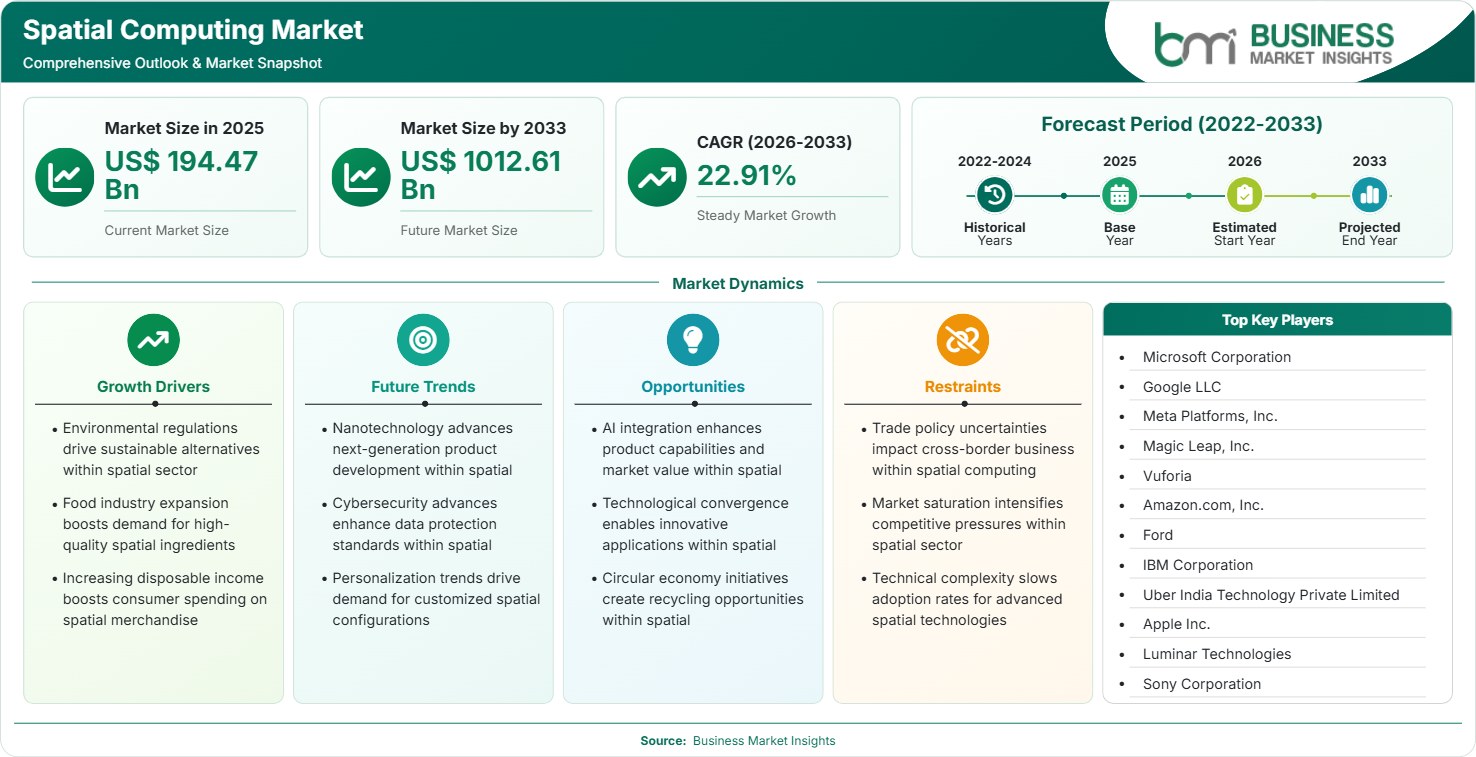
The Spatial Computing Market size was valued at US$ 194.47 Billion in 2025 and is projected to reach US$ 1012.61 Billion by 2033, growing at a CAGR of 22.91% during 2026–2033, driven by immersive technology adoption, enterprise digital transformation, AI integration, industrial simulation, healthcare visualization, and next-generation computing experiences.

Report Coverage
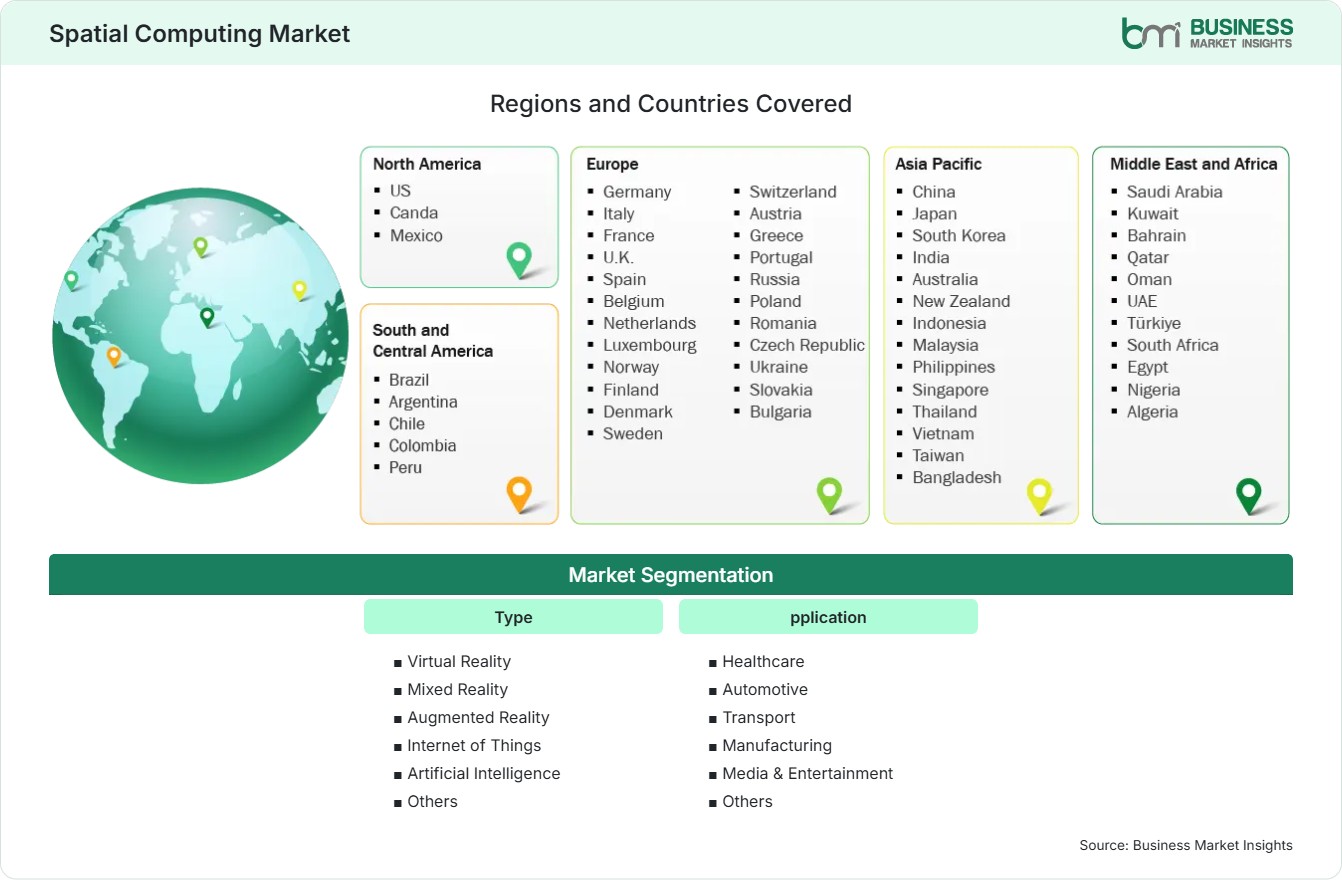
  • Type: Virtual Reality, Mixed Reality, Augmented Reality, Internet of Things, Artificial Intelligence, Others
  • pplication: Healthcare, Automotive, Transport, Manufacturing, Media & Entertainment, Others
US$ 194.47 Bn Market size in 2025
US$ 1012.61 Bn Market Size by 2033
22.91% CAGR, 2026 - 2033
2026-2033 Forecast Period

AI Overview

Spatial Computing Market Summary

  • North America Region: North America holds a 38%–42% share in 2025, growing with a CAGR of 21%–24% during 2026–2033, supported by enterprise AR/VR adoption, AI investments, cloud ecosystems, defense modernization, healthcare innovation, and industrial applications. The US market demonstrates strong adoption across technology enterprises, healthcare providers, and automotive companies, expanding with a CAGR of 22%–25% between 2026 and 2033 due to advanced R&D capabilities and commercial deployment.
  • Fastest Growing Region: Asia Pacific maintains a 27%–31% share in 2025, expanding with a CAGR of 24%–27% during 2026–2033, driven by smart manufacturing, digital infrastructure development, consumer electronics innovation, government technology initiatives, and increasing adoption of immersive learning and enterprise solutions across emerging economies.
  • Leading Segment: Augmented Reality accounts for a 32%–36% share in 2025, advancing with a CAGR of 21%–24% during 2026–2033, supported by industrial assistance, retail visualization, navigation solutions, remote collaboration, workforce training, and enterprise deployment requiring real-time digital overlays.
  • High Growth Segment: Mixed Reality represents a 22%–26% share in 2025, progressing with a CAGR of 25%–28% during 2026–2033, driven by spatial interfaces, advanced simulation environments, healthcare procedures, defense applications, digital twins, and increasing investments in immersive computing platforms.
  • Key Market Opportunity: Enterprise spatial platforms, AI-powered immersive applications, digital twins, and industrial visualization solutions create strong opportunities through automation, remote operations, workforce enhancement, and advanced customer experiences across multiple industries.
  • Major Market Players: Microsoft Corporation, Google LLC, Meta Platforms, Inc., Magic Leap, Inc., Vuforia, Amazon.com, Inc., Ford, IBM Corporation, Uber India Technology Private Limited, Apple Inc., Luminar Technologies, Sony Corporation, and Others.
Strategic Insights

Spatial Computing Market: Strategic Insights

Spatial Computing Market Strategic Framework
FREE PDF
Request your free sample
Request free sample
Stakeholder View

Key Takeaways

  • The ecosystem is shifting from isolated immersive devices toward integrated spatial platforms combining hardware, software, cloud computing, artificial intelligence, and analytics. Companies across the value chain are focusing on interoperability, scalable solutions, and industry-specific applications to improve commercial adoption.
  • Healthcare, automotive, manufacturing, and media applications represent significant opportunity areas as organizations seek advanced visualization, simulation, and collaboration capabilities. Enterprise-focused solutions are gaining importance due to measurable improvements in operational efficiency, training effectiveness, and workflow optimization.
  • Innovation is increasingly centered on lightweight wearable devices, AI-enhanced spatial understanding, advanced sensors, and realistic digital environments. Research and development activities are prioritizing improved user experience, reduced latency, and seamless interaction between physical and virtual environments.
  • Asia Pacific provides an attractive investment environment due to expanding electronics manufacturing capabilities, government-backed digital initiatives, and rising enterprise technology adoption. Countries including China, Japan, South Korea, and India are becoming important contributors to ecosystem development.
  • Strategic partnerships, acquisitions, and platform collaborations are shaping competitive positioning as technology companies seek capabilities in hardware development, AI integration, cloud services, and immersive application ecosystems. Investment activity is supporting innovation and market consolidation.
  • Standardization, cybersecurity enhancement, and cross-platform compatibility will influence future industry expansion as organizations require reliable, secure, and scalable spatial solutions for mission-critical applications. Stakeholders focusing on ecosystem partnerships can capture long-term opportunities.
Geographic Outlook

Spatial Computing Market Regional Highlights

North America Spatial Computing Market

North America maintains a 38%–42% share in 2025 and expands with a CAGR of 21%–24% during 2026–2033, supported by strong technology infrastructure, enterprise adoption, and advanced research capabilities. The region benefits from investments by leading software and hardware companies developing immersive platforms. The market share is influenced by demand from healthcare, automotive, manufacturing, and defense sectors. The Spatial Computing Market growth is supported by AI integration, cloud platforms, and increasing adoption of digital twin technologies across industries.

  • The United States remains the primary contributor due to advanced technology ecosystems, strong venture funding, and enterprise deployment of immersive solutions across healthcare, automotive, manufacturing, and industrial applications requiring advanced visualization capabilities.
  • Canada demonstrates increasing adoption through research institutions, healthcare innovation programs, and investments in digital transformation initiatives supporting spatial technologies for education, training, remote collaboration, and enterprise productivity improvement.
  • Enterprise demand for extended reality platforms continues expanding as organizations integrate immersive solutions into engineering, simulation, workforce training, and operational planning processes across multiple industries.
  • Strategic collaborations between technology providers and industrial organizations are accelerating development of AI-enabled spatial applications, strengthening regional competitiveness and commercialization opportunities.

US Spatial Computing Market

The US represents a 31%–35% share within North America in 2025 and grows at a CAGR of 22%–25% during 2026–2033. The country remains a leading innovation hub due to extensive investments in artificial intelligence, cloud computing, semiconductor technologies, and immersive platforms. The US Spatial Computing Market benefits from strong enterprise demand, government technology initiatives, and significant research activities. Major technology companies are developing advanced spatial ecosystems targeting healthcare, automotive design, industrial automation, and consumer experiences.

  • Technology companies in the US are accelerating product development through AI-powered spatial platforms, advanced sensors, and cloud-based computing environments supporting enterprise and consumer applications.
  • Healthcare organizations are adopting immersive visualization technologies for medical training, surgical planning, rehabilitation programs, and patient education, improving operational accuracy and healthcare delivery capabilities.
  • Automotive manufacturers are implementing spatial solutions for vehicle design, simulation, autonomous driving development, and engineering collaboration, reducing development cycles and improving product innovation.
  • Strong venture capital activity and research partnerships continue supporting startups developing specialized spatial computing applications across industrial, commercial, and entertainment segments.

Europe Spatial Computing Market

Europe accounts for a 22%–26% share in 2025 and expands with a CAGR of 20%–23% during 2026–2033. The region is supported by industrial automation, manufacturing modernization, healthcare digitization, and regulatory support for advanced technologies. Germany, the United Kingdom, and France represent leading markets, while Nordic countries demonstrate strong adoption potential. The Spatial Computing Market share reflects growing enterprise implementation, whereas increasing investments in immersive training and digital twins influence future adoption patterns across European industries.

  • Germany leads regional adoption through advanced manufacturing capabilities, Industry 4.0 initiatives, and automotive engineering applications requiring simulation, visualization, and digital production optimization solutions.
  • The United Kingdom demonstrates strong growth through technology startups, healthcare innovation programs, and increasing enterprise adoption of immersive collaboration and training platforms.
  • France is expanding spatial technology deployment through aerospace, automotive, healthcare, and industrial applications supported by government-backed digital transformation initiatives.
  • European manufacturers are integrating spatial solutions to improve production efficiency, maintenance operations, employee training, and product development processes through virtual environments.

Asia Pacific Spatial Computing Market

Asia Pacific represents a 27%–31% share in 2025 and records a CAGR of 24%–27% during 2026–2033, making it the fastest-growing regional market. Increasing electronics manufacturing, digital infrastructure investments, and enterprise technology adoption support expansion. China, Japan, South Korea, and India are key contributors due to strong technology ecosystems. The region’s Spatial Computing Market trends are shaped by smart manufacturing, gaming innovation, education technology, healthcare modernization, and government initiatives supporting immersive technology development.

  • China benefits from large-scale manufacturing capabilities, artificial intelligence investments, and extensive consumer electronics ecosystems supporting development and deployment of spatial computing technologies.
  • Japan demonstrates strong adoption through robotics, automotive innovation, healthcare applications, and advanced electronics manufacturing requiring immersive visualization and simulation capabilities.
  • South Korea is expanding through semiconductor expertise, gaming industries, and technology investments supporting next-generation immersive devices and spatial platforms.
  • India shows increasing adoption through digital transformation initiatives, enterprise technology implementation, education solutions, and growing investments in advanced computing infrastructure.

Rest of World Spatial Computing Market

Rest of World accounts for an 8%–12% Spatial Computing Market share in 2025 and expands with a CAGR of 19%–22% during 2026–2033. South and Central America are gradually adopting immersive technologies through healthcare modernization, industrial applications, and digital education initiatives. Middle East and Africa markets are investing in smart infrastructure, tourism experiences, and enterprise modernization. Growth is supported by increasing technology accessibility, government digitization programs, and partnerships with global technology providers.

  • Brazil and Mexico are emerging markets due to increasing digital transformation initiatives, healthcare technology adoption, and enterprise demand for immersive training and visualization solutions.
  • Middle Eastern countries are investing in smart cities, tourism technologies, infrastructure planning, and advanced simulation platforms to support economic diversification strategies.
  • African markets are exploring spatial technologies through education, healthcare accessibility, and remote collaboration applications supported by improving digital infrastructure.
  • Regional partnerships with global technology providers are helping organizations access advanced spatial platforms while reducing implementation barriers across developing economies.
Global Market Geography
FREE PDF
Request your free sample
Request free sample
Segment Analysis

Spatial Computing Market Segmentation

Type

The Type segment includes Virtual Reality, Mixed Reality, Augmented Reality, Internet of Things, Artificial Intelligence, and Others. The segment structure reflects increasing convergence between immersive technologies, connected devices, and intelligent computing platforms. Augmented Reality held a 32%–36% Spatial Computing Market share in 2025 and is projected to grow at a CAGR of 21%–24% during 2026–2033. Adoption is driven by enterprise visualization, industrial assistance, healthcare applications, and interactive experiences.

  • Virtual Reality: Virtual Reality solutions provide immersive environments for gaming, training, simulation, and healthcare applications. Increasing hardware improvements, reduced latency, and enterprise adoption support broader implementation across industries.
  • Mixed Reality: Mixed Reality combines physical and digital environments for advanced collaboration, simulation, and professional workflows. Growing demand for realistic interactions supports adoption in healthcare, defense, engineering, and industrial applications.
  • Augmented Reality: Augmented Reality enables digital information overlays on real-world environments. Industrial guidance, retail visualization, navigation, and maintenance applications continue driving adoption across commercial sectors.
  • Internet of Things: Internet of Things integration connects spatial platforms with sensors and devices. Real-time data visualization, smart infrastructure, and industrial monitoring applications enhance operational efficiency.
  • Artificial Intelligence: Artificial Intelligence enhances spatial understanding, automation, object recognition, and predictive capabilities. AI-driven improvements are enabling smarter immersive applications across multiple industries.

Application

The Application segment includes Healthcare, Automotive, Transport, Manufacturing, Media & Entertainment, and Others. Healthcare represents a major adoption area due to advanced visualization requirements, while manufacturing applications benefit from digital twins and simulation technologies. The segment demonstrates increasing adoption as organizations implement immersive solutions for operational optimization. The Spatial Computing Market scope continues expanding through enterprise applications requiring improved collaboration, visualization accuracy, and real-time decision-making capabilities across industrial environments.

  • Healthcare: Healthcare applications use spatial technologies for surgical planning, medical training, rehabilitation, and patient education. Improved visualization capabilities support enhanced clinical workflows and healthcare innovation.
  • Automotive: Automotive companies utilize spatial solutions for vehicle design, simulation, autonomous technology development, and engineering collaboration. Digital environments improve development efficiency and product innovation.
  • Transport: Transport applications include navigation, infrastructure planning, passenger experiences, and operational management. Spatial technologies improve safety, efficiency, and real-time transportation decision-making.
  • Manufacturing: Manufacturing industries adopt spatial platforms for digital twins, maintenance assistance, employee training, and production optimization. Immersive solutions improve accuracy and operational productivity.
  • Media & Entertainment: Media and entertainment companies leverage spatial computing for immersive content, interactive experiences, gaming, and virtual environments. Consumer engagement continues driving application expansion.
Market Forces

Spatial Computing Market Dynamics

Key Market Drivers

Enterprise Adoption of Immersive Digital Workflows

Enterprise adoption of immersive workflows is accelerating as organizations seek improved visualization, collaboration, and operational efficiency. The market growth is supported by increasing implementation across manufacturing, healthcare, automotive, and engineering sectors, where digital twins and simulation platforms reduce development cycles. The Spatial Computing Market trends indicate that there is increasing emphasis on requirements of real-time data visualization, remote guidance capabilities, and decision support by artificial intelligence systems. Enterprises are adopting spatial applications for effective workforce training, product development, and customer interaction management. Developments in cloud computing and edge computing, as well as sensing technologies, are supporting their widespread deployment.

Integration of Artificial Intelligence and Advanced Sensors

Incorporation of artificial intelligence technology in the field of spatial computing is helping in enhancing various aspects, such as object identification, perception of the environment, automation, and interactions with the user through better spatial mapping, predictive analytics, and intelligent content creation. Advanced sensors and cameras, in addition to processing power, have been increasing in recent times. The Spatial Computing Market trends are shifting toward intelligent platforms that combine AI, machine learning, and real-time analytics for industrial and commercial applications. Technology providers are focusing on developing systems capable of understanding physical environments and delivering personalized digital experiences. These advancements are creating opportunities across healthcare, manufacturing, transportation, and enterprise collaboration.

Expansion of Digital Twin and Simulation Applications

Digital twin adoption is becoming a major driver as industries require accurate virtual representations of physical assets, processes, and environments. Manufacturing, automotive, aerospace, and infrastructure companies are using spatial technologies to simulate operations, identify inefficiencies, and improve decision-making. Rising demands for predictive maintenance and optimization of manufacturing systems have been contributing to the deployment of digital twin systems. Moreover, government programs that are aimed at the development of intelligent infrastructure and industrialization have also been contributing towards the adoption of digital twins. Better connectivity through IoT technology and 5G technologies helps in better integration of physical and digital worlds.

Key Market Opportunities

Growth of Healthcare and Medical Visualization Solutions

Healthcare represents a significant opportunity area as medical institutions increasingly adopt immersive technologies for surgical planning, medical education, rehabilitation, and patient engagement. Advanced visualization capabilities enable healthcare professionals to analyze complex anatomical structures and improve procedural accuracy. The Spatial Computing Market Forecasts indicate rising investments in applications related to health care as hospitals and vendors create specialized solutions. Collaboration between health care institutions and technology vendors is giving rise to new platforms for education as well as clinical decisions. With health care digitization on rise and increased demands for collaboration and advancements in imaging technologies, spatial computing will see more uses in global health care systems.

Development of Industrial Metaverse and Smart Manufacturing Platforms

Industrial metaverse applications are creating new opportunities through connected factories, virtual collaboration environments, and AI-driven operational management. Manufacturers are exploring spatial technologies to improve design processes, workforce training, maintenance activities, and production planning. Integration with Internet of Things (IoT) systems and digital twins makes it possible to monitor industrial equipment and processes in real time. Organizations that are developing smart manufacturing facilities can take advantage of spatial technologies to increase their productivity and minimize potential risks. The increasing use of Industry 4.0 around the globe drives technology providers to come up with scalable solutions for industrial applications.

Expansion of Consumer and Entertainment Experiences

Consumer applications in gaming, entertainment, retail, and virtual experiences represent emerging opportunities for spatial computing providers. Increasing demand for immersive content and interactions, as well as for personalized digital experiences, is prompting increased investments in the development of sophisticated hardware and software solutions. Media companies are testing various approaches to storytelling, including immersive events, spatial experiences, and virtual commerce. Improved availability and accessibility of such devices and digital media content, as well as better design of user experience, are projected to enable further consumer adoption. Tech companies are working on platforms that will blend AI, graphics processing, and cloud computing.

Market Restraints and Challenges

High Hardware Costs and Infrastructure Requirements

Factor: High development costs associated with advanced spatial devices, sensors, and computing infrastructure create adoption barriers for small and medium-sized organizations.

Impact: Cost-effectiveness issues may lead to delays in implementation, especially for industries that are cost-conscious and for countries just launching into use of these innovations, where costs associated with technologies require long payoff times. Even though hardware is becoming more capable, businesses have to take care of costs involved in buying equipment and integrating software, besides having maintenance concerns and training for staff. Issues of infrastructure, like high-end computers and connectivity issues, affect decision-making regarding the implementation of these innovations.

Data Privacy, Security, and Standardization Concerns

Factor: Spatial technologies collect extensive environmental, behavioral, and operational data, creating concerns regarding privacy protection, cybersecurity, and regulatory compliance.

Impact: Difficult standards and security issues could prevent businesses from using this technology in areas where security is of the utmost importance such as health care, military use, and industrial processes. Businesses will need to have proper data management systems, data processing systems, and policy guidelines to properly implement this technology. Interoperability difficulties could arise due to the existence of multiple hardware platforms and software systems. Industry players are striving towards developing uniform standards, more advanced encryption techniques, and compliance.

Company Analysis

Competitive Landscape

The Spatial Computing Market analysis highlights a competitive ecosystem consisting of global technology companies, immersive platform developers, automotive innovators, and enterprise solution providers. Market participants are focusing on hardware advancement, artificial intelligence integration, cloud capabilities, and industry-specific applications to strengthen their positioning. Strategic partnerships and ecosystem development remain important approaches as companies compete to deliver scalable spatial computing platforms.

Company Name

Overview

Products and Services relevant to this market

Microsoft Corporation

Microsoft develops enterprise technology platforms with strong cloud, AI, and immersive computing capabilities supporting digital transformation initiatives.

Provides mixed reality solutions, cloud platforms, AI services, enterprise collaboration tools, and spatial application development technologies.

Google LLC

Google delivers advanced computing, artificial intelligence, mapping, and software technologies supporting immersive digital experiences and spatial applications.

Offers AI platforms, mapping technologies, cloud infrastructure, augmented reality solutions, and developer tools for spatial experiences.

Meta Platforms, Inc.

Meta focuses on immersive technologies, virtual environments, and digital interaction platforms through extensive hardware and software development.

Provides virtual reality devices, mixed reality platforms, immersive applications, and metaverse-oriented computing ecosystems.

Magic Leap, Inc.

Magic Leap specializes in enterprise augmented reality solutions designed for professional workflows and industrial applications.

Develops augmented reality headsets, spatial computing platforms, enterprise software solutions, and immersive collaboration technologies.

Vuforia

Vuforia provides augmented reality software solutions enabling industrial, commercial, and enterprise visualization applications.

Offers AR development platforms, computer vision technologies, object recognition tools, and enterprise augmented reality solutions.

Amazon.com, Inc.

Amazon provides cloud computing, artificial intelligence, and digital infrastructure capabilities supporting spatial technology development.

Delivers cloud services, AI tools, computing infrastructure, and developer resources for immersive application deployment.

Ford

Ford applies spatial technologies within automotive design, engineering, manufacturing, and mobility development processes.

Utilizes immersive design tools, simulation platforms, virtual engineering environments, and advanced automotive technology solutions.

IBM Corporation

IBM develops enterprise AI, cloud, and digital transformation solutions supporting advanced computing applications.

Provides AI platforms, cloud services, enterprise analytics, and technology consulting for spatial computing applications.

Uber India Technology Private Limited

Uber India Technology Private Limited develops mobility technology solutions incorporating advanced digital platforms and operational technologies.

Supports transportation technology, mapping solutions, data platforms, and mobility-focused digital innovation applications.

Apple Inc.

Apple develops consumer electronics and software ecosystems focused on immersive experiences and advanced computing interfaces.

Provides spatial computing devices, operating systems, developer platforms, and immersive application ecosystems.

Luminar Technologies

Luminar Technologies specializes in automotive sensing technologies supporting advanced mobility and spatial understanding applications.

Develops LiDAR systems, perception technologies, autonomous mobility solutions, and spatial awareness platforms.

Sony Corporation

Sony develops entertainment, imaging, gaming, and sensor technologies supporting immersive digital experiences.

Provides virtual reality hardware, gaming platforms, imaging technologies, sensors, and entertainment-focused spatial solutions.

Trust & Transparency

Research Methodology

The market analysis combines proprietary research with secondary data from government agencies, company disclosures, regulatory filings, industry databases and expert interviews. Market estimates are validated through data triangulation, cross-market benchmarking and analyst review.

View Full Research Methodology

Questions Answered

Frequently Asked Questions

Why is the Spatial Computing Market Report important for businesses?

The Spatial Computing Market Report provides insights into technology adoption patterns, competitive positioning, application opportunities, regional developments, and future investment areas helping businesses make informed strategic decisions.

What are the major challenges limiting spatial computing adoption?

Key challenges include high hardware costs, infrastructure requirements, cybersecurity concerns, interoperability issues, and limited standardization. Companies are addressing these barriers through cloud platforms, improved hardware design, and industry collaboration.

How are digital twins connected with spatial computing?

Digital twins use spatial computing technologies to create interactive virtual representations of physical assets and environments. Organizations use these models for monitoring, simulation, maintenance planning, and operational optimization.

What role does artificial intelligence play in spatial computing?

Artificial intelligence improves spatial computing through environmental understanding, object recognition, automation, predictive analysis, and intelligent interaction. AI enables more accurate and personalized immersive experiences across enterprise and consumer applications.

What industries are adopting spatial computing technologies fastest?

Healthcare, automotive, manufacturing, media, and entertainment industries are among the fastest adopters. These sectors use spatial solutions for simulation, visualization, remote assistance, digital twins, training, and improved customer experiences.

Access the Full Spatial Computing Market Report

Get segment-level forecasts, regional estimates, competitive benchmarking, company profiles and downloadable Excel datasets.

Access the full Spatial Computing Market Report
350 pages PDF & Excel | 2026-08-31
Similar Research

Related Market Reports