
Data Analytics Market Outlook: Size, Share, Trends, Growth Analysis, Competitive Landscape & Forecast, 2026-2033

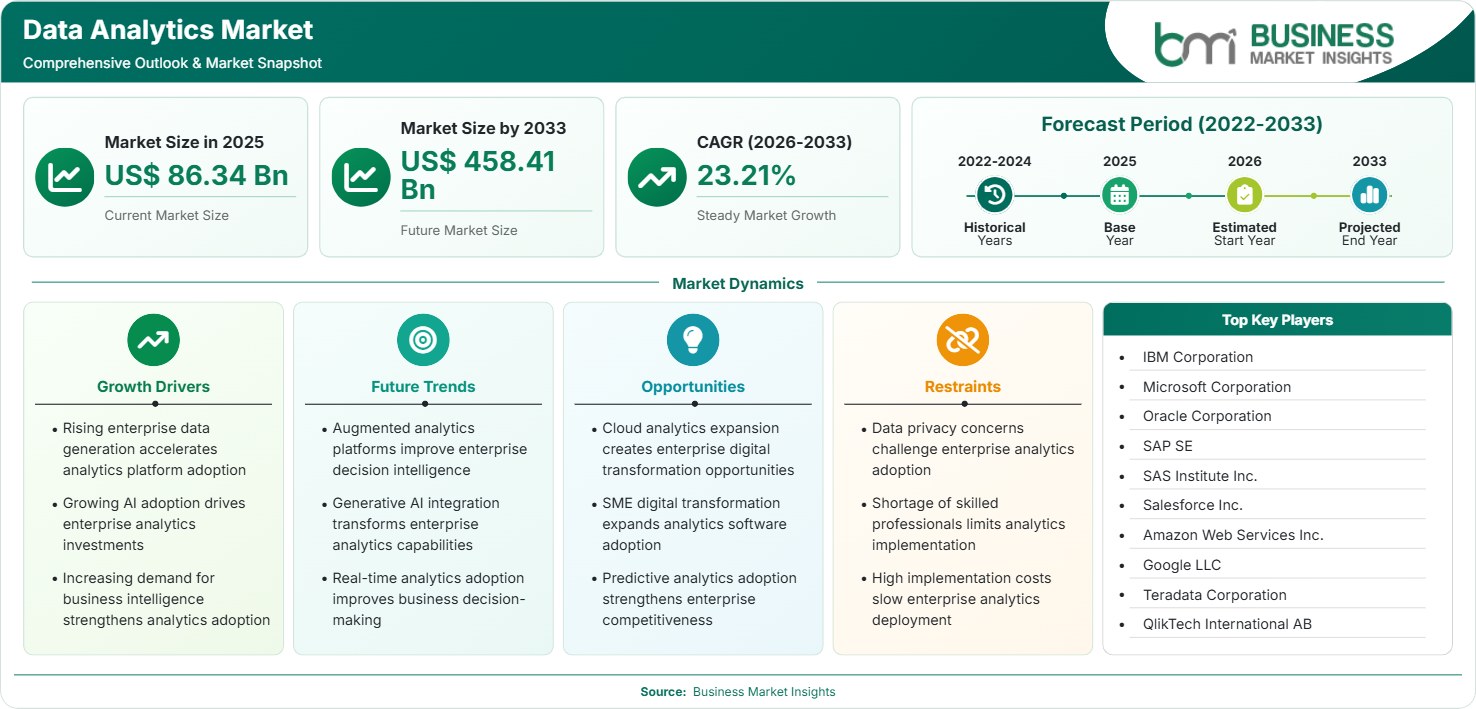
The Data Analytics Market size was valued at US$ 86.34 billion in 2025 and is projected to reach US$ 458.41 billion by 2033, growing at a CAGR of 23.21% during 2026–2033. Increasing enterprise data volumes, rapid artificial intelligence integration, and rising demand for advanced business intelligence solutions are accelerating adoption. Expansion of cloud analytics platforms, predictive modelling capabilities, and digital transformation initiatives are creating significant opportunities across industries.

Report Coverage
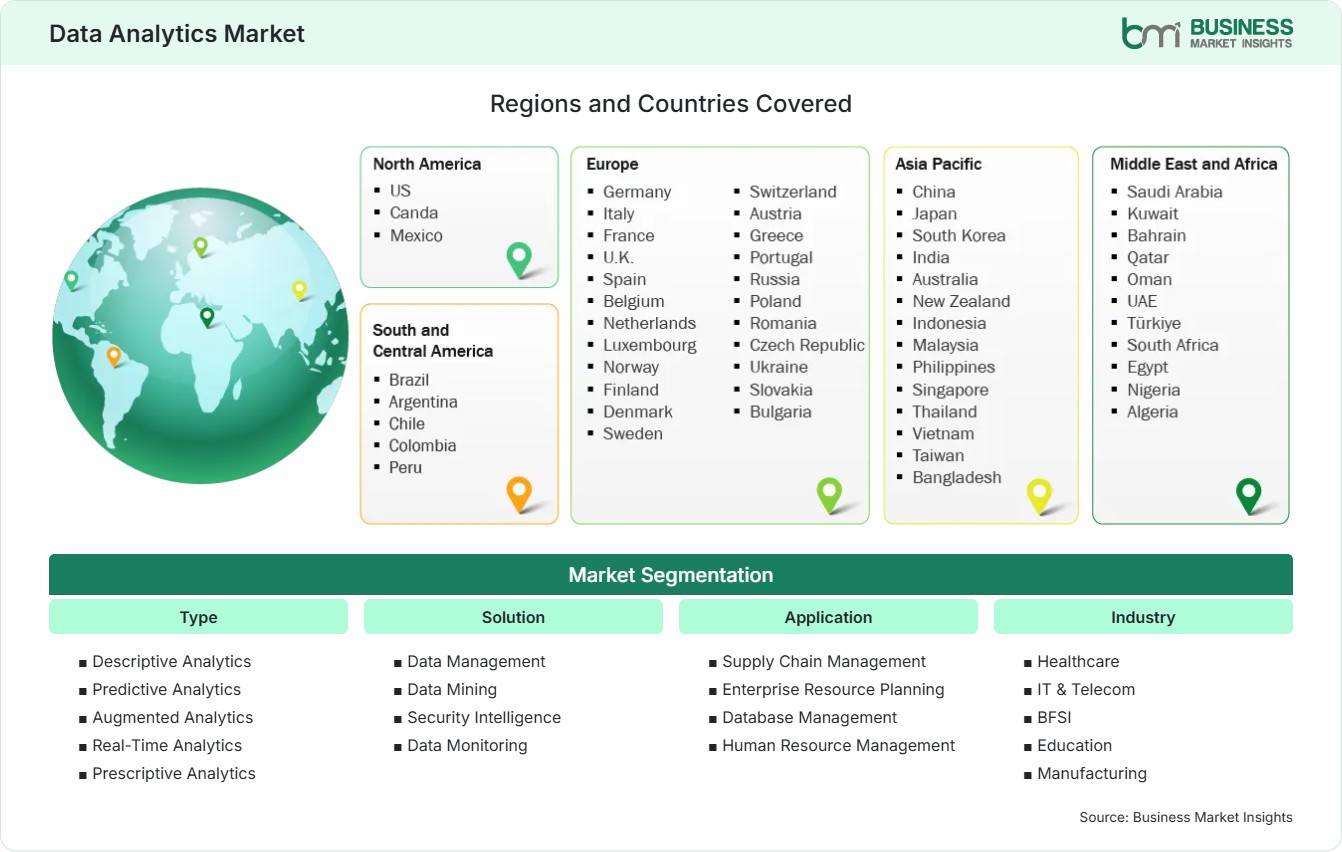
  • Type: Descriptive Analytics, Predictive Analytics, Augmented Analytics, Real-Time Analytics, Prescriptive Analytics
  • Solution: Data Management, Data Mining, Security Intelligence, Data Monitoring
  • Application: Supply Chain Management, Enterprise Resource Planning, Database Management, Human Resource Management
  • Industry: Healthcare, IT & Telecom, BFSI, Education, Manufacturing
US$ 86.34 Bn Market size in 2025
US$ 458.41 Bn Market Size by 2033
23.21% CAGR, 2026 - 2033
2026-2033 Forecast Period

01 AI Overview

Data Analytics Market Summary

  • North America Region: North America accounted for 36%–39% of global revenue in 2025 and is projected to grow at a CAGR of 21.5%–22.5% during 2026–2033. Strong enterprise technology adoption, AI investments, cloud infrastructure development, and advanced analytics implementation support regional leadership. The United States contributes approximately 84%–87% of regional revenue and is expected to expand at a CAGR of 21.8%–22.8%, driven by enterprise AI deployment and business intelligence modernization.
  • Fastest Growing Region: Asia Pacific represented 25%–28% of global revenue in 2025 and is forecast to register the fastest CAGR of 25.0%–26.0% due to accelerating digital transformation, expanding cloud adoption, growing enterprise data generation, and increasing analytics investments across emerging economies.
  • Leading Segment: Predictive Analytics accounted for 27%–30% of revenue in 2025 and is expected to grow at a CAGR of 24.0%–24.8% due to increasing demand for forecasting, risk management, customer insights, and operational optimization.
  • High Growth Segment: Augmented Analytics represented 16%–19% of market revenue in 2025 and is projected to expand at a CAGR of 26.0%–27.0% supported by artificial intelligence, machine learning automation, natural language processing, and self-service analytics adoption.
  • Key Market Opportunity: Cloud-based analytics platforms, AI-driven insights, SME digital transformation, and predictive intelligence solutions are creating substantial opportunities for technology providers across global industries.
  • Major Market Players: IBM Corporation, Microsoft Corporation, Oracle Corporation, SAP SE, SAS Institute Inc., Salesforce Inc., Amazon Web Services Inc., Google LLC, Teradata Corporation, QlikTech International AB.
02 Strategic Insights

Data Analytics Market: Strategic Insights

data-analytics-market-market-strategic-framework
FREE PDF
Request your free sample
Request free sample
03 Stakeholder View

Key Takeaways

1. The market ecosystem is evolving from traditional reporting tools toward integrated analytics platforms combining artificial intelligence, machine learning, automation, and real-time decision support capabilities.

2. Predictive analytics, augmented analytics, and cloud-based solutions represent major data analytics market growth areas as organizations prioritize proactive decision-making and operational intelligence.

3. Technology innovation is increasingly focused on automated insights, natural language interfaces, embedded analytics, and AI-powered data interpretation to simplify enterprise adoption.

4. Asia Pacific provides strong investment potential due to rapid digitization, expanding cloud infrastructure, increasing enterprise technology spending, and growing adoption among emerging economies.

5. Strategic partnerships, cloud ecosystem expansion, acquisitions, and AI-focused investments are shaping competitive positioning among leading analytics providers.

6. Organizations increasingly prioritize secure and scalable analytics environments to balance data-driven innovation with governance, compliance, and privacy requirements.

04 Geographic Outlook

Data Analytics Market Regional Highlights

North America Data Analytics Market

North America represented 36%–39% of global revenue in 2025 and is expected to grow at a CAGR of 21.5%–22.5% during 2026–2033. The region maintains leadership due to mature enterprise technology infrastructure, widespread cloud adoption, advanced AI investments, and strong demand from BFSI, healthcare, and technology sectors. The Data Analytics Market Share remains concentrated among large enterprises adopting advanced analytics platforms for operational efficiency and strategic decision-making.

  • The United States dominates regional adoption through strong enterprise AI investments, advanced cloud infrastructure, and widespread business intelligence implementation.
  • Canada continues expanding analytics adoption through digital government initiatives, financial technology development, and increasing enterprise modernization programs.
  • Technology providers are strengthening regional presence through AI-enabled platforms, industry-specific analytics solutions, and cloud ecosystem partnerships.
  • Healthcare organizations increasingly deploy analytics solutions for patient insights, operational improvement, and healthcare resource optimization.

US Data Analytics Market

The United States accounted for approximately 84%–87% of North American revenue in 2025 and is projected to grow at a CAGR of 21.8%–22.8% through 2033. Strong enterprise technology spending, artificial intelligence adoption, and demand for advanced decision-support solutions continue supporting market expansion across industries.

  • Large enterprises increasingly integrate analytics platforms with cloud infrastructure, enterprise applications, and artificial intelligence systems, aligning with data analytics market trends.
  • BFSI organizations utilize advanced analytics for fraud detection, risk assessment, customer personalization, and regulatory compliance.
  • Technology companies continue investing in AI-driven analytics capabilities to enhance automation, scalability, and business intelligence solutions.

Europe Data Analytics Market

Europe accounted for 28%–31% of global revenue in 2025 and is projected to expand at a CAGR of 22.0%–22.8% during 2026–2033. The region benefits from increasing enterprise digitization, strict data governance frameworks, cloud adoption, and rising investments in artificial intelligence-driven analytics. Germany represents the largest market, while the United Kingdom demonstrates strong growth momentum with a CAGR of 23.0%–23.8% due to expanding financial technology and enterprise intelligence adoption.

  • Germany leads European adoption through strong manufacturing analytics demand, Industry 4.0 implementation, and enterprise automation initiatives in data analytics market.
  • The United Kingdom continues expanding analytics deployment through financial services innovation, cloud transformation, and artificial intelligence investments.
  • France is increasing analytics adoption across healthcare, government services, retail, and manufacturing sectors through digital transformation programs.
  • European enterprises are prioritizing secure analytics platforms to comply with evolving data protection requirements and improve operational intelligence.
  • Technology providers are expanding partnerships with European organizations to deliver industry-specific analytics solutions and cloud-based platforms.

Asia Pacific Data Analytics Market

Asia Pacific accounted for 25%–28% of global revenue in 2025 and is expected to register the fastest CAGR of 25.0%–26.0% through 2033. Rapid digital transformation, increasing enterprise data generation, cloud infrastructure expansion, and government-led technology initiatives are strengthening regional demand. China represents the largest market, while India is expected to experience accelerated adoption with a CAGR of 26.5%–27.5% due to expanding digital ecosystems and enterprise modernization.

  • China continues driving regional growth through artificial intelligence investments, cloud adoption, smart manufacturing, and large-scale enterprise analytics deployment.
  • In data analytics market, India demonstrates strong momentum through expanding IT services, digital transformation programs, startup ecosystems, and increasing analytics implementation among businesses.
  • Japan adopts advanced analytics solutions across manufacturing, automotive, healthcare, and financial sectors to improve operational efficiency.
  • Southeast Asian economies are increasing analytics adoption through cloud migration, e-commerce expansion, and growing digital business models.
  • Regional enterprises are investing in analytics platforms to improve customer experience, automation, forecasting, and competitive positioning.

Rest of World Data Analytics Market

The Rest of World region accounted for 7%–10% of global revenue in 2025 and is projected to grow at a CAGR of 22.8%–23.8% during 2026–2033. South & Central America and the Middle East & Africa are witnessing increasing adoption due to digital transformation initiatives, cloud infrastructure development, and growing demand for operational intelligence across industries.

Organizations across emerging markets are implementing analytics platforms to improve decision-making, optimize resources, and strengthen competitiveness.

  • Brazil leads South & Central America adoption through expanding digital services, financial technology growth, and increasing enterprise analytics investments.
  • The United Arab Emirates demonstrates strong growth through smart city initiatives, government digitalization, and advanced technology adoption.
  • Saudi Arabia is increasing analytics implementation through economic diversification programs and enterprise modernization initiatives in data analytics market.
  • South Africa continues adopting analytics solutions across financial services, telecommunications, and public sector applications.
  • Regional technology investments are creating opportunities for analytics providers through cloud platforms, managed services, and industry-focused solutions.
global-market-geography
FREE PDF
Request your free sample
Request free sample
05 Segment Analysis

Data Analytics Market Segmentation

Type

The Type segment accounted for 64%–67% of total revenue in 2025 and is projected to grow at a CAGR of 23.5%–24.2% during 2026–2033. Enterprises increasingly adopt advanced analytics capabilities to transform raw information into actionable insights. The segment benefits from growing artificial intelligence integration, automated decision-making, and increasing demand for predictive business strategies.

  • Descriptive Analytics: Descriptive analytics enables organizations to understand historical performance, identify operational patterns, and generate reports supporting data-driven business decisions.
  • Predictive Analytics: Predictive analytics helps enterprises forecast future outcomes, optimize resources, manage risks, and improve strategic planning through advanced statistical and machine learning models.
  • Augmented Analytics: Augmented analytics combines artificial intelligence, machine learning, and automation to simplify data discovery, generate insights, and improve accessibility for non-technical users.
  • Real-Time Analytics: Real-time analytics supports immediate decision-making by processing continuous data streams from connected systems, digital platforms, and operational environments.
  • Prescriptive Analytics: Prescriptive analytics provides recommended actions by analyzing multiple scenarios, enabling enterprises to optimize operations, improve efficiency, and achieve strategic objectives.

Solution

The Solution segment represented 33%–36% of market revenue in 2025 and is expected to expand at a CAGR of 22.8%–23.5% through 2033. Enterprises are investing in integrated analytics solutions that improve data accessibility, security, monitoring, and management. Increasing complexity of enterprise data environments continues encouraging adoption of specialized analytics technologies.

  • Data Management: Data management solutions support data integration, governance, quality improvement, and centralized information access across enterprise systems.
  • Data Mining: Data mining solutions identify hidden patterns, relationships, and valuable insights from large datasets to support strategic decision-making.
  • Security Intelligence: Security intelligence solutions improve threat detection, cybersecurity monitoring, and risk management through advanced analytics capabilities.
  • Data Monitoring: Data monitoring solutions enable continuous tracking of information quality, system performance, and operational changes across enterprise environments.

Application

The Application segment accounted for 39%–42% of revenue in 2025 and is projected to grow at a CAGR of 23.0%–23.8% during the forecast period. Organizations across industries are implementing analytics applications to improve operational efficiency, automate processes, and strengthen decision-making capabilities.

  • Supply Chain Management: Analytics improves supply chain visibility, demand forecasting, inventory optimization, logistics efficiency, and supplier performance management.
  • Enterprise Resource Planning: Analytics integration with ERP systems enables improved financial planning, operational monitoring, resource allocation, and enterprise-wide performance evaluation.
  • Database Management: Database analytics solutions enhance information organization, accessibility, performance monitoring, and efficient utilization of enterprise data assets.
  • Human Resource Management: Analytics supports workforce planning, employee performance evaluation, talent management, and recruitment optimization through data-driven insights.

Industry

The Industry segment accounted for 37%–40% of total revenue in 2025 and is expected to expand at a CAGR of 23.2%–24.0% during 2026–2033. Organizations across major industries are adopting analytics platforms to improve operational visibility, automate decision-making, optimize customer engagement, and strengthen competitive positioning. Increasing digital transformation initiatives and enterprise data generation are supporting widespread analytics deployment across industry verticals.

  • Healthcare: Healthcare organizations utilize analytics for patient insights, clinical decision support, operational optimization, healthcare resource management, and improved treatment outcomes through data-driven approaches.
  • IT & Telecom: IT and telecommunications companies implement analytics for network optimization, customer experience improvement, service monitoring, and infrastructure performance management.
  • BFSI: Banks and financial institutions adopt analytics for fraud detection, risk assessment, customer personalization, compliance monitoring, and financial forecasting.
  • Education: Educational institutions use analytics to improve student performance tracking, enrollment management, personalized learning, and institutional decision-making processes.
  • Manufacturing: Manufacturing companies deploy analytics for predictive maintenance, production optimization, quality improvement, supply chain visibility, and smart factory transformation.
06 Market Forces

Data Analytics Market Dynamics

Key Market Drivers

Rising enterprise data generation accelerates analytics platform adoption

The increasing amounts of structured and unstructured data are being created by the companies using digital platforms, connections from devices, business apps, and their customers' interactions. This huge growth of informational resources is making the businesses implement the advanced analytics solutions which will be able to process complex data and provide useful insights. Various enterprises, from manufacturing to healthcare, finance, and retail, use analytics in order to increase efficiency and optimize processes while providing a better customer experience.

Growing AI adoption drives enterprise analytics investments

The use of AI and machine learning technologies is becoming an integral part of the modern analytics strategy as companies strive for automation and accurate decision making. AI-powered analytics solutions enable businesses to detect patterns, make forecasts, automate workflows, and increase responsiveness. Growing investments in generative AI, natural language processing, and intelligent automation are leading companies to modernize their analytics stack. AI capabilities are becoming one of the critical factors driving tech investments.

Increasing demand for business intelligence strengthens analytics adoption

Organizations have been increasingly emphasizing on deploying business intelligence solutions for enhancing the visibility of operations, behavior of customers, trends in the markets, and financial results. The use of analytics software provides the ability to access live dashboards, performance measurements, and other relevant information by decision-makers. The increasing competition, changing expectations of consumers, and need for making quick decisions strategically have driven organizations towards implementing analytics. The adoption of business intelligence is on the rise.

Key Market Opportunities

Cloud analytics expansion creates enterprise digital transformation opportunities

Cloud analytics systems are offering great opportunities by providing scalability in data processing, flexibility in infrastructure, ease of deployment, and accessibility. Organizations are adopting cloud analytics systems in order to enable remote collaboration, integrate advanced AI technology, and facilitate real-time data processing. Cloud vendors are growing their analytics ecosystem by incorporating services, automation tools, and industry solutions. This trend allows organizations of all sizes to implement advanced analytics technologies without substantial infrastructure.

SME digital transformation expands analytics software adoption

SMEs (small and medium enterprises) present an attractive opportunity for growth owing to cloud analytics services that are affordable, subscription-based, and simple to use. Customers are becoming more aware of the value of analytics tools as means of gaining deeper insight into their customers and operations. Technologists are creating scalable solutions that suit the needs of smaller companies through automated insights and features that meet specific industry requirements. The growing digitalization trend among SMEs will open up new customer prospects for analytics providers.

Predictive analytics adoption strengthens enterprise competitiveness

The implementation of predictive analytics tools has been opening up new avenues for organizations since most of them require proactiveness in making decisions on their operations, marketing, finance, and supply chain management departments. With the help of advanced forecasting techniques, companies can predict demand trends and manage risk, among other processes. More access to machine learning systems and better data access have made it easier for organizations to utilize predictive tools.

Market Restraints and Challenges

Data privacy concerns challenge enterprise analytics adoption

Factor: Increased concern over the issues of data sensitivity, security risks, regulations, and compliance creates problems for companies that implement their analytics systems.

Impact: Data privacy issues may result in delays in implementing new technologies, increased compliance costs, and extra investments in governance, security measures, and data management processes. Companies have to find a proper balance between innovation through analytics and proper treatment of data.

Shortage of skilled professionals limits analytics implementation

Factor: Lack of availability of personnel skilled in areas such as data science, machine learning, analytics engineering, and data management.

Impact: The lack of talent may affect the speed of implementing analytics solutions, increase operating expenses, and impair organizations' abilities to derive maximum value from their analytics spend. Organizations are making efforts to mitigate their capability deficiencies through training and automation.

07 Company Analysis

Competitive Landscape

The competitive environment is shaped by technology providers offering artificial intelligence-enabled analytics platforms, cloud-based solutions, business intelligence tools, data management capabilities, and industry-specific analytics applications. The Data Analytics Market Analysis indicates that leading companies are focusing on AI integration, cloud ecosystem expansion, automation, and strategic partnerships to improve enterprise decision-making capabilities and strengthen global market positioning.

Company Name

Overview

Products and Services relevant to this market

IBM Corporation

Global technology company providing enterprise software, cloud solutions, artificial intelligence, and analytics platforms.

IBM Cognos Analytics, IBM Watsonx, data management solutions, AI analytics, business intelligence, and enterprise data platforms.

Microsoft Corporation

Global technology leader offering cloud computing, productivity solutions, artificial intelligence, and enterprise analytics services.

Microsoft Power BI, Azure Synapse Analytics, Fabric analytics platform, AI services, and cloud data solutions.

Oracle Corporation

Enterprise software provider delivering database technologies, cloud infrastructure, and analytics solutions.

Oracle Analytics Cloud, database analytics, enterprise performance management, AI-powered insights, and cloud data services.

SAP SE

Enterprise software company specializing in business applications, cloud platforms, and intelligent analytics solutions.

SAP Analytics Cloud, SAP Business Technology Platform, enterprise reporting, predictive analytics, and data management solutions.

SAS Institute Inc.

Analytics software company focused on advanced analytics, artificial intelligence, and data-driven decision solutions.

SAS Viya platform, predictive analytics, AI solutions, data management, and industry-specific analytics applications.

Salesforce Inc.

Customer relationship management technology provider offering cloud-based business intelligence and AI solutions.

Tableau analytics, CRM analytics, Einstein AI, customer insights, and enterprise data visualization platforms.

Amazon Web Services Inc.

Cloud computing provider delivering scalable data processing, storage, and analytics infrastructure services.

Amazon Redshift, QuickSight, data lakes, machine learning services, cloud analytics, and big data solutions.

Google LLC

Technology company providing cloud infrastructure, artificial intelligence, and advanced analytics platforms.

Google Cloud analytics, BigQuery, Looker, machine learning tools, AI services, and data visualization solutions.

Teradata Corporation

Enterprise analytics company specializing in large-scale data management and business intelligence solutions.

Teradata Vantage platform, cloud analytics, enterprise data warehouses, AI analytics, and data integration solutions.

QlikTech International AB

Analytics software company focused on business intelligence, visualization, and data integration technologies.

Qlik Sense, Qlik Cloud Analytics, data integration, visualization tools, and self-service analytics solutions.


10 Trust & Transparency

Research Methodology

The market analysis combines proprietary research with secondary data from government agencies, company disclosures, regulatory filings, industry databases and expert interviews. Market estimates are validated through data triangulation, cross-market benchmarking and analyst review.

View Full Research Methodology

11 Questions Answered

Frequently Asked Questions

How do market forecasts support business decisions?

Data Analytics Market Forecasts help enterprises, investors, and technology providers evaluate future demand patterns, identify emerging opportunities, optimize investments, and develop competitive strategies.

What does a market report provide?

A Data Analytics Market Report provides detailed insights into market size, competitive landscape, regional trends, technology developments, segmentation analysis, growth opportunities, challenges, and future industry outlook.

Which analytics technology is expected to grow fastest?

Augmented analytics is expected to experience strong growth due to increasing adoption of artificial intelligence, automated insights, natural language processing, and simplified analytics access for business users.

Why are enterprises shifting toward cloud analytics platforms?

Cloud analytics platforms provide scalability, flexible infrastructure, lower maintenance requirements, faster deployment, remote accessibility, and integration with artificial intelligence technologies, making them attractive for enterprises of different sizes.

What industries are adopting data analytics solutions rapidly?

Healthcare, BFSI, manufacturing, IT & telecom, retail, and education sectors are adopting analytics platforms to improve operational efficiency, customer insights, forecasting accuracy, automation, and strategic decision-making.

Access the Full Data Analytics Market Report

Get segment-level forecasts, regional estimates, competitive benchmarking, company profiles and downloadable Excel datasets.

Access the full Data Analytics Market Report
350 pages PDF & Excel | 2026-08-04