
Data Conversion Service Market Outlook: Size, Share, Trends, Growth Analysis, Competitive Landscape & Forecast, 2026–2033

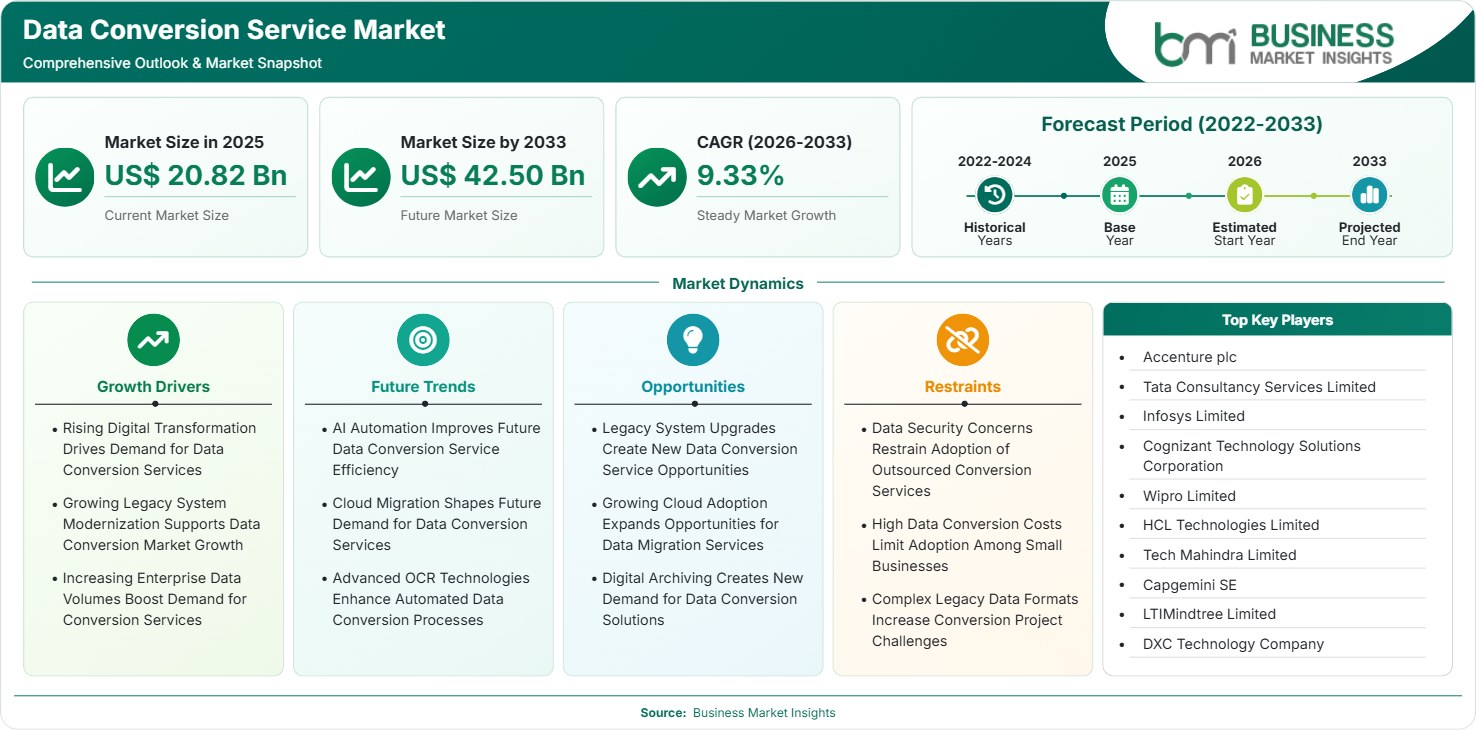
The Data Conversion Service Market size was valued at US$ 20.82 Billion in 2025 and is projected to reach US$ 42.50 Billion by 2033, growing at a CAGR of 9.33% during 2026–2033, driven by legacy modernization, cloud migration, rising data volumes, digital archiving, and AI-ready data transformation requirements.

Report Coverage
  • Service Type: Document Conversion, Database Conversion, Image and Audio/Video Conversion, E-book and XML Conversion, and CAD Conversion
  • Deployment Mode: On-Premise, Cloud-Based
  • End User Industry: IT & Telecom, Healthcare, BFSI, Government, Others
US$ 20.82 Bn Market size in 2025
US$ 42.50 Bn Market Size by 2033
9.33% CAGR, 2026 - 2033
2026-2033 Forecast Period

01 AI Overview

Data Conversion Service Market Summary

  • North America Region: North America holds market share of 35%–38% in 2025, growing with a CAGR of 8.70%–9.40% influenced by cloud migration, legacy modernization, AI readiness, regulatory compliance, and enterprise digitization. The US market maintains the region's largest service base, with a CAGR of 8.80%–9.50% between 2026 and 2033, supported by technology spending, cloud transformation, and data governance investments.
  • Fastest Growing Region: Asia Pacific holds market share of 27%–30% in 2025, growing with a CAGR of 10.20%–11.10% as enterprises modernize legacy systems, expand cloud adoption, and invest in multilingual data processing, AI infrastructure, and scalable outsourcing capabilities across rapidly digitizing economies.
  • Leading Segment: Document Conversion holds market share of 34%–37% in 2025, growing with a CAGR of 8.90%–9.60% driven by enterprise digitization, regulatory archiving, paper-to-digital workflows, and demand for accessible information across highly document-intensive industries.
  • High Growth Segment: Cloud-Based Deployment holds market share of 42%–46% in 2025, growing with a CAGR of 10.80%–11.70% driven by flexible infrastructure, migration programs, scalable processing, distributed workforces, and growing enterprise preference for managed technology environments.
  • Key Market Opportunity: Rising modernization budgets create opportunities for providers combining automated conversion, cloud migration, metadata enrichment, multilingual processing, and AI-ready data preparation into integrated transformation programs serving complex enterprise environments.
  • Major Market Players: Accenture plc, Tata Consultancy Services Limited, Infosys Limited, Cognizant Technology Solutions Corporation, Wipro Limited, HCL Technologies Limited, Tech Mahindra Limited, Capgemini SE, LTIMindtree Limited, DXC Technology Company.
02 Strategic Insights

Data Conversion Service Market: Strategic Insights

Data Conversion Service Market Strategic Framework
FREE PDF
Request your free sample
Request free sample
03 Stakeholder View

Key Takeaways

  • The value chain is shifting from labor-intensive format conversion toward integrated data transformation involving discovery, extraction, cleansing, validation, metadata management, migration, and post-conversion governance.
  • Cloud-based deployment and database conversion offer strong upside because enterprises increasingly modernize application estates while moving workloads across hybrid and multi-cloud architectures.
  • AI-assisted document understanding, automated classification, intelligent extraction, and multimodal processing are changing the economics of conversion. Investment in proprietary automation and quality assurance can improve throughput while reducing manual intervention in large-scale transformation programs.
  • Asia Pacific presents a compelling investment case as digital public infrastructure, financial inclusion, healthcare digitization, and enterprise modernization increase conversion requirements. India and Southeast Asia combine expanding demand with established technology service ecosystems and specialized delivery talent.
  • The competitive focus is moving toward partnerships and capability expansion that enable providers to support data-intensive transformation, rather than relying exclusively on traditional outsourcing contracts.
  • Service providers that demonstrate measurable accuracy, regulatory controls, and transparent validation processes can differentiate themselves in high-value healthcare, BFSI, and government engagements.
04 Geographic Outlook

Data Conversion Service Market Regional Highlights

North America Data Conversion Service Market

North America accounts for 35%–38% share in 2025 and is projected to expand at a CAGR of 8.70%–9.40% through 2033. The region benefits from mature enterprise technology ecosystems, extensive legacy infrastructure, cloud modernization, regulatory digitization, and high demand for secure transformation. Data Conversion Service Market share remains concentrated in the US, while Canada contributes through public-sector digitization and financial services modernization.

  • Enterprise modernization programs are driving conversion demand as banks, insurers, healthcare providers, and government agencies migrate information from legacy repositories into interoperable digital environments while maintaining auditability, security, and operational continuity.
  • AI adoption is increasing demand for structured, standardized, and machine-readable datasets, encouraging organizations to convert historical documents and databases before deploying analytics, generative AI, and automated decision-support applications.
  • Regulatory requirements for privacy, accessibility, retention, and electronic records management are supporting specialized conversion projects requiring documented workflows, validation controls, encryption, and traceable data lineage.

US Data Conversion Service Market

The US data conversion service market represents approximately 29%–32% of global demand and 78%–84% of North American activity in 2025, with a CAGR of 8.80%–9.50% through 2033. The country's large installed base of legacy applications, advanced cloud ecosystem, healthcare digitization, financial modernization, and federal data initiatives sustain demand.

  • Federal and state agencies continue digitizing records and improving information accessibility, creating demand for conversion services capable of handling sensitive documents, archival formats, metadata, and compliance requirements.
  • Financial institutions require reliable database and document transformation as legacy platforms are modernized, while conversion workflows must preserve transaction histories and satisfy stringent governance and audit expectations.
  • Healthcare organizations increasingly require structured conversion of clinical and administrative records to support interoperability, analytics, electronic workflows, and secure information exchange across fragmented technology environments.

Europe Data Conversion Service Market

Europe data conversion service market holds 24%–27% share in 2025 and is expected to grow at a CAGR of 8.30%–9.10%. Germany, the United Kingdom, and France remain leading markets, while Poland and the Netherlands offer attractive growth. Germany is projected at 8.50%–9.20% CAGR, while Poland is positioned among higher-growth markets at 10.00%–10.80%, supported by expanding digital transformation and technology outsourcing.

  • GDPR-driven governance increases the importance of controlled conversion processes that protect personal information, document data lineage, and maintain auditable handling procedures throughout transformation projects.
  • Public administrations are digitizing archival collections and citizen records, supporting document conversion, metadata enrichment, and searchable repositories that improve accessibility while reducing dependence on physical storage.
  • European manufacturers and financial institutions are modernizing enterprise applications, creating demand for database conversion and migration services that preserve historical records and integrate older systems with cloud platforms.

Asia Pacific Data Conversion Service Market

Asia Pacific data conversion service market accounts for 27%–30% share in 2025 and is projected to record the strongest regional CAGR of 10.20%–11.10%. India is estimated at 10.50%–11.30% CAGR, supported by technology outsourcing and enterprise cloud adoption. China, India, Japan, and Australia are leading markets, while Southeast Asia provides high-growth opportunities.

  • India benefits from a deep technology services ecosystem, established outsourcing capabilities, and increasing enterprise modernization, supporting complex database, document, and application conversion projects.
  • China is advancing enterprise digitization and domestic technology infrastructure, creating demand for conversion services supporting modernization, data integration, and localized digital ecosystems.
  • Japan's aging enterprise systems create sustained modernization requirements, particularly where organizations must preserve historical information while integrating legacy platforms with newer digital architectures.
  • Southeast Asian economies are accelerating digital government, financial technology, and cloud adoption, expanding opportunities for multilingual conversion, archival digitization, and database migration services.

Rest of World Data Conversion Service Market

South and Central America data conversion service market account for 6%–8% share in 2025 and are projected to expand at 9.00%–10.00% CAGR. Brazil and Mexico lead regional demand as banks, governments, and enterprises digitize records and modernize applications. Brazil is estimated at 9.50%–10.40% CAGR, supported by financial technology and public-sector digitization. Middle East and Africa represent 5%–7% share in 2025, with a CAGR of 9.20%–10.30%. Saudi Arabia, the UAE, and South Africa lead adoption, while Gulf digital transformation programs create attractive opportunities.

  • Latin American financial institutions are modernizing legacy systems, creating demand for secure database conversion, document processing, and migration programs that preserve historical customer information.
  • Public-sector digitization is expanding across emerging economies, supporting large-scale archival conversion and digital records initiatives that improve service accessibility and administrative efficiency.
  • Gulf economies are investing in digital government and cloud infrastructure, increasing demand for secure conversion services aligned with national data governance and localization requirements.
  • South Africa provides a regional delivery hub for organizations requiring multilingual processing, enterprise modernization, and technology outsourcing across African markets with expanding digital adoption.
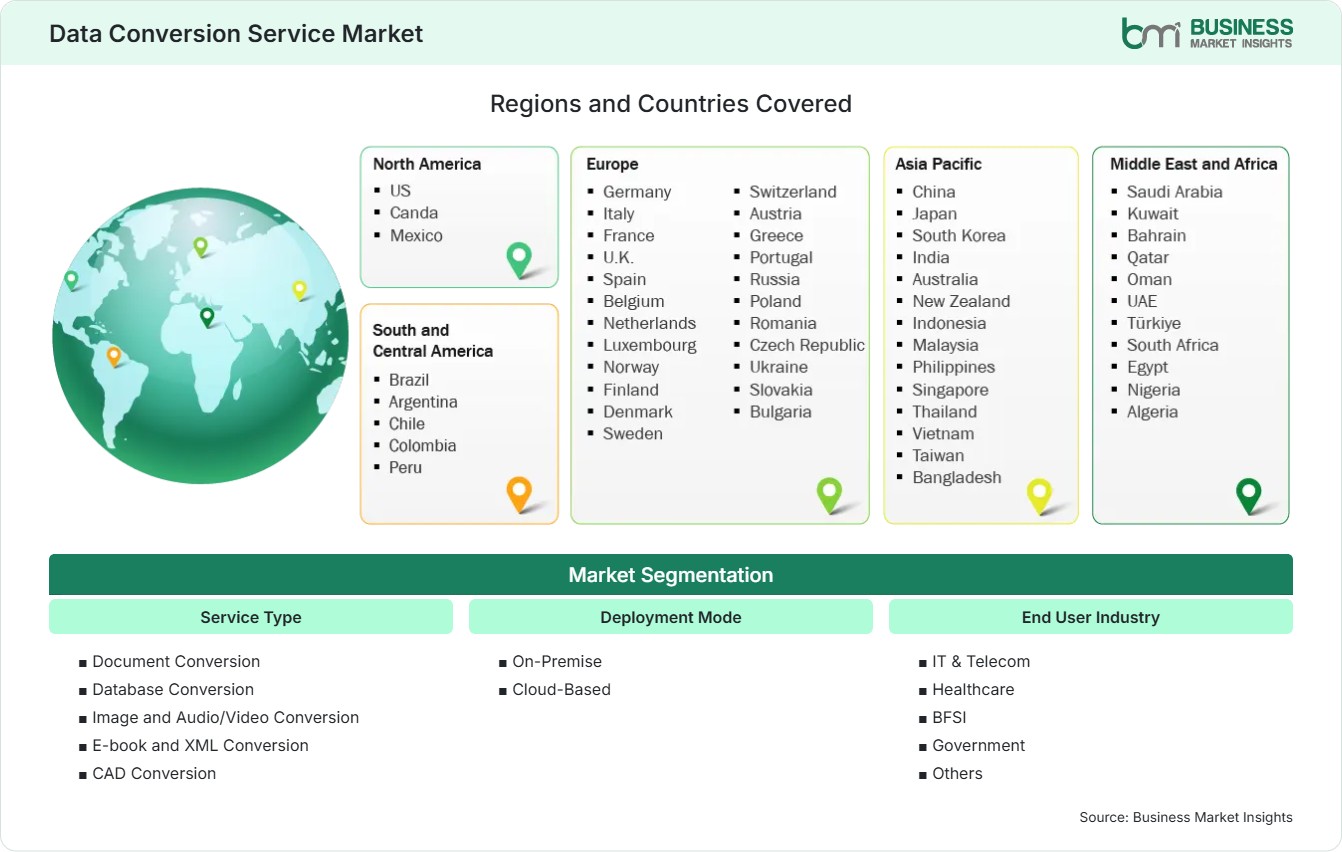
Global Market Geography
FREE PDF
Request your free sample
Request free sample
05 Segment Analysis

Data Conversion Service Market Segmentation

Service Type

Document Conversion leads with 34%–37% share in 2025 and a CAGR of 8.90%–9.60% between 2026–2034. Demand is supported by enterprise digitization, regulatory archiving, searchable repositories, automated extraction, and accessibility requirements.

  • Document Conversion: Demand remains strong across legal, healthcare, government, and financial records, where paper and legacy digital files require searchable, accessible, standardized formats supporting compliance, workflow automation, and secure long-term retention.
  • Database Conversion: Organizations modernizing legacy applications require database restructuring and platform migration, with demand supported by cloud adoption, interoperability, improved performance, and integration with contemporary analytics architectures.
  • Image and Audio/Video Conversion: Media-rich enterprises convert aging formats to preserve content and improve accessibility, supporting demand across entertainment, healthcare imaging, education, archives, and digital asset management environments.
  • E-book and XML Conversion: Publishers and information providers require structured digital content for flexible distribution, accessibility, search, and device compatibility, encouraging conversion toward standardized XML and digital publishing formats.
  • CAD Conversion: Engineering organizations convert legacy drawings and technical files to modern CAD formats, supporting collaboration, manufacturing workflows, design reuse, lifecycle management, and compatibility with contemporary engineering platforms.

Deployment Mode

Cloud-Based Deployment accounts for 42%–46% share in 2025 and is projected to grow at a CAGR of 10.80%–11.70% between 2026–2034. Adoption is enabled by scalable processing, reduced infrastructure needs, distribution of work, and migration services. On-premises environments retain relevance where high sensitivity, regulations, and enterprise control over infrastructure are necessary, but hybrid models become common to meet security, location, and flexibility considerations.

  • On-Premise: Adoption persists among regulated enterprises and organizations managing sensitive information, where infrastructure control, data residency, security policies, and internal governance influence deployment decisions.
  • Cloud-Based: Growth is supported by scalable processing, elastic storage, rapid provisioning, and integration with cloud migration programs, enabling organizations to handle large conversion workloads without expanding dedicated infrastructure.

End User Industry

IT & Telecom remains a major demand center, while BFSI and healthcare generate high-value projects requiring secure, accurate, and compliant information transformation. Data Conversion Service Market trends increasingly reflect industry-specific workflows, regulatory requirements, and integration needs.

  • IT & Telecom: Technology companies require conversion for application modernization, cloud migration, platform integration, and large-scale data restructuring, supporting continuous demand across complex technology environments.
  • Healthcare: Providers and technology vendors convert clinical documents, images, and administrative records to improve interoperability, accessibility, analytics, and secure information exchange while preserving sensitive historical data.
  • BFSI: Banks and insurers modernize databases and document repositories to improve digital workflows, regulatory reporting, customer service, and integration between legacy systems and modern financial platforms.
  • Government: Public agencies digitize archives, citizen records, and administrative information, requiring secure conversion workflows that improve accessibility, retention, searchability, and long-term preservation.
06 Market Forces

Data Conversion Service Market Dynamics

Key Market Drivers

Rising Digital Transformation Drives Demand for Data Conversion Services

Digital transformation initiatives are increasing both the quantity and complexity of data that organizations need to transform, standardize, and migrate. Organizations upgrading their fragmented systems realize that their legacy data is stored in incompatible formats; thus, data transformation is required before the organization can be modernized. The Data Conversion Service Market growth is currently evident in industries with many legacy systems, where access to data will determine the success of modernization efforts.

Growing Legacy System Modernization Supports Data Conversion Market Growth

Legacy application migration ensures continuous requirement generation since businesses cannot shut down legacy applications without taking care of the operational data, transaction logs, and regulatory documents. Mainframe, proprietary databases, and old document management systems may need to be converted into some specific format prior to integration. Businesses in finance, government, healthcare, and transportation sectors are more susceptible since the legacy systems have long-term data storage needs. Legacy application conversion is now also including processes like data profiling, cleansing, mapping, validation, and reconciliation. This will add value for the services and ensure repeat business.

Increasing Enterprise Data Volumes Boost Demand for Conversion Services

The growing volume of enterprise data is creating a greater demand for organizing document that is present in databases, images, audio, video, and engineering documents. Unstructured data adds another layer of complexity to this issue, as it is necessary to identify, categorize, extract and standardize data before being able to use it for any further analysis or for artificial intelligence systems. The presence of multiple digital channels is creating multiple versions of the record and format of the document, thus necessitating their consolidation and normalization. This evolution is shaping Data Conversion Service Market trends toward intelligent workflows capable of handling multimodal information.

Key Market Opportunities

Legacy System Upgrades Create New Data Conversion Service Opportunities

Legacy modernization presents a lucrative opportunity as organizations now increasingly opt for a phase-by-phase transformation instead of a disruptive replacement. Value is captured through the process of assessment of the legacy estate, mapping data structures, conversion of the legacy data, validation of the output, and migration to the modern application. The most lucrative opportunities for the engagement exist in areas that have high switching costs and long data retention periods. The financial services, health care, governmental bodies, and industrial corporations frequently need specialized knowledge to maintain the data relationship during application modernization.

Growing Cloud Adoption Expands Opportunities for Data Migration Services

Cloud adoption is opening up new avenues to link conversion with migration services. Companies that migrate their workloads from on-premises infrastructure often face issues with legacy databases, old file formats, and scattered repositories that need to be converted prior to cloud migration. Companies can distinguish themselves by providing a one-stop solution in terms of assessment, conversion, migration, testing, and governance services. Hybrid and multi-cloud solutions also lead to continuous needs in migrating data across clouds or combining technological stacks.

Digital Archiving Creates New Demand for Data Conversion Solutions

Digital archiving represents emerging opportunity as firms aim to archive historical data while minimizing the need for physical storage and maximizing accessibility. Government organizations, universities, libraries, health care providers, financial firms, and businesses hold huge amounts of documentation that exist in paper format, outdated digital format, and legacy systems. The conversion services would be able to convert such data into searchable and interoperable databases that have been assigned metadata and retention policies. Data Conversion Service Market Forecasts show growing interest in archiving solutions that would allow for both preservation and advanced searches.

Market Restraints and Challenges

Data Security Concerns Restrain Adoption of Outsourced Conversion Services

Factor: Data conversion includes the use of private and sensitive data such as personal, financial, medical, governmental and intellectual property data, exposing organizations to risks at various stages of transmission, processing, storing and validating. Impact: There is potential to have security issues impede the outsourcing decision process, cause higher due diligence demands and prefer outsourcing partners with auditable facilities. High risk programs might demand on-premises or heavily controlled hybrid environments.

High Data Conversion Costs Limit Adoption Among Small Businesses

Factor: The process of converting complex systems may entail assessing, cleansing, mapping, reviewing, quality assurance, testing, migration, and hiring specialists, making initial expenses considerable for small companies with limited technology budgets. Impact: Cost considerations may lead to delayed conversion, reliance on inefficient legacy systems, or the adoption of cheaper but less functional technologies. Smaller firms may not have qualified personnel to establish system requirements and assess vendors.

07 Company Analysis

Competitive Landscape

Data conversion service market analysis reveals a competitive market scenario dominated by diversified IT services vendors who integrate data conversion services with cloud migrations, application modernization services, data management, artificial intelligence (AI), and managed services. Competitive advantage is based on automation, industry knowledge, security, global delivery, and execution of big transformation programs.

Company Name

Overview

Products and Services relevant to this market

Accenture plc

Global consulting and technology services provider with extensive transformation capabilities across complex enterprise environments and industry-specific modernization programs.

Cloud migration, data modernization, application modernization, AI, analytics, managed services, digital transformation, and enterprise data transformation capabilities.

Tata Consultancy Services Limited

Global IT services and consulting provider with strong delivery capabilities across large enterprises, legacy modernization, cloud transformation, and data-intensive programs.

Cloud transformation, data migration, application modernization, analytics, AI, enterprise content management, and technology modernization services.

Infosys Limited

Technology services company combining consulting, cloud, AI, automation, and modernization expertise for enterprises undergoing complex digital transformation programs.

Cloud migration, data modernization, AI, automation, application transformation, analytics, enterprise content, and digital transformation services.

Cognizant Technology Solutions Corporation

IT services and consulting company focused on digital transformation across healthcare, financial services, technology, and other data-intensive industries.

Data modernization, cloud transformation, application modernization, AI, analytics, digital engineering, and managed technology services.

Wipro Limited

Global technology services and consulting provider emphasizing cloud, AI, infrastructure modernization, and industry-specific transformation programs.

Cloud services, data and analytics, AI, application modernization, infrastructure transformation, automation, and managed services.

HCL Technologies Limited

Global technology company supporting enterprises with engineering, cloud, application modernization, data, and infrastructure transformation capabilities.

Data engineering, cloud migration, application modernization, digital transformation, AI, analytics, and managed infrastructure services.

Tech Mahindra Limited

Technology services provider serving telecom and diversified enterprises through digital engineering, cloud, data, and modernization programs.

Cloud transformation, data engineering, analytics, AI, application modernization, enterprise integration, and digital services.

Capgemini SE

Global consulting and technology services group with broad capabilities spanning cloud, data, AI, engineering, and enterprise transformation.

Data transformation, cloud migration, application modernization, AI, analytics, digital engineering, and managed services.

LTIMindtree Limited

Digital transformation and technology services provider combining cloud, data, AI, and modernization capabilities across enterprise industries.

Data modernization, cloud transformation, application services, AI, analytics, enterprise integration, and digital transformation.

DXC Technology Company

Enterprise technology services provider with expertise in modernization, cloud, applications, data, and mission-critical technology environments.

Application modernization, cloud migration, data services, managed infrastructure, analytics, enterprise technology transformation, and legacy modernization.

10 Trust & Transparency

Research Methodology

The market analysis combines proprietary research with secondary data from government agencies, company disclosures, regulatory filings, industry databases and expert interviews. Market estimates are validated through data triangulation, cross-market benchmarking and analyst review.

View Full Research Methodology

11 Questions Answered

Frequently Asked Questions

What should enterprises consider when selecting a conversion provider?

Key criteria include conversion accuracy, security controls, industry experience, scalability, data governance, validation methodology, interoperability, migration expertise, and the provider's ability.

How does AI affect data conversion service market report?

AI improves automated extraction, classification, recognition, validation, and metadata enrichment. These capabilities can reduce manual processing requirements and make large volumes of unstructured information more suitable.

Why are cloud-based conversion services gaining popularity in market?

Cloud-based delivery provides elastic processing capacity, reduces dedicated infrastructure requirements, and supports geographically distributed teams. It is particularly valuable when conversion forms part of a broader cloud migration or application modernization program.

What is the difference between data conversion and data migration?

Data conversion changes information from one format, structure, or encoding into another, while migration transfers data between systems or environments.

Which industries have the highest demand for data conversion services?

The market demand is strongest in IT and telecom, BFSI, healthcare, and government because these sectors manage large legacy repositories, regulated records, complex databases.

Access the Full Data Conversion Service Market Report

Get segment-level forecasts, regional estimates, competitive benchmarking, company profiles and downloadable Excel datasets.

Access the full Data Conversion Service Market Report
350 pages PDF & Excel | 2026-08-12