
Data Protection Market Outlook: Size, Share, Trends, Growth Analysis, Competitive Landscape & Forecast, 2026-2033

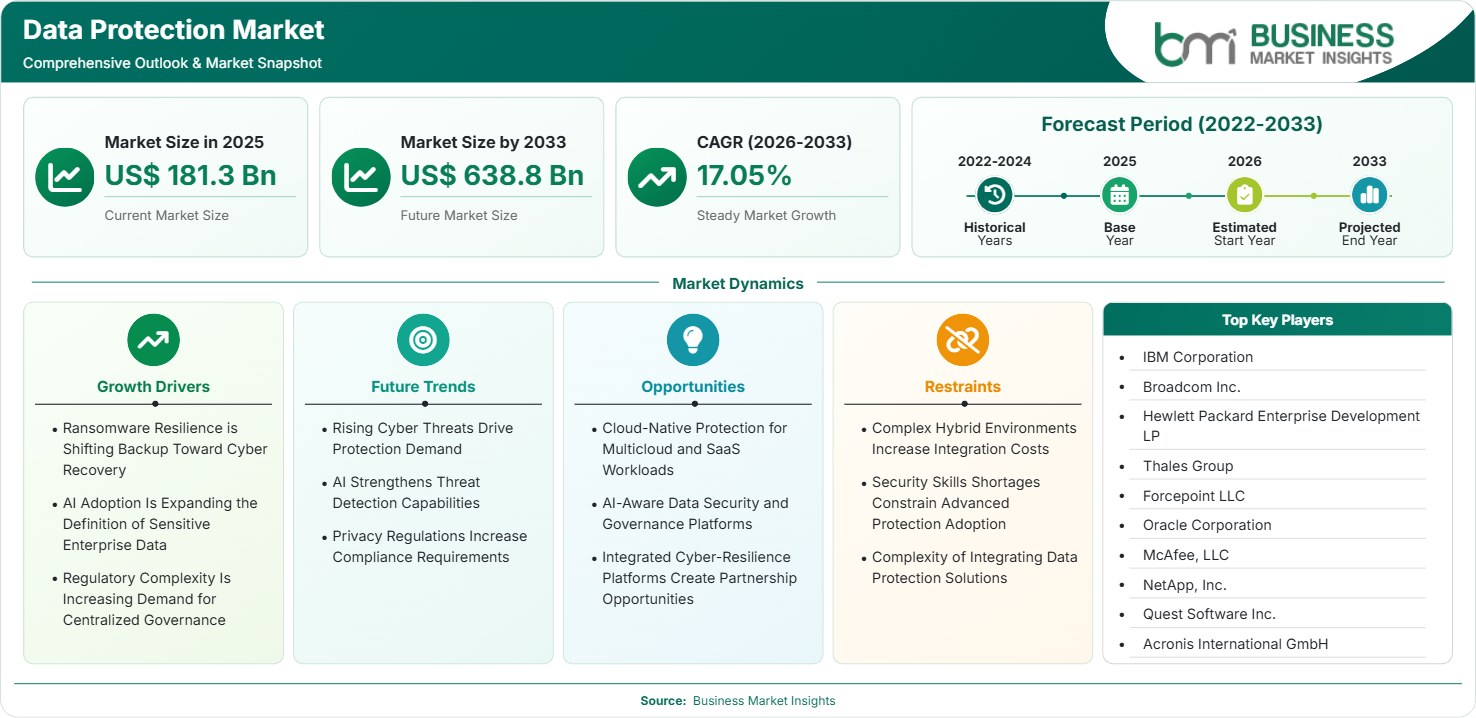
The Data Protection Market size was valued at US$ 181.3 Billion in 2025 and is projected to reach US$ 638.8 Billion by 2033, growing at a CAGR of 17.05% during 2026–2033, driven by ransomware exposure, cloud migration, AI adoption, regulatory compliance, and rising demand for resilient recovery architectures.

Report Coverage
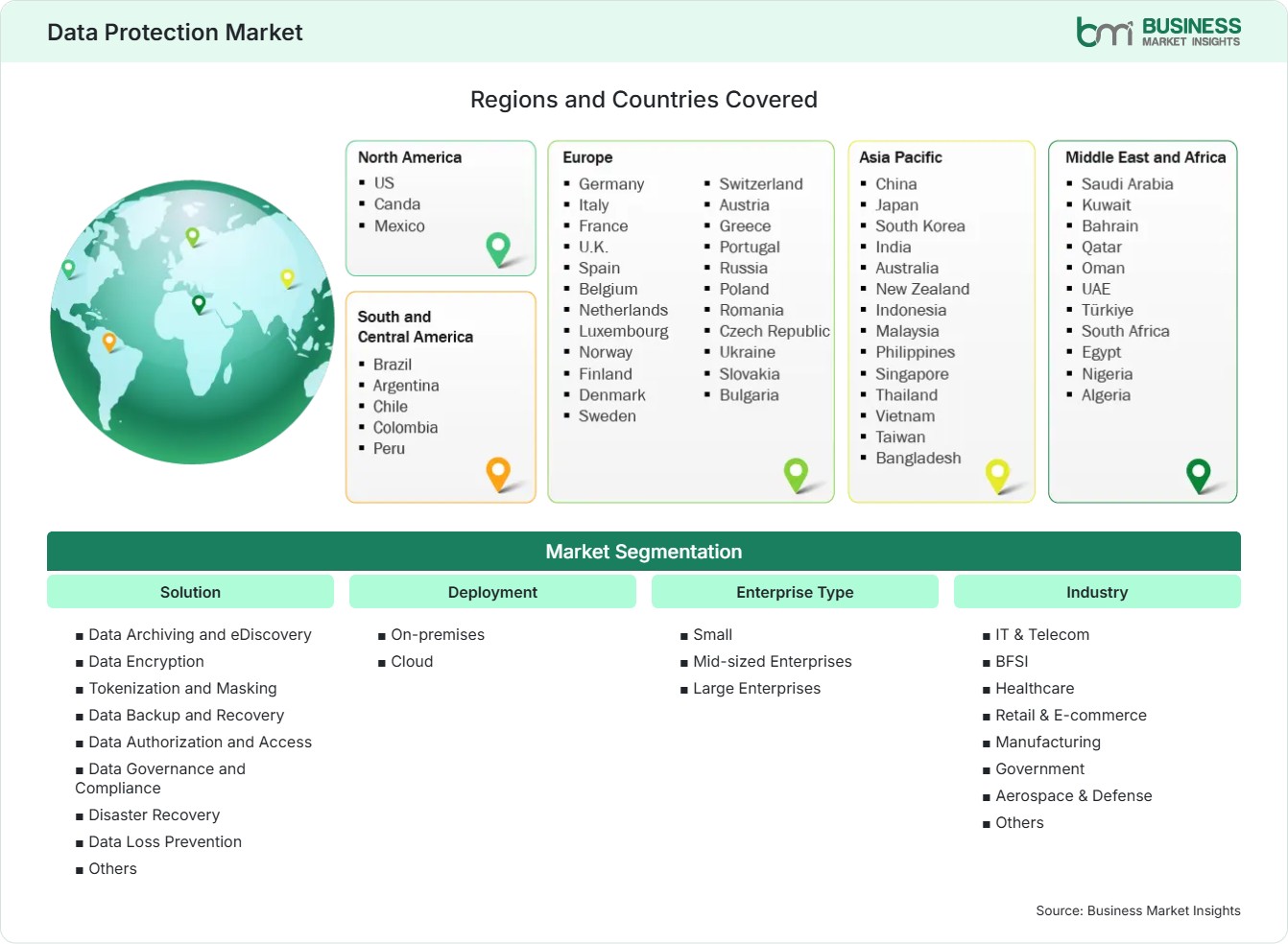
  • Solution: Data Archiving and eDiscovery, Data Encryption, Tokenization and Masking, Data Backup and Recovery, Data Authorization and Access, Data Governance and Compliance, Disaster Recovery, Data Loss Prevention , Others
  • Deployment: On-premises, Cloud
  • Enterprise Type: Small, Mid-sized Enterprises, Large Enterprises
  • Industry: IT & Telecom, BFSI, Healthcare, Retail & E-commerce, Manufacturing, Government, Aerospace & Defense, Others
US$ 181.3 Bn Market size in 2025
US$ 638.8 Bn Market Size by 2033
17.05% CAGR, 2026 - 2033
2026-2033 Forecast Period

AI Overview

Data Protection Market Summary

  • North America Region: North America holds a 30%–33% share in 2025, growing at a 15.5%–17.5% CAGR, supported by cloud workloads, ransomware defense, stringent privacy requirements, zero-trust adoption, AI governance, and enterprise cyber-resilience investment. The US Data Protection market benefits from mature enterprise security spending, regulated industries, hyperscale infrastructure, and accelerated AI adoption, supporting a 16.0%–18.0% CAGR through 2033. Gartner-related cybersecurity spending expectations cited by IBM indicate strong security budget momentum as enterprises respond to cloud migration, threat escalation, and generative AI risks.
  • Fastest Growing Region: Asia Pacific accounts for 28%–31% of the Data Protection market share in 2025 and records a 19.0%–21.5% CAGR, driven by cloud expansion, digital payments, healthcare digitization, data localization requirements, manufacturing automation, and increasing enterprise security investment.
  • Leading Segment: Data Backup and Recovery represents a 22%–25% share in 2025 and advances at a 15.0%–17.0% CAGR, supported by ransomware resilience, immutable backups, hybrid infrastructure, recovery-time requirements, and business continuity priorities.
  • High Growth Segment: Cloud deployment captures a 20%–23% share of the Data Protection market in 2025 and expands at a 19.0%–22.0% CAGR, driven by distributed workloads, SaaS adoption, multicloud operations, scalable security controls, remote work, and cloud-native application modernization.
  • Key Market Opportunity: AI-aware data security creates a major opportunity as enterprises require unified controls for sensitive datasets, model access, shadow AI, governance, encryption, discovery, and automated policy enforcement across hybrid environments.
  • Major Market Players: IBM Corporation, Broadcom Inc., Hewlett Packard Enterprise Development LP, Thales Group, Forcepoint LLC, Oracle Corporation, McAfee, LLC, NetApp, Inc., Quest Software Inc., and Acronis International GmbH.
Strategic Insights

Data Protection Market: Strategic Insights

Data Protection Market Strategic Framework
FREE PDF
Request your free sample
Request free sample
Stakeholder View

Key Takeaways

  • The ecosystem is moving toward integrated cyber-resilience architectures linking primary storage, backup, identity, encryption, governance, DLP, recovery orchestration, and security analytics. Vendors that unify these layers can increase wallet share and reduce operational complexity.
  • Cloud-based protection, backup and recovery, data governance, and AI-aware DLP provide the strongest expansion opportunities because organizations increasingly manage sensitive information across multiple clouds, SaaS applications, endpoints, and AI environments.
  • Product development is moving toward automated classification, behavioral analytics, immutable recovery, confidential computing, policy automation, and AI-aware security. Symantec DLP 26.1, for example, adds capabilities for generative AI application visibility and automated remediation.
  • Asia Pacific offers the strongest investment case because rapidly digitizing economies combine expanding cloud infrastructure, financial technology adoption, manufacturing digitization, and increasingly formal privacy and cybersecurity requirements.
  • Strategic alliances are becoming important competitive mechanisms. Thales and Deloitte combined encryption, key management, data protection, governance, and cybersecurity implementation capabilities in April 2025, demonstrating the value of integrated service ecosystems.
  • Vendors increasingly compete on recovery assurance, operational simplicity, integration breadth, and measurable resilience rather than encryption or backup functionality alone. Enterprises are favoring platforms capable of protecting data throughout its lifecycle.
Geographic Outlook

Data Protection Market Regional Highlights

North America Data Protection Market

North America had a 30% to 33% share in 2025 and is expected to see a 15.5% to 17.5% CAGR till 2033. North America has mature cybersecurity spending budgets, established cloud ecosystems, savvy enterprise buyers, and high regulatory requirements. The US continues to be the primary driver of the Data Protection market, while Canada drives demand from finance services, healthcare, government transformation, and cloud services. The trend among enterprises is towards integrated cyber-resilience solutions that incorporate backup, DLP, encryption, identity, and recovery solutions. There is an upswing in demand driven by significant investment in AI.

  • Ransomware resilience remains a central purchasing criterion, with enterprises prioritizing immutable recovery, air-gapped copies, continuous replication, and automated restoration to reduce operational downtime and limit extortion leverage.
  • Financial institutions and healthcare organizations increasingly require centralized encryption, privileged access controls, data classification, and auditable governance to address sensitive information exposure across hybrid infrastructure.
  • AI adoption is widening protection requirements beyond conventional databases because organizations must govern model inputs, prompts, outputs, training datasets, and third-party AI services.
  • Hyperscale cloud usage encourages security vendors to integrate native cloud controls with enterprise backup, identity, encryption, and governance technologies instead of maintaining separate protection silos.

US Data Protection Market

The United States has a market share of 24%–27% globally in 2025 and is forecast to expand at a 16.0%–18.0% CAGR between 2026 and 2033. High enterprise cybersecurity investments, government security mandates, critical infrastructure protection, healthcare technology, and financial industry resilience enable growth. AI governance is emerging as yet another driver for AI adoption as firms shift experimental AI implementations into production. As per an IBM study, only 37% of companies in India had any form of AI access control mechanism in place.

  • Federal agencies and critical infrastructure operators are emphasizing zero-trust principles, resilient recovery, identity controls, and auditable security practices, supporting demand for integrated protection platforms.
  • Large technology enterprises increasingly require policy enforcement across endpoints, SaaS applications, cloud storage, databases, and AI services, increasing demand for unified DLP and governance.
  • US healthcare and financial institutions remain high-value targets, encouraging spending on encryption, tokenization, backup immutability, access governance, and rapid disaster recovery.

Europe Data Protection Market

Europe is estimated to have a market share of 24%–27% in 2025 and is projected to grow at a CAGR of 14.5%–16.5% through 2033. Germany, the UK, and France lead in adoption due to advanced enterprise IT markets, while Italy, Spain, and the Netherlands represent additional growth areas. EU General Data Protection Regulation compliance, sovereignty needs, cloud transformation, and cross-border data governance impact buying considerations. More and more companies in Europe need encryption, tokenization, consent-based access control, data discovery, and audit trail governance.

  • Germany combines industrial digitization with strong privacy requirements, creating demand for resilient manufacturing data protection, identity governance, encryption, and disaster recovery.
  • France benefits from public-sector modernization, financial services investment, and a strong cybersecurity ecosystem, supporting adoption of encryption, key management, and sovereign cloud protection.
  • The United Kingdom remains a significant technology market where financial services, healthcare, and government organizations prioritize resilience, cloud security, and regulated information management.
  • The Netherlands and Spain provide high-growth opportunities in the Data Protection market as cloud adoption, digital commerce, and data-intensive business services increase requirements for scalable governance and recovery.

Asia Pacific Data Protection Market

Asia Pacific holds a 28% to 31% market share in 2025 and is projected to grow at a CAGR of 19.0% to 21.5%, making it the region with the highest growth rate in the Data Protection market. The key demand centers include China, Japan, South Korea, India, Singapore, and Australia; India and Southeast Asia are especially poised for significant growth. Digitization of banking, e-commerce, telecommunications, intelligent manufacturing, healthcare, and cloud computing is all contributing to the increased volume and strategic importance of enterprise data.

  • India combines rapid digital transformation with rising breach costs, creating strong demand for enterprise backup, DLP, identity protection, encryption, and compliance technologies.
  • China emphasizes data governance, localization, and cybersecurity controls, supporting domestic and multinational investment in classified data protection and controlled information environments.
  • Japan and South Korea offer mature enterprise opportunities in the Data Protection market where manufacturing, electronics, financial services, and advanced technology companies require high availability and resilient data architectures.
  • Singapore and Australia provide regional hubs for cloud, financial services, and government workloads, encouraging sophisticated encryption, governance, disaster recovery, and managed protection deployments.

Rest of World Data Protection Market

South and Central America are becoming increasingly attractive as banking digitization, e-commerce, cloud adoption, and government modernization continue to heighten exposure to data security threats. Brazil and Mexico are the key countries driving regional demand for Data Protection, with Colombia and Chile showing very strong growth potential, estimated at around 16.0%–18.0% CAGR. Key buying entities include banks and telcos, driven by the increasing size of customer data sets.

Demand in the Middle East and Africa is driven by smart-city initiatives, digital government projects, fintech, cloud infrastructure, and cybersecurity strategy. Key drivers of adoption include the UAE and Saudi Arabia, while South Africa is an important enterprise market. The regional growth rate is modeled at a 15.0%–18.0% CAGR through 2033, which may be higher in regions with sovereign cloud and regulated data requirements.

  • Brazil's large financial sector and expanding digital economy support encryption, DLP, identity governance, backup, and disaster recovery investment across regulated enterprises.
  • Mexico benefits from manufacturing modernization and cross-border business activity, increasing requirements for controlled data exchange, cloud security, resilience, and compliance.
  • The UAE and Saudi Arabia are developing advanced digital infrastructure, creating demand for sovereign data controls, cloud protection, encryption, and resilient government systems.
  • South Africa's financial, telecommunications, and public sectors continue to require stronger recovery and governance capabilities as digital services become more data-intensive.
Global Market Geography
FREE PDF
Request your free sample
Request free sample
Segment Analysis

Data Protection Market Segmentation

Solution

Data Backup and Recovery is the leader in the solutions market with a share of 22% to 25% in 2025 and a CAGR of 15.0% to 17.0% from 2026 to 2034, driven by ransomware protection, recovery automation, hybrid infrastructure, immutable storage, and business continuity requirements.

  • Data Archiving and eDiscovery: Organizations use archival controls to retain records, reduce storage costs, and support investigations. Automated classification and searchable repositories improve regulatory response across long-lived datasets.
  • Data Encryption: Encryption protects information at rest, in transit, and increasingly during processing. Cloud key management and hardware security modules support stronger controls across distributed enterprise environments.
  • Tokenization and Masking: Tokenization and masking reduce exposure of payment, health, customer, and employee information. Their adoption expands as organizations share data across analytics, testing, and third-party environments.
  • Data Backup and Recovery: Backup platforms are evolving toward immutable copies, continuous protection, automated recovery, and ransomware-aware orchestration. Hybrid deployment requirements are expanding demand for integrated recovery architectures.
  • Data Authorization and Access: Identity-centric controls increasingly determine who can access sensitive information, from employees to applications and AI agents. Least-privilege policies and behavioral analytics strengthen authorization decisions.
  • Data Governance and Compliance: Governance technologies classify sensitive information, map ownership, enforce retention, and produce audit evidence. Regulatory complexity makes automated policy management increasingly important for multinational organizations.
  • Disaster Recovery: Disaster recovery platforms coordinate replication, failover, testing, and restoration across sites and clouds. Demand rises where downtime directly affects financial performance, safety, or regulated operations.
  • Data Loss Prevention (DLP): DLP platforms identify and control sensitive information across endpoints, networks, cloud applications, and email. AI-aware detection is broadening DLP beyond conventional document and database protection.

Deployment

Cloud deployment drives adoption momentum, with 20% to 23% market share in 2025 and a 19.0% to 22.0% CAGR from 2026 to 2034, owing to distributed computing, SaaS growth, multicloud environments, remote operations, and scalable security requirements.

  • On-premises: On-premises protection remains important for regulated workloads, legacy applications, sovereignty-sensitive information, and organizations requiring direct infrastructure control. Integrated appliances and immutable storage sustain demand.
  • Cloud: Cloud deployment benefits from elastic capacity, managed services, rapid provisioning, geographic redundancy, and integration with SaaS and hyperscale infrastructure, making it attractive for modern distributed data estates.

Enterprise Type

Large enterprises represent the dominant customer group with a 68%–72% share in 2025 and a 15.0%–17.0% CAGR during 2026–2034, reflecting complex infrastructure, regulatory exposure, and larger sensitive-data volumes.

  • Small & Mid-sized Enterprises (SMEs): SMEs increasingly adopt managed and cloud-based protection because limited security teams favor automated backup, monitoring, encryption, and compliance capabilities delivered through subscription models.
  • Large Enterprises: Large enterprises require integrated protection spanning data centers, clouds, endpoints, applications, and subsidiaries. Centralized governance, policy automation, and recovery orchestration support large-scale deployments.

Industry

IT & Telecommunications is one of the major industry segments for the Data Protection market report, holding a 23% to 26% market share in 2025 and registering a CAGR of 16.0% to 18.0% between 2026 and 2034. The huge amount of data, along with availability requirements, supports adoption.

  • IT & Telecom: Telecom networks and technology providers generate large volumes of customer and operational information, requiring encryption, DLP, backup, access governance, and resilient infrastructure.
  • BFSI: Banks and insurers prioritize transaction integrity, customer privacy, fraud resistance, regulatory reporting, and rapid recovery. Encryption, tokenization, immutable backup, and access controls remain core requirements.
  • Healthcare: Healthcare providers protect electronic records, diagnostic information, and research datasets through encryption, access governance, backup, and disaster recovery designed around availability and privacy requirements.
  • Retail & E-commerce: Digital commerce creates extensive payment, identity, transaction, and behavioral datasets. Tokenization, DLP, cloud backup, and identity controls help reduce exposure across distributed retail ecosystems.
  • Manufacturing: Smart factories connect operational technology with enterprise systems, creating protection requirements for intellectual property, production data, industrial applications, and recovery-critical workloads.
  • Government: Government organizations require sovereign information controls, secure access, resilient archives, and disaster recovery for citizen records, public services, critical infrastructure, and sensitive administrative information.
  • Aerospace & Defense: Aerospace and defense organizations protect classified designs, operational information, supply-chain data, and mission systems through stringent encryption, access controls, segmentation, and resilient recovery architectures.
Market Forces

Data Protection Market Dynamics

Key Market Drivers

Ransomware Resilience is Shifting Backup Toward Cyber Recovery

Ransomware is making backup go from a standard part of the infrastructure to a strategic part of resilience planning. There is a need for immutable backups, isolated environments for recovery, continuous backup and recovery, and tested recovery processes due to the success of ransomware attacks, which can affect both the production environment and backups simultaneously. By 2025, HPE will have developed a portfolio of data protection solutions that will include immutable backups, cyber resilience, and rapid backup and recovery processes for enterprise workloads. HPE has introduced the StoreOnce appliances, which offer encryption, multifactor authentication, and immutability and are suitable for small environments. These factors are good for the Data Protection Market growth due to their focus on recovery. The resulting market trends favor architectures that connect detection with clean recovery points, automated orchestration, and measurable recovery objectives rather than relying on isolated backup software.

AI Adoption Is Expanding the Definition of Sensitive Enterprise Data

Generative AI introduces new data protection requirements because organizations are feeding proprietary documents, customer information, source code, operational records, and regulated information into AI workflows. Specific risks have been identified by IBM in the areas of shadow AI, model access, data management, and governance. Meanwhile, improvements to Guardium AI Security for 2025 include the integration of AI security and governance features. AI systems generate new types of data, such as prompts, embeddings, training datasets, model outputs, and agent activity logs. Managing these data sources requires classification, authorization, encryption, monitoring, and life-cycle governance. Thus, Data Protection Market trends include the development of policy-aware mechanisms that understand interactions between AI and data.

Regulatory Complexity Is Increasing Demand for Centralized Governance

Global privacy and cybersecurity requirements are becoming more complex because enterprises operate across multiple jurisdictions with different retention, residency, reporting, and cross-border transfer obligations. IBM identifies increasing regulatory activity, international data transfer requirements, cybersecurity reporting obligations, and enforcement activity as ongoing business risks. Organizations, therefore, need centralized discovery, classification, encryption, authorization, retention, and audit capabilities that can apply different policies to specific datasets and jurisdictions. It is especially crucial for multinational banks, healthcare providers, tech firms, and vendors to governments. Centralized governance makes it easier to comply without making much manual effort while increasing the quality of evidence collected in the event of an audit or investigation. It thus becomes possible for vendors to compete on the basis of governance success instead of security capabilities.

Key Market Opportunities

Cloud-Native Protection for Multicloud and SaaS Workloads

Cloud migration is creating a significant opportunity for vendors that can consistently protect information across public and private clouds, SaaS applications, containers, virtual machines, and edge environments. The fact is, traditional backup and security solutions tend to rely on infrastructure-based policies, creating blind spots in a distributed environment. Cloud-based protection platforms, however, can fill this void through centralized discovery, encryption, access control, backup, recovery, and compliance policies. This is especially true for companies that adopt a multicloud strategy but lack sufficient security experts to oversee their own controls. The subscription pricing model can lower the barriers to entry for smaller companies. Integrating with hyperscalers and SaaS providers can help vendors earn more while offering more protection options. This is what Data Protection Market Forecasts suggest, pointing toward stronger investment in automated, API-driven, policy-centric cloud protection architectures.

AI-Aware Data Security and Governance Platforms

AI presents an emerging investment opportunity in the data protection market, as conventional DLP and governance products may not fully understand how information moves through AI models, copilots, agents, vector databases, or retrieval-augmented generation systems. Platforms that detect sensitive input data, track AI systems' interactions with the environment, enforce access controls, and prevent data leakage can serve as the building blocks of an enterprise’s AI program. IBM’s combination of its Guardium AI Security capability within watsonx.governance is one example of how vendors are combining AI security solutions with the governance process. This can also extend to model inventory, prompt checking, data lineage, policy enforcement, and agent monitoring. The demand will likely be highest from firms in finance, healthcare, the public sector, and technology.

Integrated Cyber-Resilience Platforms Create Partnership Opportunities

Integration of storage, backup, security analytics, identity, DLP, and recovery opens up possibilities for vendors to build an ecosystem and not isolated products. The ecosystem approach can accelerate the Data Protection market, as consumers are becoming interested in proven technology bundles. For example, the alliance between Thales and Deloitte for 2025 focuses on encryption and key management, cybersecurity solutions, data protection, governance, and delivery. HPE has also extended its partnership programs related to cyber resilience and recovery. There will be multiple options to develop this ecosystem, including MSSPs, storage, cloud, consulting, and specialized security vendors. Vendors with open APIs and strong partner programs can benefit from this opportunity.

Market Restraints and Challenges

Complex Hybrid Environments Increase Integration Costs

Factor: Enterprise data estates frequently combine legacy infrastructure, multiple public clouds, SaaS applications, edge systems, databases, and specialized workloads that use different security policies and interfaces.

Impact: Integration complexity increases deployment time, migration effort, administrative burden, and control inconsistency. It is not possible for organizations to consolidate platforms because the platforms are already integrated into their business processes. Data classification becomes complex due to duplication across repositories and translation between applications. It is necessary for vendors to ensure interoperability, automated discovery, APIs, and centralized policy management. Small businesses have limited options due to the limited availability of integration staff. Increasingly, successful products are highlighting their strengths in ease of deployment, prebuilt connectors, and policy templates.

Security Skills Shortages Constrain Advanced Protection Adoption

Factor: Organizations face shortages of personnel capable of operating complex security, privacy, cloud, backup, and governance platforms simultaneously.

Impact: Insufficient staffing might lead to suboptimal deployment of protective controls, delays in policy tuning, or failure to conduct recovery testing for the purchased technologies. IBM, in its Cyber Security 2025 study, identified the ongoing skills shortage as a contributor to the increased costs and complexities of handling cybersecurity incidents. This is especially true for SMEs implementing advanced cloud systems without any separate data security teams. This problem can be solved by vendors through automation, managed services, artificial intelligence-driven policy guidance, simplified interfaces, and assisted recovery processes. On the other hand, excessive automation may create governance problems due to the inability to verify policy decisions and to control their effects on critical processes.

Company Analysis

Competitive Landscape

Competitive positioning increasingly centers on platform breadth, recovery performance, AI security, regulatory coverage, cloud integration, and ecosystem reach. Data Protection Market analysis indicates that leading vendors are expanding beyond individual capabilities such as encryption or backup toward integrated data security and cyber-resilience architectures.

Company Name

Overview

Products and Services relevant to this market

IBM Corporation

Global technology and services provider with extensive cybersecurity, governance, hybrid-cloud, and enterprise data-management capabilities.

IBM Guardium, data security, encryption, governance, AI security, risk management, backup, recovery, and compliance services.

Broadcom Inc.

Major technology company operating Symantec enterprise security capabilities across information protection, DLP, endpoint, and cloud security.

Symantec Data Loss Prevention, information-centric analytics, cloud DLP, endpoint protection, discovery, monitoring, and policy enforcement.

Hewlett Packard Enterprise Development LP

Enterprise infrastructure provider combining storage, hybrid cloud, backup, disaster recovery, and cyber-resilience technologies.

HPE Alletra, StoreOnce, Zerto, Cyber Resilience Vault, backup, recovery, immutable snapshots, and hybrid-cloud data protection.

Thales Group

Global technology and security company specializing in encryption, key management, identity, and trusted data protection.

CipherTrust Data Security Platform, encryption, tokenization, key management, HSM, data discovery, and access controls.

Forcepoint LLC

Cybersecurity specialist focused on protecting sensitive information across users, endpoints, networks, and cloud environments.

Data Loss Prevention, data security, insider-risk controls, cloud security, classification, monitoring, and policy enforcement.

Oracle Corporation

Enterprise technology provider integrating database, cloud, identity, security, and data-management capabilities for business-critical workloads.

Database security, encryption, access control, cloud security, data masking, auditing, backup, and recovery capabilities.

McAfee, LLC

Cybersecurity company providing consumer and enterprise-oriented technologies for protecting digital identities, devices, and sensitive information.

Endpoint protection, threat prevention, identity protection, privacy controls, secure browsing, and security monitoring capabilities.

NetApp, Inc.

Data infrastructure company specializing in hybrid-cloud storage, data management, backup, recovery, and cyber-resilience technologies.

ONTAP data protection, SnapMirror, Snapshot, ransomware protection, backup integration, replication, and cyber-resilience capabilities.

Quest Software Inc.

Enterprise software provider delivering data management, migration, recovery, and protection solutions across complex IT environments.

Rapid Recovery, NetVault, data backup, disaster recovery, migration, recovery management, and data protection administration.

Acronis International GmbH

Cyber-protection provider combining backup, disaster recovery, endpoint security, and data protection through integrated platforms.

Acronis Cyber Protect, backup, disaster recovery, endpoint security, ransomware protection, cloud backup, and recovery management.

Trust & Transparency

Research Methodology

The market analysis combines proprietary research with secondary data from government agencies, company disclosures, regulatory filings, industry databases and expert interviews. Market estimates are validated through data triangulation, cross-market benchmarking and analyst review.

View Full Research Methodology

Questions Answered

Frequently Asked Questions

What should enterprises assess when selecting a protection platform?

Enterprises should assess coverage across cloud and on-premises environments, recovery objectives, encryption and key management, identity integration, DLP capabilities, compliance reporting, automation, APIs, scalability, ecosystem compatibility, and total operating cost. Recovery testing and operational simplicity should receive the same attention as feature breadth.

What role does data sovereignty play in technology selection?

Data sovereignty influences where information can be stored, processed, transferred, and recovered. Organizations operating across multiple jurisdictions increasingly require regional storage controls, encryption-key governance, auditable transfers, and policy-aware cloud architectures that can satisfy national and sector-specific requirements.

Why are immutable backups becoming strategically important?

Immutable backups prevent protected recovery copies from being altered or deleted during defined retention periods. This limits the ability of attackers to compromise recovery resources after gaining privileged access, improving an organization's ability to restore clean systems following ransomware or destructive incidents.

How does AI affect data protection architecture?

AI expands the protection perimeter to include training datasets, prompts, embeddings, model outputs, agent interactions, and application interfaces. Organizations therefore need data discovery, authorization, encryption, monitoring, governance, and DLP controls that understand AI-specific workflows rather than treating AI as another conventional application.

What factors are changing the decisions of enterprises in the data protection market?

Organizations increasingly evaluate recovery speed, ransomware resilience, AI governance, cloud coverage, regulatory compliance, automation, and integration breadth rather than selecting standalone encryption or backup tools. Buyers increasingly prefer platforms that provide measurable protection across data stores, applications, identities, endpoints, and recovery environments.

Access the Full Data Protection Market Report

Get segment-level forecasts, regional estimates, competitive benchmarking, company profiles and downloadable Excel datasets.

Access the full Data Protection Market Report
350 pages PDF & Excel | 2026-09-23
Similar Research

Related Market Reports