
Data Transmission Service Market Outlook: Size, Share, Trends, Growth Analysis, Competitive Landscape & Forecast, 2026-2033

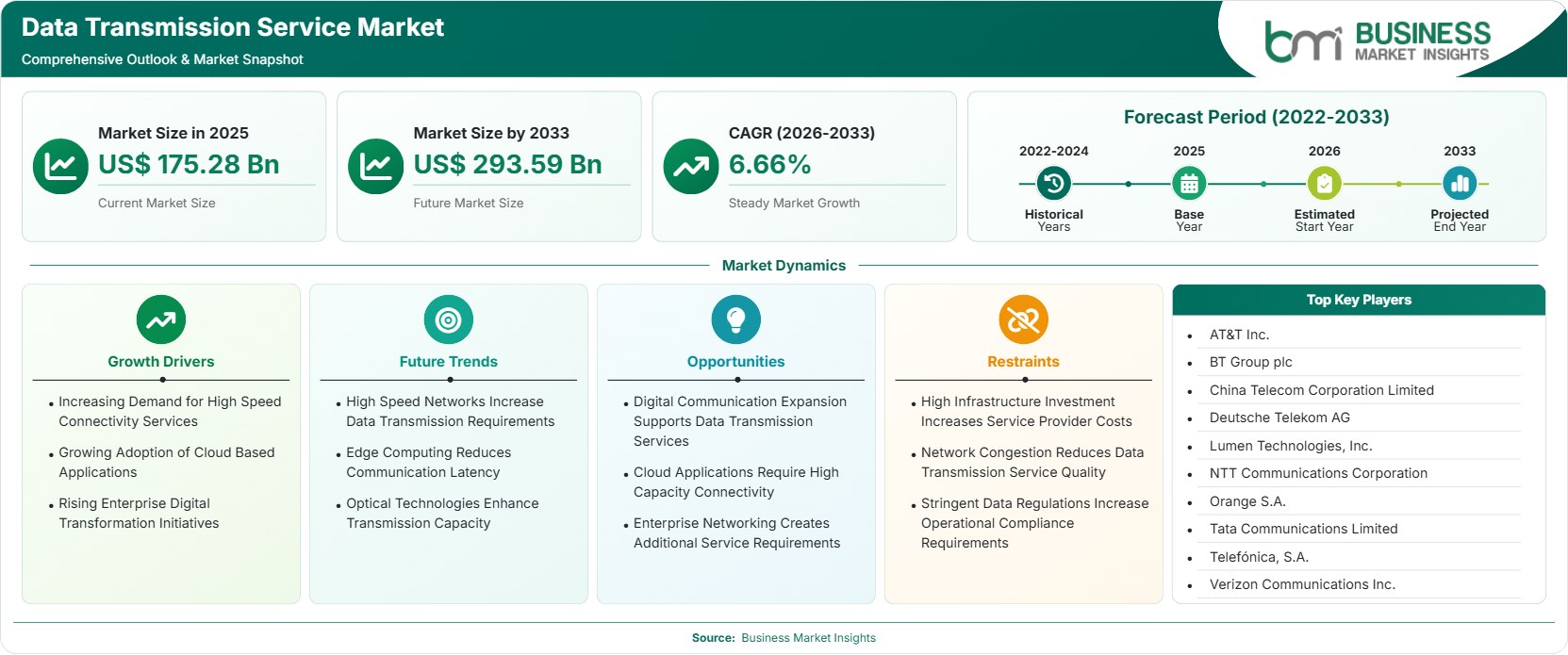
The Data Transmission Service Market size was valued at US$ 175.28 Billion in 2025 and is projected to reach US$ 293.59 Billion by 2033, growing at a CAGR of 6.66% during 2026–2033, driven by cloud adoption, rising bandwidth needs, enterprise digitization, 5G expansion, and secure network modernization.

Report Coverage
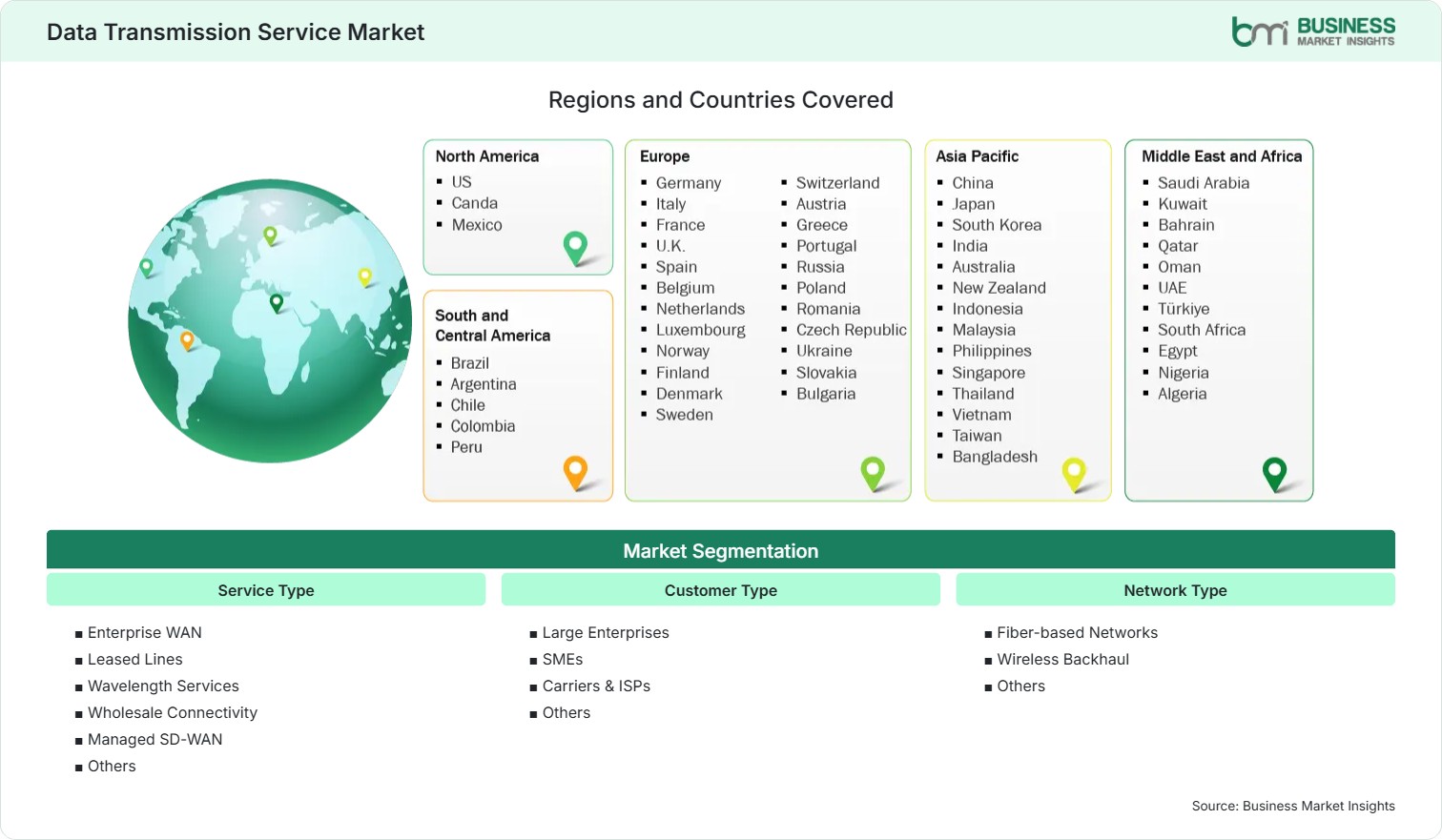
  • Service Type: Enterprise WAN, Leased Lines, Wavelength Services, Wholesale Connectivity, Managed SD-WAN, Others
  • Customer Type: Large Enterprises, SMEs, Carriers & ISPs, Others
  • Network Type: Fiber-based Networks, Wireless Backhaul, Others
US$ 175.28 Bn Market size in 2025
US$ 293.59 Bn Market Size by 2033
6.66% CAGR, 2026 - 2033
2026-2033 Forecast Period

AI Overview

Data Transmission Service Market Summary

  • North America Region: North America holds a 31%–35% Data Transmission Service market share in 2025, growing at a 5.9%–6.5% CAGR through 2033, supported by hyperscale cloud deployment, fiber densification, AI workloads, enterprise modernization, secure connectivity demand, and advanced network investments. The US remains the dominant contributor, with a 5.5%–6.2% CAGR as enterprises upgrade fiber, SD-WAN, wavelength, and multi-cloud connectivity infrastructure.
  • Fastest Growing Region: Asia Pacific accounts for a 27%–31% share in 2025 and is projected to expand at a 7.4%–8.2% CAGR through 2033, supported by 5G rollout, digital economies, hyperscale data centers, submarine cable investments, cloud migration, industrial digitization, and rapidly increasing enterprise bandwidth consumption.
  • Leading Segment: Enterprise WAN represents a 30%–34% share in 2025 and is estimated to advance at a 6.2%–6.9% CAGR through 2033, supported by distributed workforces, cloud applications, branch connectivity, centralized network management, cybersecurity integration, and demand for predictable performance across geographically dispersed operations.
  • High Growth Segment: Managed SD-WAN represents a 17%–21% share of the Data Transmission Service Market in 2025 and is projected to grow at an 8.7%–9.6% CAGR through 2033, driven by cloud-first architectures, application-aware routing, integrated security, network automation, multi-access connectivity, operational simplification, and demand for flexible enterprise infrastructure.
  • Key Market Opportunity: AI workloads, edge computing, private 5G, cloud interconnection, wavelength services, and programmable networks create opportunities for providers to monetize bandwidth, latency guarantees, automation, security, and network-as-a-service capabilities.
  • Major Market Players: AT&T Inc., BT Group plc, China Telecom Corporation Limited, Deutsche Telekom AG, Lumen Technologies, Inc., NTT Communications Corporation, Orange S.A., Tata Communications Limited, Telefónica, S.A., and Verizon Communications Inc.
Strategic Insights

Data Transmission Service Market: Strategic Insights

Data Transmission Service Market Strategic Framework
FREE PDF
Request your free sample
Request free sample
Stakeholder View

Key Takeaways

  • Value creation is moving from basic bandwidth resale toward integrated connectivity ecosystems combining access, transport, cloud interconnection, security, orchestration, monitoring, and managed services. Providers with extensive fiber, peering, data-center access, and automation capabilities can capture greater recurring revenue per enterprise connection.
  • Managed SD-WAN and wavelength services offer stronger upside than mature leased-line propositions because enterprises increasingly require application-aware routing, cloud connectivity, rapid provisioning, and high-capacity links for AI and data-intensive applications.
  • Network virtualization, programmable optical transport, SASE integration, AI-assisted operations, and on-demand capacity are changing service architectures. NTT demonstrated automated optical wavelength-path switching in 2025, while AT&T introduced high-capacity wavelength services designed for AI and cloud workloads.
  • Asia Pacific offers a compelling investment case because mobile and fixed traffic growth, data-center construction, 5G adoption, and digitalization are increasing the need for domestic and international transmission capacity. India, China, Southeast Asia, and Japan remain important infrastructure markets.
  • Telecom operators are increasingly using acquisitions and infrastructure partnerships to expand fiber footprints and converge mobile, fixed, and enterprise services. Deutsche Telekom's August 2026 agreement to acquire Fiberhost and Inea for €1 billion illustrates continued strategic interest in fixed-network assets.
  • Competitive differentiation increasingly depends on service activation speed, network visibility, resilience, security integration, and cloud reach rather than bandwidth alone. Enterprises are favoring providers that can manage the complete connectivity lifecycle through unified platforms.
Geographic Outlook

Data Transmission Service Market Regional Highlights

North America Data Transmission Service Market

The North American Data Transmission Service Market is projected to hold a market share of 31%-35% in 2025, with a growth rate of 5.9%-6.5% by 2033. North American market advantages include enterprise maturity, the presence of hyperscale clouds, fiber networks, data center development, and early-stage AI infrastructure deployment. Most regional market spend is accounted for by the United States, with Canada adding to spend on cloud, broadband, and data center development. There has been a growing trend of combining private connectivity, SD-WAN, SASE, and wavelength services to address distributed enterprise workloads and resilience requirements.

  • Enterprise modernization: Large enterprises are replacing fragmented WAN architectures with managed, software-defined connectivity that integrates broadband, fiber, wireless access, cloud links, and centralized policy management for distributed locations.
  • AI infrastructure: AI training and inference workloads are increasing demand for high-capacity optical services. AT&T introduced 100G and 400G wavelength options in 2025, demonstrating the movement toward faster enterprise provisioning.
  • Security convergence: SASE and SD-WAN are increasingly integrated because enterprises want connectivity and security managed through unified operational frameworks rather than separate infrastructure stacks.
  • Fiber expansion: Data centers, cloud regions, and enterprise campuses require dense fiber connectivity, encouraging operators to prioritize metropolitan fiber, backbone capacity, and direct cloud interconnection.

US Data Transmission Service Market

The US accounted for 25%-28% of worldwide revenue in 2025 and is forecasted to record a CAGR of 5.5%-6.2% between 2026 and 2033. Growth drivers include cloud infrastructure, enterprise fiber services, artificial intelligence data centers, 5G, and substantial corporate investments in technology. The Data Transmission Service market is dominated by national telecom companies, fiber operators, cloud connectivity service providers, and managed networking firms that cater to large companies and advanced SMEs.

  • AI-driven bandwidth: Enterprise AI workloads require high-throughput, low-latency links between data centers, cloud environments, users, and storage systems, increasing demand for scalable optical connectivity.
  • Managed networking: Businesses are adopting managed SD-WAN to simplify branch connectivity and optimize traffic across fiber, broadband, and wireless paths.
  • Small-business digitization: SMEs increasingly depend on cloud applications, payment platforms, cybersecurity services, and collaboration tools, expanding demand for reliable managed connectivity.

Europe Data Transmission Service Market

The Data Transmission Service Market in Europe held a share of 25%–29% in 2025 and is expected to grow at a 5.8%–6.5% CAGR through 2033. Germany, the UK, and France are among the major countries, whereas Poland, Spain, Italy, and the Netherlands are other promising regions in Europe. Some of the focus areas of European telecom operators are fiber modernization, cloud-based networks, energy-efficient networks, and software-defined networks. The Western European mobile data volume is expected to grow at a 15% annual rate through 2031, supporting continued transport-capacity investment.

  • Germany: Industrial digitalization, automotive automation, cloud migration, and enterprise fiber upgrades support a 5.8%–6.5% CAGR in transmission-service demand.
  • United Kingdom: Enterprise cloud adoption and managed networking requirements support approximately 6.0%–6.7% growth, with SD-WAN and secure connectivity gaining importance.
  • France: Telecom modernization and multinational enterprise demand support approximately 5.9%–6.6% growth, while Orange Business continues expanding programmable WAN capabilities.
  • Poland: Fiber deployment and data-center development provide a higher-growth opportunity, with demand supported by enterprise digitization and expanding cloud infrastructure.

Asia Pacific Data Transmission Service Market

The Market Share for the Data Transmission Service Market in the Asia Pacific region stood at 27%–31% in 2025 and is projected to grow at a CAGR of 7.4%–8.2% from 2026 to 2033. The countries that drive the regional market include China, Japan, India, South Korea, Singapore, and Australia, while Southeast Asia presents significant growth potential. India, Nepal, and Bhutan witnessed mobile data traffic of 30 EB per month in 2025 and are expected to reach 68 EB per month in 2031, demonstrating the region's bandwidth trajectory.

  • China: Hyperscale cloud investment, industrial digitalization, 5G deployment, and extensive fiber infrastructure support strong demand for domestic and international transmission services.
  • India: Enterprise cloud adoption, digital public infrastructure, data-center investment, and rising mobile traffic create opportunities for fiber, managed WAN, and international connectivity providers.
  • Japan: High-reliability requirements and advanced optical networking support premium transmission services. NTT demonstrated 140 Gbps bidirectional wireless transmission for future high-capacity backhaul in 2025.
  • Southeast Asia: Singapore, Indonesia, Malaysia, and Thailand benefit from data-center expansion, submarine cable investments, cloud adoption, and multinational enterprise connectivity requirements.

Rest of World Data Transmission Service Market

The Data Transmission Service market segment in South and Central America accounted for 7%–10%, while the Middle East & Africa accounted for a significant share of the rest of the global demand base. Revenue from the Rest of the World segment stood at 13%–17% and is expected to grow at a 7.0%–8.0% CAGR through 2033. Leading regions include Brazil, Mexico, Saudi Arabia, the UAE, and South Africa, driven by their digital transformation efforts and infrastructure modernization.

Latin America benefits from cloud computing adoption, enterprise digitization, and growing demand for mobile traffic. Middle Eastern regions invest significantly in data center operations, international connectivity services, and smart cities initiatives, while Africa focuses on mobile broadband backhaul capacity, fiber connectivity, and international networks.

  • Brazil: Large enterprise networks, cloud migration, data-center development, and broadband expansion support continued demand for managed connectivity and high-capacity transmission.
  • Mexico: Nearshoring and manufacturing investments increase requirements for reliable cross-border connectivity, enterprise WAN, data-center interconnection, and low-latency services.
  • Saudi Arabia and UAE: Digital transformation programs and data-center investment support premium connectivity, cloud interconnection, and secure managed-network demand.
  • South Africa: Enterprise digitization and regional data-center development create opportunities for fiber networks, international connectivity, and wireless backhaul.
Global Market Geography
FREE PDF
Request your free sample
Request free sample
Segment Analysis

Data Transmission Service Market Segmentation

Service Type

Enterprise WAN is expected to account for 30-34% market share by 2025, growing at a CAGR of 6.2-6.9% through 2033. Factors fueling the deployment of such services include cloud migrations, branch distribution networks, security integration, and network management. The Data Transmission Service Market coverage is expanding to include WAN, Cloud, Security, and Transport Services.

  • Enterprise WAN: Connects geographically distributed business locations with controlled performance, centralized management, and application-aware routing, supporting cloud applications, branch modernization, and hybrid workforce connectivity.
  • Leased Lines: Dedicated point-to-point or point-to-multipoint capacity remains important for financial, government, industrial, and mission-critical applications requiring predictable performance, service-level guarantees, and network isolation.
  • Wavelength Services: High-capacity optical connections address AI, cloud, storage, and data-center workloads requiring deterministic throughput, low latency, and scalable capacity across metropolitan and long-haul routes.
  • Wholesale Connectivity: Carriers, ISPs, and digital infrastructure providers purchase capacity for network expansion, backhaul, international routes, and service aggregation, creating recurring infrastructure demand.
  • Managed SD-WAN: Managed platforms optimize traffic across multiple access technologies while integrating security, centralized control, cloud connectivity, and application-aware routing for distributed enterprises.

Customer Type

The Large Enterprises accounted for a market share of 48%-52% in 2025 and are expected to grow at a CAGR of 6.0%-6.7% till 2033. Multinational corporations need robust networks, predictable latency, cloud support, security, and network visibility. SMEs can help the segment grow by offering managed services.

  • Large Enterprises: Multinational organizations require high availability, multi-cloud connectivity, centralized orchestration, and differentiated service levels to support geographically dispersed operations and critical applications.
  • SMEs: Managed connectivity enables smaller organizations to access enterprise-grade networking without building extensive internal network teams, supporting cloud applications, remote work, security, and branch expansion.
  • Carriers & ISPs: Operators purchase wholesale capacity, backhaul, transit, wavelengths, and international connectivity to extend coverage and increase network capacity without duplicating infrastructure.

Network Type

Fiber-based Networks hold a market share of 63% to 67% in Data Transmission Services in 2025 and are expected to grow at a CAGR of 6.4% to 7.1% till 2033. Fiber is essential owing to its capabilities, low latency, scalability, and its suitability in data center and enterprise environments. Wireless backhaul complements fiber where deployment economics favor radio-based transport.

  • Fiber-based Networks: Fiber provides high-capacity backbone and access infrastructure for enterprises, carriers, data centers, cloud providers, and metropolitan networks, supporting scalable transmission requirements.
  • Wireless Backhaul: Microwave and millimeter-wave links provide flexible connectivity for mobile sites, remote locations, temporary deployments, and areas where fiber construction is costly or delayed.
Market Forces

Data Transmission Service Market Dynamics

Key Market Drivers

AI and Cloud Workloads Increase High-Capacity Connectivity Demand

AI training, inference, cloud computing, and distributed data processing are increasing the volume and performance requirements of enterprise networks. According to Ericsson, total fixed data traffic was estimated at 380 EB per month in 2025 and is expected to rise to 710 EB per month by 2031, with an 11% CAGR. The mobile network traffic was estimated at 203 EB per month in 2025 and is expected to reach 515 EB per month by 2031. This trend would contribute to the Data Transmission Service Market growth as businesses will demand improved connectivity among data centers, cloud infrastructure, branch offices, and end users. The wavelength services would be particularly suitable where there is a requirement for guaranteed throughput and low latency.

Enterprise Cloud Migration Accelerates Managed WAN Adoption

Cloud-first IT architectures are shifting enterprise network requirements from static branch connectivity to application-aware, dynamically managed transmission. Increasing adoption of multi-cloud services, SaaS apps, remote locations, and workload distribution makes the classical WAN architecture less effective. Managed SD-WAN allows operators to leverage fiber, broadband, MPLS, and 4G or 5G links and select the optimal route within the network. According to BT, SD-WAN is an architectural approach that can utilithat can usesport services and offer direct connectivity, and according to Orange Business, SD-WAN includes SASE and programmable network services. All these implementations help reinforce the Data Transmission Service market trends by moving the focus of purchases from bandwidth connectivity to management, security, visibility, and application performance.

5G Expansion Strengthens Wireless Backhaul Requirements

5G deployment is creating additional demand for transport capacity connecting radio sites, aggregation points, edge facilities, and core networks. Ericsson reports that 5G carried 48% of global mobile data traffic at the end of 2025, while total mobile network traffic reached 203 EB per month. Wireless backhaul remains strategically significant when fiber installation is constrained by terrain, timing, or cost. The NTT test of 140 Gbps duplex wireless transport in the 71-86 GHz band demonstrates the technical path forward for wireless transport solutions. In preparing for future technologies, mobile operators developing dense 5G networks will enable transmission providers to exploit higher-capacity, low-latency transport and hybrid fiber-wireless architectures.

Key Market Opportunities

AI-Optimized Wavelength and Data-Center Interconnection

AI infrastructure creates an opportunity for telecom operators to develop specialized wavelength, Ethernet, and optical transport offerings that connect data centers, cloud regions, and high-performance computing facilities. For example, AT&T launched the 2025 Express Waves services, in which carriers are offering 100G/400G wavelengths and quick service turnaround times. Lumen also launched the Wavelength RapidRoutes, where carriers have provided 100G/400G wavelengths and a 20-day service delivery period. This indicates that carriers are moving towards value-added service offerings through latency, provisioning time, route diversity, and capacity guarantees. Optical networks aligned with AI cluster networks will help increase carrier revenues by enabling better partnerships with cloud, colocation, and infrastructure partners.

Network-as-a-Service and Programmable Connectivity

Programmable connectivity creates an investment opportunity because enterprises increasingly want networks that can be provisioned, modified, and monitored through software interfaces. The Orange Business Evolution Platform is built around on-demand connectivity, virtual network functions, and cloud services, whereas BT focuses on managed connectivity, cloud integration, and security. Consequently, Data Transmission Service market forecasts now rely on providers' ability to transform their physical assets into serviceable resources through APIs. Network-as-a-service solutions may speed up deployment, simplify configuration, and enable consumption-oriented pricing models. Service providers with advanced fiber networks, data center interconnects, software platforms, and orchestration tools are set to leverage their positions to secure more value-added enterprise deals.

Secure Converged Connectivity for Distributed Enterprises

The combination of networking and cybersecurity technologies offers an opportunity to integrate transmission services, SD-WAN, SASE, cloud access, and security monitoring into a single enterprise offering. The SASE concept was launched by AT&T and Cisco in 2025 and is designed to integrate SD-WAN, multi-cloud connectivity, observability, and the automation of security procedures. Orange Business, in providing SD-WAN and SASE services, has applied the same concept to its WAN solutions worldwide. The integration of network and cybersecurity technologies presents a unique challenge for multinational organizations that employ remote workers, operate branches, use cloud applications, and handle sensitive information across different countries. Network operators can enhance customer retention by integrating connectivity and security management, and enterprises will gain an easy acquisition process and policy enforcement.

Market Restraints and Challenges

High Capital Requirements and Fiber Deployment Complexity

Factor: Significant capital expenditure is required to build transmission networks involving fiber-optic links, optical equipment, data center connectivity, spectrum, and network management. The construction process may encounter regulatory issues, limited access to routes, labor shortages, and terrain challenges.

Impact: These factors may lengthen payback periods and limit expansion to less-populated areas where enterprise revenues cannot justify the creation of additional infrastructure. The carriers have to strike the right balance between network densification and utilization rates, especially in light of growing expectations for flexible pricing and rapid capacity upgrades. Competition from established infrastructure providers can also weaken pricing position in mature markets. Wireless backhaul may address some deployment challenges, but not for high-capacity services that still require fiber optics.

Cybersecurity, Resilience, and Network Complexity

Factor: Corporate communication increasingly entails an amalgamation of private networks, public internet, cloud systems, SD-WAN, 5G, edge computing, and third-party security systems.

Implication: Any problem in the network, such as a cyberattack, failure, misconfiguration, or fiber cut, would affect multiple systems and locations simultaneously. Therefore, it becomes necessary for vendors to ensure redundant routing, constant monitoring, encryption, identity management, automated mitigation, and disaster recovery systems. Where regulatory compliance is required, it would be costly for companies to handle sensitive information crossing borders. Moreover, the complexity of the networks also means difficulties for small and medium enterprises with inadequate technical staff. Managed services can help in that scenario; however, vendors need to ensure transparency in security measures, availability, incident response, and performance across diverse access methods.

Company Analysis

Competitive Landscape

The Data Transmission Service market analysis indicates that competition is shifting from basic transmission capacity toward integrated, programmable, secure, and cloud-connected network services. Major providers differentiate through global backbone reach, fiber assets, enterprise customer relationships, managed SD-WAN capabilities, optical capacity, cloud partnerships, and service automation. AT&T, BT, Orange Business, and other leading operators are increasingly combining connectivity with security and cloud networking.

Company Name

Overview

Products and Services relevant to this market

AT&T Inc.

US-based telecommunications provider with extensive wireless, fiber, enterprise networking, cloud connectivity, and managed communications capabilities.

Enterprise WAN, managed SD-WAN, VPN, fiber connectivity, wavelength services, wireless connectivity, cloud interconnection, and SASE solutions.

BT Group plc

UK-based communications group serving multinational enterprises through global network infrastructure and managed digital networking services.

Managed SD-WAN, hybrid connectivity, private networking, cloud connectivity, managed network services, and international enterprise transmission.

China Telecom Corporation Limited

Major Chinese telecommunications operator with extensive fixed, mobile, cloud, enterprise, and international network capabilities.

Enterprise connectivity, leased connectivity, fiber networks, cloud networking, wholesale services, and international transmission infrastructure.

Deutsche Telekom AG

European telecommunications group with extensive fixed, mobile, enterprise, and international network operations.

Enterprise WAN, fiber connectivity, managed networks, cloud connectivity, wireless infrastructure, and international data transmission services.

Lumen Technologies, Inc.

Network infrastructure provider focused on enterprise connectivity, fiber, wavelength services, cloud networking, and high-capacity transport.

Wavelength services, Ethernet, fiber connectivity, managed networking, private connectivity, cloud interconnection, and enterprise network solutions.

NTT Communications Corporation

Japanese global communications provider delivering enterprise networking, data-center connectivity, cloud integration, and advanced optical infrastructure.

Enterprise WAN, SD-WAN, cloud connectivity, data-center interconnection, fiber transport, international networks, and managed services.

Orange S.A.

French telecommunications group with extensive European and international enterprise networking capabilities through Orange Business.

Global WAN, SD-WAN, SASE, cloud connectivity, fiber, international transmission, network virtualization, and managed connectivity.

Tata Communications Limited

Indian global digital infrastructure provider connecting enterprises, carriers, cloud platforms, and international network locations.

Global WAN, Ethernet, leased connectivity, cloud interconnection, SD-WAN, fiber transport, wholesale connectivity, and international networks.

Telefónica, S.A.

Spanish telecommunications group with significant European and Latin American fixed, mobile, enterprise, and digital infrastructure operations.

Enterprise networking, fiber connectivity, SD-WAN, managed connectivity, cloud networking, mobile backhaul, and international transmission.

Verizon Communications Inc.

US telecommunications company providing enterprise connectivity through extensive wireless, fiber, network, and managed communications infrastructure.

Enterprise WAN, fiber, Ethernet, managed SD-WAN, wireless backhaul, cloud connectivity, private networking, and security services.

Trust & Transparency

Research Methodology

The market analysis combines proprietary research with secondary data from government agencies, company disclosures, regulatory filings, industry databases and expert interviews. Market estimates are validated through data triangulation, cross-market benchmarking and analyst review.

View Full Research Methodology

Questions Answered

Frequently Asked Questions

How should enterprises evaluate a Data Transmission Service market Report?

Organizations should compare geographic coverage, fiber and backbone reach, service-level guarantees, cloud interconnection, security capabilities, provisioning speed, network visibility, redundancy, pricing models, and managed-service expertise rather than evaluating bandwidth alone.

Which technologies will influence transmission infrastructure through 2033?

Optical networking, programmable transport, 5G and future wireless technologies, network automation, AI-assisted operations, SASE, edge computing, and network-as-a-service architectures will influence infrastructure investment and service design.

How are SD-WAN services changing enterprise connectivity?

SD-WAN enables organizations to combine fiber, broadband, MPLS, and wireless access while dynamically optimizing traffic. Managed offerings reduce internal network complexity and increasingly integrate cloud connectivity, security, monitoring, and application-aware routing.

What makes wavelength services strategically important?

Wavelength services provide dedicated high-capacity optical connectivity suited to AI, data-center interconnection, cloud computing, storage replication, and latency-sensitive workloads. Their value is increasing as enterprises require predictable performance and faster access to large volumes of data.

What is driving demand for enterprise data transmission services?

Cloud migration, AI workloads, 5G expansion, data-center development, remote operations, and cybersecurity requirements are increasing enterprise demand for high-capacity, reliable, low-latency connectivity. Organizations are also moving toward managed SD-WAN and integrated network-security architectures.

Access the Full Data Transmission Service Market Report

Get segment-level forecasts, regional estimates, competitive benchmarking, company profiles and downloadable Excel datasets.

Access the full Data Transmission Service Market Report
350 pages PDF & Excel | 2026-09-16
Similar Research

Related Market Reports