
Electronic Data Interchange (EDI) Software Market Outlook: Size, Share, Trends, Growth Analysis, Competitive Landscape & Forecast, 2026-2033

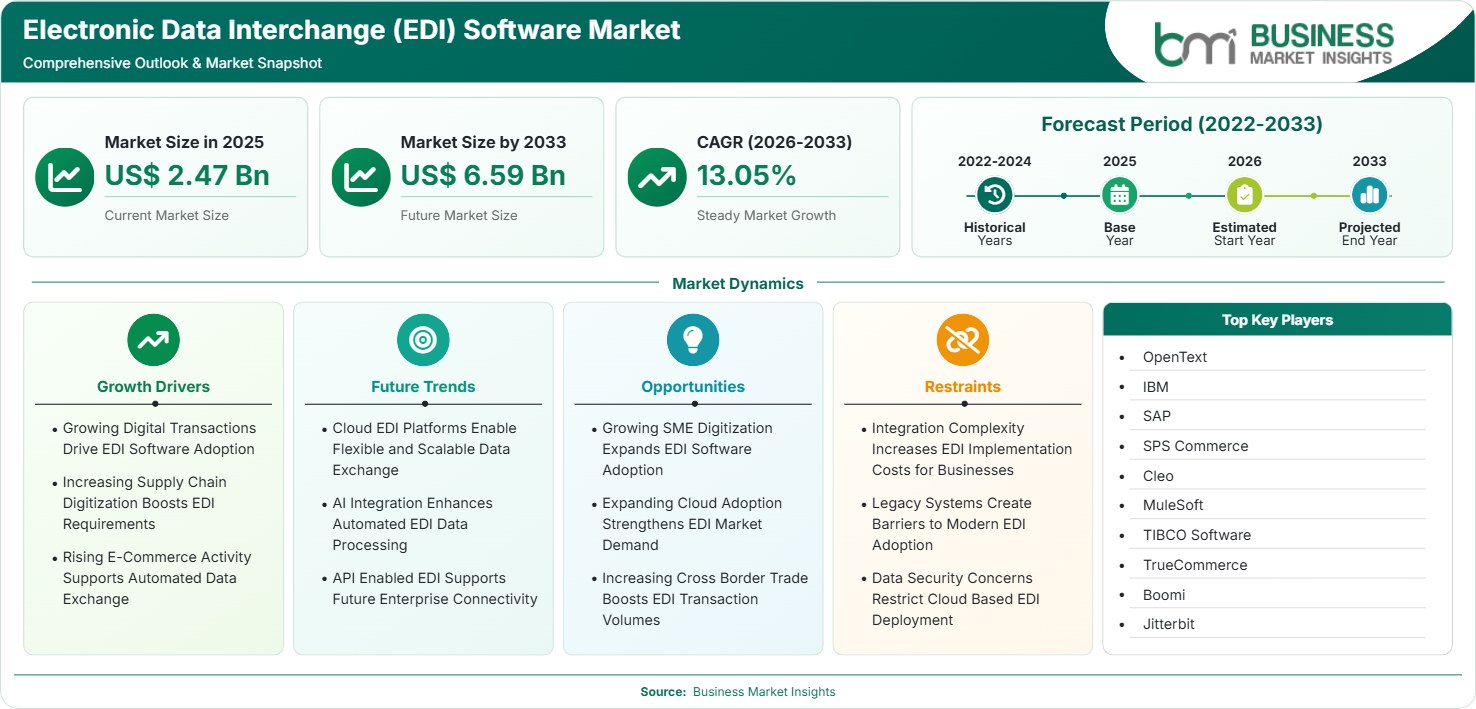
The Electronic Data Interchange (EDI) Software Market size was valued at US$ 2.47 billion in 2025 and is projected to reach US$ 6.59 billion by 2033, growing at a CAGR of 13.05% during 2026–2033, driven by digital transactions, supply chain digitization, cloud adoption, and cross-border commerce.

Report Coverage
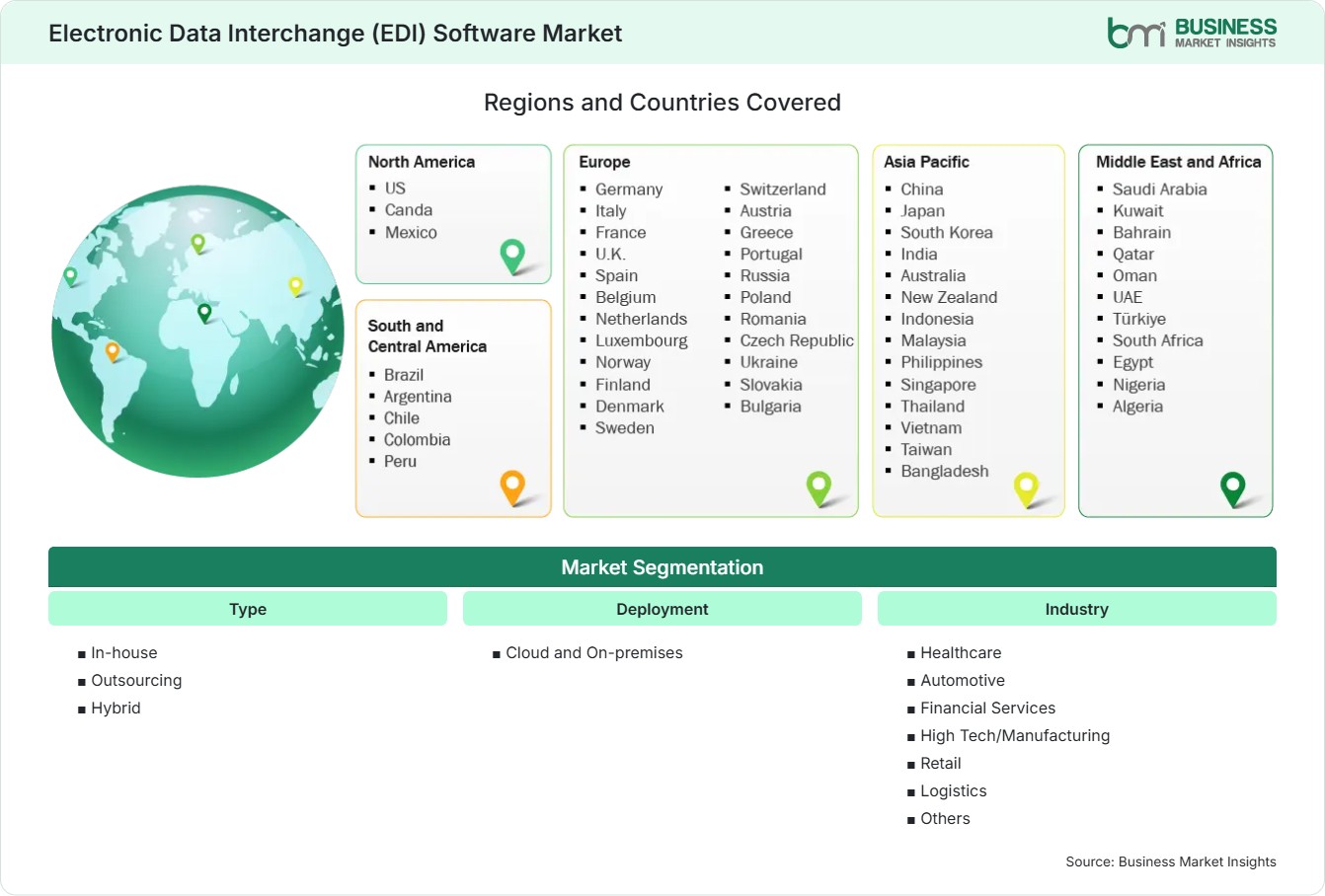
  • Type: In-house, Outsourcing, Hybrid
  • Deployment: Cloud and On-premises
  • Industry: Healthcare, Automotive, Financial Services, High Tech/Manufacturing, Retail, Logistics, Others
US$ 2.47 Bn Market size in 2025
US$ 6.59 Bn Market Size by 2033
13.05% CAGR, 2026 - 2033
2026-2033 Forecast Period

AI Overview

Electronic Data Interchange (EDI) Software Market Summary

  • North America Region: North America holds a 34%–39% share in 2025, growing at a CAGR of 11.5%–13.5% during 2026–2033, supported by mature supply chains, cloud migration, regulatory data requirements, e-commerce expansion, and integration modernization. The US Electronic Data Interchange (EDI) Software Market is projected to grow at a 12.0%–14.0% CAGR, supported by retail, healthcare, logistics, and manufacturing digitization.
  • Fastest Growing Region: Asia Pacific holds a 25%–30% share in 2025 and is projected to expand at a CAGR of 14.5%–16.5%, driven by expanding e-commerce, manufacturing ecosystems, cross-border trade, cloud infrastructure, and increasing adoption among small and medium-sized enterprises.
  • Leading Segment: Cloud deployment holds a 52%–57% share in 2025 and is projected to grow at a CAGR of 14.0%–16.0%, supported by lower infrastructure requirements, flexible scalability, remote accessibility, managed integration, and faster onboarding of trading partners.
  • High Growth Segment: Hybrid deployment represents a 20%–25% share in 2025 and is projected to grow at a CAGR of 13.5%–15.5%, supported by enterprises balancing legacy infrastructure with cloud modernization, data control, operational continuity, and gradual technology migration.
  • Key Market Opportunity: Growing SME digitization, cloud migration, and cross-border commerce create opportunities for affordable managed EDI platforms offering rapid onboarding, automated compliance, API integration, and scalable transaction processing.
  • Major Market Players: OpenText, IBM, SAP, SPS Commerce, Cleo, MuleSoft, TIBCO Software, TrueCommerce, Boomi, and Jitterbit.
Strategic Insights

Electronic Data Interchange (EDI) Software Market: Strategic Insights

Electronic Data Interchange (EDI) Software Market Strategic Framework
FREE PDF
Request your free sample
Request free sample
Stakeholder View

Key Takeaways

  • The value chain is shifting from standalone document exchange toward integrated transaction ecosystems connecting ERP, warehouse management, procurement, logistics, e-commerce, and financial platforms.
  • Cloud deployment presents the strongest near-term expansion opportunity because businesses increasingly prioritize scalability, lower infrastructure requirements, faster partner onboarding, and managed maintenance.
  • API connectivity is reshaping product development as enterprises seek continuous data exchange alongside established EDI standards, creating demand for platforms capable of supporting multiple integration methods.
  • Asia Pacific offers an attractive investment case as manufacturing networks, digital commerce, and cross-border trade expand while SMEs increasingly adopt cloud-based business infrastructure.
  • Strategic investment is increasingly focused on platform consolidation, integration capabilities, supplier enablement, and ecosystem partnerships, allowing vendors to broaden transaction volumes and deepen customer relationships.
  • Vendors with strong mapping automation, security controls, compliance capabilities, and partner onboarding tools are positioned to differentiate as EDI environments become more complex.
Geographic Outlook

Electronic Data Interchange (EDI) Software Market Regional Highlights

North America Electronic Data Interchange (EDI) Software Market

North America holds a 34%–39% share in 2025 and is projected to grow at a 11.5%–13.5% CAGR during 2026–2033. The region benefits from established EDI ecosystems across retail, healthcare, logistics, and manufacturing. Electronic Data Interchange (EDI) Software Market share remains supported by extensive trading-partner networks.

  • Retail and consumer goods companies continue modernizing supplier connectivity to manage growing transaction volumes and improve order visibility.
  • Healthcare organizations require reliable electronic transaction processing to support administrative workflows, claims-related exchanges, and standardized data communication.
  • Cloud migration is encouraging enterprises to replace aging infrastructure while maintaining compatibility with established trading-partner requirements.
  • API-enabled integration is expanding the role of EDI platforms across broader enterprise application environments.

US Electronic Data Interchange (EDI) Software Market

The US accounts for a 28%–33% share of the global market in 2025 and is projected to grow at a 12.0%–14.0% CAGR during 2026–2033. Mature digital supply chains, high e-commerce penetration, and established enterprise software adoption support demand. Retail, healthcare, logistics, automotive, and manufacturing organizations continue upgrading integration infrastructure. Growing use of cloud platforms and managed services is also making EDI capabilities accessible to organizations seeking lower internal technology requirements.

  • Large retailers and suppliers maintain extensive trading-partner networks that require standardized, secure, and reliable transaction exchange.
  • Cloud-based integration is attracting businesses seeking faster implementation and reduced infrastructure management responsibilities.
  • Enterprise modernization is increasing demand for EDI platforms that connect legacy applications with APIs and cloud services.

Europe Electronic Data Interchange (EDI) Software Market

Europe represents a 24%–29% share in 2025 and is forecast to expand at a 11.5%–13.5% CAGR through 2033. Germany, the UK, France, and Italy lead regional demand, while Poland and Spain provide attractive growth opportunities. Germany is projected to grow at a 12.0%–14.0% CAGR, while Poland could reach a 14.0%–16.0% CAGR. Digital commerce, industrial supply chains, electronic invoicing, and regulatory modernization support adoption across multiple industries.

  • Germany benefits from sophisticated manufacturing and automotive ecosystems requiring extensive supplier and logistics connectivity.
  • The UK and France offer opportunities through retail digitization, cloud migration, and increasing demand for automated business transactions.
  • European regulatory developments around digital documentation and electronic invoicing can encourage organizations to modernize transaction infrastructure.
  • Eastern European markets provide growth potential as businesses integrate with international supply chains and adopt cloud-based enterprise technologies.

Asia Pacific Electronic Data Interchange (EDI) Software Market

Asia Pacific holds a 25%–30% share in 2025 and is projected to register a 14.5%–16.5% CAGR during 2026–2033, making it the fastest-growing regional market. China, Japan, India, South Korea, and Australia represent major demand centers. India is projected to grow at a 16.0%–18.0% CAGR, while Southeast Asian markets are expected to record strong expansion. Manufacturing, e-commerce, logistics, and cross-border trade are accelerating integration requirements.

  • China benefits from extensive manufacturing and logistics networks requiring standardized electronic communication between suppliers and buyers.
  • India offers substantial potential as SMEs digitize operations and businesses participate more actively in organized supply chains.
  • Southeast Asia is benefiting from e-commerce expansion, regional manufacturing investment, and cross-border trade connectivity.
  • Japan and South Korea provide mature opportunities through automotive, electronics, manufacturing, and logistics applications.

Rest of World Electronic Data Interchange (EDI) Software Market

South and Central America represent a 5%–8% share in 2025 and are projected to expand at a 9.5%–11.5% CAGR during 2026–2033. Brazil, Mexico, and Argentina lead demand as businesses modernize supply chains and participate in international commerce. The Middle East and Africa account for a 6%–10% share and are projected to grow at a 10.0%–12.0% CAGR, supported by logistics, retail, manufacturing, and digital transformation initiatives.

Brazil and Mexico offer opportunities through expanding commerce and manufacturing connectivity, while the Middle East benefits from logistics investment and digital trade infrastructure. The UAE and Saudi Arabia are leading markets, whereas South Africa provides opportunities across retail, logistics, and industrial applications. Cloud-based solutions are particularly relevant where businesses seek modern integration without extensive local infrastructure.

  • Brazil and Mexico offer opportunities as exporters and manufacturers strengthen connections with international trading partners.
  • Middle Eastern logistics hubs are increasing investment in digital infrastructure to support increasingly connected supply chains.
  • The UAE and Saudi Arabia provide attractive opportunities through retail modernization, logistics development, and enterprise digitization.
  • South Africa offers potential as businesses modernize transaction systems across retail, manufacturing, and logistics networks.
Global Market Geography
FREE PDF
Request your free sample
Request free sample
Segment Analysis

Electronic Data Interchange (EDI) Software Market Segmentation

Type

The Type segment is led by In-house solutions, representing a 38%–43% share in 2025 and growing at a CAGR of 10.5%–12.5% through 2033. The Electronic Data Interchange (EDI) Software Market scope extends across organizations requiring direct infrastructure control, outsourced transaction management, and flexible hybrid architectures.

  • In-house: In-house EDI supports organizations requiring direct control over infrastructure, security, customization, and partner connectivity, particularly among large enterprises with established internal integration teams.
  • Outsourcing: Outsourced EDI reduces internal technology requirements by transferring infrastructure management, monitoring, and partner onboarding to specialized providers, supporting organizations with limited integration resources.
  • Hybrid: Hybrid models combine internal control with external managed services, allowing enterprises to retain sensitive workloads while outsourcing selected transaction processing and connectivity functions.

Deployment

Cloud deployment leads with a 52%–57% share in 2025 and is projected to grow at a CAGR of 14.0%–16.0% during 2026–2033. Businesses increasingly favor scalable infrastructure, managed maintenance, and faster onboarding. On-premises systems remain relevant among enterprises requiring direct infrastructure control, established legacy compatibility, and specific security policies.

  • Cloud: Cloud EDI enables flexible scaling, remote accessibility, automated updates, and lower infrastructure management requirements, supporting SMEs and enterprises modernizing transaction environments.
  • On-premises: On-premises EDI remains relevant for organizations prioritizing internal control, established workflows, direct infrastructure management, and compatibility with legacy enterprise systems.

Industry

The Industry segment is led by Retail, representing a 28%–33% share in 2025 and growing at a CAGR of 12.5%–14.5% through 2033. Retailers and suppliers depend on standardized transaction exchange for orders, invoices, shipment notifications, and inventory coordination. Healthcare, automotive, financial services, high tech and manufacturing, and logistics provide additional demand.

  • Healthcare: Healthcare organizations use EDI for standardized administrative transactions, supporting interoperability, transaction accuracy, claims workflows, and communication between providers, payers, and suppliers.
  • Automotive: Automotive supply chains rely on structured data exchange for procurement, production planning, shipping, inventory management, and supplier coordination across geographically distributed networks.
  • Financial Services: Financial institutions use electronic data exchange to streamline transaction workflows, improve processing efficiency, and support secure communication between business systems and partners.
  • High Tech/Manufacturing: High tech and manufacturing companies require EDI for complex supplier networks, procurement, production coordination, inventory management, and international sourcing activities.
  • Retail: Retail remains a major application area as retailers and suppliers exchange high transaction volumes involving purchase orders, invoices, shipping information, and inventory updates.
  • Logistics: Logistics providers use EDI to coordinate shipments, transportation documentation, warehouse activities, and status updates across interconnected supply chains.
Market Forces

Electronic Data Interchange (EDI) Software Market Dynamics

Key Market Drivers

Growing Digital Transactions Drive EDI Software Adoption

As digital transactions become more prevalent, there is a growing demand for automated business-to-business data exchange. Large companies, which deal with bigger amounts of orders, invoices, shipments, and stock, need solutions which minimize manual input and increase precision. Electronic Data Interchange (EDI) Software Market growth is driven by electronic documents, which have been standardized within the existing trading community. Cloud solutions also help make EDI available to enterprises that do not have an integration platform. EDI solutions are becoming more integrated with APIs and other integration tools.

Increasing Supply Chain Digitization Boosts EDI Requirements

The adoption of digital supply chain operations has increased the need for automated connectivity among manufacturers, suppliers, distributors, retailers, and logistics service providers. Companies need data exchange to improve visibility into inventory and procurement processes while reducing manual processing. The Electronic Data Interchange (EDI) Software Market trends have seen the incorporation of EDI technology with APIs, cloud computing, and workflow automation. With these technologies, companies can continue using their existing transaction standards while incorporating digital integration.

Rising E-Commerce Activity Supports Automated Data Exchange

Growth in e-commerce leads to transactional complexity amongst retailers, marketplaces, suppliers, fulfillment, and logistics firms. Electronic data interchange ensures coordination of purchase orders, stock levels, shipment status, invoices, and returns. Companies operating across different sales channels need efficient communication to avoid stock discrepancies or fulfillment issues. EDI solutions are evolving as they link traditional trading partners with new commerce applications and cloud technologies. An increased need for marketplace integrations requires software that can onboard diverse partners and handle multiple transaction types.

Key Market Opportunities

Growing SME Digitization Expands EDI Software Adoption

Small and medium enterprises offer significant growth opportunities as digital procurement becomes more prominent and SMEs become involved in the procurement process. Managed services hosted on cloud computing platforms are overcoming implementation barriers through subscription pricing, easier integration, and outsourcing of technology management functions. These vendors can capitalize on these growth opportunities with affordable solutions tailored to specific industries and volume levels. The supplier enablement strategy is another tool that can be leveraged to help larger companies integrate smaller players more effectively. The Electronic Data Interchange (EDI) Software Market forecasts indicate significant potential due to the participation of SMEs in organized retail and manufacturing.

Expanding Cloud Adoption Strengthens EDI Market Demand

Cloud migration offers opportunities to improve EDI infrastructure through enhanced scalability and access. Cloud computing reduces the need for hardware, maintenance, and faster deployment in a distributed environment. The integration of cloud-based enterprise resource planning, procurement, warehouse management, and e-commerce platforms can enhance the platform's value. Providers that offer managed monitoring, security controls, automatic updates, and partner onboarding can distinguish themselves in the marketplace. The importance of hybrid environments remains high, as many companies cannot afford to replace all legacy platforms immediately.

Increasing Cross Border Trade Boosts EDI Transaction Volumes

There is potential for EDI solution vendors in cross-border commerce as businesses become more involved in managing their increasingly complex cross-border supply chains. The global commerce process includes regular exchanges of purchase orders, shipment details, bills of lading, invoices, customs forms, and inventory. Organizations that operate across borders will require solutions that support different standards. Multilingual sign-up, support for document standards, and automation of compliance processes could help vendors establish a competitive edge. Logistic companies and international producers can serve as target customers.

Market Restraints and Challenges

Integration Complexity Increases EDI Implementation Costs for Businesses

Factor: EDI environments often require integration with ERP, warehouse, procurement, logistics, financial, and legacy applications, while trading partners may impose different technical requirements. Impact: Implementation complexity can increase consulting, mapping, testing, and maintenance costs, particularly for businesses with fragmented technology environments. Smaller organizations may struggle to finance extensive integration projects. Vendors can reduce this challenge through prebuilt connectors, automated mapping, low-code tools, and managed services. However, complex enterprise ecosystems continue to make implementation timelines and ownership costs important considerations for buyers.

Legacy Systems Create Barriers to Modern EDI Adoption

Factor: Many enterprises continue operating legacy ERP and supply chain applications that depend on established EDI workflows and older communication methods. Impact: Legacy dependencies can delay cloud migration, restrict integration flexibility, and increase modernization costs. Businesses may hesitate to replace stable systems supporting critical trading relationships. Migration can also create risks involving data continuity, partner compatibility, and operational disruption. Vendors must provide hybrid connectivity and gradual transition pathways. Platforms integrating legacy applications with cloud services and APIs are better positioned to address modernization barriers without requiring immediate replacement of established transaction systems.

Company Analysis

Competitive Landscape

The Electronic Data Interchange (EDI) Software Market analysis indicates a competitive environment shaped by integration breadth, cloud capabilities, transaction security, partner enablement, and enterprise application connectivity. Leading providers increasingly compete through broader integration ecosystems rather than standalone EDI functionality.

Company Name

Overview

Products and Services relevant to this market

OpenText

Enterprise information management provider with extensive business network and integration capabilities serving large global organizations.

EDI and business network services, transaction management, partner connectivity, integration, document exchange, and supply chain automation.

IBM

Global technology company providing enterprise integration and automation solutions across complex business environments.

B2B integration, API management, transaction processing, data exchange, cloud integration, and supply chain connectivity solutions.

SAP

Enterprise software provider with broad capabilities connecting business processes, suppliers, customers, and trading partners.

Business network integration, electronic document exchange, supplier connectivity, transaction automation, and cloud-based enterprise integration.

SPS Commerce

Specialized provider focused on retail supply chain connectivity and automation across trading partner ecosystems.

EDI, supplier enablement, order management integration, inventory connectivity, fulfillment, and retail supply chain automation.

Cleo

Integration technology provider specializing in ecosystem connectivity and business process automation.

EDI integration, API connectivity, managed services, partner onboarding, data transformation, and supply chain integration.

MuleSoft

Integration platform provider supporting connectivity between applications, systems, APIs, and digital ecosystems.

API-led connectivity, application integration, data integration, automation, and enterprise ecosystem connectivity supporting EDI environments.

TIBCO Software

Enterprise integration and data management provider supporting complex business processes and connected ecosystems.

Integration platforms, API management, data exchange, event processing, and connectivity for enterprise transaction environments.

TrueCommerce

Supply chain connectivity provider helping businesses automate transactions with customers, suppliers, retailers, and logistics partners.

EDI, supply chain integration, supplier enablement, order management, fulfillment connectivity, and transaction automation.

Boomi

Integration and automation provider offering cloud-based connectivity across applications, data, APIs, and business processes.

Integration platform, API management, data synchronization, workflow automation, and connectivity supporting EDI-related processes.

Jitterbit

Integration and automation company providing tools for connecting applications, data, APIs, and business processes.

EDI integration, application connectivity, API management, workflow automation, data transformation, and partner integration capabilities.

Trust & Transparency

Research Methodology

The market analysis combines proprietary research with secondary data from government agencies, company disclosures, regulatory filings, industry databases and expert interviews. Market estimates are validated through data triangulation, cross-market benchmarking and analyst review.

View Full Research Methodology

Questions Answered

Frequently Asked Questions

What information is included in an Electronic Data Interchange (EDI) Software Market Report?

The report covers market size, growth projections, segmentation, regional analysis, competitive positioning, technology trends, drivers, opportunities, restraints, deployment patterns, and industry dynamics.

Why are SMEs becoming important customers for EDI providers?

SMEs are increasingly participating in digital supply chains and organized commerce networks. Affordable cloud platforms and managed services are reducing traditional implementation barriers and making electronic data exchange more accessible.

How is cloud adoption influencing EDI software demand?

Cloud adoption is reducing infrastructure requirements, enabling faster deployment, simplifying maintenance, and allowing businesses to scale transaction processing without extensive internal technology resources.

Which deployment segment is leading the EDI software industry?

Cloud deployment represents the leading segment because businesses increasingly prioritize scalability, lower infrastructure requirements, managed maintenance, faster implementation, and flexible connectivity across distributed trading-partner networks.

What factors are supporting Electronic Data Interchange (EDI) Software Market growth?

Growing digital transactions, supply chain digitization, e-commerce expansion, cloud migration, cross-border trade, and increasing demand for automated business-to-business data exchange are supporting market expansion.

Access the Full Electronic Data Interchange (EDI) Software Market Report

Get segment-level forecasts, regional estimates, competitive benchmarking, company profiles and downloadable Excel datasets.

Access the full Electronic Data Interchange (EDI) Software Market Report
350 pages PDF & Excel | 2026-08-06
Similar Research

Related Market Reports