
Accounting Software Market Outlook: Size, Share, Trends, Growth Analysis, Competitive Landscape & Forecast, 2026-2033

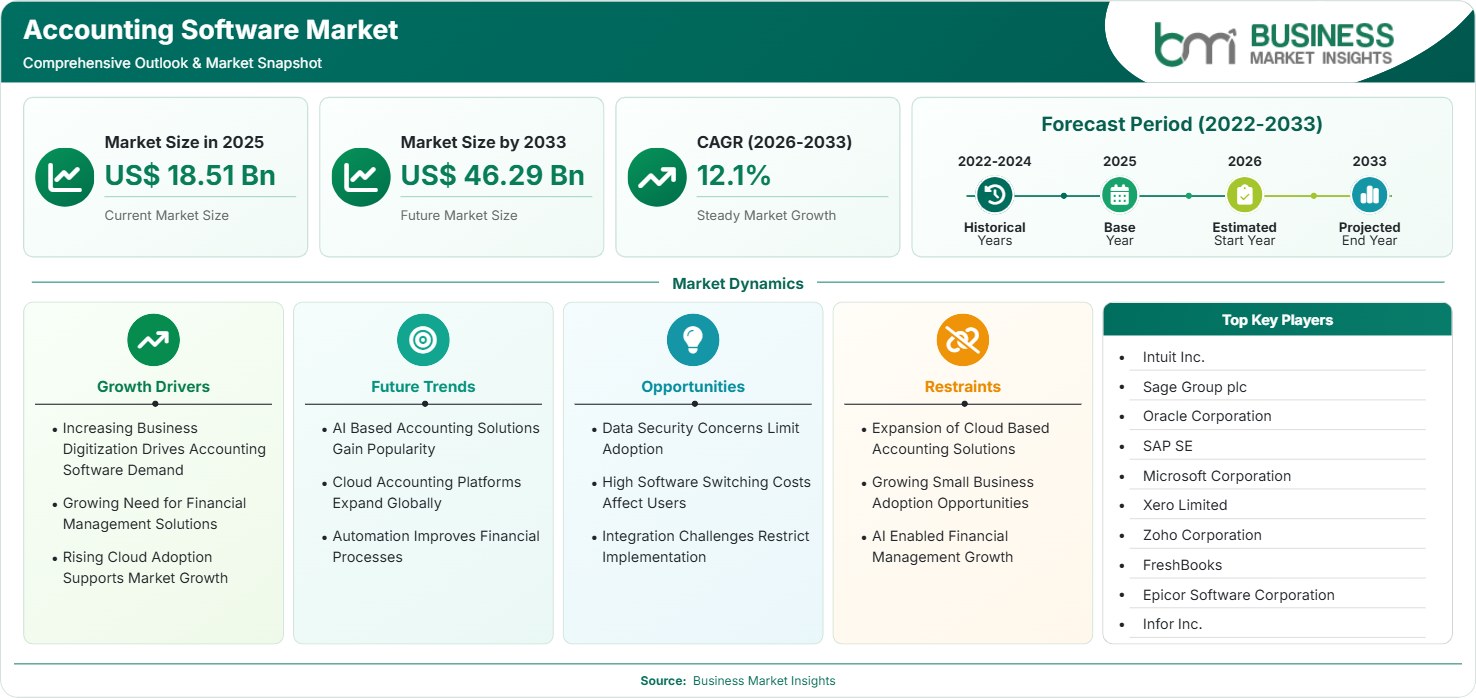
The Accounting Software Market size was valued at US$ 18.51 billion in 2025 and is projected to reach US$ 46.29 billion by 2033, growing at a CAGR of 12.1% during 2026–2033, driven by cloud adoption, automation of financial processes, digital transformation among enterprises, regulatory compliance requirements, and opportunities from AI-powered accounting platforms.

Report Coverage
  • Deployment: Cloud, On-premise
  • Enterprise Type: Small & Medium Enterprises, Large Enterprises
  • Type: General Accounting, Payroll Accounting, Tax & Compliance Accounting, Industry Specific Accounting, Others
  • End-use Industry: BFSI, Manufacturing, Retail & E-Commerce, IT & Telecom, Construction, Healthcare, Government & Public Sector, Others
US$ 18.51 Bn Market size in 2025
US$ 46.29 Bn Market Size by 2033
12.1% CAGR, 2026 - 2033
2026-2033 Forecast Period

AI Overview

Accounting Software Market Summary

  • North America Region: North America holds market share of 39%–42% in 2025, growing with a CAGR of 11.5%–12.5% influenced by cloud migration, enterprise automation, subscription-based software adoption, and advanced financial analytics opportunities. The US market demonstrates strong demand from SMEs and large enterprises, supported by digital accounting transformation with a CAGR of 11.8%–12.8% during 2026–2033.
  • Fastest Growing Region: Asia Pacific accounts for 24%–27% share in 2025, expanding with a CAGR of 13.5%–14.5% driven by SME digitization, government initiatives for financial transparency, expanding cloud infrastructure, and increasing adoption of automated accounting solutions across emerging economies.
  • Leading Segment: Cloud deployment represents 62%–65% share in 2025, progressing with a CAGR of 13.0%–14.0% due to scalability, lower infrastructure requirements, remote accessibility, automated updates, and growing preference for software-as-a-service financial platforms.
  • High Growth Segment: Tax & Compliance Accounting demonstrates strong expansion with a CAGR of 13.5%–14.5% supported by evolving regulatory requirements, automated reporting capabilities, compliance complexity, and increasing demand for accurate financial management solutions.
  • Key Market Opportunity: Integration of artificial intelligence, predictive analytics, robotic process automation, and embedded finance capabilities creates opportunities for accounting software providers to improve efficiency, decision-making, compliance management, and financial visibility.
  • Major Market Players: Intuit Inc., The Sage Group plc, Oracle Corporation, SAP SE, Microsoft Corporation, Xero Limited, Zoho Corporation, FreshBooks, Epicor Software Corporation, and Infor Inc.
Strategic Insights

Accounting Software Market: Strategic Insights

Accounting Software Market Strategic Framework
FREE PDF
Request your free sample
Request free sample
Stakeholder View

Key Takeaways

  • Accounting software technology trends are shifting away from standalone accounting programs toward a financial management ecosystem that integrates accounting, payroll, taxation, analytics, enterprise resource planning, and banking systems.
  • Small and medium enterprises are a promising segment as businesses become more reliant on cloud accounting platforms to increase efficiency, ease administration, and access professional accounting services.
  • Innovations like artificial intelligence, machine learning, and automation technologies are revolutionizing accounting by enabling intelligent reconciliations, predictive analytics, automated reporting, and compliance monitoring.
  • The Asia Pacific region offers great potential for investment due to growing SME ecosystems, cloud adoption, digital financial initiatives, and demand for cost-effective accounting solutions in developing economies.
  • Strategic alliances, acquisitions, and integrations have been growing as software companies build new competencies in financial automation, enterprise applications, payroll management, and industry-specific accounting solutions.
  • Embedded finance and open banking integration offer strategic potential for accounting platforms to expand into a wider range of financial services and connectivity solutions.
Geographic Outlook

Accounting Software Market Regional Highlights

North America Accounting Software Market

North America maintains a leading position with 39%–42% share in 2025 and a CAGR of 11.5%–12.5% from 2026–2033. The region benefits from mature software ecosystems, strong cloud adoption, advanced enterprise technology infrastructure, and widespread automation demand. Accounting Software Market share remains concentrated among established software providers serving SMEs and large enterprises.

  • The United States leads regional adoption through cloud accounting solutions, automation tools, and enterprise financial management platforms with a CAGR of 11.8%–12.8%.
  • Canada is expanding through SME technology adoption, digital tax compliance requirements, and increasing demand for cloud-based accounting solutions.
  • Businesses are integrating accounting software with enterprise resource planning and customer management platforms to improve operational visibility.
  • Financial automation adoption continues increasing as organizations seek improved accuracy and reduced manual accounting workloads.

US Accounting Software Market

The US Accounting Software Market captures 34%–37% share in 2025 and expands at a CAGR of 11.8%–12.8% during 2026–2033. The country benefits from high software adoption, strong SME presence, advanced cloud infrastructure, and increasing demand for automated financial management. Businesses are prioritizing integrated platforms that support compliance, reporting, and strategic decision-making.

  • SMEs are increasingly adopting subscription-based accounting platforms to reduce operational costs and improve financial management capabilities.
  • Large enterprises are investing in integrated accounting solutions connected with ERP, payroll, and analytics systems.
  • Regulatory reporting requirements are encouraging organizations to adopt automated compliance and tax management solutions.
  • AI-enabled accounting tools are gaining traction for reconciliation, forecasting, and financial analysis applications.

Europe Accounting Software Market

Europe accounts for 25%–28% share in 2025, expanding with a CAGR of 11.0%–12.0% through 2026–2033. The region benefits from regulatory digitization, strong enterprise software adoption, and increasing demand for automated financial processes. Germany, the United Kingdom, and France represent leading markets, while Poland demonstrates growth potential with a CAGR of 12.5%–13.5%.

  • Germany leads through enterprise software adoption, compliance requirements, and demand for integrated financial management systems.
  • The United Kingdom demonstrates strong growth through cloud accounting adoption among SMEs and professional service providers.
  • France benefits from increasing digital transformation initiatives and automated tax reporting requirements.
  • Poland is expanding through SME digitization and growing adoption of affordable cloud-based accounting platforms.
  • European businesses are increasingly prioritizing software solutions that support regulatory compliance and financial transparency.

Asia Pacific Accounting Software Market

Asia Pacific holds 24%–27% share in 2025 and records the fastest growth with a CAGR of 13.5%–14.5% during 2026–2033. The region benefits from expanding SME ecosystems, cloud infrastructure development, government digitization initiatives, and increasing technology adoption. China, India, Japan, and Southeast Asian economies represent major markets, with India achieving a CAGR of 14.0%–15.0%.

  • China is expanding through enterprise digitization, cloud adoption, and increasing demand for automated financial management solutions.
  • India benefits from SME growth, digital compliance initiatives, and rising adoption of affordable accounting platforms.
  • Southeast Asian markets are adopting cloud accounting solutions to support growing entrepreneurial ecosystems.
  • Japan is integrating accounting automation technologies to improve business efficiency and reporting accuracy.
  • Regional software investments are increasing as businesses modernize financial operations.

Rest of World Accounting Software Market

Rest of World accounts for 7%–10% share in 2025 with a CAGR of 12.5%–13.5% during 2026–2033. Latin America, the Middle East, and Africa are adopting accounting platforms through digital transformation initiatives and expanding cloud access. Brazil leads regional adoption, while the UAE demonstrates strong growth potential with a CAGR of 13.5%–14.5%.

  • Brazil is expanding through SME digitization, cloud software adoption, and increasing demand for automated accounting services.
  • Mexico benefits from business technology modernization and growing adoption of digital financial management tools.
  • Middle Eastern economies are investing in cloud infrastructure and financial technology transformation programs.
  • The UAE is advancing accounting software adoption through enterprise digitization and regulatory modernization.
  • African markets are gradually adopting affordable accounting platforms to improve business financial management capabilities.
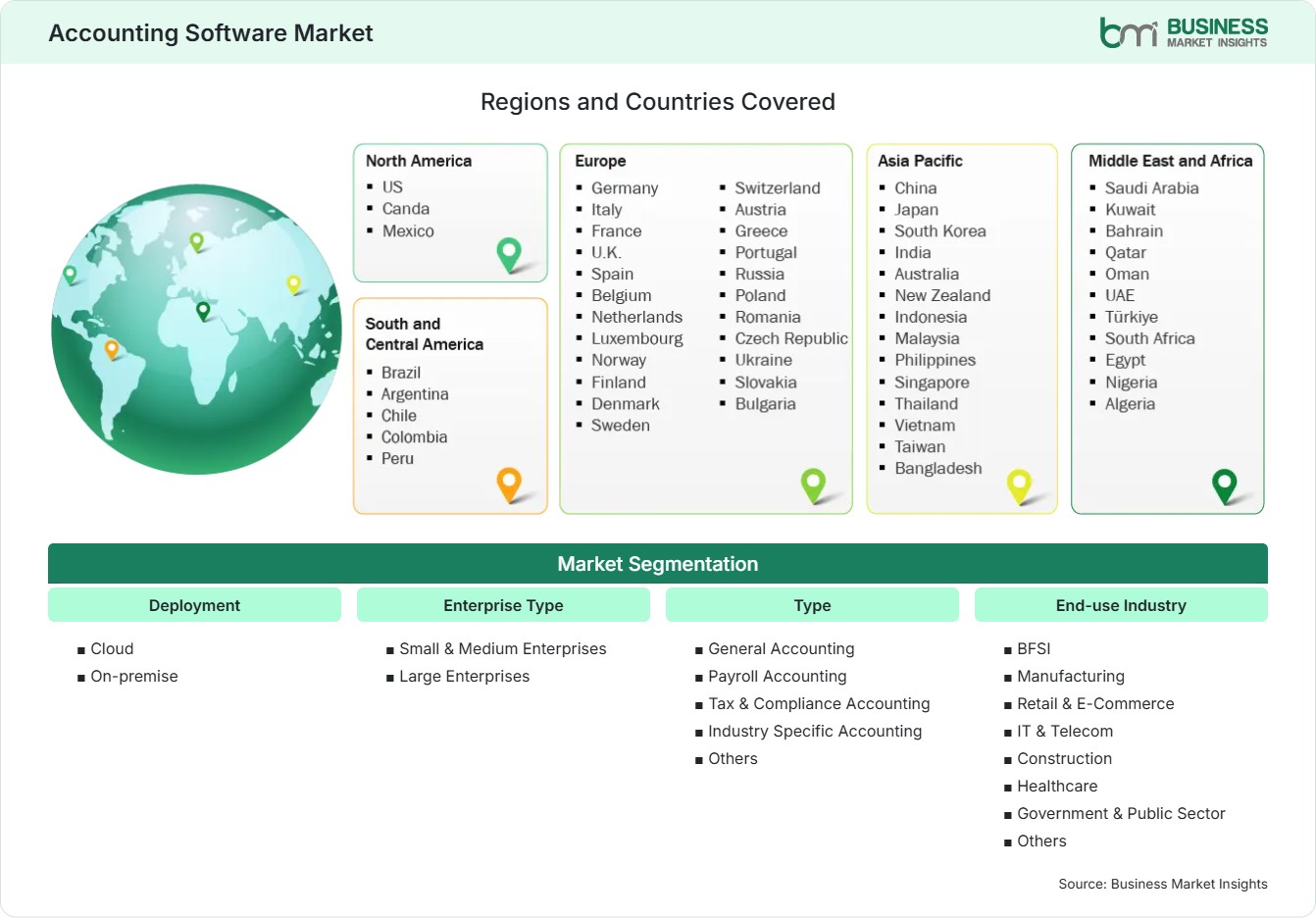
Global Market Geography
FREE PDF
Request your free sample
Request free sample
Segment Analysis

Accounting Software Market Segmentation

Deployment

The Deployment segment defines software delivery preferences across businesses, with Cloud solutions accounting for 62%–65% share in 2025 and a CAGR of 13.0%–14.0% from 2026–2033. Cloud platforms are gaining traction due to scalability, remote accessibility, lower infrastructure requirements, and automated updates. On-premise solutions continue serving organizations requiring greater control over internal systems, security policies, and customized deployment environments.

  • Cloud: Cloud-based accounting platforms enable flexible access, automatic updates, and subscription-based pricing models. Increasing SME digitization, remote work adoption, and demand for scalable financial solutions are accelerating cloud deployment.
  • On-premise: On-premise accounting software provides organizations with direct control over infrastructure, data management, and customization. Enterprises with strict security requirements and legacy systems continue adopting these solutions.

Enterprise Type

The Enterprise Type section consists of Small & Medium Enterprises (SMEs) and Large Enterprises, where Small & Medium Enterprises (SMEs) hold 58% – 61% market share by 2025, along with a CAGR of 13.0% – 14.0% during 2026 – 2033. SMEs are using cost-effective cloud accounting software for automation, while large enterprises use integrated systems for reporting and compliance.

  • Small & Medium Enterprises (SMEs): SMEs are adopting accounting software to automate bookkeeping, invoicing, payroll, and compliance activities. Affordable subscription models and simplified interfaces are improving accessibility among growing businesses.
  • Large Enterprises: Large enterprises require advanced accounting platforms integrated with ERP, analytics, and financial management systems. Demand is increasing for scalable solutions supporting complex operations and regulatory requirements.

Type

The type segment encompasses various accounting solutions, with general accounting accounting for 34%–37% of market share in 2025 and a CAGR of 11.5%–12.5% during 2026–2033. There is increasing use of specific accounting software packages to meet the needs related to payroll, taxation, regulations, and industry-specific requirements. The increased need for automation, the regulatory environment, and real-time financial information is pushing companies towards using complete accounting systems.

  • General Accounting: General accounting solutions support core financial activities including ledger management, reporting, expense tracking, and reconciliation. Businesses use these platforms to improve accuracy and streamline routine accounting operations.
  • Payroll Accounting: Payroll accounting software automates salary processing, employee records, deductions, and compliance reporting. Growing workforce complexity and regulatory requirements are increasing adoption across organizations.
  • Tax & Compliance Accounting: Tax and compliance accounting solutions help businesses manage regulatory obligations, reporting requirements, and financial documentation. Increasing compliance complexity is driving demand for automated tax management capabilities.
  • Industry Specific Accounting: Industry-specific accounting platforms provide customized functionalities aligned with sector requirements. Businesses are adopting specialized solutions to improve operational efficiency and address unique financial processes.

End-use Industry

The End-use Industry segment includes BFSI, Manufacturing, Retail & E-Commerce, IT & Telecom, Construction, Healthcare, Government & Public Sector, and Others. BFSI accounts for 22%–25% share in 2025 with a CAGR of 11.8%–12.8% from 2026–2033 due to high compliance requirements and complex financial operations. Industries are increasingly adopting accounting software to improve automation, reporting, and financial control.

  • BFSI: Financial institutions are adopting accounting platforms to improve reporting accuracy, regulatory compliance, and transaction management. Integration with analytics and automation tools supports operational efficiency.
  • Manufacturing: Manufacturers use accounting software to manage costs, inventory-related financial activities, procurement records, and operational reporting. Integrated solutions support better financial visibility across production processes.
  • Retail & E-Commerce: Retail and e-commerce businesses are adopting accounting solutions for sales tracking, inventory management, payments, and financial reporting. Digital commerce expansion is increasing demand for integrated platforms.
  • IT & Telecom: Technology companies require accounting platforms for subscription management, project accounting, revenue tracking, and global operations. Cloud-based solutions support flexible financial management across distributed teams.
  • Construction: Construction companies use accounting software for project costing, budgeting, expense tracking, and contract management. Specialized solutions improve financial planning and project profitability analysis.
  • Healthcare: Healthcare organizations are implementing accounting platforms to manage billing, financial reporting, compliance activities, and operational expenses. Automation helps improve accuracy and administrative efficiency.
  • Government & Public Sector: Government organizations adopt accounting solutions to improve transparency, reporting efficiency, budget management, and compliance with financial governance requirements.
Market Forces

Accounting Software Market Dynamics

Key Market Drivers

Increasing Business Digitization Drives Accounting Software Demand

Digital transformation efforts are rapidly gaining momentum across various companies in order to make businesses more efficient, accurate, and effective at making decisions. Companies are turning to software solutions to automate all their activities, including bookkeeping, reporting, invoicing, and compliance management. The Accounting Software Market growth is driven by increased adoption by both small and medium businesses and large corporations to ensure real-time financial transparency. Digital business models, remote work, and an increasing number of online transactions will require greater integration in accounting. Current market trends show that integration is becoming the norm, as platforms offer a full range of tools from accounting and analytics to payroll and financial planning.

Growing Need for Financial Management Solutions

Organizations are looking for financial management systems that can help them improve their budgeting, forecasting, and reporting processes. The increasing complexity of operations, along with ever-increasing regulations, is forcing companies to seek software solutions that provide greater control over their finances. Accounting applications help organizations improve the accuracy and speed of reporting and derive actionable intelligence from financial information. Organizations are now connecting their accounting applications with their ERP, customer management, and payment applications to create business ecosystems. The need for precise financial information is driving increased adoption across several industries, including retail, manufacturing, healthcare, and professional services.

Rising Cloud Adoption Supports Market Growth

Cloud adoption trends are changing how accounting software is adopted, allowing firms to use it cost-effectively and flexibly. There is no longer a need for costly infrastructure, as cloud platforms provide automated updates, greater accessibility, and improved collaboration. SMEs, in particular, are enjoying subscription-based accounting software, which lowers the cost of acquiring and managing technology. Larger organizations are also opting for cloud accounting software to operate from multiple locations and synchronize financial information across them. The development of cloud infrastructures and improved internet connections is driving the adoption of the software-as-a-service business model.

Key Market Opportunities

Expansion of Cloud Based Accounting Solutions

The expansion of cloud-based accounting solutions creates significant opportunities as businesses increasingly prefer flexible and scalable software platforms. Cloud accounting providers can capture demand by offering integrated features including automated reporting, real-time collaboration, mobile accessibility, and artificial intelligence capabilities. As acceptance grows in the small- and medium-sized business segment, a new category of customers is emerging for accounting software that operates on a subscription model. In addition, there is a demand for software services that can connect with banks, payment systems, and enterprise applications. Those who invest in cloud infrastructure and develop user-friendly interfaces, along with industry-specific application features, will gain a competitive edge in the accounting software market.

Growing Small Business Adoption Opportunities

Small businesses are emerging as a key growth area as entrepreneurs increasingly use software to streamline financial tasks. The development of affordable accounting software is allowing small businesses to streamline processes such as invoicing, expense tracking, tax filing, and financial reporting without requiring accounting skills. Software developers can increase their client base by providing user-friendly solutions, regulatory support across various locations, and flexible pricing. There have been government efforts to encourage the digitization of businesses and online finance services, which will enhance the use of accounting software.

AI Enabled Financial Management Growth

Opportunities are emerging with the advent of artificial intelligence, driven by improved automation, predictive analytics, fraud detection, and financial decision-making within accounting software. With the help of AI-based systems, businesses can automate reconciliation, categorization, and reporting processes and gain insights for business planning. There has been an increase in software companies' integration of machine learning capabilities to improve accuracy and reduce administrative workload. Intelligent accounting software is being sought after by businesses that want it to identify financial trends and enable proactive decision-making.

Market Restraints and Challenges

Data Security Concerns Limit Adoption

Factor: Increasing cyber threats, data breaches, and concerns regarding financial information protection create challenges for accounting software adoption. Impact: Organizations may delay cloud adoption or limit software use due to concerns about security breaches, compliance issues, and privacy risks. Accounting software stores companies' financial information; hence, companies need to consider security when choosing software. Software developers need to keep upgrading their products by implementing security technologies to win consumers' trust. Smaller companies with limited technical expertise may find it difficult to evaluate the software's security.

High Software Switching Costs Affect Users

Factor: Transitioning from existing accounting systems involves data migration, employee training, workflow adjustments, and integration challenges. Impact: High switching costs may prevent companies from adopting other solutions, even when those solutions offer better features or efficiency. Companies usually have processes and records that make migration difficult. When companies have customized software, they will face additional complications when moving to new software. Software providers need to ensure migration, support, and integration to reduce barriers to adoption. This situation limits market growth by prolonging customer retention with existing solutions and delaying decision-making among potential customers.

Company Analysis

Competitive Landscape

The Accounting Software Market analysis highlights a competitive environment shaped by cloud transformation, artificial intelligence integration, automation capabilities, and increasing demand for scalable financial management platforms. Market participants are targeting SMEs and large enterprises through cloud platforms, industry-specific solutions, payroll automation, tax management tools, and analytics-driven financial applications.

Company Name

Overview

Products and Services relevant to this market

Intuit Inc.

Financial software company providing accounting and business management solutions for individuals and organizations.

QuickBooks accounting software, payroll solutions, invoicing, expense management, financial analytics.

The Sage Group plc

Enterprise software provider specializing in accounting, payroll, and business management solutions.

Sage Accounting, Sage Business Cloud, payroll management, compliance solutions.

Oracle Corporation

Global technology company offering enterprise financial management and cloud applications.

Oracle Fusion Cloud Financials, ERP accounting solutions, financial analytics platforms.

SAP SE

Enterprise software provider delivering integrated business and financial management solutions.

SAP S/4HANA Finance, accounting applications, enterprise resource planning solutions.

Microsoft Corporation

Technology company providing cloud-based productivity and enterprise software solutions.

Dynamics 365 Finance, accounting integrations, business management applications.

Xero Limited

Cloud accounting software company serving small businesses and accounting professionals.

Xero accounting platform, invoicing, payroll integrations, expense management tools.

Zoho Corporation

Business software provider offering cloud-based financial and operational applications.

Zoho Books, invoicing, expense tracking, tax management, financial reporting.

FreshBooks

Accounting software provider focused on small businesses and freelancers.

Cloud accounting, invoicing, expense tracking, payment management solutions.

Epicor Software Corporation

Enterprise software company providing industry-focused business management platforms.

ERP accounting modules, financial management, industry-specific accounting solutions.

Infor Inc.

Enterprise software provider delivering industry-specific cloud applications.

Cloud financial management, ERP solutions, accounting automation platforms.

Industry Activity

Recent Developments

October 2025

Oracle Corporation introduced new AI agents within Oracle Fusion Cloud Applications to automate core finance processes, improve productivity, and provide predictive insights for finance teams. The AI enhancements support accounting functions such as payables, financial analysis, and workflow automation through embedded intelligence in Oracle’s cloud applications.

September 2025

Xero Limited launched new capabilities for its AI financial assistant Just Ask Xero (JAX), evolving it into an AI financial superagent designed to automate accounting workflows, provide business insights, and reduce manual tasks for small businesses and accountants.

June 2025

Sage Group plc expanded Sage Copilot capabilities by launching Sage Copilot for Sage X3 globally. The AI-powered assistant was introduced to help businesses improve operational visibility, decision-making, and productivity by providing insights across financial and business management processes.

January 2025

Epicor Software Corporation launched Epicor Prism, a network of vertical AI agents designed for supply chain and ERP environments. The solution integrates conversational AI capabilities into Epicor Industry ERP Cloud, including Epicor Kinetic, helping businesses access enterprise data, automate complex tasks, and improve operational decision-making across finance and business management workflows.

Trust & Transparency

Research Methodology

The market analysis combines proprietary research with secondary data from government agencies, company disclosures, regulatory filings, industry databases and expert interviews. Market estimates are validated through data triangulation, cross-market benchmarking and analyst review.

View Full Research Methodology

Questions Answered

Frequently Asked Questions

What challenges impact accounting software adoption?

Data security concerns, migration complexity, and high switching costs can limit adoption. Addressing these challenges has become an important accounting software market trend, as organizations increasingly require strong cybersecurity measures, seamless integration, and reliable migration support before transitioning from existing accounting systems.

Which business segment offers significant opportunities for accounting software providers?

Small and medium enterprises offer significant growth opportunities due to increasing digital adoption, demand for affordable financial tools, and the need to automate bookkeeping, invoicing, payroll, and compliance activities.

How is artificial intelligence influencing accounting software development?

The use of artificial intelligence in the automation of accounting can be achieved by means of intelligent reconciliation, predictive analytics, automated reporting, anomaly detection, and financial forecasting. It will definitely have a significant impact on the accounting software market forecast, as it will help companies minimize manual tasks and make better decisions.

Which deployment model is gaining higher adoption in the accounting software market report?

Cloud deployment is gaining strong adoption due to scalability, lower infrastructure requirements, subscription-based pricing, remote accessibility, and automatic software updates. SMEs and enterprises are increasingly selecting cloud platforms for flexible financial management.

What is driving the growth of the Market?

The market is driven by business digitization, increasing automation requirements, cloud adoption, regulatory compliance needs, and demand for real-time financial visibility. Organizations are replacing manual accounting processes with integrated software platforms.

Access the Full Accounting Software Market Report

Get segment-level forecasts, regional estimates, competitive benchmarking, company profiles and downloadable Excel datasets.

Access the full Accounting Software Market Report
350 pages PDF & Excel | 2026-08-03
Similar Research

Related Market Reports