Market Summary
Executive Summary and Global Market Analysis
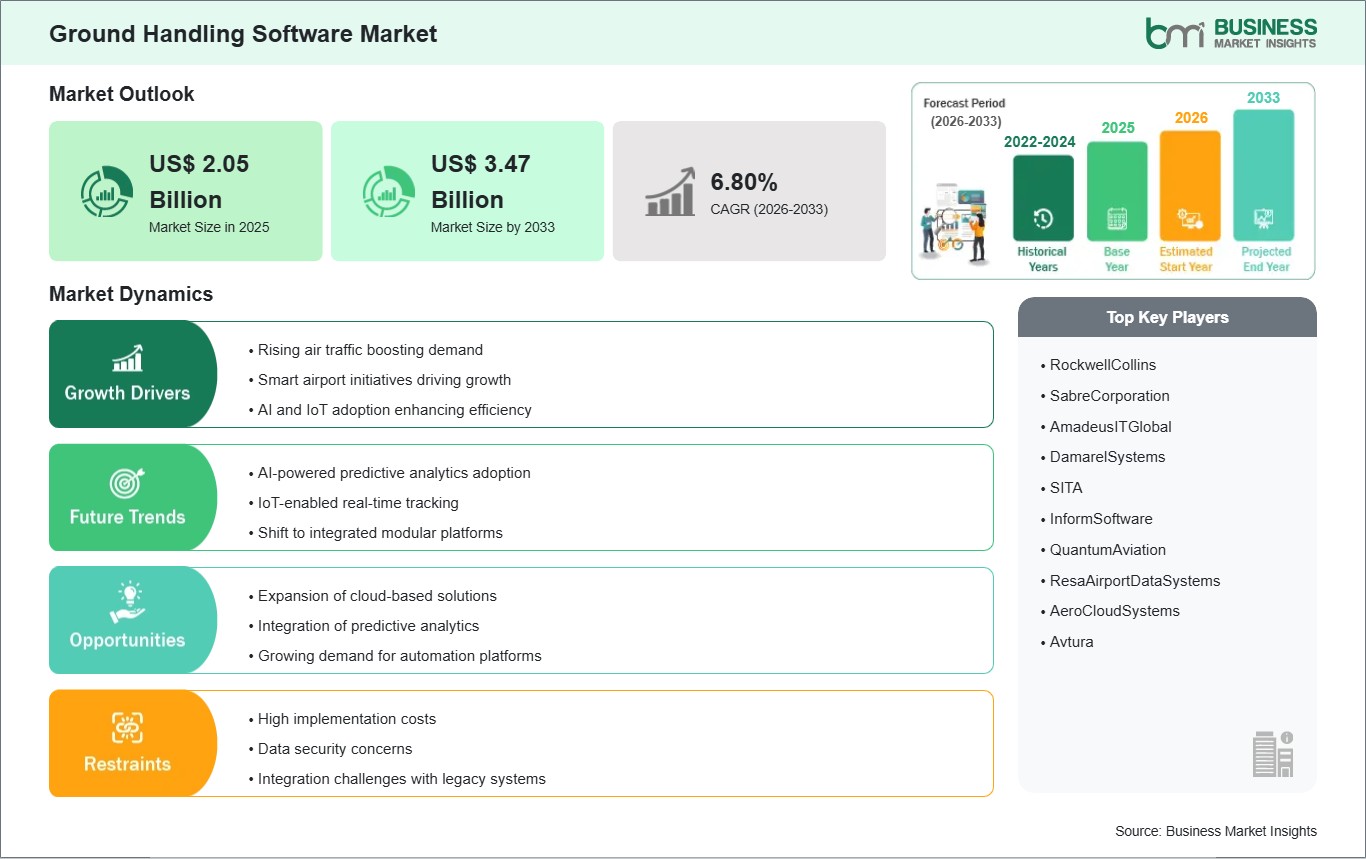
Ground handling software refers to integrated digital platforms engineered to manage and optimize airport ground operations, encompassing baggage handling, aircraft turnaround coordination, passenger processing, and resource allocation. By utilizing technologies such as real-time data analytics, cloud computing, and AI-driven predictive algorithms, these systems generate efficient, data-driven workflows that enhance operational visibility and coordination across multiple ground service providers. This technology is fundamental to the operational architecture of modern airport management, enabling faster turnaround times, reduced delays, and improved passenger experiences. Market expansion is being propelled by the rapid integration of automation solutions into airport ecosystems, the rising institutional requirement for real-time operational intelligence in smart airports, and the increasing demand for seamless coordination between airlines, ground handlers, and airport authorities.
However, several factors may restrain market progression. The high capital intensity associated with advanced software implementation, including cloud-based platforms and IoT-enabled monitoring systems, remains a primary hurdle for smaller airports and ground service providers with limited budgets. The industry also faces persistent technical challenges regarding system integration and data interoperability, as legacy airport infrastructure often lacks compatibility with modern software solutions, requiring significant customization and migration efforts. Additionally, the lack of standardized protocols across different airports and regions creates an interoperability gap that complicates seamless data exchange between disparate systems. These hurdles, compounded by cybersecurity concerns surrounding sensitive operational and passenger data, and the complexity of maintaining real-time accuracy in dynamic, high-pressure airport environments, increase the total cost of ownership and the technical risk for large-scale deployments.
Despite these hurdles, the market outlook remains highly favorable as the sector transitions toward AI-enhanced operational intelligence. Opportunities are emerging through the adoption of generative AI and edge computing; the market is witnessing the launch of ground handling platforms capable of predictive resource allocation and dynamic scheduling, allowing airports to achieve human-like operational coordination in increasingly congested environments. The expansion of smart airport initiatives is gaining significant traction, with ground handling software serving as the primary orchestration tool for real-time baggage tracking, turnaround management, and safety compliance monitoring. Furthermore, the growth of touchless passenger processing and automated cargo management aligns with global goals for enhanced public hygiene and operational efficiency in a post-pandemic aviation landscape. Collectively, these innovations position the ground handling software industry f
Segment Analysis
Ground Handling Software Market Segmentation
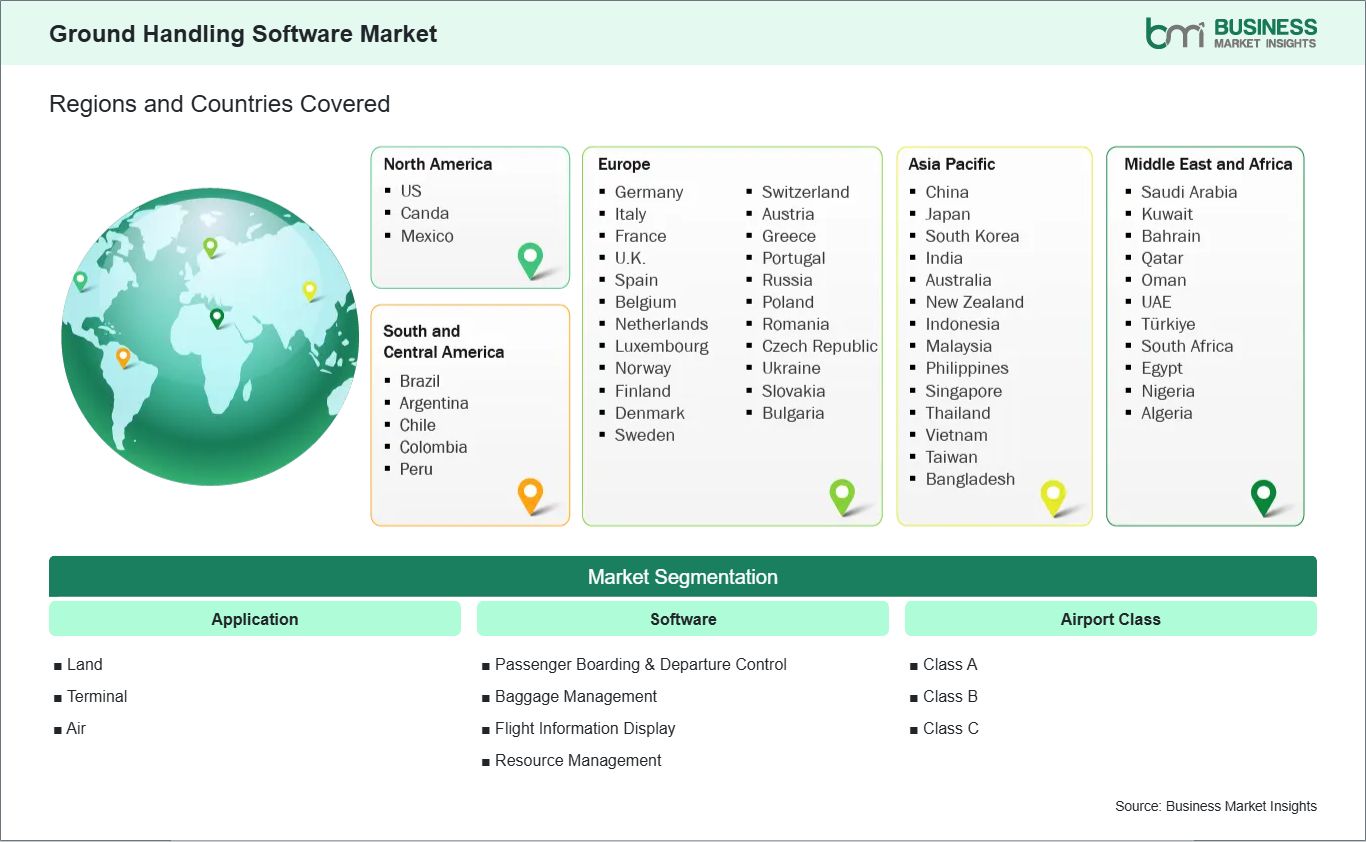
The Ground Handling Software market is segmented based on application, software type, and airport class, reflecting the growing demand for digital solutions that streamline ground operations across the aviation industry.
By Application
- Land: Manages ground support equipment (GSE) coordination, vehicle tracking, and personnel deployment across tarmac and apron areas
- Terminal: Oversees passenger check-in, security screening, boarding processes, and baggage handling within airport buildings
- Air: Coordinates aircraft turnaround activities including refueling, catering, cabin cleaning, and pushback operations
By Software
- Passenger Boarding & Departure Control: Manages check-in, boarding passes, and departure processes with real-time updates
- Passenger Boarding & Departure Control: Manages check-in, boarding passes, and departure processes with real-time updates
- Flight Information Display: Provides real-time flight status updates to passengers and staff
- Resource Management: Optimizes allocation of ground support equipment (GSE), vehicles, and personnel
By Airport Class
- Class A: Large international airports handling high passenger volumes (typically over 25 million annual passengers) requiring comprehensive, multi-module software suites
- Class B: Medium-sized regional airports (typically 5-25 million annual passengers) seeking scalable, cost-effective solutions
- Class C: Small local airports (typically under 5 million annual passengers) prioritizing essential functionalities and cloud-based deployments
Market Forces
Ground Handling Software Market Drivers and Opportunities
Rising Air Traffic Demand and Operational Efficiency Needs
The ground handling software market is being driven by the growing global demand for air travel and the corresponding need for efficient ground operations to handle increasing flight volumes, passengers, and cargo. Unlike manual or legacy systems, ground handling software automates and optimizes complex workflows, enabling faster aircraft turnaround times, reduced delays, and enhanced coordination between multiple ground service providers. Rising adoption of digital solutions by airports and airlines is amplifying demand, as stakeholders increasingly seek real-time data integration, predictive analytics, and seamless communication across operational silos. In aviation, ground handling software is being integrated into airport management systems to support baggage tracking, resource allocation, and safety compliance. Healthcare-adjacent applications such as medical cargo tracking and pharmaceutical logistics are reinforcing growth in specialized segments. Additionally, industrial automation and logistics sectors are leveraging ground handling principles for warehouse and freight management. The expansion of smart airport initiatives and digital transformation investments is further propelling adoption. Collectively, operational efficiency requirements and air traffic growth are fueling sustained expansion in the global ground handling software market.
Rising Integration of AI, IoT, and Emerging Technologies
Opportunities in the ground handling software market are expanding through the integration of artificial intelligence, Internet of Things (IoT) sensors, and cloud-based platforms. AI-enabled ground handling software is opening lucrative opportunities by delivering predictive analytics for delay prevention, automated resource optimization, and real-time anomaly detection. The growing emphasis on smart airport technologies is fueling demand for interoperable ground handling solutions that support seamless data exchange between airlines, ground handlers, and airport authorities. Emerging applications in baggage tracking are driving innovation, as IoT-enabled sensors enable real-time location monitoring and automated reconciliation. In cargo operations, ground handling software is increasingly used for chain-of-custody tracking, regulatory documentation, and warehouse optimization. Additionally, sustainability trends are encouraging deployment of energy-efficient solutions that optimize ground support equipment usage and reduce fuel consumption, aligning with global environmental goals. The expansion of connected airport ecosystems and 5G infrastructure is creating new pathways for adoption, where ground handling software integrates with smart sensors and automated vehicles to enhance turnaround efficiency. Vendors who focus on cost-effective, AI-driven, and cloud-ready solutions are well-positioned to capture growth. The convergence of AI, IoT, and smart infrastructure underscores a transformative trajectory for the global ground handling software market.
Size and Share Analysis
Ground Handling Software Market Size and Share Analysis
The Ground Handling Software Market is projected to grow from US$ 2.05 Billion in 2025 to US$ 3.47 Billion by 2033 , registering a CAGR of 6.80% from 2026 to 2033.
By application, terminal operations account for a significant share as passenger processing and baggage handling remain core priorities for airports managing growing traveler volumes. Land application continues to grow with increasing adoption of vehicle tracking and GSE optimization solutions, while air application is expanding steadily with rising focus on reducing turnaround times and improving aircraft coordination.
By software type, passenger boarding and departure control holds a substantial share due to its critical role in check-in efficiency and on-time departures. Baggage management is witnessing strong growth as airlines prioritize mishandling reduction and passenger satisfaction, while resource management software is gaining traction for optimizing ground support equipment and personnel allocation. Flight information display continues to serve essential passenger communication and operational coordination functions.
By airport class, Class A airports dominate adoption due to their complex operational requirements, high passenger volumes, and substantial IT budgets for comprehensive software suites. Class B airports are experiencing significant growth as they seek scalable, modular solutions that balance functionality with cost, while Class C airports are increasingly adopting cloud-based platforms for essential ground handling capabilities.
Report Coverage
Ground Handling Software Market Report Coverage and Deliverables
The "Ground Handling Software Market Size and Forecast (2022–2033)" report provides a detailed analysis of the market covering below areas:
- Ground Handling Software market size and forecast at global, regional, and country levels for all market segments covered under the scope
- Ground Handling Software market trends, as well as drivers, restraints, and opportunities
- Ground Handling Software market analysis covering key trends, global and regional framework, major players, regulations, and recent developments
- Industry landscape and competition analysis covering market concentration, heat map analysis, prominent players, and recent developments for the Ground Handling Software market
- Detailed company profiles, including SWOT analysis
Geographic Insights
Ground Handling Software Market Geographic Insights
The Ground Handling Software Market shows diverse regional adoption patterns influenced by advancements in airport digitalization, increasing air traffic volumes, and rising demand for operational efficiency.
North America, being a technologically advanced region with a dense aviation network, has a strong presence of leading software vendors and advanced airport infrastructure. The region comprises the United States and Canada, where investments are being made in smart airport technologies, real-time data analytics, and automated ground handling solutions. The region focuses on enhancing operational accuracy and improving passenger experiences through advanced resource management and baggage tracking systems. It has well-established aviation and technology sectors, allowing for widespread adoption of ground handling software across major hubs, regional airports, and cargo facilities.
Asia Pacific is growing significantly, driven by rapid expansion of air travel demand, increasing airport construction projects, and rising adoption of digital technologies in emerging economies. The region comprises countries such as China, India, Japan, and Australia, where airport authorities are actively integrating ground handling solutions to manage soaring passenger volumes and complex multi-terminal operations. The region focuses on improving turnaround efficiency and supporting innovation in baggage handling and passenger processing technologies. The expansion of low-cost carriers, greenfield airport investments, and government initiatives for airport modernization is also contributing to the growth of the Ground Handling Software Market, along with increasing investments in cloud-based and AI-enabled platforms.
Both regions are contributing significantly to the growth of the Ground Handling Software Market, focusing on technological advancements, increasing adoption of smart airport solutions, and rising demand for integrated ground handling systems across various end-user segments.
Report Guidance
Ground Handling Software Market Report Guidance
The report includes qualitative and quantitative data for the Ground Handling Software market across application, software type, airport class, and geography.
- The report starts with the key takeaways (chapter 2), highlighting the key trends and outlook of the Ground Handling Software market.
- Chapter 3 focuses on the research methodology of the study.
- Chapter 4 includes ecosystem analysis.
- Chapter 5 highlights the major industry dynamics in the Ground Handling Software market, including factors that are driving the market, prevailing deterrents, potential opportunities, as well as future trends. Impact analysis of these drivers and restraints is also covered in this section.
- Chapter 6 discusses the Ground Handling Software market scenario, in terms of historical market revenues, and forecast till the year 2033.
- Chapters 7 to 10 cover Ground Handling Software market segments by application, software type, airport class, and geography across North America, Europe, Asia Pacific, Middle East and Africa, and South and Central America. They cover the market revenue, forecast, and factors driving the market.
- Chapter 11 describes the competitive analysis along with the heat map analysis for the key players operating in the market.
- Chapter 12 describes the industry landscape analysis. It provides detailed descriptions of business activities such as market initiatives, new developments, mergers, and joint ventures globally, along with a competitive landscape.
- Chapter 13 provides detailed profiles of the major companies operating in the Ground Handling Software market. Companies have been profiled on the basis of their key facts, business descriptions, products and services, financial overview, SWOT analysis, and key developments.
- Chapter 14, i.e., the appendix, is inclusive of a brief overview of the company, list of abbreviations, and disclaimer.
Industry Activity
Recent Developments
The Ground Handling Software market is evaluated by gathering qualitative and quantitative data post primary and secondary research, which includes important corporate publications, association data, and databases. A few of the key developments in the Ground Handling Software market are:
- In April 2025, NextGen Ground Handling Services (NextGen GHS), a leading provider of ground support solutions, today announced the launch of its proprietary NexOps software platform that provides real-time reporting to its airline carrier partners on the status of all ground handling operations. NextGen GHS has initially deployed its first-of-a-kind ground handling software in four of its airport locations: Austin (AUS); Portland, OR (PDX); Richmond, VA (RIC) and Seattle (SEA).
- In September 2025, Luxcargo Handling, a subsidiary of Cargolux the largest all-cargo airline in Europe and flag carrier for Luxembourg, has partnered with IBS Software to digitally update and streamline its ground handling operations. Luxcargo Handling, with an annual capacity up to 1,200,000 tons of cargo, will implement iCargo CTO (Cargo Terminal Operations) to update legacy systems for their core ground handling operations.
Trust & Transparency
Research Methodology
The market analysis combines proprietary research with secondary data from government agencies, company disclosures, regulatory filings, industry databases and expert interviews. Market estimates are validated through data triangulation, cross-market benchmarking and analyst
review.
View Full Research Methodology
Key Sources Referred:
World Bank – Global Trade Indicators
World Trade Organization (WTO)
International Monetary Fund (IMF)
International Trade Administration (ITA)
Company Websites
Company Annual Reports
Company Investor Presentations