
Engineering Software Market Outlook: Size, Share, Trends, Growth Analysis, Competitive Landscape & Forecast, 2026-2033

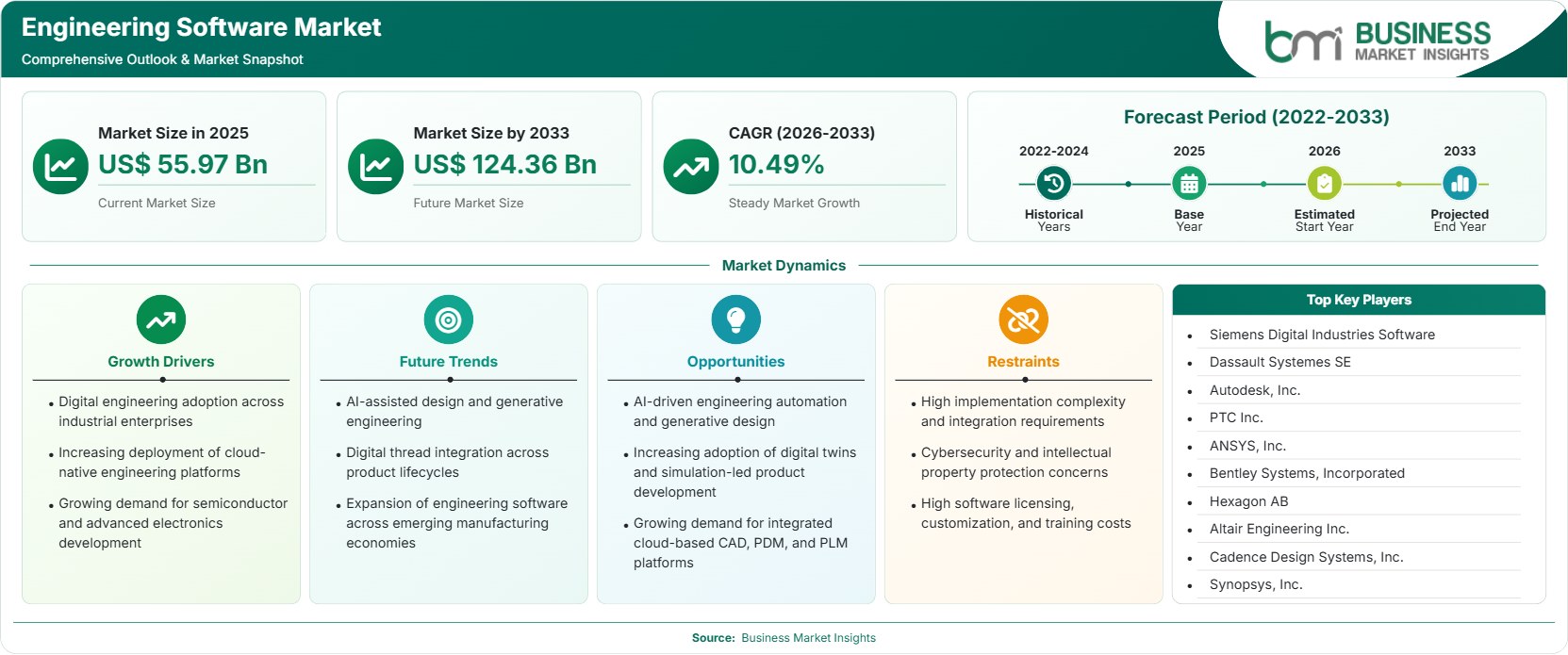
The Engineering Software Market size was valued at US$ 55.97 Billion in 2025 and is projected to reach US$ 124.36 Billion by 2033, growing at a CAGR of 10.49% during 2026–2033. Growth is supported by digital engineering adoption, cloud-native design environments, digital twins, AI-assisted product development, simulation-led innovation, and increasing lifecycle management investments across industrial sectors.

Report Coverage
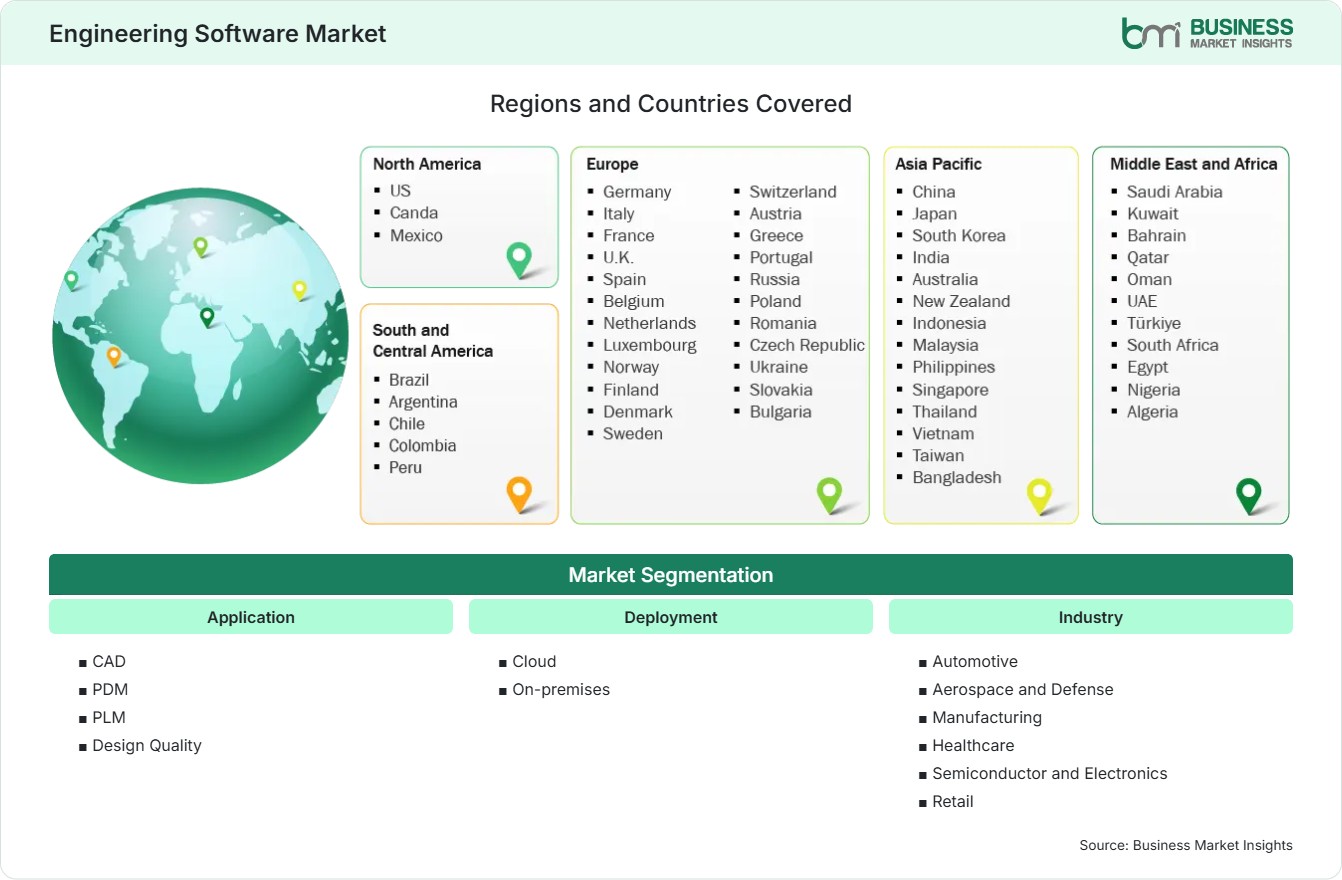
  • Application: CAD, PDM, PLM, Design Quality
  • Deployment: Cloud, On-premises
  • Industry: Automotive, Aerospace and Defense, Manufacturing, Healthcare, Semiconductor and Electronics, Retail
US$ 55.97 Bn Market size in 2025
US$ 124.36 Bn Market Size by 2033
10.49% CAGR, 2026 - 2033
2026-2033 Forecast Period

AI Overview

Engineering Software Market Summary

  • North America Region: North America holds a market share of 36%–39% in 2025, growing with a CAGR of 9.4%–10.2% during 2026–2033. Demand is supported by aerospace digitization, smart manufacturing, industrial software modernization, simulation investments, and expanding digital twin deployment. The U.S. market dominates regional demand through advanced manufacturing programs, engineering digitization, and product innovation initiatives, expanding at 9.6%–10.4% CAGR.
  • Fastest Growing Region: Asia Pacific holds a market share of 28%–31% in 2025 and grows at a CAGR of 11.8%–12.8%. Expanding manufacturing capacity, industrial automation, semiconductor investments, engineering outsourcing, and government-backed digital transformation programs continue accelerating enterprise software adoption.
  • Leading Segment: CAD accounts for 34%–37% market share in 2025 and advances at a CAGR of 9.8%–10.6%. Product design modernization, collaborative engineering workflows, cloud accessibility improvements, and demand for digital prototyping continue reinforcing adoption across industries globally.
  • High Growth Segment: Cloud deployment represents 44%–47% share in 2025 and expands at a CAGR of 12.5%–13.5%. Scalability benefits, remote collaboration, subscription pricing, faster implementation, and AI-enabled engineering workflows continue attracting enterprises of varying sizes.
  • Key Market Opportunity: Digital thread integration across design, manufacturing, quality, simulation, and service operations creates opportunities for unified data management, predictive engineering decisions, lifecycle visibility, efficiency improvements, and recurring software revenues.
  • Major Market Players: Siemens Digital Industries Software, Dassault Systèmes SE, Autodesk, Inc., PTC Inc., ANSYS, Inc., Bentley Systems, Incorporated, Hexagon AB, Altair Engineering Inc., Cadence Design Systems, Inc., Synopsys, Inc.
Strategic Insights

Engineering Software Market: Strategic Insights

Engineering Software Market Strategic Framework
FREE PDF
Request your free sample
Request free sample
Stakeholder View

Key Takeaways

  • The value chain is moving toward integrated platforms connecting design, simulation, data management, manufacturing execution, and lifecycle intelligence through shared engineering datasets.
  • Cloud-based deployment and PLM modernization present the strongest medium-term upside as enterprises seek scalable and collaborative engineering environments.
  • AI-assisted design automation, generative engineering, and digital twins are reshaping product development cycles and reducing design iteration timelines.
  • Asia Pacific offers the strongest investment case due to expanding electronics manufacturing, automotive production, and industrial digitalization initiatives.
  • Strategic acquisitions increasingly focus on simulation technologies, cloud engineering platforms, manufacturing intelligence, and digital thread capabilities.
  • Engineering teams are prioritizing interoperability between CAD, PDM, PLM, and quality systems to improve operational efficiency and regulatory compliance.
Geographic Outlook

Engineering Software Market Regional Highlights

North America Engineering Software Market

North America accounts for 36%–39% Engineering Software Market share in 2025 and is projected to expand at a CAGR of 9.4%–10.2% through 2033. The region benefits from advanced aerospace, defense, automotive, electronics, and industrial manufacturing sectors. Strong software spending, extensive cloud adoption, mature engineering workflows, and digital twin investments support sustained demand. Enterprise modernization initiatives continue improving deployment of integrated design, simulation, and lifecycle management platforms across multiple industries.

  • Aerospace manufacturers increasingly adopt simulation-driven engineering, digital twins, and model-based systems engineering to accelerate product development and certification requirements.
  • Automotive companies are expanding software-driven vehicle development processes that demand integrated design, validation, and lifecycle management environments.
  • Strong industrial automation investment supports engineering platform upgrades across manufacturing and infrastructure sectors.
  • Growing cybersecurity and compliance requirements encourage deployment of enterprise-grade engineering software ecosystems.
  • Research-intensive industries continue prioritizing collaborative cloud engineering capabilities to support globally distributed development teams.

US Engineering Software Market

The U.S. represents approximately 78%–82% of regional revenue and is expected to record 9.6%–10.4% CAGR through 2033. Strong demand originates from aerospace innovation, semiconductor design, electric vehicle development, and industrial modernization programs. Advanced digital infrastructure, extensive R&D activity, and technology leadership encourage adoption of sophisticated engineering tools. Large enterprises increasingly integrate product lifecycle management, simulation, and quality management capabilities into unified digital engineering architectures.

  • Federal manufacturing initiatives support wider digital engineering adoption.
  • Semiconductor investments generate demand for advanced design automation solutions.
  • Defense modernization increasingly relies on model-based engineering frameworks.
  • Cloud-native engineering collaboration is becoming standard across multinational development environments.

Europe Engineering Software Market

Europe holds 24%–27% market share in 2025 and is forecast to grow at 9.8%–10.8% CAGR. Regional demand is supported by automotive engineering, industrial automation, sustainability-focused product design, and advanced manufacturing initiatives. Germany remains the leading market, while Eastern European countries demonstrate higher growth trajectories. Regulatory emphasis on product traceability, environmental compliance, and lifecycle assessment strengthens demand for integrated engineering platforms supporting digital thread strategies across industrial sectors.

  • Germany leads regional adoption, supported by Industry 4.0 investments and advanced manufacturing ecosystems.
  • France benefits from aerospace engineering programs and high-value industrial innovation activities.
  • Italy continues increasing adoption among machinery and industrial equipment manufacturers.
  • Poland records among the fastest regional growth rates, supported by manufacturing expansion.
  • Sustainability mandates increase investment in lifecycle design and product compliance software.

Asia Pacific Engineering Software Market

Asia Pacific represents 28%–31% of the market in 2025 and is expected to achieve the fastest CAGR of 11.8%–12.8%. Expanding manufacturing output, semiconductor fabrication investments, industrial automation programs, and growing engineering outsourcing activities support strong demand. China accounts for the largest regional revenue contribution, while India and Southeast Asian economies demonstrate rapid growth. Engineering digitization initiatives and smart manufacturing roadmaps continue accelerating software procurement decisions across numerous verticals.

  • China remains the largest adopter through manufacturing digitization and industrial modernization investments.
  • India benefits from engineering services expansion and increasing software development capabilities.
  • Japan continues emphasizing precision manufacturing and simulation-led product development.
  • South Korea supports growth through semiconductor and advanced electronics production investments.
  • Southeast Asia gains momentum from expanding industrial production and foreign direct investment inflows.

Rest of World Engineering Software Market

Rest of World accounts for 8%–11% market share and is projected to grow at 10.2%–11.2% CAGR. South and Central America are benefiting from industrial modernization and infrastructure development projects. Middle East and Africa markets are supported by energy, construction, transportation, and smart city initiatives. Growing awareness regarding lifecycle management, engineering efficiency, and digital transformation is encouraging broader software deployment across industrial enterprises and public infrastructure programs.

  • Brazil leads Latin American demand through industrial manufacturing and energy sector digitization.
  • Mexico benefits from automotive production and cross-border manufacturing integration.
  • Saudi Arabia increases software adoption through industrial diversification initiatives.
  • United Arab Emirates expands investment in infrastructure and smart city programs.
  • South Africa remains an important regional market supported by industrial modernization activities.
Global Market Geography
FREE PDF
Request your free sample
Request free sample
Segment Analysis

Engineering Software Market Segmentation

Application

Application solutions account for core industry demand. CAD remains the dominant category with 34%–37% share in 2025, while advanced lifecycle-focused applications continue gaining traction. Segment expansion is supported by complexity in product development, simulation requirements, collaborative engineering practices, and data-driven decision-making. CAGR ranges between 9.8% and 11.8% across major application categories. The Engineering Software Market scope continues expanding through broader enterprise integration.

  • CAD: Widely adopted for product design, drafting, visualization, and digital prototyping across automotive, aerospace, manufacturing, and electronics sectors.
  • PDM: Supports centralized engineering data control, revision management, collaboration workflows, and configuration management across distributed teams.
  • PLM: Enables lifecycle visibility, cross-functional collaboration, compliance management, and digital thread implementation throughout product development.
  • Design Quality: Addresses validation, compliance, quality assurance, testing coordination, and continuous improvement requirements within engineering environments.

Deployment

Deployment preferences continue evolving as enterprises balance security, scalability, and collaboration requirements. Cloud deployment holds 44%–47% share in 2025 and exhibits the strongest growth trajectory at 12.5%–13.5% CAGR. Organizations increasingly favor flexible implementation models supporting remote engineering collaboration, integrated data access, and subscription-based procurement approaches while maintaining compliance and governance standards.

  • Cloud: Improves accessibility, collaborative engineering, implementation speed, scalability, and integration with artificial intelligence functionality.
  • On-premises: Preferred in highly regulated sectors requiring extensive customization, data control, security management, and established infrastructure investments.

Industry

Industry adoption patterns differ according to product complexity, compliance obligations, and innovation intensity. Manufacturing and automotive collectively account for the largest revenue contribution with shares ranging between 38%–42%, while healthcare and semiconductor sectors register stronger growth rates. The paragraph reflects ongoing Engineering Software Market trends driven by digital product development and lifecycle management adoption.

  • Automotive: Accelerates utilization for vehicle design, simulation, electrification programs, and software-defined product development.
  • Aerospace and Defense: Relies on engineering platforms for validation, certification support, digital twins, and systems engineering.
  • Manufacturing: Uses integrated design and lifecycle management solutions to improve productivity and product quality.
  • Healthcare: Supports medical device engineering, compliance requirements, and traceability management across development processes.
  • Semiconductor and Electronics: Requires sophisticated design automation, simulation workflows, and product complexity management capabilities.
  • Retail: Utilizes engineering and product development software for product design, packaging innovation, and lifecycle coordination.
Market Forces

Engineering Software Market Dynamics

Key Market Drivers

Digital Twin Adoption Across Industrial Enterprises

Artificial intelligence is creating opportunities to automate design iterations, optimize simulation parameters, identify quality risks, and generate engineering recommendations. AI is becoming more common among the design, lifecycle management, and validation tools being used by vendors. This enhances efficiency in engineering and eliminates repetitive activities. Companies that embrace AI-driven processes will cut down on their time to market and improve the quality of decisions made. This technological advancement will drive future growth in the market and create revenue streams through high-end software subscriptions and engineering experiences.

Cloud-native Lifecycle Management Platforms

Investment in Cloud-Native Engineering Architectures Is Still Worthwhile. Companies require central access to systems, the ability to work collaboratively, and scalability for operations globally. Cloud provides quick deployment and reduces the burden of infrastructure, allowing analytics and integration of AI technology. Engineering Software Market Forecasts indicate continued migration from legacy environments toward integrated lifecycle management ecosystems. Vendors capable of delivering secure and interoperable cloud services are positioned to capture significant revenue opportunities over the coming years.

Growing Demand from Semiconductor Development

Large-scale investments in semiconductor manufacturing and electronics innovation are increasing demand for advanced engineering and design automation tools. The increase in chip complexity, small technology nodes, and the fast turnaround of products necessitate effective software. The governments of North America, Europe, and Asia Pacific keep on providing support to semiconductor value chains via their strategic financing programs. This creates a positive environment for the engineering software companies that provide services such as simulation and design automation, among others.

Market Restraints and Challenges

High Implementation Complexity and Integration Requirements

Factor: Deployment frequently requires integration with legacy ERP, manufacturing, and engineering systems. Impact: The organization could face longer implementation periods, higher costs of consulting services, and training expenses for staff members. Long implementation periods reduce the return on investment, especially when dealing with SMEs. Integration, interoperability issues, and customized solutions raise risks in such projects. Despite the benefits that come with implementing such technologies in the long run, some implementation hurdles could affect their adoption and purchase decisions.

Cybersecurity and Intellectual Property Protection Concerns

Factor: Engineering environments store proprietary designs, product data, simulations, and manufacturing information. Impact: Security issues could slow down migration to cloud computing in some industries. As cybersecurity threats continue to rise, companies must keep investing in governance, encryption, access controls, and compliance systems. Businesses handling crucial intellectual property have been adopting conservative approaches. Such factors can take time and complicate processes, especially for companies in sectors such as aerospace, defense, health care, and advanced manufacturing.

Company Analysis

Competitive Landscape

The competitive environment is characterized by platform consolidation, cloud innovation, simulation advancement, and lifecycle integration. This Engineering Software Market analysis highlights leading participants.

Company Name

Overview

Products and Services relevant to this market

Siemens Digital Industries Software

Global engineering software leader with strong digital twin and lifecycle management capabilities.

NX, Teamcenter, Simcenter, digital twin solutions, manufacturing software.

Dassault Systèmes SE

Major provider of integrated design and lifecycle management platforms.

CATIA, SOLIDWORKS, ENOVIA, DELMIA, 3DEXPERIENCE platform.

Autodesk, Inc.

Leading design software company serving industrial and manufacturing users.

AutoCAD, Fusion, Inventor, cloud collaboration tools.

PTC Inc.

Specializes in lifecycle management and digital thread solutions.

Creo, Windchill, Arena, model-based engineering tools.

ANSYS, Inc.

Prominent engineering simulation and digital engineering provider.

Structural, fluid, electronics, and systems simulation solutions.

Bentley Systems, Incorporated

Infrastructure-focused engineering software specialist.

MicroStation, OpenRoads, digital infrastructure engineering tools.

Hexagon AB

Industrial technology company with engineering design capabilities.

CADWorx, simulation, manufacturing intelligence solutions.

Altair Engineering Inc.

Focused on simulation, AI, and high-performance computing.

Altair HyperWorks, simulation and optimization platforms.

Cadence Design Systems, Inc.

Electronic design and computational software company.

Semiconductor design, system analysis, digital engineering tools.

Synopsys, Inc.

Major provider of design automation software solutions.

EDA platforms, verification tools, semiconductor engineering software.

Trust & Transparency

Research Methodology

The market analysis combines proprietary research with secondary data from government agencies, company disclosures, regulatory filings, industry databases and expert interviews. Market estimates are validated through data triangulation, cross-market benchmarking and analyst review.

View Full Research Methodology

Questions Answered

Frequently Asked Questions

What does the Engineering Software Market Report cover?

The report evaluates market size, growth outlook, regional dynamics, deployment models, applications, industry adoption patterns, competitive positioning, opportunities, restraints, and future strategic developments.

How does PLM enhance engineering operations?

PLM centralizes product information, improves collaboration, strengthens traceability, supports compliance management, and enables digital thread implementation across product development and service lifecycles.

Which industries generate the highest demand?

Automotive, aerospace and defense, manufacturing, semiconductor and electronics, and healthcare industries account for significant demand due to extensive design, simulation, compliance, and lifecycle management requirements.

Which deployment model is growing the fastest?

Cloud deployment is registering the strongest growth because it supports scalability, collaborative engineering, subscription-based access, and integration with advanced analytics and artificial intelligence capabilities.

What is driving adoption of engineering software across industries?

Increasing product complexity, digital twins, AI-assisted design, smart manufacturing initiatives, and lifecycle management requirements are encouraging organizations to expand engineering software investments.

Access the Full Engineering Software Market Report

Get segment-level forecasts, regional estimates, competitive benchmarking, company profiles and downloadable Excel datasets.

Access the full Engineering Software Market Report
350 pages PDF & Excel | 2026-08-27