
Application Development Software Market Outlook: Size, Share, Trends, Growth Analysis, Competitive Landscape & Forecast, 2026-2033

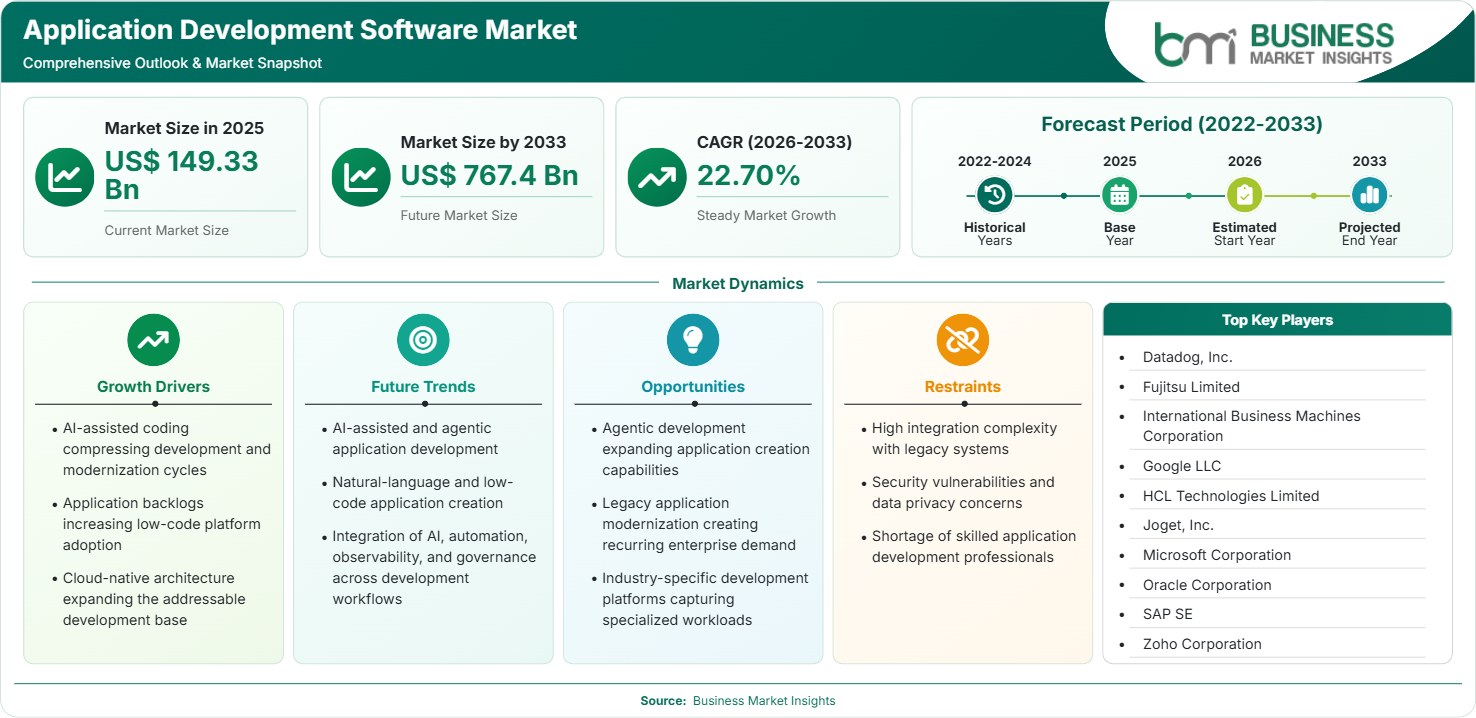
The Application Development Software Market size was valued at US$ 149.33 Billion in 2025 and is projected to reach US$ 767.4 Billion by 2033, growing at a CAGR of 22.70% during 2026–2033, driven by AI-assisted coding, cloud modernization, low-code adoption, application backlogs, and enterprise demand for faster digital delivery.

Report Coverage
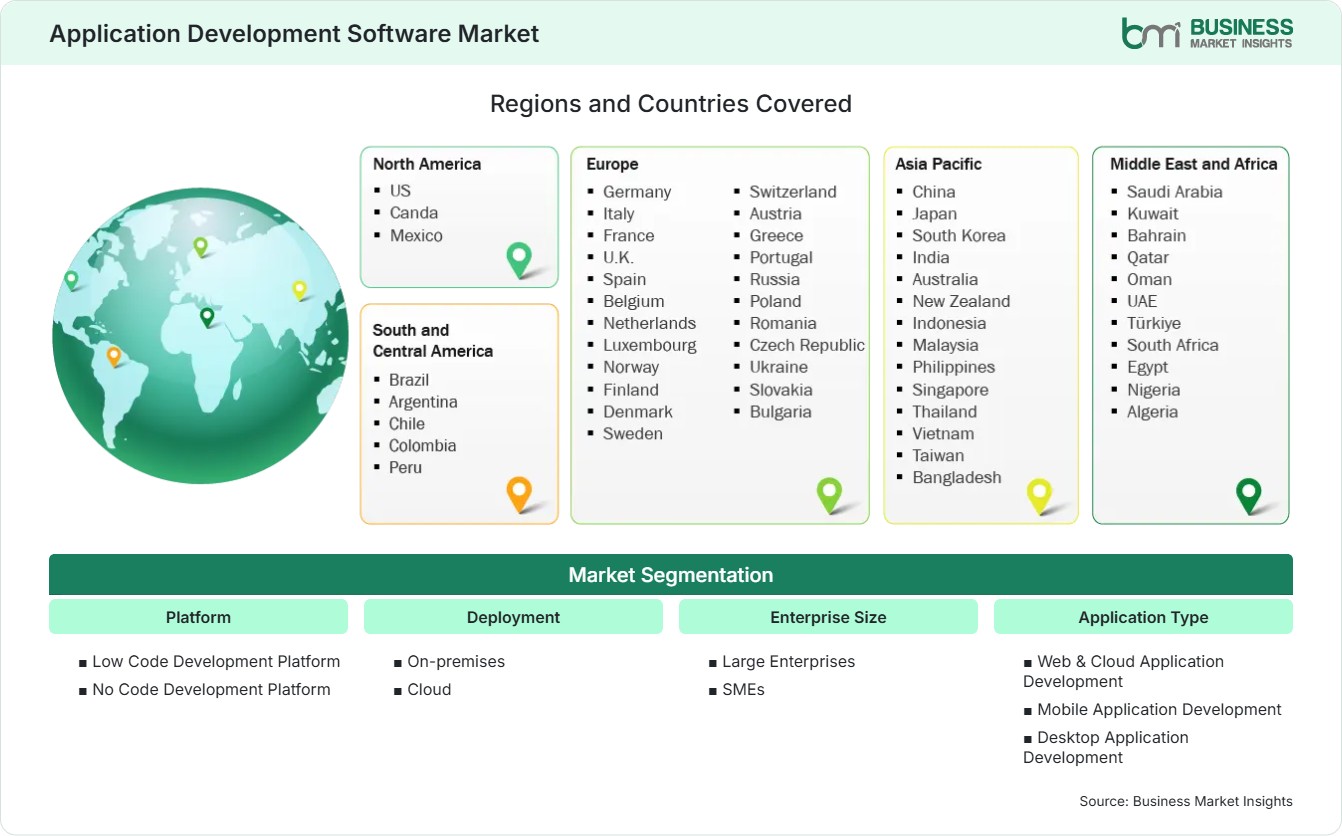
  • Platform: Low Code Development Platform, No Code Development Platform
  • Deployment: On-premises, Cloud
  • Enterprise Size: Large Enterprises, SMEs
  • Application Type: Web & Cloud Application Development, Mobile Application Development, Desktop Application Development
  • Industry: BFSI, Healthcare & Pharma, IT and Telecom, Media and Entertainment, Retail & E-commerce, Travel and Tourism, Education, Government
US$ 149.33 Bn Market size in 2025
US$ 767.4 Bn Market Size by 2033
22.70% CAGR, 2026 - 2033
2026-2033 Forecast Period

AI Overview

Application Development Software Market Summary

  • North America Region: North America holds a market share of 33%–35% in 2025, growing with a CAGR of 20%–22% during 2026–2033, influenced by enterprise cloud migration, AI coding, developer shortages, modernization, cybersecurity, platform consolidation, and strong software investment. The US market remains the regional anchor, with 20%–22% CAGR, supported by AI-native development, cloud platforms, and enterprise application modernization.
  • Fastest Growing Region: Asia Pacific holds a market share of 25%–28% in 2025, growing with a CAGR of 24%–26% during 2026–2033, supported by digital transformation, expanding developer communities, cloud adoption, mobile-first services, government digitization, and increasing enterprise investment.
  • Leading Segment: Low Code Development Platform holds a market share of 58%–62% in 2025, growing with a CAGR of 21%–23% during 2026–2033, driven by application backlogs, citizen development, workflow automation, reusable components, faster delivery cycles, and enterprise modernization.
  • High Growth Segment: Mobile Application Development holds a market share of 24%–27% in 2025, growing with a CAGR of 25%–28% during 2026–2033, supported by mobile commerce, digital banking, connected services, personalized experiences, cross-platform frameworks, and AI-enabled development.
  • Key Market Opportunity: AI-assisted development is widening the addressable market by allowing professional developers and business users to translate natural-language requirements into applications, workflows, integrations, tests, and deployment assets with stronger governance.
  • Major Market Players: Datadog, Inc.; Fujitsu Limited; International Business Machines Corporation; Google LLC; HCL Technologies Limited; Joget, Inc.; Microsoft Corporation; Oracle Corporation; SAP SE; Zoho Corporation.
Strategic Insights

Application Development Software Market: Strategic Insights

Application Development Software Market Strategic Framework
FREE PDF
Request your free sample
Request free sample
Stakeholder View

Key Takeaways

  • The value chain is consolidating around platforms that combine development environments, AI assistants, application lifecycle management, integration, deployment, monitoring, security, and governance. Vendors with broad enterprise ecosystems can cross-sell development capabilities into existing cloud, data, ERP, CRM, and observability relationships.
  • Low-code platforms remain the largest adoption pool, while mobile and AI-enabled application creation provide stronger upside. Financial services, healthcare, retail, and government are particularly attractive because application demand is continuous and process-specific.
  • Natural-language development is becoming an interface layer above visual builders and conventional coding. The competitive frontier is moving toward agentic development, automated testing, application understanding, code modernization, API orchestration, and governance rather than simple drag-and-drop construction.
  • Asia Pacific presents the strongest expansion case because enterprises are simultaneously digitizing customer services, government processes, manufacturing operations, financial channels, and mobile ecosystems. India, China, and Southeast Asian markets provide substantial developer and enterprise adoption pools.
  • Strategic investment is increasingly directed toward AI coding, application modernization, observability, workflow automation, and platform integration. Buyers are prioritizing technologies that shorten development cycles while preserving security, lifecycle visibility, and enterprise governance.
  • Platform interoperability is becoming a purchasing criterion. Vendors that support APIs, hybrid deployment, multiple programming languages, external databases, enterprise identity, and extensibility can reduce switching barriers and address both citizen developers and professional engineering teams.
Geographic Outlook

Application Development Software Market Regional Highlights

North America Application Development Software Market

North America holds a 33%–35% Application Development Software Market share in 2025 and is projected to record 20%–22% CAGR during 2026–2033. The region benefits from mature cloud infrastructure, high enterprise software spending, AI investment, developer-tool adoption, and extensive modernization requirements. The US accounts for most regional demand, while Canada contributes through financial services, public-sector digitization, and technology investment. Application development software adoption is increasingly connected with AI governance, observability, DevSecOps, and enterprise integration rather than standalone application building. The region remains the principal commercialization center for emerging development technologies.

  • Enterprise buyers increasingly combine low-code tools with professional development environments to address application backlogs without compromising customization, security, or integration requirements.
  • AI coding assistants are expanding development capacity by automating documentation, testing, code generation, debugging, modernization, and repetitive engineering activities across large software estates.
  • Cloud-native application development remains a core demand driver as enterprises modernize legacy workloads and connect applications with APIs, data platforms, analytics, and AI services.
  • Strong venture and enterprise technology investment supports experimentation with agentic development, while governance requirements increasingly determine which AI development capabilities reach production environments.

US Application Development Software Market

The US represents approximately 78%–82% of North American Application Development Software Market demand in 2025, equivalent to roughly 26%–29% of global demand, and is projected to expand at 20%–22% CAGR during 2026–2033. Its position reflects concentrated software investment, hyperscale cloud infrastructure, large developer communities, and strong enterprise adoption of AI-enabled tools. Financial institutions, healthcare providers, retailers, manufacturers, and government agencies increasingly prioritize application modernization and automation. The US also provides the strongest environment for platform experimentation, enterprise partnerships, and commercialization of AI-assisted development technologies.

  • Large enterprises are embedding AI assistants into application lifecycle processes, increasing emphasis on code quality, security controls, testing automation, and explainability.
  • Cloud providers and enterprise software vendors increasingly combine application development with data, AI, workflow, identity, and observability services, creating integrated purchasing environments.
  • Demand for modernization tools remains strong because organizations must extend legacy applications while progressively migrating selected workloads toward cloud-native architectures.

Europe Application Development Software Market

Europe accounts for a 27%–29% Application Development Software Market share in 2025 and is projected to register 21%–23% CAGR during 2026–2033. Germany, the UK, France, and the Netherlands represent leading adoption centers, while Poland, Spain, and the Nordic countries offer strong expansion potential. Application development software demand is shaped by industrial digitization, financial technology, healthcare modernization, and public-sector transformation. Data protection, cybersecurity, accessibility, and AI governance requirements encourage buyers to prioritize platforms with strong lifecycle controls. The region’s industrial base also supports development demand for connected operations and enterprise applications.

  • Germany remains a leading market because manufacturers require applications linking production systems, enterprise resource planning, industrial data, and automation workflows.
  • The UK provides strong demand from financial services and technology companies, with development platforms increasingly supporting automation, customer applications, and regulated digital services.
  • France and the Netherlands benefit from public-sector modernization, cloud adoption, and expanding digital business models requiring secure application development environments.
  • Poland and Nordic economies provide high-growth opportunities through software engineering capacity, digital public services, and enterprise cloud transformation.

Asia Pacific Application Development Software Market

Asia Pacific holds a 25%–28% Application Development Software Market share in 2025 and is forecast to achieve 24%–26% CAGR during 2026–2033, making it the fastest-growing region. China, Japan, India, South Korea, Singapore, and Australia form major adoption centers, while India and Southeast Asia provide especially strong expansion opportunities. Mobile-first consumer behavior, fintech, e-commerce, digital government, manufacturing modernization, and cloud migration are expanding application workloads. Vendors increasingly target regional developer communities through localized services, partner ecosystems, training, and cloud-based development environments.

  • India offers high-growth potential through expanding digital services, enterprise technology adoption, software engineering capacity, and increasing use of low-code tools for business applications.
  • China combines large-scale enterprise digitization with mobile ecosystems, cloud adoption, manufacturing automation, and application requirements across financial, retail, and public-sector environments.
  • Japan and South Korea support sophisticated development demand through manufacturing, telecommunications, automotive technology, robotics, and enterprise modernization initiatives.
  • Singapore and Australia provide strong regional hubs for cloud development, financial technology, government applications, cybersecurity, and regional technology operations.

Rest of World Application Development Software Market

Rest of World represents a 10%–13% Application Development Software Market share in 2025 and is projected to grow at 18%–21% CAGR during 2026–2033. South and Central America benefit from fintech, e-commerce, telecommunications, and government digitization, with Brazil and Mexico serving as leading markets. Middle East and Africa demand is concentrated around Saudi Arabia, the UAE, South Africa, and digitally transforming economies. Cloud adoption and public-sector modernization support development demand, while skills shortages increase interest in visual and AI-assisted development platforms.

Latin American enterprises increasingly require localized customer applications, digital payment services, logistics software, and cloud-based business platforms. In the Middle East, smart-city programs, digital government initiatives, financial services modernization, and enterprise AI strategies support application investment. Africa provides longer-term opportunities through mobile financial services, public digital infrastructure, and cloud-enabled applications. These markets favor flexible deployment and integration capabilities because organizations often modernize incrementally rather than replace entire technology estates simultaneously.

  • Brazil and Mexico lead regional adoption as fintech, retail digitization, telecommunications, and enterprise cloud initiatives increase application workloads.
  • Saudi Arabia and the UAE are attractive growth markets because national digital transformation programs require applications spanning government, finance, tourism, mobility, and business services.
  • South Africa remains a technology hub for enterprise software, financial services, telecommunications, and regional application development partnerships.
  • Mobile-first economies create demand for lightweight applications, APIs, digital payments, and customer platforms that can scale without extensive infrastructure investment.
Global Market Geography
FREE PDF
Request your free sample
Request free sample
Segment Analysis

Application Development Software Market Segmentation

Platform

The Platform segment is led by Low Code Development Platform, representing a modelled 58%–62% share in 2025 and 21%–23% CAGR during 2026–2033. Visual development, reusable components, AI assistance, and workflow automation support adoption, while no-code tools broaden access among business users and departmental teams.

  • Low Code Development Platform: Professional developers and technical business users employ visual builders, reusable components, APIs, and custom-code extensions to accelerate enterprise applications, modernization, integration, and workflow automation.
  • No Code Development Platform: Business users create lightweight applications without conventional programming, supporting departmental automation, forms, approvals, dashboards, customer workflows, and rapid experimentation where extensive customization is unnecessary.

Deployment

The Deployment segment is increasingly cloud-oriented, with cloud platforms gaining adoption through scalability, continuous updates, integration, remote collaboration, and consumption-based economics. On-premises environments remain relevant for regulated and sensitive workloads, but cloud deployment provides stronger expansion potential across application portfolios.

  • On-premises: Organizations retain applications within controlled infrastructure where data sovereignty, security, latency, legacy integration, or regulatory requirements constrain movement to public cloud environments.
  • Cloud: Cloud deployment supports elastic capacity, managed infrastructure, continuous platform updates, distributed development, integrated AI services, and faster application release cycles across geographically dispersed teams.

Enterprise Size

Large enterprises remain major adopters because application estates are extensive and modernization needs span multiple departments. SMEs provide strong incremental growth as cloud platforms reduce infrastructure barriers and subscription models make sophisticated development capabilities more accessible.

  • Large Enterprises: Complex application portfolios, legacy modernization, governance, security, and integration requirements encourage adoption of platforms that coordinate professional developers, citizen developers, APIs, and enterprise data.
  • SMEs: Smaller organizations use cloud development platforms to reduce infrastructure costs, accelerate product launches, automate internal workflows, and access application capabilities without maintaining large engineering teams.

Application Type

Web and cloud applications remain foundational, while mobile development offers the strongest upside, with a modelled 24%–27% share in 2025 and 25%–28% CAGR during 2026–2033. Cross-platform frameworks and AI-assisted development increasingly unify application delivery.

  • Web & Cloud Application Development: Browser-based and cloud-native applications support enterprise workflows, customer portals, SaaS products, analytics interfaces, and distributed operations requiring scalable integration.
  • Mobile Application Development: Mobile apps support digital banking, commerce, healthcare, travel, entertainment, and workforce services, with cross-platform development reducing duplicated engineering effort and accelerating releases.
  • Desktop Application Development: Desktop applications remain important for specialized enterprise, engineering, design, industrial, and productivity workloads requiring rich interfaces, local processing, or controlled operating environments.

Industry

Industry demand is broad because application development has become embedded in operational modernization, customer experience, analytics, automation, and digital service delivery. BFSI, healthcare, IT and telecom, retail, government, and education provide particularly diverse application requirements.

  • BFSI: Financial institutions develop secure applications for digital banking, payments, customer onboarding, risk workflows, lending, compliance, and personalized financial services.
  • Healthcare & Pharma: Providers and pharmaceutical organizations use development platforms for patient engagement, clinical workflows, data access, scheduling, research processes, and operational automation.
  • IT and Telecom: Technology companies require applications for network operations, service management, customer portals, analytics, automation, and rapidly evolving digital products.
  • Media and Entertainment: Development platforms support content workflows, streaming interfaces, personalization, advertising technology, audience analytics, and digital customer experiences.
  • Retail & E-commerce: Retailers build applications for commerce, inventory, fulfillment, loyalty, payments, personalization, and omnichannel engagement across increasingly complex customer journeys.
  • Travel and Tourism: Airlines, hotels, agencies, and travel platforms use applications for booking, customer engagement, itinerary management, loyalty, operations, and personalized services.
  • Education: Institutions develop applications for learning management, student services, administration, assessment, collaboration, and digital campus experiences.
  • Government: Public agencies use application platforms for citizen services, licensing, benefits administration, records, workflow automation, and digital public infrastructure.
Market Forces

Application Development Software Market Dynamics

Key Market Drivers

AI-Assisted Coding Is Compressing Development and Modernization Cycles

AI-assisted development is reshaping Application Development Software Market growth by moving code generation, documentation, testing, explanation, debugging, and modernization into integrated development workflows. IBM’s watsonx Code Assistant supports context-aware code generation and modernization across multiple languages, while its Z offering applies AI to mainframe modernization. Microsoft is also expanding Power Apps around AI agents, natural-language creation, and enterprise data-connected application experiences. This enables the overcoming of a structural issue: there is more demand for applications than there is specialization in the engineering workforce to handle this demand. Therefore, the market dynamics work in favor of platforms that incorporate AI support alongside governance, instead of code-generation-only platforms. The AI may help boost productivity, but not without testing and security.

Application Backlogs Are Increasing Low-Code Platform Adoption

Enterprises face persistent demand for workflow, customer, analytics, and operational applications across departments, creating backlogs that traditional development teams cannot always clear quickly. The solution provided by the low-code platforms to this limitation involves the use of reusable components, visual workflow, connectivity, templates, and citizen development under control. Oracle defines low-code development as "a visual methodology that can potentially reduce time taken to build applications from traditional weeks or months to days". The growth of this market is driven by businesses trying to achieve speed without compromising enterprise architecture. The Application Development Software Market trends are consequently moving toward platforms that allow business teams to participate while retaining professional developer oversight, identity management, security policies, data controls, and lifecycle governance.

Cloud-Native Architecture Is Expanding the Addressable Development Base

Cloud development expands application deployment flexibility by providing managed infrastructure, elastic capacity, integrated services, distributed collaboration, and continuous platform updates. Companies now link application development with databases, APIs, analytics, machine learning models, identity, monitoring, and security instead of buying standalone application development tools. The resulting model enables more experimentation and gives access to advanced functionality for smaller teams using consumption-based services. The effect on the Application Development Software Market growth is further enhanced by modernization efforts, which involve moving workloads and not replacing entire estates. Cloud first development also alters the nature of competition for vendors since consumers judge the developer experience as a whole, including the pipeline, observability, governance, and integration. Those platforms that can run in a hybrid mode are relevant in cases when complete cloud migration is not possible.

Key Market Opportunities

Agentic Development Can Extend Application Creation Beyond Visual Builders

Agentic development represents a major opportunity because software creation can increasingly move from manually assembling components toward describing business objectives and allowing AI agents to plan, generate, test, refine, and deploy application elements. Microsoft’s 2025 Power Apps roadmap describes agent-supported application creation, while SAP positions Joule Studio around AI agents, applications, workflows, and governed enterprise runtimes. These developments broaden the Application Development Software Market scope through linking application generation with autonomous workflow execution and orchestration of business processes. The case for investment becomes very compelling when the organization can create proper approval checkpoints, test criteria, identity management, and auditing. Companies offering agentic functionality in conjunction with enterprise data and governance can do more valuable jobs than no-code builders.

Application Modernization Creates Recurring Enterprise Development Demand

Legacy modernization provides a durable opportunity because large organizations must preserve business logic while improving user experiences, architecture, security, integration, and maintainability. IBM’s enhancements for watsonx Code Assistant for Z in 2025 illustrate how AI can help to interpret and understand mainframe code, discover business rules, and help in the process of modernization. The Application Development Software Market Forecasts therefore include recurring spending around code transformation, application understanding, testing, documentation, and cloud migration rather than only new application creation. Vendors can deepen customer relationships by offering lifecycle services around existing estates. This potential becomes especially attractive for those industries like banks, insurance firms, governments, telecoms, and large-scale industrial companies in which old applications continue to play an important role and may be difficult to replace.

Industry-Specific Platforms Can Capture Higher-Value Application Workloads

Industry-specific development environments offer an opportunity to move beyond generic application creation by embedding regulatory requirements, workflows, data structures, integrations, and domain terminology. The financial services application could include compliance, the healthcare application could include patient process, and the governmental application could have citizen services. Specialization will result in faster implementation and less customization. The investment rationale for the Application Development Software Market is strength can be achieved by blending reusable industry templates, AI capability and integration capability from vendors. Another source of defensibility is vertical specialization due to the fact that customers find expertise in particular domains valuable, certified connectors and partnerships within an ecosystem. Platforms that understand the business context have a chance of competing against others in terms of strategic application loads.

Market Restraints and Challenges

AI-Generated Code Creates Security, Quality, and Governance Risks

Factor: AI-generated code can accelerate development while introducing defects, insecure dependencies, undocumented logic, or inappropriate data handling when outputs are accepted without sufficient review. Impact: Organizations face increased remediation costs, technical debt, compliance risk, and operational risk, thereby decreasing the economics value of quick development cycles. This problem becomes relevant for the Application Development Software Market due to the fact that modern businesses require proof of safety, maintainability, explainability, and auditability of the generated applications. Academic research in the area of AI-generated software reveals challenges associated with generating complete and trustworthy applications, especially those with requirements that involve multiple components and different lifecycle stages. Vendors have to spend effort and money on testing, code scanning, policy enforcement, observability, human review, and provenance control.

Platform Lock-In and Integration Complexity Can Limit Enterprise Adoption

Factor: Application platforms frequently depend on proprietary components, connectors, runtime services, data models, licensing structures, and deployment environments. Impact: customers can face migration costs, architectural constraints, escalating subscription expenses, and difficulty integrating applications with heterogeneous enterprise systems. These are issues of particular importance when dealing with companies that work within a multi-cloud or hybrid model, in which applications will need to interact with legacy databases, packaged applications, APIs, identities, and specialized infrastructure. Consequently, the adoption of Application Development Software Market is contingent upon interoperability, support of standards, API access, portability, and lifecycle control transparency. Companies with the ability to offer extensibility and pro-code integration are able to address these concerns, while vendors who rely on a closed ecosystem will have a hard time addressing procurement issues.

Company Analysis

Competitive Landscape

The Application Development Software Market analysis shows competition extending beyond conventional development environments toward integrated AI, cloud, observability, automation, modernization, and enterprise workflow ecosystems.

Company Name

Overview

Products and Services relevant to this market

Datadog, Inc.

US-based observability provider serving developers and IT teams across cloud-native application environments and software delivery workflows.

Application performance monitoring, infrastructure monitoring, logs, traces, security, developer tools, observability, incident management, and AI-assisted operational capabilities.

Fujitsu Limited

Japanese technology company providing enterprise digital transformation, cloud, systems integration, and application modernization services.

Cloud application services, digital transformation, modernization, systems integration, managed services, enterprise software development, and technology consulting.

International Business Machines Corporation

Global enterprise technology provider with strong application modernization, AI development, hybrid cloud, and automation capabilities.

watsonx.ai, watsonx Code Assistant, Red Hat-related technologies, application modernization, AI development, hybrid cloud, and enterprise consulting.

Google LLC

Global technology company supporting application developers through cloud infrastructure, AI, databases, development environments, and developer services.

Google Cloud application development, Firebase, AI development tools, APIs, databases, Kubernetes, cloud runtimes, and developer productivity services.

HCL Technologies Limited

Indian technology services company providing application engineering, modernization, cloud transformation, and digital engineering services globally.

Application modernization, engineering services, cloud development, DevSecOps, digital platforms, enterprise integration, testing, and managed application services.

Joget, Inc.

US-based low-code platform provider focused on accessible application development and workflow automation for organizations.

Joget low-code platform, visual application development, workflow automation, plugins, integrations, enterprise applications, and rapid application development capabilities.

Microsoft Corporation

Global software and cloud leader with an extensive developer ecosystem and low-code application platform portfolio.

Power Apps, Azure application services, GitHub, Visual Studio, Power Platform, AI-assisted development, APIs, databases, and cloud deployment.

Oracle Corporation

Enterprise technology provider combining database, cloud infrastructure, application development, and low-code capabilities.

Oracle APEX, Oracle Cloud Infrastructure, databases, application development services, APIs, low-code tools, integration, and enterprise cloud services.

SAP SE

Enterprise applications leader expanding development capabilities through low-code, pro-code, AI, workflows, and business-process context.

SAP Build, Joule Studio, SAP Business Technology Platform, application development, workflow automation, AI agents, integration, and enterprise extensions.

Zoho Corporation

Indian software provider offering business applications, cloud services, and development tools for organizations of varying sizes.

Zoho Creator, low-code application development, workflow automation, business applications, integrations, analytics, AI capabilities, and cloud services.

Trust & Transparency

Research Methodology

The market analysis combines proprietary research with secondary data from government agencies, company disclosures, regulatory filings, industry databases and expert interviews. Market estimates are validated through data triangulation, cross-market benchmarking and analyst review.

View Full Research Methodology

Questions Answered

Frequently Asked Questions

What should enterprises evaluate before selecting a development platform?

Organizations should assess security, integration, deployment flexibility, governance, interoperability, lifecycle management, AI controls, developer experience, total cost of ownership, and portability. The strongest platform is not necessarily the one that creates an application fastest, but the one that remains manageable at enterprise scale.

How important is application modernization to vendors?

The Application Development Software Market Report highlights that modernization creates recurring demand because enterprises must understand, document, refactor, test, integrate, and progressively migrate legacy applications. AI-assisted modernization can extend platform value beyond new application creation into long-term lifecycle management.

What makes mobile development an important opportunity?

Mobile applications remain central to digital banking, commerce, travel, healthcare, entertainment, and workforce services. Cross-platform technologies and AI-assisted development can reduce duplicated engineering work while enabling faster feature releases across operating systems.

Why are low-code platforms attractive to SMEs?

Cloud delivery and visual development reduce infrastructure and specialist engineering requirements. SMEs can build workflow, customer, reporting, and operational applications using reusable components and integrations without maintaining large development organizations.

How is AI changing enterprise application development?

AI is shifting development from manual coding toward natural-language requirements, code generation, automated testing, application explanation, modernization, and agentic workflows. Enterprise value increasingly depends on combining these capabilities with governance, security, observability, and human approval.

Access the Full Application Development Software Market Report

Get segment-level forecasts, regional estimates, competitive benchmarking, company profiles and downloadable Excel datasets.

Access the full Application Development Software Market Report
350 pages PDF & Excel | 2026-08-27