
3D Rendering Software Market Outlook: Size, Share, Trends, Growth Analysis, Competitive Landscape & Forecast, 2026-2033

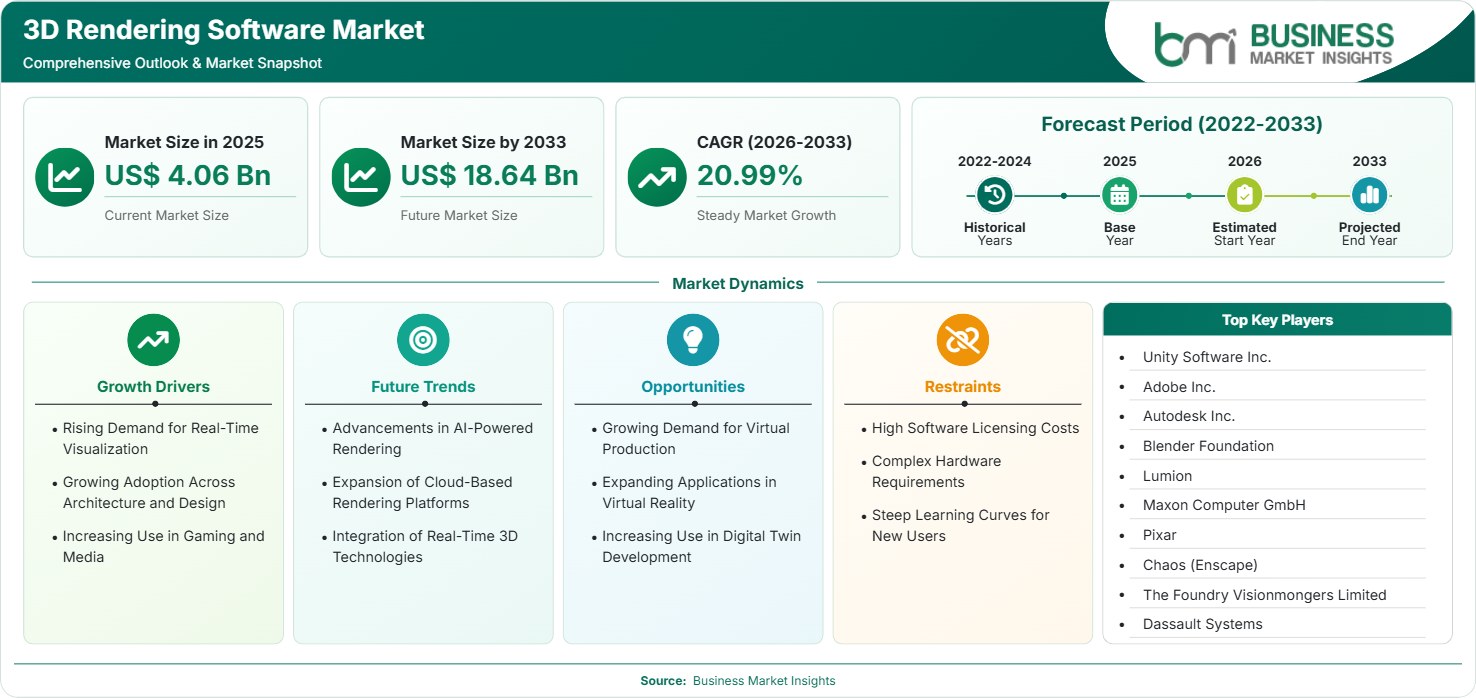
The 3D Rendering Software Market size was valued at US$ 4.06 Billion in 2025 and is projected to reach US$ 18.64 Billion by 2033, growing at a CAGR of 20.99% during 2026–2033, driven by real-time visualization, AI-assisted rendering, cloud workflows, immersive design, and rising demand for photorealistic digital assets.

Report Coverage
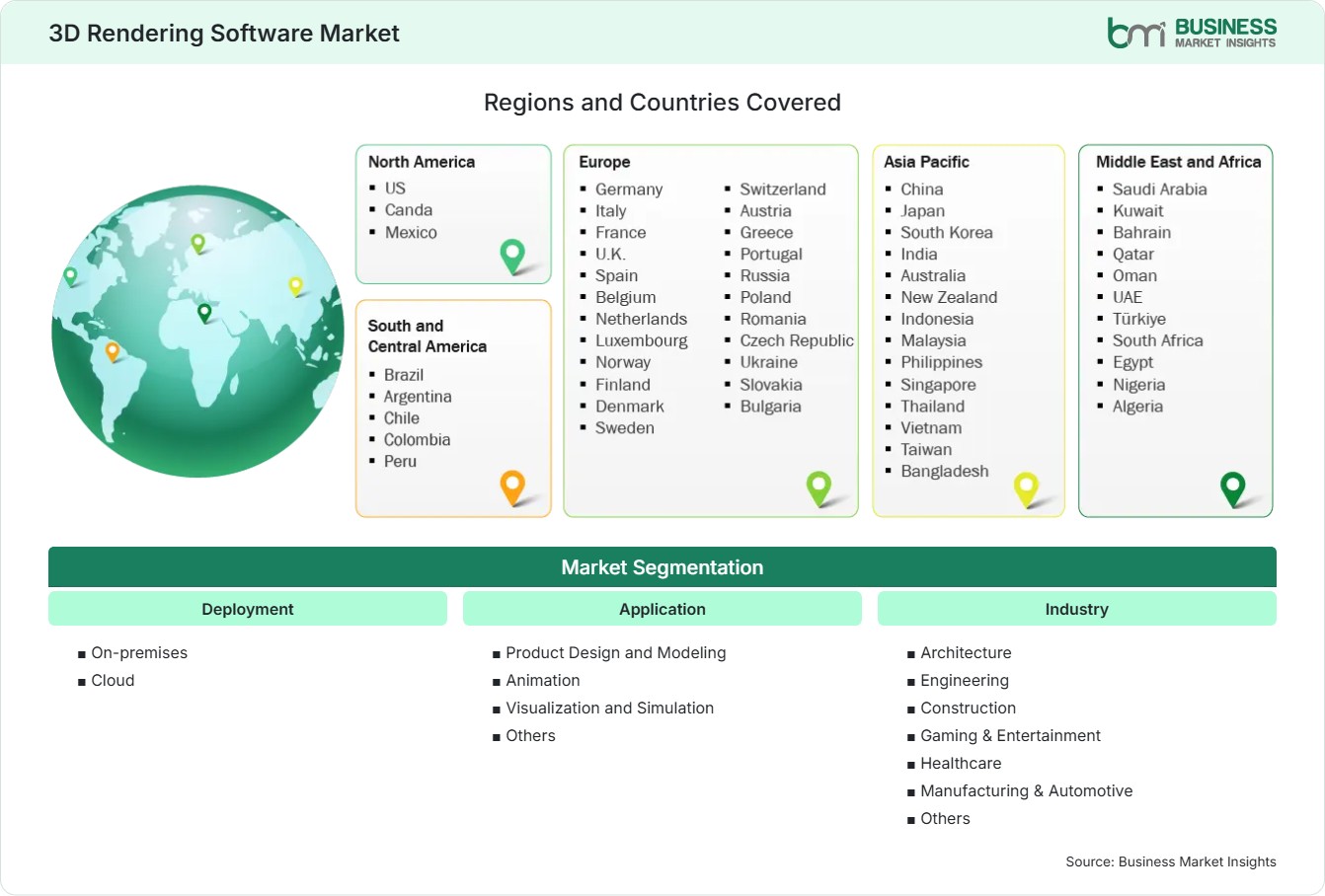
  • Deployment: On-premises, Cloud
  • Application: Product Design and Modeling, Animation, Visualization and Simulation, Others
  • Industry: Architecture, Engineering, Construction, Gaming & Entertainment, Healthcare, Manufacturing & Automotive, Others
US$ 4.06 Bn Market size in 2025
US$ 18.64 Bn Market Size by 2033
20.99% CAGR, 2026 - 2033
2026-2033 Forecast Period

AI Overview

3D Rendering Software Market Summary

  • North America Region: North America holds a 34%–38% share in 2025, growing at a CAGR of 18%–21% during 2026–2033, supported by advanced GPU infrastructure, established software ecosystems, gaming investment, AI adoption, and enterprise visualization. The U.S. market benefits from mature cloud infrastructure, strong game development activity, and rapid enterprise adoption of real-time 3D workflows, supporting approximately 19%–22% CAGR through 2033.
  • Fastest Growing Region: Asia Pacific holds a 27%–31% share in 2025 and is projected to expand at a CAGR of 23%–26% during 2026–2033, driven by expanding gaming production, architectural digitization, manufacturing visualization, cloud adoption, and increasing availability of skilled 3D professionals.
  • Leading Segment: Cloud deployment represents a 55%–60% share in 2025, expanding at a CAGR of 22%–25% during 2026–2033, as distributed rendering, flexible computing capacity, collaborative production, and lower infrastructure requirements accelerate enterprise migration.
  • High Growth Segment: Healthcare applications represent a 22%–26% CAGR during 2026–2033, supported by medical visualization, surgical planning, anatomical modeling, training simulations, digital twins, and increasing use of immersive visualization across healthcare institutions.
  • Key Market Opportunity: AI-generated assets, cloud rendering, browser-based collaboration, and real-time engines can reduce iteration cycles while opening demand among smaller design teams, e-commerce brands, manufacturers, educators, and emerging content studios.
  • Major Market Players: Unity Software Inc.; Adobe Inc.; Autodesk, Inc.; Blender Foundation; Lumion; Maxon Computer GmbH; Pixar; Chaos; Foundry Visionmongers Limited; Dassault Systèmes SE.
Strategic Insights

3D Rendering Software Market: Strategic Insights

3D Rendering Software Market Strategic Framework
FREE PDF
Request your free sample
Request free sample
Stakeholder View

Key Takeaways

  • The ecosystem is moving towards integration with the rendering engines becoming increasingly integrated with modeling, simulation, assets libraries, cloud computing infrastructure, and collaborative reviews.
  • Cloud-based solutions provide a major structural advantage in that companies would not need to have specialized high-performance hardware but could scale their rendering capabilities based on the needs of individual projects.
  • Artificial intelligence is altering the production process through automation in areas like texture creation, scene improvements, asset creation, image reconstruction, and production.
  • Asia Pacific offers a compelling investment case because gaming, animation, manufacturing, architecture, and digital-content ecosystems are expanding simultaneously.
  • Ecosystems have become key differentiators, not only rendering capabilities, leading to alliances, integrations, acquisitions, and developer communities.
Geographic Outlook

3D Rendering Software Market Regional Highlights

North America 3D Rendering Software Market

North America holds a 34%–38% 3D Rendering Software Market share in 2025 and is expected to expand at a CAGR of 18%–21% through 2033. The region benefits from established software vendors, advanced GPU infrastructure, sophisticated entertainment production, and high enterprise spending on visualization. The U.S. accounts for most regional demand, supported by gaming, film, advertising, architecture, and product development. AI-enabled rendering is strengthening productivity, while cloud platforms are broadening access to high-performance capabilities for smaller studios and distributed design teams.

  • Gaming studios increasingly require real-time rendering, procedural environments, advanced lighting, and cross-platform asset pipelines.
  • Architecture and engineering firms are adopting immersive visualization to improve design reviews, stakeholder communication, and project coordination.
  • Enterprise manufacturers use rendering for product configuration, digital prototyping, marketing visualization, and virtual demonstrations.
  • Cloud rendering providers are expanding scalable infrastructure, reducing dependence on capital-intensive local render farms.

US 3D Rendering Software Market

The U.S. represents approximately 72%–76% of North American demand in 2025 and is projected to grow at a CAGR of 19%–22% during 2026–2033. Strong software ecosystems, large game and media industries, advanced cloud infrastructure, and high enterprise technology spending sustain adoption. Demand increasingly centers on integrated workflows combining modeling, rendering, AI, simulation, and collaboration rather than standalone rendering utilities.

  • Game development remains a major demand generator, particularly for real-time environments and interactive experiences.
  • Hollywood and streaming production require high-quality visual effects, virtual production, compositing, and simulation capabilities.
  • Enterprise users increasingly apply visualization to product launches, digital commerce, training, and customer engagement.

Europe 3D Rendering Software Market

Europe accounts for a 25%–29% share in 2025 and is projected to register a CAGR of 19%–22% through 2033. Germany, the U.K., France, and Italy form important demand centers, supported by automotive engineering, architecture, industrial design, gaming, and media production. Sustainability objectives encourage digital prototyping and visualization before physical manufacturing. Germany remains a leading industrial user, while the U.K. provides strong creative-industry demand.

  • Germany benefits from automotive and industrial engineering applications requiring high-fidelity product visualization.
  • The U.K. supports demand through film, television, gaming, advertising, and visual-effects production.
  • France and Italy provide opportunities in architecture, luxury products, automotive design, and creative content.
  • European interoperability requirements favor software supporting standardized assets and collaborative multi-platform workflows.

Asia Pacific 3D Rendering Software Market

Asia Pacific holds a 27%–31% share in 2025 and is forecast to grow at 23%–26% CAGR through 2033, making it the fastest-growing regional market. China, Japan, South Korea, and India are important demand centers. Gaming, animation, manufacturing, architecture, infrastructure development, e-commerce visualization, and expanding cloud infrastructure are broadening software adoption. Rising digital-content exports and increasing availability of trained 3D professionals further support demand.

  • China combines large gaming, manufacturing, construction, and digital-content ecosystems with expanding cloud infrastructure.
  • Japan maintains strong demand from gaming, automotive design, animation, and industrial visualization.
  • South Korea offers opportunities through gaming, entertainment, electronics, and virtual-content production.
  • India is expanding as a cost-effective hub for animation, VFX, gaming services, architecture, and engineering visualization.

Rest of World 3D Rendering Software Market

Rest of World represents approximately 8%–12% of global demand in 2025 and is projected to grow at 17%–20% CAGR through 2033. South and Central America are adopting visualization across construction, gaming, advertising, and industrial design, while Middle Eastern markets are investing in architectural visualization, smart-city development, immersive experiences, and digital infrastructure. The UAE, Saudi Arabia, and Brazil provide important growth opportunities as cloud availability and professional 3D capabilities improve.

  • Brazil is a leading Latin American opportunity, supported by advertising, architecture, gaming, and industrial visualization.
  • Mexico benefits from manufacturing, automotive supply chains, architecture, and proximity to North American production ecosystems.
  • The UAE is adopting advanced visualization for real estate, tourism, infrastructure, and smart-city projects.
  • Saudi Arabia offers long-term demand through large-scale construction, entertainment, and digital transformation programs.
Global Market Geography
FREE PDF
Request your free sample
Request free sample
Segment Analysis

3D Rendering Software Market Segmentation

Deployment

Cloud deployment leads with a 55%–60% share in 2025 and a 22%–25% CAGR through 2033, reflecting demand for scalable computing, collaboration, flexible licensing, and remote rendering. Deployment choices increasingly balance performance, security, cost, and data-control requirements across enterprise environments.

  • On-premises: Remains important for studios and enterprises requiring direct control over sensitive assets, predictable performance, specialized infrastructure, and offline workflows.
  • Cloud: Gains adoption through elastic computing, distributed teams, browser-based access, usage-based resources, faster rendering, and reduced investment in dedicated hardware.

Application

Application demand is broadening as rendering becomes embedded across product development, visualization, animation, simulation, marketing, and customer experience workflows. The segment reflects the expanding 3D Rendering Software Market scope of 3D content beyond specialist visualization teams.

  • Product Design and Modeling: Supports virtual prototypes, material evaluation, product configuration, and iterative design before physical production.
  • Animation: Enables character, environment, motion, lighting, and effects production for games, film, advertising, and digital media.
  • Visualization and Simulation: Supports architecture, engineering, manufacturing, healthcare, and training through realistic environments and scenario modeling.

Industry

Industry adoption is led by sectors where visual fidelity directly influences design decisions, customer engagement, or production efficiency. Gaming and entertainment remain major users, while industrial and healthcare applications create additional opportunities.

  • Architecture, Engineering, and Construction: Uses rendering for design reviews, visualization, BIM communication, client presentations, and immersive project evaluation.
  • Gaming & Entertainment: Requires real-time rendering, animation, visual effects, interactive environments, and increasingly AI-assisted content creation.
  • Healthcare: Applies 3D visualization to anatomy, training, treatment planning, medical education, and simulation.
  • Manufacturing & Automotive: Uses rendering for prototyping, vehicle visualization, product configuration, engineering communication, and digital-twin workflows.
Market Forces

3D Rendering Software Market Dynamics

Key Market Drivers

Rising Demand for Real-Time Visualization

Real-time rendering is becoming central to design review because users expect immediate visual feedback instead of waiting for lengthy offline rendering cycles. The use of GPU acceleration, ray tracing, physically based lighting, and optimized scene processing is enhancing the interactive experience. The industries of architecture, automotive, games, and product visualization are increasingly relying on fast iterations since they make decisions as a group. Such a process is reducing the gap between modeling and visualization and thus making the use of integrated rendering software very useful. This trend boosts the 3D Rendering Software Market growth through increased integration of rendering into daily design activities. Other factors that increase demand for the solution include immersive experiences, digital twin, virtual showrooms, and product configurators.

Growing Adoption Across Architecture and Design

Photorealistic rendering is increasingly being used by architecture and design agencies to present their ideas, compare materials, assess lighting, and gain approval from stakeholders prior to construction. With integration into BIM and CAD systems, there are no redundancies in modeling and changes made in the design can be incorporated in the process of visualization. Cloud-based collaboration is especially important for geographically dispersed groups. Consequently, rendering software is increasingly becoming a component of the larger project delivery system, as opposed to being a standalone visualization application. Professionals would also like to have access to libraries and procedural materials as well as to view live previews and interoperability with leading design applications. This increases the recurrent software purchase cycle since the companies need constant access to updated rendering tools and libraries.

Increasing Use in Gaming and Media

Gaming and media producers require increasingly detailed environments, realistic characters, complex simulations, and rapid content iteration. Real-time engines give the creators the ability to repurpose assets throughout development, virtual production, marketing, and interactive applications, thus making the creation process economically beneficial. Rendering systems are also integrating with AI in order to speed up the repetitive activities such as asset searching, scene preparation, enhancements, and scripting. The 3D Rendering Software Market trends indicate combination of game engines, film production, advertising, and immersive media widens the market potential of rendering solutions. With the increasing amounts of content, production houses are increasingly emphasizing scalability, collaborative working, and interoperability within their pipelines.

Key Market Opportunities

Advancements in AI-Powered Rendering

AI can shorten rendering workflows by generating materials, reconstructing geometry, enhancing images, recommending assets, and automating repetitive scene operations. Adobe has already leveraged the power of text-to-3D research and generative abilities in its Substance workflow solutions, thus showing how AI technologies can unite 2D and 3D productions. Generative AI foundation models are also being developed by Autodesk for design and geometry. The 3D Rendering Software Market forecast here to integrate AI technologies straight into professional software where creators do not have to switch from concept to production. The vendors that are able to provide AI along with precise geometries, controllable output, protection of intellectual property rights, and professional rendering can capture higher-value enterprise workflows while reducing time spent on low-value production tasks.

Expansion of Cloud-Based Rendering Platforms

The cloud rendering solution presents an opportunity for software companies to leverage computing power, storage, collaboration, and rendering power as a combined service. This type of service is appealing to small companies that cannot afford to buy render farms and international teams requiring remote access. Cloud computing services can also provide burst rendering services when projects demand them, reducing the requirement to have hardware capacity for the highest demands. Integrating the platform with asset management, review, version control, and web visualization may enable a subscription service on top of existing software. With improvements in GPU power and non-negligible hardware requirements, customers can assess rendering as a service based on usage, performance, and productivity.

Integration of Real-Time 3D Technologies

Real-time 3D is creating opportunities beyond traditional rendering through digital twins, virtual showrooms, immersive training, simulation, interactive sales tools, and virtual production. The commercial opportunity increases when rendering platforms connect with CAD, BIM, PLM, game engines, and enterprise data. Interoperability therefore becomes a competitive differentiator. Vendors can capture new users by allowing existing models and assets to move efficiently across design and visualization stages. Standardized scene formats, APIs, and cloud collaboration can further reduce integration costs. The convergence of real-time visualization and enterprise applications is likely to expand rendering demand into departments that historically purchased neither specialist visualization software nor dedicated rendering infrastructure.

Market Restraints and Challenges

High Software Licensing Costs

Factor: Professional rendering platforms can involve subscription fees, add-on render capacity, asset libraries, specialized plugins, and multiple application licenses. Impact: Total ownership costs can discourage small studios, independent creators, educational institutions, and price-sensitive enterprises from adopting premium solutions. Subscription-based models improve vendor recurring revenue but can also intensify customer scrutiny over productivity gains and utilization. Buyers increasingly compare integrated platforms against free or open-source alternatives. Vendors therefore face pressure to provide flexible tiers, educational access, usage-based pricing, and cloud options. Pricing strategies that align cost with rendering volume and project complexity can reduce adoption barriers, particularly in emerging economies where software budgets remain lower than in mature creative markets.

Complex Hardware Requirements

Factor: High-quality rendering can require capable GPUs, substantial memory, fast storage, compatible drivers, and reliable networking, particularly for large scenes and advanced ray-traced workflows. Impact: Hardware complexity increases deployment costs and can limit access for smaller teams. Cloud rendering reduces some infrastructure requirements but introduces network dependency, data-transfer considerations, and recurring compute costs. Professional workflows may also require hardware upgrades as software adds more sophisticated simulation, AI, and rendering features. Vendors can address this constraint through optimized engines, scalable cloud rendering, efficient scene management, and support for broader hardware configurations. Lowering technical barriers is important for expanding adoption beyond high-end studios and specialized enterprise users.

Company Analysis

Competitive Landscape

The 3D Rendering Software Market analysis indicates competition is increasingly centered on workflow integration, AI functionality, real-time performance, interoperability, asset ecosystems, and cloud delivery.

Company Name

Overview

Products and Services Relevant to the Market

Unity Software Inc.

Real-time 3D platform with broad adoption across gaming and industrial visualization.

Unity Engine, real-time rendering, development tools, cloud services, AI-assisted workflows.

Adobe Inc.

Major creative software provider expanding professional 3D creation through Substance technologies.

Substance 3D Painter, Designer, Sampler, Stager, Modeler and 3D asset services.

Autodesk, Inc.

Design software leader serving architecture, engineering, manufacturing, and media workflows.

Maya, 3ds Max, Arnold, Forma, Fusion and visualization technologies.

Blender Foundation

Supports the open-source Blender ecosystem used across modeling, animation and rendering.

Blender modeling, Cycles rendering, animation, simulation, compositing and asset workflows.

Lumion

Visualization platform focused strongly on architecture and design presentation.

Lumion rendering, real-time visualization, landscape assets and architectural presentation tools.

Maxon Computer GmbH

Creative software provider combining Cinema 4D with GPU-accelerated rendering.

Cinema 4D, Redshift, rendering, animation, motion graphics and visualization.

Pixar

Animation technology leader with extensive expertise in production rendering and digital content.

RenderMan, animation technology, USD-related workflows and production rendering capabilities.

Chaos

Visualization specialist serving architecture, design, media and rendering professionals.

V-Ray, Enscape, Corona, Vantage, Chaos Cloud and AI visualization tools.

Foundry Visionmongers Limited

Creative technology company focused on visual effects and professional content production.

Nuke, Katana, Mari and advanced 3D, compositing and rendering workflows.

Dassault Systèmes SE

Engineering and design technology provider connecting 3D design with simulation and industry workflows.

3DEXPERIENCE, CATIA, SOLIDWORKS and visualization-related design technologies.

Trust & Transparency

Research Methodology

The market analysis combines proprietary research with secondary data from government agencies, company disclosures, regulatory filings, industry databases and expert interviews. Market estimates are validated through data triangulation, cross-market benchmarking and analyst review.

View Full Research Methodology

Questions Answered

Frequently Asked Questions

What does the 3D Rendering Software Market Report cover?

The report evaluates deployment, application, and industry segments, regional dynamics, competitive positioning, market drivers, opportunities, restraints, recent developments, and forecast trends through 2033.

What makes real-time rendering commercially important?

Real-time rendering provides immediate feedback during design and visualization, enabling faster iteration, collaborative review, interactive product experiences, and immersive applications.

Which industries offer new demand opportunities?

Healthcare, manufacturing, automotive, architecture, e-commerce, education, and digital twins provide opportunities beyond traditional gaming, animation, and visual-effects workflows.

Why is cloud deployment gaining traction?

Cloud deployment allows organizations to scale computing resources according to project requirements, support distributed teams, and reduce investment in dedicated rendering infrastructure.

How is AI changing professional rendering workflows?

AI is automating asset generation, material creation, image enhancement, scene ideation, and repetitive production tasks. This allows artists and designers to focus more heavily on creative direction and decision-making.

Access the Full 3D Rendering Software Market Report

Get segment-level forecasts, regional estimates, competitive benchmarking, company profiles and downloadable Excel datasets.

Access the full 3D Rendering Software Market Report
350 pages PDF & Excel | 2026-08-21