
Encryption Software Market Outlook: Size, Share, Trends, Growth Analysis, Competitive Landscape & Forecast, 2026–2033

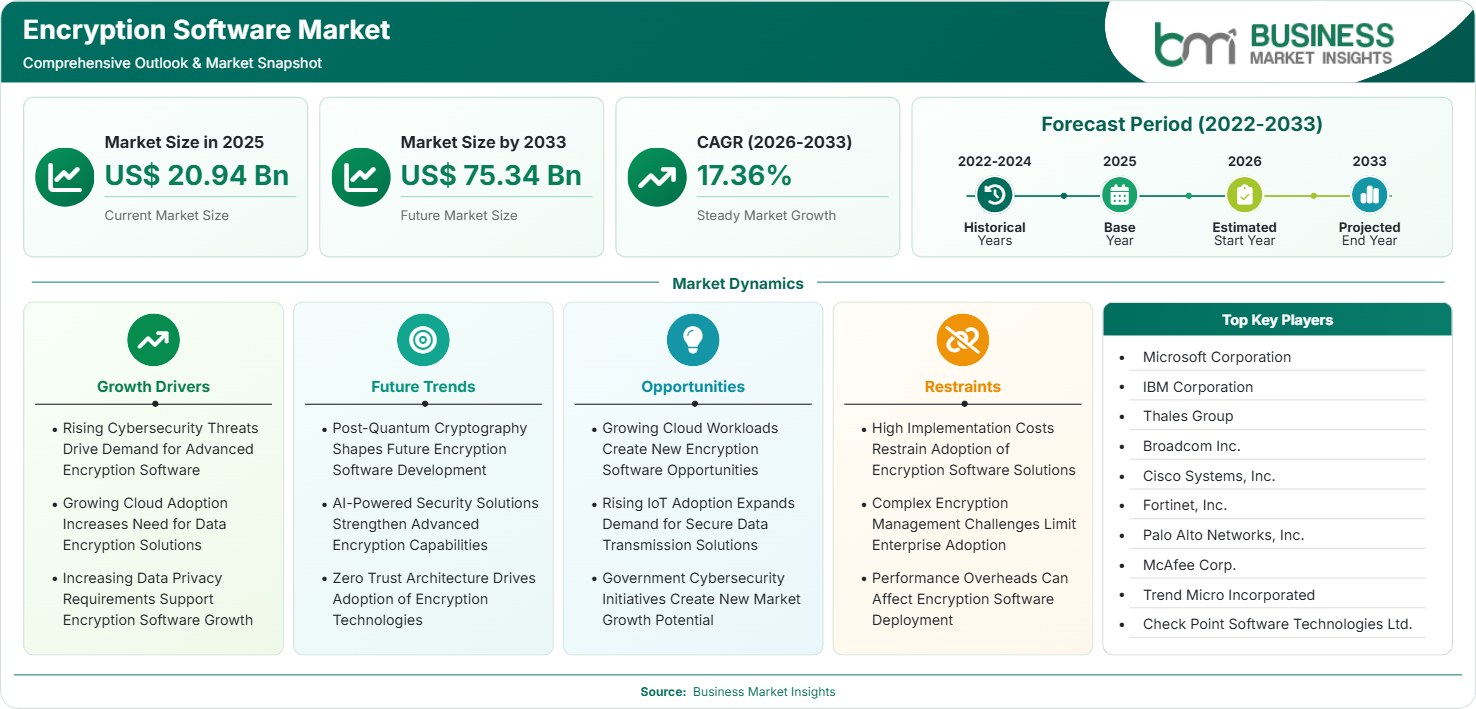
The Encryption Software Market size was valued at US$ 20.94 Billion in 2025 and is projected to reach US$ 75.34 Billion by 2033, growing at a CAGR of 17.36% during 2026–2033, driven by escalating cyber threats, cloud migration, stringent privacy mandates, IoT expansion, and post-quantum security investments.

Report Coverage
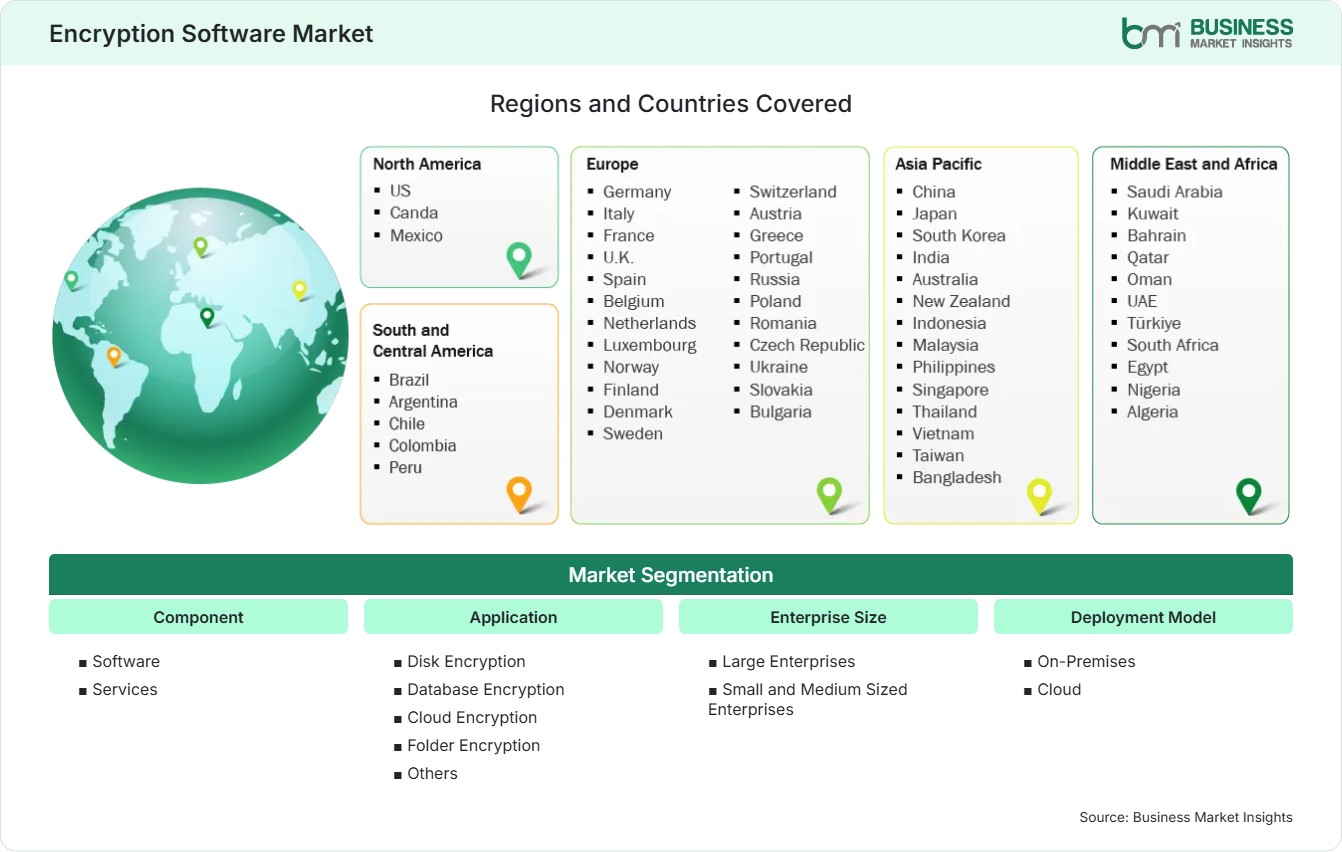
  • Component: Software, Services
  • Application: Disk Encryption, Database Encryption, Cloud Encryption, Folder Encryption, Others
  • Enterprise Size: Large Enterprises, Small and Medium Sized Enterprises
  • Deployment Model: On-Premises, Cloud
  • Industry Vertical: IT and Telecommunications, Banking, Finance, Security and Insurance , Healthcare and Life Sciences, Manufacturing, Retail, Government, Energy and Utilities, Others
US$ 20.94 Bn Market size in 2025
US$ 75.34 Bn Market Size by 2033
17.36% CAGR, 2026 - 2033
2026-2033 Forecast Period

01 AI Overview

Encryption Software Market Summary

  • North America Region: North America holds a 35%–39% share in 2025, growing at a CAGR of 16.20%–17.40%, supported by mature cybersecurity spending, cloud infrastructure, regulatory compliance, zero-trust adoption, and strong enterprise encryption investments. The US market grows at a CAGR of 16.50%–17.70%, supported by federal cybersecurity modernization, cloud workloads, critical infrastructure protection, and enterprise data security investments.
  • Fastest Growing Region: Asia Pacific holds a 23%–27% share in 2025, expanding at a CAGR of 19.20%–21.00%, driven by rapid digitization, and growing enterprise investment in protecting sensitive information.
  • Leading Segment: Software holds a 67%–71% share in 2025, growing at a CAGR of 16.80%–18.00%, supported by scalable deployment, and increasing demand for data security across distributed enterprise environments.
  • High Growth Segment: Cloud Encryption holds a 24%–28% share in 2025, advancing at a CAGR of 20.50%–22.50%, driven by multicloud adoption, and increasing demand for encryption throughout distributed data environments.
  • Key Market Opportunity: Post-quantum cryptography, confidential computing, encryption-as-a-service, and automated key management create attractive opportunities as organizations modernize security architectures and prepare for emerging computational threats.
  • Major Market Players: Microsoft Corporation, IBM Corporation, Thales Group, Broadcom Inc., Cisco Systems, Inc., Fortinet, Inc., Palo Alto Networks, Inc., McAfee Corp., Trend Micro Incorporated, Check Point Software Technologies Ltd.
02 Strategic Insights

Encryption Software Market: Strategic Insights

Encryption Software Market Strategic Framework
FREE PDF
Request your free sample
Request free sample
03 Stakeholder View

Key Takeaways

  • Enterprise security architecture is shifting from isolated encryption products toward integrated data protection ecosystems combining encryption, key management, identity controls, access governance, and data discovery.
  • Cloud encryption and database protection represent strong expansion areas as enterprises distribute workloads across public, private, and hybrid clouds. Solutions supporting granular controls, and automated rotation are positioned to gain greater enterprise adoption.
  • Post-quantum readiness is becoming a strategic technology priority. NIST’s evolving standards landscape is encouraging organizations to inventory cryptographic dependencies, and develop migration roadmaps.
  • Asia Pacific offers a compelling investment case because digital transformation, cloud adoption, data localization, and expanding connected-device ecosystems are simultaneously increasing the volume and sensitivity of information requiring protection.
  • Competitive positioning increasingly depends on platform integration and ecosystem partnerships rather than standalone encryption capabilities. Vendors that integrate encryption into cloud security, and network security portfolios can strengthen customer retention.
  • Risk management and compliance Insight evolving regulations, cybersecurity requirements, operational risks, and compliance obligations on market participants, product development, and long-term investment decisions.
04 Geographic Outlook

Encryption Software Market Regional Highlights

North America Encryption Software Market

North America holds 35%–39% of share in 2025 and North America encryption software market forecast to grow at a CAGR of 16.20%–17.40% through 2033. Strong enterprise cybersecurity budgets, cloud migration, regulatory scrutiny, and advanced technology adoption support regional leadership. The United States dominates regional demand through extensive cloud infrastructure and federal modernization programs, while Canada benefits from financial-sector digitization and privacy compliance.

  • Mature cybersecurity investment supports broad deployment across financial services, healthcare, government, technology, and critical infrastructure, strengthening demand for enterprise-grade encryption platforms and centralized cryptographic management.
  • Cloud-first architectures are increasing demand for encryption integrated directly into infrastructure, applications, databases, and storage environments, particularly among organizations operating complex hybrid and multicloud estates.
  • Federal agencies and regulated industries are prioritizing stronger cryptographic controls, creating opportunities for vendors offering compliance-ready solutions, lifecycle management, and cryptographic inventory capabilities.

US Encryption Software Market

The US accounts for 27%–31% of the global Encryption Software Market share in 2025 and expands at a CAGR of 16.50%–17.70% through 2033. Large technology enterprises, financial institutions, healthcare organizations, and government agencies drive demand through extensive digital infrastructure. The market is also advancing toward cryptographic agility, automated key management, and post-quantum preparedness.

  • Federal cybersecurity modernization is encouraging stronger data protection controls, creating sustained demand for encryption across government systems, cloud services, endpoints, and sensitive information repositories.
  • Financial institutions and healthcare providers require stringent protection of regulated information, supporting adoption of database, disk, application, and cloud encryption alongside broader identity and access controls.

Europe Encryption Software Market

Europe represents 25%–29% of global Encryption Software Market share in 2025, with a CAGR of 15.80%–17.00% through 2033. Germany, the United Kingdom, and France remain leading markets, while Poland and the Netherlands offer comparatively faster expansion. Organizations are prioritizing encryption, and data sovereignty as digital supply chains become more interconnected and cyber incidents increasingly affect essential services and public infrastructure.

  • Germany leads regional demand through industrial digitization, enterprise cloud adoption, and strong cybersecurity requirements, while manufacturing organizations increasingly protect operational and intellectual property data.
  • The United Kingdom maintains substantial adoption across financial services, government, healthcare, and technology, supported by cloud transformation and increasing focus on cyber resilience.
  • France benefits from public-sector digitization and sovereign cloud priorities, encouraging encryption solutions that support sensitive information protection and stronger control over data access.
  • Poland is projected to grow at a CAGR of 18.00%–20.00%, supported by expanding digital services, cloud adoption, cybersecurity investment, and modernization of enterprise IT infrastructure.

Asia Pacific Encryption Software Market

Asia Pacific accounts for 23%–27% of Encryption Software Market share in 2025 and records a CAGR of 19.20%–21.00% through 2033, making it the fastest-growing regional market. China, Japan, South Korea, India, and Australia lead adoption, while India and Southeast Asian economies provide faster expansion opportunities.

  • China remains a leading regional market as cloud infrastructure, digital platforms, industrial connectivity, and data governance requirements increase demand for encryption and cryptographic controls.
  • Japan and South Korea benefit from advanced technology ecosystems, high enterprise digitization, and extensive connected-device deployment, supporting demand for efficient data protection across complex environments.
  • India is projected to grow at a CAGR of 22.00%–24.00%, driven by digital public infrastructure, cloud adoption, financial technology expansion, and increasing cybersecurity awareness among enterprises.
  • Southeast Asia presents strong expansion potential as businesses migrate workloads to cloud platforms and governments strengthen data protection frameworks across rapidly digitizing economies.

Rest of World Encryption Software Market

South and Central America represent an estimated 7%–9% of global Encryption Software Market share in 2025, while Middle East and Africa contribute approximately 6%–8%. Combined regional demand expands at a CAGR of 17.50%–19.50% through 2033. Brazil and Mexico lead Latin American adoption, while the United Arab Emirates, Saudi Arabia, and South Africa anchor demand across MEA. Middle Eastern economies are investing heavily in smart infrastructure and digital government services, creating demand for encryption across sensitive information systems. Saudi Arabia and the United Arab Emirates are emerging as high-growth markets as national digital transformation strategies accelerate cloud and cybersecurity investment.

  • Brazil and Mexico benefit from expanding digital payments, cloud adoption, and financial technology ecosystems, creating demand for encryption protecting customer information and transaction data.
  • Saudi Arabia is emerging as a high-growth market through national digital transformation initiatives, smart infrastructure development, and increasing cybersecurity investment across government and enterprises.
  • The United Arab Emirates benefits from advanced digital government programs and data center development, increasing demand for secure cloud workloads and cryptographic controls.
  • South Africa remains a regional technology hub, with financial institutions and large enterprises prioritizing encryption as digital services and cyber risks expand.
Global Market Geography
FREE PDF
Request your free sample
Request free sample
05 Segment Analysis

Encryption Software Market Segmentation

Component

Software accounts for 67%–71% of 2025 market share and expands at a CAGR of 16.80%–18.00% through 2034, supported by scalable deployment, centralized policy management, automated encryption, and cloud integration. Services complement adoption through implementation, migration, consulting, and managed cryptographic operations.

  • Software: Software remains dominant because enterprises require scalable encryption across endpoints, applications, databases, and cloud environments, while centralized management simplifies policy enforcement and cryptographic lifecycle administration.
  • Services: Services support deployment, integration, migration, compliance assessment, and managed operations, helping enterprises address specialist skill shortages and manage complex encryption architectures across heterogeneous technology environments.

Application

Application-based demand is expanding as enterprises protect information across storage, databases, cloud infrastructure, and user-accessible folders. Cloud Encryption represents a particularly strong opportunity as multicloud architectures expand. The Encryption Software Market scope increasingly encompasses protection throughout data lifecycles, and continuous monitoring across distributed environments.

  • Disk Encryption: Disk encryption protects information stored on endpoints and servers, supporting compliance and reducing exposure from lost devices, unauthorized access, and endpoint compromise across distributed workforces.
  • Database Encryption: Database encryption safeguards structured information at rest and during controlled access, supporting financial, healthcare, retail, and government organizations managing highly sensitive records.
  • Cloud Encryption: Cloud encryption is expanding rapidly as enterprises migrate workloads, requiring granular controls, customer-managed keys, data sovereignty capabilities, and protection across public, private, and hybrid cloud environments.
  • Folder Encryption: Folder encryption provides targeted protection for sensitive files and directories, supporting departmental data security where organizations require granular controls without encrypting entire storage environments.

Enterprise Size

Large enterprises account for 61%–65% of 2025 market share and grow at a CAGR of 16.00%–17.20%, reflecting extensive data estates, regulatory obligations, and complex infrastructure. SMEs expand faster at 18.50%–20.50% as cloud-based security reduces deployment complexity.

  • Large Enterprises: Large enterprises require centralized encryption governance across global operations, supporting demand for advanced key management, policy automation, compliance reporting, and integration with identity and security platforms.
  • Small and Medium Sized Enterprises (SMEs): SMEs increasingly adopt cloud-delivered encryption and managed security services because simplified deployment models reduce specialist staffing requirements, infrastructure costs, and operational complexity.

Deployment Model

Cloud deployment accounts for 39%–43% of 2025 market share and expands at a CAGR of 20.00%–22.00% through 2034, supported by scalable infrastructure and distributed workloads. On-premises solutions remain important for regulated organizations requiring direct control over cryptographic assets.

  • On-Premises: On-premises deployment remains relevant for government, defense, financial, and industrial organizations requiring direct infrastructure control, localized key custody, and stringent compliance management.
  • Cloud: Cloud deployment benefits from flexible scaling, rapid provisioning, centralized management, and integration with cloud-native services, making it attractive for enterprises modernizing distributed application and data architectures.

Industry Vertical

IT and Telecommunications accounts for 23%–27% of 2025 demand and grows at a CAGR of 18.00%–20.00%, supported by cloud infrastructure and high data volumes. BFSI and healthcare maintain strong adoption because regulated information requires robust protection. Government and energy organizations increasingly prioritize encryption for critical infrastructure.

  • IT and Telecommunications: High-volume data processing, cloud infrastructure, and interconnected networks create sustained demand for encryption across applications, databases, communications, and distributed computing environments.
  • Banking, Finance, Security and Insurance (BFSI): BFSI organizations prioritize encryption to protect payment information, customer records, transaction data, and financial systems while meeting stringent security and regulatory expectations.
  • Healthcare and Life Sciences: Healthcare providers and life sciences companies require encryption for patient records, research data, medical applications, and connected systems subject to strict privacy obligations.
  • Manufacturing: Industrial digitization and connected production environments increase the need to protect operational data, intellectual property, industrial systems, and communications across increasingly distributed facilities.
  • Retail: Retailers use encryption to protect payment information, customer identities, loyalty data, and ecommerce transactions as omnichannel platforms and digital commerce ecosystems expand.
  • Government: Government agencies require robust encryption for citizen information, classified data, public services, and critical systems, supporting demand for compliant and centrally managed cryptographic solutions.
  • Energy and Utilities: Connected grids, operational technology, and remote monitoring increase demand for encryption protecting infrastructure data and communications against unauthorized access and cyber disruption.
06 Market Forces

Encryption Software Market Dynamics

Key Market Drivers

Rising Cybersecurity Threats Drive Demand for Advanced Encryption Software

Enterprises are moving towards encrypting endpoints, databases, cloud applications, and backup archives to reduce the value of any breached data. Thus, market growth will be associated with increased adoption of the zero-trust model, identity-based security, and data loss prevention. There is also an increasing integration of encryption software with security platforms, thereby making it easier to enforce policies and manage keys. With increasing digitalization by enterprises, there are growing demands for protecting structured and unstructured data.

Growing Cloud Adoption Increases Need for Data Encryption Solutions

Cloud Migration is impacting the way enterprises manage their sensitive data and imposing new needs for an encryption solution that can be consistent and work across public, private, and hybrid clouds. Multicloud solutions increase complexity of data flows which results in increasing importance of visibility and control of encryption keys. Enterprises use customer-managed encryption keys, bring your own keys, and automate the key rotation processes in order to maintain better control over their sensitive information. The cloud-based encryption solution allows organizations to address data sovereignty needs through defining locations for their cryptographic keys and authorization mechanisms.

Increasing Data Privacy Requirements Support Encryption Software Growth

Regulatory standards related to privacy are making the business value of encryption more significant, since companies have to prove that they have greater control over their confidential data at all stages of its lifecycle. Multiple enterprises rely on encryption in connection with privacy-by-design approaches that include not only cryptography but also data classification, access management, data retention, and monitoring. The Encryption Software Market trend is therefore supported by compliance-driven investment as well as direct cyber risk mitigation.

Key Market Opportunities

Growing Cloud Workloads Create New Encryption Software Opportunities

The accelerated growth of cloud-based workloads is driving a need for encryption products that can ensure data protection throughout storage, computation, and transmission contexts. Encryption companies could leverage the move toward multi-cloud and hybrid-cloud strategies to build key management, policy enforcement, and cloud-based security features. Combining their products with cloud access security, identity, and data loss prevention solutions could enhance the value of their products. Companies providing scalable encryption with low overhead can benefit from this opportunity as businesses are modernizing their infrastructures.

Rising IoT Adoption Expands Demand for Secure Data Transmission Solutions

Increased deployment of connected devices results in increased demand for encryption techniques to protect the data that transfers from to endpoint, through gateway, network, and cloud platform. The environment of IoT opens up possibilities to implement encryption techniques which cater to resource-limited devices and distributed systems. Encryption can help providers improve their market positioning by combining device authentication, secure communication, and lifecycle management. The requirement of such encryption techniques is highly significant in sectors like industrial, healthcare, automotive, and smart infrastructures.

Government Cybersecurity Initiatives Create New Market Growth Potential

The efforts towards cybersecurity by governments are presenting new opportunities for companies involved in encryption software. The need for enhanced cybersecurity for government communications, critical infrastructure, and data can lead to higher investments into more sophisticated encryption. Suppliers that are able to deliver solutions that meet the compliance demands and enable secure exchange of data can capitalize on modernization projects within the public sector. Collaboration with government agencies, technology integrators, and infrastructure providers can give additional access to large-scale procurements of cybersecurity solutions.

Market Restraints and Challenges

High Implementation Costs Restrain Adoption of Encryption Software Solutions

Factor: Implementation of encryption technology may demand financial resources in the form of software licensing, security infrastructure hardware, key management systems, migration, and skilled personnel. Additional costs arise where there are many legacy systems or protection of geographically dispersed systems is needed. Impact: The high cost of implementation may lead to delayed implementation of this technology in small firms due to the limited budget for cybersecurity. The problem becomes even more relevant when encryption technology needs to be implemented without disruption of business processes.

Complex Encryption Management Challenges Limit Enterprise Adoption

Factor: The management of cryptographic keys through various clouds, applications, databases, endpoints, and geographical regions is a complicated process, especially when there is no centralized monitoring system and the organization lacks expertise in cryptography. Impact: Weak cryptographic key management can result in access, compliance, and availability issues, which make it less likely for the organization to implement encryption beyond mission-critical workloads.

07 Company Analysis

Competitive Landscape

The Encryption Software Market analysis reveal that competition will be increasingly characterized by breadth of platform, integration with cloud computing, lifecycle management of cryptography, and adaptability to new standards. Major firms are increasingly integrating their encryption offerings within larger cyber security solutions, as end-users are becoming more inclined towards adopting solutions that integrate various controls to simplify operations.

Company Name

Overview

Products and Services relevant to this market

Microsoft Corporation

A major enterprise technology provider with extensive cloud, identity, productivity, and security ecosystems serving global organizations.

Provides encryption capabilities across cloud, endpoint, database, identity, information protection, key management, and enterprise security environments.

IBM Corporation

A global technology company combining enterprise infrastructure, hybrid cloud, artificial intelligence, and cybersecurity capabilities for regulated industries.

Offers data encryption, key management, cloud security, database protection, cryptographic services, and security consulting for enterprise environments.

Thales Group

A diversified technology and cybersecurity provider with strong expertise in data protection, digital identity, and cryptographic security.

Provides encryption, hardware security modules, key management, data security, cloud protection, and cryptographic lifecycle solutions.

Broadcom Inc.

A diversified technology company with enterprise security capabilities supporting large organizations and complex infrastructure environments.

Offers data protection and security capabilities through enterprise software portfolios, supporting encryption, identity, infrastructure, and risk management requirements.

Cisco Systems, Inc.

A global networking and cybersecurity provider integrating data protection into broader network, cloud, and security architectures.

Supports encryption through secure networking, cloud security, data protection, identity controls, and integrated cybersecurity solutions.

Fortinet, Inc.

A cybersecurity provider focused on integrated security architectures across networks, cloud environments, endpoints, and distributed enterprises.

Offers encryption-related protection through secure networking, cloud security, endpoint controls, and integrated security management platforms.

Palo Alto Networks, Inc.

A cybersecurity company serving enterprises with cloud, network, endpoint, and security operations technologies.

Provides data security and encryption-related capabilities through cloud security, network protection, endpoint security, and security operations platforms.

McAfee Corp.

A cybersecurity company focused primarily on consumer and endpoint protection, with capabilities addressing digital privacy and data security.

Provides device security, privacy protection, secure connectivity, and endpoint-focused technologies supporting protection of sensitive digital information.

Trend Micro Incorporated

A cybersecurity specialist providing protection across cloud, networks, endpoints, and enterprise workloads.

Supports data protection through cloud security, workload security, endpoint controls, threat prevention, and enterprise cybersecurity platforms.

Check Point Software Technologies Ltd.

A global cybersecurity provider offering integrated protection across networks, cloud environments, mobile devices, and enterprise systems.

Provides data security, cloud protection, network security, endpoint controls, and encryption-related capabilities within broader cybersecurity architectures.

10 Trust & Transparency

Research Methodology

The market analysis combines proprietary research with secondary data from government agencies, company disclosures, regulatory filings, industry databases and expert interviews. Market estimates are validated through data triangulation, cross-market benchmarking and analyst review.

View Full Research Methodology

11 Questions Answered

Frequently Asked Questions

Why is the encryption software market Report relevant to technology decision-makers?

It helps decision-makers assess technology shifts, regional opportunities, deployment models, competitive positioning, and emerging cryptographic requirements shaping enterprise data protection strategies.

What role does encryption play in IoT security?

Encryption protects data generated and transmitted by connected devices, while lightweight cryptography enables security controls for devices with limited processing power, memory, and energy resources.

Why is cloud encryption becoming increasingly important?

Cloud encryption enables organizations to protect data across public, private, and hybrid environments while supporting stronger control over keys, access permissions, data sovereignty, and regulatory compliance.

How is post-quantum cryptography influencing the encryption software industry?

Post-quantum migration is encouraging enterprises to assess cryptographic dependencies and adopt crypto-agile architectures capable of transitioning toward quantum-resistant algorithms as standards mature.

What is driving demand for encryption software across enterprises?

Demand is being driven by cloud migration, rising cyber threats, privacy obligations, remote workforces, and the need to protect sensitive information across distributed infrastructure.

Access the Full Encryption Software Market Report

Get segment-level forecasts, regional estimates, competitive benchmarking, company profiles and downloadable Excel datasets.

Access the full Encryption Software Market Report
350 pages PDF & Excel | 2026-08-12