
Geophysical Software Service Market Outlook: Size, Share, Trends, Growth Analysis, Competitive Landscape & Forecast, 2026–2033

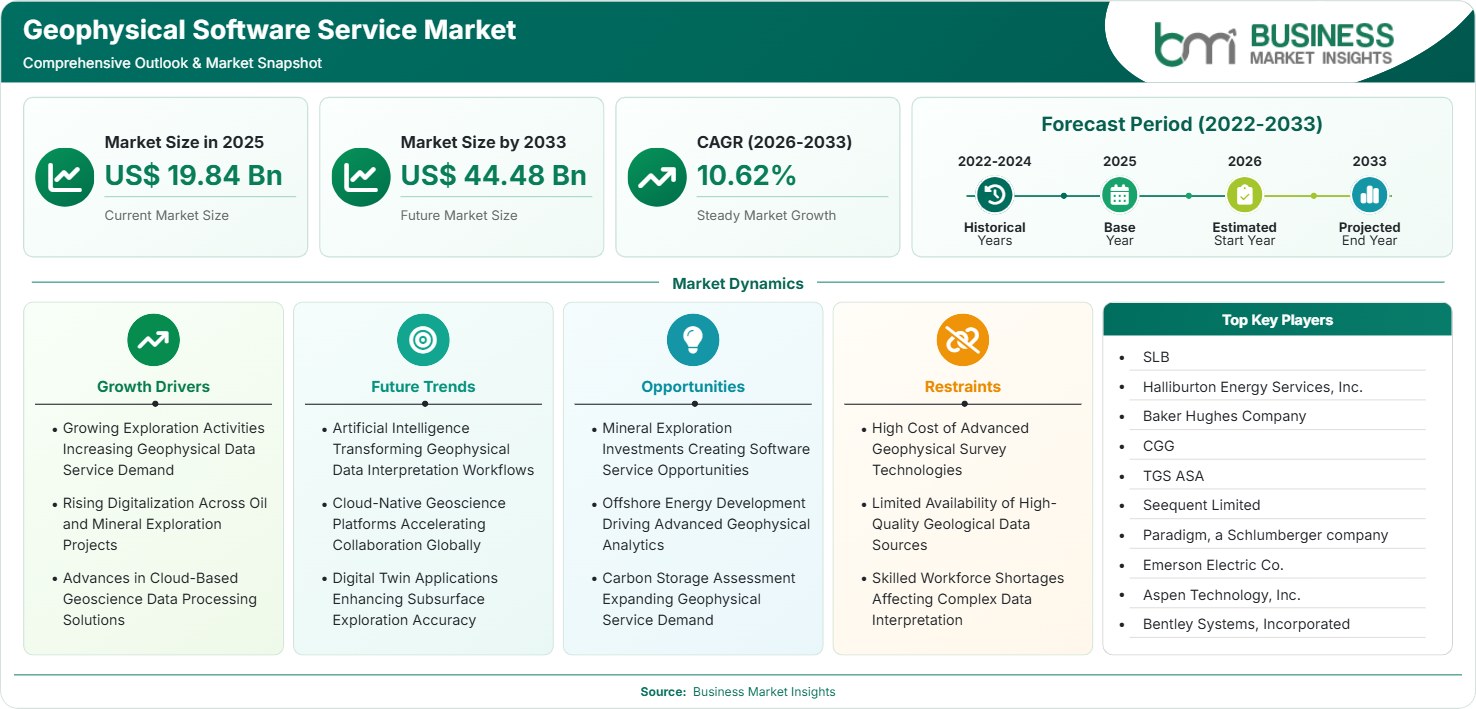
The Geophysical Software Service Market size was valued at US$ 19.84 Billion in 2025 and is projected to reach US$ 44.48 Billion by 2033, growing at a CAGR of 10.62% during 2026–2033. Rising investments in energy exploration, and expanding cloud-based geological data analytics are accelerating market development across multiple industries.

Report Coverage
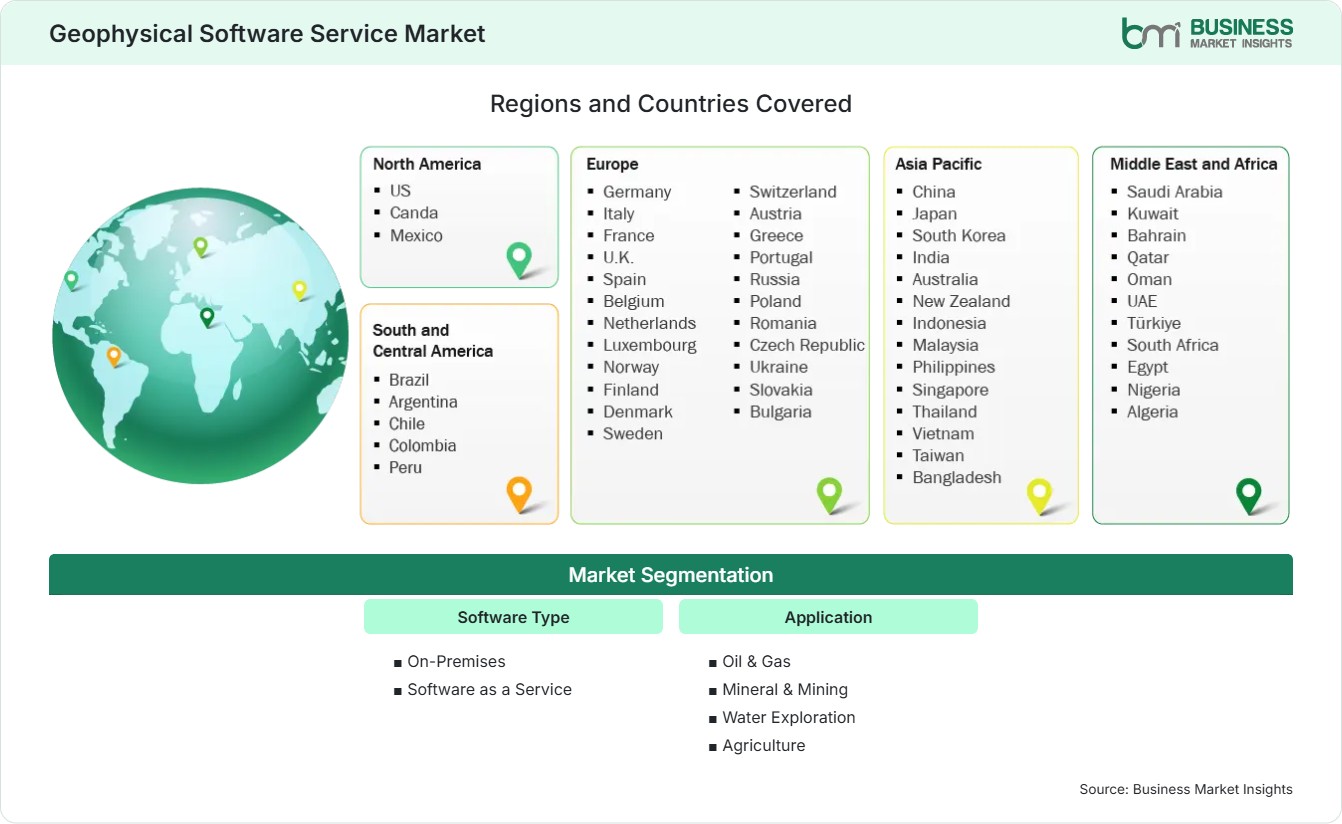
  • Software Type: On-Premises, Software as a Service
  • Application: Oil & Gas, Mineral & Mining, Water Exploration, Agriculture
US$ 19.84 Bn Market size in 2025
US$ 44.48 Bn Market Size by 2033
10.62% CAGR, 2026 - 2033
2026-2033 Forecast Period

AI Overview

Geophysical Software Service Market Summary

  • North America Region: North America holds 38%–41% market share in 2025 and is projected to grow at a 9.8%–10.4% CAGR during 2026–2033. Mature oil and gas exploration, increasing investments in digital subsurface interpretation, and widespread adoption of cloud-based geoscience platforms continue supporting regional expansion. The U.S. dominates the regional market through extensive exploration activities, and digital energy transformation initiatives, advancing at approximately 9.9%–10.5% CAGR during the forecast period.
  • Fastest Growing Region: Asia Pacific accounts for 25%–28% market share in 2025 and is expected to register a 11.6%–12.2% CAGR during 2026–2033. Rising mineral exploration investments, increasing offshore energy projects, expanding infrastructure development, and growing digital geological surveying continue accelerating regional demand.
  • Leading Segment: Oil & Gas represents 44%–48% market share in 2025 while expanding at a 10.4%–11.0% CAGR through 2033. Increasing seismic interpretation, reservoir characterization, exploration risk reduction, and production optimization continue supporting widespread adoption across upstream energy operations.
  • High Growth Segment: Software as a Service (SaaS) accounts for 36%–40% market share in 2025 and is anticipated to register a 12.3%–12.9% CAGR during 2026–2033. Growing cloud adoption, remote collaboration, scalable computing infrastructure, and AI-enabled geological analytics continue strengthening enterprise demand.
  • Key Market Opportunity: Expanding carbon capture projects, digital twin technologies, artificial intelligence-driven subsurface modeling, cloud-native geological interpretation, and integrated exploration platforms are creating substantial long-term opportunities for geophysical software service providers.
  • Major Market Players: SLB, Halliburton Energy Services, Inc., Baker Hughes Company, CGG, TGS ASA, Seequent Limited, Paradigm, a SLB company, Emerson Electric Co., Aspen Technology, Inc., and Bentley Systems, Incorporated.
Strategic Insights

Geophysical Software Service Market: Strategic Insights

Geophysical Software Service Market Strategic Framework
FREE PDF
Request your free sample
Request free sample
Stakeholder View

Key Takeaways

  • The ecosystem in the market is now formed through the use of integrated digital geoscience platform where software engineers, seismic service providers, cloud infrastructure firms, and exploration organizations partner to enhance subsurface evaluation and decision making process.
  • Exploration of oil and gas remains the greatest potential for earning revenue opportunity while exploration of minerals, water and carbon storage has diversified the demand for geophysical software services.
  • Artificial intelligence, machine learning, cloud-native computing, high-performance computing, and automatic seismic interpretation have changed geoscience process by cutting down the time taken and enhancing the accuracy in the process.
  • Asia Pacific offers the strongest long-term investment potential owing to rising exploration spending, expanding mining activities, offshore energy developments, and government initiatives supporting digital resource exploration technologies.
  • Strategic acquisitions, software partnerships, and cloud technology collaborations are accelerating development of integrated geoscience platforms capable of delivering scalable data processing, collaborative interpretation, and advanced subsurface analytics.
  • Future competitive differentiation will increasingly depend on AI-powered interpretation capabilities, cloud deployment flexibility, cybersecurity, interoperability with exploration workflows, and advanced visualization technologies.
Geographic Outlook

Geophysical Software Service Market Regional Highlights

North America Geophysical Software Service Market

North America accounted for approximately 38%–41% of the Geophysical Software Service Market share in 2025 and is projected to expand at a CAGR of 9.8%–10.4% through 2033. The region benefits from mature oil and gas exploration, advanced digital geoscience capabilities, increasing carbon storage assessment programs, and extensive adoption of cloud-based exploration technologies.

  • Oil and gas operators continue investing in advanced seismic processing platforms to improve exploration accuracy, optimize drilling decisions, and reduce geological uncertainty across conventional and unconventional resource developments.
  • Carbon capture and storage initiatives increasingly utilize sophisticated subsurface modeling software to identify secure geological formations and strengthen long-term storage assessment capabilities.
  • Cloud-based collaboration platforms continue improving geoscience workflow efficiency by enabling distributed exploration teams to securely process and interpret large geophysical datasets.
  • Integration of artificial intelligence with seismic interpretation software continues accelerating geological analysis while improving operational productivity and exploration success rates.

US Geophysical Software Service Market

The United States remains the largest contributor within North America, accounting for approximately 80%–83% of regional revenue while expanding at a CAGR of 9.9%–10.5% during the forecast period. Strong investments in unconventional oil and gas resources, digital exploration technologies, geothermal assessment, and carbon management projects continue supporting widespread adoption of advanced geophysical software solutions.

  • Energy companies increasingly integrate AI-powered interpretation platforms with high-performance computing to accelerate reservoir characterization and seismic imaging.
  • Growing investments in carbon storage assessment and geothermal exploration continue expanding demand for sophisticated geological modeling and subsurface visualization software.
  • Mineral exploration companies utilize cloud-based geological analytics to improve exploration planning, drilling optimization, and resource estimation efficiency.
  • Academic institutions and government agencies continue strengthening geoscience research through advanced software platforms supporting large-scale geological data interpretation.

Europe Geophysical Software Service Market

Europe represented 23%–26% market share in 2025 and is anticipated to grow at a CAGR of 10.3%–10.9% through 2033. Growing emphasis on energy transition, offshore resource development, mineral security, and carbon storage initiatives continues driving regional demand. Norway leads the regional market through offshore energy expertise, while Germany records one of the fastest growth rates supported by expanding geothermal and carbon management projects.

  • Norway continues investing in advanced offshore exploration software supporting seismic interpretation, reservoir analysis, and offshore carbon storage evaluation.
  • Germany demonstrates strong growth through increasing geothermal exploration, underground energy storage projects, and digital geological mapping initiatives.
  • European mining companies continue adopting AI-enabled exploration software to improve mineral targeting while reducing exploration costs and environmental impact.

Asia Pacific Geophysical Software Service Market

Asia Pacific accounted for 25%–28% of global revenue in 2025 and is projected to register the highest CAGR of 11.6%–12.2% during 2026–2033. Rising exploration investments, expanding mining operations, offshore energy development, and government-backed geological surveying programs continue accelerating market expansion. China leads regional demand through extensive resource exploration activities, while Australia records the fastest growth owing to advanced mining technologies and mineral exploration investments.

  • China continues expanding digital exploration initiatives supporting oil, gas, mineral, and groundwater resource development through advanced geophysical software platforms.
  • Australia demonstrates rapid market growth as mining companies increasingly adopt AI-driven geological interpretation and cloud-based exploration workflows.
  • India continues investing in digital geological surveying, groundwater resource assessment, and offshore hydrocarbon exploration technologies.

Rest of World Geophysical Software Service Market

The Rest of the World contributed 9%–11% of global revenue in 2025 and is expected to expand at a CAGR of 10.7%–11.3% through 2033.bSouth & Central America continues expanding investments in mineral exploration, copper mining, and hydrocarbon development, increasing adoption of advanced geophysical interpretation software. The Middle East & Africa are strengthening digital exploration capabilities through offshore energy projects, mining investments, and groundwater resource management initiatives.

  • Brazil leads South & Central America by increasing investments in offshore exploration, seismic interpretation, and digital reservoir characterization technologies.
  • Saudi Arabia and the United Arab Emirates continue modernizing upstream exploration through AI-enabled geoscience software supporting energy diversification initiatives.
  • African mining companies increasingly adopt cloud-based geological interpretation platforms to improve exploration efficiency and mineral resource evaluation.
  • Expanding groundwater exploration programs continue encouraging deployment of advanced geophysical analysis software across water resource management projects.
Global Market Geography
FREE PDF
Request your free sample
Request free sample
Segment Analysis

Geophysical Software Service Market Segmentation

Software Type

Software deployment models are evolving rapidly as exploration companies seek greater flexibility, scalability, and computational efficiency for processing increasingly complex geophysical datasets. This segment accounted for approximately 52%–56% market share in 2025 and is projected to register a CAGR of 11.0%–11.6% during 2026–2033.

  • On-Premises: Continues serving organizations requiring complete control over sensitive exploration datasets, high-performance computing infrastructure, regulatory compliance, and customized geological interpretation workflows for mission-critical operations.
  • Software as a Service (SaaS): Experiences the fastest adoption owing to cloud scalability, subscription-based deployment, remote collaboration, lower infrastructure costs, automatic software updates, and AI-powered geological interpretation capabilities.

Application

Application diversity continues expanding as digital geoscience technologies become essential across natural resource exploration, environmental assessment, and infrastructure planning. This segment represented approximately 44%–48% market share in 2025 while advancing at a CAGR of 10.4%–11.0% through the forecast period. Growing investments in digital exploration technologies continue strengthening Geophysical Software Service Market trends while enabling faster, more accurate, and data-driven geological interpretation.

  • Oil & Gas: Remains the largest application segment owing to extensive utilization of seismic processing, reservoir characterization, structural interpretation, drilling optimization, and hydrocarbon prospect evaluation across upstream exploration activities.
  • Mineral & Mining: Increasingly adopts advanced geophysical interpretation software to improve mineral targeting, ore body modeling, exploration planning, drilling efficiency, and resource estimation while minimizing exploration risks.
  • Water Exploration: Expanding groundwater assessment projects encourage deployment of geophysical software for aquifer mapping, subsurface imaging, hydrogeological analysis, and sustainable water resource management.
  • Agriculture: Precision agriculture applications increasingly utilize geophysical software to analyze soil characteristics, groundwater conditions, land suitability, irrigation planning, and environmental sustainability across modern farming operations.
Market Forces

Geophysical Software Service Market Dynamics

Key Market Drivers

Growing Exploration Activities Increasing Geophysical Data Service Demand

Increasing investments in oil and gas exploration, critical mineral development, geothermal resources, and groundwater assessment are significantly expanding demand for advanced geophysical software services. Exploration companies require accurate subsurface imaging, seismic interpretation, and reservoir characterization to improve drilling success rates while reducing exploration risks. These developments continue supporting Geophysical Software Service Market growth by accelerating adoption of AI-enabled interpretation platforms, high-performance computing, and advanced geoscience analytics across exploration workflows.

Rising Digitalization Across Oil and Mineral Exploration Projects

The digital transformation efforts have transformed the process of exploration using cloud computing, artificial intelligence, machine learning, and visualization techniques. Companies are now shifting from traditional approaches to interpreting data using digital geoscience tools that are able to handle large amounts of seismic data much more effectively. These innovations continue influencing Geophysical Software Service Market trends by improving data accessibility, and geological interpretation efficiency.

Advances in Cloud-Based Geoscience Data Processing Solutions

The cloud-based geophysical software platforms offer scalable computing capabilities to handle complex seismic survey data, geological modeling, and reservoir simulations. Exploration companies get the advantages of saving on hardware costs, better performance in computations, automatic software upgrades, and collaboration among the geographically scattered workforces. The integration of AI-powered analysis, digital twins, and high-performance computing helps in quicker interpretations of subsurface information along with more educated decision-making. Ongoing innovations in technology are expected to drive future market growth in energy, mining, environmental, and water management sectors.

Key Market Opportunities

Mineral Exploration Investments Creating Software Service Opportunities

The increasing demand for minerals used in the development of renewables, electric cars, and sophisticated manufacturing is further driving exploration efforts around the globe. The mining industry is employing geological models powered by AI, cloud interpretation systems, and predictive analytics to increase the efficiency of their exploration processes. Geophysical Software Service Market Forecasts suggest that there will be numerous opportunities for software vendors offering integrated exploration platforms.

Offshore Energy Development Driving Advanced Geophysical Analytics

Expanding offshore oil, gas, and renewable energy projects require sophisticated geophysical interpretation software capable of analyzing complex marine seismic datasets and subsurface geological structures. Advanced imaging technologies, automated seismic processing, and reservoir modeling improve exploration accuracy while reducing drilling risks. Growing investments in offshore energy infrastructure continue creating sustained demand for cloud-enabled geophysical software services supporting efficient offshore exploration operations.

Carbon Storage Assessment Expanding Geophysical Service Demand

Global carbon capture, utilization, and storage projects are becoming increasingly dependent on geophysical software in order to analyze the underground storage capacity, monitor the reservoirs, and examine the long-term performance of the carbon storage. AI-enabled geological analysis, 3D seismic surveys, and digital reservoir modeling are enhancing the process of selecting locations for carbon storage projects and planning operations. This brings ample opportunities for the developers of geophysical software.

Market Restraints and Challenges

High Cost of Advanced Geophysical Survey Technologies

Factor: Modern geophysical exploration requires substantial investment in seismic acquisition, high-performance computing, advanced software platforms, specialized interpretation tools, and skilled technical professionals. Impact: High project costs may discourage adoption among smaller exploration companies and emerging market participants while extending investment payback periods. Budget limitations can delay software modernization, restrict deployment of advanced analytical capabilities, and reduce accessibility to premium geophysical technologies across resource exploration projects.

Limited Availability of High-Quality Geological Data Sources

Factor: Accurate geological interpretation depends on the availability of reliable, high-resolution subsurface datasets collected through extensive exploration activities and quality-controlled survey methods. Impact: Incomplete, inconsistent, or outdated geological information reduces interpretation accuracy, increases exploration uncertainty, and limits the effectiveness of advanced analytical software. Organizations frequently invest in additional surveys and data validation processes, increasing operational costs and extending project timelines.

Company Analysis

Competitive Landscape

The competitive landscape is characterized by continuous innovation in cloud-native geoscience platforms, AI-powered subsurface interpretation, seismic processing technologies, and integrated exploration workflows. The Geophysical Software Service Market analysis indicates that leading companies are strengthening digital capabilities through software modernization, strategic acquisitions, cloud partnerships, and advanced analytics to improve exploration accuracy and operational efficiency.

Company Name

Overview (20–30 words)

Products and Services Relevant to this Market (20–30 words)

SLB

Global energy technology company delivering advanced digital geoscience solutions, reservoir technologies, and integrated exploration software for energy and resource industries.

Seismic interpretation software, reservoir characterization, cloud geoscience platforms, AI-driven subsurface analytics, and digital exploration services.

Halliburton Energy Services, Inc.

International energy services provider offering digital exploration technologies supporting geological modeling and reservoir analysis.

Geophysical interpretation software, seismic processing, reservoir modeling, drilling optimization, and digital subsurface evaluation solutions.

Baker Hughes Company

Energy technology company providing advanced exploration software and digital solutions across upstream energy operations.

Geological interpretation platforms, reservoir analytics, exploration data management, cloud software, and digital energy solutions.

CGG

Leading geoscience technology company specializing in seismic imaging, subsurface interpretation, and digital exploration services.

Seismic processing software, geoscience analytics, Earth imaging solutions, reservoir characterization, and exploration consulting services.

TGS ASA

Global provider of energy data and advanced geophysical information supporting exploration decision-making.

Multi-client seismic data, subsurface analytics, geological interpretation software, and exploration data services.

Seequent Limited

Geoscience software company focused on geological modeling and subsurface visualization technologies.

Geological modeling software, 3D visualization, groundwater analysis, mining solutions, and cloud-enabled geoscience platforms.

Paradigm, a SLB company

Digital geoscience software provider delivering integrated interpretation and reservoir evaluation technologies.

Seismic interpretation, reservoir modeling, geological visualization, exploration workflow software, and digital subsurface analysis.

Emerson Electric Co.

Industrial technology company supporting digital transformation across energy and industrial sectors.

Industrial software, automation technologies, operational analytics, digital engineering, and integrated asset management solutions.

Aspen Technology, Inc.

Software company specializing in industrial optimization and engineering performance technologies.

Engineering software, process optimization, industrial analytics, asset performance management, and operational intelligence platforms.

Bentley Systems, Incorporated

Infrastructure engineering software provider supporting geospatial and subsurface digital workflows.

Geotechnical software, subsurface modeling, infrastructure engineering platforms, geological data management, and digital twin solutions.

Trust & Transparency

Research Methodology

The market analysis combines proprietary research with secondary data from government agencies, company disclosures, regulatory filings, industry databases and expert interviews. Market estimates are validated through data triangulation, cross-market benchmarking and analyst review.

View Full Research Methodology

Questions Answered

Frequently Asked Questions

How does this Geophysical Software Service Market Report support business decisions?

The Market Report provides insights into technology trends, competitive positioning, regional opportunities, application analysis, and future growth prospects, enabling organizations to formulate informed investment and expansion strategies.

Which region leads the Geophysical Software Service Market?

North America dominates the market due to mature exploration industries, advanced digital technologies, significant upstream investments, and increasing deployment of AI-enabled geological interpretation platforms.

Which application segment holds the largest market share?

Oil & Gas remains the leading application because of continuous demand for seismic interpretation, reservoir characterization, drilling optimization, and exploration risk reduction across upstream operations.

Why is Software as a Service (SaaS) gaining significant adoption?

SaaS platforms provide scalable computing resources, lower infrastructure costs, automatic software updates, remote collaboration, and AI-powered analytics, making them attractive for modern geoscience workflows.

What factors are driving the Market?

Growing investments in oil and gas exploration, mineral prospecting, groundwater assessment, carbon storage projects, and cloud-based digital geoscience technologies are the primary factors supporting market expansion.

Access the Full Geophysical Software Service Market Report

Get segment-level forecasts, regional estimates, competitive benchmarking, company profiles and downloadable Excel datasets.

Access the full Geophysical Software Service Market Report
350 pages PDF & Excel | 2026-08-20