
Drone Software Market Outlook: Size, Share, Trends, Growth Analysis, Competitive Landscape & Forecast, 2026-2033

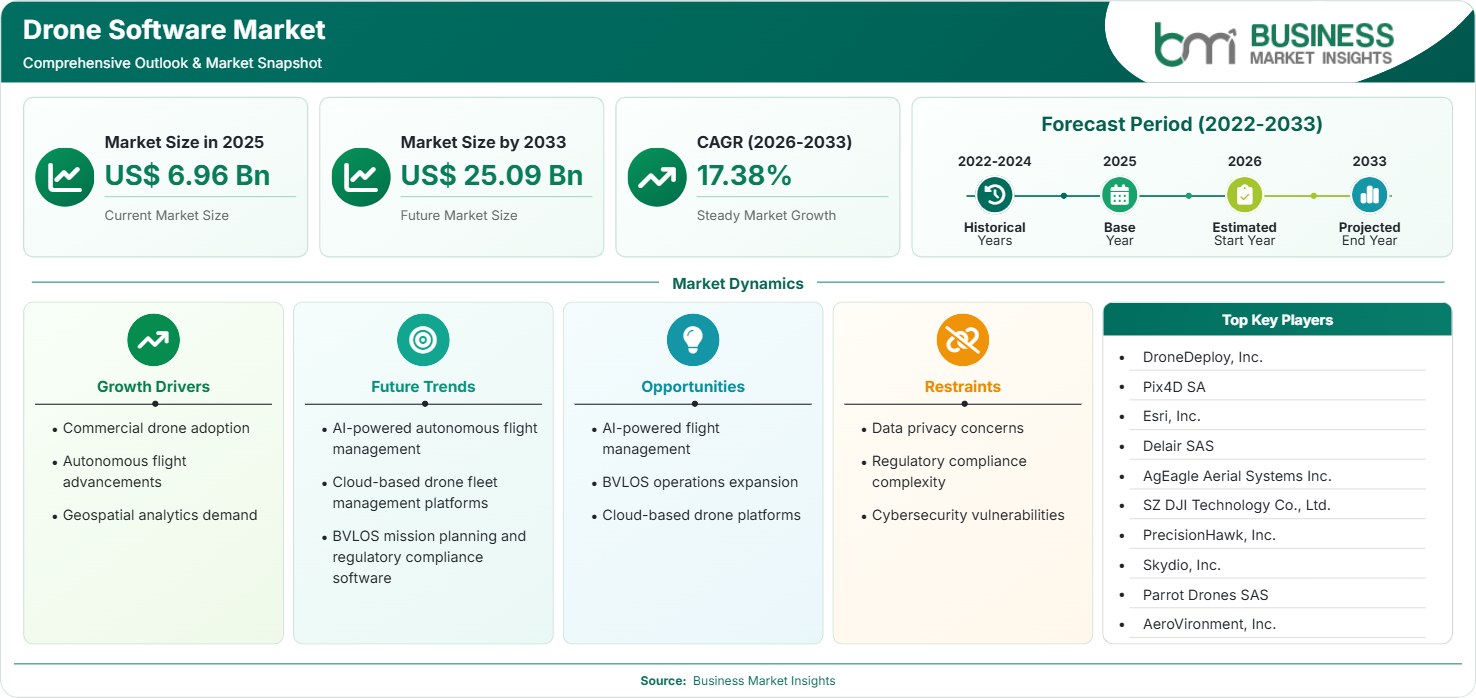
The Drone Software Market size was valued at US$ 6.96 billion in 2025 and is projected to reach US$ 25.09 billion by 2033, growing at a CAGR of 17.38% during 2026–2033. Growth is driven by commercial drone adoption, autonomous flight advancements, geospatial analytics demand, AI-powered flight management, BVLOS operations expansion, and cloud-based drone platforms.

Report Coverage
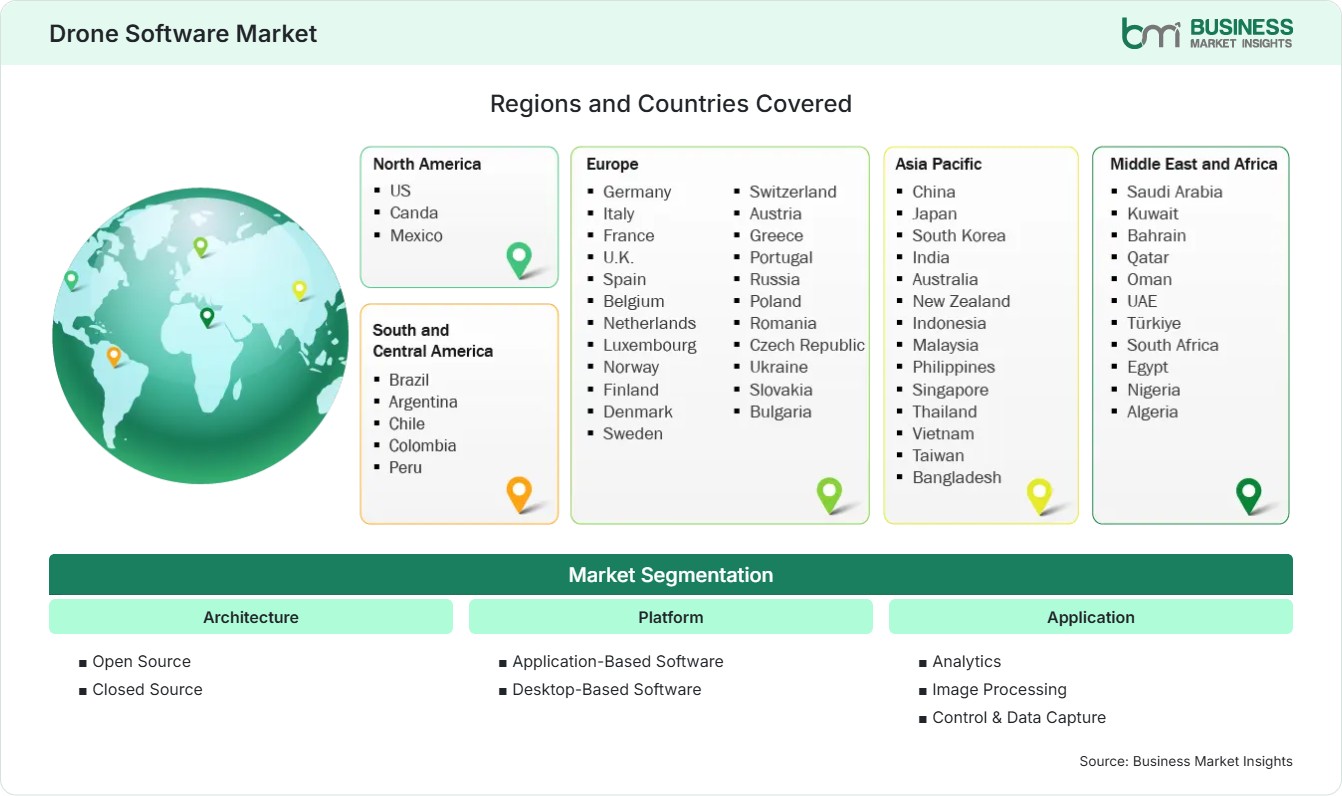
  • Architecture: Open Source, Closed Source
  • Platform: Application-Based Software, Desktop-Based Software
  • Application: Analytics, Image Processing, Control & Data Capture
US$ 6.96 Bn Market size in 2025
US$ 25.09 Bn Market Size by 2033
17.38% CAGR, 2026 - 2033
2026-2033 Forecast Period

01 AI Overview

Drone Software Market Summary

  • North America Region: North America holds an estimated 38%–42% drone software market share in 2025, growing at a 16.8%–17.5% CAGR during 2026–2033. Strong commercial drone deployment, advanced aerospace ecosystem, infrastructure inspection demand, and geospatial analytics adoption support regional expansion. The US market remains the leading contributor, growing at an estimated 17.0%–17.7% CAGR through 2033 due to enterprise drone adoption and software innovation.
  • Fastest Growing Region: Asia Pacific represents an estimated 26%–30% share in 2025, expanding at a 18.2%–19.0% CAGR during 2026–2033. Increasing industrial automation, smart agriculture adoption, urban mapping requirements, and expanding drone manufacturing capabilities accelerate regional growth.
  • Leading Segment: Application-Based Software accounts for an estimated 62%–66% share in 2025, growing at a 17.0%–17.8% CAGR during 2026–2033. Demand is supported by cloud accessibility, specialized workflow solutions, analytics capabilities, and industry-specific drone operations.
  • High Growth Segment: AI-enabled Analytics applications represent an estimated 20%–24% share in 2025, expanding at a 19.0%–20.0% CAGR during 2026–2033. Machine learning integration, automated insights, predictive analysis, and advanced image interpretation are accelerating adoption.
  • Key Market Opportunity: AI-powered flight management, beyond visual line of sight operations, cloud-based platforms, and autonomous drone ecosystems are creating opportunities for software providers serving industrial, commercial, and government applications.
  • Major Market Players: DroneDeploy, Inc., Pix4D SA, Esri, Inc., Delair SAS, AgEagle Aerial Systems Inc., SZ DJI Technology Co., Ltd., PrecisionHawk, Inc., Skydio, Inc., Parrot Drones SAS, AeroVironment, Inc.
02 Strategic Insights

Drone Software Market: Strategic Insights

Drone Software Market Strategic Framework
FREE PDF
Request your free sample
Request free sample
03 Stakeholder View

Key Takeaways

  • The drone software ecosystem includes software developers, drone manufacturers, cloud providers, analytics companies, mapping specialists, and enterprise users, with platform integration becoming a major competitive factor.
  • Industrial applications such as infrastructure inspection, agriculture monitoring, construction mapping, and energy asset management represent high-value opportunities due to increasing demand for automated data collection.
  • Artificial intelligence, machine learning, computer vision, and automated analytics are reshaping drone software capabilities by improving operational efficiency and enabling autonomous decision-making.
  • North America remains a strategic investment region due to advanced commercial drone regulations, enterprise adoption, strong technology infrastructure, and demand from industrial sectors.
  • Partnerships between drone hardware manufacturers, software providers, and cloud technology companies are increasing as companies seek integrated solutions for large-scale drone operations.
  • Emerging markets provide growth opportunities through smart city initiatives, agricultural modernization, infrastructure development, and increasing adoption of unmanned aerial technologies.
04 Geographic Outlook

Drone Software Market Regional Highlights

North America Drone Software Market

North America accounts for an estimated 38%–42% share in 2025, supported by strong enterprise drone adoption, advanced technology infrastructure, and increasing use of aerial analytics. The region is projected to grow at a 16.8%–17.5% CAGR during 2026–2033. The United States remains the primary market due to commercial drone operations, regulatory advancements, and demand across construction, defense, agriculture, and infrastructure industries.

  • The United States dominates regional demand through strong enterprise adoption and advanced drone software development capabilities.
  • Infrastructure inspection companies increasingly use drone analytics platforms to improve asset monitoring efficiency.
  • Construction firms are adopting aerial mapping software for project tracking and site management.
  • Agricultural users are implementing drone analytics for crop monitoring and precision farming applications.

US Drone Software Market

The US represents an estimated 84%–88% share of North America's Drone Software Market in 2025 and is expected to expand at a 17.0%–17.7% CAGR through 2033. Growth is supported by commercial drone adoption, technology innovation, enterprise software integration, and increasing demand for autonomous aerial data solutions across multiple industries.

  • Regulatory progress supporting advanced drone operations is encouraging enterprise software adoption.
  • Defense and security applications continue increasing demand for advanced drone management platforms.
  • Businesses are adopting cloud-based solutions for scalable drone data processing and analytics.

Europe Drone Software Market

Europe represents an estimated 24%–28% share in 2025, expanding at a 16.5%–17.3% CAGR during 2026–2033. Growth is supported by industrial automation, environmental monitoring, smart infrastructure programs, and increasing adoption of unmanned aerial systems. Germany, France, the United Kingdom, and the Netherlands remain important markets due to strong technology ecosystems and industrial applications.

  • Germany supports demand through industrial automation, engineering applications, and infrastructure monitoring.
  • France is expanding drone software adoption across agriculture, defense, and environmental applications.
  • The United Kingdom is developing commercial drone ecosystems through technology innovation and regulatory support.
  • European companies are increasing investment in geospatial analytics and automated mapping solutions.

Asia Pacific Drone Software Market

Asia Pacific represents an estimated 26%–30% share in 2025 and records the fastest growth at a 18.2%–19.0% CAGR during 2026–2033. Regional expansion is supported by drone manufacturing capabilities, smart city development, agricultural modernization, and industrial automation initiatives. China, Japan, India, South Korea, and Southeast Asian countries are driving adoption.

  • China leads regional demand through drone manufacturing strength and commercial software adoption.
  • India is expanding drone applications through agriculture, infrastructure, and mapping initiatives.
  • Japan supports adoption through robotics integration and advanced industrial automation.
  • South Korea is investing in autonomous technologies and smart infrastructure applications.
  • Southeast Asian markets are adopting drones for agriculture and environmental monitoring.

Rest of World Drone Software Market

Latin America, the Middle East, and Africa collectively represent an estimated 7%–10% share in 2025, growing at a 17.0%–17.8% CAGR through 2033. Growth is supported by infrastructure development, agricultural technology adoption, mining applications, and increasing demand for aerial monitoring solutions. Brazil, UAE, Saudi Arabia, and South Africa represent emerging markets.

  • Brazil is expanding drone software adoption through agriculture and environmental monitoring applications.
  • Middle Eastern countries are investing in drones for infrastructure, security, and smart city programs.
  • Mining companies are increasingly using drone analytics for surveying and operational monitoring.
  • African markets are adopting drone solutions for agriculture, mapping, and resource management.
  • Infrastructure modernization programs are creating opportunities for software providers.
Global Market Geography
FREE PDF
Request your free sample
Request free sample
05 Segment Analysis

Drone Software Market Segmentation

Architecture

The Architecture segment represents a core foundation of the market, accounting for an estimated 88%–92% share in 2025 and expanding at a 17.0%–17.7% CAGR during 2026–2033. Software architecture selection is influenced by enterprise security requirements, customization needs, scalability, and operational complexity. Open-source platforms support innovation and flexibility, while closed-source solutions provide controlled environments, dedicated support, and advanced enterprise features. Increasing demand for secure, reliable, and scalable drone operations is encouraging organizations to adopt specialized software architectures across commercial applications, supporting drone software market growth.

  • Open Source: Open-source drone software platforms support customization, community-driven development, and flexible integration for research organizations, developers, and specialized drone applications.
  • Closed Source: Closed-source solutions provide enterprise-grade security, technical support, proprietary features, and optimized workflows for commercial drone operations requiring reliability.

Platform

The Platform segment accounts for an estimated 72%–76% share in 2025 and is projected to grow at a 17.5%–18.2% CAGR during 2026–2033. Platform selection is increasingly influenced by accessibility, processing requirements, operational scale, and industry-specific workflows. Application-based software is gaining adoption due to cloud connectivity and mobile accessibility, while desktop-based platforms remain important for advanced data processing and professional users during drone software market forecasts, requiring powerful analytical capabilities.

  • Application-Based Software: Application-based drone software enables mobile accessibility, cloud integration, real-time monitoring, and simplified workflows for commercial drone operators.
  • Desktop-Based Software: Desktop-based software supports advanced processing, detailed analysis, offline capabilities, and professional applications requiring extensive computing resources.

Application

The Application segment represents an estimated 80%–84% share in 2025 and is expected to expand at a 17.3%–18.0% CAGR through 2033. Increasing drone adoption across industries is generating demand for software solutions supporting data capture, image analysis, and operational intelligence. Businesses are using drone software to convert aerial data into actionable insights for decision-making, asset management, and process optimization. The Drone Software Market trends indicate increasing integration of artificial intelligence, automation, and analytics capabilities across application areas.

  • Analytics: Analytics software enables organizations to process drone-generated data, identify patterns, monitor assets, and improve operational decisions across industries.
  • Image Processing: Image processing solutions support aerial imagery analysis, mapping, modeling, and visualization for construction, agriculture, surveying, and inspection applications.
  • Control & Data Capture: Control and data capture platforms enable mission planning, autonomous operations, flight management, and real-time collection of aerial information.
06 Market Forces

Drone Software Market Dynamics

Key Market Drivers

Commercial drone adoption accelerates software demand

Drone deployment for commercial use in sectors such as construction, agriculture, energy, logistics, and infrastructure inspection is rising, thereby giving rise to high demand for sophisticated software platforms. Enterprises have started employing drones in order to cut down their operational expenses, increase the rate of information gathering, and make decision-making accurate. The role of software platforms is that they offer automation in terms of flight plan creation, data analysis, and processing. The factors behind growth in the Drone Software Market include growth in the number of commercial applications and understanding that drones are productive rather than being just aerial imaging equipment.

Autonomous flight advancements improve operational efficiency

The improvements in autonomous flight technology have increased the need for advanced software that can handle complex missions with minimal human interference. The developments in artificial intelligence, navigation, computer vision, and sensor integration have enabled drones to perform inspection, mapping, and surveillance missions. The development of autonomous technology increases efficiency in operations because of reduced manual handling and mission consistency. The software vendors are creating platforms that facilitate automatic route planning, obstacle detection, and intelligent decision-making.

Geospatial analytics demand expands software applications

Rising need for geospatial analysis is driving the adoption of drone software that can convert aerial data into valuable insights. Agricultural, construction, mining, and urban development sectors are employing drones for their ability to map, survey, monitor assets, and analyze environments. These complex software solutions combine geographic information systems, three-dimensional modeling, and imagery analysis capabilities to ensure better visibility in operations. The rising availability of high-resolution aerial data is prompting businesses to adopt analytics software solutions that aid quick decision-making. The combination of geospatial technologies with drones is widening the application of software from flight management to data intelligence.

Key Market Opportunities

AI-powered flight management creates automation opportunities

AI-based flight management is one of the key opportunities in view of growing requirements for automation, safety, and effectiveness of drone usage. AI technology allows predicting flight trajectories, providing automated navigation, obstacle detection, and intelligent mission optimization. The software vendors are creating platforms based on machine learning technologies and real-time data from sensors that will provide better drone performance within various environments. The forecasts of the Drone Software Market are driven by growing investments in autonomous systems, industrial automation, and intelligent aerial platforms.

BVLOS operations expansion increases software adoption

BVLOS is presenting new possibilities for drone software vendors by facilitating long-range and complex commercial tasks. Advanced software is needed to handle communications, autonomy, airspace situational awareness, and safety for BVLOS operations. As the regulatory environment changes, businesses are considering drone use cases that demand long-range operations such as pipeline inspection, delivery, and surveys. Compliance, monitoring, and automation software solutions are likely to become increasingly important as BVLOS becomes widely used around the world.

Cloud-based drone platforms enhance scalability

The emergence of cloud-based drone platforms will result in new possibilities through the provision of capabilities such as centralized data storage, remote cooperation, and operation of the fleet of drones in the cloud. The companies with multiple drone implementations need platforms that can handle massive amounts of aerial data and allow safe access for all teams involved. Cloud-based solutions minimize the amount of infrastructure and facilitate the process of analysis, reporting, and integration with enterprise systems. The growing popularity of the software-as-a-service model pushes companies to move away from individual applications to the drone platforms ecosystem.

Market Restraints and Challenges

Data privacy concerns restrict enterprise adoption

Factor: Drone software platforms capture large amounts of imagery and other data related to location, which results in issues related to data ownership, privacy, and security.

Impact: Issues of privacy can delay the implementation of such technology in companies, government bodies, and other sectors that are highly concerned about data management issues. Companies have to adopt certain measures to handle data securely.

Regulatory compliance complexity increases operational barriers

Factor: Drones need adherence to regulatory guidelines related to the aviation industry, operational limitations, license conditions, and airspace control practices in different regions.

Impact: The complexity of regulatory frameworks may lead to a delay in using drones for commercial purposes, as well as necessitate further software development. Providers will have to ensure that their platforms adjust to new regulatory requirements on a regular basis.

07 Company Analysis

Competitive Landscape

The competitive environment of the market is shaped by software developers, drone manufacturers, geospatial technology providers, and aerial intelligence companies developing integrated solutions for commercial and enterprise applications. Companies are focusing on cloud-based platforms, artificial intelligence integration, autonomous flight management, analytics capabilities, and industry-specific workflows. The Drone Software Market analysis highlights increasing competition around scalable platforms, advanced data processing, and solutions that support regulatory compliance, fleet management, and enterprise drone operations.

Company Name

Overview

Products and Services relevant to this market

DroneDeploy, Inc.

Drone software company providing cloud-based aerial data solutions for commercial industries.

Drone mapping software, analytics platforms, inspection solutions, construction and agriculture applications.

Pix4D SA

Swiss software company specializing in photogrammetry and drone mapping technologies.

Image processing software, mapping solutions, 3D reconstruction, geospatial analysis platforms.

Esri, Inc.

Geographic information system company offering location intelligence and mapping solutions.

GIS platforms, drone data integration, spatial analytics, mapping and visualization solutions.

Delair SAS

Drone technology company providing industrial unmanned aerial solutions and software capabilities.

Drone mission planning, aerial intelligence platforms, data processing, industrial monitoring solutions.

AgEagle Aerial Systems Inc.

Drone solutions provider focused on commercial and industrial aerial applications.

Drone software platforms, aerial analytics, agricultural monitoring, data management solutions.

SZ DJI Technology Co., Ltd.

Global drone manufacturer developing hardware and software ecosystems for aerial applications.

Flight control software, drone management platforms, imaging solutions, enterprise applications.

PrecisionHawk, Inc.

Drone technology company providing aerial data and analytics solutions.

Drone analytics software, agricultural intelligence platforms, inspection and mapping solutions.

Skydio, Inc.

Autonomous drone company specializing in AI-powered flight technologies.

Autonomous flight software, drone control systems, enterprise drone management solutions.

Parrot Drones SAS

European drone manufacturer developing professional and consumer aerial platforms.

Flight software, mapping applications, enterprise drone solutions, aerial imaging platforms.

AeroVironment, Inc.

Aerospace company providing unmanned systems and related technologies.

Drone software solutions, autonomous systems, mission management platforms, defense applications.

08 Industry Activity

Recent Developments

July 2026

Emesent secured US$17 million in funding to accelerate development of its Cortex AI autonomy platform and expand its Aura cloud software offering. The investment will support manufacturing scale-up and advance autonomous intelligence solutions for GPS-denied environments across mining, defense, and construction industries.

June 2026

ZenaTech, Inc. unveiled Zoo Office, an AI-powered enterprise productivity platform designed to unify its SaaS ecosystem through agentic AI capabilities. The platform automates enterprise workflows, enhances decision-making, and supports intelligent business operations, with rollout beginning through a private beta program.

June 2026

XTEND secured approximately US$9.0 million in defense orders to expand autonomous multi-drone operations for a Middle East defense customer. The deployment leverages the company's XOS operating system to enable mission management, multi-system orchestration, and scalable autonomous robotic fleet operations while maintaining human oversight for critical decisions.

June 2026

Cognizant launched its Sovereign Physical AI Platform-as-a-Service, built on the Cognizant Intelligence Spine, to integrate industrial sensors, IoT devices, factory automation systems, and energy infrastructure into a unified AI-driven platform. The solution enables enterprises to deploy and manage autonomous physical AI applications across manufacturing, logistics, energy, and other industrial sectors.

10 Trust & Transparency

Research Methodology

The market analysis combines proprietary research with secondary data from government agencies, company disclosures, regulatory filings, industry databases and expert interviews. Market estimates are validated through data triangulation, cross-market benchmarking and analyst review.

View Full Research Methodology

11 Questions Answered

Frequently Asked Questions

What challenges affect drone software adoption?

In the drone software market report, key challenges include data privacy concerns, cybersecurity risks, regulatory compliance complexity, changing aviation requirements, and the need for secure management of drone-generated information.

Why are cloud-based drone platforms becoming popular?

Cloud-based platforms enable scalable data storage, remote collaboration, real-time processing, centralized fleet management, and easier integration with enterprise software systems.

How is artificial intelligence influencing drone software development?

Artificial intelligence is improving autonomous flight management, object recognition, predictive analytics, route optimization, and automated decision-making capabilities across commercial drone operations.

Which drone software application is gaining importance?

Analytics applications are gaining importance as organizations increasingly require advanced processing capabilities to convert drone-generated imagery and sensor data into actionable business insights.

What factors are driving the Drone Software Market?

The market is driven by commercial drone adoption, autonomous flight advancements, increasing demand for geospatial analytics, expansion of industrial drone applications, and growing need for automated aerial data processing.

Access the Full Drone Software Market Report

Get segment-level forecasts, regional estimates, competitive benchmarking, company profiles and downloadable Excel datasets.

Access the full Drone Software Market Report
350 pages PDF & Excel | 2026-07-30