
Drone Detection Market Outlook: Size, Share, Trends, Growth Analysis, Competitive Landscape & Forecast, 2026–2033

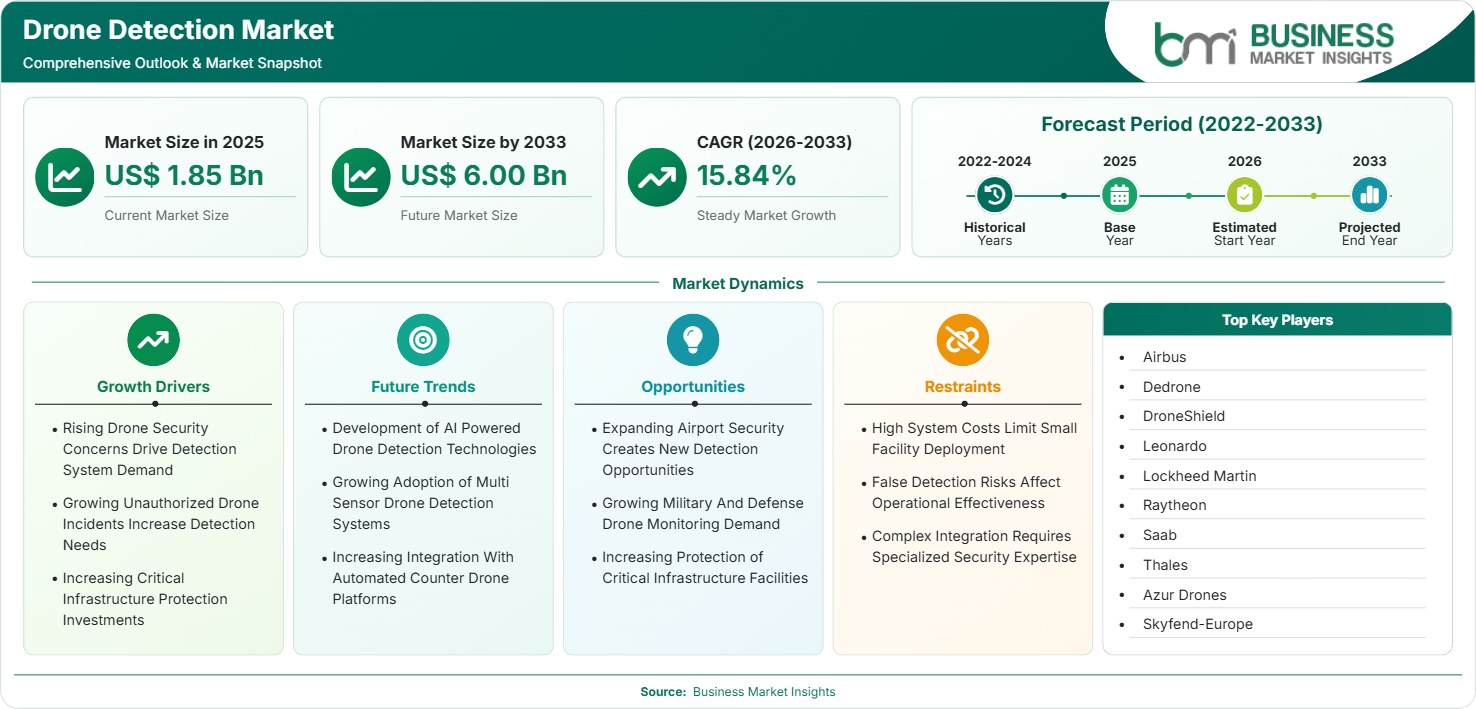
The Drone Detection Market size was valued at US$ 1.85 billion in 2025 and is projected to reach US$ 6.00 billion by 2033, growing at a CAGR of 15.84% during 2026–2033, driven by rising airspace security requirements, unauthorized drone activity, critical infrastructure protection, airport security modernization, and defense surveillance needs.

Report Coverage
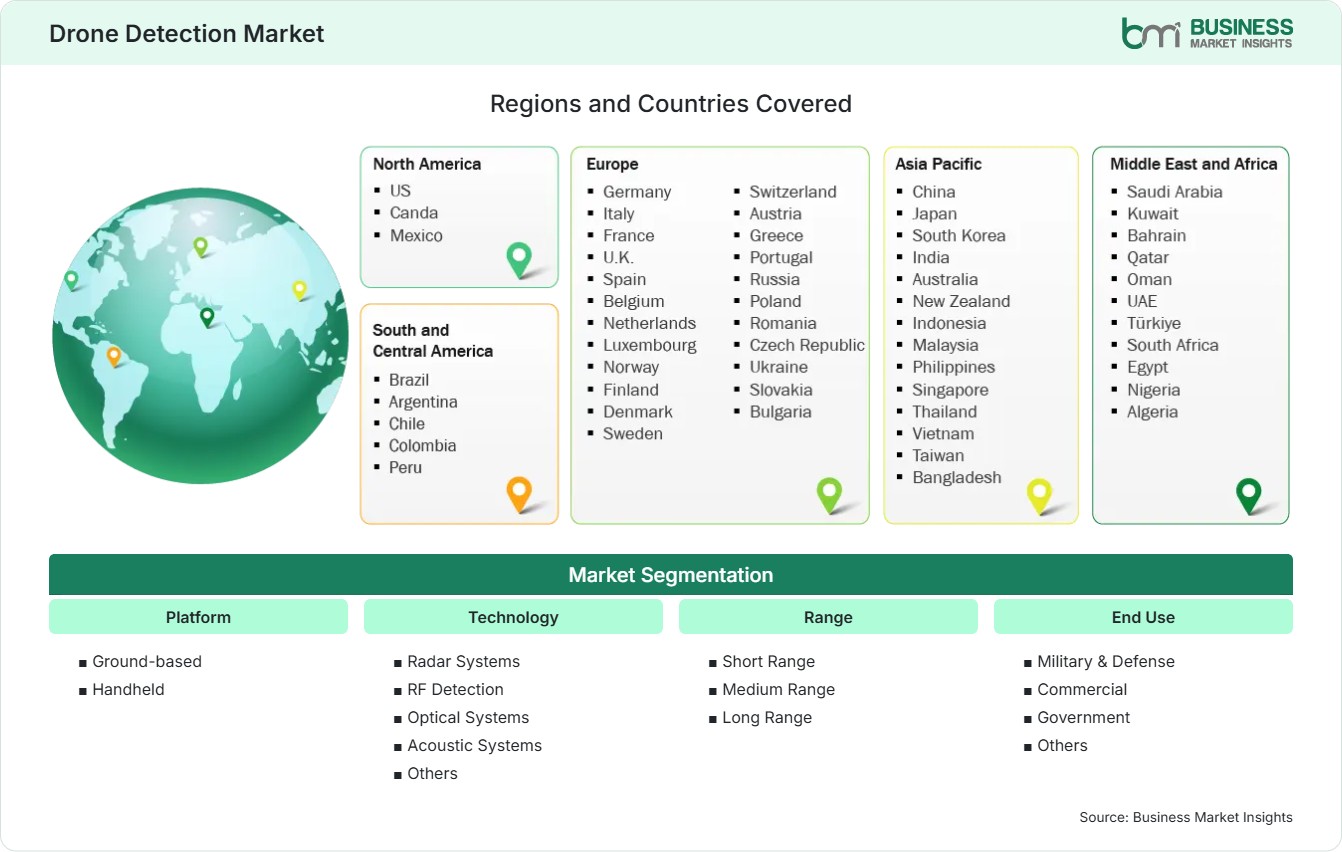
  • Platform: Ground-based, Handheld
  • Technology: Radar Systems, RF Detection, Optical Systems, Acoustic Systems, Others
  • Range: Short Range , Medium Range , Long Range
  • End Use: Military & Defense, Commercial, Government, Others
US$ 1.85 Bn Market size in 2025
US$ 6.00 Bn Market Size by 2033
15.84% CAGR, 2026 - 2033
2026-2033 Forecast Period

AI Overview

Drone Detection Market Summary

  • North America Region: North America holds a 32%–36% share in 2025, growing at a 14.5%–16.5% CAGR during 2026–2033, supported by airport security, defense modernization, critical infrastructure protection, border surveillance, and increasing demand for integrated counter-drone monitoring capabilities.
  • Fastest Growing Region: Asia Pacific holds a 22%–26% share in 2025, expanding at a 17.5%–19.5% CAGR during 2026–2033, driven by expanding defense budgets, airport development, border security requirements, commercial drone deployment, and modernization of surveillance infrastructure.
  • Leading Segment: Radar Systems hold a 31%–35% share in 2025, expanding at a 15.0%–17.0% CAGR, supported by wide-area monitoring, detection of moving aerial objects, all-weather operation, and integration with command-and-control architectures.
  • High Growth Segment: RF Detection holds a 24%–28% share in 2025, expanding at a 17.0%–19.0% CAGR, benefiting from passive signal monitoring, rapid identification capabilities, low-power deployments, and growing demand for layered drone surveillance systems.
  • Key Market Opportunity: Expanding airport, defense, energy, logistics, and public-sector security programs creates opportunities for multi-sensor detection platforms combining radar, RF, optical, acoustic, analytics, and automated alerting capabilities.
  • Major Market Players: Airbus, Dedrone, DroneShield, Leonardo, Lockheed Martin, Raytheon, Saab, Thales, Azur Drones, and Skyfend-Europe.
Strategic Insights

Drone Detection Market: Strategic Insights

Drone Detection Market Strategic Framework
FREE PDF
Request your free sample
Request free sample
Stakeholder View

Key Takeaways

  • Detection is becoming an integrated security function rather than a standalone sensor purchase, increasing the importance of interoperability between surveillance hardware, analytics platforms, command systems, and existing security infrastructure.
  • Airport security, defense installations, energy facilities, logistics sites, and high-value public infrastructure provide the strongest commercial pathways because unauthorized drone activity can create operational, safety, and security consequences.
  • Sensor fusion is becoming central to product development as radar, RF, optical, and acoustic technologies provide complementary detection characteristics under different environmental and operational conditions.
  • Asia Pacific presents a compelling expansion opportunity because defense modernization, infrastructure construction, airport development, and increasing drone adoption are occurring simultaneously across multiple national markets.
  • Procurement strategies are increasingly favoring scalable architectures that allow customers to add sensors, coverage zones, analytics capabilities, and command functions as security requirements evolve.
  • Competitive differentiation will increasingly depend on detection accuracy, low-altitude tracking, rapid classification, integration flexibility, deployment speed, and the ability to minimize nuisance alerts in complex environments.
Geographic Outlook

Drone Detection Market Regional Highlights

North America Drone Detection Market

North America represents a 32%–36% share in 2025 and is projected to expand at a 14.5%–16.5% CAGR through 2033. The region benefits from extensive defense infrastructure, large airport networks, critical facilities, and established security technology adoption. The Drone Detection Market share is reinforced by demand for layered surveillance and rapid threat identification.

  • Defense installations are strengthening low-altitude surveillance capabilities as drones become increasingly relevant to perimeter security, facility monitoring, and protection of sensitive operational areas.
  • Airports represent an important demand center because unauthorized drone activity can disrupt aircraft operations, creating requirements for continuous monitoring and rapid identification around controlled airspace.
  • Critical infrastructure operators are evaluating multi-sensor architectures that can provide persistent aerial awareness across energy, transportation, communications, and industrial facilities.
  • Commercial security providers are developing mobile and fixed detection configurations to address different site sizes, deployment conditions, and operational requirements.

US Drone Detection Market

The US accounts for a 78%–82% share of the North American market in 2025 and is projected to grow at a 14.8%–16.8% CAGR during 2026–2033. Defense facilities, airports, correctional institutions, energy infrastructure, and commercial sites contribute to demand.

  • Defense and homeland security requirements support demand for mobile and fixed detection platforms capable of monitoring sensitive areas without extensive changes to existing security architecture.
  • Airport operators require dependable detection across complex environments where buildings, aircraft, terrain, and legitimate radio-frequency activity can complicate identification.
  • Commercial facilities are increasingly considering scalable detection systems that can be deployed around warehouses, campuses, event venues, and other locations requiring controlled airspace awareness.

Europe Drone Detection Market

Europe holds a 25%–29% share in 2025 and is projected to grow at a 13.8%–15.8% CAGR through 2033. France leads regional demand, while the UK and Germany provide important growth opportunities. France is projected to grow at a 14.5%–16.5% CAGR, while Germany could reach 14.0%–16.0% CAGR. Airport protection, defense readiness, public security, and critical infrastructure modernization are supporting regional adoption.

  • France provides a strong market base because defense, aviation, and public security organizations require increasingly capable low-altitude surveillance and drone identification technologies.
  • Germany offers opportunities through defense modernization and protection of strategically important infrastructure, creating demand for interoperable detection architectures and advanced sensor integration.
  • The UK provides demand across airports, defense facilities, prisons, and critical infrastructure where unauthorized drone activity can create safety and security challenges.
  • European customers increasingly favor systems that integrate detection information with established surveillance, security management, and command platforms.

Asia Pacific Drone Detection Market

Asia Pacific represents a 22%–26% share in 2025 and is forecast to expand at a 17.5%–19.5% CAGR through 2033. China, Japan, South Korea, India, and Southeast Asian economies are contributing to regional expansion. India is projected to grow at a 18.0%–20.0% CAGR, while Japan could reach 16.5%–18.5% CAGR. Defense modernization, airport construction, border surveillance, and infrastructure protection are key demand drivers.

  • India offers strong opportunities as defense, airport, industrial, and public-security organizations strengthen capabilities for monitoring unauthorized or unidentified unmanned aerial activity.
  • Japan presents demand across defense, airports, industrial facilities, and public infrastructure where security operators require precise monitoring of increasingly active low-altitude airspace.
  • South Korea provides opportunities through defense surveillance, border monitoring, and protection of strategically important infrastructure requiring persistent aerial awareness.
  • Southeast Asian markets are developing demand through airport expansion, maritime facilities, industrial sites, and growing adoption of commercial and recreational drones.

Rest of World Drone Detection Market

Rest of World accounts for a 17%–21% share in 2025 and is projected to grow at a 14.5%–17.0% CAGR through 2033. Latin America is supported by airport and critical infrastructure security, while Middle Eastern and African markets benefit from defense modernization. Brazil is projected to grow at 15.0%–17.0% CAGR, while Saudi Arabia could reach 16.0%–18.0% CAGR.

South and Central America offers opportunities across airports, energy assets, government facilities, and major industrial sites. Middle Eastern markets are developing sophisticated security requirements around airports, military installations, energy infrastructure, and large-scale development projects.

  • Brazil provides potential across airports, energy infrastructure, logistics facilities, and public-sector sites where operators require stronger protection against unauthorized aerial activity.
  • Saudi Arabia offers substantial opportunities through defense modernization, airport development, energy infrastructure, and large infrastructure projects requiring sophisticated aerial surveillance capabilities.
  • African markets can adopt mobile and fixed detection platforms around airports, mining facilities, government sites, and other high-value installations where conventional surveillance may provide limited low-altitude coverage.
  • Latin American operators are increasingly evaluating modular systems that can provide localized protection before expanding toward broader multi-site surveillance architectures.
Global Market Geography
FREE PDF
Request your free sample
Request free sample
Segment Analysis

Drone Detection Market Segmentation

Platform

Ground-based platforms hold a 62%–66% share in 2025 and are projected to grow at a 15.0%–16.5% CAGR through 2033. Drone Detection Market scope is expanding through mobile and handheld solutions that address temporary security requirements and difficult-to-cover locations.

  • Ground-based: Fixed and transportable ground systems provide persistent aerial monitoring around protected facilities, supporting continuous surveillance, sensor integration, and centralized security operations.
  • Handheld: Portable platforms support mobile teams, temporary protection zones, tactical deployments, and rapid surveillance where fixed detection infrastructure is unavailable or impractical.

Technology

Radar Systems hold a 31%–35% share in 2025 and are projected to grow at a 15.0%–17.0% CAGR through 2033. Radar provides broad-area monitoring and supports detection across challenging conditions.

  • Radar Systems: Radar supports wide-area detection and tracking, making it suitable for airports, defense facilities, infrastructure sites, and environments requiring persistent aerial surveillance.
  • RF Detection: RF systems monitor communication signals associated with drones and controllers, supporting passive detection and identification where radio-frequency activity provides useful classification information.
  • Optical Systems: Cameras and electro-optical sensors provide visual confirmation, helping security operators classify detected objects and assess activity after initial sensor alerts.
  • Acoustic Systems: Acoustic sensors identify characteristic sound signatures from drone propulsion systems and can supplement other technologies where visual or RF detection is constrained.

Range

Long Range systems hold a 34%–38% share in 2025 and are projected to grow at a 15.5%–17.5% CAGR through 2033. Large protected areas require earlier detection to provide security teams with more time for assessment and response.

  • Short Range (Up to 1 Km): Short-range systems support localized protection around buildings, restricted areas, events, and tactical positions where immediate detection is required.
  • Medium Range (1 Km to 5 Km): Medium-range platforms balance coverage and deployment requirements, making them suitable for airports, industrial sites, military facilities, and perimeter monitoring.
  • Long Range (Above 5 Km): Long-range detection provides extended warning distances for large installations and protected zones, allowing operators greater time to classify and assess aerial activity.

End Use

Military & Defense applications hold a 43%–47% share in 2025 and are projected to grow at a 15.5%–17.5% CAGR through 2033. Defense organizations require persistent awareness around bases, operational areas, and strategic facilities.

  • Military & Defense: Defense users require layered detection capabilities for base protection, perimeter monitoring, tactical surveillance, and identification of unauthorized unmanned aerial systems.
  • Commercial: Commercial applications include airports, industrial facilities, logistics centers, event venues, and corporate properties seeking stronger control over low-altitude aerial activity.
  • Government: Government organizations deploy detection systems around public facilities, correctional institutions, border areas, and sensitive sites requiring controlled aerial environments.
Market Forces

Drone Detection Market Dynamics

Key Market Drivers

Rising Drone Security Concerns Drive Detection System Demand

With the widespread application of unmanned aerial vehicles, there will be an ever-increasing necessity for surveillance in terms of the activities that take place in controlled and restricted airspace. It is important that the security officers have systems that can detect any new aircraft in the airspace to prevent disruptions or threats to safety that arise from the new equipment. The Drone Detection Market growth will thus be very much associated with the evolution of the drone security field as a whole. The customers are turning towards layering systems since there isn’t any sensor that works best in all environments. Radar, RF, optical, and acoustic sensors can provide complementary data. This trend is prompting suppliers to come up with integrated systems featuring centralized surveillance, alerts, object classification, and scalable deployment options for airports, military bases, critical infrastructures, and business premises.

Growing Unauthorized Drone Incidents Increase Detection Needs

Unauthorized drones pose problems in the aviation industry, military, public safety, industrial sites, and other controlled spaces. Detection represents the first ability needed to locate the unmanned aerial vehicle and decide if any further security measures should be taken. Rising understanding of these threats has encouraged companies to progress from reacting to observation into constant surveillance. The Drone Detection Market trends are focusing on fast identification, constant tracking, and integration with the current security solutions. Analytics software becomes increasingly critical since the operators have to analyze the data from different sources while avoiding false positives. Suppliers able to enhance detection capabilities without adding additional load to the operator become increasingly competitive.

Increasing Critical Infrastructure Protection Investments

There is a need for energy, transportation, communication, industry, and public infrastructure to be secured from a wide array of potential threats from both physical and aerial sources. There are various technologies that are utilized to ensure the safety of such areas; drone detection is among them, as it can help augment existing surveillance technologies such as cameras, radars, access control, and perimeter technologies. Resources are being increasingly allocated to systems that have the capability of being able to provide wide coverage of large or complex installations while being integrated into existing security systems. The Drone Detection Market forecast suggests that there is an opportunity for flexible installation options due to varying terrain and electromagnetic conditions of infrastructure locations.

Key Market Opportunities

Expanding Airport Security Creates New Detection Opportunities

The airport offers a good chance because the safe operations of airplanes involve controlled airspace around the runways, terminals, and other facilities. Detection solutions can be used to detect unauthorized drones before they enter the critical zones, so that security officers can evaluate any possible threats. The demand may not only be from the international airports but also from the regional ones. Manufacturers have an opportunity to create solutions such as fixed perimeter solutions, mobile detection solutions, sensor-fusion solutions, and software for monitoring. Integration with the existing infrastructure of the airport may bring additional value to the business. Continuous operation, minimal false alarms, fast deployment, and simple user interfaces of developed products can help to meet the practical needs of aviation security personnel.

Growing Military and Defense Drone Monitoring Demand

Complex demands exist for military services when it comes to low-altitude surveillance due to the ability of drones to operate at various distances, heights, speeds, and signatures. Detection technologies may be utilized as an early form of situational awareness prior to consideration of identification and other security solutions. Opportunities are available for systems that can perform under conditions that include fixed facilities, temporary locations, mobile units, and strategic sites. Modular design will enable defense customers to integrate radar, RF, optical, and acoustic sensors based on mission needs. Needs also exist for advanced processing capabilities, automated tracking, sensor networks, and command and control integration. Companies with scalable architectures and superior performance in tough environments are well-positioned to meet procurement needs.

Increasing Protection of Critical Infrastructure Facilities

There is an increasing desire for operators to have enhanced security cover as the facilities are increasingly connected and disruption has wider repercussions. Drone detection technology could be used to enhance security around energy facilities, industrial sites, transportation infrastructure, communication networks, and logistics operations centers. There is an opportunity for technologies that can work together with video cameras, access control systems, perimeter protection, and command systems. The customers could prefer solutions that can scale depending on the changes in the size of the facility to be secured. Remote monitoring could also be used for central management of geographically distributed facilities. The vendors can generate revenue through the supply of software solutions, integration, and other services.

Market Restraints and Challenges

High System Costs Limit Small Facility Deployment

Factor: Advanced drone detection installations can require multiple sensors, communications equipment, analytics software, integration services, infrastructure modifications, and ongoing maintenance. Impact: High acquisition and deployment costs can discourage smaller facilities from implementing comprehensive systems. Customers with limited security budgets may initially select single-sensor or localized solutions, reducing the addressable opportunity for sophisticated multi-layer architectures. The challenge is particularly relevant for smaller airports, commercial properties, municipal facilities, and industrial sites. Suppliers can address this limitation through modular platforms, phased deployment models, software upgrades, mobile systems, and flexible service arrangements. Lowering entry costs while preserving expansion capability can broaden adoption without requiring customers to commit to extensive infrastructure at the outset.

False Detection Risks Affect Operational Effectiveness

Factor: Birds, aircraft, environmental signals, radio-frequency activity, and other airborne or electromagnetic sources can resemble characteristics associated with drones. Impact: False alerts can increase workload, reduce operator confidence, and divert security resources from genuine threats. Detection systems must therefore distinguish relevant objects accurately within complex environments. Sensor fusion can help by combining information from different technologies rather than relying on a single detection source. Advanced classification algorithms, improved signal processing, contextual analytics, and configurable alert thresholds can further reduce unnecessary notifications. Suppliers that deliver accurate detection while maintaining rapid response performance can improve operational value and strengthen customer confidence in automated or semi-automated surveillance systems.

Company Analysis

Competitive Landscape

The Drone Detection Market analysis includes aerospace and defense companies, specialized counter-drone technology providers, surveillance technology manufacturers, and security solution developers. Competition centers on sensor performance, detection range, classification accuracy, software intelligence, integration capabilities, deployment flexibility, and support for fixed or mobile architectures.

Company Name

Overview

Products and Services Relevant to This Market

Airbus

Global aerospace and defense company with capabilities spanning security, surveillance, aerospace systems, and advanced technologies.

Airspace surveillance, security systems, command solutions, sensor integration, and technologies supporting detection and monitoring of unauthorized aerial activity.

Dedrone

Specialized counter-drone technology company focused on detecting, identifying, and monitoring unauthorized unmanned aircraft.

Drone detection platforms, RF sensors, analytics software, sensor fusion, airspace monitoring, and integrated counter-drone solutions.

DroneShield

Security technology company specializing in drone detection and counter-drone solutions for defense and security applications.

RF detection systems, drone detection platforms, portable systems, fixed installations, and integrated counter-UAS technologies.

Leonardo

Aerospace and defense company providing electronics, radar, surveillance, and security technologies for complex operational environments.

Radar systems, sensors, surveillance platforms, electronic systems, and integrated technologies applicable to drone detection and monitoring.

Lockheed Martin

Major defense technology company providing advanced surveillance, sensing, aerospace, and defense systems.

Radar, sensors, command-and-control technologies, surveillance systems, and integrated defense solutions supporting aerial threat detection.

Raytheon

Defense technology provider specializing in advanced sensors, radars, air surveillance, and integrated defense architectures.

Radar systems, sensing technologies, surveillance solutions, command systems, and technologies supporting counter-drone detection architectures.

Saab

Defense and security company with expertise in radar, surveillance, sensors, command systems, and airspace monitoring.

Radar systems, surveillance technologies, sensors, command-and-control solutions, and integrated airspace awareness capabilities.

Thales

Technology and defense company serving aerospace, security, transportation, and critical infrastructure markets.

Radar, surveillance, sensors, command systems, airspace monitoring, and security technologies relevant to unauthorized drone detection.

Azur Drones

Drone technology company focused on autonomous aerial systems and related security applications.

Autonomous drone platforms, surveillance capabilities, security solutions, and technologies supporting aerial monitoring requirements.

Skyfend-Europe

Counter-UAS technology provider focused on portable and integrated solutions for drone detection and security operations.

Drone detection systems, RF monitoring, portable counter-UAS platforms, surveillance technologies, and security-oriented deployment solutions.

Trust & Transparency

Research Methodology

The market analysis combines proprietary research with secondary data from government agencies, company disclosures, regulatory filings, industry databases and expert interviews. Market estimates are validated through data triangulation, cross-market benchmarking and analyst review.

View Full Research Methodology

Questions Answered

Frequently Asked Questions

What does the Drone Detection Market Report cover?

The report covers market size, regional outlook, technology adoption, platform types, detection ranges, end-use applications, growth drivers, opportunities, restraints, segmentation, competitive positioning, and strategic developments shaping future demand.

What factors influence drone detection system selection?

Organizations typically evaluate detection range, accuracy, environmental performance, false-alert rates, sensor compatibility, deployment requirements, integration with existing security infrastructure, scalability, maintenance needs, and total lifecycle cost.

Which locations have strong demand for drone detection systems?

Airports, military facilities, energy installations, government sites, logistics centers, industrial facilities, correctional institutions, and other sensitive locations can require drone detection where unauthorized aerial activity could affect safety, security, or operations.

Why is sensor fusion becoming important in drone surveillance?

Different sensors have different strengths and limitations. Combining radar, RF, optical, and acoustic information can provide more complete situational awareness, improve object classification, and reduce dependence on a single detection method.

What technologies are commonly used for drone detection?

Drone detection systems commonly use radar, radio-frequency monitoring, optical sensors, and acoustic sensing. Multi-sensor architectures combine these technologies to improve detection, tracking, classification, and situational awareness across different operating environments.

Access the Full Drone Detection Market Report

Get segment-level forecasts, regional estimates, competitive benchmarking, company profiles and downloadable Excel datasets.

Access the full Drone Detection Market Report
350 pages PDF & Excel | 2026-09-03