
Anomaly Detection Market Outlook: Size, Share, Trends, Growth Analysis, Competitive Landscape & Forecast, 2026-2033

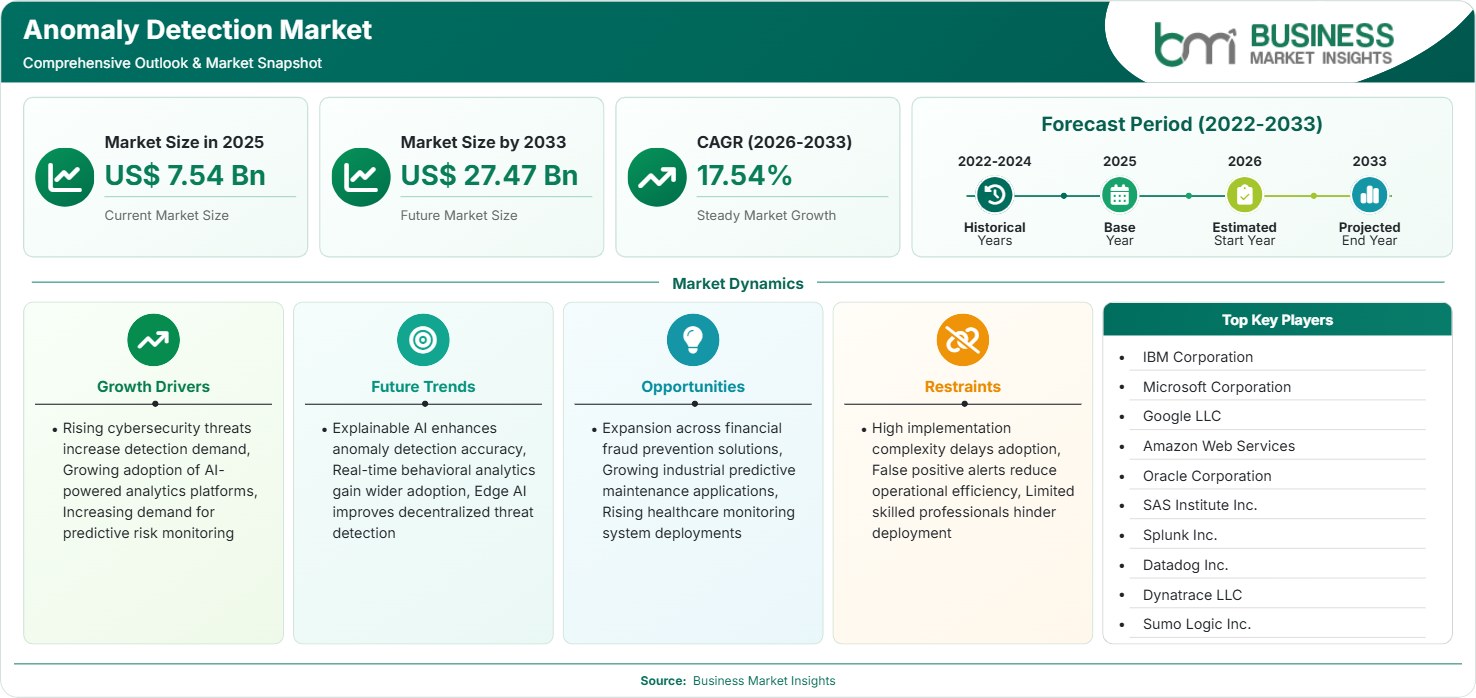
The Anomaly Detection Market size was valued at US$ 7.54 billion in 2025 and is projected to reach US$ 27.47 billion by 2033, growing at a CAGR of 17.54% during 2026–2033. Rising cybersecurity threats, expanding adoption of AI-powered analytics platforms, and increasing demand for predictive risk monitoring continue to accelerate enterprise investments in anomaly detection technologies.

Report Coverage
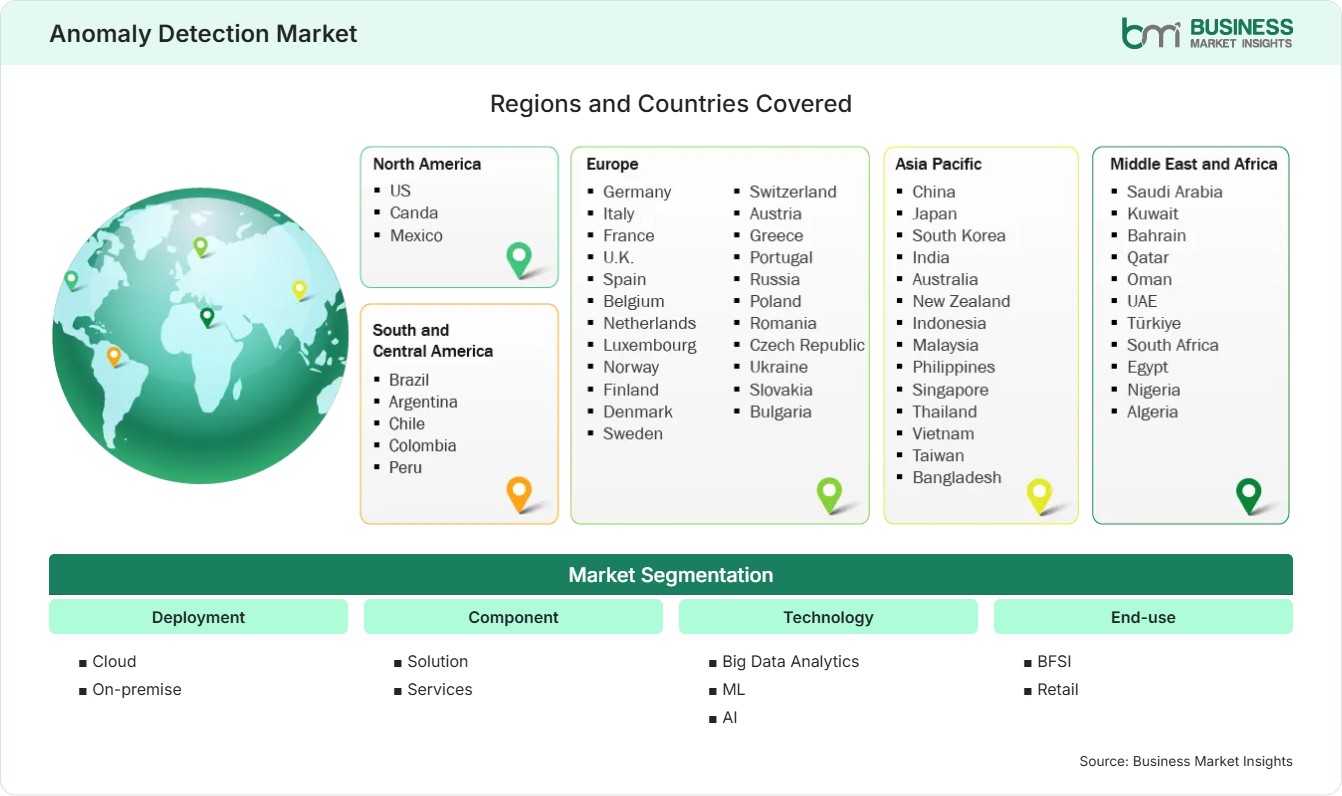
  • Deployment: Cloud, On-premise
  • Component: Solution, Services
  • Technology: Big Data Analytics, ML, AI
  • End-use: BFSI, Retail
US$ 7.54 Bn Market size in 2025
US$ 27.47 Bn Market Size by 2033
17.54% CAGR, 2026 - 2033
2026-2033 Forecast Period

AI Overview

Anomaly Detection Market Summary

  • North America Region: North America accounts for 37%–40% market share in 2025 and is projected to expand at a CAGR of 16.8%–17.3% during 2026–2033. Strong cloud adoption, rising cybersecurity investments, and increasing enterprise digital transformation continue supporting regional expansion. The U.S. remains the leading contributor with a CAGR of 16.9%–17.4%, driven by rapid deployment of AI-enabled security and analytics platforms.
  • Fastest Growing Region: Asia Pacific represents 27%–30% market share in 2025 and is expected to register a CAGR of 18.9%–19.5%, supported by expanding cloud infrastructure, digital banking, industrial automation, and enterprise AI adoption.
  • Leading Segment: Cloud accounts for 58%–61% market share in 2025 and is anticipated to grow at a CAGR of 18.0%–18.6%, driven by scalable deployment, lower infrastructure costs, and increasing adoption of cloud-native analytics platforms.
  • High Growth Segment: ML & AI captures 52%–55% market share in 2025 and is projected to register a CAGR of 18.6%–19.2%, supported by advances in machine learning algorithms, automation, and real-time threat detection.
  • Key Market Opportunity: Expanding AI-driven analytics, industrial monitoring, healthcare diagnostics, and financial fraud prevention are creating significant opportunities for advanced anomaly detection solutions across enterprise environments.
  • Major Market Players: IBM Corporation, Microsoft Corporation, Google LLC, Amazon Web Services, Inc., Oracle Corporation, SAS Institute Inc., Splunk Inc., Datadog, Inc., Dynatrace LLC, and Sumo Logic, Inc.
Strategic Insights

Anomaly Detection Market: Strategic Insights

Anomaly Detection Market Strategic Framework
FREE PDF
Request your free sample
Request free sample
Stakeholder View

Key Takeaways

  • Organizations are shifting from rule-based monitoring toward AI-driven anomaly detection systems capable of identifying unknown threats and operational irregularities in real time.
  • Financial institutions, healthcare providers, manufacturers, and cloud service operators continue expanding investments in predictive analytics to improve security, reliability, and operational efficiency.
  • Machine learning technologies are enhancing detection accuracy by continuously adapting to changing datasets and minimizing manual intervention across enterprise environments.
  • Asia Pacific presents the strongest long-term growth opportunity due to accelerating digital transformation, cloud adoption, and government support for artificial intelligence development.
  • Strategic collaborations among cloud providers, cybersecurity firms, and enterprise software vendors are accelerating innovation in intelligent monitoring and automated threat detection.
  • Increasing regulatory focus on cybersecurity and data protection is encouraging enterprises to strengthen anomaly detection capabilities across mission-critical digital infrastructure.
Geographic Outlook

Anomaly Detection Market Regional Highlights

North America Anomaly Detection Market

North America accounts for 37%–40% Anomaly Detection Market share in 2025 and is projected to grow at a CAGR of 16.8%–17.3% during 2026–2033. The region benefits from advanced cloud infrastructure, mature cybersecurity ecosystems, and widespread adoption of AI-driven enterprise software. Organizations continue investing in predictive analytics platforms that strengthen cyber resilience, improve operational visibility, and support regulatory compliance across highly digitalized industries.

  • Financial institutions continue deploying AI-driven fraud detection platforms to improve transaction monitoring and reduce financial crime.
  • Cloud providers strengthen security operations through automated anomaly detection integrated with enterprise monitoring platforms.
  • Manufacturing companies increasingly implement predictive analytics to minimize equipment failures and improve operational continuity.
  • Growing regulatory requirements continue encouraging investments in cybersecurity monitoring and enterprise risk management technologies.

US Anomaly Detection Market

The United States contributes 82%–85% of North American revenue and is projected to expand at a CAGR of 16.9%–17.4% through 2026–2033. Continuous investments in cloud computing, cybersecurity modernization, and enterprise artificial intelligence continue supporting widespread deployment across public and private sectors.

  • Large enterprises increasingly integrate AI-powered monitoring into cybersecurity operations.
  • Financial institutions continue investing in real-time fraud detection technologies.
  • Cloud-native software platforms strengthen enterprise operational visibility and system reliability.
  • AI innovation continues supporting adoption across healthcare, finance, manufacturing, and retail industries.

Europe Anomaly Detection Market

Europe represents 24%–27% market share in 2025 and is expected to register a CAGR of 16.5%–17.0% during the forecast period. Strong regulatory compliance requirements, digital transformation initiatives, and increasing cybersecurity investments continue driving market expansion. Germany leads regional adoption, while the Netherlands records the fastest growth through expanding enterprise cloud deployment and AI investments.

  • Financial regulations continue encouraging investment in intelligent fraud detection platforms.
  • Manufacturers adopt predictive maintenance solutions powered by AI-driven analytics.
  • Cloud transformation initiatives strengthen enterprise demand for advanced monitoring solutions.
  • Public sector cybersecurity modernization continues expanding regional technology adoption.

Asia Pacific Anomaly Detection Market

Asia Pacific holds 27%–30% market share in 2025 and is expected to register the fastest 18.9%–19.5% CAGR through 2026–2033. Rapid enterprise digitalization, expanding cloud infrastructure, industrial automation, and increasing adoption of artificial intelligence continue supporting strong regional demand. China leads overall market revenue, while India records the fastest growth due to accelerating digital transformation and financial technology expansion.

  • Banking institutions continue expanding AI-powered fraud monitoring across digital payment platforms.
  • Industrial automation increases demand for predictive equipment monitoring and operational analytics.
  • Government investments in AI development strengthen enterprise technology adoption.
  • Cloud infrastructure expansion supports deployment of scalable anomaly detection platforms.

Rest of World Anomaly Detection Market

The Rest of World region accounts for 7%–10% market share in 2025 and is projected to grow at a CAGR of 17.1%–17.7% during 2026–2033. Increasing digitalization, cybersecurity awareness, and cloud adoption continue creating opportunities across Latin America, the Middle East, and Africa.

  • Brazil remains the leading regional market supported by financial technology expansion and enterprise cloud adoption.
  • GCC countries continue investing in digital government services and cybersecurity infrastructure.
  • Healthcare providers increasingly implement intelligent monitoring solutions for patient data security.
  • Growing enterprise digital transformation strengthens long-term demand for AI-powered anomaly detection platforms.
Global Market Geography
FREE PDF
Request your free sample
Request free sample
Segment Analysis

Anomaly Detection Market Segmentation

Deployment

The deployment segment represents a critical area of market development as enterprises seek scalable and secure implementation models. It accounted for 58%–61% market share in 2025 and is expected to register a CAGR of 18.0%–18.6% during 2026–2033. Increasing cloud adoption, remote infrastructure management, and enterprise digital transformation continue expanding the Anomaly Detection Market scope across industries requiring real-time monitoring and intelligent analytics.

  • Cloud: Leads adoption because it provides scalability, lower infrastructure costs, rapid deployment, continuous updates, and seamless integration with enterprise security platforms and AI-powered analytics applications.
  • On-premise: Continues serving organizations requiring greater control over sensitive information, regulatory compliance, customized deployment environments, and dedicated infrastructure for mission-critical workloads.

Component

The component segment continues evolving as organizations combine advanced software with professional implementation and support services. It represented 69%–72% market share in 2025 and is projected to grow at a CAGR of 17.6%–18.1% through 2026–2033. Rising enterprise investments in AI-driven monitoring platforms and cybersecurity modernization continue strengthening demand across both software and service offerings.

  • Solution: Holds the largest share owing to growing demand for automated anomaly detection platforms, predictive analytics, real-time monitoring, and integrated threat intelligence across enterprise environments.
  • Services: Experience strong demand as organizations require consulting, implementation, integration, managed services, employee training, and continuous platform optimization to maximize operational performance.

Technology

Technology innovation remains central to market expansion as enterprises prioritize intelligent analytics over traditional rule-based monitoring systems. This segment accounted for 52%–55% market share in 2025 and is anticipated to register a CAGR of 18.6%–19.2% during 2026–2033. Current Anomaly Detection Market trends indicate increasing adoption of machine learning models capable of continuously improving detection accuracy while reducing manual intervention.

  • Big Data Analytics: Supports analysis of massive structured and unstructured datasets, enabling organizations to identify operational abnormalities, cyber threats, and financial irregularities across complex enterprise environments.
  • ML & AI: Records the fastest adoption because self-learning algorithms continuously improve detection capabilities, automate threat identification, reduce response time, and strengthen predictive decision-making.

End-use

Demand varies significantly across industries depending on digital maturity, cybersecurity priorities, and operational complexity. The segment captured 41%–44% market share in 2025 and is projected to register a CAGR of 17.8%–18.4% through 2026–2033. Financial institutions and retailers continue expanding investments in intelligent monitoring platforms to improve fraud prevention, customer protection, and operational efficiency.

  • BFSI: Dominates adoption through extensive use of anomaly detection for fraud prevention, anti-money laundering, cybersecurity monitoring, transaction analysis, and regulatory compliance across digital banking ecosystems.
  • Retail: Increasingly deploys intelligent analytics to detect payment fraud, monitor customer behavior, optimize inventory management, and strengthen cybersecurity across omnichannel retail operations.
Market Forces

Anomaly Detection Market Dynamics

Key Market Drivers

Rising cybersecurity threats increase detection demand

Cyber-attacks are becoming more frequent and advanced with the expansion of digital infrastructure and cloud systems of companies. AI-based anomaly detection systems detect anomalies on networks prior to the occurrence of cyberattacks, thereby helping to minimize operational disturbances and economic losses. Such trends will continue driving the Anomaly Detection Market, especially in banking, healthcare, government, and manufacturing industries.

Growing adoption of AI-powered analytics platforms

Organizations are increasingly integrating artificial intelligence and machine learning into enterprise analytics platforms to improve operational intelligence and automate complex monitoring tasks. AI is capable of learning from dynamic datasets compared to traditional rule-based systems, thereby providing accurate detection of abnormalities within networks, applications, and business processes. Organizations are using intelligent analytics to improve their cybersecurity processes, cloud workload monitoring, customer experience management, and compliance programs. Advancements in the areas of generative AI, predictive analytics, and decision-support systems are also driving the adoption of intelligent monitoring solutions.

Increasing demand for predictive risk monitoring

Organizations are moving towards adopting predictive risk management solutions where they are able to detect operational anomalies before these transform into major failures. Banks analyze suspicious transactions instantly, while manufacturers adopt predictive failure detection by analyzing sensors. Healthcare organizations are able to detect abnormalities in their patients through intelligent monitoring solutions. Increasing reliance on information technology has made it necessary to adopt solutions for continuous monitoring. These developments continue shaping Anomaly Detection Market trends, encouraging wider deployment across both operational technology and enterprise IT environments.

Key Market Opportunities

Expansion across financial fraud prevention solutions

Financial institutions continue investing in AI-powered anomaly detection to strengthen fraud prevention, anti-money laundering compliance, and transaction monitoring capabilities. Digital banking growth, real-time payment systems, and expanding fintech ecosystems generate massive transactional datasets requiring intelligent monitoring platforms. Anomaly Detection Market Forecasts show that an increased level of regulatory focus as well as the increase in financial cybercrime is going to continue driving the adoption of advanced fraud analytics. Companies that develop scalable models for fraud detection using AI and which reduce false positives are likely to thrive.

Growing industrial predictive maintenance applications

Industries are using anomaly detection systems to observe production equipment and spot abnormalities in operation and avoid downtime. Machine learning systems are used for analysis of the data coming from sensors to predict deviations in equipment operation and avoid equipment breakdown. The firms that utilize Industry 4.0 solutions keep on incorporating predictive maintenance with intelligent analytical tools for increasing efficiency and extending equipment lifetime.

Rising healthcare monitoring system deployments

Smart monitoring tools are being adopted by healthcare companies to ensure patient safety, secure medical data, and improve the efficiency of hospital operations. AI-enabled anomaly detection technology helps detect any abnormal conditions in clinical settings, cyberattacks on networks, and medical devices malfunctioning. As more and more healthcare becomes digitized along with the use of EHRs, remote patient monitoring, and connected medical devices, anomaly detection applications will keep developing opportunities. More investments in digitalizing healthcare will create strong prospects for the market's future growth.

Market Restraints and Challenges

High implementation complexity delays adoption

Enterprise deployment often requires integration across multiple legacy systems, cloud environments, databases, and security platforms. Factor: Complex implementation processes increase deployment time, technical resource requirements, and overall project costs for organizations adopting advanced anomaly detection solutions. Impact: Many small and medium-sized enterprises postpone implementation or limit deployment scope due to integration challenges and limited technical expertise. Vendors continue simplifying deployment through cloud-native architectures and automated configuration tools, although implementation complexity remains a significant market restraint.

False positive alerts reduce operational efficiency

Although anomaly detection systems continue improving, inaccurate alerts remain a significant operational challenge for enterprise users. Factor: Difficult implementation process adds to time, technical resources, and overall cost for organizations implementing more sophisticated solutions for anomaly detection. Impact: Small and medium-sized enterprises usually avoid implementation due to difficulties in integration and lack of technical knowledge. Vendors keep on making the implementation easier using cloud-based architecture and automation tools; however, complexity of implementation is still considered an important market constraint.

Company Analysis

Competitive Landscape

The competitive environment is shaped by continuous investments in artificial intelligence, cloud-native analytics, cybersecurity, and real-time monitoring capabilities. Anomaly Detection Market analysis indicates that leading technology providers are strengthening their platforms through AI integration, predictive analytics, automation, and strategic partnerships to address growing enterprise demand for intelligent threat detection and operational monitoring.

Company Name

Overview

Products and Services Relevant to this Market

IBM Corporation

Global technology company providing enterprise AI, hybrid cloud, cybersecurity, and advanced analytics solutions across multiple industries.

IBM QRadar Suite, Watson AI, security analytics, anomaly detection platforms, predictive analytics, and managed security services.

Microsoft Corporation

Leading software and cloud provider delivering intelligent security and analytics solutions for enterprise customers worldwide.

Microsoft Sentinel, Azure AI, Microsoft Defender, cloud analytics, security monitoring, and AI-powered anomaly detection services.

Google LLC

Technology leader offering cloud computing, artificial intelligence, and enterprise data analytics solutions.

Google Cloud Security, Vertex AI, Chronicle Security Operations, machine learning platforms, and cloud-based anomaly detection services.

Amazon Web Services, Inc.

Global cloud infrastructure provider delivering scalable analytics, AI, and cybersecurity solutions.

Amazon GuardDuty, Amazon Lookout, SageMaker, cloud analytics, predictive monitoring, and managed AI services.

Oracle Corporation

Enterprise software company providing cloud infrastructure, database management, and AI-powered analytics platforms.

Oracle Cloud Infrastructure, AI analytics, database security, enterprise monitoring, and predictive anomaly detection solutions.

SAS Institute Inc.

Analytics software company specializing in artificial intelligence, machine learning, and advanced statistical modeling.

SAS Viya, fraud detection, predictive analytics, AI models, risk monitoring, and enterprise analytics solutions.

Splunk Inc.

Developer of data analytics and security platforms focused on operational intelligence and cybersecurity.

Splunk Enterprise Security, observability solutions, log analytics, SIEM, and anomaly detection software.

Datadog, Inc.

Cloud monitoring and observability company serving enterprise IT and cloud-native environments.

Infrastructure monitoring, application performance monitoring, cloud security, AI analytics, and anomaly detection capabilities.

Dynatrace LLC

Software intelligence company delivering AI-powered observability and enterprise automation platforms.

Full-stack observability, Davis AI engine, application monitoring, infrastructure analytics, and automated anomaly detection.

Sumo Logic, Inc.

Cloud-native analytics provider specializing in security operations and machine data intelligence.

SIEM, cloud security analytics, log management, compliance monitoring, and AI-driven anomaly detection solutions.

Trust & Transparency

Research Methodology

The market analysis combines proprietary research with secondary data from government agencies, company disclosures, regulatory filings, industry databases and expert interviews. Market estimates are validated through data triangulation, cross-market benchmarking and analyst review.

View Full Research Methodology

Questions Answered

Frequently Asked Questions

What does the Anomaly Detection Market Report include

The Market Report provides comprehensive insights into market dynamics, competitive landscape, regional performance, technology trends, segmentation analysis, investment opportunities, and long-term business outlook for industry participants.

Which region offers the strongest growth opportunities?

Asia Pacific is expected to record the fastest expansion due to increasing cloud infrastructure investments, enterprise AI adoption, digital banking growth, industrial automation, and supportive government initiatives promoting digital transformation.

Why is machine learning becoming important in anomaly detection?

Machine learning enables systems to identify previously unknown threats, continuously improve detection accuracy, automate monitoring, reduce manual intervention, and adapt to changing operational environments more effectively than traditional rule-based approaches.

Which deployment model dominates the market?

Cloud deployment holds the largest share because it provides scalability, faster implementation, lower infrastructure costs, continuous software updates, and seamless integration with enterprise AI and cybersecurity platforms.

What factors are driving the Anomaly Detection Market?

The market is driven by increasing cybersecurity threats, expanding cloud adoption, rapid digital transformation, AI-powered analytics, and rising enterprise demand for predictive monitoring across financial services, healthcare, manufacturing, and retail industries.

Access the Full Anomaly Detection Market Report

Get segment-level forecasts, regional estimates, competitive benchmarking, company profiles and downloadable Excel datasets.

Access the full Anomaly Detection Market Report
350 pages PDF & Excel | 2026-08-11
Similar Research

Related Market Reports