
Managed Detection And Response Market Outlook: Size, Share, Trends, Growth Analysis, Competitive Landscape & Forecast, 2026-2033

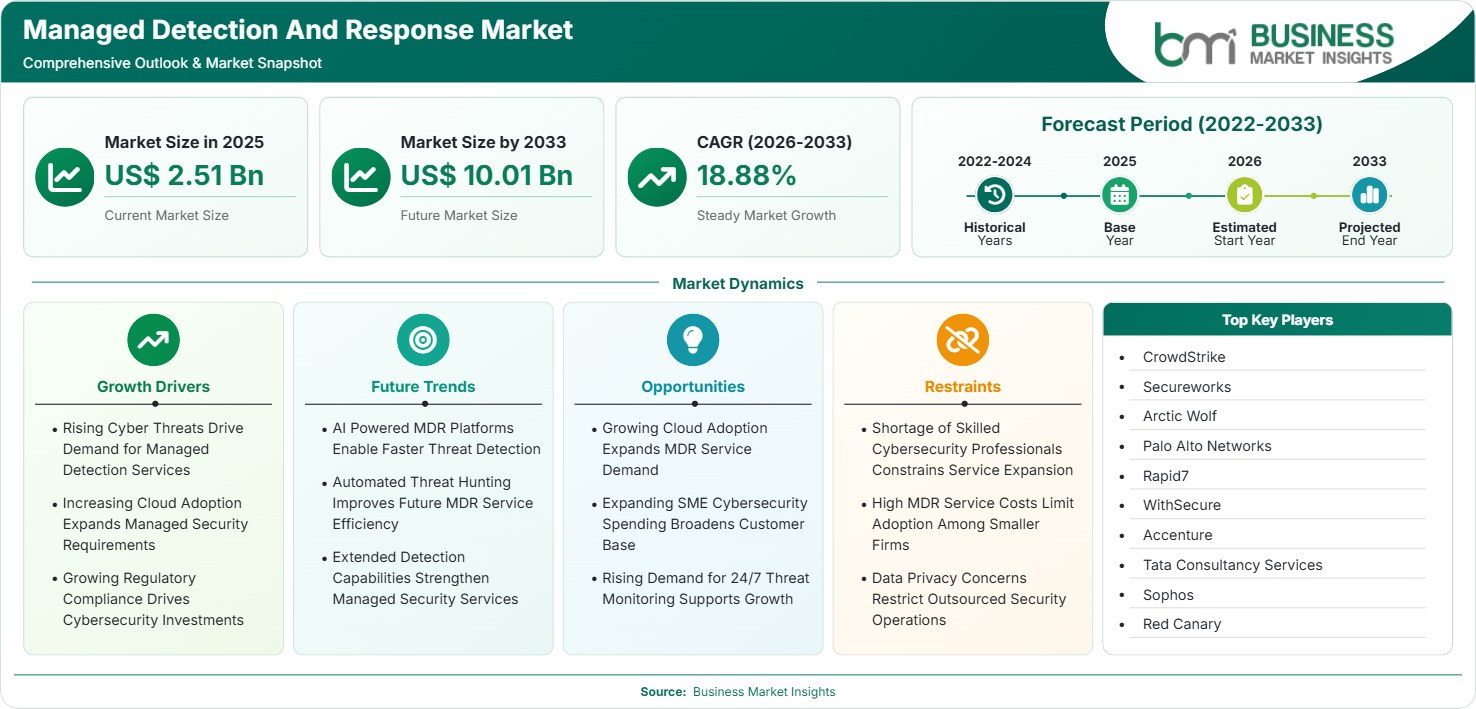
The Managed Detection And Response Market size was valued at US$ 2.51 billion in 2025 and is projected to reach US$ 10.01 billion by 2033, growing at a CAGR of 18.88% during 2026–2033. Rising cyberattack sophistication, expanding cloud environments, increasing compliance requirements, and demand for continuous threat monitoring are accelerating adoption of managed security services among organizations globally.

Report Coverage
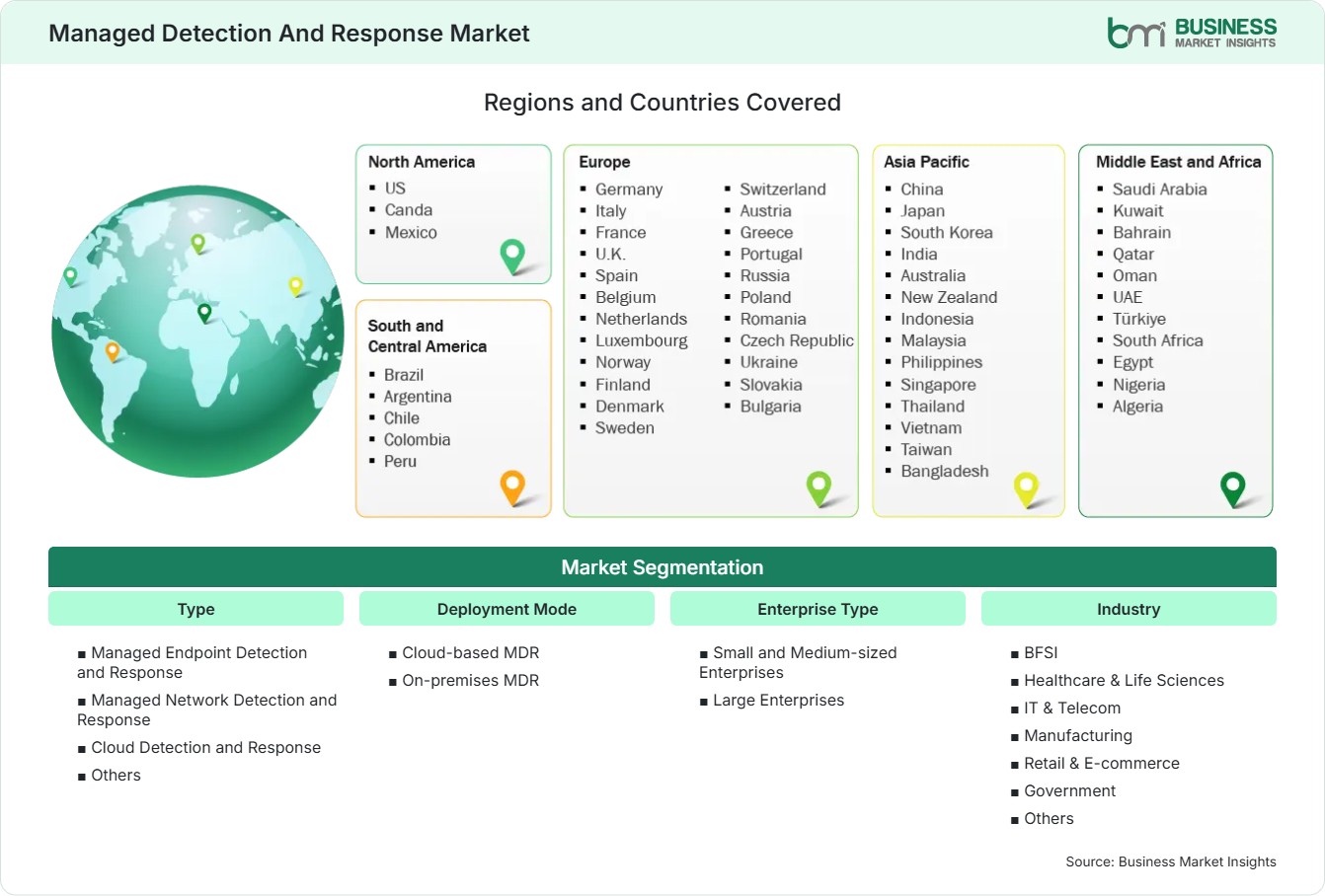
  • Type: Managed Endpoint Detection and Response, Managed Network Detection and Response, Cloud Detection and Response, Others
  • Deployment Mode: Cloud-based MDR, On-premises MDR
  • Enterprise Type: Small and Medium-sized Enterprises, Large Enterprises
  • Industry: BFSI, Healthcare & Life Sciences, IT & Telecom, Manufacturing, Retail & E-commerce, Government, Others
US$ 2.51 Bn Market size in 2025
US$ 10.01 Bn Market Size by 2033
18.88% CAGR, 2026 - 2033
2026-2033 Forecast Period

01 AI Overview

Managed Detection And Response Market Summary

  • North America Region: North America holds 38%–42% market share in 2025, growing with a CAGR of 17.8%–18.6% during 2026–2033, supported by advanced cybersecurity infrastructure, high enterprise security spending, increasing ransomware incidents, mature managed service adoption, and strong presence of cybersecurity vendors. The U.S. market demonstrates strong momentum with a CAGR of 18.0%–18.8% from 2026–2033, driven by enterprise cyber resilience programs, regulatory pressure, and rapid adoption of outsourced security operations.
  • Fastest Growing Region: Asia Pacific represents 22%–26% market share in 2025 and is expanding at a CAGR of 20.1%–21.0% through 2033, supported by accelerating digital transformation, cloud migration, increasing cyber threats, expanding SME security investments, and rising government initiatives for cybersecurity modernization.
  • Leading Segment: Managed Endpoint Detection and Response (MEDR) accounts for 34%–38% market share in 2025 and is expected to grow at a CAGR of 18.6%–19.4% during 2026–2033, driven by endpoint proliferation, remote workforce security requirements, advanced threat detection capabilities, and integration with security operations platforms.
  • High Growth Segment: Cloud Detection and Response (CDR) holds 24%–28% market share in 2025 and is projected to expand at a CAGR of 21.0%–22.0% through 2033, supported by cloud-native infrastructure growth, hybrid environments, workload protection requirements, and increasing demand for scalable security monitoring.
  • Key Market Opportunity: Growing adoption of artificial intelligence-powered threat detection, increasing cybersecurity outsourcing among SMEs, expansion of cloud workloads, and demand for round-the-clock monitoring services create significant opportunities for MDR providers.
  • Major Market Players: CrowdStrike, Secureworks, Arctic Wolf, Palo Alto Networks, Rapid7, WithSecure, Accenture, Tata Consultancy Services, Sophos, and Red Canary.
02 Strategic Insights

Managed Detection And Response Market: Strategic Insights

managed-detection-and-response-market-market-strategic-framework
FREE PDF
Request your free sample
Request free sample
03 Stakeholder View

Key Takeaways

  • The Managed Detection And Response Market ecosystem is shifting toward integrated security operations models where MDR providers combine endpoint analytics, network monitoring, cloud visibility, threat intelligence, and human expertise to deliver continuous protection.
  • Small and medium-sized enterprises represent a major growth opportunity as organizations with limited cybersecurity teams increasingly seek affordable managed services to address sophisticated threats and regulatory requirements.
  • Artificial intelligence, machine learning, behavioral analytics, and automated response capabilities are becoming central innovation areas as vendors improve detection accuracy and reduce incident response timelines.
  • Asia Pacific provides a strong investment opportunity due to rapid cloud adoption, expanding digital economies, increasing cybercrime activity, and growing government focus on cybersecurity infrastructure development.
  • Strategic partnerships, acquisitions, and technology integrations are reshaping competition as cybersecurity vendors expand service portfolios, strengthen threat intelligence capabilities, and improve managed security delivery.
  • Increasing adoption of security orchestration, automation, and response technologies is enabling MDR providers to improve operational efficiency, support proactive threat hunting, and deliver more customized cybersecurity solutions for diverse industries.
04 Geographic Outlook

Managed Detection And Response Market Regional Highlights

North America Managed Detection And Response Market

North America accounted for 38%–42% of global revenue in 2025 and is expected to expand at a CAGR of 17.8%–18.6% through 2033. The region maintains leadership due to advanced cybersecurity maturity, high enterprise technology spending, widespread cloud adoption, and strong vendor presence. The Managed Detection And Response Market share remains concentrated in the region because organizations increasingly prioritize continuous monitoring, regulatory compliance, and proactive cyber defense strategies.

  • Growing ransomware frequency is encouraging enterprises to adopt managed detection services with advanced threat intelligence and response capabilities.
  • Strong adoption of cloud infrastructure is increasing demand for scalable security monitoring solutions across large organizations.
  • Regulatory frameworks are driving investments in cybersecurity operations and third-party security service partnerships.
  • Presence of leading cybersecurity companies strengthens innovation, competition, and adoption of advanced MDR platforms.

US Managed Detection And Response Market

The United States represents the largest contributor within North America, accounting for 80%–84% of regional revenue and growing at a CAGR of 18.0%–18.8% during 2026–2033. High cyber risk exposure, extensive enterprise technology adoption, increasing compliance obligations, and strong cybersecurity spending continue driving MDR demand across industries.

  • Enterprises are increasingly outsourcing security operations due to shortages of qualified cybersecurity professionals and rising attack complexity.
  • Large organizations are investing in AI-enabled threat detection platforms to improve incident identification and response efficiency.
  • Government cybersecurity initiatives are encouraging organizations to strengthen resilience against advanced cyber threats.

Europe Managed Detection And Response Market

Europe represented 25%–29% of global revenue in 2025 and is forecast to grow at a CAGR of 18.2%–19.0% through 2033. Increasing cybersecurity regulations, rising digital transformation initiatives, and growing enterprise awareness regarding cyber risk are supporting market expansion. Germany leads regional adoption, while the United Kingdom and Netherlands demonstrate strong growth due to advanced technology ecosystems.

  • Implementation of cybersecurity regulations is increasing demand for managed monitoring and compliance-focused security services.
  • Enterprises are adopting MDR solutions to strengthen protection against ransomware and sophisticated intrusion attempts.
  • Growing cloud migration across industries is accelerating demand for managed cloud security capabilities.
  • Cybersecurity partnerships between enterprises and service providers are expanding across European markets.

Asia Pacific Managed Detection And Response Market

Asia Pacific accounted for 22%–26% of global revenue in 2025 and is projected to record the fastest expansion with a CAGR of 20.1%–21.0% through 2033. Increasing digitalization, cloud adoption, expanding internet connectivity, and rising cyber threats are accelerating demand for managed security services. China leads regional revenue contribution, while India and Southeast Asian markets demonstrate strong growth potential.

  • Rapid enterprise cloud adoption is increasing the need for continuous security monitoring and managed response services.
  • Growing SME digitalization is creating demand for cost-effective cybersecurity outsourcing solutions.
  • Government cybersecurity initiatives are supporting stronger security infrastructure development.
  • Expanding technology service ecosystems are encouraging MDR partnerships and service innovation.

Rest of World Managed Detection And Response Market

The Rest of World region accounted for 7%–10% of global revenue in 2025 and is expected to grow at a CAGR of 18.5%–19.3% through 2033. South America and the Middle East are experiencing increased cybersecurity investment due to digital transformation programs, cloud adoption, and growing awareness of cyber risks. Brazil leads South American adoption, while the UAE and Saudi Arabia demonstrate strong cybersecurity modernization efforts.

  • Increasing digital banking adoption is creating demand for stronger managed security monitoring capabilities.
  • Government technology modernization programs are supporting cybersecurity service expansion.
  • Growing enterprise awareness regarding cyber insurance requirements is encouraging security investments.
  • International cybersecurity providers are expanding partnerships across emerging markets.
global-market-geography
FREE PDF
Request your free sample
Request free sample
05 Segment Analysis

Managed Detection And Response Market Segmentation

Type

Managed Endpoint Detection and Response (MEDR) represented the leading segment with 34%–38% market share in 2025 and is expected to grow at a CAGR of 18.6%–19.4% through 2033. Increasing endpoint complexity, remote work adoption, and demand for advanced threat visibility are strengthening adoption. The Managed Detection And Response Market scope continues expanding as organizations integrate endpoint, network, and cloud security capabilities.

  • Managed Endpoint Detection and Response (MEDR): Provides continuous endpoint monitoring, behavioral analysis, threat investigation, and automated response capabilities for enterprise security teams.
  • Managed Network Detection and Response (MNDR): Supports network-level visibility, anomaly detection, and threat analysis across increasingly complex enterprise environments.
  • Cloud Detection and Response (CDR): Enables protection of cloud workloads through continuous monitoring, analytics, and security automation across hybrid infrastructures.
  • Others: Includes specialized MDR capabilities integrating identity security, vulnerability management, and threat intelligence services.

Deployment Mode

Cloud-based MDR accounted for 62%–66% market share in 2025 and is projected to grow at a CAGR of 20.0%–20.8% during 2026–2033. Organizations are increasingly selecting cloud-based security services due to scalability, reduced infrastructure requirements, faster deployment, and flexible operational models.

  • Cloud-based MDR: Supports scalable threat monitoring through cloud-native platforms, automation capabilities, and centralized security management.
  • On-premises MDR: Remains relevant among organizations requiring greater infrastructure control, customized security configurations, and internal compliance alignment.

Enterprise Type

Large enterprises represented the dominant enterprise category with 58%–62% market share in 2025, supported by complex infrastructure, higher cyber risk exposure, and greater security budgets.

  • Small and Medium-sized Enterprises: Increasingly adopt MDR services to overcome cybersecurity skill shortages and access enterprise-grade protection without maintaining large security teams.
  • Large Enterprises: Utilize MDR solutions for extensive threat monitoring, compliance management, global operations protection, and advanced incident response capabilities.
06 Market Forces

Managed Detection And Response Market Dynamics

Key Market Drivers

Rising Cyber Threats Drive Demand for Managed Detection Services

The increasing frequency and sophistication of cyberattacks are accelerating demand for managed detection and response solutions across industries. Ransomware, phishing, credential theft, and advanced persistent threats are creating complex security challenges that require continuous monitoring and rapid incident response. Organizations are moving beyond traditional security tools toward proactive threat hunting, behavioral analytics, and automated response capabilities. Market growth is supported by enterprises seeking specialized cybersecurity expertise to strengthen resilience against evolving threats. The Managed Detection And Response Market trends indicate rising preference for integrated platforms combining artificial intelligence, threat intelligence, and expert security analysts to improve detection accuracy and reduce response time.

Increasing Cloud Adoption Expands Managed Security Requirements

The fast-paced movement towards cloud technologies, hybrid architectures, and distributed infrastructure is driving demand for scalable managed security services. It is necessary for businesses to have constant visibility into their cloud workloads, applications, and surface networks as their attack surfaces expand. Business models based on cloud technology have further increased the need for security service providers who can monitor their complex environments without consuming excessive internal resources. MDR vendors are working to improve their products by integrating cloud-native detection, automation, and real-time analytics in order to meet the needs of today’s enterprises. The trend of using multi-cloud is increasing across the BFSI, healthcare, IT, and manufacturing sectors, making it imperative for these sectors to have flexible monitoring tools.

Growing Regulatory Compliance Drives Cybersecurity Investments

With the growth in cybersecurity compliance and industry-specific compliance requirements, organizations are finding it necessary to enhance their security operations. Companies in various industries, including finance, health care, government, and critical infrastructures, are now focusing on managed security solutions. Regulatory environments that emphasize data protection, breach notification, and resilience have increased the need for external cybersecurity professionals. The services offered by MDR vendors help businesses meet their compliance requirements through continuous monitoring, threat detection, and security reporting. With regulatory requirements expanding worldwide, companies value managed security relationships.

Key Market Opportunities

Growing Cloud Adoption Expands MDR Service Demand

Further growth in cloud computing offers great opportunities for MDR companies developing cloud-based security services. Modern companies tend to utilize hybrid and multi-cloud architectures, which need to be managed and protected from threats using such technologies such as centralized monitoring and workload protection. Cloud Detection and Response is gaining popularity now. Cloud security posture management, identity monitoring, and remediation capabilities integrated into MDR offerings will help vendors capitalize on the growing market potential. The market potential will be further driven by digital transformation efforts by enterprises and government agencies to securely adopt the cloud.

Expanding SME Cybersecurity Spending Broadens Customer Base

There is growing potential in small and medium enterprises as threats rise, and in-house security skills are inadequate. Most SMEs lack cybersecurity personnel and thus need cost-effective services that deliver enterprise-class security without large infrastructure investments. The flexible subscriptions, easy deployment processes, and managed services being offered by MDR vendors can cater to the needs of small organizations. The heightened awareness of ransomware threats, regulations, and business continuity considerations is prompting small businesses to spend more on cybersecurity solutions. This customer base has significant scope for MDR growth.

Rising Demand for 24/7 Threat Monitoring Supports Growth

The growing demand for continuous security monitoring has created an ideal opportunity for MDR service providers to deliver round-the-clock threat detection and management to their customers. Companies operating in the global market need the ability to detect cybersecurity incidents at any time. MDR makes organizations less dependent on their in-house security teams. The demand for such services is increasing in industries that handle sensitive information, such as BFSI, healthcare, government, and technology. Such services are expected to be at an advantage over their competitors in the expanding cybersecurity services market.

Market Restraints and Challenges

Shortage of Skilled Cybersecurity Professionals Constrains Service Expansion

Factor: The global shortage of qualified cybersecurity professionals limits the ability of organizations and service providers to scale advanced security operations. Impact: Limited availability of skilled analysts can increase operational pressure, delay threat investigations, and constrain MDR service expansion. Although MDR solutions reduce dependence on internal teams, providers still require experienced security experts for threat hunting, incident analysis, and strategic advisory services. The growing complexity of cyber threats requires continuous workforce development and specialized expertise. Addressing the cybersecurity talent gap remains essential for improving service quality and supporting long-term market growth.

High MDR Service Costs Limit Adoption Among Smaller Firms

Factor: Premium MDR platforms require investments in advanced technologies, expert monitoring services, and continuous operational support. Impact: Higher service costs may restrict adoption among budget-sensitive small businesses with limited cybersecurity spending capacity. While subscription-based models are improving accessibility, advanced features such as threat intelligence integration, automated response, and dedicated analyst support can increase expenses. MDR providers are addressing this challenge through tiered service packages and scalable offerings designed for different enterprise requirements. However, affordability remains an important consideration for broader adoption among smaller organizations.

Data Privacy Concerns Restrict Outsourced Security Operations

Factor: Organizations may hesitate to outsource security monitoring due to concerns regarding sensitive data access, third-party risks, and regulatory obligations. Impact: Privacy concerns can slow MDR adoption among enterprises operating in highly regulated industries. Businesses handling financial, healthcare, and government information require strong controls over data processing, storage, and access management. MDR providers must demonstrate transparent security practices, compliance certifications, and robust data protection frameworks to build customer confidence. Increasing emphasis on privacy-preserving security models will influence purchasing decisions as enterprises evaluate external cybersecurity partnerships.
 

07 Company Analysis

Competitive Landscape

The competitive landscape is characterized by cybersecurity vendors strengthening their platforms through artificial intelligence, automation, threat intelligence, and managed security expertise. The Managed Detection And Response Market analysis highlights increasing competition among providers focused on endpoint protection, cloud security, network monitoring, and industry-specific cybersecurity solutions.

Company Name

Overview

Products and Services relevant to this market

CrowdStrike

Cybersecurity company specializing in cloud-native endpoint security and threat intelligence solutions.

Falcon platform, managed threat hunting, endpoint detection, incident response, and security operations services.

Secureworks

Cybersecurity provider focused on managed security services and threat intelligence capabilities.

Taegis XDR platform, managed detection, threat hunting, and incident response solutions.

Arctic Wolf

Security operations company delivering cloud-native managed security solutions.

Managed detection and response, security operations center services, and threat intelligence capabilities.

Palo Alto Networks

Global cybersecurity company offering integrated security platforms.

Cortex XDR, managed security services, cloud security, and automated threat response solutions.

Rapid7

Cybersecurity provider focused on vulnerability management and detection technologies.

MDR services, Insight platform, threat analytics, vulnerability management, and incident response.

WithSecure

Cybersecurity company providing enterprise protection and managed security services.

Managed detection, endpoint protection, threat intelligence, and security consulting services.

Accenture

Global professional services company with extensive cybersecurity capabilities.

Managed security operations, threat intelligence, cloud security, and cybersecurity consulting services.

Tata Consultancy Services

IT services company delivering enterprise cybersecurity solutions globally.

Managed security services, SOC operations, cloud security, and threat monitoring solutions.

Sophos

Cybersecurity provider specializing in endpoint and network protection.

MDR services, endpoint security, threat response, and managed security operations.

Red Canary

Security operations provider focused on detection engineering and threat response.

Managed detection and response, threat hunting, security monitoring, and incident investigation services.

10 Trust & Transparency

Research Methodology

The market analysis combines proprietary research with secondary data from government agencies, company disclosures, regulatory filings, industry databases and expert interviews. Market estimates are validated through data triangulation, cross-market benchmarking and analyst review.

View Full Research Methodology

11 Questions Answered

Frequently Asked Questions

What is included in the Managed Detection And Response Market Report?

The market report covers market size, growth drivers, opportunities, restraints, segmentation, regional analysis, competitive landscape, and recent industry developments.

How does artificial intelligence impact MDR services?

AI improves threat detection accuracy, automates analysis, identifies abnormal behavior patterns, and helps security teams respond faster to complex cyber incidents.

Why are SMEs adopting MDR solutions?

SMEs are increasingly using MDR services to access specialized cybersecurity expertise, reduce operational complexity, and strengthen protection without building expensive internal security teams.

Which MDR segment is expected to grow fastest?

According to Managed Detection And Response Market forecast, Cloud Detection and Response is expected to experience strong growth due to expanding cloud workloads, hybrid environments, and demand for scalable cloud security monitoring.

What is driving adoption of managed detection and response services?

Increasing cyber threats, cloud adoption, regulatory requirements, and cybersecurity workforce shortages are encouraging organizations to adopt MDR services for continuous monitoring and faster incident response.

Access the Full Managed Detection And Response Market Report

Get segment-level forecasts, regional estimates, competitive benchmarking, company profiles and downloadable Excel datasets.

Access the full Managed Detection And Response Market Report
350 pages PDF & Excel | 2026-08-05