
Employee Fraud Detection Market Outlook: Size, Share, Trends, Growth Analysis, Competitive Landscape & Forecast, 2026-2033

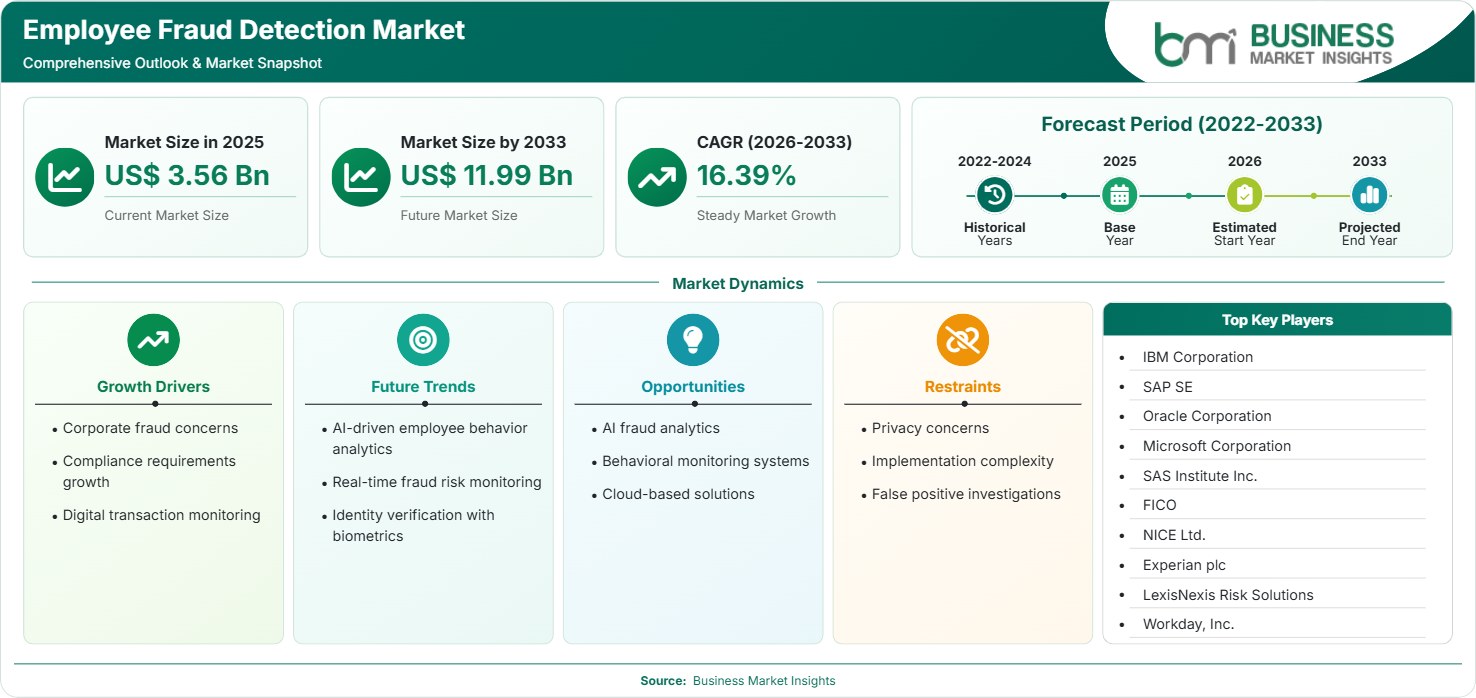
The Employee Fraud Detection Market size was valued at US$ 3.56 billion in 2025 and is projected to reach US$ 11.99 billion by 2033, growing at a CAGR of 16.39% during 2026–2033. Increasing corporate fraud risks, expanding regulatory compliance requirements, rising digital transaction volumes, and growing adoption of artificial intelligence-based monitoring systems are driving demand for advanced fraud prevention solutions across global enterprises. The market size analysis highlights increasing enterprise investments in AI-powered monitoring solutions.

Report Coverage
  • Solution Type: Real-time Transaction Screening, Behavior Analytics, Real-time Reporting, Others
  • Deployment: On-Premise, Cloud
  • Application: Asset Misappropriation, Vendor Fraud, Accounting Fraud, Payroll Fraud
  • Vertical: BFSI, IT & Telecommunication, Retail & Consumer Packaged Goods, Health & Life Sciences
US$ 3.56 Bn Market size in 2025
US$ 11.99 Bn Market Size by 2033
16.39% CAGR, 2026 - 2033
2026-2033 Forecast Period

AI Overview

Employee Fraud Detection Market Summary

  • North America Region: North America holds an estimated 38%–42% market share in 2025 and is projected to expand at a 15.8%–16.5% CAGR during 2026–2033. Strong financial sector adoption, mature cybersecurity infrastructure, regulatory enforcement, and enterprise investment in fraud analytics support regional growth. The United States remains the leading market, growing at a 16.0%–16.7% CAGR, driven by digital payment expansion, compliance investments, and increased demand for real-time employee activity monitoring. The Employee Fraud Detection Market Share in North America is supported by strong enterprise cybersecurity adoption.
  • Fastest Growing Region: Asia Pacific accounts for approximately 21%–25% share in 2025 and is forecast to register a 17.5%–18.5% CAGR through 2033. Rapid digital transformation, expanding financial services, increasing cyber risk awareness, and cloud adoption are accelerating implementation of employee fraud detection platforms across emerging economies. These developments are expected to accelerate employee fraud detection market growth across emerging economies.
  • Leading Segment: Behavior Analytics represents an estimated 34%–38% share in 2025 and is expected to grow at a 16.8%–17.5% CAGR. Growing demand for insider threat detection, anomaly identification, and AI-driven employee activity analysis is supporting segment leadership. This segment remains a major contributor to overall Employee Fraud Detection Market Trends.
  • High Growth Segment: Cloud Deployment accounts for approximately 55%–60% market share in 2025 and is projected to expand at a 17.0%–18.0% CAGR. Scalability, lower infrastructure requirements, faster implementation, and integration with enterprise platforms are driving cloud adoption.
  • Key Market Opportunity: AI-powered fraud analytics, behavioral monitoring solutions, and cloud-based platforms are creating opportunities for organizations to strengthen insider threat prevention, automate risk assessment, and improve compliance management.
  • Major Market Players: IBM Corporation, SAP SE, Oracle Corporation, Microsoft Corporation, SAS Institute Inc., FICO, NICE Ltd., Experian plc, LexisNexis Risk Solutions, Workday, Inc.
Strategic Insights

Employee Fraud Detection Market: Strategic Insights

Employee Fraud Detection Market Strategic Framework
FREE PDF
Request your free sample
Request free sample
Stakeholder View

Key Takeaways

  • The market ecosystem is shifting toward integrated fraud intelligence platforms connecting enterprise software providers, cybersecurity vendors, compliance teams, financial institutions, and analytics specialists.  This transformation is creating new opportunities within the market for technology providers and enterprise security vendors.
  • Growth opportunities are concentrated in AI-driven analytics, cloud-based fraud management platforms, and behavioral monitoring solutions. Increasing demand for these capabilities is expected to positively influence the Employee Fraud Detection Market Growth trajectory.
  • Innovation is centered on machine learning-based anomaly detection, natural language processing, automated risk scoring, and continuous monitoring capabilities. Vendors are developing intelligent platforms that analyze large volumes of employee, transaction, and workflow data to detect potential fraud risks more accurately. Such advancements are shaping the future direction of the market.
  • Asia Pacific presents a significant expansion opportunity due to rapid digital banking growth, increasing enterprise technology adoption, expanding regulatory requirements, and rising awareness of insider threats. Countries such as China, India, Singapore, and Japan are strengthening fraud prevention infrastructure across financial and corporate sectors.
  • Investment activity is increasingly focused on strategic partnerships, cybersecurity integration, cloud platform development, and acquisitions aimed at strengthening fraud analytics capabilities. Technology providers are expanding their solutions to address evolving enterprise risks associated with remote work, digital transactions, and complex organizational structures.
  • Future competitive differentiation will depend on artificial intelligence capabilities, integration flexibility, data privacy management, regulatory compliance support, and the ability to provide real-time fraud intelligence across diverse enterprise environments.
Geographic Outlook

Employee Fraud Detection Market Regional Highlights

North America Employee Fraud Detection Market

North America represents the largest regional market, accounting for an estimated 38%–42% share in 2025 and expanding at a projected 15.8%–16.5% CAGR during 2026–2033. The region benefits from advanced enterprise technology adoption, strong regulatory frameworks, and high awareness of insider risk management. The United States remains the primary contributor due to extensive BFSI adoption, increasing digital transaction monitoring requirements, and growing investments in artificial intelligence-based fraud prevention platforms. The Employee Fraud Detection Market Analysis indicates that North America will continue maintaining a dominant position.

  • The United States leads regional adoption through strong enterprise cybersecurity investments, increasing compliance requirements, and widespread deployment of advanced analytics for employee risk monitoring.
  • Canada is expanding fraud detection capabilities through digital transformation initiatives, financial sector modernization, and increasing adoption of cloud-based risk management platforms.
  • Organizations across BFSI and technology sectors are integrating behavioral analytics solutions to identify unusual employee actions, reduce internal threats, and strengthen governance frameworks.
  • Regulatory focus on financial transparency and data protection is encouraging enterprises to implement automated monitoring systems capable of providing continuous fraud risk assessment.

US Employee Fraud Detection Market

The United States accounts for approximately 33%–36% of global revenue in 2025 and is projected to grow at a 16.0%–16.7% CAGR through 2033. Strong enterprise digitization, rising insider threat concerns, and increasing compliance obligations are supporting market expansion. Financial institutions, technology companies, and large enterprises are investing in advanced fraud analytics platforms to monitor employee activities and protect sensitive business operations.

  • Financial organizations are adopting real-time transaction screening and behavior analytics solutions to detect suspicious activities and improve regulatory compliance.
  • Enterprises are increasing investment in AI-powered monitoring systems that analyze employee behavior patterns and provide early warnings of potentially fraudulent activities.
  • Cloud adoption is accelerating as organizations seek scalable fraud detection platforms with faster deployment, easier integration, and reduced infrastructure requirements.

Europe Employee Fraud Detection Market

Europe accounts for an estimated 26%–30% share of the global market in 2025 and is expected to register a 15.5%–16.2% CAGR during 2026–2033. The region benefits from strict compliance standards, advanced financial infrastructure, and increasing enterprise focus on governance and risk management. Germany leads regional adoption, while the United Kingdom and France demonstrate strong growth due to digital transformation and increasing demand for automated fraud prevention technologies.

  • Germany maintains regional leadership through strong enterprise software adoption, financial sector modernization, and increased investment in compliance-oriented fraud monitoring solutions.
  • The United Kingdom demonstrates significant demand due to advanced banking infrastructure, digital payment growth, and increasing focus on preventing internal financial misconduct.
  • France continues expanding adoption through regulatory compliance initiatives, enterprise cybersecurity investments, and increasing use of analytics-driven risk management platforms.
  • European organizations are prioritizing privacy-conscious fraud detection systems that balance security requirements with employee data protection regulations.
  • Businesses are integrating fraud analytics platforms with enterprise resource planning and human resource systems to improve monitoring efficiency and operational visibility. These developments contribute significantly to market growth across Europe.

Asia Pacific Employee Fraud Detection Market

Asia Pacific represents approximately 21%–25% of market revenue in 2025 and is forecast to achieve the fastest expansion with a 17.5%–18.5% CAGR through 2033. Rapid digitalization, expanding financial services, increasing cyber risks, and growing cloud adoption are accelerating demand. China represents the largest regional market, while India and Southeast Asian countries are experiencing strong adoption due to enterprise technology modernization and regulatory improvements.

  • China leads regional demand through expanding digital finance ecosystems, increasing enterprise security investments, and adoption of advanced fraud analytics solutions.
  • India is experiencing rapid growth due to digital payment expansion, increasing corporate governance requirements, and rising adoption of cloud-based security platforms.
  • Japan continues developing fraud prevention capabilities through advanced technology adoption, financial sector innovation, and enterprise risk management initiatives.
  • Southeast Asian markets are investing in digital infrastructure and compliance technologies to address growing risks associated with online transactions and remote workforce models.
  • Regional enterprises are increasingly adopting artificial intelligence-based monitoring solutions to improve fraud detection accuracy and reduce investigation complexity.

Rest of World Employee Fraud Detection Market

The Rest of the World contributes approximately 7%–10% of global revenue in 2025 and is projected to expand at a 16.5%–17.3% CAGR through 2033. South and Central America are witnessing increased adoption due to digital banking expansion, enterprise modernization, and rising fraud awareness, particularly in Brazil and Mexico.

Middle East and Africa markets are developing through financial technology adoption, cybersecurity investments, and increasing regulatory attention toward corporate governance. The United Arab Emirates and Saudi Arabia represent attractive markets due to digital transformation programs and growing enterprise security requirements.

  • Brazil remains the largest regional market due to expanding financial technology adoption, increasing digital transactions, and rising demand for enterprise fraud monitoring solutions.
  • Mexico benefits from growing corporate technology investments, financial sector digitization, and increased focus on internal risk management frameworks.
  • The United Arab Emirates is expanding adoption through financial innovation initiatives, enterprise digital transformation, and increased emphasis on compliance technologies.
  • Saudi Arabia demonstrates growth potential through economic diversification programs, digital banking expansion, and investments in advanced enterprise security infrastructure.
  • Regional organizations are increasingly implementing cloud-based fraud detection platforms to improve scalability, monitoring capabilities, and operational resilience. These factors are expected to create new opportunities within the market Report during the forecast period.
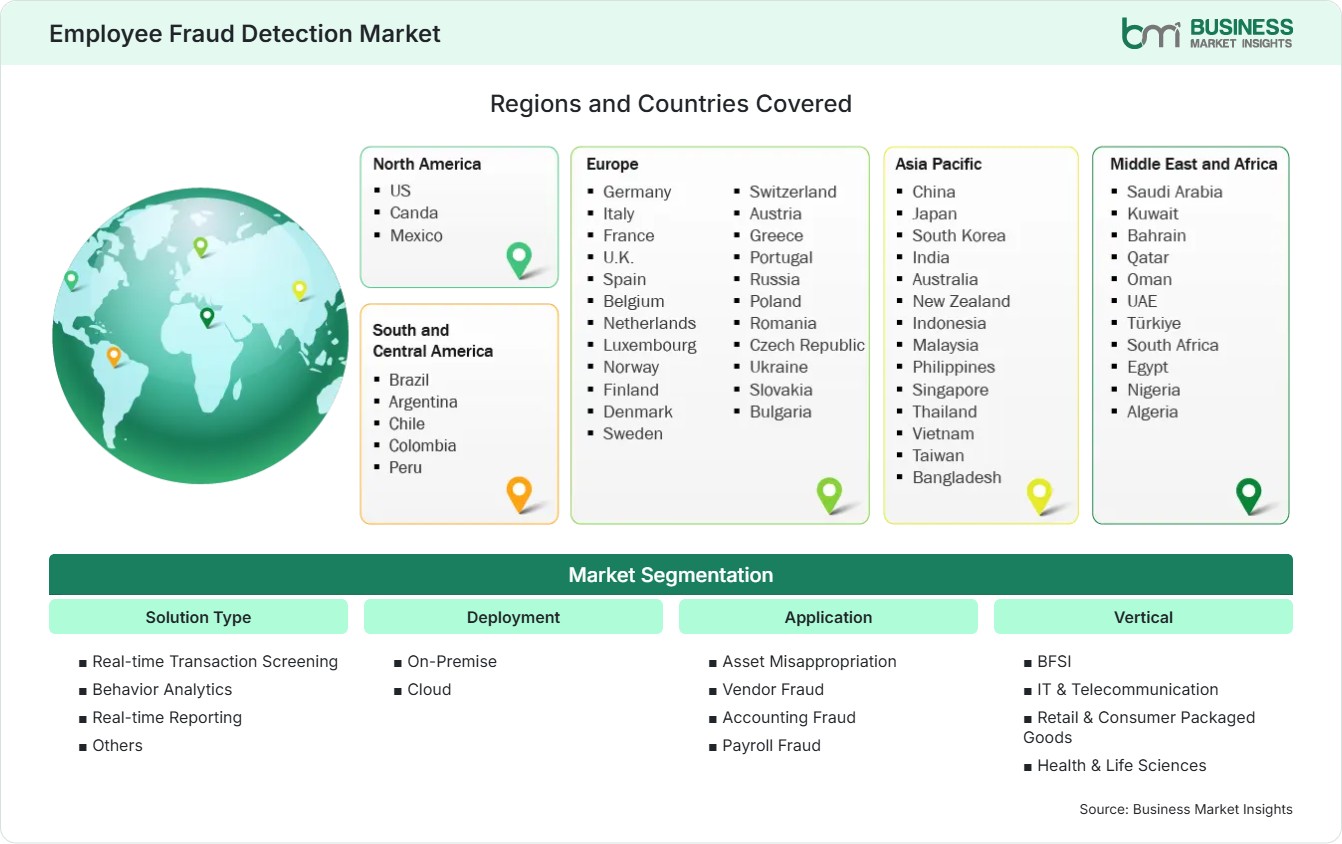
Global Market Geography
FREE PDF
Request your free sample
Request free sample
Segment Analysis

Employee Fraud Detection Market Segmentation

Solution Type

The Solution Type segment is the key technological backbone of the fraud prevention solution, with behavior analytics as the dominant approach owing to the rising need for insider threat and anomaly detection capabilities. The segment held 80% market share in 2025 and is expected to grow at a CAGR of 16.39% to 17.2% from 2026 to 2033. Companies are looking forward to deploying solutions that incorporate transaction monitoring, reporting, and analytics to build a robust fraud prevention strategy. The Employee Fraud Detection Market Share analysis highlights the significance of behavioral analytics.

  • Real-time Transaction Screening: Real-time transaction screening solutions are gaining adoption as enterprises seek immediate detection of suspicious financial activities, unauthorized transactions, and irregular employee-driven operational behavior.
  • Behavior Analytics: Behavior analytics represents a major growth category through AI-based pattern recognition, anomaly identification, insider threat monitoring, and continuous assessment of employee activities.
  • Real-time Reporting: Real-time reporting tools support faster investigation processes by providing actionable fraud insights, automated alerts, compliance visibility, and improved decision-making capabilities.

Deployment

The deployment segment reflects changing enterprise preferences toward flexible and scalable fraud management infrastructure. The segment represented an estimated 100% share in 2025 and is expected to grow at a 16.39%–17.5% CAGR between 2026–2033. Cloud adoption is increasing as organizations prioritize rapid implementation, lower infrastructure requirements, and seamless integration with enterprise applications while maintaining strong security controls. These developments are positively influencing the Employee Fraud Detection Market Forecasts as enterprises increasingly transition toward scalable cloud-based fraud monitoring solutions.

  • On-Premise: On-premise deployment remains relevant among organizations requiring direct infrastructure control, customized security environments, and strict internal data management policies.
  • Cloud: Cloud deployment is expanding rapidly due to scalability, reduced maintenance requirements, faster implementation, remote accessibility, and integration capabilities with modern enterprise technology ecosystems.

By Application

The Application segment highlights the growing need to prevent fraud in enterprise applications such as finance, procurement, payroll, and operations. The Application segment captured 100% market share in 2025 and is projected to grow at a CAGR of 16.39%-17.4% during the forecast period of 2026-2033. Increasing risks of corporate fraud and advanced monitoring features have driven increased demand for dedicated fraud detection solutions. According to the Employee Fraud Detection Market Analysis, increasing adoption is evident across various applications.

  • Asset Misappropriation: Asset misappropriation detection solutions help organizations identify unauthorized resource usage, financial irregularities, and employee-related asset management risks.
  • Vendor Fraud: Vendor fraud monitoring is expanding as businesses seek improved transparency across supplier relationships, procurement processes, and third-party financial interactions.
  • Accounting Fraud: Accounting fraud detection solutions support financial accuracy by identifying suspicious reporting patterns, irregular transactions, and potential manipulation within organizational financial systems.
  • Payroll Fraud: Payroll fraud prevention technologies are gaining importance through automated employee verification, payment monitoring, and detection of irregular compensation-related activities.

Vertical

Vertical segment analysis reveals widespread adoption across industries due to these increased vulnerabilities to fraud, regulatory requirements, and transaction complexity. The Vertical segment was estimated to hold a 100% share in 2025 and was anticipated to expand at a CAGR of 16.39%–17.6% in 2026–2033. Financial services continue to be one of the major markets for this solution, but more and more investments are being made in fraud monitoring by technology companies, retailers, and healthcare providers.

  • BFSI: BFSI firms are an important use case due to the volume of transactions and the need for systems to prevent employee fraud under regulations.
  • IT and Telecommunication: IT and telecommunication firms are using technology to detect fraud, secure their confidential data, and manage their digital operations and complex workforce.
  • Retail and Consumer Packaged Goods: Retail and consumer packaged goods firms are using fraud analytics to minimize inventory theft and fraud during the transaction process.
  • Health and Life Sciences: Health and life sciences firms are using fraud detection systems to improve their compliance, confidentiality, and financial governance.
Market Forces

Employee Fraud Detection Market Dynamics

Key Market Drivers

Rising Corporate Fraud Concerns and Insider Risk Exposure

Increasing incidents of employee fraud, illegal transactions, data abuse, and other financial crimes are prompting companies to beef up their internal monitoring systems. Market growth is being driven by recognition of the dangers of insider threats and the costs of fraud across industries. Companies have adopted advanced analytical software that constantly monitors employee behavior, transaction patterns, and operational activities to identify potential threats. Employee Fraud Detection Market trends show the need for smart solutions that integrate behavioral data, automation, and investigative processes to combat fraud efficiently.

Increasing Compliance Requirements Across Industries

Strengthening regulatory requirements and corporate governance standards are accelerating the adoption of fraud detection solutions across financial services, healthcare, retail, and technology sectors. Organizations are required to maintain stronger controls over transaction monitoring, reporting accuracy, and risk management. Compliance obligations are encouraging enterprises to deploy automated platforms that provide continuous monitoring and audit capabilities.  These factors continue to expand the global market.

Growth of Digital Transactions and Enterprise Monitoring Needs

The fast-paced digital revolution, along with the increasing number of electronic transactions, is driving demand for real-time fraud-monitoring tools. The volume of processed financial and operational data is growing, and, consequently, the effectiveness of manual fraud detection processes is declining. AI and machine learning technologies enable the automated analysis of transactional behavior, employee activities, and work-process patterns.

Key Market Opportunities

Expansion of AI-Based Fraud Analytics Platforms

AI Fraud Analytics is an important area due to the increased demand for more precise and proactive approaches to detecting unusual activity by companies. The Employee Fraud Detection Forecasts indicate there is an increasing need for software solutions that employ machine learning algorithms to analyze employee behavior, transaction patterns, and historical risk factors. Such solutions can help detect unusual activity faster, with fewer false alarms, and automate the investigative process.

Growing Adoption of Behavioral Monitoring Systems

There is increased emphasis on behavioral monitoring tools, which are becoming important as companies shift from conventional transaction-based fraud detection approaches. Behavioral monitoring tools assess employees' behavioral patterns, their access habits, and any other unusual operational behaviors that may pose a risk. Many organizations are currently looking for ways to continuously monitor to combat internal threats posed by the remote-working environment.

Increasing Demand for Cloud-Based Fraud Detection Solutions

The adoption of cloud solutions has created new possibilities for growth, enabling companies to implement fraud detection mechanisms with minimal infrastructure requirements and greater scalability. Companies can leverage the cloud platform to integrate their fraud detection mechanisms into their existing business applications and analytical frameworks. The adoption of cloud solutions is gaining popularity among small and medium-sized enterprises.

Market Restraints and Challenges

Data Privacy Concerns Affecting Employee Monitoring Adoption

Factor: Employee fraud detection systems require analysis of behavioral data, transaction information, and workplace activity records, creating concerns regarding privacy, data protection, and employee surveillance. Impact: Organizations may face challenges in implementing monitoring solutions due to regulatory restrictions, employee acceptance issues, and the need to maintain ethical data practices.

Complex Implementation and Integration Requirements

Factor: Deploying employee fraud detection platforms often requires integration with enterprise resource planning systems, financial applications, human resource platforms, and cybersecurity infrastructure. Impact: Complex implementation processes can increase deployment timelines, require specialized expertise, and create operational challenges for organizations with fragmented technology environments.

Company Analysis

Competitive Landscape

The Employee Fraud Detection Market analysis highlights a competitive ecosystem shaped by artificial intelligence capabilities, enterprise software integration, analytics expertise, compliance support, and real-time monitoring technologies.

Company Name

Overview

Products and Services relevant to this market

IBM Corporation

Global technology company providing enterprise security and analytics solutions.

AI-based fraud analytics, risk management platforms, security intelligence, and monitoring solutions.

SAP SE

Enterprise software provider supporting business operations and compliance management.

Fraud management solutions, analytics platforms, enterprise monitoring, and risk management tools.

Oracle Corporation

Global software company delivering enterprise applications and cloud technologies.

Fraud detection platforms, financial analytics, cloud applications, and compliance solutions.

Microsoft Corporation

Technology provider offering cloud, security, and analytics capabilities.

AI security solutions, cloud-based monitoring, identity protection, and enterprise analytics tools.

SAS Institute Inc.

Analytics company specializing in data-driven decision-making technologies.

Fraud analytics, behavioral monitoring, risk scoring, and advanced analytics platforms.

FICO

Analytics company focused on predictive modeling and risk management solutions.

Fraud detection analytics, transaction monitoring, scoring technologies, and decision platforms.

NICE Ltd.

Enterprise software provider specializing in customer experience and risk management.

Fraud prevention platforms, behavioral analytics, investigation tools, and compliance solutions.

Experian plc

Global information services company providing data and analytics solutions.

Fraud intelligence, identity verification, risk analytics, and enterprise fraud prevention services.

LexisNexis Risk Solutions

Risk analytics provider supporting fraud prevention and compliance activities.

Fraud detection analytics, identity solutions, risk assessment, and data intelligence platforms.

Workday, Inc.

Enterprise cloud software company focused on workforce and financial management.

Employee analytics, workforce risk insights, financial monitoring, and enterprise management solutions.

Industry Activity

Recent Developments

June 2026

Nasdaq Verafin announced the expansion of its Agentic AI Workforce with new role-based agentic workers, including the Agentic Fraud Analyst for triaging unusual ACH activity alerts.

May 2026

Indian Railways began deploying DRISHTI, an AI and blockchain-powered Smart Workforce Management System, across its 1.2 million-strong workforce.

March 2026

Charm Security and Reality Defender formed a strategic partnership to integrate deepfake detection technology into Charm's Agentic AI Workforce platform.

January 2026

authID Inc. and TurboCheck announced that one of the world's largest workforce solutions providers selected their combined biometric identity verification and fraud detection platform to combat employment identity fraud.

Trust & Transparency

Research Methodology

The market analysis combines proprietary research with secondary data from government agencies, company disclosures, regulatory filings, industry databases and expert interviews. Market estimates are validated through data triangulation, cross-market benchmarking and analyst review.

View Full Research Methodology

Questions Answered

Frequently Asked Questions

How does the Employee Fraud Detection Report evaluate market opportunities?

The Employee Fraud Detection Report evaluates opportunities through analysis of technology adoption, enterprise risk trends, deployment models, industry applications, competitive strategies, and regional growth patterns.

Why are cloud-based fraud detection solutions gaining popularity?

Cloud platforms provide scalability, faster deployment, reduced infrastructure costs, easier integration, and flexible access, making them attractive for enterprises seeking efficient fraud prevention capabilities.

Which industries are major adopters of the employee fraud detection market?

BFSI, IT and telecommunications, retail, consumer goods, healthcare, and life sciences organizations are major adopters due to higher fraud exposure and regulatory requirements.

Which technologies are shaping employee fraud detection solutions?

Artificial intelligence, machine learning, behavioral analytics, cloud computing, and automated risk scoring technologies are transforming fraud detection by improving accuracy, speed, and predictive capabilities.

What is driving adoption of the employee fraud detection market?

Increasing corporate fraud incidents, regulatory compliance requirements, digital transaction growth, and the need for continuous employee activity monitoring are driving organizations to implement advanced fraud detection platforms.

Access the Full Employee Fraud Detection Market Report

Get segment-level forecasts, regional estimates, competitive benchmarking, company profiles and downloadable Excel datasets.

Access the full Employee Fraud Detection Market Report
350 pages PDF & Excel | 2026-07-30
Similar Research

Related Market Reports