
Software as a Service Market Outlook: Size, Share, Trends, Growth Analysis, Competitive Landscape & Forecast, 2026-2033

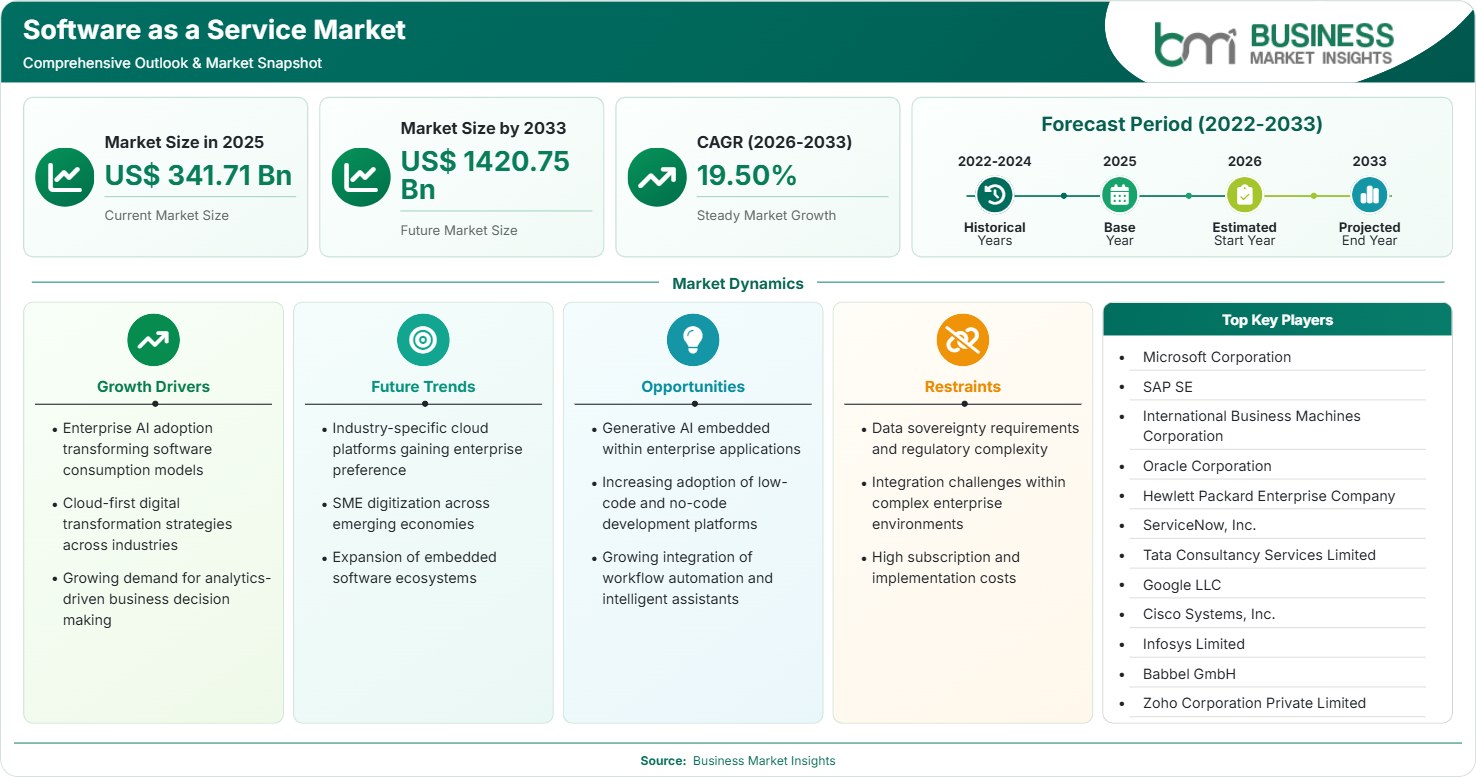
The Software as a Service Market size was valued at US$ 341.71 Billion in 2025 and is projected to reach US$ 1420.75 Billion by 2033, growing at a CAGR of 19.50% during 2026–2033, driven by cloud-native transformation, AI integration, subscription-based software adoption, enterprise digitization, industry-specific platforms, and expanding opportunities across emerging economies, analytics ecosystems, and workflow automation solutions.

Report Coverage
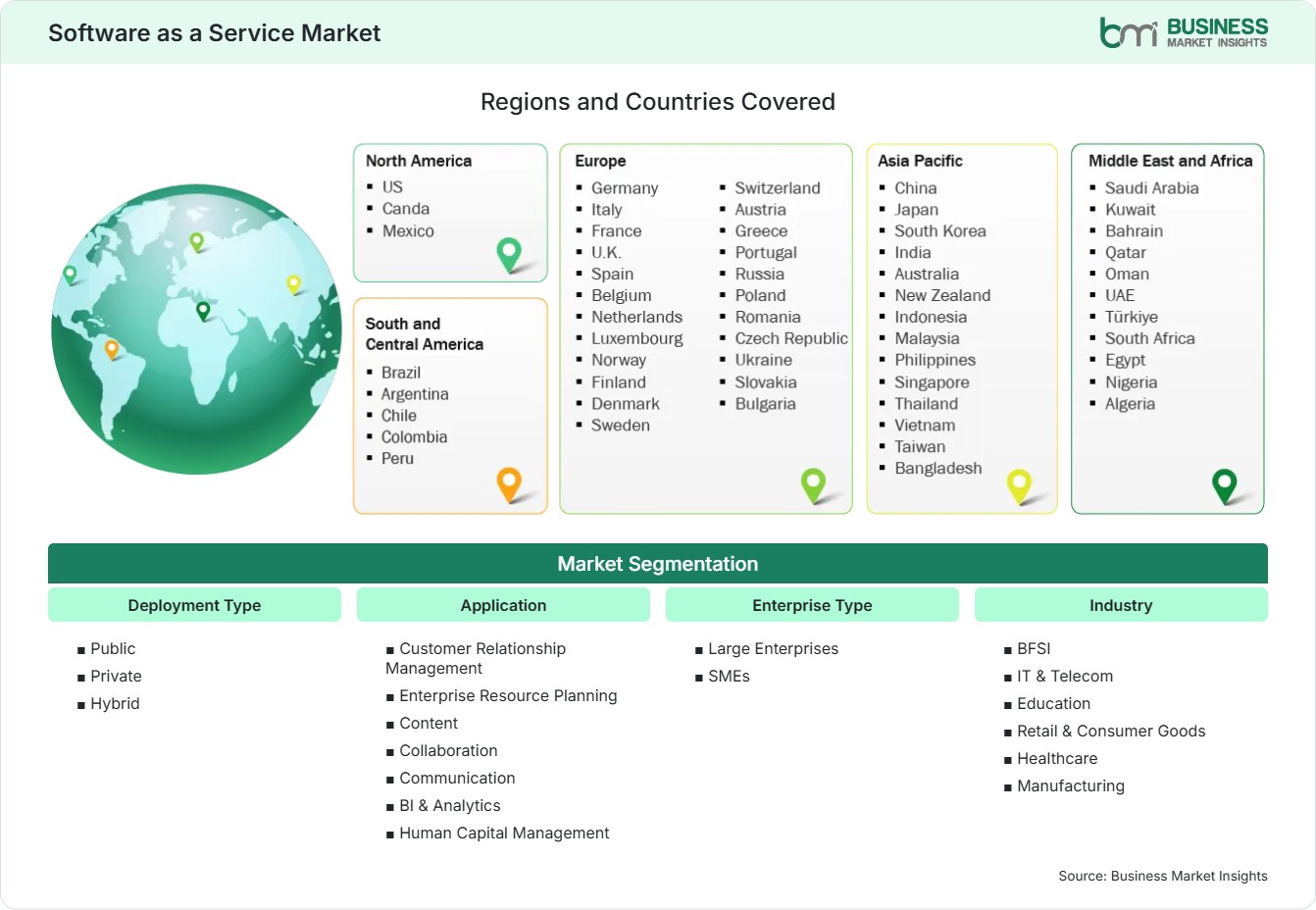
  • Deployment Type: Public, Private, Hybrid
  • Application: Customer Relationship Management, Enterprise Resource Planning, Content, Collaboration, Communication, BI & Analytics, Human Capital Management
  • Enterprise Type: Large Enterprises, SMEs
  • Industry: BFSI, IT & Telecom, Education, Retail & Consumer Goods, Healthcare, Manufacturing
US$ 341.71 Bn Market size in 2025
US$ 1420.75 Bn Market Size by 2033
19.50% CAGR, 2026 - 2033
2026-2033 Forecast Period

AI Overview

Software as a Service Market Summary

  • North America Region: North America holds a Software as a Service Market share of 39%–42% in 2025, growing with a CAGR of 17.8%–18.8% during 2026–2033, supported by enterprise cloud migration, AI-enabled software platforms, cybersecurity investments, subscription modernization initiatives, digital workplace transformation, partner ecosystems, regulatory compliance tools, scalable infrastructure demand, industry cloud deployments, data governance programs, productivity enhancements, and automation adoption across sectors. The U.S. leads regional demand with a CAGR of 18.0%–19.0%, supported by strong enterprise software spending and AI integration.
  • Fastest Growing Region: Asia Pacific accounts for 24%–27% share of the Software as a Service Market in 2025 and expands at a CAGR of 22.0%–23.5% during 2026–2033, driven by SME digitization, cloud-first policies, hyperscale infrastructure investments, startup expansion, mobile workforce adoption, e-commerce growth, government digital initiatives, fintech innovation, enterprise modernization, and growing demand for scalable software subscriptions.
  • Leading Segment: Customer Relationship Management (CRM) represents a 24%–27% share in 2025 and advances at a CAGR of 18.5%–19.5% during 2026–2033, supported by omnichannel customer engagement, sales automation, AI-powered insights, marketing optimization, service management integration, predictive analytics deployment, retention strategies, cloud accessibility, workflow efficiency, and customer experience enhancement initiatives.
  • High Growth Segment: BI & Analytics captures 12%–15% share of the Software as a Service Marketin 2025 and records a CAGR of 23.0%–24.5% during 2026–2033, fueled by real-time intelligence requirements, generative AI applications, predictive decision-making, self-service analytics adoption, data democratization, enterprise reporting modernization, cloud data platforms, operational visibility, business optimization goals, and performance management initiatives.
  • Key Market Opportunity: Industry-specific cloud applications combining AI, analytics, compliance management, and workflow orchestration create substantial opportunities as organizations prioritize faster deployment, lower operational costs, scalable innovation, and measurable business outcomes.
  • Major Market Players: Microsoft Corporation, SAP SE, International Business Machines Corporation, Oracle Corporation, Hewlett Packard Enterprise Company, ServiceNow, Tata Consultancy Services Limited, Google LLC, Cisco Systems, Inc., Infosys Limited, Babbel GmbH, Zoho Corporation Private Limited, Workiva Inc., Tencent Holdings Limited, and Trend Micro Incorporated.
Strategic Insights

Software as a Service Market: Strategic Insights

Software as a Service Market Strategic Framework
FREE PDF
Request your free sample
Request free sample
Stakeholder View

Key Takeaways

  • The value chain is evolving from standalone software licensing toward integrated ecosystems involving cloud infrastructure providers, application developers, systems integrators, cybersecurity specialists, and managed service partners.
  • BI & Analytics and industry-specific software platforms offer the highest upside as organizations seek data-driven decision support, process intelligence, and AI-enabled operational optimization.
  • Innovation is increasingly centered on generative AI, embedded analytics, workflow automation, low-code development, and intelligent assistants integrated directly into enterprise applications.
  • Asia Pacific presents the most compelling investment opportunity due to expanding cloud infrastructure, rising SME technology spending, and government-supported digital transformation initiatives.
  • Strategic acquisitions increasingly target AI startups, workflow automation providers, data analytics companies, and cybersecurity specialists to strengthen cloud platform capabilities.
  • Demand for hybrid deployment architectures remains strong among regulated industries balancing cloud scalability with security, compliance, and data residency requirements.
Geographic Outlook

Software as a Service Market Regional Highlights

North America Software as a Service Market

North America accounted for 39%–42% of global revenue in 2025 and is projected to register a CAGR of 17.8%–18.8% through 2033. Strong enterprise technology spending, mature cloud ecosystems, and widespread AI deployment support regional leadership. The Software as a Service Market share remains concentrated among large enterprises adopting integrated cloud platforms for operations, analytics, customer engagement, and cybersecurity. Investments in digital workplace technologies, automation solutions, and industry-specific applications continue expanding adoption across financial services, healthcare, retail, and public-sector organizations throughout the region.

  • Enterprises increasingly consolidate vendors to improve interoperability, strengthen governance frameworks, and reduce technology complexity while expanding cloud application portfolios across mission-critical business functions.
  • AI-powered productivity suites, automated workflows, and advanced analytics platforms are generating measurable efficiency gains, supporting larger software budgets and accelerated cloud transformation programs.
  • BFSI organizations continue prioritizing compliance-focused solutions, digital customer engagement tools, and intelligent risk management applications to improve competitiveness and operational resilience.
  • Healthcare providers increasingly deploy cloud-based operational, patient engagement, and workforce management solutions to enhance service delivery and resource utilization.

US Software as a Service Market

The United States represents 79%–82% of North American revenue and is anticipated to expand at a CAGR of 18.0%–19.0% through 2033. Strong presence of global software vendors, extensive venture capital activity, and high enterprise cloud maturity support continued leadership. The Software as a Service Market growth benefits from rising adoption of generative AI applications, intelligent automation tools, and cloud-native business platforms. Digital transformation priorities across government agencies, financial institutions, healthcare providers, and technology enterprises continue driving demand for scalable subscription-based software ecosystems nationwide.

  • Generative AI integration within enterprise applications is accelerating adoption by improving productivity, customer interactions, and business decision-making capabilities across industries.
  • Large organizations increasingly prioritize workflow automation and analytics-driven operations to enhance efficiency, reduce costs, and improve organizational agility.
  • Cybersecurity and compliance software demand remains elevated as enterprises address regulatory requirements, data protection mandates, and evolving threat environments.
  • Technology startups continue influencing innovation through the development of specialized cloud applications targeting vertical-specific business requirements and emerging digital use cases.

Europe Software as a Service Market

Europe accounted for around 27% to 30% of worldwide revenues in 2025 and is projected to register a CAGR of 18.5% to 19.5% from 2026 to 2033. Demand in this region has been driven by efforts toward enterprise transformation, digital sovereignty ambitions, and growing adoption of the cloud in midsize enterprises. Germany Software as a Service Market is the leader, while Eastern Europe shows stronger growth. Increased adoption has been seen in sectors such as manufacturing, financial services, public administration, and healthcare.

  • Germany leads adoption through advanced industrial digitization initiatives and strong enterprise investment in cloud-based operational platforms.
  • Poland demonstrates one of the fastest expansion trajectories due to growing technology investments, startup development, and enterprise modernization programs.
  • Public-sector cloud initiatives are encouraging broader adoption of workflow management, collaboration, and citizen-service applications throughout the region.
  • Sustainability reporting requirements increase demand for compliance, analytics, and performance management software among large enterprises.
  • Manufacturing organizations are adopting integrated cloud applications to improve operational visibility, predictive maintenance, and supply chain coordination.

Asia Pacific Software as a Service Market

The Asia Pacific accounted for 24%-27% of the global market in 2025 and is expected to grow at a CAGR of 22.0%-23.5 % in the Software as a Service Market until 2033, making it the fastest-growing region. Digitization of SMEs, the growth of cloud services, and government initiatives for digital economies have been driving growth. China has the highest regional demand, whereas India is experiencing the fastest growth. Increased use of the internet, the growth of fintechs, e-commerce, and enterprise modernization programs have continued to boost software investment.

  • India benefits from digital public infrastructure initiatives, growing startup ecosystems, and increasing enterprise investment in cloud-based business applications.
  • China remains a major revenue contributor through extensive enterprise software deployment, industrial digitalization, and expanding cloud infrastructure capabilities.
  • Regional SMEs increasingly adopt subscription-based solutions to improve productivity, customer management, and operational efficiency while limiting capital expenditure.
  • Financial technology expansion creates demand for scalable software supporting payments, compliance, customer engagement, and analytics capabilities.
  • Government programs promoting digital transformation continue strengthening cloud adoption among public institutions and commercial enterprises.

Rest of World Software as a Service Market

Rest of World accounted for 8%–10% of global revenue in 2025 and is projected to register a CAGR of 19.5%–20.5% through 2033. South and Central America benefit from growing cloud investments and expanding digital commerce ecosystems. The Middle East and Africa are witnessing increasing adoption supported by smart city programs, government digitization efforts, and enterprise modernization initiatives. Brazil leads regional demand in Latin America, while the United Arab Emirates demonstrates strong momentum through technology investment programs and cloud infrastructure expansion activities.

  • Brazil continues benefiting from enterprise digitization strategies, fintech innovation, and increasing software adoption among medium-sized organizations.
  • The United Arab Emirates supports adoption through smart government programs, cloud investments, and technology-driven economic diversification initiatives.
  • Regional organizations increasingly adopt cloud-based collaboration and workforce management solutions to support distributed operations and productivity goals.
  • International cloud providers continue expanding local infrastructure to address latency, compliance, and data sovereignty requirements.
  • Healthcare, financial services, and public administration sectors are emerging as key adopters of advanced cloud applications across developing markets.
Global Market Geography
FREE PDF
Request your free sample
Request free sample
Segment Analysis

Software as a Service Market Segmentation

Deployment Type

Deployment Types played a significant role in adoption decisions within various industries. The Hybrid deployment type was the largest market segment, with a 42%-45% share in 2025, and is projected to grow at a CAGR of 20.0%-21.0% through 2033. Businesses now take into account factors such as safety, flexibility, and compliance. The scope of the Software as a Service Market continues widening as enterprises combine public cloud scalability with private infrastructure controls to optimize performance and governance.

  • Public: Enables rapid scalability, lower upfront investment, and faster deployment, making it attractive for growing organizations seeking flexible digital transformation strategies and broad accessibility across distributed workforces.
  • Private: Preferred by highly regulated organizations requiring enhanced security controls, data residency management, and customized environments supporting strict compliance obligations and operational governance frameworks.
  • Hybrid: Combines flexibility and security advantages, supporting workload optimization, regulatory alignment, and seamless integration between legacy systems and modern cloud-based business applications.

Application

The diversity in applications will remain a distinct feature of the market expansion. CRM retained its position as the top segment with the highest market share, ranging from 24% to 27% in 2025, and is projected to grow at a CAGR of 18.5% to 19.5% until 2033. The increasing focus on customer experience, automation, and AI-led engagement is driving its adoption.

  • Customer Relationship Management (CRM): Supports sales automation, customer engagement, service optimization, and marketing effectiveness through integrated data management and predictive intelligence capabilities.
  • Enterprise Resource Planning (ERP): Facilitates operational coordination, financial management, procurement visibility, and resource optimization through centralized business process integration and automation.
  • Content, Collaboration, & Communication: Enhances workforce productivity by supporting remote operations, knowledge sharing, document management, and real-time communication across distributed organizations.
  • BI & Analytics: Delivers actionable insights through advanced reporting, predictive modeling, performance monitoring, and data-driven decision support capabilities across business functions.
  • Human Capital Management: Supports workforce planning, talent acquisition, employee engagement, learning management, and performance optimization through integrated digital platforms.

Enterprise Type

The Large Enterprises segment contributed 62%-65% of the market revenue in 2025 and is expected to grow at a CAGR of 18.5%-19.5% during 2026-2033. There is considerable uptake owing to complicated processes, large digital transformation initiatives, and large IT budgets. On the other hand, subscription-based software is being adopted by Small & Medium Enterprises.

  • Large Enterprises: Invest heavily in integrated platforms supporting global operations, advanced analytics, compliance management, cybersecurity, and enterprise-wide automation initiatives.
  • SMEs: Utilize cloud applications to access advanced capabilities without significant infrastructure investments, enabling competitiveness, agility, and sustainable business expansion.

Industry

The BFSI industry held the top spot with a market share of 20% - 23% in 2025 and is projected to grow at a CAGR of 20.0% - 21.0% through 2033. Increasing adoption of services such as digital banking, compliance management, customer analytics, and risk monitoring solutions, driven by growing demand, is boosting these Software as a Service Market trends.

  • BFSI: Prioritizes customer engagement, fraud detection, regulatory compliance, and digital service delivery through integrated cloud-based applications.
  • IT & Telecom: Leverages scalable software to manage operations, service delivery, customer relationships, and performance analytics across dynamic digital environments.
  • Education: Adopts cloud platforms for virtual learning, administration, student engagement, and institutional performance management initiatives.
  • Retail & Consumer Goods: Uses cloud applications for inventory optimization, customer personalization, omnichannel management, and demand forecasting activities.
  • Healthcare: Deploys software solutions supporting patient engagement, workforce coordination, compliance management, and operational efficiency objectives.
  • Education: Expands utilization of collaborative technologies, digital content delivery platforms, and administrative automation capabilities supporting modern learning ecosystems.
  • Manufacturing: Implements cloud-based systems to improve production planning, supply chain visibility, asset management, and operational intelligence capabilities.
Market Forces

Software as a Service Market Dynamics

Key Market Drivers

Enterprise AI adoption transforming software consumption models

AI integration is emerging as one of the key drivers of growth within the enterprise software category. Companies are increasingly adopting AI-driven software solutions for customer interactions, process automation, analytics, and decision-making. Industry studies have shown that about 50% of large enterprises have deployed some form of generative AI on their cloud software platforms. Software as a Service market growth will increasingly depend on the intelligence embedded in software applications rather than on AI implementations. Providers are continually investing in developing conversational user interfaces, predictive technologies, automated content creation, and intelligent process management.

Cloud-first digital transformation strategies across industries

Enterprises will continue to migrate from legacy on-premises applications to more agile and resilient cloud environments. Financial services companies, health care providers, manufacturing firms, and governments all favor subscription software, which enables continuous updates and rapid deployment. Multi-cloud strategies, API-first offerings, and data-driven ecosystems are other factors that contribute to adoption. Organizations can reduce the burden of managing their IT infrastructure and achieve a consistent expense model for operations. Increasing demands for remote work, digital customer experience management, and business continuity planning are driving priorities for software investments.

Growing demand for analytics-driven business decision making

Organizations are realizing that data is a valuable resource and are therefore adopting software platforms to leverage it and gain meaningful insights. Advanced analytics, real-time dashboards, predictive analysis, and performance management systems are becoming important for all businesses today. According to the Software as a Service Market report, there has been strong demand for software among executives seeking to improve their operations and gain a competitive edge through data-driven decision-making. Machine learning, self-service analytics, and cloud-based data platforms add to the popularity of these solutions.

Key Market Opportunities

Industry-specific cloud platforms gaining enterprise preference

There is a growing need for software that meets industry-specific operational needs rather than general solutions. Industries such as healthcare, finance, manufacturing, education, and retail will all need software with compliance, workflow, analysis, and reporting features tailored to their industries' needs. Vendors providing industry-specific software platforms will be better differentiated and have higher customer loyalty. The Software as a Service Market Forecasts suggest there is a growing need for industry-specific clouds that are easy to implement and fast-track value generation. Integrating artificial intelligence and automation into industry-specific ecosystems creates greater value.

SME digitization across emerging economies

Small and medium enterprises constitute an important potential market segment that remains largely untapped, especially in the Asia-Pacific, Latin America, and parts of Africa. The increased accessibility of the Internet and cloud infrastructure, along with the need for digitization, are driving the uptake of software products. A subscription-based business model makes it more affordable and easier for users, without requiring technological investments. Governments are becoming more supportive of SMEs' efforts to modernize through digitization initiatives and incentives. Application vendors who can develop localized, easy-to-use applications have an opportunity amid growing demand.

Expansion of embedded software ecosystems

Software vendors are increasingly embedding applications into broader business ecosystems that include e-commerce, payment, customer engagement, and operational technology systems. Embedded software applications increase efficiency by enabling functionality within an organization’s current business processes. There is demand for software applications that enable interoperability across different applications and data sources. Software vendors that build more relationships, APIs, and marketplace ecosystems can generate additional revenue streams and add value for their customers. The emergence of this trend will also help software vendors through the platform business model.

Market Restraints and Challenges

Data sovereignty requirements and regulatory complexity

Factor: Expanding global regulations governing data protection, privacy, and cross-border information transfers create operational complexity for software providers.

Impact: Vendors must invest heavily in localized infrastructure, compliance frameworks, auditing capabilities, and legal oversight. Requirements differ significantly across regions, increasing deployment costs and implementation timelines. Organizations operating internationally face challenges maintaining consistent governance standards while complying with local mandates. These factors can delay purchasing decisions and increase total ownership costs. Although cloud adoption remains strong, regulatory fragmentation continues influencing vendor strategies, infrastructure investments, and platform design decisions, particularly among highly regulated industries managing sensitive information and critical operational data.

Integration challenges within complex enterprise environments

Factor: Many organizations continue operating legacy applications, fragmented databases, and customized workflows that complicate software integration efforts.

Impact: Deployment timelines, implementation costs, and operational risks often increase when integrating new cloud applications with existing technology environments. Data migration challenges, interoperability limitations, and process redesign requirements can affect adoption rates. Enterprises frequently require specialized consulting and systems integration support to achieve desired outcomes. These complexities may slow project execution and reduce short-term return on investment. Addressing integration barriers remains critical for vendors seeking broader adoption among large organizations with extensive technology portfolios and highly customized operational infrastructures.

Company Analysis

Competitive Landscape

The competitive environment remains highly dynamic as providers expand AI capabilities, industry-specific functionality, and ecosystem partnerships. Software as a Service Market analysis indicates competition is increasingly centered on platform integration, automation, analytics, and customer experience innovation.

Company Name

Overview

Products and Services relevant to this market

Microsoft Corporation

Global technology leader with extensive cloud ecosystem supporting enterprise productivity, analytics, AI, and business applications.

Microsoft 365, Dynamics 365, Power Platform, Azure-integrated SaaS applications, collaboration and workflow solutions.

SAP SE

Enterprise software provider focused on operational management, business intelligence, and digital transformation platforms.

SAP S/4HANA Cloud, SuccessFactors, SAP Analytics Cloud, customer experience and ERP solutions.

International Business Machines Corporation

Delivers enterprise software, consulting, automation, and AI capabilities across multiple industries.

IBM watsonx, automation software, cloud applications, data management and analytics platforms.

Oracle Corporation

Major provider of cloud business applications and enterprise database technologies.

Oracle Fusion Cloud ERP, HCM, CX applications, analytics and database services.

Hewlett Packard Enterprise Company

Enterprise technology company supporting hybrid cloud and digital transformation initiatives.

GreenLake services, cloud management tools, infrastructure and application modernization services.

ServiceNow, Inc.

Specializes in workflow automation and enterprise service management solutions.

IT service management, employee workflows, customer service management and AI-driven automation.

Tata Consultancy Services Limited

Global IT services and digital transformation provider serving enterprise customers worldwide.

Cloud consulting, application modernization, SaaS implementation, managed services and analytics.

Google LLC

Technology leader delivering cloud-native applications and AI-enabled enterprise solutions.

Google Workspace, analytics tools, AI services, cloud collaboration and productivity applications.

Cisco Systems, Inc.

Provides networking, collaboration, security, and cloud-based business solutions.

Webex, cloud security, networking management, and enterprise collaboration services.

Infosys Limited

IT consulting and digital services company supporting enterprise modernization initiatives.

Cloud migration, SaaS implementation, automation, analytics, and managed digital services.

Babbel GmbH

Digital language learning provider leveraging subscription-based software delivery models.

Language learning applications, content platforms, training management and digital education tools.

Zoho Corporation Private Limited

Offers comprehensive cloud business software targeted at organizations of varying sizes.

CRM, finance, collaboration, HR, analytics and productivity applications.

Workiva Inc.

Focuses on connected reporting, compliance, and performance management solutions.

ESG reporting, compliance management, financial reporting and governance applications.

Tencent Holdings Limited

Technology conglomerate with extensive cloud and digital platform capabilities.

Enterprise cloud services, collaboration tools, communication platforms and business applications.

Trend Micro Incorporated

Cybersecurity-focused software provider supporting enterprise cloud environments.

Cloud security, threat detection, risk management and compliance software solutions.

Trust & Transparency

Research Methodology

The market analysis combines proprietary research with secondary data from government agencies, company disclosures, regulatory filings, industry databases and expert interviews. Market estimates are validated through data triangulation, cross-market benchmarking and analyst review.

View Full Research Methodology

Questions Answered

Frequently Asked Questions

Why are hybrid deployment models gaining popularity?

Hybrid architectures allow organizations to balance scalability, security, compliance, and operational control while integrating existing systems with modern cloud applications more effectively.

What does the Software as a Service Market Report indicate about future opportunities?

The Market Report highlights opportunities in industry-specific cloud applications, SME digitization, AI-powered analytics, embedded software ecosystems, and emerging market expansion initiatives.

How is artificial intelligence influencing software demand?

AI enhances productivity, automates workflows, improves decision-making, and strengthens customer engagement. Embedded AI capabilities are becoming a major competitive differentiator across enterprise software categories.

Which industry is currently the largest adopter of cloud-based software solutions?

The BFSI sector remains a leading adopter due to demand for compliance management, customer engagement, fraud detection, analytics, and digital banking capabilities delivered through scalable cloud platforms.

What is driving enterprise adoption of subscription-based software platforms?

Organizations increasingly seek flexibility, continuous innovation, lower infrastructure costs, and faster deployment cycles. Subscription-based software provides scalable capabilities while reducing the complexity associated with traditional software ownership models.

Access the Full Software as a Service Market Report

Get segment-level forecasts, regional estimates, competitive benchmarking, company profiles and downloadable Excel datasets.

Access the full Software as a Service Market Report
350 pages PDF & Excel | 2026-08-27