
Electronic Data Capture Market Outlook: Size, Share, Trends, Growth Analysis, Competitive Landscape & Forecast, 2026–2033

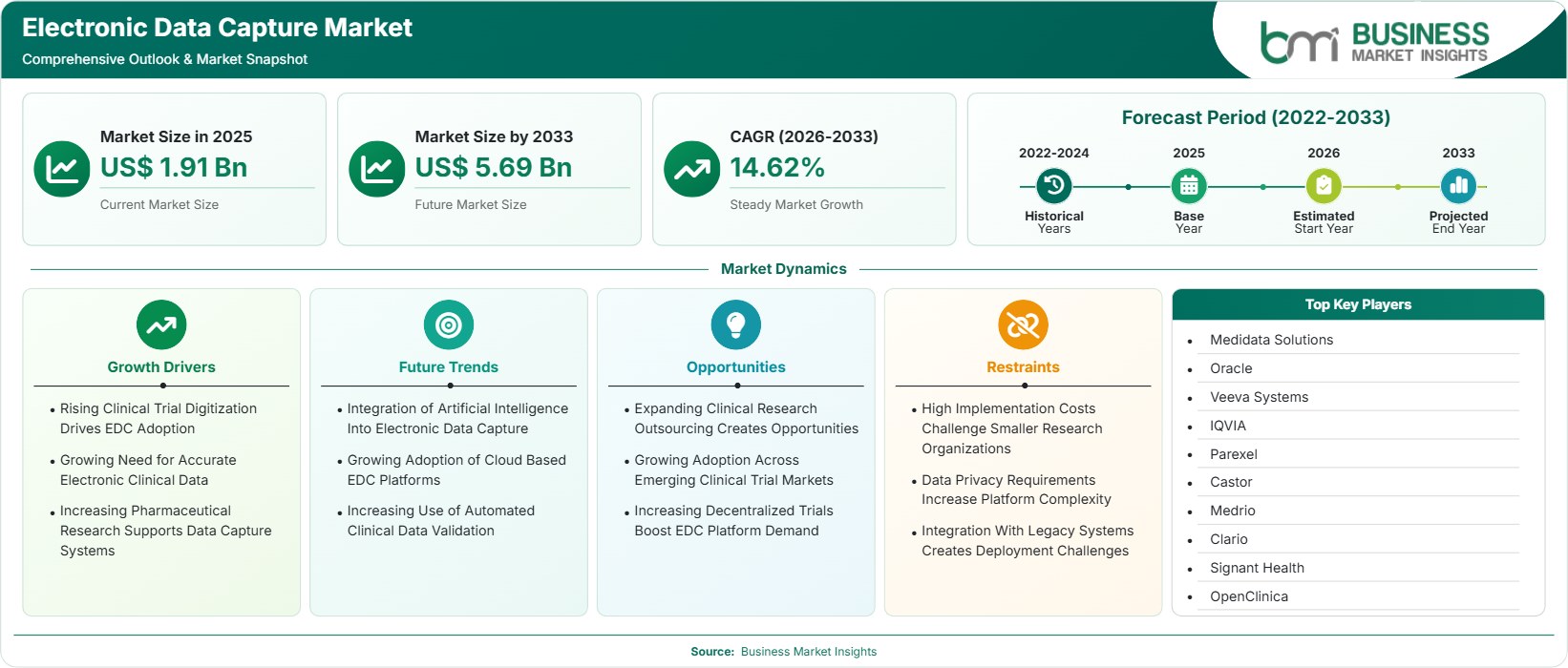
The Electronic Data Capture Market size was valued at US$ 1.91 billion in 2025 and is projected to reach US$ 5.69 billion by 2033, growing at a CAGR of 14.62% during 2026–2033, driven by clinical trial digitization, data-quality requirements, cloud adoption, decentralized research, and pharmaceutical innovation.

Report Coverage
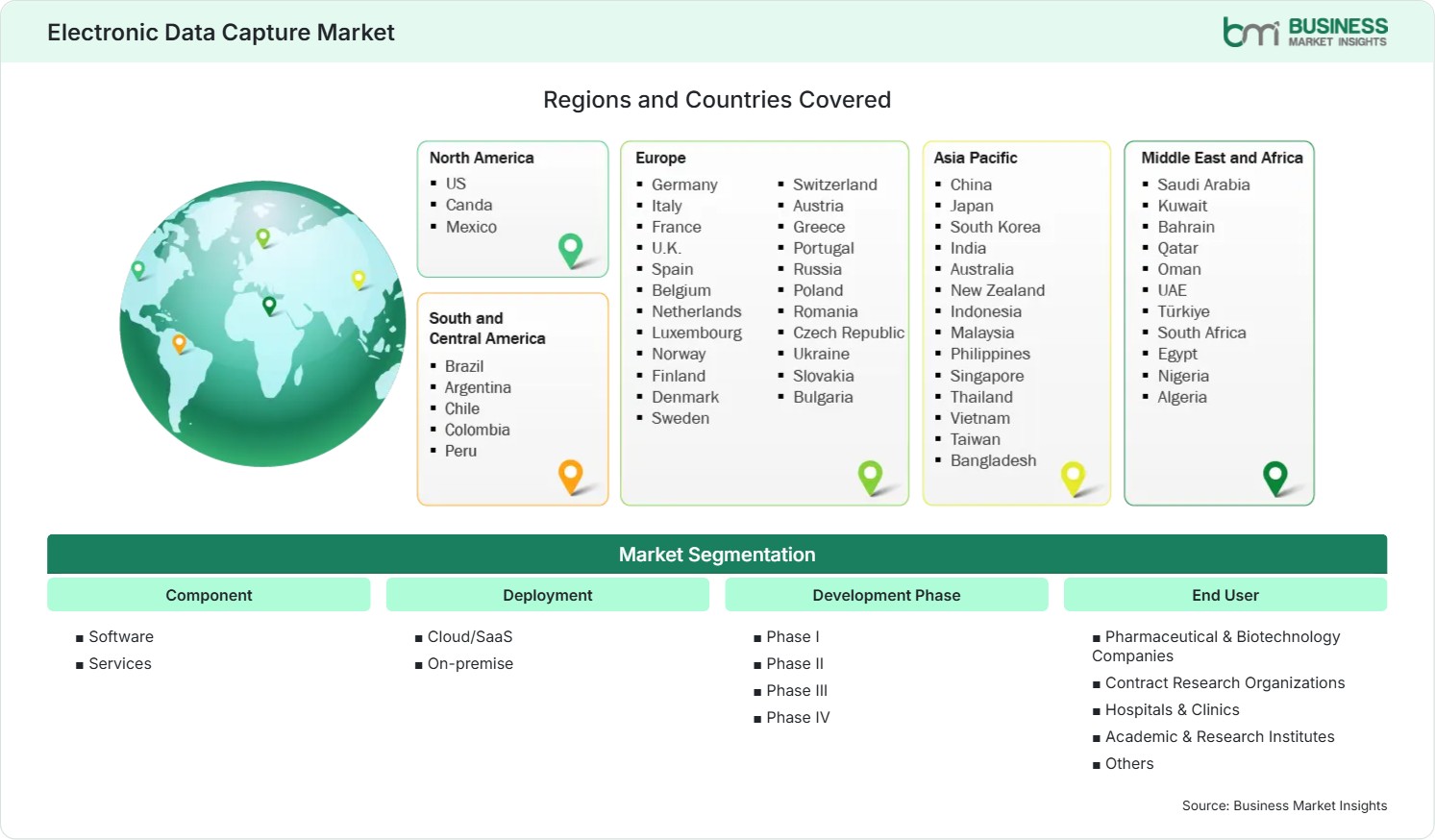
  • Component: Software, Services
  • Deployment: Cloud/SaaS, On-premise
  • Development Phase: Phase I, Phase II, Phase III, Phase IV
  • End User: Pharmaceutical & Biotechnology Companies, Contract Research Organizations, Hospitals & Clinics, Academic & Research Institutes, Others
US$ 1.91 Bn Market size in 2025
US$ 5.69 Bn Market Size by 2033
14.62% CAGR, 2026 - 2033
2026-2033 Forecast Period

01 AI Overview

Electronic Data Capture Market Summary

  • North America Region: North America holds a 40%–43% share in 2025, growing with a 13.8%–14.4% CAGR through 2033, influenced by mature clinical infrastructure, integrated workflows, regulatory alignment, and enterprise technology investment.
  • Fastest Growing Region: Asia Pacific holds a 23%–26% share in 2025, growing with a 16.2%–17.0% CAGR through 2033, supported by expanding trials, emerging sponsors, CRO activity, digital infrastructure, and regulatory modernization.
  • Leading Segment: Software holds a 72%–76% share in 2025, growing with a 14.8%–15.4% CAGR through 2033, supported by subscription adoption, configurable workflows, integration capabilities, automation, and recurring platform demand.
  • High Growth Segment: Cloud/SaaS holds a 61%–66% Electronic Data Capture Market share in 2025, growing with a 16.0%–16.8% CAGR through 2033, supported by remote access, scalability, faster deployment, interoperability, centralized upgrades, and distributed trial operations.
  • Key Market Opportunity: Demand is shifting toward unified platforms that connect EDC with eSource, EHR, eCOA, eConsent, randomization, analytics, and remote monitoring, creating expansion opportunities across sponsors, CROs, sites, and emerging trial ecosystems.
  • Major Market Players: Medidata Solutions, Oracle, Veeva Systems, IQVIA, Parexel, Castor, Medrio, Clario, Signant Health, and OpenClinica.
02 Strategic Insights

Electronic Data Capture Market: Strategic Insights

Electronic Data Capture Market Strategic Framework
FREE PDF
Request your free sample
Request free sample
03 Stakeholder View

Key Takeaways

  • The value chain is evolving from standalone EDC licensing toward integrated clinical data ecosystems linking collection, validation, monitoring, safety, patient-generated information, and analytics within governed workflows.
  • Cloud-native architectures offer the strongest strategic upside because sponsors can scale studies, provision distributed users, manage protocol changes, and integrate external data sources without maintaining extensive local infrastructure.
  • Artificial intelligence is moving from experimental analytics toward practical configuration, data review, anomaly detection, coding assistance, and source-data processing, increasing the importance of explainability and human oversight.
  • Asia Pacific presents the strongest expansion case as sponsors and CROs increase regional trial activity while local research organizations modernize technology infrastructure and adopt internationally aligned data-management practices.
  • Competitive positioning is increasingly shaped by platform breadth, interoperability, implementation expertise, validation support, site usability, and the ability to connect EDC with adjacent clinical technologies rather than by basic data-entry functionality alone.
  • Vendor strategies are likely to emphasize modular ecosystems and partnerships, enabling customers to add eSource, eCOA, eConsent, randomization, analytics, and decentralized capabilities without replacing the underlying clinical data environment.
04 Geographic Outlook

Electronic Data Capture Market Regional Highlights

North America Electronic Data Capture Market

North America holds a 40%–43% share in 2025 and is projected to expand at a 13.8%–14.4% CAGR through 2033. The region benefits from mature sponsor infrastructure, established CRO networks, cloud readiness, strong regulatory expectations, and extensive use of integrated clinical technologies across complex studies.

  • Enterprise sponsors increasingly prioritize interoperable data environments that reduce reconciliation between EDC, EHR, eSource, safety, and patient-reported data streams.
  • Regulatory expectations around traceability and standardized study data reinforce demand for validated platforms with audit trails, controlled access, and structured workflows.
  • Canada provides additional opportunity through research institutions and biotechnology activity seeking scalable cloud platforms with multinational study compatibility.
  • Vendor differentiation increasingly centers on implementation speed, site usability, configurable workflows, and integration with decentralized trial technologies.

US Electronic Data Capture Market

The US represents approximately 74%–78% of North American demand in 2025 and is projected to grow at a 13.6%–14.2% CAGR through 2033. Strong sponsor spending, CRO utilization, technology maturity, and regulatory familiarity support sustained platform upgrades across therapeutic areas.

  • Large pharmaceutical sponsors favor enterprise environments capable of supporting multinational protocols, centralized oversight, complex data models, and integrated clinical operations.
  • Biotechnology companies increasingly seek configurable platforms that shorten study initiation while avoiding excessive internal data-management infrastructure.
  • EHR-to-EDC interoperability is becoming a competitive requirement as research organizations pursue lower site burden and cleaner source-data transfer.

Europe Electronic Data Capture Market

Europe accounts for approximately 27%–30% of 2025 demand and is expected to expand at a 14.1%–14.8% CAGR through 2033. Germany, the United Kingdom, and France remain important markets, while Spain and Italy provide additional research expansion opportunities.

  • Germany combines pharmaceutical research depth with increasing demand for interoperable clinical data workflows and compliant cloud environments.
  • The United Kingdom remains a strong technology market because sponsors and research institutions increasingly prioritize connected data capture and decentralized study capabilities.
  • France benefits from pharmaceutical activity and hospital research networks seeking standardized clinical data processes.
  • Spain and Italy offer higher-growth opportunities as multinational sponsors expand site networks and digitize research operations.

Asia Pacific Electronic Data Capture Market

Asia Pacific represents approximately 23%–26% of 2025 demand and is projected to grow at a 16.2%–17.0% CAGR through 2033. China, Japan, India, South Korea, and Australia provide distinct growth pathways through research expansion, technology adoption, and infrastructure development.

  • China benefits from expanding clinical research capabilities, domestic pharmaceutical innovation, and increasing requirements for structured electronic study data.
  • India combines a large research ecosystem with expanding CRO participation and demand for cost-efficient cloud technologies supporting multinational studies.
  • Japan remains a mature research market where interoperability, compliance, and localized workflow capabilities influence technology selection.
  • South Korea and Australia offer attractive adoption environments through advanced healthcare infrastructure and participation in international clinical research.

Rest of World Electronic Data Capture Market

Rest of World represents approximately 10%–13% of 2025 demand and is expected to grow at a 15.0%–15.8% CAGR through 2033. South America and the Middle East and Africa provide opportunities as research infrastructure expands and sponsors diversify trial locations.

Middle Eastern markets, particularly the Gulf states, are developing digital healthcare infrastructure and research capabilities, while South Africa remains an important African clinical research hub.

  • Brazil offers scale through pharmaceutical research, hospital networks, and expanding participation in international clinical programs.
  • Argentina provides specialized clinical research capabilities and growing demand for compliant electronic study management.
  • Gulf markets are investing in healthcare digitization and research infrastructure, creating opportunities for cloud-based clinical technologies.
  • South Africa remains relevant for multinational studies requiring established research sites and standardized electronic data workflows.
Global Market Geography
FREE PDF
Request your free sample
Request free sample
05 Segment Analysis

Electronic Data Capture Market Segmentation

Component

Software represents the leading component, holding a 72%–76% share in 2025 and expanding at a 14.8%–15.4% CAGR through 2033. The Electronic Data Capture Market scope is broadening as software absorbs functions previously handled through separate systems.

  • Software: Subscription-based platforms support configurable forms, edit checks, data review, coding, audit trails, integrations, and database management, making software central to increasingly complex clinical research workflows.
  • Services: Implementation, validation, migration, configuration, training, integration, and managed data-management support remain essential where sponsors require specialized expertise, particularly during modernization or multi-system deployment.

Deployment

Cloud/SaaS represents the high-growth deployment category, holding a 61%–66% share in 2025 and expanding at a 16.0%–16.8% CAGR through 2033. Cloud delivery supports distributed research teams, faster provisioning, centralized updates, elastic capacity, and integration with external applications.

  • Cloud/SaaS: Remote accessibility, standardized upgrades, scalable infrastructure, subscription economics, and simplified multi-site administration make cloud delivery increasingly attractive for modern clinical research programs.
  • On-premise: Local deployments remain relevant for organizations with established infrastructure, strict internal controls, legacy integrations, or governance requirements that favor direct technology administration.

Development Phase

Phase III remains the leading development-phase application, supported by large participant populations, complex site networks, extensive data requirements, and regulatory submission pressure. Across phases, Electronic Data Capture Market trend development is moving toward flexible platforms that support continuous protocol changes and diverse data sources.

  • Phase I: Early studies require rapid database configuration, dosing-related workflows, safety monitoring, and flexible forms that accommodate changing protocols and smaller research populations.
  • Phase II: Biomarker, efficacy, laboratory, and patient-reported data increase requirements for validation, integration, and frequent data review during exploratory development programs.
  • Phase III: Large pivotal programs generate extensive multi-site data and require robust quality controls, monitoring, reconciliation, auditability, and regulatory-ready database management.
  • Phase IV: Post-market studies increasingly connect routine-care information, safety observations, patient outcomes, and real-world evidence, expanding the need for flexible long-duration data capture.

End User

Pharmaceutical and biotechnology companies remain the principal users because they sponsor regulated development programs and require controlled, auditable clinical data environments. CROs represent a major adoption channel because outsourced studies require scalable platforms across multiple sponsors and protocols.

  • Pharmaceutical & Biotechnology Companies: Sponsors prioritize enterprise scalability, regulatory readiness, integration, standardized workflows, and efficient oversight across global development portfolios.
  • Contract Research Organizations (CROs): CROs require flexible multi-study environments that support different sponsors, therapeutic areas, sites, protocols, reporting requirements, and data-management models.
  • Hospitals & Clinics: Research-active healthcare organizations increasingly need EDC capabilities that connect clinical workflows with study data while minimizing duplicate entry and operational disruption.
  • Academic & Research Institutes: Universities and research centers favor configurable, accessible platforms that support investigator-led studies, collaborative research, registries, and diverse funding structures.
06 Market Forces

Electronic Data Capture Market Dynamics

Key Market Drivers

Rising Clinical Trial Digitization Drives EDC Adoption

Paper-based procedures in clinical research organizations are gradually being substituted by digital ones, which help to make data collection and processing more accessible, validated, auditable, and controlled. Contemporary solutions allow the connection of electronic case report forms with EHR, eSource, laboratory, patient-reported, and monitoring solutions. Another advantage of digitalization of data processing is easier management of protocol amendments since configuration tools allow changing electronic forms and validation rules without redeploying an entire environment. The centralized processing of data is becoming an essential function due to the increasing complexity and dispersion of clinical trials organized by sponsors. Thus, the Electronic Data Capture Market growth depends on both paper substitution and overall modernization of clinical data infrastructure.

Growing Need for Accurate Electronic Clinical Data

Trial complexity has been rising due to more endpoints and sources of data and interaction between patients and other elements of research. Transcription introduces risks of discrepancies, delays in asking questions, and reconciliations, and therefore, electronic capture becomes essential. Contemporary systems for EDC include edit checks, validation rules, audit trail, access controls, and workflow management to secure data. The Electronic Data Capture Market trends  have been shifting towards systems that ensure high data quality throughout the process, rather than at the point of cleaning the database. Companies that manage to balance usability and governance can help in site adoption.

Increasing Pharmaceutical Research Supports Data Capture Systems

Drug and biotech development programs demand systematic clinical data management through discovery-related research, clinical development, regulatory activities, and post-launch data generation efforts. The growing trend towards precision medicine, specialty drugs, intricate protocols, and patient-specific data necessitates increased configurability of clinical data infrastructure. The rationale becomes further reinforced due to sponsors' desire to have infrastructure that will enable managing multiple studies and various therapeutic areas without developing separate technology stacks. The rationale gains additional support due to the outsourcing of functions by sponsors since CROs require a standard clinical data infrastructure that can be utilized in multiple programs.

Key Market Opportunities

Expanding Clinical Research Outsourcing Creates Opportunities

Outsourcing clinical research provides pharmaceutical sponsors with access to expertise in operational execution without needing to invest in internal infrastructure. This is why CROs would need EDC systems that can support multiple sponsors, studies, therapeutic indications, and sites in different geographically distributed configurations through customizable environment solutions. Vendors would be able to add additional value to their solutions through services in implementation, migration, validation, integration, training, and management, in addition to software. There is a possibility of creating recurring opportunities for deployment through collaboration between the vendor and the CRO. For investors, the Electronic Data Capture Market Forecasts would depend on the ability of the vendors.

Growing Adoption Across Emerging Clinical Trial Markets

There is an opportunity for market growth by way of expanding into emerging research markets through a combination of diversified trial sites, expanded population groups, and development of new networks of investigators. The local companies will favor the use of cloud computing as they will not have to make massive investments in infrastructure, yet have access to standard technology and vendor support. The providers will be able to increase adoption through localization, multiple languages, data management within the region, commercial models, and implementation collaborations. It takes more to ensure successful growth than merely having the products available, since site training, connection, regulation interpretation, and integration within the local health care system will all have an impact.

Increasing Decentralized Trials Boost EDC Platform Demand

Decentralized and hybrid trials involve the collection of data from outside traditional trial locations, and thus have a greater need for platforms that can collect data from participants from remote locations, from home visits, from connected devices, and from electronic medical records. With regulatory approval for decentralized technology components, sponsors find it easier to design workflows that cater to patient convenience without sacrificing data integrity and control. EDC vendors stand to gain from the integration of eConsent, eCOA, eSource, telemedicine, randomization, and remote monitoring in a connected environment. This is especially the case when various data is generated by the decentralized technologies and reconciled into the clinical study database.

Market Restraints and Challenges

High Implementation Costs Challenge Smaller Research Organizations

Factor: implementation could include configuration, validation, migration, integration, training, cybersecurity considerations, and technical resources. Impact: smaller sponsors and research organizations might spend more time on implementing the solution, opt for minimal functionality software, or stick to the previous approach, than the big corporations would. Cost implication factor becomes even more relevant when there are fewer research projects being done, and costs cannot be shared across multiple researchers. In order to address this problem, vendors are providing no-code configuration, template solutions, subscription models, and implementation packages. Nonetheless, research under a regulatory framework still requires validation and governance.

Data Privacy Requirements Increase Platform Complexity

Factor: The use of clinical trials is becoming more widespread in terms of having participant data that may be sensitive in nature and is spread out across many different areas. Impact: The vendor will have to provide strict access control, encryption, auditing, retention policies, consent management, segregation of data, and specific jurisdictional governance. In addition, interoperability will increase complexity since the data will pass through EDC, EHR, labs, patient applications, and other analytics environments. This factor makes implementation more difficult due to the lack of mature data governance within the organization. Privacy architecture is still important since a problem in the platform could lead to risks of a regulatory nature.

07 Company Analysis

Competitive Landscape

The Electronic Data Capture Market analysis indicates a competitive field spanning established clinical technology providers, specialized EDC vendors, CRO-linked platforms, and integrated eClinical ecosystems. Competition increasingly centers on interoperability, configurable study design, data quality, deployment flexibility, implementation speed, and integration with adjacent clinical applications.

Company Name

Overview

Products and Services relevant to this market

Medidata Solutions

Established clinical technology provider with extensive experience in electronic clinical data management and trial workflows.

Rave EDC, clinical data management, study build, data review, integration, analytics, and connected clinical technologies.

Oracle

Global technology company with a dedicated life sciences portfolio supporting clinical research and regulated data workflows.

Oracle Clinical One Data Collection, clinical data management, EHR interoperability, safety integration, and clinical technology infrastructure.

Veeva Systems

Cloud-focused life sciences technology provider with a broad clinical development ecosystem and strong sponsor adoption.

Veeva EDC, Clinical Data, Vault applications, data connections, study management, and integrated clinical workflows.

IQVIA

Global clinical research and technology provider combining technology platforms with extensive research services capabilities.

EDC capabilities, EMR-to-EDC integration, clinical eSource, data management, trial services, and connected research solutions.

Parexel

Clinical research organization supporting sponsors through technology-enabled development and operational services.

Clinical data management, EDC-related study services, data review, validation, and technology-enabled clinical operations.

Castor

Specialized clinical research technology provider focused on flexible, connected, and accessible study data environments.

EDC, CDMS, eConsent, ePRO/eCOA, decentralized trial technology, data management, and AI-assisted source-data workflows.

Medrio

Clinical trial technology provider focused on configurable solutions for small and scaling research teams.

EDC, CDMS, eConsent, ePRO, RTSM, CTMS, eTMF, study configuration, and compliance support.

Clario

Clinical trial technology provider specializing in endpoint data and technology-enabled evidence generation.

Electronic data capture capabilities, eCOA, imaging, respiratory assessments, cardiac data, and connected clinical trial technologies.

Signant Health

Clinical technology and evidence-generation provider with integrated capabilities for modern and decentralized studies.

EDC, eSource, eCOA, eConsent, telehealth, randomization, remote monitoring, and unified clinical trial workflows.

OpenClinica

Clinical data technology provider offering flexible platforms for research organizations and clinical study teams.

EDC, electronic consent, electronic patient outcomes, data management, study configuration, and clinical research workflows.

10 Trust & Transparency

Research Methodology

The market analysis combines proprietary research with secondary data from government agencies, company disclosures, regulatory filings, industry databases and expert interviews. Market estimates are validated through data triangulation, cross-market benchmarking and analyst review.

View Full Research Methodology

11 Questions Answered

Frequently Asked Questions

What does the Electronic Data Capture Market Report indicate about future competition?

The report indicates that competition will increasingly focus on interoperability, configurable architecture, implementation efficiency, data quality, security, and ecosystem integration. Vendors that connect EDC with adjacent clinical technologies while simplifying study configuration and supporting different sponsor sizes can strengthen long-term positioning.

Why are decentralized clinical trials creating new opportunities?

Decentralized models distribute trial activities across homes, local providers, digital channels, and traditional sites. This increases the need for centralized systems capable of receiving and validating diverse information while maintaining participant privacy, data lineage, monitoring, and regulatory traceability.

How are advanced data integration technologies influencing adoption?

EHR interoperability, eSource connectivity, electronic patient outcomes, connected devices, automated validation, and centralized data review are increasing the value of EDC platforms. Integration reduces duplicate entry and reconciliation while enabling research teams to manage broader datasets through controlled workflows.

Which applications present the strongest opportunity in the market?

Pharmaceutical development programs, outsourced clinical research, decentralized and hybrid trials, emerging-market studies, and post-market evidence generation present strong opportunities. These applications require configurable data environments capable of supporting diverse endpoints, distributed participants, multiple sites, and connected data sources.

What factors are improving Electronic Data Capture Market return on investment?

Increasing clinical trial digitization, stronger data-quality requirements, cloud adoption, decentralized research, and greater integration with EHR and eSource systems are improving return on investment. EDC platforms reduce manual data handling, support faster study workflows, strengthen data integrity, and provide scalable infrastructure for sponsors, CROs, hospitals, and research institutions.

Access the Full Electronic Data Capture Market Report

Get segment-level forecasts, regional estimates, competitive benchmarking, company profiles and downloadable Excel datasets.

Access the full Electronic Data Capture Market Report
350 pages PDF & Excel | 2026-08-20