
Workforce Management Market Outlook: Size, Share, Trends, Growth Analysis, Competitive Landscape & Forecast, 2026-2033

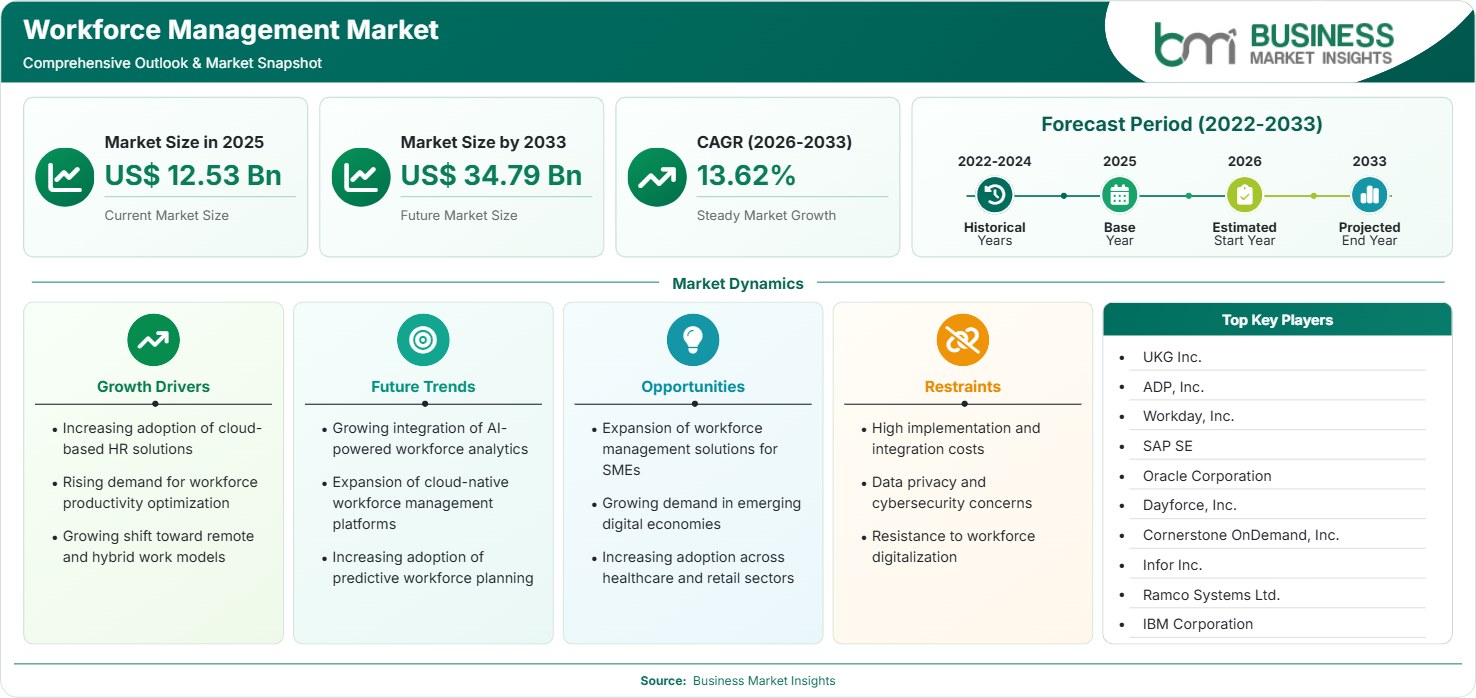
The Workforce Management Market size was valued at US$ 12.53 Billion in 2025 and is projected to reach US$ 34.79 Billion by 2033, growing at a CAGR of 13.62% from 2026 to 2033. Increasing cloud adoption, workforce optimization needs, hybrid work expansion, automation integration, and demand for real-time workforce intelligence are driving market growth and creating technology opportunities.

Report Coverage
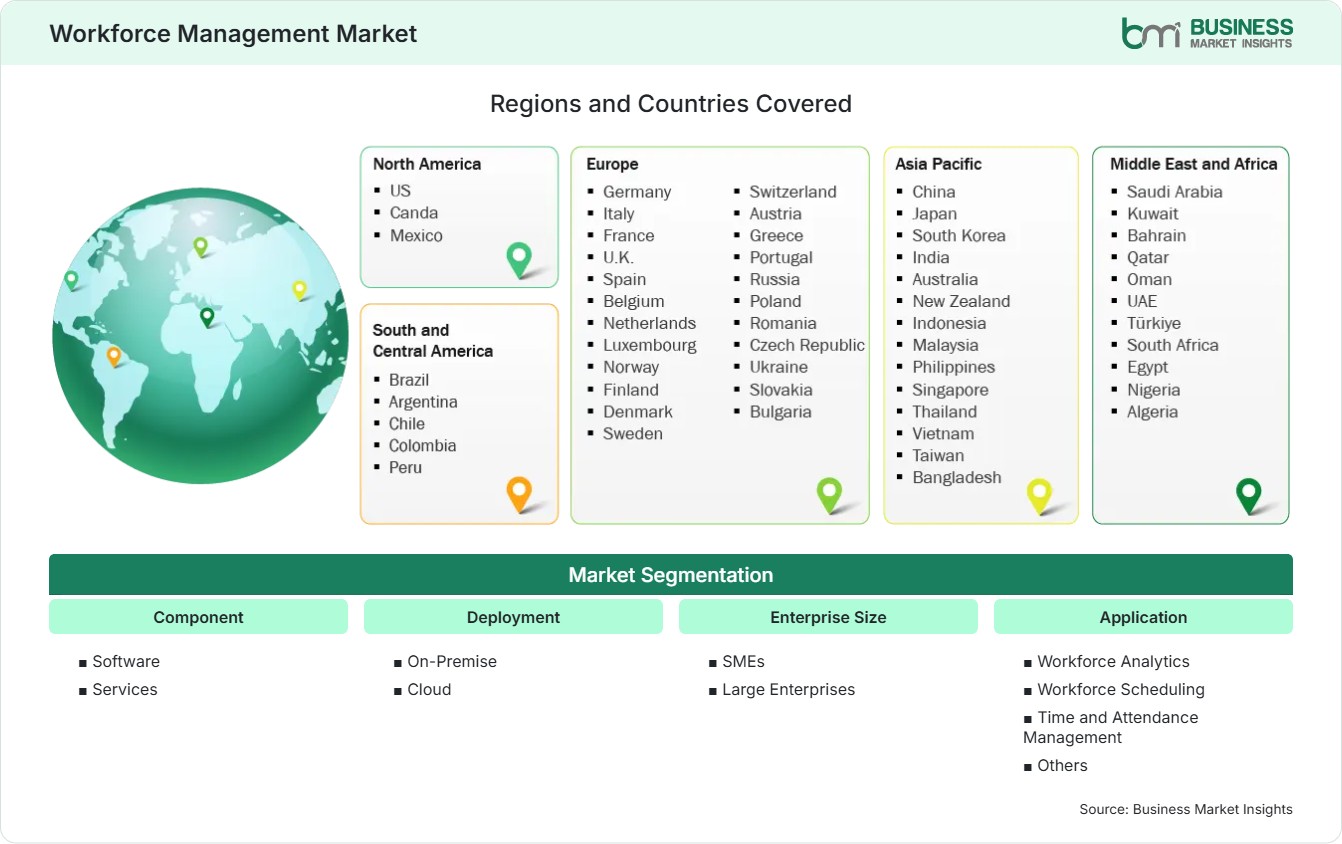
  • Component: Software, Services
  • Deployment: On-Premise, Cloud
  • Enterprise Size: SMEs, Large Enterprises
  • Application: Workforce Analytics, Workforce Scheduling, Time and Attendance Management, Others
  • End-Use Industry: IT and Telecommunication, BFSI, Government, Retail, Healthcare, Education, Manufacturing, Others
US$ 12.53 Bn Market size in 2025
US$ 34.79 Bn Market Size by 2033
13.62% CAGR, 2026 - 2033
2026-2033 Forecast Period

AI Overview

Workforce Management Market Summary

  • North America Region: North America holds a 38%–41% market share in 2025, expanding at a 12.8%–13.3% CAGR during 2026–2033, supported by advanced HR technology adoption, enterprise digital transformation, cloud migration, automation investments, and demand for workforce analytics. The U.S. market remains dominant through strong software adoption, enterprise modernization, and a 12.9%–13.4% CAGR from 2026 to 2033.
  • Fastest Growing Region: Asia Pacific represents 23%–26% market share in 2025 and grows at a 15.0%–15.6% CAGR during 2026–2033, driven by digital transformation, expanding enterprises, cloud adoption, workforce automation, and increasing demand for scalable HR platforms.
  • Leading Segment: Software accounts for 65%–68% market share in 2025 and grows at a 13.8%–14.2% CAGR during 2026–2033, supported by automation capabilities, analytics integration, cloud-based platforms, and increasing enterprise demand for centralized workforce management systems.
  • High Growth Segment: Cloud deployment represents 60%–63% market share in 2025, expanding at a 15.2%–15.8% CAGR during 2026–2033 due to scalability, lower infrastructure requirements, remote accessibility, and growing preference for subscription-based enterprise software.
  • Key Market Opportunity: Expansion among SMEs, adoption in emerging digital economies, and increasing workforce management requirements across healthcare, retail, and service industries are creating new growth opportunities for technology providers.
  • Major Market Players: UKG Inc., ADP, Inc., Workday, Inc., SAP SE, Oracle Corporation, Dayforce, Inc., Cornerstone OnDemand, Inc., Infor Inc., Ramco Systems Ltd., and IBM Corporation.
Strategic Insights

Workforce Management Market: Strategic Insights

Workforce Management Market Strategic Framework
FREE PDF
Request your free sample
Request free sample
Stakeholder View

Key Takeaways

  • The workforce management ecosystem is expanding through collaboration between software providers, cloud infrastructure companies, HR technology consultants, implementation partners, and enterprises. This interconnected value chain is improving platform capabilities, integration efficiency, and workforce optimization outcomes.
  • Software-based workforce management solutions represent the strongest commercial opportunity due to increasing automation demand, analytics adoption, and integration with broader human capital management platforms. Cloud-based models are also gaining importance among organizations seeking flexible deployment options.
  • Artificial intelligence, machine learning, predictive analytics, and automation are transforming workforce planning by enabling demand forecasting, intelligent scheduling, employee engagement analysis, and improved operational decision-making.
  • Asia Pacific provides strong investment potential due to expanding digital economies, growing enterprise adoption, increasing cloud infrastructure availability, and rising demand from technology-driven industries.
  • Strategic partnerships, acquisitions, and platform integrations are shaping competitive dynamics as technology providers seek broader capabilities across workforce analytics, payroll, employee engagement, and human capital management solutions.
  • Increasing emphasis on employee experience, compliance management, and operational efficiency is encouraging organizations across industries to replace fragmented workforce processes with integrated digital platforms.
Geographic Outlook

Workforce Management Market Regional Highlights

North America Workforce Management Market

North America accounts for 38%–41% of the global market in 2025 and is projected to expand at a 12.8%–13.3% CAGR during 2026–2033. The region maintains leadership due to advanced enterprise technology adoption, strong cloud infrastructure, automation investments, and increasing demand for workforce intelligence solutions. The Workforce Management Market share remains high as organizations prioritize digital HR transformation, employee experience enhancement, compliance management, and real-time workforce optimization across multiple industries.

  • The United States remains the primary contributor due to widespread adoption of cloud HR platforms, enterprise software investments, and strong demand for workforce analytics solutions.
  • Organizations across healthcare, retail, financial services, and technology sectors are implementing automated scheduling and workforce planning tools to improve operational efficiency.
  • Growing adoption of artificial intelligence and predictive analytics is enabling businesses to optimize labour allocation, forecast workforce requirements, and improve productivity outcomes.
  • Strong presence of leading HR technology providers supports continuous innovation, platform integration, and expansion of advanced workforce management capabilities.

US Workforce Management Market

The United States represents 82%–85% of the North American market in 2025 and is expected to grow at a 12.9%–13.4% CAGR during 2026–2033. Strong enterprise software adoption, digital workplace transformation, and increasing hybrid work models are supporting market expansion. Organizations are investing in workforce platforms to improve scheduling accuracy, compliance management, employee engagement, and operational visibility across complex workforce environments in Workforce Management Market.

  • Large enterprises are adopting integrated workforce platforms to connect scheduling, analytics, payroll, and employee management functions through centralized systems.
  • Growing demand for automation is encouraging businesses to deploy artificial intelligence-based workforce forecasting and productivity optimization tools.
  • The expansion of remote and hybrid work structures is increasing demand for flexible workforce management technologies.
  • Continuous innovation from software providers is strengthening adoption across industries requiring complex workforce coordination.

Europe Workforce Management Market

Europe represents 27%–30% of the market in 2025 and is forecast to grow at a 12.5%–13.0% CAGR during 2026–2033. Increasing focus on workforce compliance, employee experience, automation, and digital transformation supports regional development. Germany remains a leading Workforce Management market, while the United Kingdom and France demonstrate strong growth potential due to expanding cloud adoption and increasing investment in advanced HR technologies.

  • Germany benefits from strong industrial digitization, enterprise software adoption, and demand for workforce optimization solutions across manufacturing and service industries.
  • The United Kingdom demonstrates growth through increasing cloud-based HR adoption, flexible work models, and demand for analytics-driven workforce decisions.
  • France is expanding through digital workplace initiatives, automation investments, and modernization of workforce management processes.
  • European enterprises are prioritizing compliance-focused solutions due to evolving labour regulations and increasing workforce complexity.

Asia Pacific Workforce Management Market

Asia Pacific accounts for 23%–26% of the global market in 2025 and is expected to grow at a 15.0%–15.6% CAGR during 2026–2033. The region represents the fastest-growing Workforce Management market due to expanding digital economies, cloud adoption, enterprise modernization, and increasing workforce complexity. China remains a major contributor, while India demonstrates rapid growth through technology adoption, startup expansion, and increasing demand for scalable workforce management platforms.

  • China is strengthening market growth through enterprise digitization, cloud infrastructure development, and adoption of intelligent workforce management technologies.
  • India demonstrates strong potential due to expanding IT services, growing SMEs, digital transformation initiatives, and increasing adoption of cloud-based business applications.
  • Japan continues adopting advanced workforce platforms due to automation requirements, aging workforce challenges, and demand for operational efficiency.
  • Southeast Asian economies are experiencing increased adoption through expanding technology investments and growing enterprise demand for workforce automation.

Rest of World Workforce Management Market

The Rest of World region contributes 6%–8% market share in 2025 and is projected to grow at a 13.5%–14.0% CAGR during 2026–2033. South America, the Middle East, and Africa are witnessing increasing demand due to business digitization, cloud infrastructure development, and workforce modernization initiatives. Brazil leads South America, while the UAE and Saudi Arabia demonstrate strong growth through digital transformation programs and enterprise technology investments in Workforce Management Market.

  • Brazil represents a key regional market due to increasing adoption of enterprise software, cloud solutions, and workforce automation platforms.
  • Middle Eastern countries are investing in digital transformation initiatives, encouraging organizations to modernize workforce planning and employee management processes.
  • African markets are gradually adopting cloud-based workforce solutions as businesses seek scalable platforms with lower infrastructure requirements.
  • Growing SME digitization across emerging economies is creating demand for affordable workforce management solutions.
  • Partnerships between global technology providers and regional businesses are improving platform accessibility and supporting market expansion.
Global Market Geography
FREE PDF
Request your free sample
Request free sample
Segment Analysis

Workforce Management Market Segmentation

Component

The component segment is divided into software and services, with software representing the larger revenue contribution due to increasing automation, analytics integration, and demand for centralized workforce platforms. The segment is projected to expand at a 13.62%–14.0% CAGR during 2026–2033. The Workforce Management Market scope is expanding as organizations prioritize digital workforce planning, process automation, and integrated human capital management solutions. Services continue supporting implementation, customization, and long-term platform optimization.

  • Software: Dominates adoption due to workforce analytics, scheduling automation, attendance tracking, and integration capabilities that help organizations improve productivity and operational efficiency.
  • Services: Support market growth through consulting, implementation, training, maintenance, and managed services that enable organizations to maximize workforce platform performance.

Deployment

The deployment segment reflects changing enterprise preferences toward flexible, scalable, and secure workforce management solutions. The segment is expected to grow at a 13.62%–14.2% CAGR during 2026–2033, supported by increasing cloud adoption, remote work requirements, and demand for accessible workforce platforms. Enterprises are balancing security, customization, and operational efficiency while selecting deployment models suitable for their workforce structures.

  • On-Premise: Maintains demand among organizations requiring greater infrastructure control, customized configurations, strict compliance management, and internal data management capabilities.
  • Cloud: Represents the fastest-growing deployment approach due to scalability, lower maintenance requirements, remote accessibility, automatic updates, and subscription-based pricing models.

Enterprise Size

Enterprise size segmentation highlights differences in workforce complexity, technology requirements, and investment capacity. The segment is projected to grow at a 13.62%–14.1% CAGR during 2026–2033 as organizations of all sizes adopt digital workforce solutions. Large enterprises continue leading adoption due to complex workforce structures, while SMEs increasingly adopt cloud platforms to improve efficiency without significant infrastructure investment.

  • SMEs: Experience increasing adoption through affordable cloud-based solutions, simplified deployment processes, and growing awareness of workforce optimization benefits.
  • Large Enterprises: Maintain strong demand due to complex employee management requirements, global operations, compliance needs, and demand for advanced analytics capabilities.

Application

The application segment is expanding as organizations seek improved workforce visibility, operational control, and data-driven decision-making. The segment is forecast to grow at a 13.62%–14.3% CAGR during 2026–2033. The Workforce Management Market trends indicate increasing adoption of analytics-driven workforce planning, automated scheduling, and attendance management tools across industries requiring efficient employee coordination.

  • Workforce Analytics: Gains importance through real-time insights, predictive workforce planning, productivity measurement, and data-driven decision-making capabilities for enterprises.
  • Workforce Scheduling: Supports operational efficiency by automating employee allocation, shift planning, demand forecasting, and resource optimization across complex workforce environments.
  • Time and Attendance Management: Remains essential for payroll accuracy, compliance monitoring, employee tracking, and improving workforce administration processes.

End-Use Industry

The end-use industry segment continues expanding as organizations across sectors adopt workforce management technologies to improve productivity, compliance, and employee experiences. The segment is expected to grow at a 13.62%–14.5% CAGR during 2026–2033. Industries with complex workforce requirements, such as healthcare, retail, manufacturing, and telecommunications, represent major adoption areas due to scheduling and operational challenges.

  • IT and Telecommunication: Adopt workforce platforms to manage distributed teams, optimize resource allocation, and support technology-driven operating models.
  • BFSI: Uses workforce solutions for compliance management, employee scheduling, productivity tracking, and efficient branch and service operations.
  • Government: Implements workforce technologies to improve administrative efficiency, employee management, and workforce transparency across public organizations.
  • Retail: Adopts scheduling and analytics solutions to manage fluctuating staffing requirements, customer demand, and multi-location operations.
  • Healthcare: Requires workforce platforms for complex scheduling, staff availability management, compliance requirements, and efficient patient service delivery.
  • Education: Uses workforce management solutions to coordinate faculty, administrative staff, and institutional workforce planning activities.
  • Manufacturing: Implements workforce technologies for shift management, labour optimization, production efficiency, and operational planning.
Market Forces

Workforce Management Market Dynamics

Key Market Drivers

Increasing adoption of cloud-based HR solutions

Modern organizations are moving away from using conventional systems for the workforce to cloud HR systems because of various reasons like scalability and accessibility of these systems. Cloud systems enable visibility into the workforce, real-time updates, access from anywhere, and integrations with enterprise applications. Subscription-based systems for small and medium-sized companies give them access to better workforce systems without requiring heavy investments. This transition is strengthening the Workforce Management Market growth by accelerating adoption of flexible workforce platforms. The growing preference for integrated solutions that combine scheduling, analytics, attendance, and employee engagement capabilities is further driving market expansion across industries.

Rising demand for workforce productivity optimization

The focus of companies is improving worker productivity through automation, analytics and workforce optimization software. Workforce management systems allow firms to analyze workers’ performance, streamline their schedules, decrease workload and become more efficient. Companies functioning in industries with complicated staff needs, such as healthcare, retail, manufacturing, and telecommunications, are using workforce management solutions to control labour costs and provide better services. Real-time analytics and predictive analytics enable managers to make informed decisions about employee numbers and workforce utilization. The increasing importance of worker efficiency and productivity encourages firms to adopt new workforce management solutions.

Growing shift toward remote and hybrid work models

The growth in remote and hybrid work models means there is a greater need for workforce management systems that can facilitate flexible work. Organizations need systems that provide visibility into employee availability, attendance patterns, productivity levels, and collaboration needs. Workforce management systems are being designed to incorporate mobility support, automatic scheduling tools, self-service capabilities for employees, and analytics tools. These developments are shaping Workforce Management Market forecasts as enterprises prioritize adaptable solutions that support changing workplace models and evolving employee expectations.

Key Market Opportunities

Expansion of workforce management solutions for SMEs

The area of small and medium enterprises provides a huge potential as affordable cloud computing workforce solutions get more available. Organizations are starting to implement technologies to optimize aspects of work such as scheduling, attendance tracking, payroll processing, and workforce planning, without requiring specialized IT infrastructure. The software companies offer simple-to-use solutions, flexible payment plans, and solutions specific for certain industries to meet the needs of SMEs. Productivity considerations along with increased competition, make small businesses consider upgrading their workforce processes.

Growing demand in emerging digital economies

The advent of the digital economy in emerging nations presents immense opportunities for workforce management vendors due to increased digitization, investment in technology, and larger workforces. Digital infrastructures are being built, and cloud-based business software is being used by enterprises across several countries in Asia Pacific, Latin America, and the Middle East. The need for scalable workforce management tools to support growth in operations and productivity, and the growing network of employees, makes it possible for technology vendors to profit from local platforms and cost-effective solutions.

Increasing adoption across healthcare and retail sectors

The healthcare and retail industries offer good prospects due to complex staffing needs, variable staffing requirements, and the need for operational efficiency. The healthcare sector requires highly sophisticated scheduling solutions in order to manage the staffing availability, compliance issues, and patient service needs. The retail sector adopts workforce management solutions that help in allocating employees based on customer needs and store operations. Solution providers are developing industry-specific solutions through automation, analysis, and compliance capabilities. There is an increase in the digital transformation efforts within these sectors which opens up prospects for workforce management solution providers.

Market Restraints and Challenges

High implementation and integration costs

Factor: Workforce management platforms often require significant investment in implementation, customization, employee training, and integration with existing enterprise systems. Impact: High initial costs can delay adoption, particularly among smaller organizations with limited technology budgets. Complex integration requirements involving payroll systems, HR platforms, and enterprise applications may increase deployment timelines and operational challenges. Companies must evaluate long-term efficiency benefits against implementation expenses when selecting workforce management solutions. Vendors are addressing this challenge through cloud-based offerings, modular platforms, and simplified deployment models that reduce technical complexity and improve accessibility.

Data privacy and cybersecurity concerns

Factor: Workforce management platforms process sensitive employee information, including attendance records, personal data, payroll details, and performance information. Impact: Increasing cybersecurity risks and regulatory requirements can create concerns among organizations regarding data protection and compliance. Businesses require secure platforms with encryption, access controls, and strong governance frameworks to protect workforce information. Privacy regulations across different regions also increase compliance complexity for global organizations. Technology providers must continuously strengthen security capabilities and maintain transparent data management practices to improve customer trust and encourage adoption.

Company Analysis

Competitive Landscape

The Workforce Management Market analysis indicates a competitive environment driven by cloud transformation, artificial intelligence integration, workforce analytics capabilities, and increasing demand for automated employee management solutions. Leading technology providers are focusing on platform expansion, strategic integrations, industry-specific solutions, and enhanced user experiences. Companies are differentiating through scalability, security capabilities, implementation expertise, and the ability to support complex workforce requirements across industries such as healthcare, retail, BFSI, manufacturing, and telecommunications.

Company Name

Overview

Products and Services relevant to this market

UKG Inc.

Workforce technology provider specializing in human capital management, employee experience, and workforce optimization solutions.

Provides workforce management platforms for scheduling, time tracking, analytics, employee engagement, and workforce planning.

ADP, Inc.

Global human capital management company offering payroll, HR, and workforce management technologies.

Provides workforce solutions including time and attendance, scheduling, compliance management, and HR technology services.

Workday, Inc.

Enterprise cloud software company focused on human resources, finance, and workforce management applications.

Offers cloud-based workforce planning, analytics, employee management, and human capital management solutions.

SAP SE

Global enterprise software provider delivering business applications and digital transformation solutions.

Provides SAP SuccessFactors workforce solutions supporting HR processes, workforce analytics, talent management, and employee operations.

Oracle Corporation

Technology company offering enterprise cloud applications and workforce management capabilities.

Provides Oracle Fusion Cloud HCM solutions covering workforce planning, employee management, analytics, and HR operations.

Dayforce, Inc.

Human capital management technology company focused on unified workforce management platforms.

Offers workforce management solutions including scheduling, payroll, time tracking, analytics, and employee experience tools.

Cornerstone OnDemand, Inc.

Cloud-based talent management company supporting employee development and workforce optimization.

Provides workforce solutions covering talent management, learning, employee engagement, and workforce analytics capabilities.

Infor Inc.

Enterprise software provider delivering industry-specific business applications and workforce solutions.

Offers workforce management technologies for scheduling, workforce planning, analytics, and operational efficiency improvement.

Ramco Systems Ltd.

Enterprise software company providing cloud-based business applications and workforce management solutions.

Provides workforce platforms supporting payroll, attendance management, workforce mobility, and employee administration.

IBM Corporation

Global technology company delivering artificial intelligence, cloud, and enterprise software solutions.

Provides AI-enabled workforce analytics, automation technologies, HR transformation solutions, and workforce optimization services.

Trust & Transparency

Research Methodology

The market analysis combines proprietary research with secondary data from government agencies, company disclosures, regulatory filings, industry databases and expert interviews. Market estimates are validated through data triangulation, cross-market benchmarking and analyst review.

View Full Research Methodology

Questions Answered

Frequently Asked Questions

What is the future outlook for workforce management technologies?

Future development will focus on intelligent automation, employee experience tools, predictive analytics, and integrated HR platforms supporting flexible and data-driven workplace models.

How does artificial intelligence improve workforce management market?

Artificial intelligence enables predictive scheduling, workforce forecasting, productivity analysis, and automated decision-making, helping organizations optimize employee allocation and resource planning.

Which industries are adopting workforce management solutions?

Healthcare, retail, manufacturing, IT, telecommunications, and BFSI sectors are adopting workforce platforms to improve scheduling, compliance, productivity, and operational efficiency.

Why are cloud-based workforce solutions gaining popularity?

Cloud platforms offer scalability, remote accessibility, lower infrastructure requirements, and easier integration, making them attractive for organizations seeking flexible workforce technology solutions.

What is driving workforce management market report?

Increasing cloud adoption, automation needs, hybrid work models, and demand for workforce analytics are driving organizations to implement digital workforce management platforms.

Access the Full Workforce Management Market Report

Get segment-level forecasts, regional estimates, competitive benchmarking, company profiles and downloadable Excel datasets.

Access the full Workforce Management Market Report
350 pages PDF & Excel | 2026-08-31
Similar Research

Related Market Reports