
Talent Management Software Market Outlook: Size, Share, Trends, Growth Analysis, Competitive Landscape & Forecast, 2026-2033

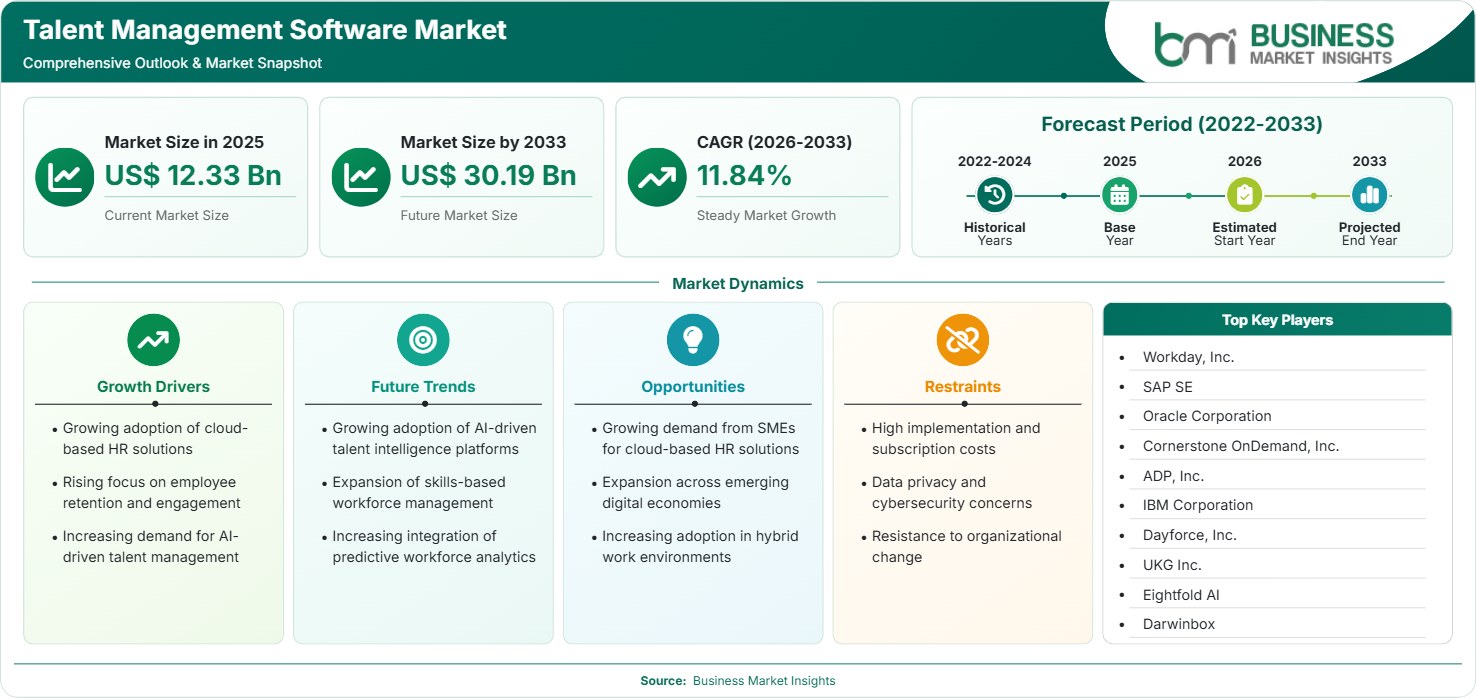
The Talent Management Software Market size was valued at US$ 12.33 Billion in 2025 and is projected to reach US$ 30.19 Billion by 2033, growing at a CAGR of 11.84% from 2026 to 2033, driven by digital HR transformation, workforce optimization needs, AI adoption, and increasing demand for flexible employee management platforms.

Report Coverage
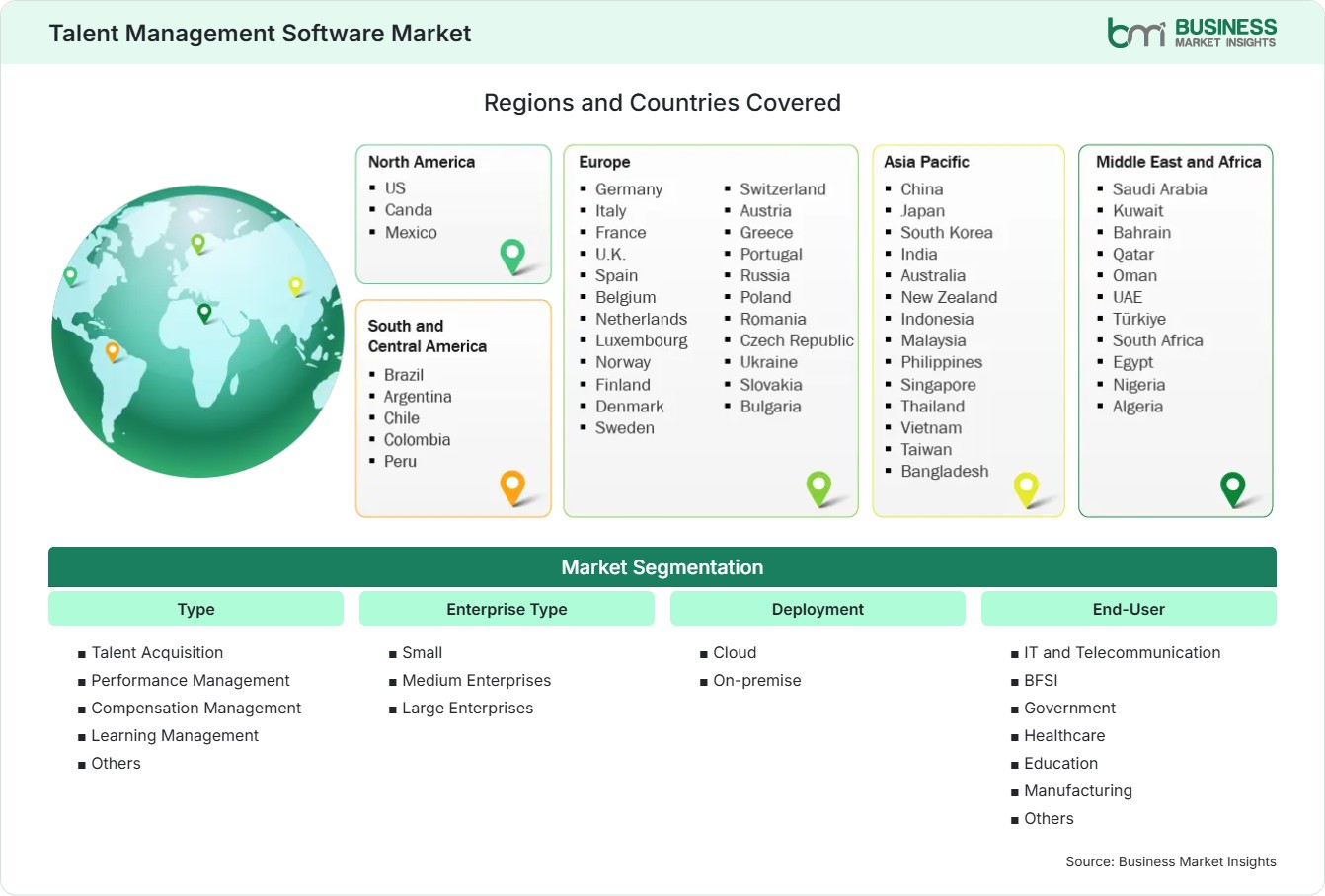
  • Type: Talent Acquisition, Performance Management, Compensation Management, Learning Management, Others
  • Enterprise Type: Small, Medium Enterprises, Large Enterprises
  • Deployment: Cloud, On-premise
  • End-User: IT and Telecommunication, BFSI, Government, Healthcare, Education, Manufacturing, Others
US$ 12.33 Bn Market size in 2025
US$ 30.19 Bn Market Size by 2033
11.84% CAGR, 2026 - 2033
2026-2033 Forecast Period

01 AI Overview

Talent Management Software Market Summary

  • North America Region: North America holds a market share of 38%–42% in 2025, growing with a CAGR of 11.20%–11.80% influenced by enterprise digitalization, cloud HR adoption, workforce analytics demand, and automation initiatives. The U.S. market analysis indicates a CAGR of 11.40%–12.00% from 2026 to 2033, supported by large enterprise adoption and HR technology investments.
  • Fastest Growing Region: Asia Pacific holds a market share of 22%–26% in 2025, growing with a CAGR of 12.50%–13.20% influenced by expanding digital economies, SME technology adoption, hybrid workforce models, and increasing investments in HR infrastructure.
  • Leading Segment: Performance Management holds a market share of 28%–32% in 2025, growing with a CAGR of 11.80%–12.40% influenced by demand for continuous feedback systems, workforce productivity measurement, and employee development programs.
  • High Growth Segment: Talent Acquisition holds a market share of 24%–28% in 2025, growing with a CAGR of 12.20%–12.90% influenced by recruitment automation, AI-based candidate screening, and increasing competition for skilled professionals.
  • Key Market Opportunity: Rising adoption among SMEs, expansion in emerging digital economies, and growing hybrid work models are creating opportunities for scalable cloud-based talent management platforms.
  • Major Market Players: Workday, Inc., SAP SE, Oracle Corporation, Cornerstone OnDemand, Inc., ADP, Inc., IBM Corporation, Dayforce, Inc., UKG Inc., Eightfold AI, Darwinbox.
02 Strategic Insights

Talent Management Software Market: Strategic Insights

Talent Management Software Market Strategic Framework
FREE PDF
Request your free sample
Request free sample
03 Stakeholder View

Key Takeaways

  • The market ecosystem is evolving from standalone HR applications toward integrated talent platforms combining recruitment, performance tracking, learning, compensation, and workforce analytics capabilities.
  • Cloud-based deployments represent the strongest growth opportunity as organizations prioritize scalability, remote accessibility, lower infrastructure requirements, and faster implementation compared with traditional systems.
  • Artificial intelligence is reshaping talent management through automated recruitment workflows, predictive workforce insights, personalized learning recommendations, and improved employee engagement strategies.
  • Asia Pacific presents a strong investment opportunity due to expanding digital economies, increasing enterprise software adoption, and rising demand from growing businesses seeking workforce automation.
  • Strategic partnerships between HR software providers, cloud infrastructure companies, and enterprise technology vendors are increasing as organizations demand connected workforce management ecosystems.
  • SMEs are becoming an important customer segment as affordable subscription-based platforms enable smaller organizations to access advanced HR capabilities previously used mainly by large enterprises.
04 Geographic Outlook

Talent Management Software Market Regional Highlights

North America Talent Management Software Market

North America accounted for 38%–42% share in 2025 and is projected to expand at a CAGR of 11.20%–11.80% during 2026–2033. The region maintains leadership due to strong enterprise technology adoption, mature cloud infrastructure, and increasing focus on workforce analytics. The Talent Management Software Market share in North America is supported by demand from large organizations seeking integrated HR platforms, automation capabilities, and improved employee experience management. The United States remains the dominant contributor, supported by high software spending and continuous investments in digital workforce transformation.

  • The United States represents the largest regional market due to strong adoption of cloud HR platforms among enterprises across multiple industries.
  • Canada is increasing investments in digital workplace solutions as organizations focus on workforce productivity, compliance, and employee engagement.
  • Organizations are adopting analytics-driven talent platforms to improve hiring decisions, performance evaluation, and workforce planning processes.
  • Growing hybrid work adoption is encouraging businesses to implement centralized employee management systems with remote accessibility features.

US Talent Management Software Market

The United States represented 32%–36% share within North America in 2025 and is expected to grow at a CAGR of 11.40%–12.00% between 2026–2033. The country remains a major market due to widespread enterprise software adoption, advanced digital infrastructure, and strong demand for workforce optimization technologies. The Talent Management Software Market analysis highlights increasing adoption of AI-enabled HR solutions among U.S. enterprises.

  • Large enterprises are adopting integrated talent management platforms to consolidate recruitment, performance, and employee development processes.
  • Growing demand for workforce analytics is encouraging companies to use data-driven insights for strategic human resource planning.
  • Cloud-based HR solutions are gaining traction due to flexibility, scalability, and reduced infrastructure requirements.

Europe Talent Management Software Market

Europe accounted for 26%–30% share in 2025 and is forecast to grow at a CAGR of 10.80%–11.50% from 2026–2033. Germany, the United Kingdom, France, and the Netherlands represent leading markets due to advanced enterprise technology adoption and digital workplace initiatives. Germany and the United Kingdom are among high-growth countries supported by workforce automation investments and demand for employee experience solutions

  • Germany is expanding adoption of HR technology platforms as enterprises focus on workforce efficiency and digital transformation.
  • The United Kingdom is experiencing demand for cloud-based talent solutions due to increasing hybrid work adoption.
  • France is investing in digital workplace technologies to improve employee management and organizational productivity.
  • The Netherlands is supporting HR technology adoption through strong enterprise digitization and innovation-focused business environments.

Asia Pacific Talent Management Software Market

Asia Pacific represented 22%–26% share in 2025 and is expected to grow at a CAGR of 12.50%–13.20% during 2026–2033. The region is witnessing strong growth due to expanding digital economies, increasing SME technology adoption, and rising demand for workforce management solutions. China, India, Japan, and Southeast Asian countries are key markets supported by enterprise modernization initiatives. The Talent Management Software Market trends in Asia Pacific are influenced by increasing cloud adoption, growing workforce complexity, and demand for automated HR processes.

  • India is experiencing rising demand for cloud HR solutions due to expanding technology services and growing digital business adoption.
  • China is investing in enterprise software platforms to improve workforce management across large organizations.
  • Japan is adopting advanced HR technologies to address workforce productivity challenges and changing employment structures.
  • Southeast Asian economies are increasingly adopting cloud-based solutions as businesses modernize operational processes.

Rest of World Talent Management Software Market

Rest of World accounted for 8%–12% share in 2025 and is projected to grow at a CAGR of 11.80%–12.50% during 2026–2033. South America and Middle East and Africa regions are gradually increasing adoption of workforce technology platforms in Talent Management Software Market due to digital transformation initiatives and business modernization efforts. Brazil, UAE, and Saudi Arabia represent emerging markets supported by enterprise technology investments.

  • Brazil is expanding enterprise software adoption as organizations improve workforce management capabilities through digital platforms.
  • Middle Eastern countries are investing in digital transformation programs supporting adoption of advanced HR technologies.
  • The UAE is encouraging business technology modernization through government-led digital economy initiatives.
  • African markets are gradually adopting cloud HR platforms as organizations seek affordable workforce management solutions.
Global Market Geography
FREE PDF
Request your free sample
Request free sample
05 Segment Analysis

Talent Management Software Market Segmentation

Type

The type segment includes talent acquisition, performance management, compensation management, learning management, and other solutions supporting workforce lifecycle management. Performance management represented the leading category with 28%–32% share in 2025 and is expected to grow at a CAGR of 11.80%–12.40% during 2026–2033. The Talent Management Software Market scope is expanding as enterprises seek integrated solutions for managing employee journeys.

  • Talent Acquisition: Talent acquisition solutions support automated recruitment workflows, candidate sourcing, applicant tracking, and hiring analytics for organizations seeking efficient workforce expansion.
  • Performance Management: Performance management platforms enable continuous feedback, goal tracking, employee evaluation, and productivity improvement through structured digital processes.
  • Compensation Management: Compensation management solutions help organizations manage salary planning, rewards, benefits administration, and workforce compensation strategies.
  • Learning Management: Learning management platforms support employee training, skill development, certification programs, and continuous professional growth initiatives.

Enterprise Type

The enterprise type segment is influenced by varying workforce management requirements among organizations of different sizes. Large enterprises represent the dominant category due to higher adoption of integrated HR platforms, while SMEs are increasingly adopting cloud-based solutions because of affordability and scalability advantages in Talent Management Software Market. The segment accounted for 56%–60% share for large enterprises in 2025 and is expected to grow at a CAGR of 11.40%–12.00% during 2026–2033. Expanding digital transformation initiatives are improving access to talent management capabilities across organizations.

  • Small & Medium Enterprises (SMEs): SMEs are adopting cloud-based talent platforms to streamline recruitment, employee engagement, and workforce management without major infrastructure investments.
  • Large Enterprises: Large enterprises require comprehensive talent solutions for managing global workforces, complex organizational structures, compliance requirements, and strategic workforce planning.

Deployment

The deployment segment is shaped by enterprise preference for flexibility, security, scalability, and operational efficiency. Cloud deployment represents the leading category in Talent Management Software Market due to lower infrastructure requirements, faster implementation, and accessibility across distributed teams. The cloud segment accounted for 62%–66% share in 2025 and is projected to grow at a CAGR of 12.00%–12.60% during 2026–2033. Organizations are increasingly selecting cloud-based platforms to support hybrid work environments and continuous software updates.

  • Cloud: Cloud-based talent management solutions provide scalable workforce management capabilities, remote accessibility, automated updates, and reduced maintenance requirements for organizations.
  • On-premise: On-premise solutions remain relevant among organizations requiring greater control over data infrastructure, customization, security policies, and internal system management.

End-User

The end-user segment is expanding as organizations across industries adopt digital workforce solutions to improve employee management and operational efficiency. IT and telecommunication companies represent a significant adoption category due to their technology-driven workforce requirements. The segment accounted for 24%–28% share in 2025 and is expected to grow at a CAGR of 11.70%–12.30% during 2026–2033. Growing demand for workforce analytics and automation is encouraging adoption across multiple industries.

  • IT and Telecommunication: IT and telecommunication companies use talent platforms to manage skilled employees, recruitment processes, performance evaluation, and workforce planning.
  • BFSI: Banking, financial services, and insurance organizations adopt talent solutions for compliance management, employee development, and large-scale workforce optimization.
  • Government: Government organizations are implementing workforce platforms to improve employee administration, recruitment efficiency, and public sector workforce management.
  • Healthcare: Healthcare organizations use talent management software to address workforce planning, employee retention, compliance, and skill development requirements.
  • Education: Educational institutions adopt talent platforms to manage faculty development, employee performance, recruitment, and administrative workforce processes.
  • Manufacturing: Manufacturing companies utilize workforce management systems to improve employee productivity, training programs, operational planning, and skill management.
06 Market Forces

Talent Management Software Market Dynamics

Key Market Drivers

Growing adoption of cloud-based HR solutions

The growing adoption of cloud-based HR solutions is accelerating demand for talent management platforms as organizations seek flexible and scalable workforce technologies. Cloud deployment enables businesses to reduce infrastructure costs, improve accessibility, and support distributed teams across multiple locations. Enterprises are replacing traditional HR systems with integrated cloud platforms that combine recruitment, performance tracking, learning, and employee engagement functions. Increasing digital transformation initiatives are encouraging companies to modernize workforce operations through subscription-based solutions. Cloud technologies also allow continuous software updates, improved collaboration, and faster implementation compared with legacy systems. The shift toward remote and hybrid work models has further increased demand for cloud-based talent management solutions that provide real-time workforce visibility in Talent Management Software Market.

Rising focus on employee retention and engagement

The rising focus on employee retention and engagement is driving organizations to adopt talent management software that provides better workforce insights and personalized employee experiences. Companies are increasingly prioritizing employee satisfaction, career development, and performance improvement to reduce turnover costs. Talent platforms allow organizations to measure engagement, identify skill gaps, and deliver targeted development programs. Increased competition for talent is pushing businesses to adopt digital technologies that help develop employees and align the organization. With advanced analytics features, the HR function can track workforce dynamics and develop preventive retention programs. The rise of employee experience as an important business aspect is boosting demand for platforms that link performance, learning, and career development.

Increasing demand for AI-driven talent management

The increasing demand for AI-driven talent management is encouraging software providers to integrate intelligent automation, predictive analytics, and recommendation engines into HR platforms. Artificial intelligence is being used to improve candidate matching, automate repetitive HR processes, identify workforce trends, and support strategic decision-making. Organizations are adopting AI capabilities to improve recruitment accuracy, personalize employee development programs, and optimize workforce planning. Technology providers are enhancing platforms with machine learning models that analyze employee data and generate actionable insights. As enterprises seek greater efficiency and data-driven HR operations, AI-enabled talent management solutions are becoming increasingly important across industries.

Talent Management Software Market: Key Trends and Dynamics

Key Market Opportunities

Growing demand from SMEs for cloud-based HR solutions

The growing demand from SMEs for cloud-based HR solutions is creating new opportunities as smaller organizations seek affordable platforms to improve workforce management capabilities. SMEs are increasingly adopting subscription-based talent management software because it reduces upfront infrastructure investments and simplifies implementation. Cloud solutions allow smaller businesses to access recruitment automation, performance tracking, employee engagement tools, and workforce analytics without maintaining complex IT environments. Software providers are introducing flexible pricing models and modular solutions designed specifically for smaller enterprises. Increasing competition for skilled employees is encouraging SMEs to invest in digital HR platforms that support efficient hiring, retention, and organizational growth while maintaining operational cost efficiency.

Expansion across emerging digital economies

The expansion across emerging digital economies is creating opportunities for talent management software vendors as businesses modernize workforce operations through technology adoption. Countries in Asia Pacific, Latin America, and the Middle East are increasing investments in digital infrastructure and enterprise software solutions. Growing business ecosystems, expanding service industries, and increasing workforce complexity are encouraging organizations to implement automated HR platforms. Vendors offering localized solutions, multilingual capabilities, and scalable cloud deployments are positioned to benefit from these developing markets. Government-led digital transformation programs and increasing awareness of workforce analytics are further supporting adoption. Emerging economies represent important growth avenues as companies seek efficient methods to manage expanding employee populations.

Increasing adoption in hybrid work environments

The increasing adoption in hybrid work environments is generating demand for talent management platforms that support collaboration, employee engagement, and performance monitoring across distributed teams. Organizations are adopting digital workforce solutions to maintain productivity while managing employees across remote and office-based settings. Talent management software enables real-time communication, goal tracking, feedback management, and employee development regardless of location. Companies are focusing on improving workforce visibility and maintaining organizational culture through technology-enabled HR practices. As hybrid work models become a long-term operating approach across industries, businesses are investing in platforms that provide flexible workforce management capabilities. This trend is encouraging vendors to develop solutions focused on employee experience and digital workplace integration.

Market Restraints and Challenges

High implementation and subscription costs

Factor: High implementation and subscription costs associated with advanced talent management software can increase financial requirements for organizations, particularly smaller businesses with limited technology budgets. Impact: Higher costs may delay adoption, extend decision-making cycles, and restrict access to advanced workforce management capabilities among cost-sensitive users. Enterprise-grade platforms often require customization, integration with existing HR systems, employee training, and ongoing technical support, increasing total ownership expenses. Organizations must evaluate long-term efficiency benefits against deployment investments before adoption. Software providers are addressing this challenge through scalable subscription models, modular solutions, and simplified implementation approaches designed to improve accessibility across different enterprise sizes.

Data privacy and cybersecurity concerns

Factor: Data privacy and cybersecurity concerns create challenges because talent management platforms store sensitive employee information, including personal records, performance data, compensation details, and career information. Impact: Security risks can reduce organizational confidence, increase compliance requirements, and slow adoption among enterprises handling highly confidential workforce data. Companies must ensure compliance with regional data protection regulations and implement strong cybersecurity frameworks to protect employee information. Cloud-based platforms require continuous monitoring, encryption, and access management controls to reduce potential vulnerabilities. Software providers are investing in security enhancements, compliance certifications, and advanced protection mechanisms to strengthen trust among enterprise customers.

07 Company Analysis

Competitive Landscape

The Talent Management Software Market analysis highlights a competitive environment driven by cloud innovation, artificial intelligence integration, workforce analytics capabilities, and demand for comprehensive HR technology platforms. Leading companies are focusing on expanding software functionality through automation, employee experience tools, data-driven insights, and integrated workforce management ecosystems.

Company Name

Overview

Products and Services relevant to this market

Workday, Inc.

Enterprise software provider specializing in human capital management, finance, and workforce planning solutions.

Provides talent management platforms covering recruitment, performance management, learning, workforce analytics, and employee engagement.

SAP SE

Global enterprise software company offering business applications and digital transformation solutions.

Provides SAP SuccessFactors solutions for talent acquisition, performance, learning, compensation, and employee management.

Oracle Corporation

Technology company delivering cloud applications and enterprise software solutions globally.

Offers Oracle Fusion Cloud HCM with talent acquisition, performance, learning, and workforce management capabilities.

Cornerstone OnDemand, Inc.

HR technology company focused on learning, talent development, and workforce management platforms.

Provides talent management software supporting learning, performance, recruitment, and employee growth strategies.

ADP, Inc.

Human capital management provider offering payroll, HR, and workforce technology solutions.

Delivers talent solutions including recruitment, workforce management, employee engagement, and HR analytics capabilities.

IBM Corporation

Technology company providing enterprise software, cloud services, and artificial intelligence solutions.

Offers AI-enabled HR solutions, workforce analytics, automation tools, and employee management technologies.

Dayforce, Inc.

Human capital management software provider focused on unified workforce management solutions.

Provides cloud HCM platforms supporting talent acquisition, performance, learning, and employee lifecycle management.

UKG Inc.

HR technology company specializing in workforce management and employee experience solutions.

Offers talent management tools covering recruitment, engagement, performance, and workforce planning functions.

Eightfold AI

Artificial intelligence company focused on talent intelligence and workforce transformation solutions.

Provides AI-powered talent acquisition, career development, workforce planning, and skills management platforms.

Darwinbox

Cloud-based HR technology company providing enterprise workforce management solutions.

Offers talent management platforms supporting recruitment, performance, engagement, payroll integration, and employee experience.

10 Trust & Transparency

Research Methodology

The market analysis combines proprietary research with secondary data from government agencies, company disclosures, regulatory filings, industry databases and expert interviews. Market estimates are validated through data triangulation, cross-market benchmarking and analyst review.

View Full Research Methodology

11 Questions Answered

Frequently Asked Questions

What insights does the Talent Management Software Market Report provide?

The report provides analysis of market size, growth factors, regional performance, technology trends, segmentation patterns, competitive landscape, challenges, and future opportunities shaping industry development.

How is artificial intelligence changing talent management software capabilities?

Artificial intelligence is improving talent management through automated recruitment, predictive workforce analytics, personalized learning recommendations, skill identification, and improved decision support for HR professionals.

Why are SMEs increasingly investing in talent management platforms?

SMEs are investing in talent management platforms because cloud-based solutions provide affordable access to recruitment, performance management, and employee engagement capabilities without requiring extensive internal technology infrastructure.

How does cloud deployment benefit talent management software users?

Cloud deployment provides scalability, faster implementation, reduced infrastructure requirements, continuous updates, and remote accessibility, allowing organizations to manage workforce activities efficiently across distributed and hybrid work environments.

What are the major factors driving adoption of Talent Management Software Market forecasts?

Organizations are adopting talent management software due to increasing workforce complexity, demand for automation, need for better employee engagement, and the growing importance of data-driven HR decision-making across industries.

Access the Full Talent Management Software Market Report

Get segment-level forecasts, regional estimates, competitive benchmarking, company profiles and downloadable Excel datasets.

Access the full Talent Management Software Market Report
350 pages PDF & Excel | 2026-08-12