
Manufacturing Operations Management Software Market Outlook: Size, Share, Trends, Growth Analysis, Competitive Landscape & Forecast, 2026-2033

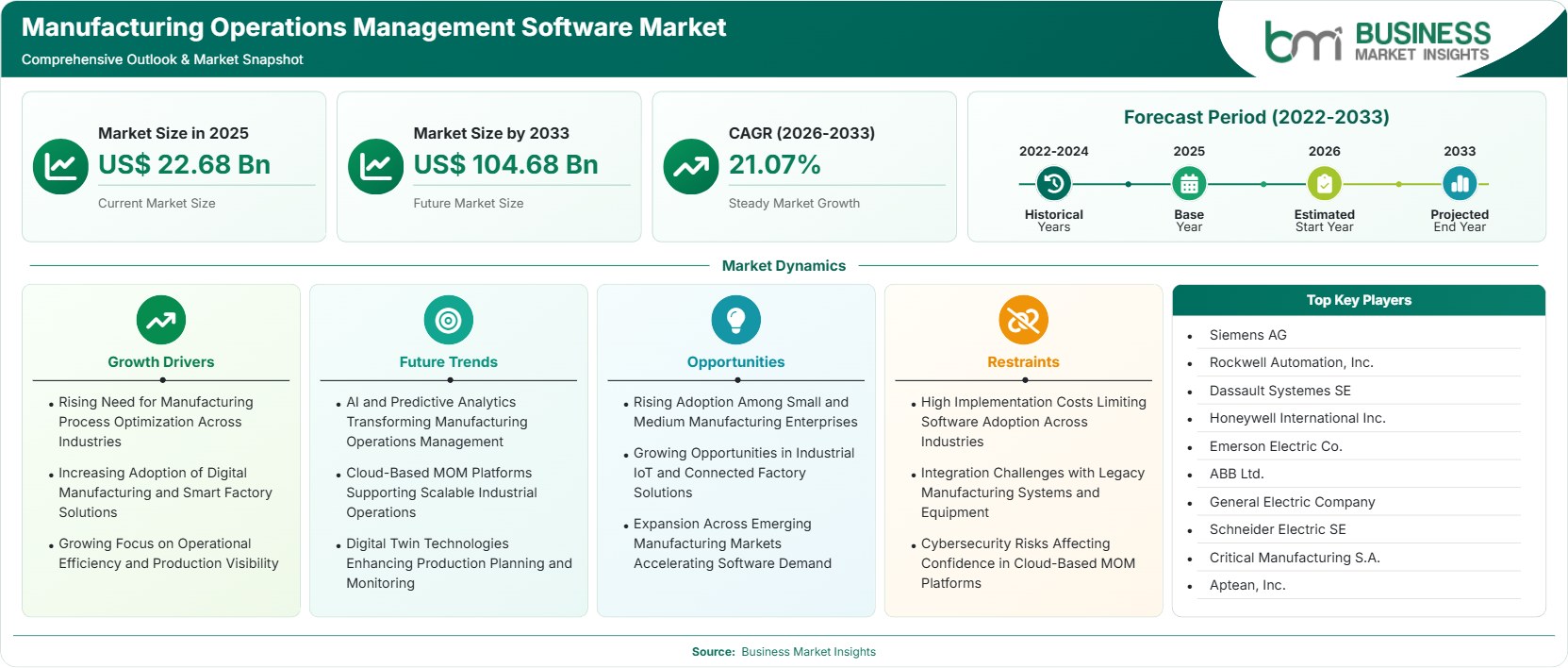
The Manufacturing Operations Management Software Market size was valued at US$ 22.68 billion in 2025 and is projected to reach US$ 104.68 billion by 2033, growing at a CAGR of 21.07% during 2026–2033, driven by smart factory adoption, production visibility, process optimization, connected equipment, industrial IoT integration, and digital transformation across manufacturing industries.

Report Coverage
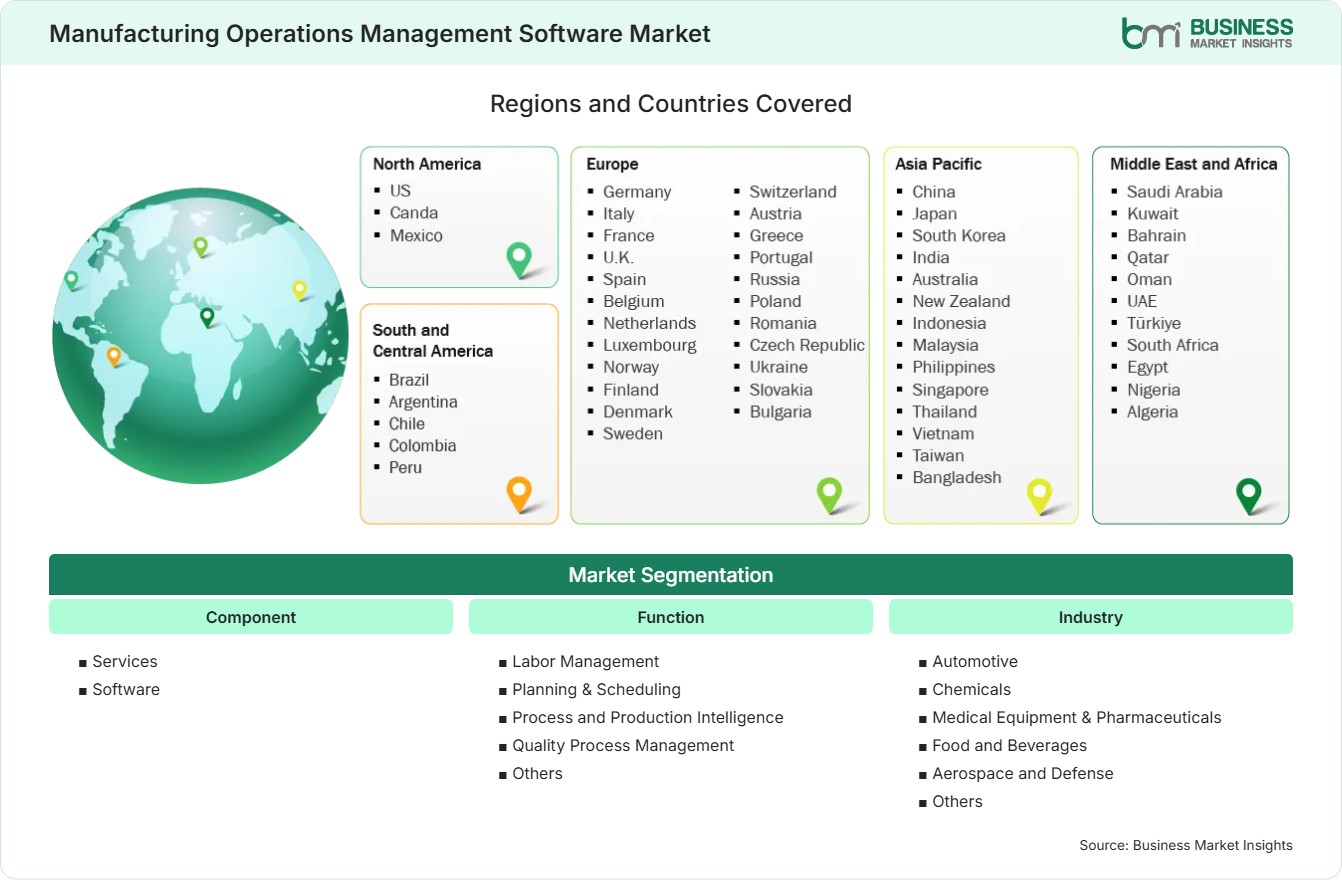
  • Component: Services, Software
  • Function: Labor Management, Planning & Scheduling, Process and Production Intelligence, Quality Process Management, Others
  • Industry: Automotive, Chemicals, Medical Equipment & Pharmaceuticals, Food and Beverages, Aerospace and Defense, Others
US$ 22.68 Bn Market size in 2025
US$ 104.68 Bn Market Size by 2033
21.07% CAGR, 2026 - 2033
2026-2033 Forecast Period

01 AI Overview

Manufacturing Operations Management Software Market Summary

  • North America Region: North America holds a 29%–33% share in 2025, growing with a CAGR of 19.0%–21.0%, influenced by smart manufacturing investment, industrial automation, cloud adoption, reshoring, and demand for real-time production visibility. The US market is growing at a 19.5%–21.5% CAGR, supported by factory digitization, industrial AI, connected equipment, and manufacturing modernization.
  • Fastest Growing Region: Asia Pacific holds a 32%–36% share in 2025, growing with a CAGR of 22.0%–24.0%, supported by large-scale manufacturing investment, Industry 4.0 adoption, factory automation, industrial IoT deployment, and digitalization across automotive, electronics, chemicals, and pharmaceutical production.
  • Leading Segment: Software holds a 68%–72% share in 2025, growing with a CAGR of 20.0%–22.0%, driven by cloud-based deployment, integrated manufacturing platforms, real-time analytics, production monitoring, and demand for scalable digital operations management.
  • High Growth Segment: Process and Production Intelligence holds a 13%–17% share in 2025, growing with a CAGR of 23.0%–25.0%, supported by industrial analytics, real-time performance monitoring, AI-enabled decision-making, predictive insights, and connected production environments.
  • Key Market Opportunity: Cloud deployment, industrial IoT, AI-powered analytics, connected factories, and scalable subscription models create significant opportunities to expand adoption among smaller manufacturers and emerging industrial economies.
  • Major Market Players: Siemens AG, Rockwell Automation, Inc., Dassault Systèmes SE, Honeywell International Inc., Emerson Electric Co., ABB Ltd., General Electric Company, Schneider Electric SE, Critical Manufacturing S.A., and Aptean, Inc.
02 Strategic Insights

Manufacturing Operations Management Software Market: Strategic Insights

manufacturing-operations-management-software-market-market-strategic-framework
FREE PDF
Request your free sample
Request free sample
03 Stakeholder View

Key Takeaways

  • The competitive ecosystem is shifting from standalone manufacturing applications toward integrated operational platforms connecting enterprise systems, production assets, workforce management, quality processes, and real-time analytics.
  • Cloud-based deployment and subscription pricing are creating stronger opportunities among small and medium manufacturers that previously faced barriers associated with large upfront technology investments and complex infrastructure requirements.
  • AI, digital twins, industrial IoT, and advanced analytics are becoming central to next-generation manufacturing operations management as manufacturers seek predictive insights rather than relying exclusively on historical production data.
  • India, China, Southeast Asia, and selected Eastern European manufacturing hubs offer compelling expansion opportunities as new factories and production lines increasingly incorporate digital operations management capabilities from the initial design stage.
  • Strategic competition is increasingly centered on platform ecosystems, technology partnerships, system integration capabilities, and acquisitions that expand functionality across manufacturing execution, production intelligence, quality, and industrial connectivity.
  • Vendors that can integrate legacy machinery with modern cloud and analytics environments are positioned to capture brownfield modernization opportunities, where manufacturers seek digital transformation without replacing existing production equipment.
04 Geographic Outlook

Manufacturing Operations Management Software Market Regional Highlights

North America Manufacturing Operations Management Software Market

North America accounted for a 29%–33% global manufacturing operations management software market share in 2025 and is projected to grow at a 19.0%–21.0% CAGR during 2026–2033. The US represents the largest regional market, supported by advanced manufacturing, industrial automation, reshoring, and cloud adoption. Canada contributes through automotive, aerospace, food processing, and energy-related manufacturing.

  • Manufacturers are increasingly integrating production management platforms with enterprise applications, industrial automation systems, and machine-level data to improve operational visibility and reduce fragmented decision-making across plants.
  • Reshoring and domestic manufacturing investments are encouraging companies to deploy modern operational software alongside new production assets, creating opportunities for vendors offering scalable and interoperable digital architectures.
  • Cloud adoption is expanding beyond corporate applications into manufacturing operations, enabling centralized monitoring, remote access, faster software deployment, and standardized processes across geographically distributed production facilities.

US Manufacturing Operations Management Software Market

The US represented a 24%–28% share in 2025 and is expected to expand at a 19.5%–21.5% CAGR through 2033. Demand is supported by industrial modernization, manufacturing reshoring, advanced automation, and growing use of AI in production environments. Manufacturers are investing in platforms that connect operational technology with enterprise systems.

  • Domestic manufacturing investment is encouraging new production facilities to incorporate connected software architectures, industrial analytics, and automated workflows from the initial plant design and commissioning stages.
  • Labor shortages are increasing demand for software that improves workforce allocation, scheduling, process standardization, and production visibility while reducing dependence on manual operational reporting.
  • Manufacturers are increasingly using AI and machine learning to identify production bottlenecks, analyze process deviations, and support faster operational decisions across complex production environments.
  • Brownfield modernization remains important as manufacturers seek to connect legacy equipment with modern operational platforms without undertaking complete machinery replacement programs.

Europe Manufacturing Operations Management Software Market

Europe held a 23%–27% share in 2025 and is forecast to register a 18.0%–20.0% CAGR through 2033. Germany leads regional demand through automotive, industrial machinery, chemicals, and advanced manufacturing. France and Italy remain significant markets as manufacturing investment and nearshoring increase. Sustainability requirements and industrial digitalization are also encouraging software adoption across energy-intensive production environments.

  • Germany's advanced manufacturing ecosystem supports demand for integrated operational platforms connecting production planning, automation, quality management, maintenance, and real-time manufacturing intelligence.
  • European manufacturers are increasingly prioritizing energy efficiency and resource optimization, creating demand for operational software capable of connecting production performance with energy and sustainability metrics.
  • Regulatory pressure and traceability requirements are encouraging manufacturers to strengthen digital documentation, quality management, production monitoring, and process transparency across increasingly complex supply chains.

Asia Pacific Manufacturing Operations Management Software Market

Asia Pacific captured a 32%–36% share in 2025 and is expected to achieve a 22.0%–24.0% CAGR through 2033, making it the fastest-growing major regional market. China leads adoption through extensive manufacturing capacity and Industry 4.0 investment. India is projected to grow at a 24.0%–26.0% CAGR, supported by electronics, automotive, pharmaceuticals, and industrial expansion. Japan, South Korea, and Southeast Asia provide additional opportunities through factory modernization and connected production.

  • China's large manufacturing base and continued investment in smart factories are supporting demand for production intelligence, quality management, process monitoring, and integrated operational software platforms.
  • India's expanding electronics, automotive, pharmaceutical, and industrial manufacturing sectors are creating strong opportunities for cloud-based and modular manufacturing operations management solutions.
  • Southeast Asian manufacturing hubs are attracting investments in electronics, automotive, semiconductors, and consumer products, increasing demand for connected production management across new industrial facilities.
  • Japan and South Korea are emphasizing advanced automation, robotics, and intelligent production, supporting integration between operational management platforms, industrial equipment, and advanced analytics.

Rest of World Manufacturing Operations Management Software Market

South and Central America represented a 7%–10% share in 2025 and are expected to grow at a 17.0%–19.0% CAGR through 2033, supported by industrial modernization and manufacturing digitization. Middle East and Africa accounted for a 5%–8% share and are projected to expand at a 18.0%–20.0% CAGR. Brazil leads regional adoption, while Saudi Arabia and the UAE benefit from industrial diversification and smart manufacturing investment.

  • Brazil's automotive, food and beverage, chemicals, and industrial manufacturing sectors provide opportunities for operational software vendors supporting production visibility, quality management, and process optimization.
  • Industrial diversification across the Middle East is encouraging investment in new manufacturing facilities, creating opportunities to implement connected operational platforms without extensive legacy technology constraints.
  • Saudi Arabia and the UAE are developing advanced industrial ecosystems, increasing demand for digital production management, automation integration, and operational intelligence across emerging manufacturing clusters.
  • Manufacturers across Latin America and Africa are increasingly exploring cloud-based solutions as lower infrastructure requirements improve accessibility and reduce barriers associated with traditional on-premises software deployment.
global-market-geography
FREE PDF
Request your free sample
Request free sample
05 Segment Analysis

Manufacturing Operations Management Software Market Segmentation

Component

Software accounted for a 68%–72% share in 2025 and is projected to grow at a 20.0%–22.0% CAGR during 2026–2033. Cloud platforms, analytics, automation, and integrated manufacturing applications support software demand. Services remain essential for implementation, integration, customization, training, and ongoing support. Manufacturing Operations Management Software Market scope is expanding as vendors combine software functionality with lifecycle services and ecosystem partnerships.

  • Services: Implementation, consulting, integration, customization, training, and maintenance services remain essential for aligning operational software with manufacturing processes and existing technology infrastructure.
  • Software: Cloud and on-premises platforms support production management, process intelligence, quality, scheduling, workforce coordination, and real-time operational visibility across manufacturing environments.

Function

Process and Production Intelligence represented a 13%–17% share in 2025 and is expected to grow at a 23.0%–25.0% CAGR through 2033. Demand is supported by real-time analytics, AI, connected equipment, and production visibility. Planning and scheduling, quality management, and labor management remain essential operational functions. Manufacturing Operations Management Software Market trends increasingly favor integrated platforms that combine execution data with predictive insights.

  • Labor Management: Workforce scheduling, productivity monitoring, skills management, and task allocation help manufacturers address labor shortages while improving workforce utilization and operational consistency.
  • Planning & Scheduling: Advanced scheduling tools coordinate production capacity, labor, materials, and equipment availability, helping manufacturers reduce delays and respond more effectively to changing production requirements.
  • Process and Production Intelligence: Real-time data, analytics, AI, and machine connectivity enable manufacturers to identify bottlenecks, monitor performance, detect deviations, and improve production decision-making.
  • Quality Process Management: Digital quality workflows improve inspection, traceability, corrective actions, and compliance while reducing manual documentation and strengthening consistency across distributed production operations.
  • Others: Additional functions support maintenance, inventory coordination, performance monitoring, workflow management, and specialized operational requirements across complex manufacturing environments.

Industry

Automotive accounted for 24%–28% of the market in 2025 and is projected to grow at a 19.0%–21.0% CAGR through 2033. Electronics, pharmaceuticals, chemicals, food and beverages, and aerospace increasingly require digital operational control. Manufacturing Operations Management Software Market trends reflect stronger demand for industry-specific workflows, traceability, production analytics, and quality systems as manufacturing complexity increases across global supply chains.

  • Automotive: Complex assembly operations, electric vehicle production, traceability requirements, and supplier coordination are driving adoption of integrated manufacturing operations platforms.
  • Chemicals: Process-intensive production requires real-time monitoring, quality management, batch control, compliance tracking, and operational intelligence to maintain consistent output and minimize production disruptions.
  • Medical Equipment & Pharmaceuticals: Strict quality requirements and regulatory traceability are encouraging manufacturers to adopt digital systems supporting production records, quality workflows, validation, and process visibility.
  • Food and Beverages: Manufacturers increasingly use operational software to improve production scheduling, quality control, traceability, batch management, and compliance across high-volume processing environments.
  • Aerospace and Defense: Complex production processes and stringent quality requirements support demand for advanced operational platforms capable of managing traceability, production intelligence, and process compliance.
  • Others: Electronics, industrial machinery, consumer products, and other manufacturing sectors provide additional demand as companies modernize production systems and improve operational visibility.
06 Market Forces

Manufacturing Operations Management Software Market Dynamics

Key Market Drivers

Rising Need for Manufacturing Process Optimization Across Industries

Manufacturing companies are now using Operations Management software to enhance throughput, minimize production bottlenecks, and achieve process standardization across several plants. In industries where downtime, quality variations, and incorrect scheduling lead to significant monetary losses, there is a greater need for real-time production visibility. Manufacturing Operations Management Software Market growth is fueled by the shift from disparate spreadsheets and systems to more integrated solutions that combine production and labor data, quality processes, and operational performance metrics.

Increasing Adoption of Digital Manufacturing and Smart Factory Solutions

With the emergence of smart factories, there is a growing need for software that can transform industrial and production data into valuable insights into business operations. Industrial machines, robots, sensors, and automation technologies are becoming increasingly connected to the factory network, thereby generating more operational data. There is also a growing need for software solutions to centralize the collection and analysis of information. The smart factory concept promotes integration of manufacturing processes with enterprise systems.

Growing Focus on Operational Efficiency and Production Visibility

These manufacturers are compelled to increase production efficiency while managing labor, energy, material, and equipment costs. Operational software will provide better insights into production efficiency, helping manufacturers identify bottlenecks and KPIs and take immediate action on any process deviations. There is a greater demand for operational software among manufacturers with multi-line or multi-site manufacturing units whose fragmented information hinders production efficiency.

Key Market Opportunities

Rising Adoption Among Small and Medium Manufacturing Enterprises

Small and medium-sized manufacturers represent an important area for expansion as cloud-based delivery, subscription-based pricing, and software modularity lower technology-related barriers to entry. Smaller organizations generally lack both capital and technical expertise to deploy enterprise-level systems and become more interested in flexible SaaS options. Vendors can capitalize on this trend by providing industry-specific templates, quick deployment, easy integration, and tiered pricing. Since SMEs face competition from large manufacturing companies on quality, speed, and customization, digital operations tools may help improve production visibility. Vendors that facilitate implementation and deliver quick ROI may gain traction in this untapped market segment.

Growing Opportunities in Industrial IoT and Connected Factory Solutions

IIoT presents opportunities to expand software for manufacturing processes further into production facilities by integrating machines, sensors, robotics, and control systems. The data produced by connected assets provides scope for monitoring production processes, identifying abnormalities, predictive maintenance, analyzing quality, and optimizing processes. The vendors can capitalize on the IIoT trend by providing architectures that enable integration of assets from various manufacturers. This is particularly relevant in brownfield factories where legacy machinery remains operational but lacks modern connectivity.

Expansion Across Emerging Manufacturing Markets Accelerating Software Demand

There are substantial opportunities in emerging markets for manufacturing as businesses construct and renovate production operations. India, Southeast Asia, Eastern Europe, Latin America, and certain countries in the Middle East are some of the examples that are especially bright when there is an emphasis on industrial digitalization and advanced manufacturing. Manufacturing Operations Management Software Market Forecasts increasingly point toward stronger adoption in emerging industrial economies as new capacity combines automation, connectivity, analytics, and software-enabled operational management.

Market Restraints and Challenges

High Implementation Costs Limiting Advanced Software Adoption

Factor: Comprehensive manufacturing platforms often entail substantial costs for licensing, implementation, integration, training, customization, cybersecurity, and maintenance.

Impact: High overall ownership costs can delay the adoption of such technologies for smaller manufacturers and enterprises with budget constraints. Complexity in the implementation process can also increase implementation time, especially when processes differ from site to site. Companies are reluctant to implement new technology when it is difficult to justify the economic benefits before implementation.

Integration Challenges with Legacy Manufacturing Systems and Equipment

Factor: The factory floor has outdated equipment and control systems, along with legacy software applications that lack the compatibility needed to share information in today’s world.

Impact: It may be difficult to integrate such legacy systems into newer manufacturing operations platforms due to interface issues and limited integration. Interoperability issues may slow the implementation process. Brownfields are more complex because they require continued production during digital transformation.

07 Company Analysis

Competitive Landscape

The Manufacturing Operations Management Software Market analysis indicates that competition is shifting from the conventional capability of manufacturing execution to the combination of operational intelligence, industrial connectivity, cloud, automation, analytics, and AI. There are big automation and industrial technology companies competing against specialized software vendors, creating a diverse ecosystem.

Company Name

Overview

Products and Services relevant to this market

Siemens AG

Global industrial technology leader offering extensive digital manufacturing and industrial automation capabilities.

Manufacturing operations software, MES, production intelligence, digital twins, industrial IoT, automation, and lifecycle management.

Rockwell Automation, Inc.

Major industrial automation and digital transformation provider serving manufacturers across multiple industries.

Manufacturing execution, production intelligence, automation software, industrial analytics, connected operations, and lifecycle services.

Dassault Systèmes SE

Global software company specializing in 3D design, simulation, virtual environments, and manufacturing digitalization.

DELMIA manufacturing operations, production planning, virtual manufacturing, digital twins, and process optimization.

Honeywell International Inc.

Diversified technology company providing automation and digital solutions for industrial production environments.

Manufacturing software, process automation, industrial analytics, asset performance, and operational intelligence solutions.

Emerson Electric Co.

Global automation technology provider supporting process, hybrid, and discrete manufacturing industries.

Manufacturing execution, operational intelligence, automation software, process analytics, and industrial control solutions.

ABB Ltd.

Technology company specializing in electrification, automation, robotics, and digital industrial solutions.

Manufacturing operations software, industrial IoT, analytics, automation, robotics, and connected asset management.

General Electric Company

Industrial technology company with capabilities spanning digital manufacturing, industrial analytics, and operational performance management.

Industrial software, asset performance management, production analytics, digital twins, and connected operations solutions.

Schneider Electric SE

Global energy management and industrial automation company with broad digital manufacturing capabilities.

Industrial automation software, manufacturing operations, connected products, analytics, energy management, and digital transformation.

Critical Manufacturing S.A.

Specialized manufacturing software provider focused on advanced manufacturing execution and operational management.

Manufacturing execution software, production intelligence, quality, scheduling, traceability, and Industry 4.0 solutions.

Aptean, Inc.

Enterprise software provider delivering industry-specific solutions for complex manufacturing and supply chain environments.

Manufacturing execution, production planning, quality management, scheduling, traceability, and operational software.


10 Trust & Transparency

Research Methodology

The market analysis combines proprietary research with secondary data from government agencies, company disclosures, regulatory filings, industry databases and expert interviews. Market estimates are validated through data triangulation, cross-market benchmarking and analyst review.

View Full Research Methodology

11 Questions Answered

Frequently Asked Questions

How can vendors overcome legacy system integration challenges?

Vendors can reduce integration barriers through open APIs, standardized industrial protocols, edge connectivity, middleware, preconfigured interfaces, and phased deployment strategies that connect existing machinery without disrupting ongoing production.

Which manufacturing industries provide the strongest opportunities?

Automotive, electronics, pharmaceuticals, chemicals, aerospace, food and beverages, and industrial machinery offer strong opportunities.

What role does AI play in manufacturing operations management software market report?

AI can analyze production data to identify anomalies, forecast operational issues, optimize scheduling, detect quality deviations, and support decision-making.

Why are cloud platforms becoming more relevant to manufacturers?

Cloud platforms reduce infrastructure requirements, simplify software updates, support multi-site access, and enable subscription pricing.

What is driving the transition from traditional manufacturing software?

Manufacturers are moving toward integrated platforms because production data increasingly needs to connect with enterprise planning, quality, workforce, maintenance, and industrial equipment.

Access the Full Manufacturing Operations Management Software Market Report

Get segment-level forecasts, regional estimates, competitive benchmarking, company profiles and downloadable Excel datasets.

Access the full Manufacturing Operations Management Software Market Report
350 pages PDF & Excel | 2026-08-04