
Decision Management Market Outlook: Size, Share, Trends, Growth Analysis, Competitive Landscape & Forecast, 2026-2033

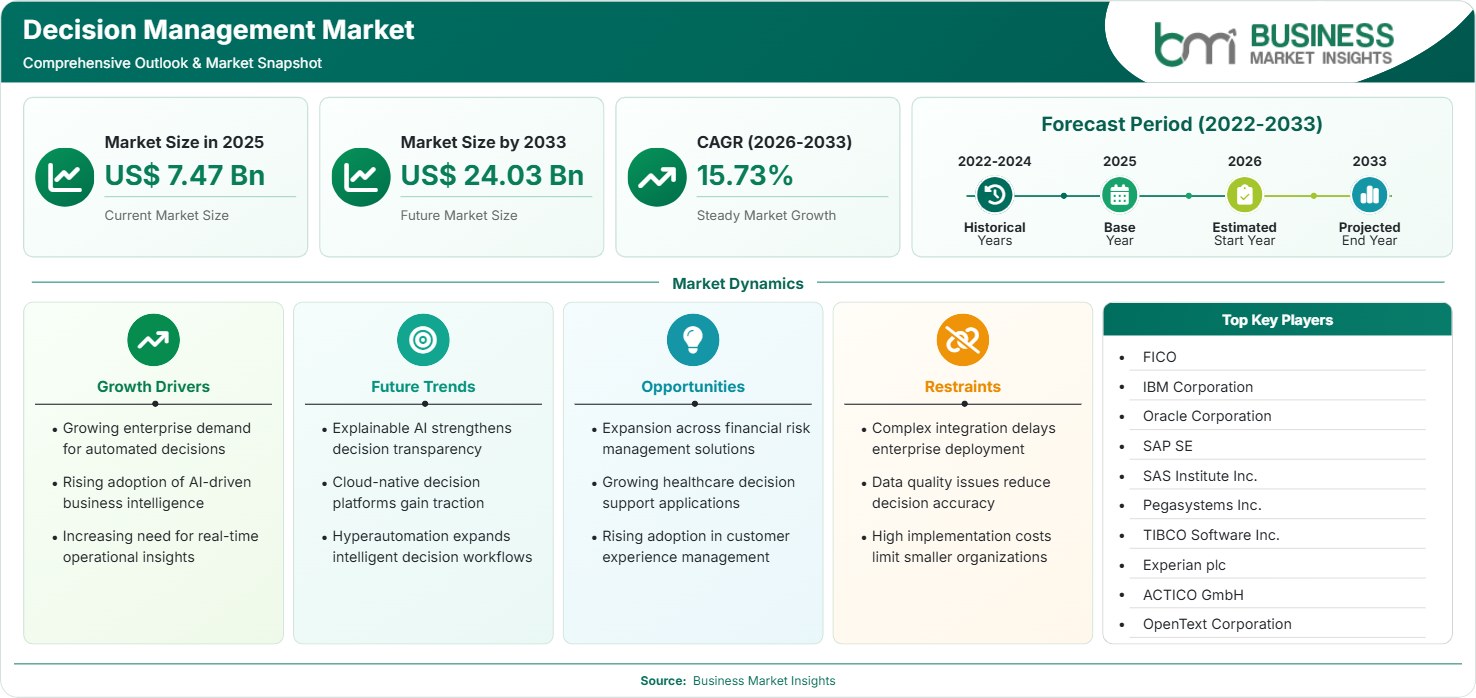
The Decision Management Market size was valued at US$ 7.47 billion in 2025 and is projected to reach US$ 24.03 billion by 2033, growing at a CAGR of 115.73% during 2026–2033. Growing enterprise demand for automated decisions, rising adoption of AI-driven business intelligence, and increasing need for real-time operational insights continue accelerating enterprise investment in intelligent decision automation platforms.

Report Coverage
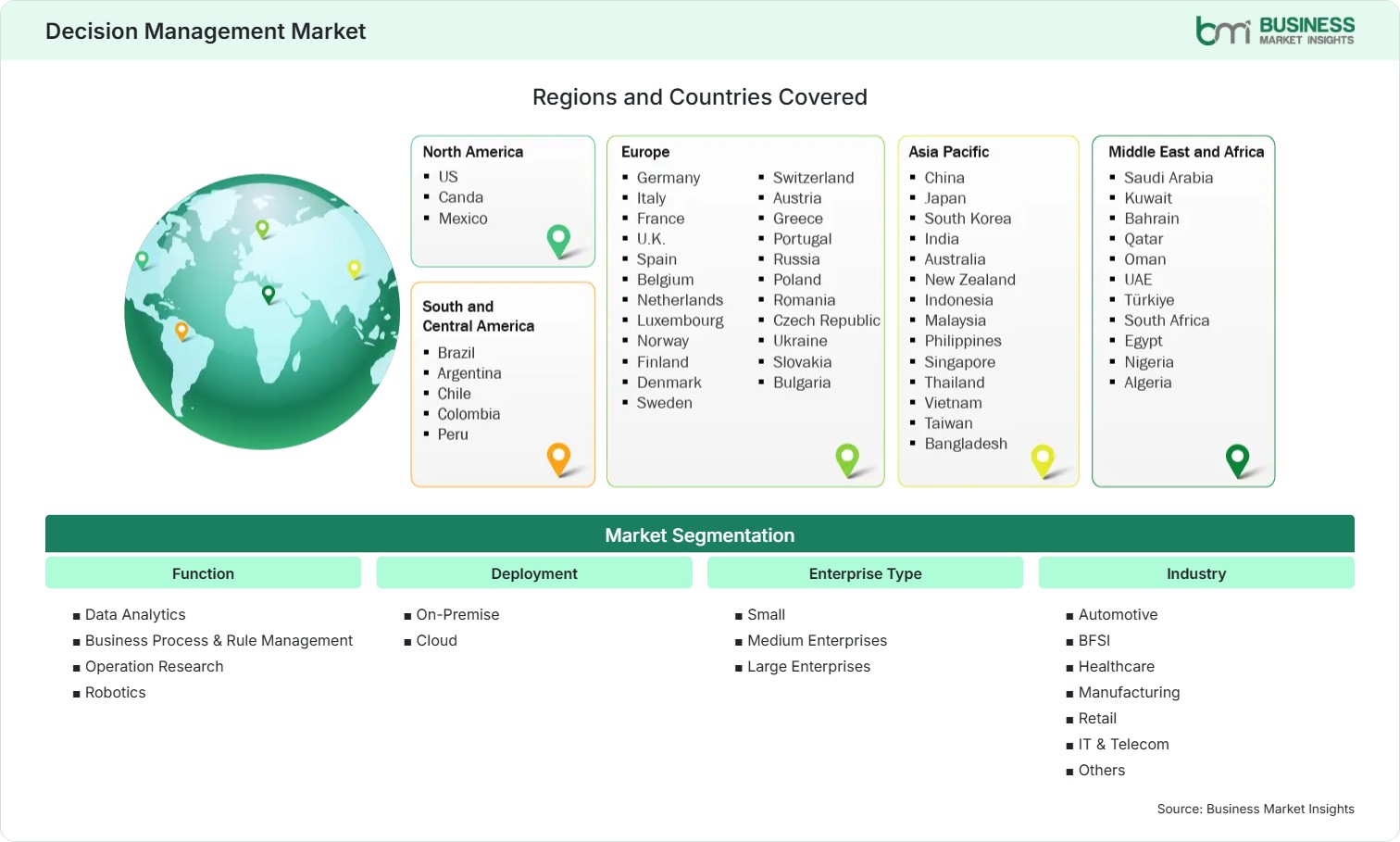
  • Function: Data Analytics, Business Process & Rule Management, Operation Research, Robotics
  • Deployment: On-Premise, Cloud
  • Enterprise Type: Small, Medium Enterprises, Large Enterprises
  • Industry: Automotive, BFSI, Healthcare, Manufacturing, Retail, IT & Telecom, Others
US$ 7.47 Bn Market size in 2025
US$ 24.03 Bn Market Size by 2033
15.73% CAGR, 2026 - 2033
2026-2033 Forecast Period

01 AI Overview

Decision Management Market Summary

  • North America Region: North America accounts for 36%–39% market share in 2025 and is projected to expand at a CAGR of 16.2%–17.1% during 2026–2033. Strong enterprise digital transformation, widespread artificial intelligence adoption, and increasing cloud investments continue supporting regional expansion. The U.S. remains the leading contributor with a CAGR of 16.4%–17.3%, supported by large-scale enterprise software deployment and advanced analytics adoption.
  • Fastest Growing Region: Asia Pacific represents 27%–30% market share in 2025 and is expected to register a CAGR of 18.8%–19.6%, driven by rapid enterprise digitalization, expanding cloud infrastructure, growing AI investments, and increasing automation across business operations.
  • Leading Segment: Cloud accounts for 61%–64% market share in 2025 and is anticipated to register a CAGR of 17.5%–18.4%, supported by scalable deployment, lower implementation costs, and increasing adoption of cloud-native enterprise software.
  • High Growth Segment: Healthcare captures 15%–18% market share in 2025 and is projected to expand at a CAGR of 19.4%–20.2%, driven by clinical decision support, predictive analytics, and operational workflow automation.
  • Key Market Opportunity: Expanding enterprise adoption of intelligent automation, predictive analytics, and AI-enabled customer engagement solutions continues creating substantial opportunities across regulated and data-intensive industries.
  • Major Market Players: FICO, IBM Corporation, Oracle Corporation, SAP SE, SAS Institute Inc., Pegasystems Inc., TIBCO Software Inc., Experian plc, ACTICO GmbH, and OpenText Corporation.
02 Strategic Insights

Decision Management Market: Strategic Insights

Decision Management Market Strategic Framework
FREE PDF
Request your free sample
Request free sample
03 Stakeholder View

Key Takeaways

  • Enterprises are shifting from traditional rule-based systems toward AI-powered decision intelligence platforms capable of supporting faster, more accurate, and scalable business decisions.
  • Cloud deployment continues strengthening market expansion by providing flexible implementation, lower infrastructure investment, simplified software updates, and enterprise-wide accessibility.
  • Financial services, healthcare, and retail remain among the most attractive industries because they require rapid, data-driven decisions supported by predictive analytics and automation.
  • Asia Pacific offers the strongest long-term investment potential as enterprises accelerate cloud adoption, digital transformation, and intelligent business process modernization.
  • Strategic partnerships among enterprise software vendors, cloud service providers, and artificial intelligence developers continue expanding integrated decision automation capabilities.
  • Continued advances in generative AI, intelligent automation, and real-time analytics are encouraging organizations to modernize decision management frameworks for improved operational agility.
04 Geographic Outlook

Decision Management Market Regional Highlights

North America Decision Management Market

North America accounts for 36%–39% Decision Management Market share in 2025 and is projected to expand at a CAGR of 16.2%–17.1% during 2026–2033. Strong enterprise software adoption, increasing investments in artificial intelligence, and widespread cloud deployment continue supporting regional leadership. Organizations are increasingly implementing intelligent decision platforms to improve customer engagement, operational efficiency, fraud detection, and regulatory compliance across multiple business functions.

  • Large enterprises continue investing in AI-powered decision intelligence platforms to automate critical operational processes.
  • Financial institutions increasingly deploy predictive analytics for fraud prevention, credit assessment, and regulatory compliance.
  • Cloud-based enterprise software continues improving scalability and reducing infrastructure costs.
  • Technology vendors strengthen regional innovation through strategic partnerships and continuous product development.

US Decision Management Market

The United States contributes 84%–87% of North American revenue and is expected to register a CAGR of 16.4%–17.3% through 2026–2033. Strong enterprise technology spending, cloud infrastructure maturity, and rapid artificial intelligence adoption continue supporting sustained market expansion.

  • AI-enabled business intelligence platforms improve enterprise productivity and operational visibility.
  • Cloud migration strategies continue accelerating deployment of intelligent decision automation solutions.
  • Financial services remain major adopters of predictive decision management technologies.
  • Continued investment in enterprise analytics strengthens software innovation across industries.

Europe Decision Management Market

Europe represents 25%–28% market share in 2025 and is forecast to grow at a CAGR of 15.8%–16.6% during the forecast period. Demand remains supported by digital transformation initiatives, regulatory compliance requirements, and enterprise modernization programs. Germany leads regional adoption, while the Netherlands records the fastest growth through increasing investment in cloud computing and AI-powered enterprise software.

  • Regulatory compliance continues encouraging adoption of intelligent governance and risk management platforms.
  • Manufacturers increasingly integrate predictive analytics into production planning and supply chain operations.
  • Cloud adoption strengthens enterprise software modernization across multiple industries.
  • AI investment continues expanding intelligent automation capabilities throughout the region.

Asia Pacific Decision Management Market

Asia Pacific holds 27%–30% market share in 2025 and is projected to record the fastest 18.8%–19.6% CAGR through 2026–2033. Rapid enterprise digitalization, expanding cloud infrastructure, and growing artificial intelligence investment continue driving regional demand. China remains the leading market, while India records the fastest growth supported by digital economy initiatives and enterprise automation investments.

  • Enterprises increasingly adopt intelligent automation to improve operational efficiency and customer experience.
  • Cloud infrastructure expansion supports deployment of scalable enterprise software platforms.
  • Digital transformation programs accelerate AI adoption across manufacturing, retail, and financial services.
  • Growing technology investments strengthen regional software innovation and analytics capabilities.

Rest of World Decision Management Market

The Rest of World region accounts for 7%–10% market share in 2025 and is projected to expand at a CAGR of 16.3%–17.0% during 2026–2033. Digital transformation, expanding cloud adoption, and modernization of enterprise operations continue supporting market development across Latin America, the Middle East, and Africa.

  • Brazil remains the leading Latin American market through increasing enterprise software investments.
  • Gulf countries continue expanding AI adoption under national digital transformation initiatives.
  • Organizations strengthen operational efficiency through intelligent automation and predictive analytics.
  • Growing cloud investments improve accessibility of enterprise decision management platforms across emerging economies.
Global Market Geography
FREE PDF
Request your free sample
Request free sample
05 Segment Analysis

Decision Management Market Segmentation

Function

The function segment forms the technological backbone of enterprise decision automation by integrating analytics, business rules, optimization models, and intelligent workflows. It accounted for 34%–37% market share in 2025 and is projected to register a CAGR of 16.9%–17.8% during 2026–2033. Continuous advances in artificial intelligence, automation, and predictive modeling continue expanding the Decision Management Market scope, enabling organizations to improve decision accuracy, operational efficiency, and business responsiveness.

  • Data Analytics: Leads adoption as organizations increasingly rely on predictive insights, real-time dashboards, and advanced analytics to support strategic planning, operational monitoring, and customer-focused decision-making across multiple business functions.
  • Business Process & Rule Management: Remains essential for automating workflows, enforcing compliance policies, standardizing enterprise operations, and improving consistency across large-scale business environments with complex decision requirements.
  • Operation Research: Supports optimization of resource allocation, scheduling, logistics planning, and production efficiency by applying mathematical models and simulation techniques to complex enterprise challenges.
  • Robotics: Gains momentum as intelligent robotic process automation integrates with AI-driven decision engines to automate repetitive business tasks while improving speed, accuracy, and operational productivity.

Deployment

Deployment preferences continue shifting toward scalable digital platforms capable of supporting enterprise-wide decision intelligence. This segment represented 61%–64% market share in 2025 and is expected to expand at a CAGR of 17.5%–18.4% during 2026–2033. Organizations increasingly prioritize flexible deployment models, stronger cybersecurity capabilities, and seamless software integration to accelerate digital transformation initiatives.

  • On-Premise: Maintains relevance among organizations requiring strict data governance, regulatory compliance, customized infrastructure, and direct control over enterprise information and mission-critical decision systems.
  • Cloud: Records the fastest adoption due to lower infrastructure investment, rapid scalability, simplified software updates, remote accessibility, and seamless integration with artificial intelligence and analytics platforms.

Enterprise Type

Enterprise adoption varies according to organizational scale, digital maturity, and operational complexity. The segment accounted for 66%–69% market share in 2025 and is projected to register a CAGR of 16.5%–17.3% through 2026–2033. Current Decision Management Market trends indicate that businesses of all sizes are increasingly investing in intelligent automation platforms to strengthen decision-making capabilities and improve competitive performance.

  • Small & Medium Enterprises: Increasingly adopt cloud-based decision management platforms to improve operational efficiency, automate workflows, enhance customer engagement, and optimize limited organizational resources through cost-effective digital solutions.
  • Large Enterprises: Continue leading investments because of extensive data volumes, complex business processes, regulatory obligations, and growing demand for enterprise-wide automation supported by artificial intelligence technologies.

Industry

Industry-specific requirements continue shaping technology adoption as organizations seek intelligent platforms tailored to operational and regulatory needs. This segment represented 22%–25% market share in 2025 and is forecast to expand at a CAGR of 18.1%–19.0% during 2026–2033. Growing investment in automation, predictive analytics, and customer intelligence continues strengthening enterprise adoption across diverse economic sectors.

  • Automotive: Manufacturers use intelligent decision platforms to optimize production planning, inventory management, predictive maintenance, and supply chain coordination across global manufacturing operations.
  • BFSI: Financial institutions deploy decision management software for fraud detection, credit risk assessment, regulatory compliance, customer analytics, and automated lending decisions.
  • Healthcare: Hospitals and healthcare providers utilize intelligent decision support systems to improve clinical workflows, patient care, diagnostics, resource utilization, and administrative efficiency.
  • Manufacturing: Industrial organizations leverage decision intelligence to optimize production scheduling, quality management, predictive maintenance, and operational performance across smart factory environments.
  • Retail: Retailers apply decision management platforms to personalize customer experiences, optimize pricing strategies, forecast demand, manage inventories, and strengthen omnichannel operations.
  • IT & Telecom: Technology providers utilize automated decision systems for network optimization, customer service automation, cybersecurity monitoring, and resource allocation across digital infrastructure.
06 Market Forces

Decision Management Market Dynamics

Key Market Drivers

Growing enterprise demand for automated decisions

Businesses are moving towards the adoption of intelligent automation software that can process large amounts of both structured and unstructured data in just seconds. Decision automation solutions increase productivity, minimize human errors, and ensure consistency in the implementation of business policies in several divisions. Banking companies, insurers, manufacturers, retailers, and telecommunication businesses are leveraging such software solutions to speed up the decision-making process, streamline workflow, and enhance customer engagement. The rapid growth of digital business models and expanding enterprise data volumes continue supporting Decision Management Market growth, encouraging organizations to invest in scalable solutions that enhance productivity, improve compliance, and enable faster business responses.

Rising adoption of AI-driven business intelligence

Artificial intelligence is becoming a core component of enterprise business intelligence strategies as organizations seek deeper operational visibility and more accurate predictive insights. Machine learning techniques, predictive analytics, and natural language processing allow enterprises to discover trends, make predictions about demands, analyze any anomalies, and help strategic planning. The growing trend towards AI integration into decision management systems enables the automatic execution of sophisticated analytics and data-driven decision-making in industries such as finance, health care, manufacturing, and retail. Improvements in cloud computing infrastructure and enterprise analytics software keep increasing adoption rates within companies.

Increasing need for real-time operational insights

Contemporary businesses function in highly dynamic settings, where quick decisions determine customer satisfaction, process optimization, and profitability. Business organizations are constantly looking for systems that can help analyze operational data in real time and provide practical advice. Through decision management solutions, it becomes possible to monitor all business processes on an ongoing basis. These capabilities continue shaping Decision Management Market trends, as businesses prioritize intelligent systems that improve agility, optimize resource allocation, and strengthen enterprise-wide performance management.

Key Market Opportunities

Expansion across financial risk management solutions

Intelligent decision management technology solutions are increasingly being invested in by financial organizations in order to enhance their ability in credit scoring, fraud detection, anti-money laundering activities, and risk management. Automated decisioning through artificial intelligence enables financial institutions to analyze financial data effectively and save on costs, while ensuring that they are in line with regulations. Increased demand for financial decision platforms has been fueled by the adoption of digital banking. Decision Management Market Forecasts indicate that financial risk management applications will remain among the most attractive long-term investment opportunities for technology providers.

Growing healthcare decision support applications

Healthcare organizations increasingly rely on intelligent decision management platforms to improve patient outcomes, optimize clinical workflows, and enhance hospital resource utilization. Advanced analytics and artificial intelligence support medical diagnosis, treatment planning, patient risk assessment, and operational scheduling while reducing administrative burdens. Growing adoption of electronic health records and connected healthcare systems is creating favorable conditions for integrated clinical decision support solutions. Technology providers continue developing specialized healthcare platforms capable of improving decision accuracy while supporting regulatory compliance and personalized patient care.

Rising adoption in customer experience management

Businesses across multiple industries are investing in intelligent decision platforms to deliver personalized customer experiences and strengthen long-term customer relationships. Decision management systems analyze customer interactions, behavioral patterns, transaction histories, and purchasing preferences to recommend appropriate actions in real time. These capabilities improve marketing effectiveness, customer retention, pricing strategies, and service quality. Organizations are increasingly integrating decision intelligence with customer relationship management platforms to create seamless omnichannel experiences while enhancing operational efficiency and business profitability.

Market Restraints and Challenges

Complex integration delays enterprise deployment

Enterprise decision management platforms often require integration with legacy software, enterprise resource planning systems, customer databases, cloud applications, and third-party analytics platforms. Factor: Complex system integration increases implementation time, project costs, and technical complexity, particularly for organizations operating across multiple business units. Impact: Extended deployment timelines delay return on investment and reduce the speed at which organizations realize operational benefits. Companies continue addressing these challenges through modular software architectures, standardized APIs, cloud-native deployment models, and professional implementation services that simplify enterprise integration.

Data quality issues reduce decision accuracy

Effective decision management depends on accurate, complete, and consistently governed enterprise data collected from multiple internal and external sources. Factor: Inconsistent datasets, duplicate records, outdated information, and fragmented data management practices reduce the reliability of analytical models and automated recommendations. Impact: Poor data quality may lead to inaccurate business decisions, operational inefficiencies, regulatory risks, and reduced confidence in intelligent decision systems. Organizations are increasingly investing in data governance frameworks, master data management, and advanced data quality tools to improve decision reliability and maximize business value from enterprise analytics platforms.

07 Company Analysis

Competitive Landscape

Competition within the industry is centered on artificial intelligence integration, cloud-native decision platforms, business rules automation, and advanced analytics capabilities. Decision Management Market analysis indicates that leading vendors are investing in machine learning, low-code automation, predictive analytics, and cloud deployment to strengthen enterprise decision intelligence. Strategic acquisitions, product innovation, and partnerships with cloud providers continue enabling companies to expand their presence across BFSI, healthcare, manufacturing, retail, and other data-intensive industries.

Company Name

Overview

Products and Services Relevant to this Market

FICO

Global analytics software company specializing in decision intelligence, predictive analytics, and enterprise risk management solutions.

Decision management platforms, business rules management, fraud detection, credit scoring, predictive analytics, and AI-powered decision automation.

IBM Corporation

Multinational technology company delivering enterprise AI, automation, and hybrid cloud solutions across multiple industries.

IBM watsonx, AI decision support, business automation software, analytics platforms, cloud services, and workflow management solutions.

Oracle Corporation

Enterprise software leader providing integrated cloud applications, analytics, and database technologies.

Oracle Fusion Cloud, decision automation, analytics platforms, business intelligence, enterprise performance management, and cloud infrastructure.

SAP SE

Global enterprise software provider focused on intelligent business applications and digital transformation solutions.

SAP Business Technology Platform, analytics, business process automation, enterprise planning, AI services, and decision intelligence solutions.

SAS Institute Inc.

Leading analytics company offering advanced data management and AI-driven business decision software.

Predictive analytics, AI models, business intelligence, decision management, risk analytics, and customer intelligence platforms.

Pegasystems Inc.

Provides AI-powered workflow automation and customer engagement solutions for enterprise organizations.

Pega Platform, case management, decisioning software, robotic process automation, CRM, and intelligent workflow automation.

TIBCO Software Inc.

Develops enterprise integration, analytics, and event-driven decision management technologies.

Data integration, business intelligence, streaming analytics, decision automation, API management, and real-time analytics solutions.

Experian plc

Global information services company delivering data analytics and risk management solutions.

Fraud prevention, identity verification, credit analytics, decision management software, customer insights, and compliance solutions.

ACTICO GmbH

Specializes in intelligent automation and rule-based decision management solutions for regulated industries.

Business rules management, compliance automation, credit decisioning, risk management, and AI-supported decision platforms.

OpenText Corporation

Enterprise information management company providing AI-powered content, automation, and analytics solutions.

Information management, workflow automation, AI analytics, business process management, cloud services, and enterprise decision support.

10 Trust & Transparency

Research Methodology

The market analysis combines proprietary research with secondary data from government agencies, company disclosures, regulatory filings, industry databases and expert interviews. Market estimates are validated through data triangulation, cross-market benchmarking and analyst review.

View Full Research Methodology

11 Questions Answered

Frequently Asked Questions

What does the Decision Management Market Report include?

The Market Report provides comprehensive insights into market dynamics, regional outlook, competitive landscape, technology trends, segmentation analysis, investment opportunities, strategic developments, and long-term business forecasts.

Which region is expected to witness the fastest growth?

Asia Pacific is projected to experience the fastest expansion owing to accelerating digital transformation, rising enterprise cloud adoption, growing AI investments, and increasing demand for intelligent business automation across multiple industries.

Why are financial institutions investing in decision management platforms?

Banks and financial institutions use decision management solutions to automate credit approvals, strengthen fraud detection, improve regulatory compliance, optimize customer engagement, and accelerate risk assessment through predictive analytics.

Which deployment model dominates the market?

Cloud deployment leads the market because it provides scalability, lower infrastructure costs, simplified implementation, continuous software updates, and seamless integration with AI, analytics, and enterprise applications.

What factors are driving the Decision Management Market?

The market is driven by increasing enterprise automation, wider adoption of artificial intelligence, demand for real-time business intelligence, cloud transformation initiatives, and the growing need for faster, data-driven operational decisions.

Access the Full Decision Management Market Report

Get segment-level forecasts, regional estimates, competitive benchmarking, company profiles and downloadable Excel datasets.

Access the full Decision Management Market Report
350 pages PDF & Excel | 2026-08-12